

Risk & Resilience

Risk and resilience research examines how complex systems anticipate, absorb, and adapt to shocks and disruptions. Modern societies face a wide range of systemic risks, including climate hazards, financial instability, geopolitical conflict, and technological disruption.

Risk analysis focuses on identifying potential threats and evaluating their likelihood and consequences. Resilience thinking extends this perspective by examining how systems respond when disruptions occur.

Resilient systems are characterized by redundancy, adaptability, and the capacity to recover from disturbance without losing core functionality. Understanding these dynamics is essential for designing institutions, infrastructure, and governance systems capable of navigating uncertainty and long-term systemic change.

Rising sea levels increasing coastal flood risk and threatening low-elevation coastal infrastructure

Measuring the Ocean: Why Coastal Flood Risk May Be Higher Than We Think

Coastal flood risk is often framed as a future consequence of sea-level rise, but present-day exposure may already be underestimated when baseline sea-level assumptions are inaccurate. Flood models depend on the relationship between water levels, land elevation, tides, storm surge, vertical datums, infrastructure protection, and local subsidence. When those baselines are wrong, the map of risk changes. This article examines how small measurement errors can produce large differences in flood exposure, especially in low-elevation coastal zones, deltas, ports, island communities, and infrastructure corridors. It connects sea-level measurement to risk governance, environmental monitoring, infrastructure resilience, and planetary-boundaries thinking. The central argument is that coastal adaptation depends not only on projecting future sea-level rise, but on accurately measuring present risk before planning systems, insurance models, and infrastructure investments lock in avoidable vulnerability.
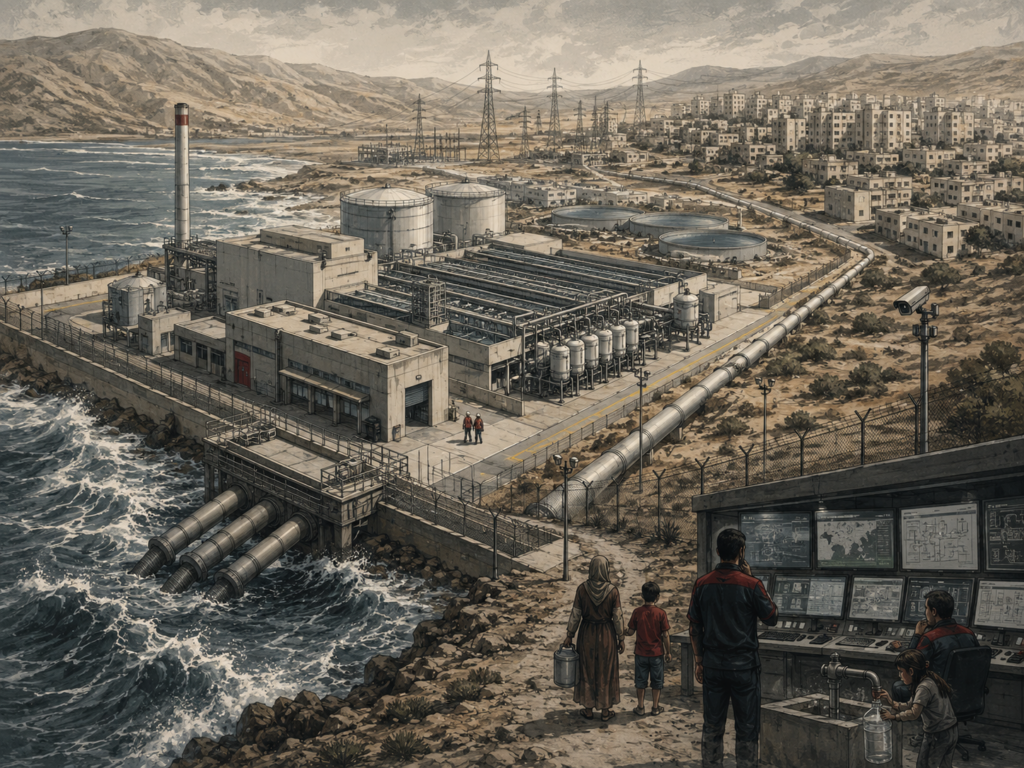
Editorial illustration of a coastal desalination plant with seawater intakes, pipelines, treatment tanks, power lines, security fencing, monitoring systems, nearby communities, and workers overseeing critical water infrastructure.

Water Infrastructure at Risk: The Security Challenge of Desalination Plants

Desalination plant security is becoming a central question for water security, urban resilience, and sustainable development. In arid coastal regions, desalination facilities are no longer secondary infrastructure; they are strategic lifelines that convert seawater into drinking water for millions of people. Yet these systems also concentrate risk. Large plants depend on coastal siting, energy supply, specialized membranes, pumps, digital controls, chemical inputs, skilled operators, and global supply chains. Disruption can cascade through public health, sanitation, hospitals, food systems, and urban stability. This article examines desalination as critical infrastructure, connecting water scarcity, climate stress, energy dependency, cyber and physical security, environmental monitoring, and resilience planning. It argues that desalination can strengthen water security only when cities design for redundancy, storage, accountability, and continuity under disruption.

Scroll to Top