
Last Updated May 9, 2026
Planetary boundaries and global system risk belong together because the planetary boundaries framework is not simply a list of environmental problems. It is a systems framework for understanding the biophysical conditions that help keep the Earth system within a relatively stable and resilient operating space for humanity. The framework identifies critical Earth-system processes whose disruption can weaken the stability, resilience, and life-support capacity of the planet itself. In that sense, planetary boundaries are already a risk-and-resilience framework: they ask how far human activity can push climate, biodiversity, land, water, nutrients, oceans, the atmosphere, and novel entities before the probability of destabilizing change rises sharply.
Global system risk begins when pressure on those Earth-system processes interacts with the interdependence of human societies. Climate stress affects food, water, health, migration, infrastructure, finance, insurance, public budgets, energy systems, and geopolitical stability. Biodiversity loss weakens ecological functions that support pollination, disease regulation, soil formation, fisheries, forests, and food systems. Freshwater change, land-system change, nutrient overload, ocean acidification, and chemical pollution do not remain neatly inside environmental categories. They move through economies, institutions, settlements, supply chains, conflict dynamics, and public-health systems.
Main Library
Publications
Article Map
Risk & Resilience
Related Topic
Thresholds
Related Topic
Climate Risk
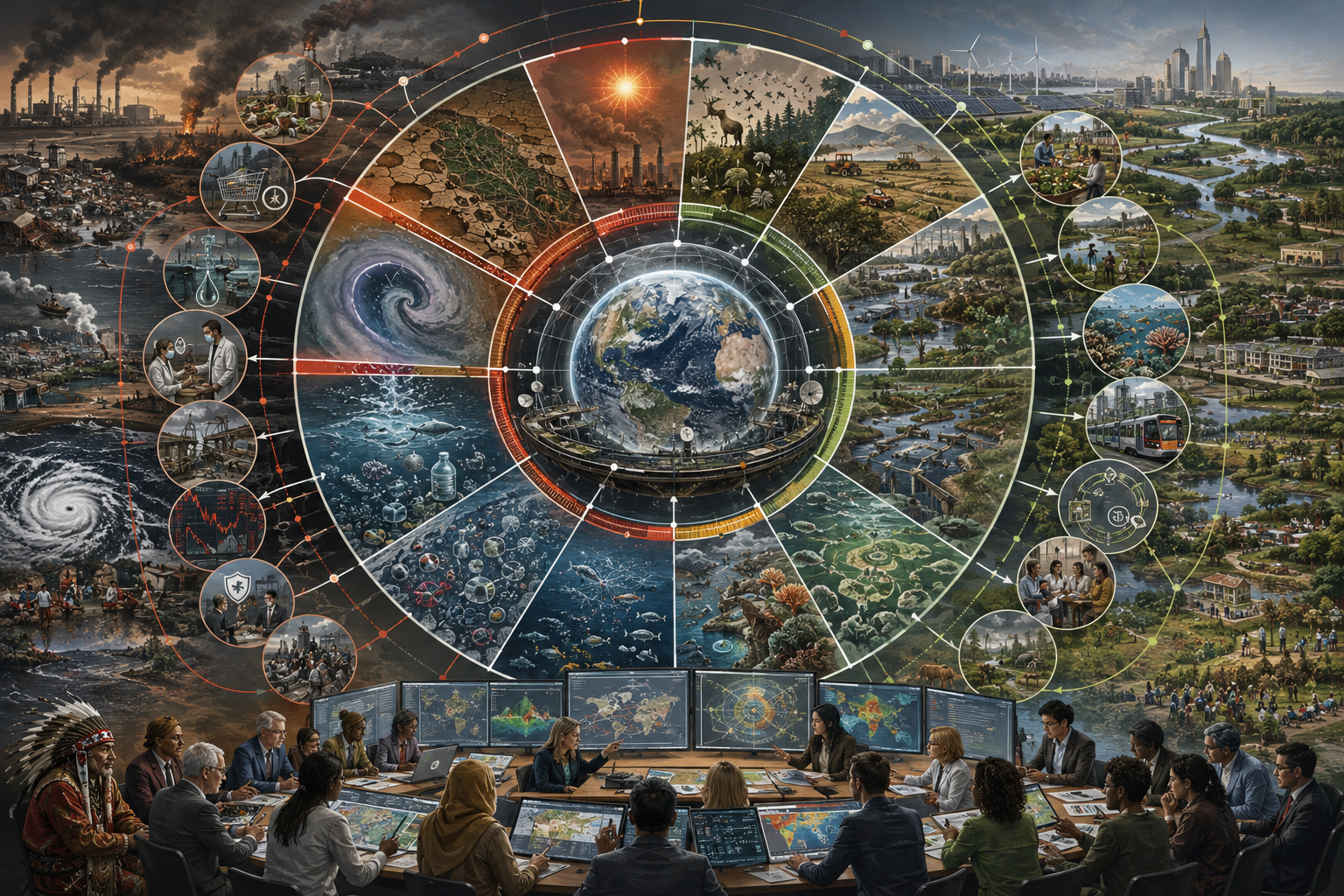
This article examines planetary boundaries as a framework for global system risk. It asks what the boundaries are, why they matter for resilience, how boundary transgression changes the risk environment for human systems, why interactions among boundaries matter, and what Earth-system resilience requires when climate, biodiversity, land, freshwater, oceans, nutrients, pollution, and social systems are increasingly coupled.
Why This Framework Matters
The planetary boundaries framework matters because it reframes environmental change as a question of systemic stability. It does not ask only whether pollution is increasing, forests are shrinking, oceans are acidifying, or species are declining. It asks whether human activity is pushing the Earth system away from the conditions that have supported relatively stable climate, ecological function, freshwater flows, agricultural systems, coastal systems, and complex societies.
That shift is crucial for risk and resilience thinking. Risk is often treated as a hazard problem: flood risk, heat risk, food risk, water risk, infrastructure risk, or financial risk. Planetary boundaries move the analysis upstream. They ask whether the underlying Earth-system conditions that shape all of those risks are themselves becoming less stable. If the climate system destabilizes, biosphere integrity declines, freshwater systems are altered, land systems are simplified, and oceans become more acidic, then many sector-specific risks become harder to manage at the same time.
The framework also matters because it provides a language for cumulative pressure. A single environmental stress can be serious. Multiple stresses across interacting planetary processes can become systemic. Climate change affects biodiversity, freshwater, land systems, oceans, agriculture, public health, and infrastructure. Land-system change affects carbon storage, regional climate, water cycling, biodiversity, food production, and fire regimes. Nutrient overload affects rivers, lakes, coastal zones, soils, food systems, and marine ecosystems. Novel entities and chemical pollution can disrupt biological and ecological processes in ways that are difficult to reverse.
This is why planetary boundaries are not merely environmental thresholds. They are resilience boundaries. They describe the shrinking margin between human pressure and the Earth-system functions that make long-term development possible. A society may build stronger infrastructure, better warning systems, improved finance, and more adaptive institutions, but those systems will remain vulnerable if the planetary operating conditions on which they depend continue to degrade.
The planetary boundaries framework therefore belongs at the Earth-system scale of a Risk & Resilience series. It identifies the background conditions that determine whether local, national, and global resilience strategies are operating within a stable biophysical context—or trying to manage risk on an increasingly destabilized planet.
What Planetary Boundaries Are
Planetary boundaries are proposed limits or guardrails associated with critical Earth-system processes. They are designed to identify a safe operating space for humanity: a zone in which human development is more likely to remain compatible with Earth-system stability and resilience. The concept does not claim that every boundary is a precise cliff edge. Instead, it identifies zones where rising human pressure increases the probability of destabilizing change.
This distinction matters. A boundary is not a simple switch between perfect safety and instant catastrophe. It is a risk threshold. Moving closer to or beyond a boundary means that uncertainty, instability, and potential irreversibility increase. In resilience terms, the system loses adaptive room. Disturbances that might once have been absorbed become more likely to produce regime shifts, cascading effects, or long-lasting damage.
The framework is precautionary because Earth-system processes are complex, nonlinear, and interdependent. Waiting for perfect certainty before acting would be dangerous because some changes may become difficult or impossible to reverse. The boundary concept therefore asks societies to act before Earth-system feedbacks become uncontrollable, not after harm is fully visible.
Planetary boundaries also differ from ordinary policy targets. A policy target may reflect political compromise, cost-benefit analysis, or sectoral planning. A planetary boundary is grounded in scientific assessment of Earth-system processes that regulate planetary stability. That does not remove politics from implementation, but it clarifies that human economies operate inside biophysical conditions, not above them.
The framework is also global, but not abstractly global. Boundary transgression is produced through concrete activities: fossil-fuel combustion, deforestation, industrial agriculture, fertilizer overuse, water extraction, chemical production, land conversion, overconsumption, waste, mining, infrastructure expansion, and unequal patterns of material throughput. These activities are unevenly distributed across countries, classes, corporations, and historical development pathways. Planetary boundaries therefore raise scientific questions and justice questions at the same time.
At its core, the framework asks: what Earth-system processes must remain within safer ranges if human societies are to preserve the ecological conditions for durable flourishing?
The Nine Earth-System Processes
The planetary boundaries framework identifies nine Earth-system processes. They are climate change, biosphere integrity, land-system change, freshwater change, biogeochemical flows, ocean acidification, stratospheric ozone depletion, atmospheric aerosol loading, and novel entities. Each process describes a domain where human pressure can alter the functioning of the Earth system.
Climate change refers to the disruption of the climate system through greenhouse gas emissions and related feedbacks. Biosphere integrity concerns the diversity, abundance, and functioning of life, including genetic diversity and ecosystem function. Land-system change refers to conversion of forests, grasslands, wetlands, and other land systems into simplified or human-dominated landscapes. Freshwater change addresses alterations in blue water and green water flows, including rivers, lakes, groundwater, soil moisture, and vegetation-mediated water cycling.
Biogeochemical flows refer primarily to human alteration of nitrogen and phosphorus cycles, especially through fertilizer use, agriculture, livestock systems, and runoff into freshwater and coastal systems. Ocean acidification reflects changes in ocean chemistry caused largely by absorption of carbon dioxide, with consequences for marine organisms, food webs, coral reefs, shell-forming species, and fisheries. Stratospheric ozone depletion concerns the protective ozone layer, where coordinated international action has shown that global environmental damage can be reduced when institutions respond seriously.
Atmospheric aerosol loading refers to particulate matter and aerosol effects on climate, monsoons, air quality, health, and regional atmospheric dynamics. Novel entities include synthetic chemicals, plastics, pesticides, industrial compounds, radioactive materials, genetically modified organisms in some formulations of the framework, and other human-made substances that can disrupt ecological or biological systems.
These boundaries are not separate boxes in reality. They are analytical lenses for interacting processes. Climate change affects freshwater change. Land conversion affects climate, biodiversity, and water cycling. Nutrient overload affects biosphere integrity and aquatic ecosystems. Novel entities can harm biodiversity, water systems, soils, oceans, and human health. The framework’s power lies in seeing these processes as connected components of planetary resilience rather than isolated environmental policy files.
Safe Operating Space and Risk
The idea of a safe operating space is central to planetary boundaries. It does not mean a world without risk. It means a zone in which Earth-system processes are more likely to remain within conditions compatible with human development, ecological function, and long-term resilience. Human societies have always faced hazards, but those hazards become more dangerous when the Earth-system background becomes less stable.
In systems terms, a safe operating space is a resilience margin. It is the distance between ordinary variation and dangerous transformation. A lake may absorb nutrient inputs for a time before flipping into eutrophic conditions. A forest may absorb drought for a time before fire, dieback, or ecological transition. A climate system may absorb disturbances for a time before feedbacks intensify. A coastal ecosystem may buffer storms for a time before degradation reduces protection. Resilience depends on remaining far enough from thresholds that disturbances can be absorbed.
Planetary boundaries translate that logic to the global scale. They identify processes where continued pressure reduces the planet’s capacity to absorb disturbance without large-scale reorganization. This does not mean that every boundary behaves like a single global tipping point. Some boundaries have regional expressions, some have global control variables, and some have complex spatial patterns. But all of them matter because they shape Earth-system stability.
The risk logic is probabilistic. Moving beyond a boundary does not guarantee immediate collapse. It increases the likelihood of harmful, nonlinear, cascading, or irreversible change. It also increases uncertainty. Systems outside safer ranges may behave in ways that are harder to predict and harder to govern. Policy systems designed for stable baselines may fail when baselines shift.
This is why planetary boundaries should not be read as an apocalyptic scoreboard. They are better understood as a warning architecture. They help societies identify where risk is rising, where adaptive capacity is narrowing, and where precautionary action is needed before damages become locked in.
The safe operating space is not merely an environmental concept. It is a development concept. It asks whether human progress is being built inside or outside the ecological conditions that make progress durable.
Current State of Boundary Transgression
The 2023 peer-reviewed update published in Science Advances concluded that six of the nine planetary boundaries were transgressed. Those six were climate change, biosphere integrity, land-system change, freshwater change, biogeochemical flows, and novel entities. The same assessment described Earth as well outside the safe operating space for humanity, while noting that ocean acidification was close to transgression, aerosol loading showed regional exceedance, and stratospheric ozone had improved relative to earlier damage.
The 2025 Planetary Health Check and Stockholm Resilience Centre update report a further deterioration: seven of nine planetary boundaries are now described as breached, with ocean acidification newly joining the transgressed boundaries. The seven breached boundaries are climate change, biosphere integrity, land-system change, freshwater change, biogeochemical flows, novel entities, and ocean acidification. The two remaining boundaries described as within the safe zone are stratospheric ozone depletion and atmospheric aerosol loading, although aerosol effects remain regionally important.
This update matters for article framing. The 2023 assessment remains the major peer-reviewed benchmark for the comprehensive quantified framework. The 2025 Planetary Health Check is the newer assessment cycle and should be reflected when presenting the current state of the framework. The safest editorial approach is therefore to distinguish them clearly: the 2023 peer-reviewed update found six of nine boundaries transgressed; the 2025 assessment reports seven of nine breached.
That distinction avoids both undercounting current risk and overstating the status of different types of evidence. It also shows the direction of travel. The planetary boundaries framework is not static. It is periodically revised as science improves, data systems expand, and Earth-system pressures change. Boundary status should therefore be treated as a living risk assessment, not a permanent table.
The deeper message is that planetary risk is worsening across multiple domains. The issue is not merely that one additional boundary has moved into a more dangerous category. It is that several already-transgressed boundaries continue to show worsening pressure, while interactions among climate, biodiversity, freshwater, land, oceans, nutrients, and novel entities increase the potential for compounding risk.
For resilience thinking, this means that the operating environment for human systems is becoming more uncertain. Climate adaptation, disaster-risk reduction, food security, water security, infrastructure planning, insurance, public health, migration governance, and economic stability all become harder when planetary background conditions deteriorate together.
From Boundaries to Global System Risk
Boundary transgression becomes global system risk when Earth-system pressures interact with the interdependence of human systems. A boundary breach is not merely an environmental indicator. It signals rising pressure on the conditions that support agriculture, water availability, climate stability, disease regulation, infrastructure reliability, coastal protection, fisheries, food webs, public health, and social stability.
Systemic risk is different from isolated risk because harm does not remain confined to one domain. A drought can affect food production, hydropower, water supply, transportation, inflation, conflict risk, migration, insurance, and public budgets. A climate-driven crop failure can interact with trade restrictions, debt stress, energy prices, and political instability. Biodiversity loss can weaken pollination, pest regulation, soil systems, fisheries, forest resilience, and disease dynamics. Ocean acidification can affect marine ecosystems, fisheries, food security, coastal livelihoods, and carbon-cycle feedbacks.
Planetary boundaries therefore help identify upstream risk multipliers. They do not predict one single catastrophe. They show how background environmental pressures can increase the probability of cascading harm across coupled human-natural systems. In a highly connected world, disturbances move through trade, finance, infrastructure, migration, information, supply chains, and governance networks.
This is why global system risk cannot be managed only through local emergency response. Local resilience matters, but the sources of planetary stress often operate through global production, consumption, energy, agriculture, extraction, finance, and trade systems. A city may improve flood preparedness, but if climate change accelerates and land systems degrade, the risk baseline changes. A country may strengthen food reserves, but if climate shocks and biodiversity loss undermine production across multiple breadbaskets, national planning becomes harder. A coastal community may restore mangroves, but ocean acidification and sea-level rise can still alter long-term conditions.
Planetary boundaries are therefore not only limits. They are diagnostic signals about the resilience of the global system. When multiple boundaries are transgressed, humanity is not merely facing more environmental problems. It is operating in a risk landscape where systemic interactions become more likely, more complex, and harder to govern.
Interdependence Across Boundaries
The planetary boundaries are interdependent. This is one of the most important features of the framework. Climate change cannot be separated from biosphere integrity, land-system change, freshwater change, ocean acidification, and biogeochemical flows. Land conversion affects carbon storage, rainfall patterns, habitat connectivity, soil moisture, evapotranspiration, flood risk, and biodiversity. Nutrient overload affects freshwater systems, coastal dead zones, soil processes, and marine ecosystems. Novel entities can affect organisms, ecosystems, water systems, soils, food webs, and human health.
This interdependence means that planetary risk is not simply additive. Crossing one boundary can make other boundaries harder to manage. Climate change can increase drought, heat stress, wildfire, ocean warming, and ecosystem disruption. Biodiversity loss can reduce ecosystem resilience to climate stress. Deforestation can increase carbon emissions while also weakening rainfall recycling and watershed function. Freshwater disruption can reduce ecosystem health and agricultural stability. Ocean acidification can weaken marine life already stressed by warming and pollution.
The system-wide effect is networked and nonlinear. Pressures can reinforce one another. Delays can hide accumulating stress. Feedback loops can amplify change. A system may appear stable until interacting pressures push it past a threshold. This is why planetary boundaries belong close to tipping-point analysis, cascading-failure analysis, and resilience-trap analysis.
Interdependence also complicates governance. Many institutions are organized by sector: climate agencies, agriculture ministries, water departments, conservation agencies, energy regulators, development banks, public-health systems, and disaster agencies. But planetary risks do not respect sector boundaries. A policy that improves one domain while worsening another may create hidden fragility. For example, poorly designed bioenergy expansion may reduce fossil fuel reliance while increasing land pressure, biodiversity loss, water stress, and food insecurity. Agricultural intensification may raise yields while worsening nutrient flows, soil degradation, and biodiversity decline.
Systems thinking is therefore essential. Boundary governance must examine trade-offs, synergies, feedbacks, and delayed effects. It must avoid treating each boundary as a separate dashboard metric. The real risk lies in the interactions.
Climate, Biodiversity, and Earth-System Stability
Climate change and biosphere integrity are especially central to global system risk because they are both major boundary domains and major multipliers of wider instability. Climate change alters temperature, precipitation, extreme events, sea level, cryosphere dynamics, ocean conditions, disease patterns, agricultural risks, and infrastructure stress. Biosphere integrity concerns the living fabric that supports ecosystem function, including species, genetic diversity, ecological interactions, habitat structure, and the capacity of ecosystems to adapt.
When climate and biodiversity weaken together, resilience declines across many other domains. Forests become more vulnerable to fire, drought, pests, and dieback. Coral reefs face warming, acidification, pollution, and ecological disruption. Pollinators and soil organisms are affected by habitat loss, chemical exposure, climate shifts, and agricultural simplification. Fisheries face warming, acidification, deoxygenation, overfishing, and habitat degradation. Wetlands and mangroves may lose capacity to buffer floods and storms. Agricultural systems become more exposed to heat, drought, pests, and rainfall variability.
This interaction matters because climate mitigation and biodiversity protection are sometimes treated separately. In reality, they are deeply linked. Forests, peatlands, grasslands, wetlands, soils, coastal ecosystems, and oceans store carbon and regulate water, climate, habitat, and biological processes. Degrading them weakens both climate resilience and ecological resilience. Protecting them can create synergies when done with justice, rights, and ecological integrity.
At the same time, climate policy can harm biodiversity if poorly designed. Monoculture plantations, poorly sited renewable infrastructure, mining without safeguards, or large-scale land conversions framed as climate solutions can create new ecological risks. Biodiversity policy can also harm communities if conservation is imposed through exclusion, displacement, or militarized control. Earth-system resilience requires integrated governance, not single-variable optimization.
Climate and biodiversity are not only environmental priorities. They are foundational risk variables. They shape the capacity of the Earth system to remain habitable, productive, and adaptive. If both decline, the operating space for food systems, water systems, settlements, public health, and development narrows sharply.
The planetary boundaries framework makes that connection explicit: climate stability and biosphere integrity are not optional environmental goods. They are structural conditions for resilience.
Planetary Boundaries and Human Systems
Planetary boundary transgression becomes human risk through concrete systems: food, water, housing, infrastructure, health, energy, migration, public finance, insurance, labor, and governance. The Earth system does not destabilize in one separate environmental sphere while society continues unchanged. Environmental stress is translated through institutions, economies, infrastructures, and lived conditions.
Food systems are among the clearest examples. Climate change, biodiversity loss, freshwater stress, nutrient flows, land-system change, soil degradation, and ocean change all affect food production, distribution, affordability, nutrition, and livelihoods. A disruption in one region can affect prices and food security elsewhere through trade networks. Food-system fragility then affects health, poverty, conflict risk, migration, and political legitimacy.
Water systems show a similar pattern. Freshwater change, climate variability, land-use change, pollution, groundwater depletion, and ecosystem degradation affect drinking water, sanitation, agriculture, hydropower, industry, public health, and ecosystems. Water stress can create household burdens, regional disputes, crop losses, urban service failures, and infrastructure strain.
Public health is also affected. Heat exposure, air pollution, water contamination, malnutrition, vector-borne disease, displacement, and mental-health stress can all intensify under planetary pressure. Health systems may then face higher demand while infrastructure, finance, and staffing are themselves stressed by disasters, conflict, or economic instability.
Infrastructure systems are exposed as well. Roads, bridges, ports, power grids, drainage networks, water utilities, hospitals, schools, and digital systems are designed around assumptions about climate, water, land, and hazard patterns. As those baselines shift, infrastructure may fail more often or require higher maintenance, redesign, relocation, or redundancy.
Planetary boundaries also affect finance and governance. Insurance becomes harder where risk becomes less predictable. Public budgets strain under repeated disasters. Debt burdens rise after reconstruction. Migration pressures increase where livelihoods become untenable. Institutions lose legitimacy when they cannot protect people from repeated shocks.
The planetary scale therefore does not replace local analysis. It explains why local risks are changing together. Boundary transgression is the upstream condition that makes many human systems more fragile at once.
Food, Water, Energy, and Material Systems
Food, water, energy, and material systems sit at the center of planetary boundary risk because they are both drivers of boundary transgression and systems vulnerable to boundary disruption. They are also tightly interconnected. Agriculture uses water, land, energy, nutrients, chemicals, machinery, transport, and global trade. Energy systems depend on minerals, water, land, infrastructure, finance, and political stability. Material systems depend on extraction, processing, transport, manufacturing, waste, and chemical flows. Water systems support agriculture, energy, ecosystems, cities, and public health.
Food systems are major contributors to climate change, land-system change, freshwater use, biogeochemical flows, biodiversity loss, and pollution. But food systems are also highly vulnerable to climate extremes, water stress, soil degradation, pollinator decline, pest shifts, conflict, price shocks, and supply disruption. This dual role makes food-system transformation one of the central tasks of Earth-system resilience.
Energy systems are equally important. Fossil-fuel combustion is a primary driver of climate change and ocean acidification. Energy infrastructure can also damage land, water, ecosystems, and communities if poorly planned. Yet energy is necessary for health systems, water systems, food storage, transport, communication, cooling, heating, industry, and household wellbeing. A just energy transition must reduce planetary pressure while expanding reliable and affordable energy access.
Material systems connect to novel entities, land-system change, climate, biodiversity, mining, waste, pollution, plastics, and chemical exposure. A linear extract-produce-dispose model increases pressure on planetary boundaries. A more circular, accountable, low-toxicity material system would reduce resource extraction, waste, pollution, and ecological damage while supporting durable infrastructure and livelihoods.
Water systems are the connecting tissue. They link climate, land, agriculture, ecosystems, cities, energy, sanitation, public health, and conflict risk. Water resilience cannot be achieved only through pipes and reservoirs if watersheds, groundwater, wetlands, soils, glaciers, forests, and rainfall patterns are destabilized.
Earth-system resilience therefore requires transformation across food, water, energy, and materials together. Optimizing one system while damaging another creates boundary pressure elsewhere. The goal is not narrow efficiency. It is systemic compatibility with planetary resilience.
Justice, Responsibility, and Unequal Risk
Planetary boundaries raise unavoidable justice questions. The benefits and harms of boundary transgression are not distributed equally. Wealthy countries, corporations, and high-consuming populations have contributed disproportionately to greenhouse gas emissions, material throughput, land conversion, chemical production, and ecological pressure. Poorer communities, Indigenous Peoples, small island states, low-income countries, informal settlements, rural producers, and marginalized groups often face the greatest vulnerability with the least historical responsibility.
This matters because planetary boundaries can be misused if framed as abstract limits without justice. A boundary framework that says humanity must reduce pressure is scientifically important, but it must also ask who is responsible for reducing pressure, who has capacity to act, who has already consumed the most ecological space, and who must be protected during transition. Otherwise, planetary limits can be turned into austerity for the poor while high-consuming actors continue to externalize harm.
The concept of a safe operating space must therefore be linked to a just operating space. Human development must remain within Earth-system limits, but the burdens and benefits of transformation must be distributed fairly. Poor households should not be denied energy, food, housing, mobility, health, and education in the name of planetary restraint while affluent consumption remains structurally protected. Indigenous and local communities should not be displaced for conservation or carbon projects imposed without rights, consent, and benefit-sharing. Workers and regions dependent on high-carbon systems should not be abandoned without transition support.
Justice also requires recognizing knowledge and stewardship. Many Indigenous and local communities have sustained ecosystems through relational land, water, and biodiversity practices. Their knowledge should not be extracted or romanticized; it should be respected within rights-based governance. Planetary resilience cannot be achieved through technocratic management alone.
Responsibility is also institutional. States, firms, financial institutions, cities, development banks, and international organizations all shape boundary pressure. Accountability must apply to production systems, investment decisions, trade rules, subsidies, land governance, energy systems, chemical regulation, food systems, and infrastructure pathways.
Earth-system resilience cannot be separated from ethics. The question is not only whether humanity remains within planetary boundaries. It is whether the transition back toward safer conditions is legitimate, protective, reparative, and fair.
Monitoring Boundaries and Planetary Intelligence
Planetary boundaries depend on monitoring. Societies cannot govern boundary risk if they cannot observe climate forcing, biodiversity change, land conversion, freshwater flows, nutrient cycles, ocean chemistry, atmospheric aerosols, ozone recovery, chemical pollution, and the spread of novel entities. Earth-system resilience therefore requires planetary intelligence: the capacity to observe, interpret, communicate, and act on changes in critical Earth-system processes.
This intelligence comes from satellites, Earth observation, field ecology, weather and climate systems, ocean monitoring, hydrological data, biodiversity surveys, soil measurements, chemical monitoring, atmospheric science, community observation, Indigenous knowledge, and integrated data platforms. But data alone are not enough. Boundary monitoring requires standards, long-term records, uncertainty documentation, data provenance, transparency, and institutional authority.
Monitoring also needs scale awareness. Planetary boundaries are global frameworks, but many processes have regional expressions. Freshwater change, land-system change, nutrient flows, aerosols, biodiversity loss, and novel entities often vary dramatically across regions. A global boundary may be transgressed while local risk differs widely. Governance must therefore connect planetary metrics to regional and local decision-making.
Monitoring must also be ethically governed. Data on Indigenous territories, biodiversity hotspots, water sources, informal settlements, environmental harm, and exposed communities can be misused if safeguards are weak. Planetary intelligence should not become planetary surveillance. It should support public accountability, ecological protection, community rights, and transparent decision-making.
The monitoring-to-action gap is a major problem. Humanity already knows enough about many boundary pressures to act. More data will improve precision, but the central barrier is often political economy, not measurement. Fossil fuel dependence, industrial agriculture, chemical production, overconsumption, deforestation, weak regulation, short-term finance, and unequal power continue to drive boundary transgression even when the evidence is clear.
Monitoring is therefore necessary but insufficient. It provides the evidence base for Earth-system governance. It makes risk visible. It allows claims to be tested. But planetary resilience depends on whether institutions respond to what monitoring reveals.
Limits, Critiques, and Cautions
The planetary boundaries framework is powerful, but it must be used carefully. It is not a prophecy machine, a simple scoreboard, or a complete theory of justice. It identifies zones of increasing Earth-system risk, but it does not by itself determine how transitions should be governed, how burdens should be shared, or which development pathways are legitimate. Those questions require ethics, politics, law, economics, Indigenous rights, public participation, and institutional accountability.
One caution is oversimplification. The nine boundaries do not behave identically. They differ in spatial scale, reversibility, control variables, uncertainty, monitoring capacity, and social implications. Climate change has global atmospheric drivers. Freshwater change has global significance but strong basin-level expression. Aerosol loading can have intense regional effects. Novel entities are extremely diverse and difficult to quantify. Biodiversity loss involves species, genes, ecosystems, functions, interactions, and spatial patterns. Treating all boundaries as equivalent dashboard categories can flatten important differences.
Another caution is false precision. Boundaries are scientifically grounded, but they are not perfect measurements of risk. Some boundaries are better quantified than others. Some require proxies. Some involve uncertainty about thresholds, interactions, and delayed effects. The correct response is not to dismiss the framework, but to use it with transparency and humility.
A further caution is depoliticization. Planetary language can sometimes obscure responsibility by saying “humanity” when drivers are highly unequal. Not all humans have contributed equally to transgression, and not all have equal capacity to respond. The framework should therefore be paired with political economy and justice analysis.
There is also a governance caution. Boundary thinking can encourage integrated action, but it can also be used to justify top-down control if democratic safeguards are weak. Earth-system governance must remain accountable, participatory, rights-based, and attentive to marginalized voices.
Finally, the framework should not produce fatalism. Boundary transgression is serious, but it is not a reason to abandon action. The recovery of the ozone layer shows that global environmental governance can work when science, regulation, technology, and international cooperation align. The question is whether similar seriousness can be brought to climate, biodiversity, land, water, nutrients, chemicals, and oceans before resilience margins narrow further.
The planetary boundaries framework is strongest when used as a disciplined risk lens: scientifically grounded, politically aware, justice-centered, and action-oriented.
Toward Earth-System Resilience
Toward Earth-system resilience means reducing pressure across multiple planetary boundaries while redesigning human systems so they do not convert ecological stress into cascading social crisis. It requires more than environmental protection as a separate policy domain. It requires development, infrastructure, food, water, energy, finance, industry, public health, and governance systems that operate within the ecological conditions that make long-term wellbeing possible.
First, Earth-system resilience requires rapid climate mitigation. Climate change is a central multiplier of systemic risk. Reducing fossil-fuel dependence, protecting carbon-rich ecosystems, transforming energy systems, improving efficiency where it supports sufficiency, and aligning infrastructure with low-carbon pathways are essential.
Second, it requires biosphere repair. Biodiversity, habitat connectivity, ecosystem function, soil health, forest resilience, wetlands, grasslands, oceans, and freshwater ecosystems must be protected and restored. Ecological resilience is not decorative. It is part of the living infrastructure of the planet.
Third, it requires food-system transformation. Agriculture must reduce nutrient pollution, land pressure, water stress, greenhouse gas emissions, chemical dependence, soil degradation, and biodiversity harm while improving nutrition, livelihoods, equity, and food security.
Fourth, it requires water stewardship. Freshwater resilience depends on watersheds, aquifers, wetlands, soils, forests, allocation systems, sanitation, pollution control, and governance that recognizes water as both ecological flow and human necessity.
Fifth, it requires chemical and material accountability. Novel entities, plastics, toxic compounds, industrial chemicals, mining waste, and persistent pollutants must be governed more seriously. A resilient material economy should reduce toxicity, waste, extraction pressure, and ecological harm.
Sixth, it requires justice-centered transition. Returning toward safer planetary conditions must not become a program of sacrifice imposed on the least powerful. It must reduce overconsumption, regulate destructive production, support vulnerable communities, protect rights, and invest in human capability.
Seventh, it requires monitoring, accountability, and adaptive governance. Planetary resilience is dynamic. Systems must observe change, evaluate interventions, update policies, and respond before thresholds are crossed.
The central lesson is clear: human resilience depends on Earth-system resilience. Societies cannot build durable wellbeing on a destabilized planet. The planetary boundaries framework gives one of the strongest scientific languages for understanding that constraint. The task now is to translate that knowledge into institutions, infrastructures, economies, and ways of life that remain compatible with the living systems that sustain them.
Mathematical Lens
A planetary system risk score can be represented as a function of boundary transgression, pressure trend, interaction strength, irreversibility, exposure of human systems, and institutional response capacity. Let \(P_r\) represent planetary system risk:
P_r = \alpha B_t + \beta T_p + \gamma I_b + \delta R_v + \epsilon H_e – \lambda A_c – \mu G_q – \nu J_t
\]
Interpretation: Planetary system risk rises when boundary transgression, worsening pressure trends, boundary interactions, irreversibility, and human-system exposure are high. It declines when adaptive capacity, governance quality, and just transition capacity are strong.
A boundary interaction index can be represented as:
I_b = \sum_{i=1}^{n}\sum_{j=1}^{n} w_{ij} x_i x_j
\]
Interpretation: Boundary interaction risk increases when multiple pressured boundaries interact. The term \(w_{ij}\) represents the strength of interaction between boundaries \(i\) and \(j\), while \(x_i\) and \(x_j\) represent the pressure or transgression level in each domain.
An Earth-system resilience margin can be represented as:
M_e = S_o – P_h
\]
Interpretation: The resilience margin \(M_e\) is the distance between safer operating conditions \(S_o\) and current human pressure \(P_h\). As human pressure approaches or exceeds safer operating conditions, the margin narrows or becomes negative.
A justice-adjusted planetary transition score can be represented as:
J_p = \frac{E_r + R_s + C_a + L_p + D_j + G_a}{6}
\]
Interpretation: Justice-adjusted planetary transition improves when emissions responsibility, rights safeguards, community adaptation, livelihood protection, distributive justice, and governance accountability are built into planetary-boundary responses.
| Term | Meaning | Interpretive role |
|---|---|---|
| \(P_r\) | Planetary system risk | Represents the combined risk produced by boundary transgression, worsening trends, interactions, irreversibility, exposure, and weak response capacity. |
| \(B_t\) | Boundary transgression | Represents how far Earth-system processes have moved beyond safer operating conditions. |
| \(T_p\) | Pressure trend | Represents whether human pressure is worsening, stabilizing, or improving across boundary domains. |
| \(I_b\) | Boundary interaction | Represents the degree to which pressures across climate, biosphere, land, water, oceans, nutrients, and pollution reinforce one another. |
| \(R_v\) | Reversibility risk | Represents the likelihood that harm becomes difficult, slow, or impossible to reverse. |
| \(H_e\) | Human-system exposure | Represents exposure of food, water, health, infrastructure, finance, migration, and governance systems to planetary instability. |
| \(A_c\) | Adaptive capacity | Represents institutional, technological, ecological, social, and community capacity to reduce harm and adjust. |
| \(G_q\) | Governance quality | Represents coordination, accountability, monitoring, public legitimacy, and ability to act across sectors and scales. |
| \(J_t\) | Just transition capacity | Represents whether planetary responses protect rights, livelihoods, vulnerable communities, and future generations. |
| \(M_e\) | Earth-system resilience margin | Represents the remaining buffer between current pressure and safer operating conditions. |
The equations are conceptual rather than predictive. Their purpose is to make the systems logic explicit: planetary risk is not produced by one boundary alone, but by the interaction of multiple Earth-system pressures with human exposure, governance capacity, and justice.
Advanced Python Workflow: Planetary Boundary Risk Scoring
This Python workflow evaluates planetary system risk by combining boundary transgression, pressure trend, interaction strength, reversibility risk, human-system exposure, monitoring confidence, adaptive capacity, governance quality, and justice transition capacity.
from __future__ import annotations

import pandas as pd
import numpy as np

INPUT_FILE = "planetary_boundaries_risk_panel.csv"
OUTPUT_FILE = "planetary_boundaries_risk_scores.csv"


def load_data(path: str) -> pd.DataFrame:
    """
    Load a planetary boundaries risk dataset.

    All *_index columns should be normalized to [0, 1].
    Higher values should mean more of the named property.

    Examples:
      - boundary_transgression_index: higher = farther beyond safer operating conditions
      - pressure_trend_index: higher = faster worsening pressure
      - adaptive_capacity_index: higher = stronger response capacity
      - justice_transition_index: higher = stronger justice safeguards in transition pathways
    """
    df = pd.read_csv(path)

    required_columns = [
        "boundary_name",
        "earth_system_domain",
        "boundary_status",
        "boundary_transgression_index",
        "pressure_trend_index",
        "interaction_strength_index",
        "reversibility_risk_index",
        "human_system_exposure_index",
        "monitoring_confidence_index",
        "adaptive_capacity_index",
        "governance_quality_index",
        "justice_transition_index",
        "policy_response_index",
    ]

    missing = [col for col in required_columns if col not in df.columns]

    if missing:
        raise ValueError(f"Missing required columns: {missing}")

    return df


def validate_indices(df: pd.DataFrame) -> pd.DataFrame:
    """Validate that all *_index fields are complete and normalized to [0, 1]."""
    index_columns = [col for col in df.columns if col.endswith("_index")]

    for col in index_columns:
        if df[col].isna().any():
            raise ValueError(f"Column '{col}' contains missing values.")

        if ((df[col] < 0) | (df[col] > 1)).any():
            raise ValueError(f"Column '{col}' contains values outside [0, 1].")

    return df


def compute_scores(df: pd.DataFrame) -> pd.DataFrame:
    """
    Compute planetary system risk, response capacity,
    and an Earth-system resilience margin proxy.
    """
    df = df.copy()

    df["planetary_pressure_score"] = (
        0.26 * df["boundary_transgression_index"] +
        0.22 * df["pressure_trend_index"] +
        0.20 * df["interaction_strength_index"] +
        0.18 * df["reversibility_risk_index"] +
        0.14 * df["human_system_exposure_index"]
    ).clip(lower=0, upper=1)

    df["response_capacity_score"] = (
        0.22 * df["adaptive_capacity_index"] +
        0.22 * df["governance_quality_index"] +
        0.18 * df["justice_transition_index"] +
        0.18 * df["policy_response_index"] +
        0.20 * df["monitoring_confidence_index"]
    ).clip(lower=0, upper=1)

    df["planetary_system_risk_score"] = (
        0.74 * df["planetary_pressure_score"] +
        0.18 * df["human_system_exposure_index"] +
        0.08 * df["reversibility_risk_index"] -
        0.24 * df["response_capacity_score"]
    ).clip(lower=0, upper=1)

    df["earth_system_resilience_margin"] = (
        df["response_capacity_score"] -
        df["planetary_pressure_score"]
    )

    df["risk_band"] = np.select(
        [
            df["planetary_system_risk_score"] >= 0.80,
            df["planetary_system_risk_score"] >= 0.60,
            df["planetary_system_risk_score"] >= 0.40,
        ],
        [
            "Severe planetary system risk",
            "High planetary system risk",
            "Moderate planetary system risk",
        ],
        default="Lower planetary system risk",
    )

    df["resilience_warning"] = np.select(
        [
            df["planetary_pressure_score"] - df["response_capacity_score"] >= 0.35,
            df["planetary_pressure_score"] - df["response_capacity_score"] >= 0.20,
            df["planetary_pressure_score"] - df["response_capacity_score"] >= 0.05,
        ],
        [
            "Severe Earth-system resilience deficit",
            "High Earth-system resilience deficit",
            "Moderate Earth-system resilience deficit",
        ],
        default="Lower deficit or stronger response capacity",
    )

    return df


def build_summary(df: pd.DataFrame) -> pd.DataFrame:
    """Return a ranked summary table for planetary boundary risk review."""
    columns = [
        "boundary_name",
        "earth_system_domain",
        "boundary_status",
        "planetary_pressure_score",
        "response_capacity_score",
        "planetary_system_risk_score",
        "earth_system_resilience_margin",
        "risk_band",
        "resilience_warning",
    ]

    summary = df[columns].copy()

    summary = summary.sort_values(
        by=[
            "planetary_system_risk_score",
            "planetary_pressure_score",
            "earth_system_resilience_margin",
        ],
        ascending=[False, False, True],
    ).reset_index(drop=True)

    return summary


def main() -> None:
    df = load_data(INPUT_FILE)
    df = validate_indices(df)
    scored = compute_scores(df)
    summary = build_summary(scored)

    summary.to_csv(OUTPUT_FILE, index=False)

    print("Planetary boundary risk scoring complete.")
    print(summary.to_string(index=False))


if __name__ == "__main__":
    main()
This workflow is diagnostic rather than definitive. It does not claim that planetary boundary risk can be reduced to one universal score. It helps reviewers distinguish boundary domains where pressure, trend, interaction, irreversibility, and human exposure are high from domains where monitoring, governance, adaptive capacity, policy response, and justice safeguards are stronger.
Advanced R Workflow: Boundary Transgression and System Risk Diagnostics
This R workflow summarizes planetary pressure, response capacity, and system risk by boundary status and Earth-system domain. It can support review of boundary transgression, Earth-system risk dashboards, planetary-health reporting, and resilience-oriented sustainability strategy.
library(readr)
library(dplyr)

input_file <- "planetary_boundaries_risk_panel.csv"
status_output_file <- "planetary_boundaries_status_summary.csv"
domain_output_file <- "planetary_boundaries_domain_summary.csv"

pb_df <- read_csv(input_file, show_col_types = FALSE)

required_cols <- c(
  "boundary_name",
  "earth_system_domain",
  "boundary_status",
  "boundary_transgression_index",
  "pressure_trend_index",
  "interaction_strength_index",
  "reversibility_risk_index",
  "human_system_exposure_index",
  "monitoring_confidence_index",
  "adaptive_capacity_index",
  "governance_quality_index",
  "justice_transition_index",
  "policy_response_index"
)

missing_cols <- setdiff(required_cols, names(pb_df))

if (length(missing_cols) > 0) {
  stop(paste("Missing required columns:", paste(missing_cols, collapse = ", ")))
}

index_cols <- names(pb_df)[grepl("_index$", names(pb_df))]

invalid_index_cols <- index_cols[
  vapply(
    pb_df[index_cols],
    function(x) any(is.na(x) | x < 0 | x > 1),
    logical(1)
  )
]

if (length(invalid_index_cols) > 0) {
  stop(
    paste(
      "Index columns must be complete and normalized to [0, 1]:",
      paste(invalid_index_cols, collapse = ", ")
    )
  )
}

pb_df <- pb_df %>%
  mutate(
    planetary_pressure_proxy = (
      boundary_transgression_index +
        pressure_trend_index +
        interaction_strength_index +
        reversibility_risk_index +
        human_system_exposure_index
    ) / 5,
    response_capacity_proxy = (
      monitoring_confidence_index +
        adaptive_capacity_index +
        governance_quality_index +
        justice_transition_index +
        policy_response_index
    ) / 5,
    planetary_system_risk_proxy = (
      planetary_pressure_proxy +
        human_system_exposure_index +
        reversibility_risk_index +
        (1 - response_capacity_proxy)
    ) / 4,
    earth_system_resilience_margin = response_capacity_proxy -
      planetary_pressure_proxy,
    risk_band = case_when(
      planetary_system_risk_proxy >= 0.75 ~ "Severe planetary system risk",
      planetary_system_risk_proxy >= 0.55 ~ "High planetary system risk",
      planetary_system_risk_proxy >= 0.35 ~ "Moderate planetary system risk",
      TRUE ~ "Lower planetary system risk"
    )
  )

status_summary <- pb_df %>%
  group_by(boundary_status) %>%
  summarise(
    avg_planetary_system_risk = mean(planetary_system_risk_proxy, na.rm = TRUE),
    avg_planetary_pressure = mean(planetary_pressure_proxy, na.rm = TRUE),
    avg_response_capacity = mean(response_capacity_proxy, na.rm = TRUE),
    avg_earth_system_resilience_margin = mean(earth_system_resilience_margin, na.rm = TRUE),
    avg_boundary_transgression = mean(boundary_transgression_index, na.rm = TRUE),
    avg_pressure_trend = mean(pressure_trend_index, na.rm = TRUE),
    avg_interaction_strength = mean(interaction_strength_index, na.rm = TRUE),
    avg_reversibility_risk = mean(reversibility_risk_index, na.rm = TRUE),
    avg_human_system_exposure = mean(human_system_exposure_index, na.rm = TRUE),
    avg_monitoring_confidence = mean(monitoring_confidence_index, na.rm = TRUE),
    avg_governance_quality = mean(governance_quality_index, na.rm = TRUE),
    avg_justice_transition = mean(justice_transition_index, na.rm = TRUE),
    boundaries = n(),
    .groups = "drop"
  ) %>%
  arrange(desc(avg_planetary_system_risk))

domain_summary <- pb_df %>%
  group_by(earth_system_domain) %>%
  summarise(
    avg_planetary_system_risk = mean(planetary_system_risk_proxy, na.rm = TRUE),
    avg_planetary_pressure = mean(planetary_pressure_proxy, na.rm = TRUE),
    avg_response_capacity = mean(response_capacity_proxy, na.rm = TRUE),
    avg_earth_system_resilience_margin = mean(earth_system_resilience_margin, na.rm = TRUE),
    avg_boundary_transgression = mean(boundary_transgression_index, na.rm = TRUE),
    avg_pressure_trend = mean(pressure_trend_index, na.rm = TRUE),
    avg_interaction_strength = mean(interaction_strength_index, na.rm = TRUE),
    avg_reversibility_risk = mean(reversibility_risk_index, na.rm = TRUE),
    avg_human_system_exposure = mean(human_system_exposure_index, na.rm = TRUE),
    avg_monitoring_confidence = mean(monitoring_confidence_index, na.rm = TRUE),
    avg_governance_quality = mean(governance_quality_index, na.rm = TRUE),
    avg_justice_transition = mean(justice_transition_index, na.rm = TRUE),
    boundaries = n(),
    .groups = "drop"
  ) %>%
  arrange(desc(avg_planetary_pressure))

write_csv(status_summary, status_output_file)
write_csv(domain_summary, domain_output_file)

cat("Planetary boundaries status summary exported to:", status_output_file, "\n")
print(status_summary)

cat("\nPlanetary boundaries domain summary exported to:", domain_output_file, "\n")
print(domain_summary)
This workflow helps distinguish boundary domains where planetary pressure is high, response capacity is weak, and Earth-system resilience margins are narrow. It can support planetary-health dashboards, sustainability risk analysis, resilience planning, and integrated environmental governance review.
GitHub Repository
Complete Code Repository
The full code distribution for this article, including planetary boundary risk scoring, Earth-system resilience diagnostics, SQL materials, optional governance-support tools, and supporting documentation, is available on GitHub.
Related Articles
- Thresholds, Tipping Points, and System Breakdown
- Climate Risk and Systemic Vulnerability
- Biodiversity Loss and Ecological Resilience
- Water Security, Drought, Flood, and Resilience
- Food System Fragility and Resilience
- Energy Security, Grid Fragility, and Resilience
- Polycrisis, Systemic Risk, and the Future of Resilience Thinking
- Environmental Monitoring as a Foundation of Resilience
Further Reading
- Earth Commission (2025) Planetary Health Check: 7 of 9 Boundaries Breached. Available at: https://earthcommission.org/planetary-health-check-7-of-9-boundaries-breached/
- Intergovernmental Panel on Climate Change (IPCC) (2022) Chapter 18: Climate Resilient Development Pathways. In: Climate Change 2022: Impacts, Adaptation and Vulnerability. Available at: https://www.ipcc.ch/report/ar6/wg2/chapter/chapter-18/
- Intergovernmental Panel on Climate Change (IPCC) (2023) AR6 Synthesis Report: Summary for Policymakers. Available at: https://www.ipcc.ch/report/ar6/syr/downloads/report/IPCC_AR6_SYR_SPM.pdf
- Planetary Health Check (2025) Planetary Health Check 2025. Available at: https://www.planetaryhealthcheck.org/
- Richardson, K. et al. (2023) ‘Earth beyond six of nine planetary boundaries’, Science Advances, 9(37). Available at: https://www.science.org/doi/10.1126/sciadv.adh2458
- Rockström, J. et al. (2009) ‘A safe operating space for humanity’, Nature, 461, pp. 472–475. Available at: https://www.nature.com/articles/461472a
- Steffen, W. et al. (2015) ‘Planetary boundaries: Guiding human development on a changing planet’, Science, 347(6223). Available at: https://www.science.org/doi/10.1126/science.1259855
- Stockholm Resilience Centre (n.d.) Planetary Boundaries. Available at: https://www.stockholmresilience.org/research/planetary-boundaries.html
- United Nations Office for Disaster Risk Reduction (UNDRR) (2022) Briefing Note on Systemic Risk. Available at: https://www.undrr.org/publication/briefing-note-systemic-risk
References
- Earth Commission (2025) Planetary Health Check: 7 of 9 Boundaries Breached. Available at: https://earthcommission.org/planetary-health-check-7-of-9-boundaries-breached/
- Intergovernmental Panel on Climate Change (IPCC) (2022) Climate Change 2022: Impacts, Adaptation and Vulnerability, Summary for Policymakers. Available at: https://www.ipcc.ch/report/ar6/wg2/chapter/summary-for-policymakers/
- Intergovernmental Panel on Climate Change (IPCC) (2022) Chapter 18: Climate Resilient Development Pathways. In: Climate Change 2022: Impacts, Adaptation and Vulnerability. Available at: https://www.ipcc.ch/report/ar6/wg2/chapter/chapter-18/
- Intergovernmental Panel on Climate Change (IPCC) (2023) AR6 Synthesis Report: Summary for Policymakers. Available at: https://www.ipcc.ch/report/ar6/syr/downloads/report/IPCC_AR6_SYR_SPM.pdf
- Planetary Health Check (2025) Planetary Health Check 2025. Available at: https://www.planetaryhealthcheck.org/
- Planetary Health Check (2025) Planetary Boundaries. Available at: https://www.planetaryhealthcheck.org/planetary-boundaries/
- Richardson, K. et al. (2023) ‘Earth beyond six of nine planetary boundaries’, Science Advances, 9(37). Available at: https://www.science.org/doi/10.1126/sciadv.adh2458
- Rockström, J. et al. (2009) ‘A safe operating space for humanity’, Nature, 461, pp. 472–475. Available at: https://www.nature.com/articles/461472a
- Steffen, W. et al. (2015) ‘Planetary boundaries: Guiding human development on a changing planet’, Science, 347(6223). Available at: https://www.science.org/doi/10.1126/science.1259855
- Stockholm Resilience Centre (n.d.) Planetary Boundaries. Available at: https://www.stockholmresilience.org/research/planetary-boundaries.html
- Stockholm Resilience Centre (2025) Seven of Nine Planetary Boundaries Now Breached. Available at: https://www.stockholmresilience.org/news–events/general-news/2025-09-24-seven-of-nine-planetary-boundaries-now-breached.html
- United Nations Office for Disaster Risk Reduction (UNDRR) (2022) Briefing Note on Systemic Risk. Available at: https://www.undrr.org/publication/briefing-note-systemic-risk