
Last Updated May 9, 2026
Clean drinking water, desalination, and water-supply resilience belong together because safe water is not secured only by finding enough water. It depends on whether societies can collect, treat, store, distribute, monitor, afford, protect, and govern water so that people can drink it safely every day, including under stress. A water system may have rivers, aquifers, rainfall, reservoirs, or coastlines and still fail to provide safe drinking water if treatment systems are weak, distribution networks leak, contamination is unmanaged, energy supply is unreliable, affordability is unequal, institutions are fragmented, or monitoring fails to detect risk before people are harmed.
This article repurposes water resilience away from drought and flood as physical extremes and toward the systems that make water potable. It examines clean drinking-water access, water quality, treatment, desalination, wastewater reuse, distribution networks, household storage, affordability, contamination, public health, brine management, energy demand, infrastructure resilience, and accountable governance. The central question is not only whether water exists, but whether it is safe, reliable, affordable, accessible, and resilient across the full chain from source to tap.
Main Library
Publications
Article Map
Risk & Resilience
Related Topic
Monitoring
Related Topic
Infrastructure
Related Topic
Energy Security
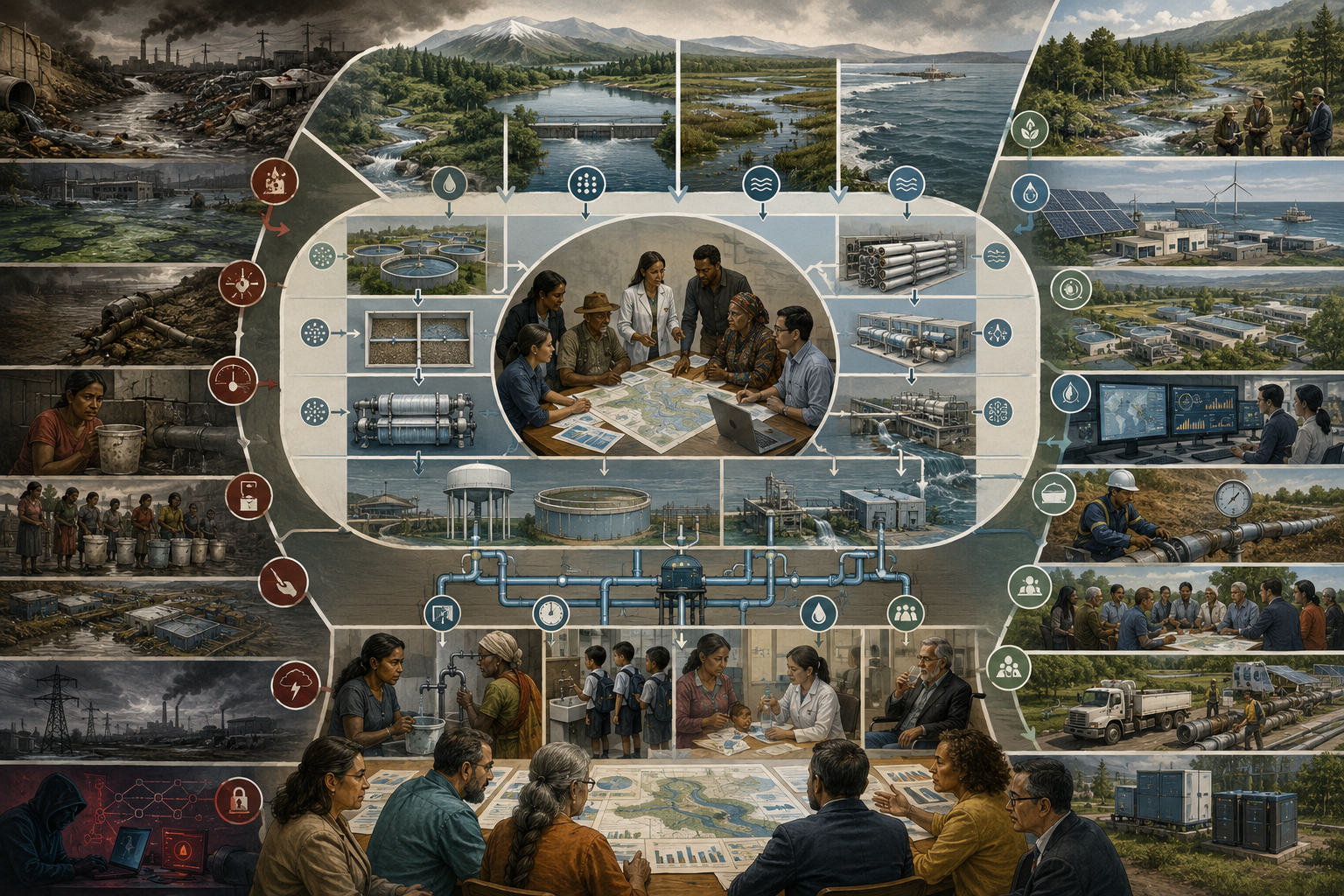
Safe water is both a public-health necessity and a resilience condition. A household without reliable drinking water is more exposed to disease, heat stress, time poverty, food insecurity, school interruption, gendered labor burdens, medical risk, and economic instability. A city without resilient water treatment and distribution is vulnerable to contamination, pipe failure, power outage, cyber disruption, drought, flood, saltwater intrusion, and public distrust. A coastal region may turn to desalination, but desalination is not a universal solution unless energy demand, brine disposal, marine impacts, cost, equity, and institutional capacity are addressed.
Why Clean Drinking Water Matters
Clean drinking water matters because it is one of the most basic foundations of human life, public health, dignity, and social stability. Without safe water, people face greater risk of diarrhoeal disease, dehydration, malnutrition, school interruption, gendered collection burdens, medical complications, household stress, and preventable mortality. Water is not only an environmental resource. It is a daily condition of bodily survival.
The United Nations recognizes safe and clean drinking water and sanitation as human rights. That rights frame is important because it shifts water away from being treated only as a commodity, engineering service, or development indicator. Safe drinking water is something people are entitled to because life, health, dignity, and participation depend on it. A resilient water system is therefore not only one that operates efficiently. It is one that protects people reliably and fairly.
Drinking-water resilience also matters because many water failures are quiet before they become visible. Contamination can move through pipes before people know they are exposed. Aging distribution networks can leak for years before collapse. Groundwater salinity can rise gradually. Treatment plants can be vulnerable to power outages, chemical shortages, cyber incidents, flooding, staffing gaps, or deferred maintenance. Household water storage can become unsafe when piped supply is intermittent. Fragility can accumulate inside the system long before a crisis is declared.
This makes clean water different from some other infrastructure services. A power outage is often immediately visible. A road closure is obvious. Unsafe water may look clear, smell normal, and still carry pathogens, chemicals, heavy metals, or other contaminants. The invisibility of water risk makes monitoring, testing, transparency, and public trust especially important.
Clean drinking water also matters for resilience because it supports other systems. Hospitals need safe water. Schools need safe water. Food preparation depends on safe water. Emergency shelters depend on safe water. Cooling centers, eldercare facilities, prisons, factories, farms, and households all depend on water that can be used without harm. When drinking-water systems fail, the failure can cascade into public health, education, labor, food security, and institutional legitimacy.
The purpose of water-supply resilience is therefore not simply to move water. It is to preserve safe water as a public-health function under conditions of uncertainty, disruption, and unequal vulnerability.
What Water-Supply Resilience Means
Water-supply resilience is the capacity of drinking-water systems to provide safe, reliable, affordable, and accessible water under changing conditions. It includes the ability to protect source water, treat water effectively, distribute it through reliable networks, monitor quality continuously, respond to contamination, maintain pressure, recover after disruption, and serve vulnerable populations equitably.
This definition is broader than water availability. A region may have enough water in physical terms but still lack resilient drinking-water service if infrastructure is weak, treatment is inadequate, contamination is widespread, utilities lack finance, households cannot afford bills, or rural communities depend on unprotected sources. Water-supply resilience therefore depends on both water quantity and water quality, but it cannot be reduced to either one alone.
Water-supply resilience also includes diversity. A resilient system may combine surface water, groundwater, rainwater harvesting, aquifer storage, recycled water, desalinated water, demand management, leakage reduction, emergency storage, and interconnections with neighboring systems. Diversity reduces dependence on a single source or pathway. But diversity must be governed carefully. A poorly managed portfolio can create new vulnerabilities if sources are contaminated, energy-intensive, unaffordable, or environmentally damaging.
Resilience also depends on continuity. Drinking-water systems are not useful only at annual averages. People need water every day. Hospitals and care facilities need water continuously. Treatment plants must operate through storms, heatwaves, power outages, supply-chain disruption, and emergency demand. A resilient water system must therefore be designed for stress, not only for normal operation.
Water-supply resilience also has a social dimension. A utility may maintain average service while some neighborhoods experience intermittent supply, low pressure, boil-water advisories, unaffordable bills, or unsafe household storage. A rural region may depend on small systems without adequate technical capacity. A coastal city may build desalination capacity while low-income households remain disconnected from affordable service. Resilience must be measured from the perspective of those most exposed to failure.
In practical terms, water-supply resilience asks: can people drink water safely today, tomorrow, during disruption, and after recovery? If the answer differs by income, geography, race, gender, age, disability, housing status, or political power, then the system is not fully resilient.
From Source to Tap
Clean drinking water is produced through a chain. That chain begins with source water: rivers, lakes, reservoirs, aquifers, springs, rainwater, seawater, brackish water, or recycled wastewater. It then moves through abstraction, conveyance, treatment, storage, distribution, household plumbing, and point of use. Every stage can strengthen or weaken water safety.
Source protection is the first line of defense. If watersheds, aquifers, wetlands, reservoirs, and recharge zones are protected from pollution, erosion, sewage, industrial discharge, agricultural runoff, saltwater intrusion, and over-extraction, treatment systems face lower risk. If source water is degraded, treatment becomes more difficult, expensive, and failure-prone. It is usually cheaper and safer to prevent contamination than to remove it after the fact.
Treatment is the second major layer. Depending on source quality, treatment may include screening, coagulation, flocculation, sedimentation, filtration, disinfection, activated carbon, membrane filtration, reverse osmosis, ion exchange, advanced oxidation, remineralization, corrosion control, and residual disinfectant management. The treatment process must match the contaminants and pathogens of concern. There is no universal treatment method suitable for all sources.
Storage and distribution form the third layer. Water that leaves a treatment plant safely can become unsafe if storage tanks are poorly maintained, pressure drops, pipes leak, biofilms grow, lead or other metals leach from plumbing, intrusion occurs through broken mains, or intermittent supply allows contamination. Distribution networks are often the hidden part of drinking-water resilience. People experience water at the tap, not at the treatment plant.
Household and community conditions are the final layer. Where piped supply is unreliable, households may store water in containers that become contaminated. Where people depend on wells, vendors, bottled water, standpipes, tanker delivery, or surface sources, safety depends on local handling, testing, storage, affordability, and trust. Safe water at the system level does not guarantee safe water at the point of use.
A source-to-tap perspective is essential because drinking-water failures are often chain failures. Source water may be polluted, treatment may be underdesigned, distribution may be fragile, monitoring may be weak, household storage may be unsafe, and institutions may fail to communicate risk. Resilience requires managing the whole chain, not only one visible component.
Water Quality and Public Health
Drinking-water quality is a public-health issue before it is a technical issue. Unsafe water can carry microbial pathogens, chemical contaminants, heavy metals, nutrients, pesticides, industrial compounds, salts, radionuclides, algal toxins, or emerging pollutants. Some hazards cause acute illness. Others create chronic exposure risks that may accumulate over years. Because many contaminants are invisible, safe drinking-water systems depend on standards, monitoring, treatment barriers, and public communication.
Microbial contamination remains one of the most urgent drinking-water risks. Bacteria, viruses, and parasites can enter water systems through sewage, animal waste, surface runoff, flooding, poor sanitation, cross-connections, low pressure, damaged pipes, or unsafe storage. Disinfection and sanitary protection are therefore central to public health. But disinfection must be managed carefully because treatment byproducts can also matter when water chemistry is poorly controlled.
Chemical contamination requires different strategies. Arsenic, fluoride, nitrate, lead, mercury, PFAS, pesticides, industrial solvents, salinity, and other contaminants require source-specific assessment and treatment. Some contaminants are naturally occurring in groundwater. Others come from agriculture, industry, mining, firefighting foams, waste disposal, plumbing, or land-use practices. A resilient system must know which contaminants are plausible, where they come from, how they move, and how exposure can be reduced.
Water quality also depends on infrastructure age. Lead pipes, corroded plumbing, aging mains, and poorly maintained tanks can turn a treated water supply into a household-level hazard. Corrosion control, pipe replacement, pressure management, flushing, monitoring, and customer communication are all part of water-quality resilience.
Public health also requires trust. If people do not trust tap water, they may buy bottled water at high cost, rely on unsafe alternatives, or ignore official guidance. Trust is not built only through assurances. It is built through transparent data, honest communication, rapid response, independent testing, community engagement, and accountability when systems fail.
Water quality should therefore be treated as a living risk-management process. It is not secured once and for all by building a treatment plant. It is maintained through ongoing monitoring, maintenance, source protection, infrastructure renewal, regulation, operator competence, and public legitimacy.
Treatment, Filtration, and Disinfection
Drinking-water treatment is a layered defense system. Its purpose is to remove or inactivate contaminants and pathogens before water reaches people. Treatment design depends on source-water quality, regulatory standards, local geology, land use, infrastructure condition, climate risk, and expected changes in demand. A resilient treatment system uses multiple barriers so that failure in one layer does not immediately become exposure at the tap.
Conventional surface-water treatment often includes coagulation, flocculation, sedimentation, filtration, and disinfection. Coagulation and flocculation help particles clump together. Sedimentation allows particles to settle. Filtration removes remaining particles and many microorganisms. Disinfection inactivates pathogens and can maintain a residual disinfectant in the distribution network. These processes are proven, but they require skilled operation, chemical supply, monitoring, maintenance, and adaptation to changing water quality.
Groundwater treatment may be simpler or more complex depending on contaminants. Some groundwater requires disinfection and corrosion control. Other groundwater requires removal of arsenic, fluoride, iron, manganese, nitrate, salinity, hardness, radionuclides, or volatile compounds. Groundwater can appear clean while containing naturally occurring contaminants that require specialized treatment.
Advanced treatment processes are increasingly important. Activated carbon can help remove taste, odor, organic chemicals, and some emerging contaminants. Ion exchange can remove certain dissolved ions. Membrane filtration can remove particles, microorganisms, salts, and other dissolved substances depending on membrane type. Reverse osmosis can remove many dissolved salts and contaminants, but it produces concentrate that must be managed. Advanced oxidation can help degrade some organic compounds, but it requires energy, chemical control, and careful design.
Treatment resilience also depends on supply chains. Treatment plants need chemicals, membranes, pumps, valves, sensors, laboratory capacity, spare parts, trained operators, and power. A plant that is technically capable under normal conditions may become fragile if supply chains fail, energy is interrupted, operators are unavailable, or raw water quality changes suddenly.
The most resilient treatment systems are not necessarily the most complex. They are the systems whose design, operation, maintenance, finance, staffing, and monitoring match the risks they face. Treatment is not only technology. It is a disciplined public-health practice.
Desalination as Strategic Supply
Desalination is the process of removing salts and other dissolved substances from seawater or brackish water to produce freshwater. It is increasingly important in arid coastal regions, island states, water-stressed cities, and places where conventional freshwater sources are overdrawn, contaminated, variable, or insufficient. Desalination can provide a drought-independent supply because seawater is not depleted in the same way as rivers, reservoirs, or aquifers.
But desalination should be understood as a strategic supply option, not a universal solution. It can strengthen resilience when it diversifies water portfolios, reduces dependence on overdrawn sources, supports critical urban supply, and is integrated with renewable energy, demand management, wastewater reuse, leakage reduction, brine safeguards, and affordability protections. It can weaken sustainability when it increases energy emissions, produces harmful brine, damages marine life through intake systems, raises water costs, or encourages continued overconsumption.
Desalination is most compelling where water stress is severe, coastal access is available, energy can be supplied sustainably, governance capacity is strong, and alternatives are limited or already optimized. It is less compelling where cheaper, lower-impact options remain underused: reducing leakage, protecting watersheds, recharging aquifers, improving irrigation efficiency, recycling wastewater, harvesting stormwater, restoring wetlands, managing demand, and preventing pollution.
Desalination also raises scale questions. Large centralized plants can provide major supply volumes but require substantial capital investment, energy, intake infrastructure, brine disposal systems, transmission pipelines, and long-term contracts. Smaller modular or mobile systems may support emergency supply, islands, remote communities, or industrial facilities, but they also need maintenance, membranes, energy, and technical capacity.
For drinking-water resilience, the central question is not whether desalination is good or bad in the abstract. The question is whether it is the right tool for a specific place, at a specific scale, with a specific energy source, brine strategy, financing structure, and equity plan. Desalination belongs inside integrated water planning, not outside it as a technological escape from governance.
Reverse Osmosis and Thermal Desalination
The two broad families of desalination are membrane-based and thermal. Reverse osmosis is the dominant membrane-based approach. It uses pressure to force water through semi-permeable membranes that allow water molecules to pass while rejecting salts and many other dissolved substances. Reverse osmosis has become widely used because membrane performance has improved and energy requirements have declined compared with older approaches.
Thermal desalination uses heat to evaporate water and then condense it as freshwater, leaving salts behind. Major thermal approaches include multi-stage flash and multi-effect distillation. Thermal systems have historically been common in regions with abundant fossil energy or where desalination is integrated with power generation. They can be robust in some contexts, but they tend to be more energy-intensive than modern reverse osmosis.
Reverse osmosis still requires significant energy because seawater must be pressurized. Energy-recovery devices, improved membranes, better pretreatment, optimized operations, and renewable electricity can reduce impacts. Brackish-water desalination generally requires less energy than seawater desalination because the salt concentration is lower, but it still produces concentrate that must be managed.
Pretreatment is crucial. Membranes can foul if feedwater contains suspended solids, organic matter, algae, microorganisms, oil, or other materials. Pretreatment may include screening, filtration, chemical conditioning, and biological control. Poor pretreatment reduces efficiency, shortens membrane life, increases costs, and can threaten reliability.
Post-treatment also matters. Desalinated water may be low in minerals and can be corrosive if not stabilized. It often requires remineralization, pH adjustment, blending, corrosion control, and disinfection before entering distribution systems. Producing water is not the same as producing water that is safe, stable, and compatible with pipes and household plumbing.
Desalination therefore is not a single machine. It is a water-treatment system with intake, pretreatment, membranes or thermal units, energy systems, concentrate handling, post-treatment, storage, distribution, monitoring, maintenance, and governance. Resilience depends on the full chain.
Brine, Energy, and Environmental Trade-Offs
Desalination creates trade-offs that must be governed directly. The two most important are energy demand and brine management. Energy demand affects cost, emissions, grid dependence, and vulnerability to power disruption. Brine disposal affects marine ecosystems, coastal water quality, benthic organisms, and cumulative environmental pressure.
Brine is the concentrated salty stream left after freshwater is separated from seawater or brackish water. It may contain high salinity, treatment chemicals, anti-scalants, coagulants, cleaning agents, metals, temperature differences, or other substances depending on the plant and process. If brine is discharged poorly, it can create dense saline plumes that settle near the seafloor and harm marine ecosystems. Brine management therefore requires careful dilution, diffusion, siting, monitoring, regulation, and in some cases resource recovery or alternative disposal.
Energy is equally important. Desalination can be made cleaner when powered by renewable energy, efficient membranes, energy recovery, and optimized operations. But renewable-powered desalination still requires infrastructure, storage, grid integration, land or marine siting, and lifecycle assessment. A plant may reduce freshwater stress while increasing energy demand if not planned carefully.
Intake systems are another concern. Open-ocean intakes can entrain or impinge marine organisms. Subsurface intakes may reduce some impacts but are not suitable everywhere and can be more expensive or technically constrained. Site selection must account for coastal ecology, water quality, currents, protected areas, fisheries, and cumulative impacts.
Costs also matter. Desalinated water is often more expensive than conventional water sources, though costs vary widely by technology, energy price, salinity, plant scale, financing, distance from users, and brine requirements. If desalination raises tariffs without protecting low-income households, water resilience can become socially unequal.
A resilient desalination strategy therefore requires more than plant construction. It requires environmental assessment, brine regulation, renewable-energy alignment, affordability planning, marine protection, emergency operating protocols, monitoring, public transparency, and integration with conservation and reuse. Desalination can be part of water resilience, but only when its risks are counted honestly.
Wastewater Reuse and Circular Water Systems
Water reuse is one of the most important complements to desalination. Instead of treating wastewater as waste, circular water systems treat it as a resource that can be safely reused for agriculture, industry, groundwater recharge, landscape irrigation, environmental flows, or even potable supply after advanced treatment. Reuse can reduce pressure on freshwater sources, improve drought resilience, reduce pollution discharge, and support more efficient urban water systems.
Non-potable reuse is already common in many contexts. Treated wastewater can be used for irrigation, cooling, industrial processes, street cleaning, construction, toilet flushing, or landscape maintenance. This reduces demand for high-quality drinking water in uses that do not require potable standards.
Potable reuse requires more advanced treatment and stronger public trust. Indirect potable reuse introduces highly treated water into an environmental buffer such as an aquifer or reservoir before later withdrawal and treatment. Direct potable reuse introduces advanced treated water more directly into drinking-water systems. Both require rigorous treatment, monitoring, regulation, operator skill, and transparent communication.
Advanced treatment for potable reuse may include microfiltration or ultrafiltration, reverse osmosis, ultraviolet disinfection, advanced oxidation, activated carbon, biological treatment, and continuous monitoring. The technology can be highly effective, but public acceptance depends on trust, governance, demonstrated safety, and clear explanation of the treatment barriers involved.
Water reuse and desalination should be compared carefully. Reuse is often less energy-intensive than seawater desalination and avoids some marine brine issues, though it has its own concentrate and treatment challenges. Desalination may be essential where wastewater volumes are insufficient, coastal seawater is available, and freshwater scarcity is severe. A resilient portfolio may use both, but not as substitutes for conservation, leakage reduction, or source protection.
Circular water systems shift the goal from supply expansion alone to water productivity and reuse. The question becomes: how many times can water safely serve human and ecological needs before leaving the system? That shift is central to long-term water-supply resilience in a water-stressed world.
Distribution Networks and Hidden Fragility
Distribution networks are among the most important and least visible parts of drinking-water resilience. Pipes, valves, pumps, pressure zones, storage tanks, service lines, meters, hydrants, and household plumbing determine whether treated water reaches people safely. A treatment plant can perform well while the distribution system still creates risk through leaks, pressure loss, intrusion, corrosion, intermittent supply, or aging materials.
Leakage is both a water-loss problem and a resilience problem. Water lost through leaks represents wasted treatment, energy, money, and scarce supply. High leakage can also indicate hidden infrastructure weakness. In some systems, leaks coexist with low pressure, contamination risk, road damage, and high maintenance burdens. Reducing non-revenue water can be one of the most cost-effective water-supply interventions.
Pressure management is crucial because distribution systems are designed to keep treated water moving outward under pressure. If pressure drops, contaminated water can intrude through cracks, joints, cross-connections, or damaged pipes. Intermittent supply can increase this risk because pipes repeatedly empty and refill, allowing contamination pathways to open. Continuous, pressurized service is therefore a water-quality protection measure.
Aging service lines and premise plumbing also matter. Lead, copper, galvanized steel, and other materials can create household-level exposure risks depending on water chemistry and corrosion control. Replacing unsafe service lines, improving corrosion control, and communicating clearly with residents are part of drinking-water resilience.
Distribution networks also face climate and disaster risks. Floods can damage pumps, mains, and treatment facilities. Heat can stress infrastructure and increase demand. Wildfire can damage pipes, contaminate systems, and disrupt service. Earthquakes can break mains. Power outages can stop pumping and treatment. Cyber incidents can disrupt controls. A resilient distribution system needs redundancy, isolation valves, backup power, emergency storage, pressure monitoring, and rapid repair capacity.
Hidden fragility in pipes becomes visible only when taps fail, contamination appears, or streets flood from broken mains. Resilient systems invest before those failures become public crises.
Monitoring, Testing, and Water Safety Plans
Drinking-water resilience depends on monitoring. Water systems must know what is happening in source water, treatment plants, storage tanks, distribution networks, and points of use. Monitoring detects pathogens, turbidity, disinfectant residuals, pH, conductivity, salinity, metals, nitrates, organic chemicals, treatment performance, pressure, flow, and other indicators of system condition. Without monitoring, water risk can remain invisible until illness, taste, odor, discoloration, or crisis appears.
Water safety plans provide a structured way to manage these risks. They focus on prevention across the entire water-supply chain, from catchment to consumer. A strong plan identifies hazards, assesses risks, defines control measures, monitors critical points, prepares corrective actions, documents responsibilities, and reviews performance. This shifts water safety from reactive testing after failure toward proactive risk management.
Testing alone is not enough. A water sample can show conditions at one place and time, but risk may change across seasons, storms, treatment operations, pipe conditions, or household storage. Monitoring must therefore be designed around plausible failure pathways. If a system is vulnerable to microbial intrusion, pressure and disinfectant residual matter. If arsenic is present in groundwater, chemical testing matters. If desalination is used, salinity, boron, remineralization, and corrosion stability may matter. If distribution pipes are aging, pressure, leaks, and metals may matter.
Digital monitoring can improve situational awareness through sensors, supervisory control systems, telemetry, smart meters, pressure loggers, laboratory information systems, and dashboards. But digital systems also introduce cyber risk, data-quality challenges, false alarms, and dependence on communications and power. Monitoring must be secure, validated, and actionable.
Public transparency is essential. People need to know whether water is safe, what risks exist, what actions are being taken, and what they should do during advisories. Boil-water notices, do-not-drink orders, contamination alerts, and service disruptions must be communicated in accessible language through trusted channels.
Monitoring is therefore not only a technical function. It is part of public trust. A resilient drinking-water system sees risk early, communicates honestly, and acts before exposure becomes harm.
Affordability, Access, and Water Justice
Clean drinking-water resilience is incomplete if water is technically available but socially inaccessible. People need water that is safe, nearby, reliable, and affordable. A household that cannot pay for service, lives outside formal networks, depends on unsafe wells, receives intermittent water, or must buy expensive bottled water is not water-secure.
Affordability is a major resilience issue. Water utilities need revenue to operate, maintain, and upgrade systems, but households also need protection from unaffordable bills and shutoffs. If tariffs rise to finance desalination, advanced treatment, pipe replacement, or climate adaptation without affordability programs, resilience investments may deepen inequality. Lifeline rates, targeted assistance, debt relief, shutoff protections, and progressive financing can help align utility sustainability with human rights.
Access is also spatial. Rural communities, informal settlements, Indigenous communities, island populations, arid regions, peri-urban areas, and low-income neighborhoods often face weaker service, higher costs, or lower political visibility. Small water systems may lack technical staff, laboratory access, financing, treatment capacity, and emergency support. Resilience planning must address these smaller and less visible systems, not only major metropolitan utilities.
Water justice also includes contamination burdens. Communities affected by industrial pollution, agricultural runoff, mining, military sites, aging pipes, failing septic systems, or groundwater contamination may face risks they did not create. They may also have less capacity to demand remediation. Justice requires source control, polluter accountability, transparent monitoring, accessible data, and investment in affected communities.
Gender and labor burdens matter as well. Where water is not available on premises, women and girls often bear disproportionate responsibility for collection, with consequences for education, safety, health, and time. Water access is therefore connected to gender justice, schooling, labor, and household wellbeing.
Desalination and advanced treatment also raise justice questions. Who pays for new supply? Who receives it? Which ecosystems absorb brine? Which communities host infrastructure? Are low-income households protected from rising costs? Are Indigenous rights and coastal livelihoods respected? Water-supply resilience must answer these questions directly.
A just drinking-water system is not only one that produces enough water. It is one that distributes safety, cost, voice, and protection fairly.
Energy Dependence and Critical Infrastructure
Water systems depend heavily on energy. Pumps move water from sources to treatment plants, storage reservoirs, distribution networks, high-rise buildings, and irrigation systems. Treatment processes require electricity for mixing, filtration, membranes, disinfection, monitoring, controls, and laboratory operations. Desalination is especially energy-dependent. Wastewater treatment and reuse also require power for pumping, aeration, membranes, ultraviolet systems, and controls.
This creates critical infrastructure interdependence. A power outage can reduce water pressure, stop pumps, interrupt treatment, disable monitoring, impair communications, and force boil-water advisories. A water failure can also affect power generation where plants need cooling water, hydropower, steam cycles, or pollution control. Water and energy systems are linked physically, operationally, and financially.
Desalination makes this interdependence especially clear. Seawater reverse osmosis can provide a drought-independent water source, but it increases dependence on electricity. If desalination becomes a major component of municipal supply, energy resilience becomes part of drinking-water resilience. Plants may need backup power, renewable-energy contracts, storage, grid reliability, emergency fuel plans, and demand-management strategies.
Critical facilities also depend on water. Hospitals, dialysis centers, laboratories, schools, shelters, eldercare facilities, prisons, food processors, and emergency operations need safe water. During disruption, water utilities must coordinate with emergency managers, health departments, energy providers, and critical facilities to preserve essential function.
Cybersecurity is another infrastructure concern. Water utilities increasingly rely on digital controls, sensors, remote monitoring, billing systems, chemical dosing controls, and operational technology. Cyber incidents can disrupt operations, corrupt data, or undermine trust. Water resilience therefore includes cyber resilience, manual fallback procedures, operator training, network segmentation, and incident response.
A resilient water system must plan for water-energy-cyber interdependence. It should not assume that electricity, communications, chemicals, roads, staff, and data systems will remain fully available during crisis. It must design fallback capacity before disruption occurs.
Governance, Finance, and Public Trust
Drinking-water resilience is a governance problem as much as an engineering problem. Utilities need stable finance, trained operators, asset management, regulatory oversight, emergency planning, public communication, source protection authority, water-quality enforcement, and long-term investment capacity. Without those institutions, even technically sound systems can become fragile.
Finance is often the constraint beneath visible failure. Pipes age, treatment plants deteriorate, pumps fail, laboratories lack capacity, operators are underpaid, and small systems defer maintenance because funds are inadequate. Deferred maintenance can appear affordable in the short term while creating higher future costs through leaks, failures, contamination, emergency repairs, and public distrust.
Governance fragmentation can also weaken resilience. Source water may be managed by one agency, treatment by another, distribution by a utility, sanitation by a separate entity, land use by local government, pollution by environmental regulators, and public health by another department. But water risk moves across these boundaries. Resilient governance requires coordination across watersheds, utilities, health agencies, energy providers, land-use planners, emergency managers, and communities.
Public trust is essential. People must believe that water providers are competent, honest, responsive, and accountable. Trust can be lost quickly through contamination events, delayed communication, inequitable service, unaffordable bills, ignored complaints, or misleading reassurance. Once lost, trust is difficult to rebuild.
Transparency strengthens trust. Water-quality data should be accessible and understandable. Advisories should be timely and clear. Infrastructure plans should explain who benefits and who pays. Desalination and reuse projects should disclose energy demand, brine impacts, treatment barriers, costs, and alternatives considered. Communities should be able to ask questions, challenge assumptions, and participate in decisions.
Governance also requires accountability for harm. When pollution contaminates sources, polluters should not simply externalize costs to utilities and households. When infrastructure neglect exposes residents, institutions should repair both the physical system and public trust. When households cannot afford water, policy should address affordability rather than treating nonpayment as moral failure.
Water-supply resilience is built through pipes, plants, membranes, sensors, and pumps. But it survives through governance, finance, legitimacy, and accountability.
Toward Resilient Drinking-Water Systems
Resilient drinking-water systems begin with a simple principle: safe water must be protected across the whole chain from source to tap. That means protecting watersheds and aquifers, matching treatment to risks, maintaining distribution networks, monitoring quality, planning for disruption, communicating transparently, and ensuring that all communities can access water affordably.
First, source protection should be treated as public-health infrastructure. Preventing contamination is usually more resilient than relying only on downstream treatment. Land-use planning, pollution control, watershed restoration, groundwater protection, septic management, agricultural best practices, industrial regulation, and aquifer recharge all support drinking-water safety.
Second, utilities should invest in asset management and maintenance. Pipe replacement, leak detection, pressure management, tank maintenance, pump redundancy, corrosion control, and backup power reduce hidden fragility. Infrastructure renewal is not glamorous, but it is one of the strongest resilience strategies available.
Third, treatment systems should be risk-based. Conventional treatment, advanced membranes, activated carbon, ion exchange, ultraviolet systems, advanced oxidation, desalination, reuse, and household treatment all have roles, but none should be treated as universal. Technology must fit source water, contaminants, scale, operator capacity, energy availability, and affordability.
Fourth, desalination should be used strategically. It can strengthen supply portfolios in water-scarce coastal regions, but it should be paired with renewable energy where possible, brine safeguards, marine protection, transparent cost analysis, demand management, and affordability protections.
Fifth, water reuse should be expanded where it can be safely governed. Wastewater is increasingly too valuable to discard. Reuse can reduce pressure on freshwater sources and diversify supply, especially when treatment, monitoring, and public trust are strong.
Sixth, monitoring and water safety plans should guide daily operation. Resilience requires knowing what can go wrong, where controls are located, how performance is verified, and what corrective actions follow.
Seventh, water justice should be built into planning. Safe water is not resilient if only some people can access it. Affordability, rural service, small systems, informal settlements, Indigenous communities, contaminated communities, and vulnerable households must be central rather than peripheral.
Clean drinking-water resilience is ultimately a public promise. It says that even under stress, people should be able to turn on the tap and trust what comes out. Keeping that promise requires technology, ecology, finance, governance, and justice working together.
Mathematical Lens
A drinking-water resilience score can be represented as a function of source protection, treatment capacity, distribution reliability, monitoring quality, supply diversity, energy resilience, affordability, and governance capacity, reduced by contamination risk, infrastructure aging, salinity pressure, energy dependence, brine burden, and access inequality. Let \(W_r\) represent drinking-water resilience:
W_r = \alpha S_p + \beta T_c + \gamma D_r + \delta M_q + \epsilon V_s + \zeta E_r + \eta A_f + \theta G_c – \lambda C_r – \mu I_a – \nu S_l – \xi E_d – \rho B_b – \sigma X_i
\]
Interpretation: Drinking-water resilience rises when source protection, treatment capacity, distribution reliability, monitoring quality, supply diversity, energy resilience, affordability, and governance capacity are strong. It declines when contamination risk, aging infrastructure, salinity, energy dependence, brine burden, and access inequality increase.
A desalination sustainability score can be represented as:
D_s = \frac{E_c + B_m + M_p + A_f + R_e + G_t}{6}
\]
Interpretation: Desalination sustainability improves when energy is clean, brine is well managed, marine impacts are reduced, water remains affordable, renewable energy is integrated, and governance transparency is strong.
A source-to-tap safety gap can be represented as:
G_{st} = R_s – C_p
\]
Interpretation: The source-to-tap safety gap grows when system risk \(R_s\) exceeds control performance \(C_p\). A large positive gap suggests that hazards are greater than the current barriers can safely manage.
| Term | Meaning | Interpretive role |
|---|---|---|
| \(W_r\) | Drinking-water resilience | Represents the capacity to provide safe, reliable, affordable water under stress. |
| \(S_p\) | Source protection | Represents watershed, aquifer, reservoir, and recharge-zone protection. |
| \(T_c\) | Treatment capacity | Represents the ability to remove or inactivate relevant contaminants and pathogens. |
| \(D_r\) | Distribution reliability | Represents pipe, pressure, storage, pumping, and service continuity. |
| \(M_q\) | Monitoring quality | Represents water-quality testing, sensors, laboratory capacity, and transparent data. |
| \(V_s\) | Supply diversity | Represents diversified sources such as surface water, groundwater, reuse, desalination, storage, and interconnections. |
| \(E_r\) | Energy resilience | Represents reliable power, backup power, renewable integration, and energy-security planning. |
| \(A_f\) | Affordability | Represents whether households can access water without unaffordable burden. |
| \(G_c\) | Governance capacity | Represents regulation, finance, operators, public trust, emergency planning, and accountability. |
| \(C_r\) | Contamination risk | Represents microbial, chemical, industrial, agricultural, geological, or distribution-system contamination. |
| \(I_a\) | Infrastructure aging | Represents deteriorating pipes, pumps, tanks, treatment systems, and service lines. |
| \(S_l\) | Salinity pressure | Represents seawater intrusion, brackish groundwater, salinized sources, and dissolved solids burden. |
| \(B_b\) | Brine burden | Represents environmental pressure from desalination concentrate and disposal practices. |
| \(X_i\) | Access inequality | Represents unequal service, affordability, safety, distance, reliability, and political voice. |
The equations are conceptual rather than predictive. Their purpose is to make the systems logic explicit: clean drinking-water resilience is not secured by one technology alone. It depends on the strength of the full source-to-tap system and the fairness of access to that system.
Advanced Python Workflow: Drinking-Water Resilience Scoring
This Python workflow evaluates drinking-water resilience by combining source protection, treatment capacity, distribution reliability, monitoring quality, supply diversity, energy resilience, affordability, governance capacity, contamination risk, infrastructure aging, salinity pressure, energy dependence, brine burden, and access inequality.
from __future__ import annotations

import pandas as pd
import numpy as np

INPUT_FILE = "drinking_water_resilience_panel.csv"
OUTPUT_FILE = "drinking_water_resilience_scores.csv"


def load_data(path: str) -> pd.DataFrame:
    """
    Load a drinking-water resilience dataset.

    All *_index columns should be normalized to [0, 1].
    Higher values should mean more of the named property.

    Examples:
      - source_protection_index: higher = stronger watershed or aquifer protection
      - treatment_capacity_index: higher = stronger ability to treat known risks
      - contamination_risk_index: higher = greater untreated or residual risk
      - access_inequality_index: higher = more unequal access to safe and affordable water
    """
    df = pd.read_csv(path)

    required_columns = [
        "water_system_name",
        "jurisdiction",
        "system_type",
        "source_protection_index",
        "treatment_capacity_index",
        "distribution_reliability_index",
        "monitoring_quality_index",
        "supply_diversity_index",
        "energy_resilience_index",
        "affordability_index",
        "governance_capacity_index",
        "contamination_risk_index",
        "infrastructure_aging_index",
        "salinity_pressure_index",
        "energy_dependence_index",
        "brine_burden_index",
        "access_inequality_index",
    ]

    missing = [col for col in required_columns if col not in df.columns]

    if missing:
        raise ValueError(f"Missing required columns: {missing}")

    return df


def validate_indices(df: pd.DataFrame) -> pd.DataFrame:
    """Validate that all *_index fields are complete and normalized to [0, 1]."""
    index_columns = [col for col in df.columns if col.endswith("_index")]

    for col in index_columns:
        if df[col].isna().any():
            raise ValueError(f"Column '{col}' contains missing values.")

        if ((df[col] < 0) | (df[col] > 1)).any():
            raise ValueError(f"Column '{col}' contains values outside [0, 1].")

    return df


def compute_scores(df: pd.DataFrame) -> pd.DataFrame:
    """
    Compute drinking-water resilience, water-system risk pressure,
    and a source-to-tap resilience gap.
    """
    df = df.copy()

    df["water_resilience_capacity_score"] = (
        0.15 * df["source_protection_index"] +
        0.16 * df["treatment_capacity_index"] +
        0.15 * df["distribution_reliability_index"] +
        0.14 * df["monitoring_quality_index"] +
        0.11 * df["supply_diversity_index"] +
        0.10 * df["energy_resilience_index"] +
        0.09 * df["affordability_index"] +
        0.10 * df["governance_capacity_index"]
    ).clip(lower=0, upper=1)

    df["water_system_risk_pressure_score"] = (
        0.22 * df["contamination_risk_index"] +
        0.18 * df["infrastructure_aging_index"] +
        0.16 * df["salinity_pressure_index"] +
        0.15 * df["energy_dependence_index"] +
        0.13 * df["brine_burden_index"] +
        0.16 * df["access_inequality_index"]
    ).clip(lower=0, upper=1)

    df["drinking_water_resilience_score"] = (
        0.72 * df["water_resilience_capacity_score"] -
        0.28 * df["water_system_risk_pressure_score"]
    ).clip(lower=0, upper=1)

    df["source_to_tap_resilience_gap"] = (
        df["water_resilience_capacity_score"] -
        df["water_system_risk_pressure_score"]
    )

    df["resilience_band"] = np.select(
        [
            df["drinking_water_resilience_score"] >= 0.80,
            df["drinking_water_resilience_score"] >= 0.60,
            df["drinking_water_resilience_score"] >= 0.40,
        ],
        [
            "Strong drinking-water resilience",
            "Moderate drinking-water resilience",
            "Limited drinking-water resilience",
        ],
        default="Weak drinking-water resilience",
    )

    df["water_safety_warning"] = np.select(
        [
            df["water_system_risk_pressure_score"] - df["water_resilience_capacity_score"] >= 0.35,
            df["water_system_risk_pressure_score"] - df["water_resilience_capacity_score"] >= 0.20,
            df["water_system_risk_pressure_score"] - df["water_resilience_capacity_score"] >= 0.05,
        ],
        [
            "Severe source-to-tap resilience deficit",
            "High source-to-tap resilience deficit",
            "Moderate source-to-tap resilience deficit",
        ],
        default="Lower deficit or stronger water-system capacity",
    )

    return df


def build_summary(df: pd.DataFrame) -> pd.DataFrame:
    """Return a ranked summary table for drinking-water resilience review."""
    columns = [
        "water_system_name",
        "jurisdiction",
        "system_type",
        "water_resilience_capacity_score",
        "water_system_risk_pressure_score",
        "drinking_water_resilience_score",
        "source_to_tap_resilience_gap",
        "resilience_band",
        "water_safety_warning",
    ]

    summary = df[columns].copy()

    summary = summary.sort_values(
        by=[
            "drinking_water_resilience_score",
            "water_system_risk_pressure_score",
            "source_to_tap_resilience_gap",
        ],
        ascending=[False, True, False],
    ).reset_index(drop=True)

    return summary


def main() -> None:
    df = load_data(INPUT_FILE)
    df = validate_indices(df)
    scored = compute_scores(df)
    summary = build_summary(scored)

    summary.to_csv(OUTPUT_FILE, index=False)

    print("Drinking-water resilience scoring complete.")
    print(summary.to_string(index=False))


if __name__ == "__main__":
    main()
This workflow is diagnostic rather than definitive. It helps analysts distinguish systems that have water available from systems that can deliver safe, affordable, reliable water across the full source-to-tap chain.
Advanced R Workflow: Water-Supply Diagnostics
This R workflow summarizes drinking-water resilience by jurisdiction and system type. It can support utility planning, desalination review, drinking-water safety planning, infrastructure renewal, small-system support, water justice analysis, and resilient water-supply strategy.
library(readr)
library(dplyr)

input_file <- "drinking_water_resilience_panel.csv"
jurisdiction_output_file <- "drinking_water_jurisdiction_summary.csv"
system_type_output_file <- "drinking_water_system_type_summary.csv"

water_df <- read_csv(input_file, show_col_types = FALSE)

required_cols <- c(
  "water_system_name",
  "jurisdiction",
  "system_type",
  "source_protection_index",
  "treatment_capacity_index",
  "distribution_reliability_index",
  "monitoring_quality_index",
  "supply_diversity_index",
  "energy_resilience_index",
  "affordability_index",
  "governance_capacity_index",
  "contamination_risk_index",
  "infrastructure_aging_index",
  "salinity_pressure_index",
  "energy_dependence_index",
  "brine_burden_index",
  "access_inequality_index"
)

missing_cols <- setdiff(required_cols, names(water_df))

if (length(missing_cols) > 0) {
  stop(paste("Missing required columns:", paste(missing_cols, collapse = ", ")))
}

index_cols <- names(water_df)[grepl("_index$", names(water_df))]

invalid_index_cols <- index_cols[
  vapply(
    water_df[index_cols],
    function(x) any(is.na(x) | x < 0 | x > 1),
    logical(1)
  )
]

if (length(invalid_index_cols) > 0) {
  stop(
    paste(
      "Index columns must be complete and normalized to [0, 1]:",
      paste(invalid_index_cols, collapse = ", ")
    )
  )
}

water_df <- water_df %>%
  mutate(
    water_resilience_capacity_proxy = (
      source_protection_index +
        treatment_capacity_index +
        distribution_reliability_index +
        monitoring_quality_index +
        supply_diversity_index +
        energy_resilience_index +
        affordability_index +
        governance_capacity_index
    ) / 8,
    water_system_risk_pressure_proxy = (
      contamination_risk_index +
        infrastructure_aging_index +
        salinity_pressure_index +
        energy_dependence_index +
        brine_burden_index +
        access_inequality_index
    ) / 6,
    drinking_water_resilience_proxy = (
      water_resilience_capacity_proxy +
        (1 - water_system_risk_pressure_proxy)
    ) / 2,
    source_to_tap_resilience_gap = water_resilience_capacity_proxy -
      water_system_risk_pressure_proxy,
    resilience_band = case_when(
      drinking_water_resilience_proxy >= 0.75 ~ "Strong drinking-water resilience",
      drinking_water_resilience_proxy >= 0.55 ~ "Moderate drinking-water resilience",
      drinking_water_resilience_proxy >= 0.35 ~ "Limited drinking-water resilience",
      TRUE ~ "Weak drinking-water resilience"
    )
  )

jurisdiction_summary <- water_df %>%
  group_by(jurisdiction) %>%
  summarise(
    avg_drinking_water_resilience = mean(drinking_water_resilience_proxy, na.rm = TRUE),
    avg_water_resilience_capacity = mean(water_resilience_capacity_proxy, na.rm = TRUE),
    avg_water_system_risk_pressure = mean(water_system_risk_pressure_proxy, na.rm = TRUE),
    avg_source_to_tap_resilience_gap = mean(source_to_tap_resilience_gap, na.rm = TRUE),
    avg_source_protection = mean(source_protection_index, na.rm = TRUE),
    avg_treatment_capacity = mean(treatment_capacity_index, na.rm = TRUE),
    avg_distribution_reliability = mean(distribution_reliability_index, na.rm = TRUE),
    avg_monitoring_quality = mean(monitoring_quality_index, na.rm = TRUE),
    avg_supply_diversity = mean(supply_diversity_index, na.rm = TRUE),
    avg_energy_resilience = mean(energy_resilience_index, na.rm = TRUE),
    avg_affordability = mean(affordability_index, na.rm = TRUE),
    avg_governance_capacity = mean(governance_capacity_index, na.rm = TRUE),
    avg_contamination_risk = mean(contamination_risk_index, na.rm = TRUE),
    avg_infrastructure_aging = mean(infrastructure_aging_index, na.rm = TRUE),
    avg_salinity_pressure = mean(salinity_pressure_index, na.rm = TRUE),
    avg_energy_dependence = mean(energy_dependence_index, na.rm = TRUE),
    avg_brine_burden = mean(brine_burden_index, na.rm = TRUE),
    avg_access_inequality = mean(access_inequality_index, na.rm = TRUE),
    systems = n(),
    .groups = "drop"
  ) %>%
  arrange(desc(avg_drinking_water_resilience))

system_type_summary <- water_df %>%
  group_by(system_type) %>%
  summarise(
    avg_drinking_water_resilience = mean(drinking_water_resilience_proxy, na.rm = TRUE),
    avg_water_resilience_capacity = mean(water_resilience_capacity_proxy, na.rm = TRUE),
    avg_water_system_risk_pressure = mean(water_system_risk_pressure_proxy, na.rm = TRUE),
    avg_source_to_tap_resilience_gap = mean(source_to_tap_resilience_gap, na.rm = TRUE),
    avg_source_protection = mean(source_protection_index, na.rm = TRUE),
    avg_treatment_capacity = mean(treatment_capacity_index, na.rm = TRUE),
    avg_distribution_reliability = mean(distribution_reliability_index, na.rm = TRUE),
    avg_monitoring_quality = mean(monitoring_quality_index, na.rm = TRUE),
    avg_supply_diversity = mean(supply_diversity_index, na.rm = TRUE),
    avg_energy_resilience = mean(energy_resilience_index, na.rm = TRUE),
    avg_affordability = mean(affordability_index, na.rm = TRUE),
    avg_governance_capacity = mean(governance_capacity_index, na.rm = TRUE),
    avg_contamination_risk = mean(contamination_risk_index, na.rm = TRUE),
    avg_infrastructure_aging = mean(infrastructure_aging_index, na.rm = TRUE),
    avg_salinity_pressure = mean(salinity_pressure_index, na.rm = TRUE),
    avg_energy_dependence = mean(energy_dependence_index, na.rm = TRUE),
    avg_brine_burden = mean(brine_burden_index, na.rm = TRUE),
    avg_access_inequality = mean(access_inequality_index, na.rm = TRUE),
    systems = n(),
    .groups = "drop"
  ) %>%
  arrange(desc(avg_water_system_risk_pressure))

write_csv(jurisdiction_summary, jurisdiction_output_file)
write_csv(system_type_summary, system_type_output_file)

cat("Drinking-water jurisdiction summary exported to:", jurisdiction_output_file, "\n")
print(jurisdiction_summary)

cat("\nDrinking-water system-type summary exported to:", system_type_output_file, "\n")
print(system_type_summary)
This workflow helps identify where water systems are strong, where source-to-tap risk remains high, where desalination creates energy or brine burdens, and where affordability or access inequality weakens the public-health value of water infrastructure.
GitHub Repository
Complete Code Repository
The full code distribution for this article, including drinking-water resilience scoring, desalination sustainability diagnostics, SQL materials, optional governance-support tools, and supporting documentation, is available on GitHub.
Related Articles
- Water Security, Drought, Flood, and Resilience
- Environmental Monitoring as a Foundation of Resilience
- Critical Infrastructure Resilience and Interdependent Systems
- Energy Security, Grid Fragility, and Resilience
- Climate Risk and Systemic Vulnerability
- Resilience Data, Provenance, and Auditability
- Why Inequality Weakens Resilience
- Resilience, Justice, and the Ethics of Transformation
Further Reading
- United Nations Children’s Fund (UNICEF) (2025) Access to Drinking Water. Available at: https://data.unicef.org/topic/water-and-sanitation/drinking-water/
- United Nations Water (UN-Water) (2025) Progress on Household Drinking Water, Sanitation and Hygiene 2000–2024: Special Focus on Inequalities. Available at: https://www.unwater.org/publications/progress-household-drinking-water-sanitation-and-hygiene-2000-2024-special-focus
- World Health Organization (WHO) (n.d.) Drinking-Water Quality Guidelines. Available at: https://www.who.int/teams/environment-climate-change-and-health/water-sanitation-and-health/water-safety-and-quality/drinking-water-quality-guidelines
- World Health Organization (WHO) (2024) Water Safety Planning: A Roadmap to Supporting Resources. Available at: https://cdn.who.int/media/docs/default-source/wash-documents/water-safety-and-quality/water-safety-planning/revised_wsp_roadmap_23sept2024.pdf
- World Bank (2019) The Role of Desalination in an Increasingly Water-Scarce World. Available at: https://openknowledge.worldbank.org/entities/publication/214476a0-e59d-55f2-a6cd-872cacc30c55
- United Nations Environment Programme (UNEP) (2019) Towards Sustainable Desalination. Available at: https://www.unep.org/news-and-stories/story/towards-sustainable-desalination
- United Nations Environment Programme (UNEP) (2021) Five Things to Know About Desalination. Available at: https://www.unep.org/news-and-stories/story/five-things-know-about-desalination
- International Energy Agency (IEA) (2026) Wired for Water: How Electrification Is Transforming Desalination. Available at: https://www.iea.org/commentaries/wired-for-water-how-electrification-is-transforming-desalination
- Office of the United Nations High Commissioner for Human Rights (OHCHR) (n.d.) About Water and Sanitation. Available at: https://www.ohchr.org/en/water-and-sanitation/about-water-and-sanitation
References
- International Energy Agency (IEA) (2026) Wired for Water: How Electrification Is Transforming Desalination. Available at: https://www.iea.org/commentaries/wired-for-water-how-electrification-is-transforming-desalination
- Office of the United Nations High Commissioner for Human Rights (OHCHR) (n.d.) About Water and Sanitation. Available at: https://www.ohchr.org/en/water-and-sanitation/about-water-and-sanitation
- United Nations Children’s Fund (UNICEF) (2025) Access to Drinking Water. Available at: https://data.unicef.org/topic/water-and-sanitation/drinking-water/
- United Nations Environment Programme (UNEP) (2019) Towards Sustainable Desalination. Available at: https://www.unep.org/news-and-stories/story/towards-sustainable-desalination
- United Nations Environment Programme (UNEP) (2021) Five Things to Know About Desalination. Available at: https://www.unep.org/news-and-stories/story/five-things-know-about-desalination
- United Nations General Assembly (2010) The Human Right to Water and Sanitation: Resolution Adopted by the General Assembly. Available at: https://digitallibrary.un.org/record/687002
- United Nations Water (UN-Water) (2024) United Nations World Water Development Report 2024: Water for Prosperity and Peace. Available at: https://www.unwater.org/publications/un-world-water-development-report-2024
- United Nations Water (UN-Water) (2025) Progress on Household Drinking Water, Sanitation and Hygiene 2000–2024: Special Focus on Inequalities. Available at: https://www.unwater.org/publications/progress-household-drinking-water-sanitation-and-hygiene-2000-2024-special-focus
- World Bank (2019) The Role of Desalination in an Increasingly Water-Scarce World. Available at: https://openknowledge.worldbank.org/entities/publication/214476a0-e59d-55f2-a6cd-872cacc30c55
- World Health Organization (WHO) (n.d.) Drinking-Water Quality Guidelines. Available at: https://www.who.int/teams/environment-climate-change-and-health/water-sanitation-and-health/water-safety-and-quality/drinking-water-quality-guidelines
- World Health Organization (WHO) (n.d.) Water Safety Planning. Available at: https://www.who.int/teams/environment-climate-change-and-health/water-sanitation-and-health/water-safety-and-quality/water-safety-planning
- World Health Organization (WHO) (2024) Water Safety Planning: A Roadmap to Supporting Resources. Available at: https://cdn.who.int/media/docs/default-source/wash-documents/water-safety-and-quality/water-safety-planning/revised_wsp_roadmap_23sept2024.pdf