
Last Updated May 9, 2026
Intergenerational justice matters for sustainable systems because it asks what the present owes to those who do not yet exist but who will nonetheless inherit the consequences of present action. The question reaches beyond prudence, legacy, or sentimental concern for posterity. It concerns justice, obligation, legitimacy, and the moral standing of future persons in a world where current generations shape climate stability, biodiversity, infrastructure resilience, public debt, technological risk, public institutions, and the long-run conditions of collective life.
Once human institutions acquire the capacity to shift harms, benefits, risks, and possibilities across decades and centuries, intergenerational concern can no longer remain a marginal ethical theme. It becomes part of the moral architecture of responsible governance. The present does not merely live before the future. It actively constructs part of the future’s inheritance.
The deeper reason this issue belongs in Stewardship & Ethics is that modern systems are structurally biased toward the present. Electoral cycles privilege near-term reward. Markets discount the future. Infrastructure maintenance is deferred. Ecological harms accumulate slowly. Public debt can finance present consumption while displacing costs into later periods. Climate change, biodiversity loss, technological lock-in, and institutional fragility all reveal the same pattern: present actors often enjoy benefits while future actors inherit diminished options, elevated risk, and degraded common conditions.
Intergenerational justice arises from the need to judge that pattern ethically rather than merely administratively. It asks whether time should function as a shield against responsibility. It asks whether future persons can be wronged even though they cannot yet speak. It asks whether present institutions are justified in consuming ecological, fiscal, infrastructural, and social inheritances that later generations will need.
A society that treats the future as morally secondary until it arrives has already made a moral decision. Intergenerational justice asks whether that decision can be defended.
Main Library
Publications
Article Map
Stewardship & Ethics
Related Topic
Sustainable Development
Related Topic
Risk & Resilience
Related Topic
Planetary Boundaries
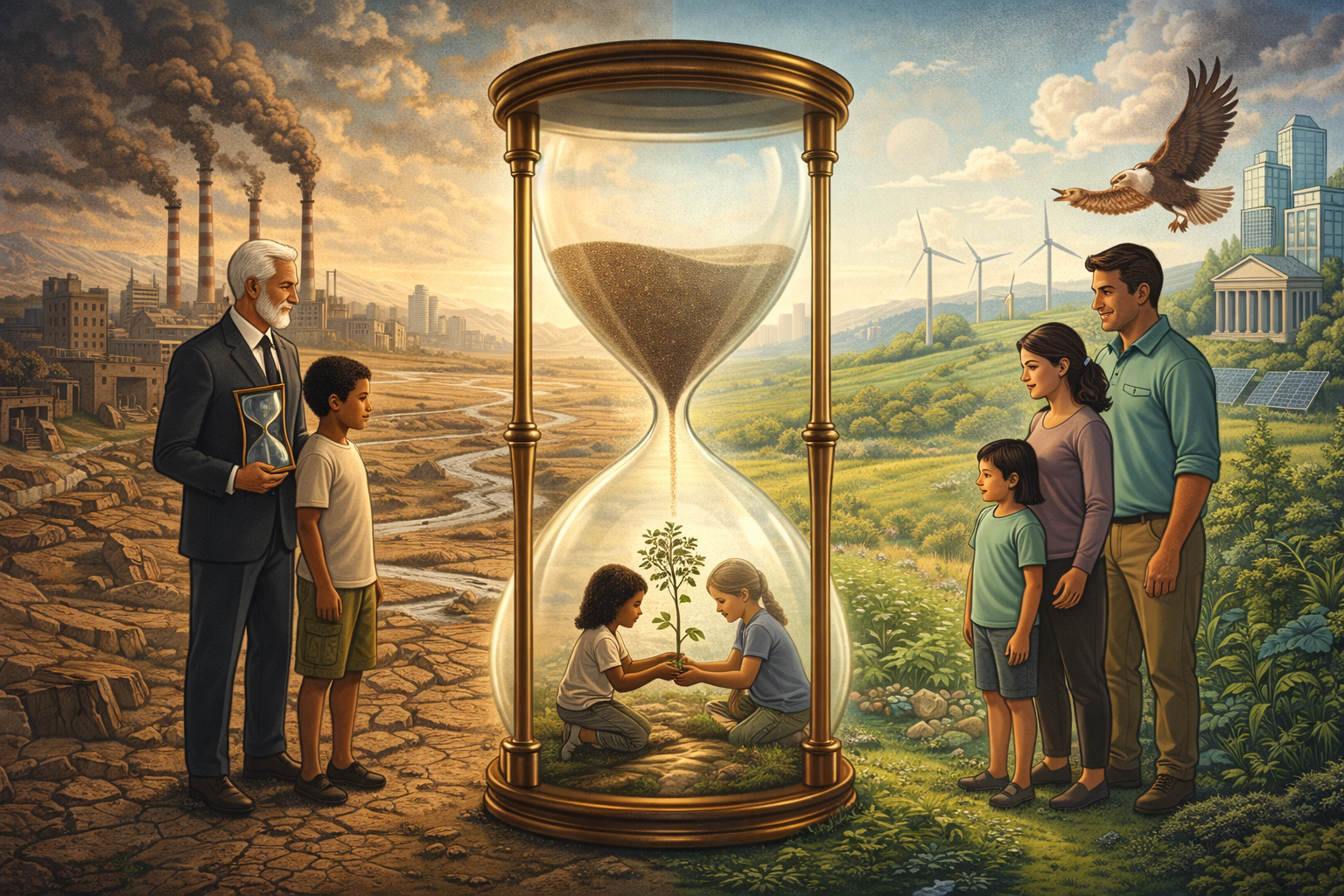
This article argues that intergenerational justice should be understood as a problem of fairness across time, institutional design, ecological restraint, and moral responsibility under uncertainty. It examines what intergenerational justice means, why the future poses special difficulties for ethical theory, how long-term obligation differs from private concern for descendants, why climate change and Earth-system disruption intensify the question, how public debt, infrastructure neglect, technology, and ecological depletion transfer burdens forward, why future generations are disadvantaged by present discounting and short-horizon governance, and why sustainable systems require institutions capable of representing those not yet born.
Why This Belongs in Stewardship & Ethics
Intergenerational justice belongs in Stewardship & Ethics because stewardship is fundamentally about inheritance. It asks how present power should be exercised when its consequences extend beyond present beneficiaries, present voters, present markets, and present institutions. It asks whether current generations are caretakers of shared conditions or merely temporary users of systems they can degrade before handing them forward.
Stewardship without intergenerational justice becomes incomplete. A society may speak of care, responsibility, sustainability, or public purpose while allowing climate instability, biodiversity loss, weakened infrastructure, fiscal fragility, technological dependence, and institutional corrosion to accumulate beyond the horizon of current decision-makers. Such a society may appear functional in the present while quietly narrowing the future.
This issue belongs in Stewardship & Ethics because future generations are structurally vulnerable. They cannot vote in present elections, participate in today’s public hearings, object to current emissions pathways, challenge today’s infrastructure neglect, or demand protection from technological risks being built into systems now. Yet they will live with the outcomes of present decisions. Their political absence makes them easy to discount, but their vulnerability makes them morally important.
Intergenerational justice therefore asks whether institutions can govern beyond the convenience of the present. It asks whether law, finance, infrastructure, climate policy, ecological protection, public health, technological design, and public debt can be organized around long-term responsibility rather than short-term extraction.
A stewardship ethic refuses to treat the future as an empty warehouse into which present societies can place deferred costs. The future is not only later time. It is a field of persons, communities, ecosystems, institutions, and possibilities already being shaped by what the present does.
What Intergenerational Justice and Long-Term Obligation Mean
Intergenerational justice concerns the fairness of relations between present and future generations. It asks whether those alive today have duties of justice to those who will live later and, if so, what those duties require. It concerns inheritance, depletion, risk transfer, institutional design, ecological preservation, fiscal responsibility, technological restraint, and the fair distribution of opportunities across time.
Long-term obligation refers to responsibilities that extend beyond immediate reciprocal relationships. These obligations apply even when the beneficiaries do not yet exist as present claimants in politics, markets, law, or public deliberation. They ask whether temporally distant persons count as subjects of justice rather than merely as objects of benevolence.
This matters because much of ordinary political life is organized as though the moral community consists mainly of current stakeholders. Budgets are evaluated in short windows. Elections reward immediate gain. Environmental harms that accumulate slowly are tolerated. Infrastructure maintenance is deferred until failure becomes visible. Debt can be normalized if its deepest costs appear later. Technological systems can be deployed before long-term dependence, social harm, or institutional fragility is fully understood.
Intergenerational justice interrupts that horizon by arguing that the future is not morally empty simply because it is not yet present.
To ask about justice across generations is therefore to ask whether time itself should function as a moral excuse. If present actors can impose foreseeable burdens on future people while retaining the gains for themselves, then fairness across time becomes one of the decisive tests of whether a society is governing responsibly at all.
Why the Future Creates a Special Problem of Justice
The future creates a special problem of justice because future persons are absent from present institutions yet vulnerable to present decisions. They cannot vote, bargain, litigate, organize, testify, or participate directly in current public deliberation. Nevertheless, they can be profoundly affected by present conduct, especially where decisions concern atmospheric change, ecological integrity, public debt, infrastructure, nuclear waste, artificial intelligence, biotechnology, land use, or irreversible depletion.
This matters because many ethical and legal frameworks were built around interactions among contemporaries. Those frameworks assume clearer reciprocity, clearer standing, clearer representation, and clearer opportunities for objection. Intergenerational justice disrupts those assumptions. It raises the problem of how obligations can be owed to persons who cannot reciprocate now, cannot express preferences now, and may be affected by decisions made long before they come into existence.
Far from making the question less important, this difficulty makes it more urgent. The fact that future generations are politically absent is one reason they are ethically vulnerable. Justice becomes necessary precisely because power is asymmetrical across time.
The present has institutional instruments. The future has consequences. The present has voice. The future has exposure. The present has discretion. The future has inheritance.
Intergenerational justice asks whether that asymmetry can be governed fairly. It asks whether present authority should be constrained by duties to preserve livable, just, and resilient conditions for those who cannot yet defend themselves against the decisions being made on their behalf.
Future Persons, Rights, and Moral Standing
A central issue in intergenerational ethics is whether future persons possess moral standing strong enough to ground claims of justice. One answer is that future people matter because they will be persons like us: beings capable of flourishing, suffering, planning, valuing, depending, belonging, creating, and being harmed. On that view, temporal distance does not erase moral importance. If an action predictably leaves future persons worse off in morally serious ways, then those persons can be wronged even though they do not yet exist now.
This matters because without some account of moral standing, obligations to the future risk collapsing into discretionary concern. A society might prefer to leave a better world behind, but justice would have no claim over what it is required to do. Future people would become objects of generosity rather than subjects of obligation.
Intergenerational justice resists that weakening. It argues that future people are not merely possible beneficiaries of present goodwill. They are among those whose lives may be shaped, constrained, or damaged by present institutions.
The issue is not whether future persons can assert their rights today in ordinary procedural terms. The issue is whether their foreseeable existence and vulnerability are sufficient to ground duties now. Intergenerational justice answers yes, because present actors can shape the conditions under which future persons will live.
This does not mean every future preference can be known or satisfied. Future people will have their own plural values, conflicts, technologies, institutions, and forms of life. But present generations can still preserve basic conditions of agency: a stable climate, viable ecosystems, durable infrastructure, manageable risk, public capacity, social trust, and enough ecological and institutional inheritance for future persons to pursue their own lives without being trapped by inherited damage.
The Nonidentity Problem and Why It Matters
One of the most difficult questions in intergenerational ethics is the nonidentity problem. The problem arises because many current decisions affect not only how well future people live, but which future people come to exist at all. If different policies produce different future populations, one might ask how future persons can claim to have been harmed by a decision that was also part of the causal pathway leading to their existence.
This problem is philosophically important because it complicates simple accounts of person-affecting harm. If a high-emissions pathway produces different future individuals than a low-emissions pathway, then some individuals living in the high-emissions future might not have existed under the alternative. Can they say they were harmed by the policy if the policy was a condition of their existence?
This matters because many long-term policy choices operate at exactly this structural level. Energy systems, migration, urban development, climate policy, fertility patterns, economic organization, and technological pathways may shape not only future living conditions but also future demographic composition.
The significance of the nonidentity problem is not that it defeats intergenerational ethics. It forces moral theory to become more sophisticated. It suggests that justice may need to be grounded not only in whether a specific future person is worse off than they otherwise would have been, but also in whether present generations preserve threshold conditions of decent life, avoid reckless degradation of shared systems, and refrain from choosing futures that are foreseeably unjust or unlivable for whoever comes to inhabit them.
A society can wrong the future not only by harming identifiable future persons, but by leaving any future persons with damaged conditions of life that no just society should deliberately impose.
Savings, Depletion, and Fairness Across Time
Intergenerational justice has long been connected to questions of savings, inheritance, and depletion. What should one generation leave to the next? Are present people required to save resources, maintain infrastructure, preserve ecological integrity, protect public institutions, or restrain extraction so that later generations inherit fair conditions rather than diminished ones?
These questions arise in philosophy, economics, sustainability, public finance, and environmental governance because the distribution of goods across time is never morally neutral.
This matters because one generation can enrich itself by drawing down stocks it did not create and does not replenish. It can consume ecological capital, neglect public works, emit greenhouse gases, deplete aquifers, degrade soils, weaken democratic institutions, and underinvest in resilience while still appearing prosperous in present terms. Yet such prosperity may be parasitic if it relies on leaving weaker ecological, institutional, and social foundations to those who come later.
Intergenerational justice therefore requires more than aggregate growth. It asks whether the terms of inheritance are fair.
The relevant inheritance includes more than money. It includes:
- climate stability and atmospheric capacity;
- biodiversity and ecosystem resilience;
- soil, water, forests, fisheries, and agricultural systems;
- public infrastructure and maintenance capacity;
- fiscal room to respond to future crises;
- democratic legitimacy and institutional trust;
- scientific knowledge and educational capacity;
- technological systems that remain governable rather than coercive or brittle.
A generation that leaves behind greater fragility, fewer options, and deeper risk while enjoying disproportionate present benefit has reason to answer for that imbalance. Fairness across time asks whether inheritance is being protected or quietly consumed.
Discounting, Short-Termism, and the Bias of Present Institutions
Modern institutions often display a structural bias toward the present. Economic discounting reduces the weight of future costs relative to present gains. Political systems reward visible short-term benefit over slow prevention. Corporate reporting cycles encourage narrow horizons. Media attention privileges immediate crises over slow violence. Budget systems often separate capital costs from long-term maintenance. Regulatory systems may demand strong evidence of harm before preventive action, even where delay increases irreversible risk.
These patterns do not merely shape policy. They shape moral perception by teaching societies to treat long-term harms as abstract, negotiable, or politically secondary.
This matters because intergenerational injustice often hides behind procedural normality. Deferred maintenance, rising emissions, biodiversity erosion, debt accumulation, soil degradation, aquifer depletion, and institutional decay can proceed for years within apparently ordinary governance. The problem is not always explicit malice. It is often systematic short-termism embedded in incentive structures that externalize future cost.
Discounting is not always irrational. Future uncertainty, opportunity cost, and changing conditions matter. But when discounting is applied too aggressively to long-term ecological, climate, health, or civilizational risks, it can make severe future harms appear morally negligible in present decision-making. It can translate the suffering of future people into small present numbers.
Long-term obligation therefore requires more than exhorting present actors to care more. It requires institutional forms capable of correcting present bias. Without such correction, justice for future generations will remain vulnerable to the temporal myopia built into many prevailing systems.
The future does not become unimportant simply because current institutions are bad at representing it.
Climate Change, Ecological Risk, and Intergenerational Burden
Climate change intensifies intergenerational justice because it combines cumulative causation, long atmospheric persistence, unequal vulnerability, and delayed consequence. Present emissions affect future climate conditions, future adaptation burdens, future loss and damage, and the long-term viability of ecosystems and human settlements. The ethical significance of climate change is therefore inseparable from the fact that current generations can enjoy the gains of carbon-intensive development while leaving part of the cost to later generations.
This matters because climate injustice is not only intragenerational but intergenerational. It concerns not only who suffers now, but who will inherit narrowing carbon budgets, heightened adaptation costs, more volatile Earth systems, damaged ecosystems, and diminished room for just development. A present-focused ethic is incapable of seeing the full moral structure of that burden.
Ecological risk deepens the same problem. Biodiversity loss, habitat fragmentation, ocean acidification, soil degradation, deforestation, freshwater depletion, and chemical contamination can leave future generations with diminished living systems. Some losses are not easily measured as economic costs. They are losses of relationship, resilience, knowledge, culture, beauty, and biological possibility.
Climate and ecological damage also interact. A future generation may inherit not one isolated problem, but compounded conditions: warmer temperatures, weaker food systems, damaged biodiversity, rising disaster risk, public-health stress, infrastructure fragility, and fiscal burdens from delayed action.
Intergenerational justice asks whether present societies are entitled to narrow the future’s room for maneuver in order to preserve present convenience.
This is one reason the question connects directly with responsibility in the Anthropocene. Once human systems alter the conditions of life at planetary scale, obligation to future generations ceases to be peripheral. It becomes central to what responsible governance means.
Future Generations and the Ethics of Irrevocable Harm
Intergenerational ethics becomes especially demanding where present actions create harms that are difficult or impossible to reverse. Species extinction, large-scale biodiversity loss, radioactive contamination, certain forms of cryosphere loss, deep soil degradation, irreversible cultural displacement, and the destruction of ecological systems all raise questions of irrevocability. Where repair is impossible or partial at best, the moral burden on present action becomes heavier.
This matters because some losses are not fairly compensable across time. A later generation may inherit wealth or technical capacity yet still be unable to restore what has been destroyed. No amount of future income can recreate an extinct species as the same evolutionary lineage. No later technological sophistication can fully restore a lost homeland, a drowned cultural landscape, or the ecological relationships erased by earlier destruction.
Irrevocable harm therefore places limits on simple trade-off reasoning. It suggests that some obligations to the future are not merely about balancing costs and benefits, but about preserving conditions whose destruction would leave future people structurally disadvantaged in ways they cannot meaningfully choose away.
This is where intergenerational justice becomes closely tied to precaution. Present actors are not free to gamble with irreplaceable ecological and civilizational goods simply because those who bear the deepest cost are not here yet to object.
The ethical question is not only whether the future can adapt. It is whether the present has the right to make adaptation necessary by choosing avoidable degradation now.
Public Debt, Infrastructure, and Hidden Future Burdens
Intergenerational justice is often discussed through climate and ecology, but fiscal policy and infrastructure also transfer burdens across time. Public debt can be justified when it finances durable public goods, crisis response, productive investment, infrastructure, education, health, or ecological transition that benefits present and future people. But debt can become unjust when it finances present consumption, tax avoidance, waste, corruption, or short-term political gain while leaving future populations with reduced fiscal capacity and weaker public systems.
The ethical issue is not debt itself. The ethical issue is what debt does across time.
Infrastructure creates a similar problem. Bridges, water systems, power grids, public transit, schools, hospitals, ports, housing, drainage systems, and digital infrastructure are inherited systems. When present societies defer maintenance, future generations inherit not only repair bills, but heightened risk: bridge failures, water contamination, flood exposure, grid fragility, public-health vulnerability, and reduced capacity to respond to crises.
This matters because hidden future burdens are often politically convenient. Maintenance is less visible than new construction. Prevention is less dramatic than emergency response. Fiscal discipline is less attractive when benefits are delayed. Climate-proofing infrastructure can be postponed until the danger becomes visible, at which point repair is more expensive and harm more likely.
Intergenerational justice asks whether present institutions are preserving public capacity or consuming it.
A responsible long-term ethic should distinguish between debt that builds future capability and debt that shifts present irresponsibility forward. It should distinguish between infrastructure investment that expands future resilience and infrastructure neglect that leaves future populations trapped by avoidable risk.
The future inherits not only nature. It inherits public systems. Those systems can be strengthened, depleted, or quietly abandoned before the future arrives.
Technology, Lock-In, and Long-Term Risk
Technological systems create intergenerational obligations because they can lock future societies into infrastructures, dependencies, risks, and governance problems that are difficult to reverse. Energy systems, transportation networks, surveillance infrastructures, artificial intelligence systems, biotechnology platforms, nuclear waste regimes, data architectures, and automated public systems may shape future possibilities long after present decision-makers are gone.
This matters because technology is often justified through present benefit while its long-term institutional effects remain uncertain. A system may be efficient now but brittle later. A platform may be convenient now but difficult to govern later. A surveillance architecture may solve a present security or administrative problem while normalizing future control. A carbon-intensive infrastructure project may provide present growth while locking future generations into emissions, stranded assets, or adaptation burdens.
Technological lock-in is an intergenerational problem because future people may inherit systems they did not choose but cannot easily escape.
Long-term obligation in technology therefore requires attention to reversibility, governance, transparency, public accountability, ecological cost, and the distribution of future risk. It asks whether present innovation preserves future agency or narrows it.
A responsible intergenerational technology ethic should ask:
- Does the system create dependencies future societies may be unable to undo?
- Are harms reversible if the system fails or is misused?
- Who will maintain, govern, audit, or repair the system over time?
- Does the technology shift risk into future infrastructure, labor, climate, health, or political systems?
- Does it preserve democratic control or centralize power in ways future generations will inherit?
The point is not to reject technology. It is to recognize that technical systems are part of intergenerational inheritance. They should be designed with humility before the fact that future societies will live inside decisions made now.
Institutional Design and Representation for the Future
If future generations matter, then institutions must ask how absent interests can be represented in present decision-making. Moral recognition alone is insufficient if political systems remain structurally organized around current constituencies. This is why intergenerational justice increasingly raises institutional questions: should constitutions protect long-term goods, should public bodies include commissioners or guardians for future generations, should impact assessments include long-horizon criteria, and should budgeting and infrastructure planning incorporate duties to future citizens explicitly?
This matters because justice across time is unlikely to be secured by private virtue alone. Future generations need institutional standing of some kind, even if indirect. Without representation, present incentives will continue to favor extraction, delay, and deferral.
Institutional representation for the future can take many forms:
- constitutional commitments to future generations;
- future generations commissioners or ombuds institutions;
- long-term fiscal and infrastructure impact assessments;
- climate-risk disclosure and transition planning;
- independent scientific advisory bodies;
- public budgeting rules that account for long-term maintenance and resilience;
- legal protections for ecological systems and public trust resources;
- youth participation in climate, technology, and development decisions;
- precautionary review for irreversible or long-duration harms.
The problem is not only that future people cannot speak now. It is that present systems often have no disciplined method for listening to the future at all.
Intergenerational justice therefore requires institutions designed to lengthen moral attention. A society serious about the future must build governance mechanisms that make deferred costs visible before they become inherited harm.
Intergenerational Justice and Sustainable Systems
Intergenerational justice belongs at the center of sustainable systems because sustainability always concerns temporal continuity. A system cannot plausibly call itself sustainable if it preserves present stability by degrading future conditions. Whether the domain is climate, public infrastructure, fiscal policy, food systems, biodiversity, water governance, public health, or technological risk, the relevant question is not only whether a system works now, but what it leaves behind.
This matters because sustainable systems are judged not merely by current output but by the fairness of their temporal structure. Do they consume ecological capital faster than it can be replenished? Do they defer maintenance and resilience costs into the future? Do they allow short-term profit to override long-term viability? Do they preserve options for those who come later, or do they lock later generations into adaptation under diminished conditions?
A sustainable system should preserve or strengthen:
- ecological resilience;
- climate stability;
- public infrastructure;
- fiscal and institutional capacity;
- social trust and democratic legitimacy;
- knowledge systems and scientific integrity;
- technological governability;
- the ability of future people to choose their own development pathways.
Intergenerational justice therefore links naturally with stewardship, environmental ethics, climate ethics, precaution, and responsibility in the Anthropocene. In each case the underlying issue is whether present power is willing to govern under obligations that exceed the present moment.
Sustainability without intergenerational justice becomes a contradiction. It may sustain current systems for a time, but only by consuming the future that makes genuine sustainability meaningful.
Why Intergenerational Justice Remains Contested
Intergenerational justice remains contested because it sits at the intersection of metaphysics, moral philosophy, economics, law, political design, and public policy. Disagreement persists over the moral standing of future persons, the relevance of the nonidentity problem, the proper level of savings or restraint, the legitimacy of discounting, the balance between current poverty reduction and future protection, and the extent to which obligations should be person-affecting or grounded in broader duties to preserve just conditions.
This matters because the contest does not show that the issue is empty. It shows that the issue is profound. The future is difficult not because it lacks moral importance, but because it forces moral and political thought to work without the comforts of reciprocity, immediate feedback, or direct representation.
There are real tensions. Present poverty is morally urgent. Development needs cannot be dismissed in the name of future abstraction. A just approach to intergenerational obligation must not ask the present poor to bear unfair costs for a future that wealthier actors have done more to endanger. The point is not to choose future people over present vulnerable people. The point is to refuse systems that sacrifice both: present vulnerable communities through exposure and future generations through deferred harm.
Intergenerational justice becomes ethically serious when it joins long-term responsibility with present justice.
The persistence of disagreement should therefore be understood as evidence that intergenerational justice is one of the deepest problems in sustainable systems thinking. Its complexity is not a reason to retreat into presentism. It is a reason to refine ethical and institutional vocabulary until it becomes adequate to the burdens already being placed across time.
Intergenerational Justice Diagnostic Table
| Ethical question | Thin long-term frame | Stewardship & Ethics frame |
|---|---|---|
| What is intergenerational justice? | Concern for posterity or future wellbeing. | Fairness across time, requiring present generations to preserve just, livable, and resilient conditions for future persons. |
| What is long-term obligation? | A preference for planning ahead. | A duty to govern present power in light of consequences inherited by those who cannot yet represent themselves. |
| Who counts morally? | Current citizens, stakeholders, and rights-holders. | Present persons, future persons, vulnerable communities, and the ecological systems future persons will depend upon. |
| What is the future? | A distant period beyond current responsibility. | A field of persons, institutions, ecosystems, risks, and possibilities already being shaped by present decisions. |
| What is the nonidentity problem? | A philosophical complication about who future policies affect. | A reason to ground future-oriented duties in decent threshold conditions, just inheritances, and protection against reckless degradation. |
| What is depletion? | Using resources faster than they are replaced. | Drawing down ecological, fiscal, infrastructural, and institutional inheritance in ways that reduce future agency and resilience. |
| What is discounting? | A technical method for valuing future costs and benefits. | A morally consequential practice that can make future harm appear less important than present gain. |
| What is irrevocable harm? | Damage that is difficult to reverse. | Loss that future generations cannot fully repair, replace, or consent to, including extinction, ecological collapse, and durable climate disruption. |
| What is representation for the future? | Long-range planning or youth consultation. | Institutional mechanisms that make absent future interests visible in present law, budgeting, infrastructure, technology, and environmental governance. |
| What is the ethical test? | Whether present systems remain functional now. | Whether present systems preserve or degrade the conditions future generations need for dignity, agency, justice, and flourishing. |
Conclusion: Intergenerational Justice and Long-Term Obligation
Intergenerational justice and long-term obligation matter because they ask whether present generations are willing to govern under duties to those who will inherit the world they leave behind. The central question is not whether future people matter in some sentimental way. It is whether they matter enough to constrain present extraction, reshape present institutions, and discipline present power.
This is why the issue belongs at the core of sustainable systems thought. A society that protects current advantage by degrading future conditions cannot describe itself as just simply because its victims are temporally absent. Justice across generations requires more than good intentions. It requires moral seriousness about inheritance, restraint in the face of irreversible harm, and institutions capable of representing those who cannot yet represent themselves.
To take intergenerational justice seriously is therefore to reject the fiction that the future is ethically secondary until it arrives. The future is already present in the obligations created by today’s decisions. It is present in the emissions pathway chosen now, the infrastructure maintained or neglected now, the debt incurred now, the biodiversity protected or lost now, the technology deployed now, and the institutions strengthened or weakened now.
The future cannot vote, but it can be wronged. It cannot bargain, but it can inherit. It cannot object, but it can be burdened.
Stewardship asks whether present societies can become morally mature enough to govern for those whose absence makes them easy to ignore but whose dependence makes them impossible to dismiss.
A just society does not wait for the future to arrive before recognizing that it already has obligations to it.
Related Reading
- What Is Stewardship & Ethics?
- Responsibility in the Anthropocene
- Precaution, Prudence, and Irreversible Harm
- Stewardship and the Ethics of Climate Change
- Biodiversity Loss, Extinction, and Moral Responsibility
- Environmental Ethics and the Moral Status of Nature
- The Land Ethic and the Expansion of Moral Community
- Institutional Stewardship, Governance, and Public Trust
Further Reading
- Caney, S. (2020) ‘Climate Justice’, Stanford Encyclopedia of Philosophy. Available at: https://plato.stanford.edu/entries/justice-climate/
- Gardiner, S.M. (2011) A Perfect Moral Storm: The Ethical Tragedy of Climate Change. Oxford: Oxford University Press.
- Intergovernmental Panel on Climate Change (IPCC) (2022) ‘Chapter 3: Mitigation Pathways Compatible with Long-Term Goals’, in Climate Change 2022: Mitigation of Climate Change. Available at: https://www.ipcc.ch/report/ar6/wg3/chapter/chapter-3/
- Intergovernmental Panel on Climate Change (IPCC) (2022) ‘Chapter 18: Climate Resilient Development Pathways’, in Climate Change 2022: Impacts, Adaptation and Vulnerability. Available at: https://www.ipcc.ch/report/ar6/wg2/chapter/chapter-18/
- Meyer, L. (2003) ‘Intergenerational Justice’, Stanford Encyclopedia of Philosophy. Available at: https://plato.stanford.edu/entries/justice-intergenerational/
- Roberts, M.A. (2019) ‘The Nonidentity Problem’, Stanford Encyclopedia of Philosophy. Available at: https://plato.stanford.edu/entries/nonidentity-problem/
- UNESCO (1997) Declaration on the Responsibilities of the Present Generations Towards Future Generations. Available at: https://www.unesco.org/en/legal-affairs/declaration-responsibilities-present-generations-towards-future-generations
- UNESCO (2017) Declaration of Ethical Principles in relation to Climate Change. Available at: https://www.unesco.org/en/legal-affairs/declaration-ethical-principles-relation-climate-change
- United Nations (2021) Our Common Agenda. Available at: https://www.un.org/en/common-agenda
- United Nations (2024) Declaration on Future Generations. Available at: https://www.un.org/pact-for-the-future/en/declaration-future-generations
References
- Caney, S. (2020) ‘Climate Justice’, Stanford Encyclopedia of Philosophy. Available at: https://plato.stanford.edu/entries/justice-climate/
- Gardiner, S.M. (2011) A Perfect Moral Storm: The Ethical Tragedy of Climate Change. Oxford: Oxford University Press.
- Intergovernmental Panel on Climate Change (IPCC) (2022) ‘Chapter 3: Mitigation Pathways Compatible with Long-Term Goals’, in Climate Change 2022: Mitigation of Climate Change. Available at: https://www.ipcc.ch/report/ar6/wg3/chapter/chapter-3/
- Intergovernmental Panel on Climate Change (IPCC) (2022) ‘Chapter 18: Climate Resilient Development Pathways’, in Climate Change 2022: Impacts, Adaptation and Vulnerability. Available at: https://www.ipcc.ch/report/ar6/wg2/chapter/chapter-18/
- Meyer, L. (2003) ‘Intergenerational Justice’, Stanford Encyclopedia of Philosophy. Available at: https://plato.stanford.edu/entries/justice-intergenerational/
- Roberts, M.A. (2019) ‘The Nonidentity Problem’, Stanford Encyclopedia of Philosophy. Available at: https://plato.stanford.edu/entries/nonidentity-problem/
- UNESCO (1997) Declaration on the Responsibilities of the Present Generations Towards Future Generations. Available at: https://www.unesco.org/en/legal-affairs/declaration-responsibilities-present-generations-towards-future-generations
- UNESCO (2017) Declaration of Ethical Principles in relation to Climate Change. Available at: https://www.unesco.org/en/legal-affairs/declaration-ethical-principles-relation-climate-change
- United Nations (2021) Our Common Agenda. Available at: https://www.un.org/en/common-agenda
- United Nations (2024) Declaration on Future Generations. Available at: https://www.un.org/pact-for-the-future/en/declaration-future-generations