
Last Updated May 9, 2026
Development is never merely a question of aggregate growth. It concerns the conditions under which human beings can live with dignity, security, agency, ecological safety, and meaningful opportunity. For that reason, development cannot be ethically assessed only by increases in output, trade volume, infrastructure expansion, or investment flows. It must also be judged by how benefits and burdens are distributed, whether institutions expand or constrain substantive freedom, and whether the pathways of development being pursued are compatible with ecological stability and long-term human flourishing.
The ethical problem of global inequality enters at precisely this point. A world may become richer in aggregate while remaining gravely unjust in structure if wealth, power, vulnerability, ecological exposure, and life chances remain distributed in ways that entrench domination, precarity, and exclusion. Inequality is not only a gap between rich and poor. It is also a relationship among institutions, states, firms, creditors, workers, ecosystems, and communities whose futures are shaped by unequal power.
Development therefore belongs at the center of Stewardship & Ethics. If stewardship means the responsible governance of shared institutions, resources, systems, and futures, then development cannot be treated as a matter of national advancement alone. It becomes a question of how power is exercised within an interdependent world economy, and whether that power is being used in ways compatible with justice, resilience, dignity, ecological responsibility, and long-term human possibility.
The ethics of development cannot be reduced to a simple debate between growth and redistribution, or between national policy and international aid. It is a question of justice, institutional design, ecological constraint, historical responsibility, and global stewardship. It asks whether current arrangements widen substantive freedom or intensify asymmetry; whether poorer societies are able to shape their own futures on fair terms; whether ecological burdens are being displaced onto those least responsible for them; and whether the systems that govern debt, trade, finance, technology, and climate responsibility are expanding human possibility or narrowing it.
Main Library
Publications
Article Map
Stewardship & Ethics
Related Topic
Sustainable Development
Related Topic
Institutions & Governance
Related Topic
Economic Systems
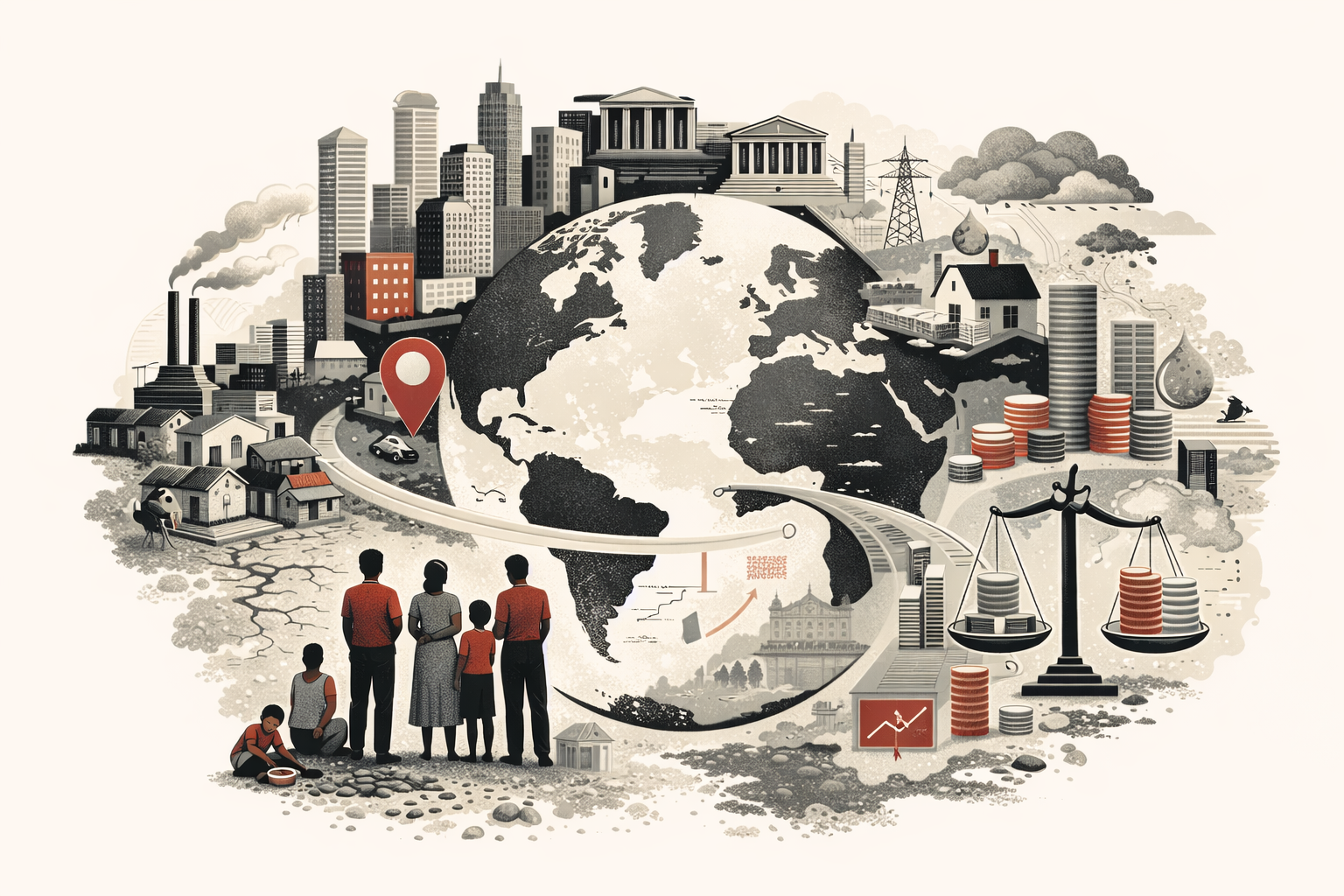
This article argues that development, stewardship, and global inequality must be understood together because development is always shaped by institutional power and unequal interdependence. It examines why development must be judged by more than growth, why global inequality is structural rather than accidental, how stewardship offers a more demanding moral vocabulary than either charity or market fatalism, why poverty must be understood as vulnerability as well as deprivation, how ecological limits reshape development ethics, how debt and financial asymmetry constrain policy space, why technological change can deepen as well as reduce inequality, and why participation matters if development is to be treated as justice rather than benevolent management.
Why This Belongs in Stewardship & Ethics
This article belongs in Stewardship & Ethics because development is not only a technical process of raising income, expanding infrastructure, increasing productivity, or attracting investment. It is a moral question about what kinds of lives societies make possible, whose suffering is treated as preventable, whose vulnerability is normalized, and how the benefits and burdens of global systems are distributed.
Stewardship is often associated with environmental care, but it also concerns the responsible governance of institutions, economies, technologies, public goods, and shared futures. Development systems shape the conditions under which people live, work, learn, migrate, build families, withstand shocks, and participate in social life. They also shape the ecological systems that make those possibilities durable.
Global inequality makes the stewardship question unavoidable. Wealthy societies, creditor institutions, multinational firms, development banks, trade regimes, tax systems, and technology platforms all help structure the conditions under which poorer societies pursue development. These relationships are not ethically neutral. They affect debt burdens, fiscal space, industrial policy, climate vulnerability, labor conditions, technology access, and the ability of states to protect their people.
A stewardship ethic therefore asks a more demanding question than whether aid is generous or whether markets are efficient. It asks whether the systems that organize development are just. It asks whether global institutions widen human capability or reproduce dependence. It asks whether ecological limits are being governed in ways that protect vulnerable people rather than imposing austerity on those least responsible for planetary stress.
Development, stewardship, and global inequality belong together because they name the same underlying ethical problem: how should power be governed in an unequal and interdependent world?
Development Beyond Growth
The reduction of development to economic growth has long been inadequate. Growth matters because poverty cannot be addressed without material capacity, productive opportunity, public revenue, infrastructure, employment, and investment. But growth is not self-interpreting. It does not tell us who benefits, who bears the costs, what is being destroyed, which institutions are strengthened, or whether people gain the substantive freedoms needed to live with dignity.
A society may experience rising output while large portions of its population remain excluded from health, education, political voice, land security, decent work, public safety, or resilience against shock. Growth can coexist with malnutrition, informal labor, extractive land use, environmental degradation, debt pressure, housing insecurity, authoritarian governance, and unequal access to public goods. Aggregate expansion can hide the erosion of the conditions that make development meaningful.
Human development approaches emerged in part as a response to this insufficiency. They argue that development should be understood as the expansion of people’s real freedoms and capabilities rather than as a simple rise in national income. That frame matters because it shifts attention from the size of the economy to the quality of life made possible by social arrangements.
To view development ethically is to ask what social and institutional conditions allow persons to flourish. This includes material sufficiency, but also education, public health, legal standing, security, participation, care, environmental safety, and freedom from avoidable humiliation. It also requires asking whether apparent development depends on hidden forms of extraction, ecological destruction, unpaid care burdens, forced displacement, or labor exploitation.
The ethical standard must therefore be richer than accumulation alone. Development is not simply about enlarging national product. It is about expanding substantive possibility under conditions that remain socially just and ecologically viable.
Once that broader standard is accepted, global inequality can no longer be dismissed as a secondary concern. Inequality shapes whose capabilities expand, whose lives remain precarious, and whose futures are made negotiable in the name of someone else’s progress.
Global Inequality as Structure, Not Accident
Global inequality is often described as though it were simply the unfortunate coexistence of rich and poor countries. That framing is too passive. Inequality is not only a distributional outcome. It is also a structural relationship shaped by trade terms, capital flows, debt burdens, tax regimes, labor hierarchies, technology access, colonial legacies, resource dependence, intellectual-property rules, climate vulnerability, and unequal bargaining power in global institutions.
The organization of the global economy matters because it determines not only who benefits from growth, but whose vulnerability is normalized as a condition of that growth. Cheap labor, resource extraction, unequal exchange, tax avoidance, debt servicing, commodity dependence, and climate exposure are not accidental background features. They are part of the institutional terrain on which development takes place.
This structural view matters ethically because it changes the logic of responsibility. If deprivation were merely local misfortune, affluent actors could imagine themselves as optional helpers. But if inequality is produced and reproduced through shared institutions and cross-border systems, then responsibility becomes more demanding.
Questions of debt, trade, finance, technology transfer, climate loss and damage, corporate power, tax justice, and policy conditionality are not peripheral to development ethics. They are central to understanding how some societies remain exposed to risks they did not create on equal terms and constrained by rules they did not shape from positions of parity.
To describe inequality structurally is not to deny domestic responsibility or internal political failure. Corruption, authoritarianism, weak state capacity, elite capture, discrimination, and poor policy design can all deepen deprivation within countries. But domestic responsibility does not erase global structure. Internal institutional failure often interacts with external constraint.
A serious ethics of global inequality must hold both levels together. It must reject the fiction that global disparities emerge from isolated national effort alone, while also recognizing that domestic institutions matter. Stewardship begins when the relationship between internal capacity and external constraint is treated honestly.
Stewardship and Interdependence
Stewardship provides a more adequate moral vocabulary for global interdependence than either charity or market fatalism.
Charity assumes a vertical relationship in which the powerful may choose to assist the less powerful. It can relieve suffering, and sometimes it is urgently necessary. But charity alone leaves the deeper structure untouched. It asks how the fortunate should help the vulnerable, but not necessarily how systems create vulnerability in the first place.
Market fatalism assumes that inequalities emerging from global systems are simply the neutral consequences of impersonal forces: competition, productivity, efficiency, comparative advantage, investor confidence, or technological change. This frame often treats inequality as unfortunate but inevitable, while obscuring the rules and institutions that make certain outcomes appear natural.
Stewardship rejects both simplifications. It begins from the premise that institutions, resources, systems, and technologies capable of affecting human futures must be governed responsibly, with attention to vulnerability, justice, and long-term consequence.
Under this view, development stewardship involves responsibilities at several levels. National governments are stewards of public goods, social protection, infrastructure, law, public health, education, fiscal systems, and inclusion within their own jurisdictions. But multilateral institutions, creditor states, development banks, corporations, investors, and wealthy societies also exercise stewardship where their decisions influence the policy space, fiscal capacity, ecological burden, and future options of others.
Because the global economy is interdependent, stewardship cannot stop at the border. Where decision-making power extends across borders, ethical responsibility extends with it.
This is what makes stewardship demanding rather than benevolent. It asks not only whether powerful actors provide assistance, but whether they govern the systems they shape in ways compatible with justice. It asks whether institutions expand human agency or merely stabilize unequal arrangements in more efficient form.
Poverty, Vulnerability, and the Moral Weight of Precaution
Poverty is not only low income. It is heightened exposure to shock, reduced capacity to absorb disruption, greater dependence on brittle institutions, and diminished room for meaningful choice. A household, community, or country near subsistence is more vulnerable to inflation, climate events, crop failure, debt distress, conflict, illness, water scarcity, job loss, or energy price spikes than one with buffers and institutional support.
This is why global inequality is not merely about gaps in living standards. It is also about asymmetries of resilience.
Vulnerability matters ethically because shocks are not experienced equally. A drought, flood, price spike, pandemic, debt crisis, currency shock, or food-system disruption may be manageable for actors with savings, insurance, strong public systems, diversified economies, and political voice. The same shock may be devastating for those without buffers. Inequality changes the moral meaning of risk because it determines who can recover and who is pushed into irreversible harm.
Stewardship in this context requires precaution. Precaution does not mean refusing all risk. It means recognizing that when systems are fragile and harms are unevenly distributed, the burden of proof should not be placed entirely on those most exposed. It means protecting those for whom institutional failure, environmental disruption, or economic volatility carries the greatest human cost.
A just development ethic cannot remain indifferent to unequal exposure. It must ask:
- Who bears risk when systems fail?
- Who has buffers and who does not?
- Who can relocate, insure, rebuild, borrow, litigate, or adapt?
- Who is trapped in risk because of poverty, geography, discrimination, or weak public systems?
- Who benefits from arrangements that shift risk elsewhere?
Development stewardship therefore treats vulnerability reduction as a central ethical responsibility. It is not enough to raise averages. Development must reduce the conditions under which people remain one shock away from catastrophe.
Development and the Planetary Condition
No contemporary ethics of development can ignore the planetary condition under which development now unfolds. Climate change, biodiversity loss, land degradation, water stress, pollution, ocean warming, and ecological overshoot are not external to development. They shape food systems, health outcomes, displacement, infrastructure risk, fiscal pressure, housing security, disease burden, and long-term viability.
At the same time, poorer countries and vulnerable populations often face the greatest harms despite having contributed least to the accumulation of many environmental risks. This creates a profound ethical tension. Development remains urgently necessary where deprivation is severe. Yet development pathways modeled on historically carbon-intensive and extractive trajectories are ecologically untenable.
Stewardship therefore requires a double commitment: first, to expand material capabilities and human flourishing where they remain gravely inadequate; second, to do so through pathways that do not reproduce planetary breakdown or simply offload environmental burdens onto poorer regions.
The challenge is not to choose between development and ecology. It is to reject models of development that treat ecological destruction as the price of admission to modernity.
Once environmental stability is recognized as a condition of durable human flourishing, sustainable development becomes not an optional refinement but an ethical necessity. Food security, public health, infrastructure, housing, education, employment, and fiscal stability all depend on ecological systems that cannot be endlessly degraded.
The planetary condition also makes historical responsibility unavoidable. Wealthy industrial economies accumulated prosperity through fossil fuels, colonial extraction, land transformation, resource consumption, and unequal global trade. A just transition cannot demand that poorer societies bear equal burdens for unequal histories. Nor can it justify continued ecological destruction in the name of delayed fairness.
The ethical task is to expand development opportunity while reducing ecological pressure, and to distribute the costs of transition according to responsibility, capacity, need, and justice.
Debt, Finance, and Constrained Policy Space
One of the clearest expressions of structural inequality is the narrowing of policy space through debt stress and financial asymmetry. When governments face high borrowing costs, volatile capital flows, currency instability, external payment pressures, or debt-servicing burdens, their ability to invest in health, education, infrastructure, adaptation, industrial development, and social protection becomes constrained.
Development is then governed not by democratic priority-setting alone, but by the discipline of creditors, markets, credit ratings, conditionality, and external financial vulnerability.
This is ethically consequential because inequality is not only about current outcomes. It is also about unequal control over the future. A state that cannot borrow on fair terms, restructure debt effectively, mobilize public investment, or protect basic services without punitive external constraints does not occupy the same moral and institutional position as one with fiscal space, monetary credibility, and low-cost capital access.
Debt can become a mechanism through which the future is pre-allocated. Public revenue that could fund schools, clinics, climate adaptation, infrastructure maintenance, clean energy, or social protection is redirected toward debt service. Austerity can weaken the very public systems needed for development. Underinvestment deepens vulnerability, which can increase future borrowing needs, creating a cycle of constrained capacity.
This does not mean debt is always illegitimate or that borrowing has no role in development. Public investment often requires finance. The question is whether the financial architecture allows societies to invest in their people and futures on fair and sustainable terms.
Global stewardship therefore includes responsibilities to design financial systems that do not trap vulnerable societies in cycles of austerity, underinvestment, and recurrent crisis. Debt restructuring, concessional finance, climate finance, fair taxation, illicit financial flow prevention, and development-oriented investment are not merely technical reforms. They are ethical questions about whether countries can retain the institutional freedom to pursue just and resilient development.
Trade, Tax, and the Architecture of Global Advantage
Global inequality is also shaped by trade and tax systems. These systems often appear technical, but they help determine which countries capture value, which workers gain protection, which firms accumulate power, and which states possess the revenue required to build public goods.
Trade can support development by expanding markets, increasing specialization, creating employment, and enabling technology diffusion. But trade can also lock countries into low-value commodity dependence, expose workers to precarious global competition, weaken domestic industry, and reproduce unequal bargaining positions. The ethical question is not whether trade is good or bad in the abstract. It is whether trade rules allow societies to build capability, diversify production, protect labor, govern ecological impact, and move up value chains.
Tax systems raise parallel questions. Public revenue is essential for development. Without revenue, states cannot sustain education, health, infrastructure, social protection, courts, environmental protection, public research, or climate adaptation. Yet many poorer countries face weakened revenue capacity because of tax avoidance, profit shifting, extractive contracts, illicit financial flows, narrow tax bases, and unequal bargaining with multinational firms.
A development ethic focused only on aid misses this point. A society may receive development assistance while losing far greater resources through unfair taxation arrangements, profit shifting, debt servicing, or extractive concession structures. Stewardship requires attention to the architecture of value capture: who earns, who pays, who shelters gains, who funds public systems, and who is left without fiscal capacity.
Trade and tax are therefore not peripheral to global inequality. They are part of the institutional machinery through which inequality is reproduced or challenged.
A just development order must give poorer societies more than access to markets. It must give them fair room to build productive capacity, raise public revenue, regulate extraction, protect workers, govern ecological costs, and finance public goods.
Technology, Capacity, and the New Development Divides
Technology is often presented as a solution to development inequality. In many cases, it can expand access, productivity, learning, health delivery, climate monitoring, financial inclusion, agricultural planning, disaster response, and public administration. But technological transformation can also create new divides where infrastructure, electricity access, education, data governance, institutional capacity, and ownership remain highly unequal.
The question is not whether technology matters for development. It is whether the benefits of technological change will be stewarded in ways that broaden human agency rather than deepen dependency or exclusion.
An ethics of global inequality must therefore resist technological solutionism. New tools cannot compensate for absent public institutions, unjust trade structures, exploitative labor arrangements, weak public finance, or ecological depletion. Nor should development be measured by access to digital services alone if underlying distributions of power remain untouched.
Technological development raises several ethical questions:
- Who owns the infrastructure?
- Who controls the data?
- Who captures productivity gains?
- Who sets technical standards?
- Who has the capacity to audit, regulate, repair, and adapt systems?
- Who becomes dependent on external platforms, vendors, or proprietary ecosystems?
- Who is excluded because of language, literacy, disability, electricity access, geography, gender, age, or income?
Stewardship in technological development requires investment in public capability, inclusive infrastructure, governance capacity, local knowledge, open standards where appropriate, and fair distribution of productive opportunity. It also requires protecting societies from new forms of extraction: data extraction, platform dependence, algorithmic control, labor surveillance, and technological lock-in.
Technology can widen possibility, but only where capability and institutional autonomy are being built rather than displaced.
Participation, Voice, and the Politics of Development
Development policy is often discussed in technical language: productivity, growth strategy, institutional reform, climate finance, public investment, governance indicators, service delivery, and risk management. Yet development is also political because it concerns who defines priorities, whose knowledge counts, and whose sacrifices are treated as acceptable.
A society is not genuinely developing in an ethical sense if its future is designed primarily by external actors, national elites, investors, creditors, or technocratic systems that marginalize the perspectives of those most affected by deprivation and risk.
For that reason, stewardship must include participation. Development should not be done to populations as an administrative project. It should be shaped through institutions that allow communities to influence priorities, contest burdens, and contribute situated knowledge about what resilience, dignity, work, care, mobility, and environmental security actually require.
Participation matters for several reasons. It improves knowledge by bringing lived experience into policy design. It strengthens legitimacy by giving affected people a voice in decisions that shape their lives. It reveals hidden harms that distant experts may overlook. It challenges paternalism by treating communities as agents rather than recipients. And it helps ensure that development does not become a project of managing people without listening to them.
This does not eliminate the need for expertise. Public health, climate adaptation, infrastructure, fiscal policy, industrial strategy, and technology governance all require specialized knowledge. But expertise must not become a substitute for democratic standing. Technical design should be accountable to the people whose lives it reorganizes.
Global inequality is perpetuated not only by unequal income, but by unequal voice in determining the terms of development itself. That is why participation is not a decorative democratic ideal within development ethics. It is one of the conditions under which development can be regarded as just rather than paternal.
From Assistance to Justice
One of the recurring weaknesses in international development discourse is the ease with which obligations are recast as benevolence. Assistance matters. Humanitarian aid, development finance, technical support, climate adaptation funding, public health assistance, and disaster relief can save lives and expand capability. But assistance is not the whole moral frame.
Where inequality is historically produced, institutionally reproduced, and environmentally intensified through shared systems, the issue is not only how much aid affluent actors are willing to provide. It is whether the rules of trade, finance, taxation, technology access, climate responsibility, and representation in global governance are just.
This is where the language of stewardship becomes most demanding. It asks whether those with greater power over global systems are exercising that power in ways compatible with human dignity, fair opportunity, and ecological continuity. It asks whether development institutions are enabling substantive freedom or merely managing disorder. It asks whether affluent societies are willing to confront the possibility that their prosperity has been intertwined with arrangements that continue to narrow the life chances of others.
The shift from assistance to justice changes the meaning of responsibility. It moves from generosity to accountability. It asks not only who gives, but who extracts; not only who helps, but who governs; not only who donates, but who benefits from rules that others cannot meaningfully shape.
In this sense, the ethics of global inequality is not about compassion alone. It is about justice in the governance of an unequal world.
Toward an Ethics of Development Stewardship
An adequate ethics of development stewardship begins with several commitments.
First, development must be judged by human flourishing rather than aggregate output alone. Growth matters, but it must be evaluated by whether it expands health, education, security, public goods, freedom, dignity, and ecological safety.
Second, inequality must be understood as structural and relational, not merely statistical. The issue is not only that some have more than others. It is that rules, institutions, and histories often organize advantage and vulnerability in durable ways.
Third, environmental sustainability must be intrinsic to development rather than treated as a later correction. A development pathway that destroys ecological foundations undermines its own moral claim.
Fourth, policy space, fiscal capacity, and institutional resilience must be treated as ethically significant goods. A society cannot pursue development if it lacks the institutional room to invest in its people and future.
Fifth, participation must be taken seriously. People affected by development decisions should help define problems, priorities, risks, trade-offs, and measures of success.
Such an ethic also requires institutional reform. Development banks, multilateral agencies, creditor frameworks, trade regimes, tax systems, climate finance mechanisms, and technology governance arrangements must be assessed not only by efficiency, but by whether they expand fair opportunity and reduce asymmetrical vulnerability.
Wealthier states and firms should be evaluated not only by their own prosperity, but by how their decisions shape the ecological and economic conditions under which others must pursue development.
Stewardship, in this sense, is the disciplined governance of interdependence.
No single institution can resolve global inequality on its own. But ethical seriousness begins when powerful actors cease treating inequality as unfortunate scenery and begin treating it as a problem in the design and governance of the systems they help control.
That is the threshold at which stewardship becomes something more than rhetoric.
Development Stewardship Diagnostic Table
| Development question | Narrow frame | Stewardship & Ethics frame |
|---|---|---|
| What is development? | Growth, output, investment, infrastructure, and productivity. | The expansion of dignity, capability, security, agency, public goods, and ecological viability. |
| What is global inequality? | A gap between rich and poor countries or households. | A structural relationship shaped by history, institutions, trade, finance, debt, technology, climate exposure, and bargaining power. |
| What is poverty? | Low income or consumption below a threshold. | Deprivation, vulnerability, reduced resilience, constrained agency, and exposure to shock. |
| What is stewardship? | Responsible assistance, aid, or benevolent management. | The accountable governance of shared systems, power, resources, risks, and futures. |
| What role does ecology play? | An environmental constraint on development. | A condition of durable human flourishing and a core dimension of justice. |
| What is the debt problem? | A fiscal or macroeconomic management issue. | A constraint on policy space, public investment, institutional capacity, and democratic self-determination. |
| What is the technology question? | How to expand access to innovation and efficiency. | How to build public capability, prevent dependency, govern data, and distribute technological gains fairly. |
| What is participation for? | Consultation, legitimacy, or community buy-in. | Shared authority over priorities, risks, knowledge, design, and the meaning of development itself. |
| What is aid? | Assistance from wealthier actors to poorer societies. | Sometimes necessary, but insufficient without justice in trade, finance, taxation, climate responsibility, and institutional voice. |
| What is the ethical test? | Whether development increases measurable progress. | Whether development expands human possibility while reducing vulnerability, respecting planetary limits, and transforming unjust structures. |
Conclusion: Development, Stewardship, and the Ethics of Global Inequality
Development, stewardship, and global inequality belong together because they address one central question: how should power, resources, ecological risk, and institutional capacity be organized in a world where life chances remain radically unequal yet deeply interconnected?
Development without stewardship risks becoming extraction with better rhetoric. Stewardship without justice risks becoming paternal management of inequality. Concern for inequality without institutional transformation risks becoming moral commentary without consequence.
The ethical task is therefore more demanding. It is to build forms of development that expand human capabilities, reduce structural vulnerability, respect planetary limits, and redistribute not only resources but also voice and institutional possibility.
That task cannot be met by aggregate growth alone. It cannot be met by aid alone. It cannot be met by technology alone. It requires a transformation in how global systems distribute risk, opportunity, ecological space, public capacity, and decision-making power.
The question is no longer whether global inequality is morally significant. It is whether institutions with the power to shape development are prepared to steward that power justly.
A serious development ethic asks whether children inherit possibility rather than deprivation, whether vulnerable societies gain room to build their futures, whether ecological burdens are shared fairly, whether technological change expands agency rather than dependency, and whether global institutions become instruments of justice rather than stabilizers of unequal order.
The measure of development is not only whether the world becomes richer. It is whether the world becomes more livable, more just, more capable, more participatory, and more responsible to those whose futures have too often been decided elsewhere.
Related Reading
- Participation, Voice, and Community-Led Development
- Finance, Disclosure, and Systemic Environmental Risk
- Sustainable Development Goals Within Planetary Boundaries
- Authority and Legitimacy in Institutions
- Risk Governance in Complex Societies
Further Reading
- Sen, A. (1999) Development as Freedom. Oxford: Oxford University Press.
- United Nations (2024) The Sustainable Development Goals Report 2024. New York: United Nations. Available at: https://unstats.un.org/sdgs/report/2024/The-Sustainable-Development-Goals-Report-2024.pdf
- United Nations Conference on Trade and Development (UNCTAD) (2024) Trade and Development Report 2024: Rethinking Development in the Age of Discontent. Geneva: UNCTAD. Available at: https://unctad.org/publication/trade-and-development-report-2024
- United Nations Conference on Trade and Development (UNCTAD) (2024) Inequality: Major Trends, Policy Challenges and the Need for a Global Economic Compact. Geneva: UNCTAD. Available at: https://unctad.org/system/files/official-document/gds2024d1_en.pdf
- United Nations Development Programme (UNDP) (2025) Human Development Report 2025: A Matter of Choice: People and Possibilities in the Age of AI. New York: UNDP. Available at: https://hdr.undp.org/content/human-development-report-2025
- World Bank (2024) Poverty, Prosperity, and Planet Report 2024: Pathways Out of the Polycrisis. Washington, DC: World Bank. Available at: https://www.worldbank.org/en/publication/poverty-prosperity-and-planet
- World Bank (n.d.) Poverty and Inequality Platform. Available at: https://pip.worldbank.org/
- Nussbaum, M.C. (2011) Creating Capabilities: The Human Development Approach. Cambridge, MA: Harvard University Press.
- Piketty, T. (2014) Capital in the Twenty-First Century. Cambridge, MA: Harvard University Press.
References
- Nussbaum, M.C. (2011) Creating Capabilities: The Human Development Approach. Cambridge, MA: Harvard University Press.
- Piketty, T. (2014) Capital in the Twenty-First Century. Cambridge, MA: Harvard University Press.
- Sen, A. (1999) Development as Freedom. Oxford: Oxford University Press.
- United Nations (2024) The Sustainable Development Goals Report 2024. New York: United Nations. Available at: https://unstats.un.org/sdgs/report/2024/The-Sustainable-Development-Goals-Report-2024.pdf
- United Nations Conference on Trade and Development (UNCTAD) (2024) Trade and Development Report 2024: Rethinking Development in the Age of Discontent. Geneva: UNCTAD. Available at: https://unctad.org/publication/trade-and-development-report-2024
- United Nations Conference on Trade and Development (UNCTAD) (2024) Inequality: Major Trends, Policy Challenges and the Need for a Global Economic Compact. Geneva: UNCTAD. Available at: https://unctad.org/system/files/official-document/gds2024d1_en.pdf
- United Nations Development Programme (UNDP) (2025) Human Development Report 2025: A Matter of Choice: People and Possibilities in the Age of AI. New York: UNDP. Available at: https://hdr.undp.org/content/human-development-report-2025
- World Bank (2024) Poverty, Prosperity, and Planet Report 2024: Pathways Out of the Polycrisis. Washington, DC: World Bank. Available at: https://www.worldbank.org/en/publication/poverty-prosperity-and-planet
- World Bank (n.d.) Poverty and Inequality Platform. Available at: https://pip.worldbank.org/