Sustainable Systems

Sustainable systems examine how social, economic, and environmental processes can be organized to support long-term stability and human well-being. Rather than treating environmental protection, economic development, and social equity as separate challenges, sustainable systems research emphasizes their deep interdependence.

The field integrates insights from sustainability science, systems theory, ecological economics, and public policy. Researchers analyze how resource use, technological development, governance structures, and social behavior interact within complex systems.

Designing sustainable systems requires understanding feedback loops, institutional incentives, and long-term environmental constraints. Effective systems must balance efficiency with resilience, innovation with stewardship, and economic opportunity with ecological limits.

By integrating interdisciplinary knowledge, sustainable systems approaches aim to create development pathways that maintain ecological integrity while supporting inclusive and resilient societies.

Painterly illustration of stabilization policy, showing public institutions, fiscal planning, monetary tools, workers, households, cities, factories, balance scales, circular arrows, and economic recovery pathways.

Stabilization Policy: Fiscal and Monetary Tools for Managing Economic Fluctuations

Stabilization policy refers to the fiscal, monetary, and institutional tools used to manage economic fluctuations, support employment, stabilize demand, and prevent recessions from becoming deeper social crises. This article explains how governments and central banks respond when aggregate demand weakens, output falls below potential, unemployment rises, or financial conditions threaten recovery. It examines Keynesian foundations, aggregate demand, fiscal stimulus, automatic stabilizers, monetary policy, exchange rates, credit conditions, policy timing, public debt, inflation risks, and debates over intervention. By connecting stabilization theory with Python, R, Stata, SQL, and Julia research workflows, the article frames stabilization policy as both a macroeconomic toolkit and a public-capacity challenge: the ability of institutions to act quickly, fairly, and credibly when private demand, confidence, and credit break down.
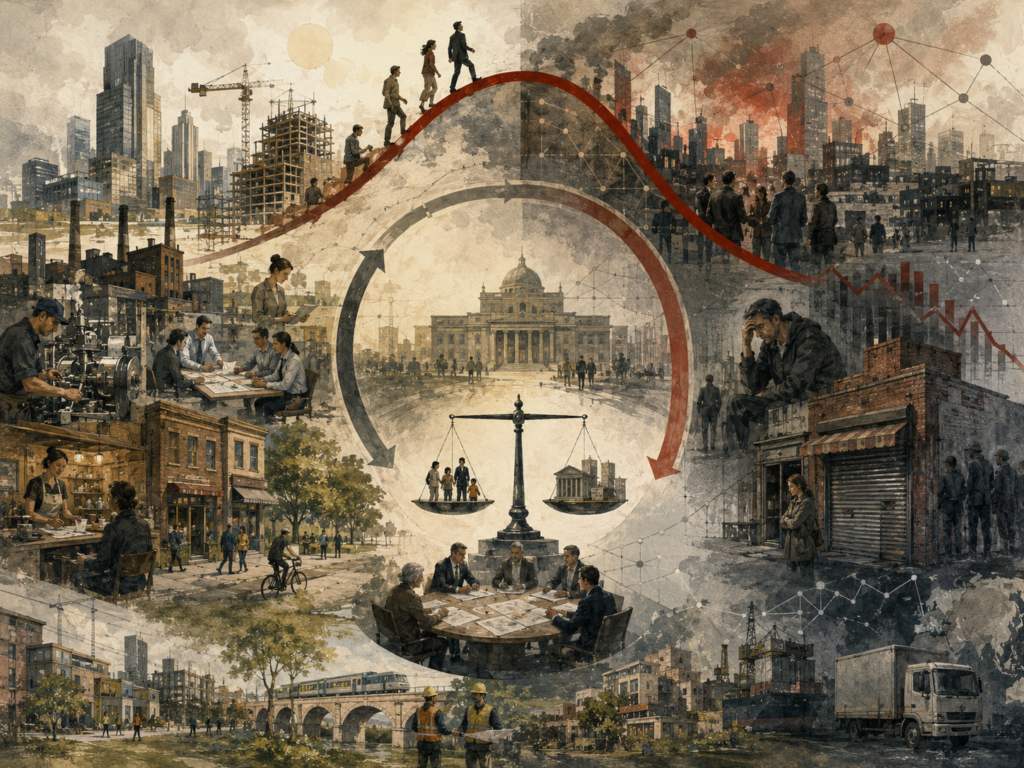
Painterly illustration of business cycles, showing economic expansion, recession, factories, cities, shuttered storefronts, public institutions, policy meetings, workers, households, and cyclical economic pathways.

Business Cycles: Economic Expansions, Recessions, and Macroeconomic Stability

Business cycles describe the recurring movement of economies through expansion, peak, recession, trough, and recovery. This article explains why economic growth rarely follows a smooth path, how short-run fluctuations differ from long-run development, and why downturns can spread through employment, income, credit, investment, production, and public confidence. It examines demand shocks, supply disruptions, expectations, financial cycles, business-cycle dating, stabilization policy, monetary policy, fiscal policy, and economic resilience. By connecting macroeconomic theory with Python, R, Stata, SQL, and Julia research workflows, the article frames business cycles as both measurable economic patterns and institutional stress tests. A resilient economy is not one that avoids every downturn, but one that can absorb shocks, protect households, stabilize demand, preserve productive capacity, and support broad-based recovery.

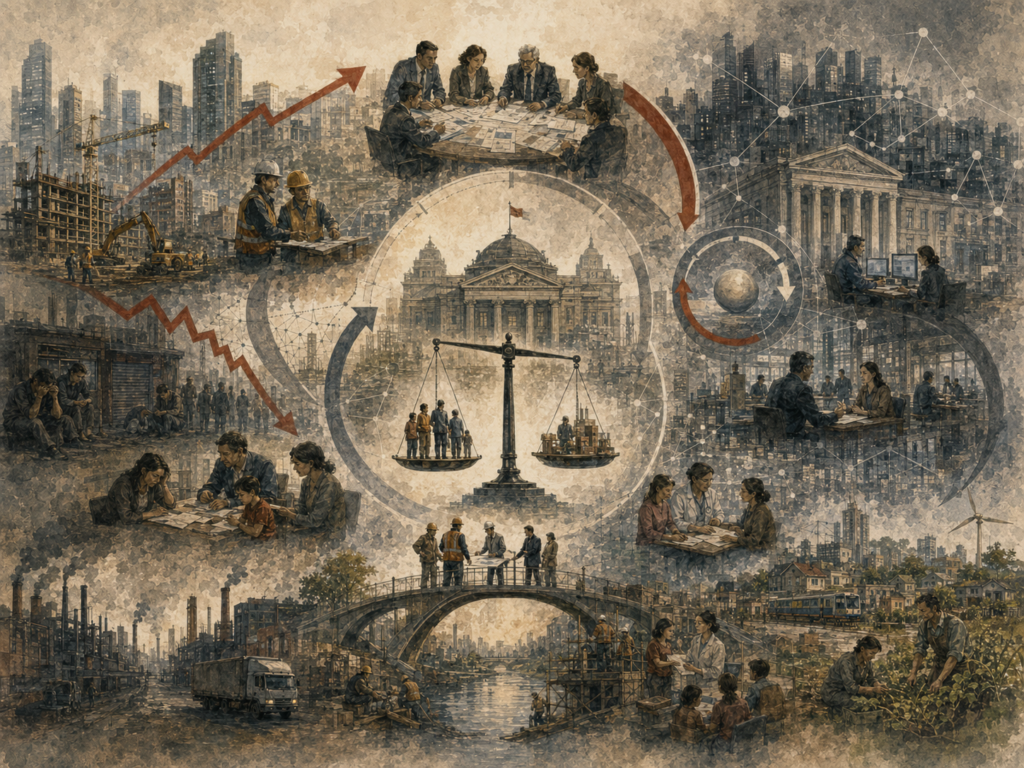
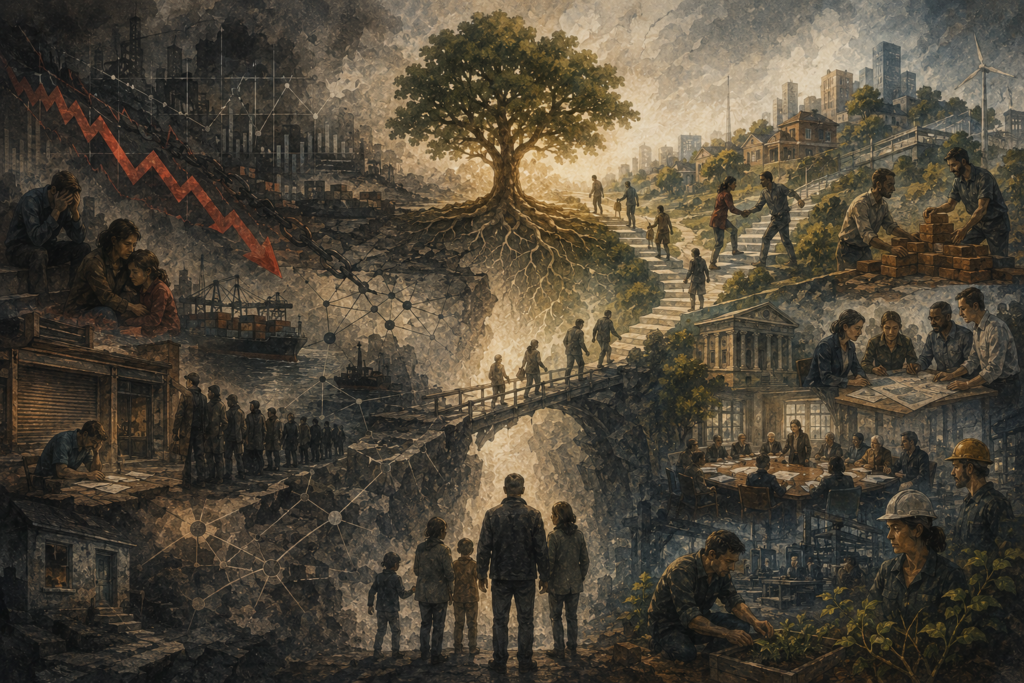
Painterly illustration of economic resilience, showing a divided economic landscape with recession, unemployment, shuttered businesses, broken supply chains, public institutions, rebuilding, worker cooperation, and gradual recovery.

Economic Resilience: Why Recessions Occur and How Economies Recover

Economic resilience explains why recessions occur, why economies can contract even when productive capacity remains intact, and how recovery depends on institutions capable of stabilizing demand, employment, credit, and public confidence. This article examines recessions through Keynesian macroeconomics, aggregate demand, involuntary unemployment, expectations, financial fragility, automatic stabilizers, monetary policy, fiscal policy, and recovery quality. It frames downturns not only as declines in GDP, but as social and institutional stress events that affect workers, households, firms, communities, and public systems unevenly. By connecting recession theory with Python, R, Stata, SQL, and Julia companion workflows, the article introduces economic resilience as both a macroeconomic concept and a practical research framework for measuring shocks, recovery paths, output gaps, unemployment dynamics, and the institutional foundations of durable economic stability.

Technical embedded systems workspace featuring a PYNQ-Z2 FPGA board, STM32 microcontroller board, breadboarded sensors, logic analyzer traces, Linux terminal windows, TinyML inference visualizations, and PYNQ Python code displayed across multiple monitors.

Energy-Efficient Embedded Systems for Sustainable Digital Infrastructure

Energy-Efficient Embedded Systems for Sustainable Digital Infrastructure examines how sustainable digital infrastructure depends on mapping workloads across ultra-low-power MCU endpoints, Linux-capable edge nodes, and adaptive acceleration platforms rather than treating all embedded compute as the same design problem. The article argues that embedded efficiency is best understood as a systems-engineering question about duty-cycling, memory discipline, local inference, power-state control, and lifecycle servicing, since billions of deployed devices turn small per-device inefficiencies into infrastructure-scale energy, maintenance, and material burdens. It explores Cortex-M event-driven design, TinyML on constrained endpoints, Linux CPUFreq and scheduler-aware edge tuning, and PYNQ-based adaptive acceleration, showing that durable digital infrastructure depends on choosing the lightest adequate compute tier and minimizing both active-time energy and long-run maintenance overhead.

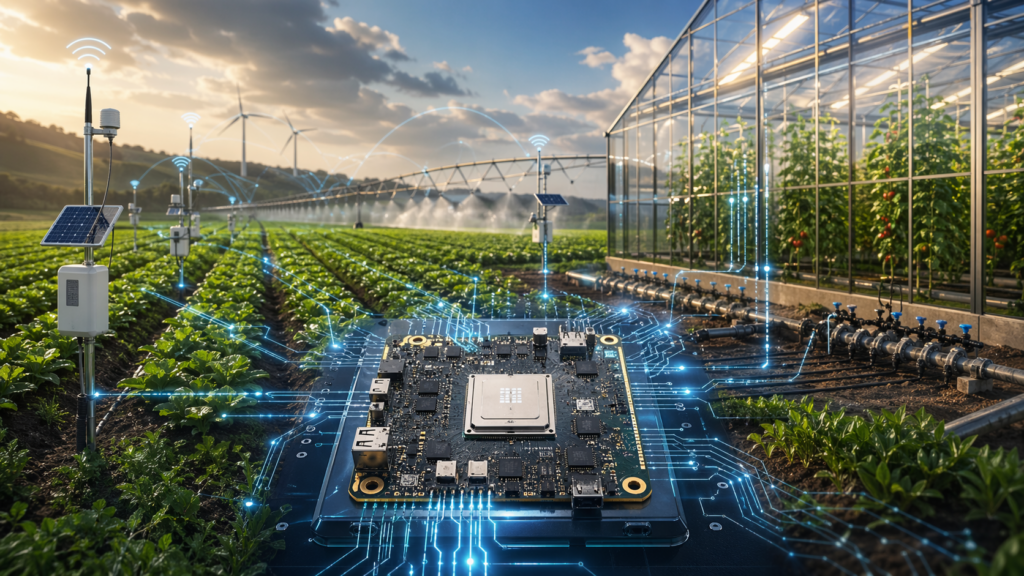
Smart agriculture scene with an FPGA board in the foreground connected visually to field sensors, irrigation infrastructure, solar-powered monitoring stations, and a greenhouse, representing reconfigurable edge hardware for environmental monitoring.

FPGA Environmental Monitoring: Reconfigurable Edge Hardware for Smart Agriculture

FPGA Environmental Monitoring: Reconfigurable Edge Hardware for Smart Agriculture examines how agricultural monitoring becomes more responsive when sensing, filtering, feature extraction, and control logic move into reconfigurable edge hardware rather than remaining entirely dependent on sequential software and cloud backhaul. The article argues that FPGA-based monitoring is most valuable where multiple noisy sensor streams, strict latency requirements, constrained communications, and local actuation needs converge, such as in irrigation control, greenhouse climate systems, pump and pipeline monitoring, and water infrastructure management. It develops the topic through workload structure, platform comparison, sensor front ends, streaming hardware pipelines, fixed-point and timing-closure considerations, Linux and PYNQ gateway integration, lightweight inference, and field verification strategy. Its central claim is that reconfigurable edge hardware can make smart agriculture more deterministic, resilient, and operationally useful under real deployment conditions.

Urban farming infrastructure including rooftop gardens and distributed city food production

Urban Farming Infrastructure: Distributed Food Systems and Urban Resilience

Urban farming infrastructure reframes local food production as a question of resilience, not lifestyle. Community gardens, rooftop greenhouses, hydroponic systems, vacant-lot farms, and peri-urban production cannot replace industrial agriculture or global trade, but they can add distributed capacity to fragile food systems. In an era of climate volatility, supply-chain disruption, food-price instability, and unequal food access, cities need more than efficient long-distance logistics; they need redundancy, proximity, visibility, and neighborhood-level adaptive capacity. This article examines urban farming as civic infrastructure: a measurable layer of food-system resilience connected to land use, water, energy, waste cycling, public health, equity, and governance. It argues that local production is most valuable when designed honestly—not as romantic self-sufficiency, but as practical distributed infrastructure that helps cities absorb shocks.

Rising sea levels increasing coastal flood risk and threatening low-elevation coastal infrastructure

Measuring the Ocean: Why Coastal Flood Risk May Be Higher Than We Think

Coastal flood risk is often framed as a future consequence of sea-level rise, but present-day exposure may already be underestimated when baseline sea-level assumptions are inaccurate. Flood models depend on the relationship between water levels, land elevation, tides, storm surge, vertical datums, infrastructure protection, and local subsidence. When those baselines are wrong, the map of risk changes. This article examines how small measurement errors can produce large differences in flood exposure, especially in low-elevation coastal zones, deltas, ports, island communities, and infrastructure corridors. It connects sea-level measurement to risk governance, environmental monitoring, infrastructure resilience, and planetary-boundaries thinking. The central argument is that coastal adaptation depends not only on projecting future sea-level rise, but on accurately measuring present risk before planning systems, insurance models, and infrastructure investments lock in avoidable vulnerability.

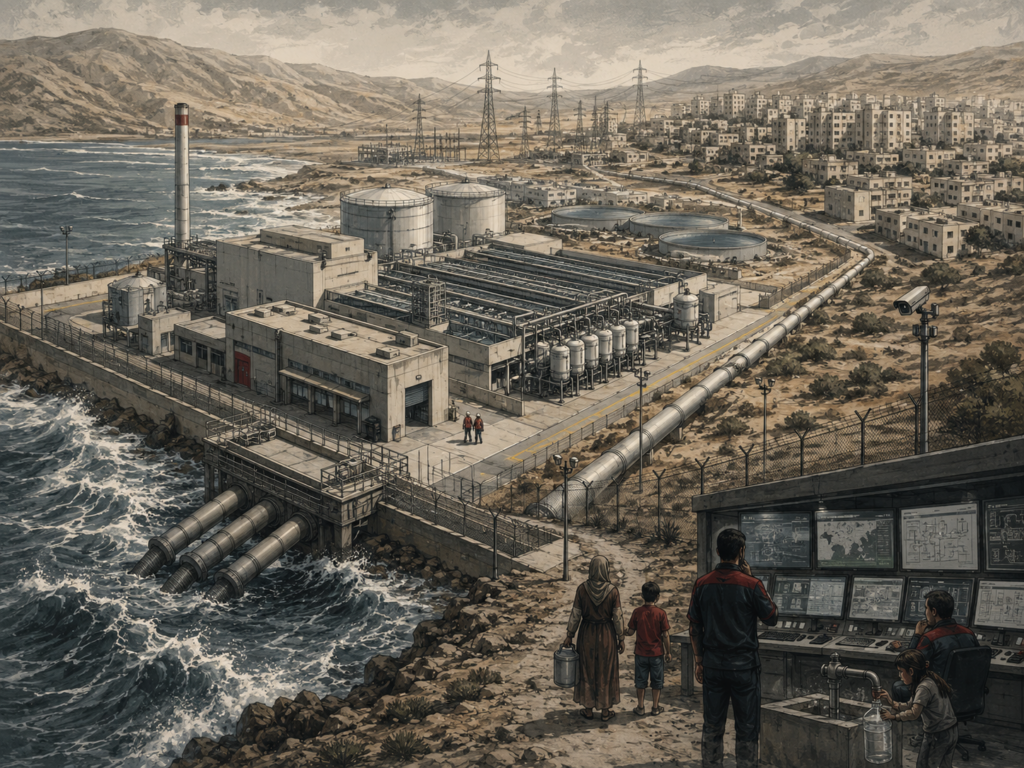
Editorial illustration of a coastal desalination plant with seawater intakes, pipelines, treatment tanks, power lines, security fencing, monitoring systems, nearby communities, and workers overseeing critical water infrastructure.

Water Infrastructure at Risk: The Security Challenge of Desalination Plants

Desalination plant security is becoming a central question for water security, urban resilience, and sustainable development. In arid coastal regions, desalination facilities are no longer secondary infrastructure; they are strategic lifelines that convert seawater into drinking water for millions of people. Yet these systems also concentrate risk. Large plants depend on coastal siting, energy supply, specialized membranes, pumps, digital controls, chemical inputs, skilled operators, and global supply chains. Disruption can cascade through public health, sanitation, hospitals, food systems, and urban stability. This article examines desalination as critical infrastructure, connecting water scarcity, climate stress, energy dependency, cyber and physical security, environmental monitoring, and resilience planning. It argues that desalination can strengthen water security only when cities design for redundancy, storage, accountability, and continuity under disruption.

Landscape associated with Indigenous stewardship traditions and long-term land management practices

Indigenous Stewardship and Relational Land Governance: Lessons for Modern Environmental Systems

Indigenous stewardship and relational land governance challenge modern environmental systems to move beyond ownership, extraction, and technocratic control. This article examines how many Indigenous traditions understand land, water, animals, plants, ancestors, seasons, and future generations through relationships of reciprocity, obligation, memory, law, and care. It argues that sustainability becomes stronger when ecological governance recognizes place-based knowledge, Indigenous sovereignty, biocultural diversity, and long-standing practices of relational responsibility rather than treating land as a passive resource base. Modern environmental systems can learn from these traditions, but only if they avoid romanticization, appropriation, or symbolic inclusion without authority. Indigenous stewardship offers not a nostalgic alternative to science, but a deeper ethical framework for governing living systems through respect, reciprocity, consent, ecological accountability, and responsibility across generations.

Scroll to Top