
Last Updated May 26, 2026
Desalination plant security is becoming central to water security, urban resilience, and sustainable development. In water-scarce coastal regions, desalination facilities are no longer supplementary infrastructure. They are strategic systems whose disruption could affect drinking water access, public health, sanitation, energy systems, supply chains, and urban stability.
Modern cities often assume that water simply arrives. Turn the tap, and it flows. Behind that ordinary expectation sits a complex infrastructure system: reservoirs, aquifers, treatment plants, pumps, pipes, control systems, energy networks, maintenance crews, chemical supply chains, storage tanks, emergency plans, and regulatory institutions. In many arid and semi-arid coastal regions, one of the most important parts of that system is desalination.
Desalination plants convert seawater or brackish water into usable freshwater. For regions facing chronic scarcity, declining groundwater, unreliable rainfall, or climate-amplified drought, desalination can stabilize municipal water supply when conventional freshwater sources are under stress. But this technological achievement creates a new form of dependency. Cities that once depended primarily on watersheds, aquifers, snowpack, or rivers may increasingly depend on coastal industrial facilities, high-pressure pumps, reverse-osmosis membranes, intake systems, power supply, digital controls, and specialized replacement parts.
This shift changes the meaning of water security. Water security is no longer only about the availability of freshwater in nature. It is also about the resilience of infrastructure systems that manufacture reliability under ecological stress. Desalination can reduce exposure to drought, but it can also concentrate essential services into visible, fixed, energy-intensive, supply-chain-dependent facilities. The result is a new resilience problem: water systems may become less dependent on rainfall while becoming more dependent on electricity, cybersecurity, coastal protection, spare parts, skilled operators, and geopolitical stability.
That is why desalination plant security belongs within a broader Risk & Resilience framework. The central issue is not whether desalination is good or bad. The issue is whether cities are building water systems that remain reliable under conditions of climate stress, conflict, infrastructure disruption, cyber risk, energy instability, and ecological uncertainty.
Main Library
Publications
Article Map
Risk & Resilience
Related Topic
Infrastructure Systems
Related Topic
Environmental Monitoring
Related Topic
Planetary Boundaries
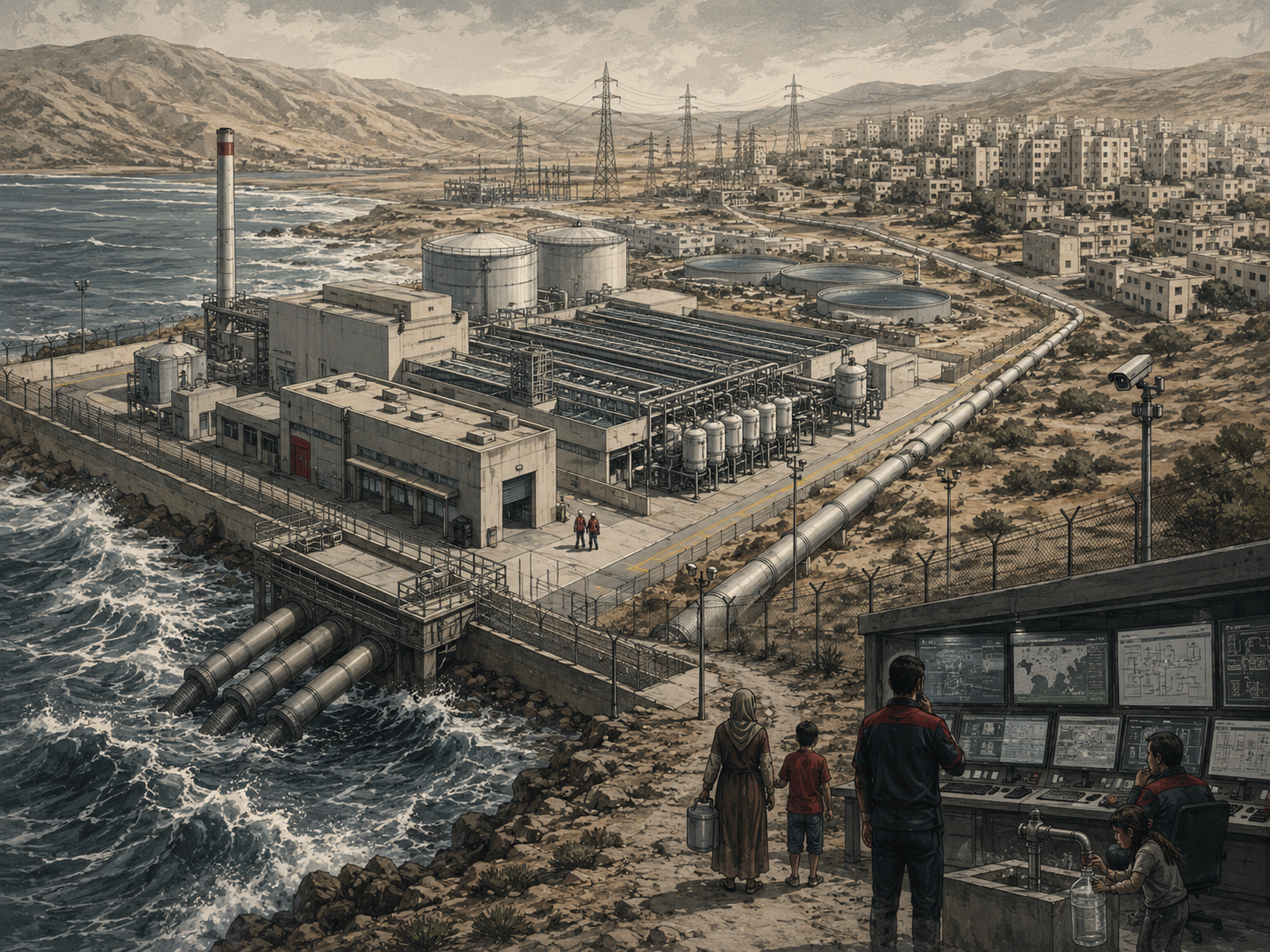
Why Desalination Plant Security Matters
Water infrastructure usually becomes visible only when it fails. Households rarely think about pumps, membranes, pressure vessels, intake structures, pretreatment chemicals, energy contracts, cybersecurity, maintenance cycles, spare parts, or emergency storage. Yet these hidden systems determine whether a city can sustain daily life.
Desalination makes this invisibility more consequential. A reservoir or aquifer can store large volumes of water before treatment and distribution. A desalination plant, by contrast, is a production facility. It continuously converts seawater into freshwater through energy-intensive industrial processes. If the facility stops, the city does not merely lose an asset. It loses a daily production stream.
This makes desalination plant security a matter of continuity. A plant does not have to be permanently destroyed to create serious harm. Temporary shutdowns, intake disruption, membrane damage, power interruption, cyber incidents, chemical shortages, labor shortages, brine-discharge problems, or supply-chain delays can reduce output. If the region has limited storage or few alternative water sources, even a short outage can create pressure on hospitals, households, sanitation systems, food services, industry, and emergency response.
The risk is amplified where desalination supplies a large share of municipal demand. In such systems, the plant functions less like a specialized utility and more like a lifeline. It becomes comparable to an electricity grid, port, airport, wastewater plant, or telecommunications backbone: a system whose failure can cascade across other systems.
Desalination plant security therefore should not be treated as a narrow technical concern. It is a public-resilience issue. The reliability of drinking water increasingly depends on how well societies protect, diversify, monitor, and govern the infrastructure that produces it.
Desalination Infrastructure as the Backbone of Water Security
Desalination has become a central component of water policy in regions where renewable freshwater resources are limited, over-allocated, or increasingly unreliable. Countries across the Middle East and North Africa, along with parts of Australia, Southern Europe, Asia, and North America, have invested in desalination capacity to stabilize supply under conditions of drought, groundwater depletion, population growth, industrial demand, and climate variability.
In some coastal cities, desalination is part of a diversified portfolio that also includes reservoirs, groundwater, wastewater reuse, conservation, stormwater capture, and inter-basin transfers. In other places, desalination is far more central: it supports a large share of domestic drinking water and provides a buffer against hydrological uncertainty.
The infrastructure itself is highly sophisticated. A large seawater reverse-osmosis plant typically depends on:
- marine intake systems that bring seawater into the facility;
- screens, filters, and pretreatment systems that remove suspended material and biological matter;
- high-pressure pumps that push water through membranes;
- reverse-osmosis membranes that separate salts from water;
- energy-recovery devices that reduce operating costs;
- post-treatment systems that stabilize water chemistry for distribution;
- brine-discharge infrastructure that returns concentrated saline waste to the marine environment;
- electrical systems, control rooms, sensors, programmable controllers, and digital operations platforms;
- skilled operators, maintenance staff, laboratory testing, and safety systems.
This complexity is a strength and a vulnerability. It allows cities to transform seawater into drinking water, but it also creates many points where reliability depends on specialized equipment, energy availability, operational knowledge, environmental conditions, and institutional preparedness.
Desalination plants are also capital-intensive. They require large upfront investment, long planning horizons, environmental review, power supply, transmission infrastructure, coastal access, and ongoing maintenance. Once a city depends on such a facility, the plant becomes part of the city’s strategic operating system. It is not merely a water asset. It is a condition of urban continuity.
Infrastructure Optimized for Efficiency Can Become Fragile
Many infrastructure systems are designed around efficiency. Efficiency is important: water should not be wasted, energy costs should be controlled, membranes should operate effectively, pumping should be optimized, and water tariffs should remain affordable. But systems optimized only for efficiency can become fragile when conditions change.
Desalination plants illustrate this tension. Large centralized facilities can produce economies of scale. They may lower unit costs, simplify operations, concentrate expertise, and support predictable water production. But the same scale can also create a single-point dependency. If one major plant supplies a large share of a region’s drinking water, disruption can have systemwide effects.
Efficiency also encourages just-in-time supply chains, lean staffing, narrow redundancy, and dependence on specialized vendors. Those choices may reduce cost under normal conditions, but they can increase exposure during crisis. If replacement membranes, high-pressure pump components, sensors, chemicals, or control-system parts are delayed, the plant’s recovery time may lengthen. If energy supply is disrupted, production may fall sharply. If intake water quality changes suddenly because of algal blooms, oil spills, sediment pulses, or heatwaves, the pretreatment system may be stressed.
This is the classic resilience problem: the system performs well under expected conditions but struggles under disruption. A resilient water system must therefore ask not only how efficiently a plant operates, but how gracefully the system fails, how quickly it recovers, and what alternatives exist when output declines.
| Design priority | Potential benefit | Potential fragility |
|---|---|---|
| Large centralized capacity | Economies of scale, specialized operations, consistent output | Single-point dependency if alternative supply is limited |
| High energy efficiency | Lower operating cost and reduced emissions intensity | High dependence on stable power and specialized energy-recovery equipment |
| Specialized membranes and pumps | Improved water quality and production performance | Long repair timelines if supply chains are disrupted |
| Digital control systems | Better monitoring, automation, and process optimization | Cybersecurity and operational-technology exposure |
| Lean storage buffers | Lower infrastructure cost and reduced storage footprint | Reduced ability to absorb temporary production outages |
The point is not that efficiency is wrong. The point is that efficiency must be balanced with redundancy, modularity, storage, security, and adaptive governance. Water systems should not be designed only for average conditions. They should be designed for disturbance.
The Strategic Geography of Desalination Infrastructure
Desalination plants are geographically constrained. Seawater desalination facilities must be located near coasts because they require access to seawater and brine discharge pathways. That technical requirement creates a strategic geography of exposure.
Coastal infrastructure is fixed, visible, and often clustered with other critical systems. Desalination plants may sit near ports, power plants, industrial zones, shipping lanes, fuel infrastructure, pipelines, wastewater facilities, and major roads. This clustering can create efficiency and shared infrastructure benefits, but it can also concentrate risk. A coastal storm, industrial accident, security incident, cyber event, power outage, or port disruption may affect multiple systems at once.
Coastal location also exposes desalination plants to environmental hazards. Sea-level rise, storm surge, coastal flooding, erosion, marine heatwaves, harmful algal blooms, oil spills, sediment loads, jellyfish blooms, salinity shifts, and pollution events can all affect operations. A plant designed for historical coastal conditions may face increasing stress as climate change alters marine and coastal environments.
The geography of desalination also matters geopolitically. Many of the regions most dependent on desalination are located in arid coastal zones where water scarcity, energy systems, maritime chokepoints, and geopolitical tensions intersect. The security of desalination infrastructure may therefore be tied to regional stability, maritime security, electricity reliability, and cross-border supply chains.
Desalination plants are not easily moved. Once built, they become anchored assets. Their exposure must be managed in place through protective design, diversified supply, emergency storage, monitoring, operational resilience, and regional water planning.
Climate Stress and the Expansion of Desalination
The strategic importance of desalination is growing because climate change is altering the reliability of traditional freshwater sources. Snowpack is changing in many mountain regions. Rainfall patterns are becoming less predictable. Droughts can intensify under higher temperatures because evaporation and atmospheric water demand increase. Groundwater is being depleted in many agricultural and urban regions. Rivers are over-allocated in several basins. Water quality is deteriorating in some systems because of salinity, pollution, nutrient loads, and reduced flows.
Under these conditions, desalination can appear attractive because seawater is abundant and drought-resistant. A desalination plant can continue producing water even when rainfall is low. It can reduce pressure on aquifers, buffer cities against drought, and provide a more predictable source of supply than climate-sensitive surface water.
But desalination does not eliminate environmental limits. It changes the form of dependency. Instead of relying primarily on local freshwater renewal, cities rely on industrial conversion. That conversion requires energy, materials, membranes, chemicals, marine intake systems, brine management, and technical expertise. Desalination can reduce one kind of scarcity while creating or intensifying other kinds of risk.
This is why desalination should be understood as part of a broader water-resilience portfolio. It can be valuable, especially where scarcity is severe, but it should not become an excuse to ignore conservation, leakage reduction, wastewater reuse, groundwater recharge, watershed protection, demand management, or equitable allocation. A city that adds desalination without addressing wasteful consumption may increase supply while leaving the underlying system fragile.
The long-term challenge is not simply to produce more water. It is to design water systems that remain secure, affordable, ecologically responsible, and resilient under climate stress.
The Water-Energy Nexus
Desalination sits directly inside the water-energy nexus. Producing freshwater from seawater requires energy, especially when reverse-osmosis membranes must overcome osmotic pressure. Energy-recovery devices and improved membrane technologies have reduced energy intensity, but desalination remains more energy-intensive than many conventional freshwater sources.
This creates a bidirectional dependency. Water systems need energy to produce, treat, pump, and distribute water. Energy systems often need water for cooling, fuel production, industrial processing, and operations. When desalination becomes central to urban water supply, water security becomes more directly linked to electricity reliability.
A power outage can reduce water production. A fuel disruption can affect electricity generation. A cyber incident in the power sector can cascade into the water sector. Extreme heat can increase electricity demand while also increasing water demand. Coastal storms can damage both power and desalination assets. In such conditions, desalination plant security cannot be separated from energy resilience.
Renewable energy integration can reduce emissions and fuel dependency, but it introduces its own planning questions. Solar and wind resources vary over time. Desalination plants require reliable production schedules. Storage, grid integration, hybrid systems, demand management, and water-storage buffers become essential if renewable power is used at scale.
A resilient desalination strategy should therefore ask:
- How much backup power is available during grid disruption?
- How long can the plant operate under emergency conditions?
- How much treated-water storage exists if production falls?
- Can operations be reduced without compromising priority users?
- Are renewable energy and storage systems integrated into resilience planning?
- Are water and energy emergency plans coordinated across agencies?
Water resilience and energy resilience are no longer separate planning domains. In desalination-dependent regions, they are the same problem seen from different sides.
Infrastructure Resilience and the Problem of Centralization
Large desalination plants can provide substantial and reliable water volumes, but centralization creates systemic exposure. If a region depends heavily on one or two large facilities, the failure of a single asset can affect the entire water system. This is especially concerning where storage capacity is limited or alternative sources are already stressed.
Centralization is not inherently wrong. Many infrastructure systems require centralized assets: airports, ports, power plants, treatment facilities, data centers, and hospitals. But centralization requires protective planning. A centralized system without redundancy is efficient only until it fails.
Water resilience depends on portfolio design. A desalination-dependent region can reduce vulnerability by combining large plants with smaller distributed systems, wastewater reuse, aquifer storage and recovery, emergency interconnections, demand-response plans, leakage reduction, strategic reserves, and regional water-sharing agreements. The goal is not to eliminate desalination, but to prevent it from becoming an unsupported single point of failure.
| Resilience strategy | How it reduces risk | Key governance question |
|---|---|---|
| Water-source diversification | Reduces dependence on any one plant, aquifer, reservoir, or transfer system | Are supply portfolios evaluated under drought, outage, and demand-surge scenarios? |
| Distributed capacity | Limits systemwide consequences of localized disruption | Which neighborhoods or critical facilities require backup production? |
| Emergency storage | Provides time to respond when production falls | How many days of priority water demand can be covered? |
| Regional interconnection | Allows water sharing across systems during disruption | Are agreements, pipes, pumps, and legal rules already in place before crisis? |
| Wastewater reuse | Creates a drought-resistant non-seawater source for nonpotable or potable reuse | Are reuse standards, public trust, and treatment systems adequate? |
| Demand management | Reduces pressure on production systems during scarcity | Are emergency restrictions equitable and enforceable? |
The resilience question is not simply whether a desalination plant can operate efficiently. It is whether the water system can continue serving essential needs when the plant cannot operate at full capacity.
Cascading Risk Across Urban Systems
Water disruption rarely remains confined to water. It cascades. If a desalination plant fails and treated-water reserves fall, households lose access, hospitals face operational stress, schools and workplaces may close, sanitation systems become strained, firefighting capacity may decline, food services may be disrupted, and public confidence can deteriorate. If the disruption is prolonged, economic activity can slow and emergency governance becomes more difficult.
Cascading risk is especially important in dense coastal cities. Urban systems are interdependent. Water depends on power. Power may depend on cooling, fuel logistics, or coastal infrastructure. Hospitals depend on water and electricity. Ports depend on transport and communications. Emergency response depends on roads, fuel, communications, and public order. A failure in one system can weaken others.
Desalination plants can also create environmental cascading risks if disruption affects brine management, chemical storage, intake operations, or adjacent industrial facilities. Coastal sites may be located near sensitive marine habitats, fisheries, ports, or industrial corridors. Resilience planning should therefore include environmental protection, not only service continuity.
A cascading-risk lens asks different questions than ordinary asset management:
- Which services fail first if desalination output drops by 25, 50, or 75 percent?
- Which communities have the least household storage or alternative access?
- Which hospitals, clinics, schools, shelters, and care facilities are most exposed?
- How does a water outage affect sanitation and public health?
- What happens if a water disruption coincides with a heatwave, power outage, cyber incident, or coastal storm?
- Which agencies are responsible for communicating risk and coordinating response?
The point of resilience planning is to identify these interdependencies before disruption, not after.
Physical, Digital, Operational, and Supply-Chain Security
Desalination plant security has multiple dimensions. It should not be reduced to physical protection alone. A plant is a physical facility, but it is also a digital system, an energy-dependent system, a supply-chain node, an environmental interface, and an operational organization.
Physical security concerns the protection of buildings, intake systems, pumping stations, chemical storage areas, control rooms, transmission links, and distribution connections. Because desalination plants are coastal and fixed, they require site protection, access control, emergency response planning, and coordination with local authorities.
Digital and operational-technology security concerns the control systems that monitor and operate pumps, valves, membranes, chemical dosing, pressure systems, alarms, water quality, and distribution interfaces. Digital monitoring improves performance, but it also requires cybersecurity governance, segmentation, backup procedures, incident response, and staff training.
Supply-chain security concerns membranes, pumps, sensors, chemicals, energy-recovery devices, spare parts, software, specialized contractors, and maintenance expertise. A facility may be physically intact but still unable to recover quickly if key components are unavailable.
Operational security concerns staffing, maintenance cycles, water-quality testing, emergency procedures, mutual-aid agreements, spare-parts inventories, contingency operations, and institutional learning. A technically advanced facility can still be fragile if operational practices are underfunded or poorly coordinated.
These dimensions should be treated as layers. No single protective measure is sufficient. A resilient desalination system requires overlapping safeguards that protect production, recovery, and public service continuity.
| Security layer | Core concern | Resilience-oriented response |
|---|---|---|
| Physical | Facility damage, access disruption, coastal hazard exposure | Site protection, emergency access, flood hardening, protective design, response coordination |
| Digital | Control-system disruption, data integrity, remote operations risk | Cybersecurity governance, monitoring, backups, segmentation, training, incident response |
| Energy | Power interruption or fuel disruption | Backup generation, renewable integration, storage, grid coordination, priority restoration |
| Supply chain | Delayed replacement parts, membrane shortages, chemical supply interruptions | Strategic inventories, diversified suppliers, maintenance planning, procurement resilience |
| Operational | Staffing, procedures, testing, emergency readiness | Training, drills, mutual aid, clear escalation rules, continuity planning |
| Environmental | Algal blooms, spills, salinity shifts, intake water quality, brine impacts | Water-quality monitoring, adaptive pretreatment, environmental safeguards, ecosystem review |
Security is not a bunker mentality. It is the disciplined design of continuity.
A Mathematical Lens: Dependency, Redundancy, and Service Continuity
A simple way to understand desalination resilience is to compare essential demand with available supply under disruption. A city remains service-stable when available water from desalination, storage, alternative sources, emergency transfers, and demand reduction can meet priority demand.
S_t = D_t + A_t + R_t + E_t – L_t
\]
Interpretation: Available supply \(S_t\) at time \(t\) can be represented as desalination output \(D_t\), alternative supply \(A_t\), stored reserves \(R_t\), and emergency transfers \(E_t\), minus system losses \(L_t\). A water system becomes fragile when this total approaches or falls below priority demand.
Priority demand can be represented as the water needed to sustain households, hospitals, sanitation, emergency services, essential industry, and critical public functions during disruption.
S_t \geq P_t
\]
Interpretation: Service continuity requires available supply \(S_t\) to remain greater than or equal to priority demand \(P_t\). When \(S_t < P_t\), emergency allocation, demand restrictions, water trucking, pressure reduction, or service interruptions may become necessary.
Desalination dependency can also be represented as a share of total reliable supply:
\delta = \frac{D}{D + A + R + E}
\]
Interpretation: The dependency ratio \( \delta \) represents the share of available supply provided by desalination. A higher value indicates greater reliance on desalination infrastructure. High dependency is not inherently unsafe, but it requires stronger redundancy, storage, protection, and recovery planning.
The resilience problem becomes clearer when a plant outage reduces desalination output:
S_{outage} = (1-\alpha)D + A + R + E – L
\]
Interpretation: During disruption, \( \alpha \) represents the fraction of desalination output lost. If alternative supply, reserves, and emergency transfers cannot compensate for the lost output, the system may fail to meet priority demand.
These equations are simplified, but they capture the core logic. A resilient desalination-dependent water system is not defined only by how much water a plant can produce on a normal day. It is defined by what happens when production falls.
Environmental Monitoring and Operational Intelligence
Desalination plant security depends on environmental monitoring as well as physical and digital protection. Because plants draw water from the marine environment, their operations are shaped by coastal conditions. Intake water quality, turbidity, biological activity, salinity, temperature, pollution, algal blooms, oil spills, sediment movement, and storm conditions can all affect production.
Monitoring systems help operators detect problems before they become outages. Sensors, sampling programs, satellite data, coastal observations, weather forecasts, marine alerts, and operational dashboards can support early warning. If an algal bloom is forming, a spill is moving toward an intake, or turbidity is rising after a storm, operators may adjust pretreatment, reduce intake, shift production schedules, or coordinate with regional agencies.
Environmental monitoring also supports accountability. Desalination can affect marine systems through intake impacts, brine discharge, chemical use, and energy-related emissions. Responsible desalination planning should therefore monitor not only production reliability, but ecological effects. A plant that secures urban water by degrading marine ecosystems may solve one problem while creating another.
A serious monitoring framework should track:
- intake water quality, turbidity, salinity, and temperature;
- harmful algal blooms and biological fouling risk;
- marine pollution events and oil-spill exposure;
- membrane performance, pressure, and energy use;
- brine discharge concentration and dispersion;
- nearshore ecosystem indicators;
- plant output, downtime, and maintenance events;
- storage levels and emergency reserve status;
- power reliability and backup system readiness;
- cyber and operational-technology alerts.
Monitoring does not guarantee resilience, but it makes resilience governable. What cannot be seen cannot be managed in time.
Planetary Boundaries, Hydrological Limits, and Manufactured Freshwater
Desalination is often framed as a technological solution to freshwater scarcity. That framing is partly accurate, but it can become misleading if it suggests that technology removes hydrological limits altogether. Desalination can expand usable supply, but it does not abolish planetary constraints.
Freshwater change, climate change, land-system change, biosphere integrity, ocean conditions, and energy systems remain connected. Desalination may reduce pressure on rivers or aquifers, but it requires energy and coastal infrastructure. If powered by fossil fuels, it can contribute indirectly to climate pressures. If brine discharge is poorly managed, it can affect marine environments. If desalination enables unlimited demand growth without conservation, it may delay deeper reforms in water governance.
From a planetary-boundaries perspective, desalination should be evaluated as part of a larger system. It may help societies adapt to freshwater stress, but it should be integrated with demand reduction, leakage control, wastewater reuse, aquifer protection, watershed restoration, and equitable allocation. Manufactured freshwater is not a license to ignore ecological limits. It is a tool that must operate within them.
This is especially important for sustainable development. A desalination plant can support urban growth, but if that growth depends on high energy use, weak marine safeguards, centralized vulnerability, or unaffordable tariffs, the system may become socially or ecologically fragile. A sustainable desalination strategy must therefore ask not only whether water can be produced, but whether the full water-energy-ecology-governance system remains durable.
The goal is not to reject desalination. In many regions, it will be necessary. The goal is to prevent desalination from becoming a technological substitute for resilient water governance.
Governance, Public Accountability, and Strategic Water Planning
Desalination plant security is a governance issue because the consequences of failure are public. Drinking water is not an ordinary commodity. It is a basic condition of health, dignity, sanitation, economic life, and public order. When a desalination-dependent water system becomes fragile, the risk is carried by households, workers, hospitals, schools, small businesses, and vulnerable communities.
Governance determines whether desalination is integrated into a resilient water portfolio or treated as a silver bullet. It determines whether utilities maintain adequate reserves, whether emergency plans are transparent, whether tariffs remain affordable, whether marine impacts are monitored, whether cyber protections are funded, whether alternative sources are preserved, and whether public agencies coordinate across water, energy, health, security, and environmental systems.
Several governance principles follow:
- Plan for portfolio resilience, not plant output alone. Desalination capacity should be evaluated alongside conservation, storage, reuse, groundwater, emergency transfer, and demand-management options.
- Make dependency visible. Public water planning should identify how much essential demand depends on each facility and how long reserves can last under outage scenarios.
- Integrate water and energy planning. Desalination-dependent regions need coordinated planning for power reliability, backup energy, emissions, and grid resilience.
- Protect operational technology. Digital control systems require cybersecurity governance, staff training, backups, incident response, and regular review.
- Design for environmental accountability. Intake and brine systems should be monitored to protect marine ecosystems and public trust.
- Prioritize vulnerable users. Emergency water plans should identify hospitals, care facilities, low-income households, informal settlements, and communities with limited storage or mobility.
- Use public-interest procurement. Long-term contracts should include resilience, transparency, maintenance, and continuity requirements, not only cost and capacity metrics.
The legitimacy of desalination infrastructure depends on public trust. People need confidence not only that water will arrive, but that the system is secure, accountable, affordable, and environmentally responsible.
Designing Future Desalination Systems for Resilience
The next generation of desalination systems should be designed for resilience from the beginning. Retrofitting resilience after dependency has already formed is more expensive, more politically difficult, and less reliable than embedding resilience into planning, procurement, siting, design, and governance.
Future desalination resilience may include:
- Modular plant design so that partial failures do not shut down entire production systems.
- Distributed desalination capacity where smaller facilities complement large centralized plants.
- Strategic treated-water storage sized for realistic outage and repair scenarios.
- Renewable energy integration with storage or backup systems to reduce fuel and grid dependency.
- Hardened coastal siting that accounts for sea-level rise, storm surge, flooding, erosion, and access routes.
- Cyber-resilient control systems with documented recovery procedures and offline operating capacity where appropriate.
- Spare-parts and membrane inventories designed around supply-chain disruption scenarios.
- Integrated environmental monitoring for intake risk, brine discharge, marine ecosystems, and coastal hazards.
- Emergency demand-management protocols that protect priority users and distribute burdens fairly.
- Regional interconnection so cities are not isolated when one facility fails.
These measures may increase upfront cost. But resilience is often cheaper before failure than after it. A city that underinvests in water-system resilience may save money on paper while accumulating hidden exposure. The cost appears later as emergency response, public health risk, economic disruption, loss of trust, and rushed infrastructure spending.
Designing for resilience means accepting that disruption is not an anomaly. It is part of the operating environment.
GitHub Repository
The companion repository for this article can support reproducible water-infrastructure resilience workflows, desalination dependency analysis, outage-scenario modeling, emergency-storage calculations, and transparent documentation of how centralized water assets shape urban risk.
Complete Code Repository
This repository provides a companion technical workspace for desalination plant security and water-infrastructure resilience analysis, including synthetic data, dependency ratios, service-continuity scenarios, outage stress tests, emergency storage calculations, and reproducible Python, R, SQL, and systems-code examples for examining critical water infrastructure risk.
Water Infrastructure and Urban Stability
Desalination technology has allowed many regions to reduce water scarcity, support urban growth, and stabilize supply under drought conditions. In a warming world, its role is likely to grow. But the expansion of desalination also changes the structure of risk.
A city that depends heavily on desalination is not simply more water-secure. It is secure only if the desalination system is protected, powered, maintained, monitored, governed, and backed by alternatives. Without redundancy, storage, emergency planning, environmental safeguards, and public accountability, desalination can become a fragile lifeline.
The broader lesson is that sustainability is not only about building new infrastructure. It is about ensuring that essential systems remain reliable under stress. Water systems must be able to absorb shocks, recover from disruption, protect vulnerable people, preserve ecosystems, and maintain public trust.
Desalination plant security therefore represents more than a technical concern. It is a central challenge of sustainable development, infrastructure resilience, climate adaptation, and urban governance in the twenty-first century. The stability of cities—and the wellbeing of millions of residents—may increasingly depend on the resilience of infrastructure located quietly along the world’s coastlines.
Related articles
- Food, Fragility, and the City
- Coastal Flood Risk and Infrastructure Planning
- Urban Farming Infrastructure
- Risk & Resilience
- Intelligent Infrastructure Systems
- Environmental Monitoring Systems
Further reading
- UN-Water. Water Scarcity.
- World Bank. Governance and Economics of Desalination and Reuse.
- World Bank. Water.
- International Energy Agency. Water-Energy Nexus.
- International Desalination and Reuse Association. Desalination and Water Reuse Resources.
- UNEP. Options for Decoupling Economic Growth from Water Use and Water Pollution.
References
- International Desalination and Reuse Association. Desalination and Water Reuse Resources.
- International Energy Agency. Water-Energy Nexus.
- UN-Water. Water Scarcity.
- World Bank. Governance and Economics of Desalination and Reuse.
- World Bank. Water Overview and Resources.