Sustainable Systems

Sustainable systems examine how social, economic, and environmental processes can be organized to support long-term stability and human well-being. Rather than treating environmental protection, economic development, and social equity as separate challenges, sustainable systems research emphasizes their deep interdependence.

The field integrates insights from sustainability science, systems theory, ecological economics, and public policy. Researchers analyze how resource use, technological development, governance structures, and social behavior interact within complex systems.

Designing sustainable systems requires understanding feedback loops, institutional incentives, and long-term environmental constraints. Effective systems must balance efficiency with resilience, innovation with stewardship, and economic opportunity with ecological limits.

By integrating interdisciplinary knowledge, sustainable systems approaches aim to create development pathways that maintain ecological integrity while supporting inclusive and resilient societies.

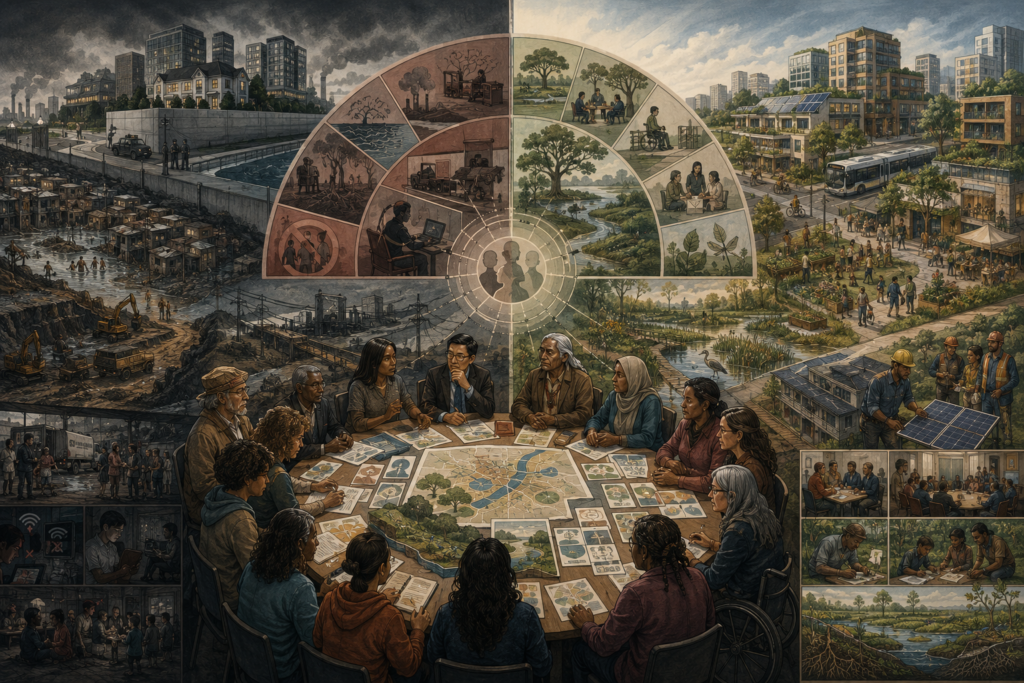
Editorial systems illustration showing a diverse group around a strategy table comparing unjust resilience with ethical transformation across housing, infrastructure, ecology, public services, and community participation.

Resilience, Justice, and the Ethics of Transformation

Resilience, justice, and the ethics of transformation belong together because resilience is never morally neutral. Every resilience strategy protects something, prioritizes someone, distributes risk, and shapes the future. This article examines why resilience cannot be judged only by recovery, adaptation, continuity, or technical performance. It must also be judged by who is protected, who bears burdens, whose knowledge counts, who participates in decisions, and whether transformation repairs vulnerability or preserves unjust systems under new language. It explores distributive justice, procedural justice, recognition, rights, maladaptation, harm-shifting, intergenerational responsibility, ecological justice, and public accountability. The article argues that genuine resilience must do more than help systems endure disruption. It must transform the conditions that produce unequal exposure, exclusion, ecological harm, and institutional mistrust in the first place.
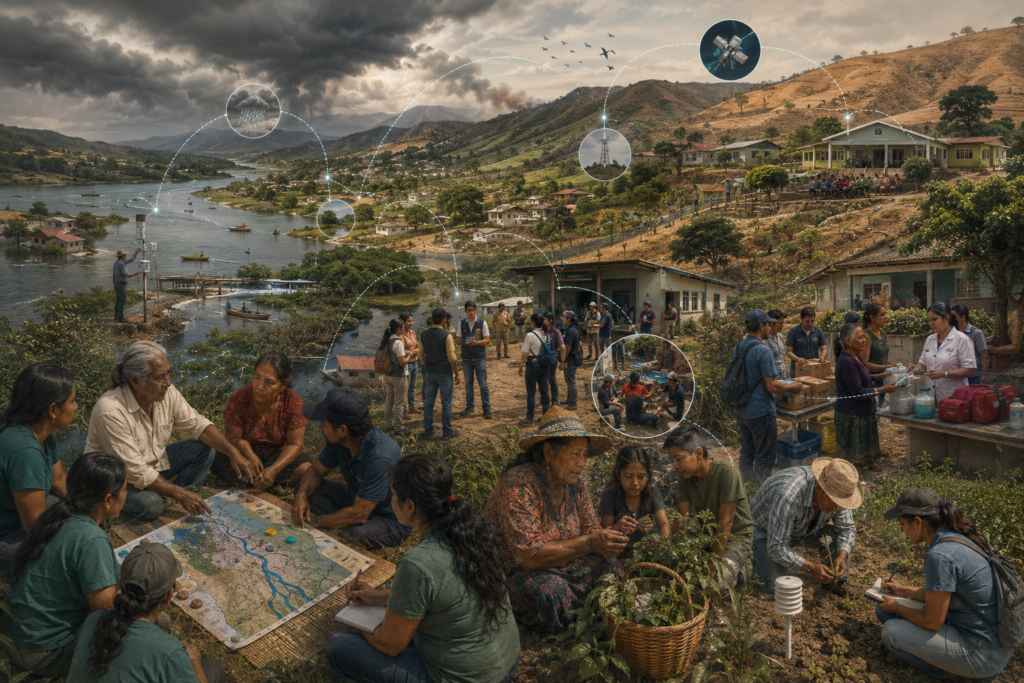
Editorial illustration showing a riverine rural community using local knowledge, intergenerational learning, environmental observation, mutual aid, and collaborative planning to strengthen resilience under environmental stress.

Community Resilience, Trust, and Local Capacity

Community resilience, trust, and local capacity belong together because resilience is not only built through infrastructure, emergency planning, or national policy. It is also built through relationships, local organizations, lived experience, practical knowledge, mutual aid, communication networks, public trust, and the ability of communities to act before, during, and after disruption. This article explains why resilience must be co-produced with communities rather than delivered to them as a finished product. It examines trust as resilience infrastructure, local capacity, mutual aid, Indigenous and place-based knowledge, early warning, inclusive participation, institutional follow-through, and the limits of romanticizing local resilience. Durable resilience requires public investment, shared authority, accessible communication, community knowledge, and institutions that keep their promises before crisis arrives.

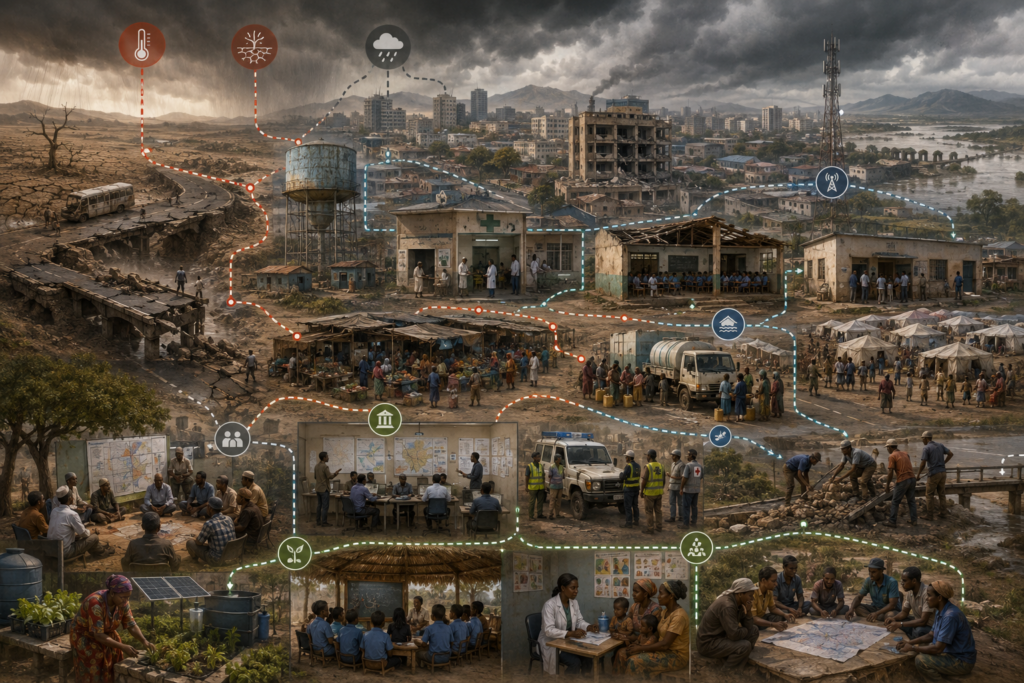
Editorial illustration showing a conflict-affected urban and rural landscape with damaged infrastructure, strained services, displacement shelters, community coordination, and local recovery efforts under climate stress.

Conflict, Fragility, and Resilience Under Stress

Conflict, fragility, and resilience under stress belong together because violent conflict is rarely only a security problem, and fragility is rarely only institutional weakness. Conflict degrades the public systems needed to manage risk, while fragility emerges where exposure to risk exceeds the capacity of states, communities, institutions, and social systems to manage, absorb, or mitigate those risks. This article explains how conflict, weak governance, service disruption, displacement, livelihood stress, climate exposure, public distrust, and institutional exclusion can reinforce one another and produce cascading system breakdown. It also examines service continuity, legitimacy, local governance, hybrid authority, displacement, early warning, anticipatory action, and resilience under fragile conditions. Durable resilience requires legitimate governance, trusted institutions, inclusive recovery, social protection, livelihood support, and the protection of essential services under stress.

Editorial illustration showing climate hazards, exposed communities, infrastructure stress, displacement pressure, ecological buffers, and planners coordinating adaptive mobility and resilience.

Migration, Displacement, and Resilience

Migration and displacement reveal whether people have real choices under stress. This article distinguishes mobility as adaptive capacity from displacement as a sign that protection has failed. Migration can strengthen resilience when people move safely, legally, and with support, using mobility to access work, education, networks, remittances, safety, or planned relocation. Displacement, by contrast, often reflects conflict, climate stress, disasters, livelihood collapse, weak services, or systemic fragility. The article argues that resilience is not measured by whether people stay in place, but by whether they can remain safely, move safely, return, integrate, or rebuild with dignity. It also examines trapped populations, host-community capacity, rights-based protection, and mobility systems that connect adaptation, social protection, public services, and justice.

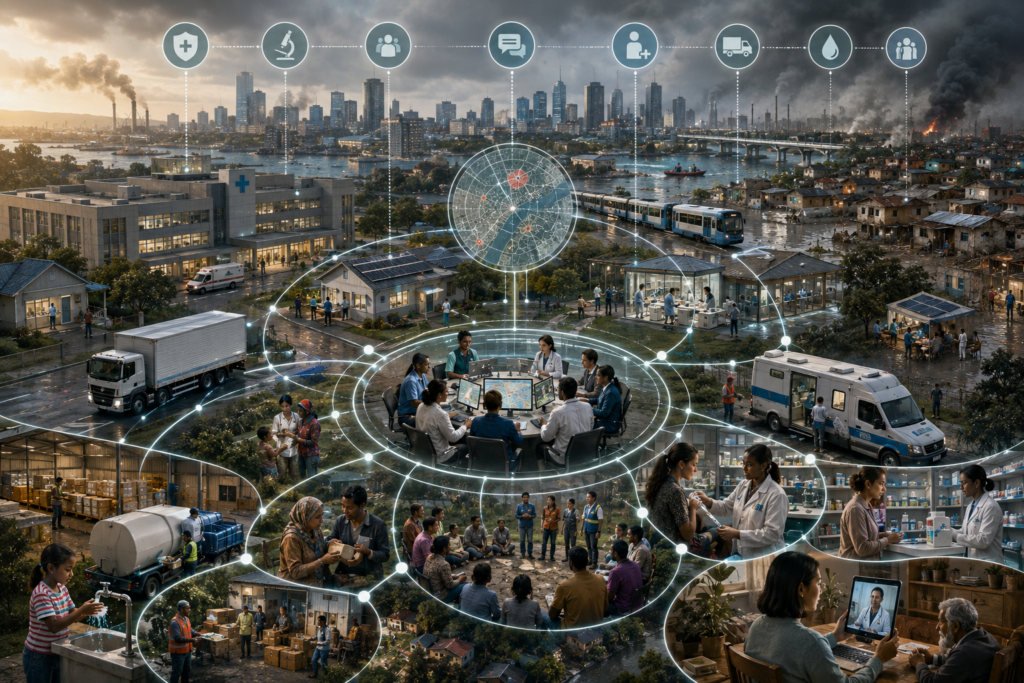
Editorial illustration showing hospitals, clinics, laboratories, community outreach, supply chains, mobile health units, and vulnerable neighborhoods linked across a city under public-health and environmental stress.

Public Health Systems and Social Resilience

Public health resilience and systemic risk belong together because public health systems are not only clinical systems. They are social, institutional, informational, logistical, preventive, and trust-based systems that help societies detect danger, preserve essential services, protect vulnerable populations, and prevent health shocks from cascading into wider social disruption. This article explains how surveillance, laboratories, vaccination, prevention, environmental health, communication, workforce readiness, supply chains, continuity of care, primary care, mental health, public trust, and equity determine whether infectious disease, heat, smoke, contaminated water, food insecurity, conflict, displacement, infrastructure failure, or chronic disease burdens become manageable disruptions or systemic crises. Durable public health resilience requires prevention, preparedness, trusted institutions, accessible care, health justice, and the protection of essential services under stress.

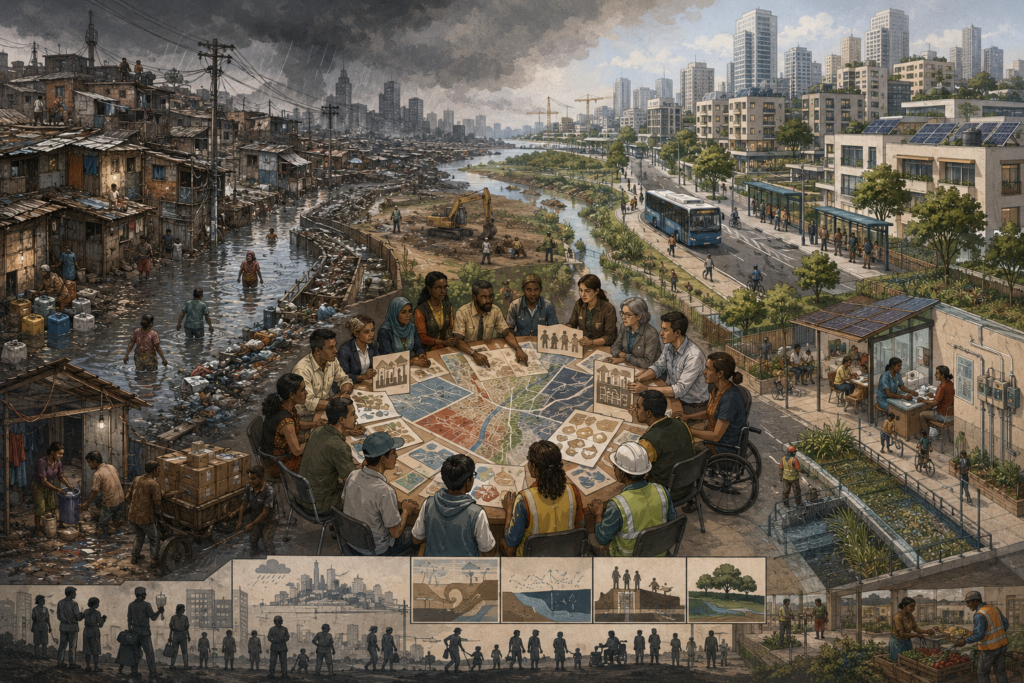
Editorial systems illustration showing informal settlements exposed to flooding, heat, weak infrastructure, and insecure tenure beside inclusive urban resilience planning, upgraded services, public transit, drainage, and community-led adaptation.

Urbanization, Informality, and Risk Exposure

Urbanization, informality, and risk exposure belong together because urban growth does not distribute safety evenly. Cities concentrate opportunity, services, infrastructure, and public life, but they also concentrate hazard, exclusion, infrastructure dependence, housing precarity, and unequal access to protection. This article examines informality not as a failure of residents, but as the spatial expression of exclusionary urbanization: unaffordable formal housing, insecure tenure, uneven infrastructure, precarious livelihoods, and public systems that recognize people only partially. It explains how flood exposure, heat risk, weak drainage, unsafe housing, limited water and sanitation, livelihood insecurity, displacement pressure, and data invisibility produce concentrated urban vulnerability. It also argues that inclusive resilience requires community-led adaptation, settlement upgrading, tenure security, service investment, protection against displacement, accountable mapping, and urban planning that distributes safety rather than concentrating danger.

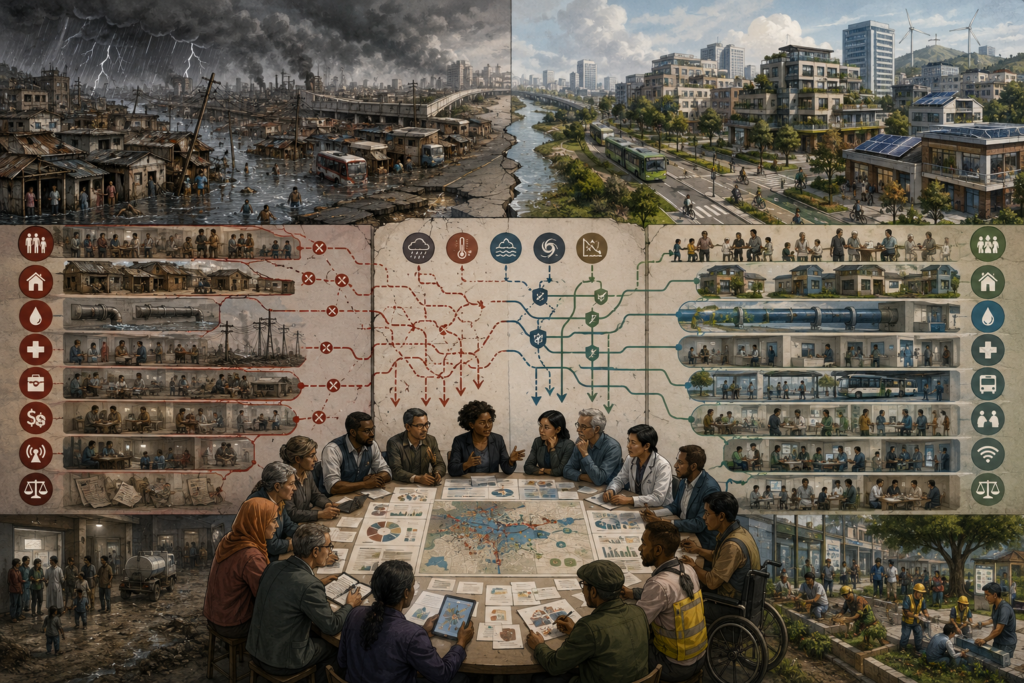
Editorial systems illustration contrasting hazard-exposed, under-serviced communities with greener, better-protected neighborhoods, centered on a diverse strategy table examining inequality, protection gaps, and resilience pathways.

Why Inequality Weakens Resilience

Inequality weakens resilience because shocks do not land on equal ground. Households, communities, regions, and institutions face disruption with very different levels of protection, savings, health, housing security, service access, political voice, and recovery capacity. This article explains inequality as a structural driver of fragility, showing how unequal exposure, thin buffers, infrastructure gaps, territorial inequality, multidimensional poverty, digital exclusion, weak social protection, and limited institutional trust make societies more vulnerable to climate shocks, disasters, economic stress, public-health crises, and service failures. It argues that equality is not only a moral goal but a resilience capacity: when protection, capability, and voice are distributed more widely before crisis, societies are better able to absorb disruption, recover without severe scarring, and adapt before future shocks become catastrophic.

Editorial systems illustration showing crisis-exposed communities, fragile services, displacement, and climate stress on one side; resilient development, functioning services, and recovery pathways on the other; with a central planning forum linking risk, poverty, and fragility.

Risk, Poverty, and Development Fragility

Risk, poverty, and development fragility belong together because poverty is not only low income. It is reduced capacity to absorb shocks without irreversible loss. This article examines poverty as a resilience problem, showing how multidimensional deprivation, insecure livelihoods, weak services, institutional fragility, conflict, displacement, climate stress, food insecurity, water risk, and thin household buffers make development gains vulnerable to reversal. It explains how shocks amplify poverty through debt, asset loss, health decline, school interruption, migration pressure, and weakened public trust. It also argues that resilient development requires more than growth: it depends on social protection, service continuity, livelihood security, climate adaptation, institutional legitimacy, community voice, and public systems designed to prevent crisis from becoming long-term developmental scarring.

Editorial systems illustration showing environmental monitoring as resilience infrastructure, with satellites, sensors, community observation, damaged monitoring gaps, functioning data systems, and a central adaptive-governance forum.

Environmental Monitoring as a Foundation of Resilience

Environmental monitoring is a foundation of resilience because systems cannot respond well to conditions they cannot see. This article examines monitoring as the observational layer beneath early warning, preparedness, adaptation, ecological protection, and accountable governance. It explains how satellites, sensors, field observation, community knowledge, weather stations, stream gauges, air-quality networks, biodiversity surveys, soil data, coastal monitoring, and environmental dashboards turn changing conditions into usable public knowledge. It also shows why monitoring must be connected to action: data only strengthens resilience when it is timely, reliable, interpretable, community-validated, ethically governed, and linked to warnings, maintenance, restoration, public-health protection, and adaptive policy. Monitoring does not eliminate uncertainty, but it reduces blindness, reveals hidden stress, exposes thresholds, and makes resilience claims testable before disruption becomes crisis.

Scroll to Top