
Last Updated May 8, 2026
Public health resilience and systemic risk belong together because public health systems are not only clinical systems. They are social, institutional, informational, logistical, preventive, and trust-based systems that help societies detect danger, preserve essential services, protect vulnerable populations, and prevent health shocks from cascading into wider social disruption. Surveillance, laboratories, vaccination systems, outbreak investigation, environmental health, risk communication, community outreach, workforce readiness, supply chains, health equity, primary care, emergency preparedness, and continuity of care all shape whether biological, environmental, and social stress becomes manageable disruption or systemic crisis.
Public health crises rarely stay inside the health sector. Infectious disease, heat, smoke, contaminated water, food insecurity, antimicrobial resistance, chronic disease burdens, mental-health stress, climate shocks, displacement, conflict, and infrastructure failure can spread through schools, workplaces, households, care systems, transportation, public finance, trust, and political legitimacy. When public health systems are resilient, they help preserve social continuity. When they are fragile, health shocks can become labor shocks, education shocks, income shocks, food shocks, governance shocks, and trust shocks.
Main Library
Publications
Article Map
Risk & Resilience
Related Topic
Sustainable Development
Related Topic
Planetary Boundaries
Related Topic
Systems Thinking
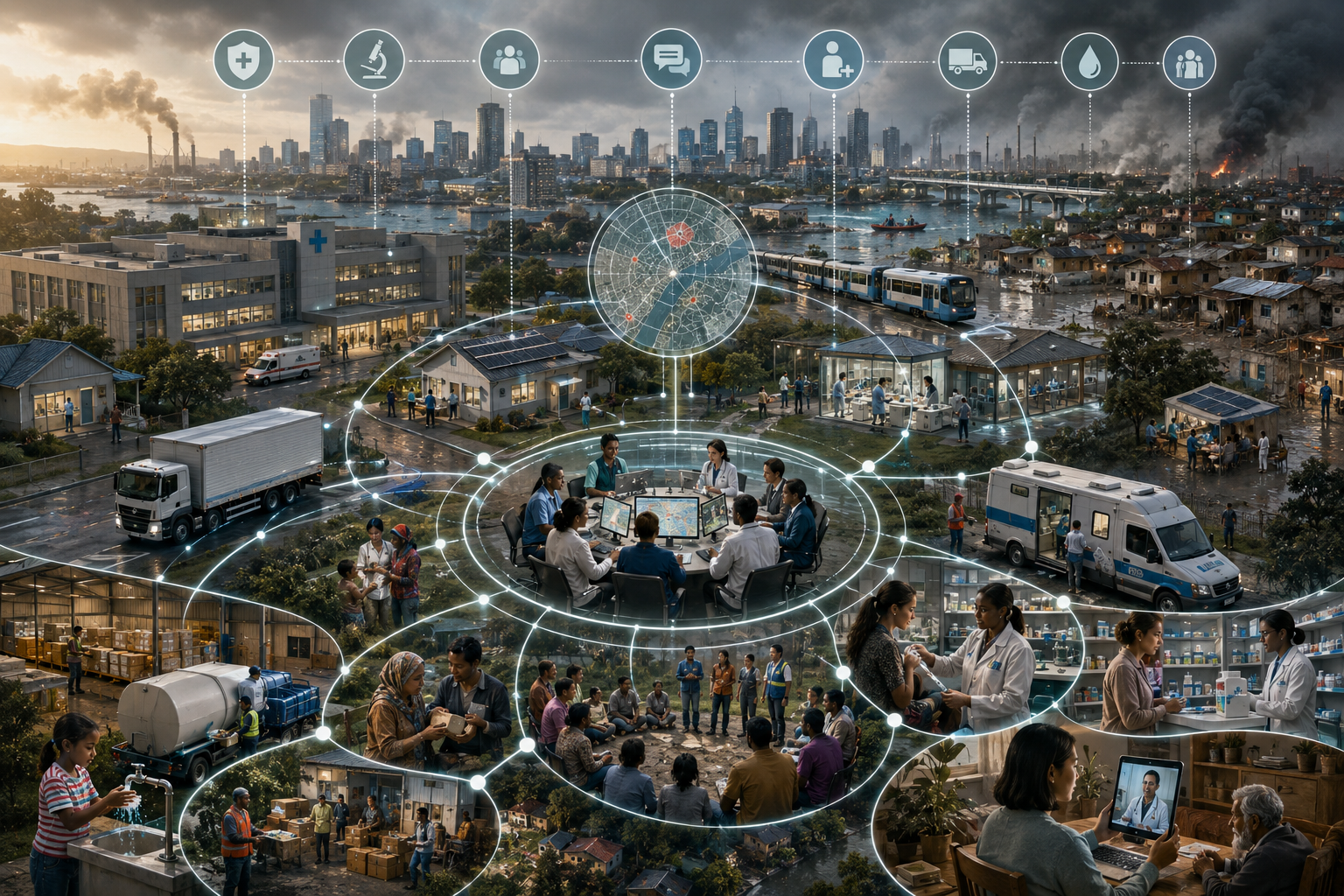
This article builds on What Is Risk and Resilience in Sustainable Systems? by examining public health as a foundational resilience system. It connects closely with Social Vulnerability and Risk Distribution, Compound Climate Events and Cascading Social Risk, Conflict, Fragility, and Resilience Under Stress, and Water Security, Drought, Flood, and Resilience, because health risk is shaped by climate, water, food, housing, infrastructure, labor, conflict, trust, inequality, and institutional capacity.
The central argument is that public health resilience is not simply the ability to treat illness after crisis arrives. It is the capacity to prevent, prepare for, detect, adapt to, respond to, and recover from public health threats while preserving essential and routine services. A resilient public health system protects hospitals, but it also protects surveillance, laboratories, vaccination, environmental health, primary care, workforce capacity, supply chains, mental health, health communication, community trust, equity, and the social conditions that allow people to act on public guidance.
Why Public Health Resilience Matters
Public health resilience matters because health threats can become society-wide disruptions. An outbreak can close schools, strain hospitals, disrupt work, increase care burdens, interrupt supply chains, deepen mistrust, expose inequalities, and destabilize public institutions. A heatwave can overwhelm emergency rooms, raise mortality, interrupt labor, increase energy demand, and expose housing insecurity. Contaminated water can become a health emergency, a governance crisis, a public-trust crisis, and a social-equity crisis at the same time.
This makes public health one of the most important layers of systemic resilience. Health systems help determine whether societies can see danger early, act before escalation, protect people at higher risk, maintain essential services, coordinate across agencies, and recover without abandoning routine care. Public health resilience is therefore not only a technical health-sector concern. It is part of the infrastructure of social continuity.
The World Health Organization frames resilient health systems as systems able to prevent, prepare for, detect, adapt to, respond to, and recover from public health threats while maintaining quality essential and routine health services. This definition matters because it links emergency response to everyday continuity. A health system that can respond to crisis only by suspending routine care, abandoning prevention, exhausting workers, or excluding vulnerable populations is not fully resilient.
Public health resilience also matters because risks are changing. Climate change, urbanization, land-use change, population aging, chronic disease burdens, antimicrobial resistance, zoonotic spillover, conflict, displacement, misinformation, cyber risk, and supply-chain fragility all increase pressure on health systems. The next health crisis may not look exactly like the last one. Resilience therefore requires adaptive capacity, not only preparedness for a known scenario.
A serious resilience framework asks whether public health systems can preserve core functions under uncertainty: surveillance, laboratories, workforce capacity, supply chains, primary care, emergency response, trusted communication, vaccination, environmental health, mental health, and equitable access. If these functions fail, health risk can cascade through society.
What Public Health Systems Are
Public health systems are broader than hospitals, doctors, clinics, and emergency rooms. They include the organized capacities that protect population health: disease surveillance, laboratory systems, outbreak investigation, vaccination, health promotion, environmental health, occupational health, sanitation, food safety, emergency preparedness, risk communication, community engagement, vital statistics, health equity, policy development, and coordination across agencies and sectors.
This breadth is essential. Clinical care treats individuals. Public health protects populations. Both are necessary, but they work differently. Clinical systems ask how to diagnose and treat illness. Public health systems ask how to prevent illness, detect threats, reduce exposure, communicate risk, improve conditions, and protect communities before harm spreads. A resilient society needs both strong care systems and strong public health systems.
Public health systems are also deeply connected to non-health sectors. Housing affects respiratory health, heat exposure, injury risk, and infectious disease spread. Water systems affect diarrheal disease, sanitation, hygiene, and chemical exposure. Food systems affect nutrition, chronic disease, immunity, and household stability. Transportation affects access to care, evacuation, air pollution, injury, and emergency response. Labor systems affect exposure, income security, leave, and caregiving. Education affects health literacy, vaccination, nutrition, and trust.
This means public health cannot be managed effectively as a narrow department. It requires coordination across health ministries, local health departments, emergency management, schools, housing agencies, water utilities, environmental regulators, employers, social services, community organizations, laboratories, data systems, and trusted local institutions. A public health system is therefore a networked governance system.
In resilience terms, public health systems are anticipatory systems. Their value is greatest when crisis is prevented or contained early. Surveillance, testing, vaccination, inspection, outreach, and communication may seem invisible when they work well. But when they fail, the costs appear across the entire society.
What Health-System Resilience Means
Health-system resilience refers to the capacity of health and public health systems to absorb, adapt, transform, and continue core functions under stress. It includes emergency response, but it also includes maintaining routine and essential services, learning from shocks, adapting to new threats, and strengthening systems before crisis arrives.
This is an important distinction. Resilience is not merely surge capacity. Surge capacity matters, but resilience also requires prevention, preparedness, governance, workforce protection, supply-chain reliability, information systems, financing, trust, equity, and recovery. A health system may have beds but lack staff. It may have staff but lack protective equipment. It may have laboratories but lack reporting systems. It may have guidance but lack public trust. Each gap weakens resilience.
Health-system resilience also involves the ability to learn. After a crisis, resilient systems identify what failed, who was harmed, what capacities were missing, where inequalities widened, and what institutions need reform. Learning is not automatic. It requires data, accountability, transparency, political will, and investment. Without learning, systems can return to the same fragile conditions that made crisis worse.
A resilient health system must also balance crisis response with routine care. During emergencies, essential services still matter: maternal care, vaccination, chronic disease management, mental health, emergency transport, medication access, sanitation, primary care, and rehabilitation. If routine services collapse, the health emergency produces secondary harm that can last for years.
Health-system resilience therefore requires design. It cannot be assumed as a byproduct of spending, technology, or infrastructure. It must be intentionally programmed through governance, financing, workforce planning, community engagement, risk assessment, supply-chain strategy, data systems, equity safeguards, and continuous improvement.
Public Health as Social Infrastructure
Public health is social infrastructure because it helps societies coordinate under threat. A functioning public health system does more than provide technical advice. It helps people understand risk, trust information, access services, protect one another, and maintain collective life during uncertainty. Public health is therefore part of the institutional fabric that allows communities to continue functioning.
When public health systems are strong, societies are better able to preserve work, schooling, caregiving, mobility, food access, and essential services. When they are weak, a health shock can quickly become a social shock. People may avoid care, mistrust guidance, lose income, miss school, experience untreated illness, face discrimination, or become isolated from support. Health risk becomes systemic because it moves through ordinary life.
Public health as social infrastructure depends on trust. People need to believe that health information is accurate, that institutions are acting in the public interest, that guidance is practical, and that burdens are distributed fairly. Trust is built before crisis through transparency, competence, equity, participation, and respect. It cannot be manufactured instantly once crisis begins.
Public health also depends on community relationships. Local organizations, clinics, faith institutions, schools, disability advocates, labor groups, neighborhood associations, mutual aid networks, and trusted messengers often determine whether information reaches people in usable form. Technical accuracy is not enough if communication fails socially.
Seeing public health as social infrastructure changes investment priorities. Laboratories, surveillance systems, and hospitals matter. But so do community health workers, multilingual communication, disability access, environmental health, primary care, mental-health support, social protection, paid sick leave, housing stability, and public trust. Resilience depends on the whole system, not only its visible clinical edge.
Surveillance, Prevention, and Essential Functions
Surveillance and prevention are central to public health resilience because they allow societies to act before harm becomes widespread. Disease surveillance, wastewater monitoring, syndromic surveillance, laboratory testing, environmental monitoring, vaccination registries, outbreak investigation, and risk analysis all help detect threats early. Without these systems, a society may not recognize danger until it has already spread.
Prevention includes vaccination, sanitation, food safety, vector control, health education, environmental regulation, occupational protection, screening, harm reduction, and chronic disease prevention. Prevention is often undervalued because success can look like nothing happened. But in resilience terms, prevention is one of the strongest forms of risk reduction. It avoids downstream pressure on hospitals, households, schools, employers, and public budgets.
Essential public health functions provide a useful way to understand this architecture. They define the capacities needed to protect population health, support health security, and strengthen resilient health systems. These functions include monitoring population health, identifying hazards, protecting communities, preparing for emergencies, promoting health, engaging communities, developing policy, ensuring access, and strengthening public health workforce and systems.
Information systems are especially important. Public health agencies need timely, accurate, privacy-protective, interoperable, and actionable data. But data alone are not enough. Surveillance must connect to decisions, resources, communication, and action. Early detection without response capacity produces knowledge without protection.
Prevention and surveillance also require equity. Communities with less access to testing, care, reporting, internet, transportation, language services, or trust may be undercounted. If surveillance misses vulnerable populations, public health systems can underestimate risk precisely where support is most needed. Resilient surveillance must see the whole society, not only the populations easiest to measure.
Continuity of Care and Essential Services
Continuity of care is a defining feature of public health resilience. A system is not resilient if it can respond to one emergency only by abandoning everything else. During crisis, people still need maternal care, emergency care, vaccination, chronic disease management, dialysis, cancer treatment, mental-health support, disability services, medication access, sanitation, nutrition support, and primary care. These needs do not pause because a new threat appears.
Service disruption can produce severe secondary harm. Missed vaccinations can create future outbreaks. Interrupted chronic disease care can increase mortality. Delayed cancer diagnosis can worsen outcomes. Disrupted maternal care can endanger parents and infants. Mental-health services become more important during crisis, not less. If routine services collapse, the total burden of the emergency becomes much larger than the immediate threat.
Continuity requires planning. Health systems need surge staffing, backup supply chains, flexible facilities, telehealth where appropriate, emergency transport, referral systems, stockpiles, infection prevention, workforce protection, and clear triage protocols. They also need financing arrangements that allow services to continue even when normal operations are disrupted.
Continuity also requires attention to geography and access. Rural communities, informal settlements, conflict-affected areas, displaced populations, low-income neighborhoods, and people with disabilities may face barriers even before crisis. During stress, those barriers widen. Public health resilience must therefore protect service access where the system is already weakest.
Essential-service continuity connects directly to social stability. When people can still receive care, medication, information, and support, society is better able to endure disruption. When care disappears, fear, mistrust, untreated illness, and avoidable death can spread alongside the original hazard.
Trust, Communication, and Collective Response
Public health resilience depends on the ability to communicate risk clearly, honestly, and credibly. During health threats, people must decide whether to seek care, vaccinate, isolate, evacuate, wear protection, boil water, avoid exposure, reduce contact, use cooling centers, follow workplace guidance, or change routines. These decisions depend not only on information, but on trust.
Trust is fragile when institutions have harmed, ignored, excluded, or misled communities in the past. Communities facing medical racism, environmental injustice, disability exclusion, language barriers, immigration enforcement, poverty, or political neglect may have good reasons to distrust official guidance. Public health communication must therefore be grounded in accountability, not condescension.
Communication must also be practical. Guidance that assumes people can work from home, take unpaid leave, isolate in spacious housing, access transport, read English, use online systems, or trust police-backed enforcement will fail many communities. Resilient communication asks whether people can actually act on the advice they receive.
Collective response requires trusted messengers. Health departments are important, but so are community clinics, local leaders, schools, unions, disability organizations, faith communities, mutual aid networks, social workers, and neighborhood groups. A resilient public health system works with these actors before crisis rather than discovering them during emergency.
Communication should also acknowledge uncertainty. Public health threats evolve. Evidence changes. Guidance may need to change. Trust is strengthened when institutions explain what is known, what is uncertain, what is being monitored, and why recommendations are changing. False certainty may appear reassuring in the short term, but it damages credibility when conditions shift.
Public health resilience is therefore partly communicative resilience: the capacity to maintain shared understanding and collective action under uncertainty.
Workforce, Supply Chains, and Institutional Capacity
Public health resilience depends on people. Health workers, public health officials, laboratory staff, epidemiologists, nurses, physicians, emergency responders, community health workers, environmental health inspectors, social workers, data analysts, logisticians, sanitation workers, pharmacists, and care workers all sustain the system. If the workforce is exhausted, unsafe, underpaid, understaffed, or unsupported, resilience collapses.
Workforce resilience requires training, staffing, protection, mental-health support, fair compensation, surge capacity, cross-training, and retention. Burnout is not only an individual problem. It is a system failure. A system that consumes its workers during every crisis is not resilient; it is borrowing capacity from the future.
Supply chains are equally critical. Public health systems depend on medicines, vaccines, diagnostics, protective equipment, oxygen, laboratory reagents, cold chains, digital systems, transportation, food, water, sanitation supplies, and energy. A missing reagent can delay testing. A cold-chain failure can weaken vaccination. A shortage of protective equipment can endanger workers. A fuel shortage can block emergency transport. These are not peripheral issues. They are core resilience concerns.
Institutional capacity connects workforce and logistics to action. Public health agencies need legal authority, funding, procurement systems, data governance, coordination mechanisms, accountability, and political support. They must be able to act quickly without abandoning rights, transparency, or equity. They must coordinate across national, regional, and local levels.
Resilience also requires redundancy. Ultra-lean systems may appear efficient under normal conditions but fail under stress. Backup staff, reserve supplies, diversified suppliers, local production capacity, interoperable data systems, and mutual aid agreements all create resilience margins. Efficiency without redundancy can become fragility.
Public health resilience therefore depends on invisible capacity: trained people, stocked systems, trusted institutions, maintained infrastructure, and financing that exists before crisis.
Climate, Health, and Compound Risk
Climate change is making public health resilience more important. Heatwaves, wildfire smoke, flooding, drought, water contamination, vector-borne disease shifts, food insecurity, displacement, extreme storms, air pollution, and mental-health stress all place new pressure on health systems. These threats often arrive together or in sequence, creating compound risk.
Heat is one of the clearest examples. Heat affects cardiovascular health, kidney function, pregnancy, mental health, labor productivity, medication safety, and mortality. It is especially dangerous for older adults, children, outdoor workers, unhoused people, people without cooling, people with chronic illness, and people in heat-island neighborhoods. A heatwave can also increase energy demand and power failure risk, turning climate stress into infrastructure stress and health-system stress at once.
Flooding connects water, sanitation, housing, infectious disease, injury, displacement, mold, mental health, and healthcare access. Wildfire smoke connects air quality, respiratory disease, work conditions, school closures, and emergency care. Drought connects water insecurity, food systems, nutrition, livelihoods, migration, and conflict risk. Public health systems must therefore be prepared for risks that cross sectors.
Compound risk also challenges emergency planning. A disease outbreak during a heatwave, a flood during a power outage, or smoke exposure during hospital strain can exceed plans built around single hazards. Public health resilience must therefore integrate climate adaptation, disaster-risk reduction, primary care, emergency management, environmental monitoring, and social protection.
Climate-health resilience is not only about emergency response. It includes heat-health plans, air-quality warning systems, water safety, vector surveillance, climate-informed healthcare planning, resilient facilities, public cooling, occupational protections, mental-health support, and community outreach. Health systems must become climate-aware because climate risk is increasingly health risk.
Equity, Vulnerability, and Health Justice
Public health resilience is inseparable from equity. Health shocks do not affect all communities equally. People with lower incomes, insecure housing, chronic illness, disabilities, limited transportation, language barriers, limited healthcare access, unsafe work, immigration precarity, environmental burdens, or distrust of institutions often face higher exposure and lower recovery capacity. A system that performs well on average may still fail those most at risk.
Health vulnerability is produced by social conditions. Crowded housing can increase infectious disease spread. Lack of paid leave can force people to work while sick. Lack of transportation can block vaccination or treatment. Poor air quality can worsen respiratory vulnerability. Food insecurity can weaken health. Medical debt can delay care. Disability exclusion can make warnings, shelters, transport, and clinics inaccessible.
Public health resilience must therefore be justice-centered. It should not simply protect the population in aggregate. It should reduce unequal exposure, unequal access, unequal communication, unequal care, and unequal recovery. Equity is not a separate value added after technical planning. It is a condition of system performance.
Health justice also requires participation. Communities most exposed to harm should help design surveillance, outreach, emergency response, communication, clinics, testing, vaccination, environmental health interventions, and recovery programs. Public health systems cannot build trust while excluding the people most affected by their decisions.
Measurement matters, but it must lead to action. Data should identify where disease burdens, environmental exposures, service gaps, and social vulnerabilities overlap. But mapping vulnerability without shifting resources can become extractive. Resilient public health systems use data to prioritize investment, repair access, and hold institutions accountable.
A health system is not resilient if it protects the already protected while leaving the most exposed people to absorb preventable harm.
Toward Resilient Public Health Systems
Resilient public health systems require intentional design. First, they need strong essential public health functions: surveillance, laboratories, prevention, environmental health, preparedness, risk communication, workforce capacity, and community engagement. These functions should be funded and maintained before crisis, not improvised afterward.
Second, they need continuity planning. Essential services must remain available during emergencies. This requires surge staffing, supply-chain resilience, referral networks, backup facilities, digital and non-digital communication, emergency transport, and protection for routine care. Continuity should be measured, not assumed.
Third, they need trusted communication. Public health guidance should be clear, multilingual, disability-accessible, culturally competent, transparent, and practical. It should travel through trusted community channels as well as formal agencies. Communication is a system capacity, not a press release.
Fourth, they need health equity at the center. Public health resilience should prioritize communities facing cumulative vulnerability, not only those easiest to reach. Equity requires investment in access, prevention, housing, environmental health, paid leave, social protection, disability inclusion, and community-based care.
Fifth, they need adaptive governance. Public health systems must learn from crisis, update plans, coordinate across sectors, and use data responsibly. They must be able to act quickly while maintaining rights, transparency, and accountability.
Finally, they need integration with broader resilience systems. Public health resilience depends on water systems, food systems, energy systems, housing systems, labor systems, education systems, transportation systems, and climate adaptation. Health security cannot be separated from social security. The strongest public health systems are embedded in societies that reduce vulnerability before people become patients.
Mathematical Lens: Public Health Resilience and Systemic Risk
Public health resilience and systemic risk can be represented as relationships among hazard pressure, exposure, vulnerability, surveillance capacity, prevention capacity, essential-service continuity, workforce capacity, supply-chain reliability, public trust, communication capacity, and recovery capacity. Let \(H_i\) represent health-hazard pressure for system or community \(i\), \(E_i\) exposure, \(V_i\) social and health vulnerability, \(S_i\) surveillance capacity, \(P_i\) prevention capacity, \(C_i\) continuity of essential services, \(W_i\) workforce capacity, \(L_i\) supply-chain reliability, \(T_i\) public trust, \(M_i\) communication capacity, and \(R_i\) recovery capacity.
A public health threat pressure score can be written as:
K_i = H_iE_i(1 + \alpha V_i)
\]
Interpretation: Health threat pressure rises when hazard intensity, exposure, and social vulnerability reinforce one another.
A public health resilience capacity score can be represented as:
Q_i = q_1S_i + q_2P_i + q_3C_i + q_4W_i + q_5L_i + q_6T_i + q_7M_i + q_8R_i
\]
Interpretation: Public health resilience increases when surveillance, prevention, service continuity, workforce capacity, supply chains, trust, communication, and recovery capacity are strong.
A systemic health-risk score can be written as:
R^{health}_i = K_i(1 – \beta Q_i)(1 + \theta U_i)
\]
Interpretation: Systemic health risk declines when resilience capacity is strong and rises when inequality or cumulative disadvantage amplifies harm.
A continuity gap can be represented as:
G_i = \max(0, D_i – C_i)
\]
Interpretation: A continuity gap appears when essential-service demand and disruption exceed the system’s ability to preserve care.
A trust-adjusted response capacity score can be written as:
A_i = (S_i + M_i + P_i)(1 + \gamma T_i)
\]
Interpretation: Detection, communication, and prevention become more effective when public trust supports collective action.
A public health resilience gap can then be written as:
\Delta_i = \max(0, R^{health}_i + G_i – A_i)
\]
Interpretation: A resilience gap appears when systemic health risk and service-continuity gaps exceed trust-adjusted response capacity.
| Term | Meaning | Interpretive role |
|---|---|---|
| \(K_i\) | Public health threat pressure | Represents hazard pressure, exposure, and vulnerability. |
| \(Q_i\) | Public health resilience capacity | Represents surveillance, prevention, continuity, workforce, supply chains, trust, communication, and recovery. |
| \(R^{health}_i\) | Systemic health risk | Represents health risk after accounting for resilience capacity and inequality. |
| \(G_i\) | Continuity gap | Represents unmet essential-service demand under disruption. |
| \(A_i\) | Trust-adjusted response capacity | Represents the ability of surveillance, communication, and prevention to support collective action. |
| \(\Delta_i\) | Public health resilience gap | Identifies where systemic health risk and continuity gaps exceed response capacity. |
This mathematical lens is not meant to reduce public health to a single number. It clarifies the structure of analysis: public health resilience depends on threat detection, prevention, service continuity, workforce capacity, supply reliability, trust, communication, equity, and recovery capacity.
Advanced Python Workflow: Public Health Resilience Diagnostics
The following Python workflow models public health resilience as relationships among health hazard pressure, exposure, vulnerability, surveillance capacity, prevention capacity, essential-service continuity, workforce capacity, supply-chain reliability, public trust, communication capacity, recovery capacity, inequality pressure, service demand, and systemic health-risk pressure.
from pathlib import Path
import numpy as np
import pandas as pd

BASE_DIR = Path("articles/public-health-resilience-and-systemic-risk")
DATA_FILE = BASE_DIR / "data" / "public_health_resilience_panel.csv"
OUTPUT_DIR = BASE_DIR / "outputs"


def load_data():
    df = pd.read_csv(DATA_FILE)

    numeric_cols = [
        col for col in df.columns
        if col not in {"system_id", "system_name", "region", "health_risk_context"}
    ]

    for col in numeric_cols:
        if ((df[col] < 0) | (df[col] > 1)).any():
            raise ValueError(f"{col} must be scaled between 0 and 1.")

    return df


def score_systems(df):
    scored = df.copy()

    scored["public_health_threat_pressure"] = (
        scored["health_hazard_pressure"]
        * scored["exposure"]
        * (1 + 0.40 * scored["social_health_vulnerability"])
    )

    scored["public_health_resilience_capacity"] = (
        0.16 * scored["surveillance_capacity"]
        + 0.14 * scored["prevention_capacity"]
        + 0.16 * scored["essential_service_continuity"]
        + 0.14 * scored["workforce_capacity"]
        + 0.12 * scored["supply_chain_reliability"]
        + 0.12 * scored["public_trust"]
        + 0.08 * scored["communication_capacity"]
        + 0.08 * scored["recovery_capacity"]
    )

    scored["systemic_health_risk"] = (
        scored["public_health_threat_pressure"]
        * (1 - 0.45 * scored["public_health_resilience_capacity"])
        * (1 + 0.35 * scored["inequality_pressure"])
    )

    scored["continuity_gap"] = np.maximum(
        0,
        scored["essential_service_demand"] - scored["essential_service_continuity"],
    )

    scored["trust_adjusted_response_capacity"] = (
        (
            0.34 * scored["surveillance_capacity"]
            + 0.33 * scored["communication_capacity"]
            + 0.33 * scored["prevention_capacity"]
        )
        * (1 + 0.30 * scored["public_trust"])
    ).clip(0, 1.5)

    scored["public_health_resilience_gap"] = np.maximum(
        0,
        scored["systemic_health_risk"]
        + scored["continuity_gap"]
        - scored["trust_adjusted_response_capacity"],
    )

    scored["diagnostic_priority"] = np.select(
        [
            scored["surveillance_capacity"] < 0.42,
            scored["essential_service_continuity"] < 0.42,
            scored["workforce_capacity"] < 0.42,
            scored["supply_chain_reliability"] < 0.42,
            scored["public_trust"] < 0.42,
            scored["public_health_resilience_gap"] > 0.55,
        ],
        [
            "strengthen_surveillance_and_laboratories",
            "protect_essential_service_continuity",
            "rebuild_workforce_capacity",
            "stabilize_health_supply_chains",
            "repair_trust_and_risk_communication",
            "close_public_health_resilience_gap",
        ],
        default="monitor_and_strengthen_public_health_resilience",
    )

    return scored.sort_values(
        ["public_health_resilience_gap", "systemic_health_risk"],
        ascending=False,
    ).reset_index(drop=True)


def main():
    OUTPUT_DIR.mkdir(parents=True, exist_ok=True)

    raw = load_data()
    scored = score_systems(raw)

    region_summary = (
        scored.groupby("region")
        .agg(
            systems=("system_id", "count"),
            mean_threat_pressure=("public_health_threat_pressure", "mean"),
            mean_resilience_capacity=("public_health_resilience_capacity", "mean"),
            mean_systemic_health_risk=("systemic_health_risk", "mean"),
            mean_continuity_gap=("continuity_gap", "mean"),
            mean_resilience_gap=("public_health_resilience_gap", "mean"),
        )
        .reset_index()
        .sort_values("mean_resilience_gap", ascending=False)
    )

    scored.to_csv(OUTPUT_DIR / "public_health_resilience_scores.csv", index=False)
    region_summary.to_csv(OUTPUT_DIR / "public_health_region_summary.csv", index=False)

    print(scored.round(3).to_string(index=False))
    print(region_summary.round(3).to_string(index=False))


if __name__ == "__main__":
    main()
This workflow operationalizes the article’s central claim: public health resilience depends on more than clinical capacity. It separates threat pressure, resilience capacity, systemic health risk, continuity gaps, trust-adjusted response capacity, and public health resilience gaps so that the analyst can see whether risk is being driven by surveillance weakness, service disruption, workforce stress, supply-chain fragility, low trust, social vulnerability, or inequality.
Advanced R Workflow: Public Health Resilience Dashboarding
The following R workflow creates dashboard-ready outputs for comparing public health threat pressure, resilience capacity, systemic health risk, continuity gaps, trust-adjusted response capacity, public health resilience gaps, regional summaries, risk-context summaries, and long-format visualization data.
library(readr)
library(dplyr)
library(tidyr)

base_dir <- "articles/public-health-resilience-and-systemic-risk"
data_file <- file.path(base_dir, "data", "public_health_resilience_panel.csv")
output_dir <- file.path(base_dir, "outputs")

dir.create(output_dir, recursive = TRUE, showWarnings = FALSE)

systems <- read_csv(data_file, show_col_types = FALSE)

score_systems <- function(df) {
  df %>%
    mutate(
      public_health_threat_pressure =
        health_hazard_pressure *
        exposure *
        (1 + 0.40 * social_health_vulnerability),

      public_health_resilience_capacity =
        0.16 * surveillance_capacity +
        0.14 * prevention_capacity +
        0.16 * essential_service_continuity +
        0.14 * workforce_capacity +
        0.12 * supply_chain_reliability +
        0.12 * public_trust +
        0.08 * communication_capacity +
        0.08 * recovery_capacity,

      systemic_health_risk =
        public_health_threat_pressure *
        (1 - 0.45 * public_health_resilience_capacity) *
        (1 + 0.35 * inequality_pressure),

      continuity_gap =
        pmax(0, essential_service_demand - essential_service_continuity),

      trust_adjusted_response_capacity =
        pmin(
          1.5,
          (
            0.34 * surveillance_capacity +
            0.33 * communication_capacity +
            0.33 * prevention_capacity
          ) *
          (1 + 0.30 * public_trust)
        ),

      public_health_resilience_gap =
        pmax(
          0,
          systemic_health_risk +
          continuity_gap -
          trust_adjusted_response_capacity
        ),

      diagnostic_priority = case_when(
        surveillance_capacity < 0.42 ~
          "strengthen_surveillance_and_laboratories",
        essential_service_continuity < 0.42 ~
          "protect_essential_service_continuity",
        workforce_capacity < 0.42 ~
          "rebuild_workforce_capacity",
        supply_chain_reliability < 0.42 ~
          "stabilize_health_supply_chains",
        public_trust < 0.42 ~
          "repair_trust_and_risk_communication",
        public_health_resilience_gap > 0.55 ~
          "close_public_health_resilience_gap",
        TRUE ~
          "monitor_and_strengthen_public_health_resilience"
      )
    ) %>%
    arrange(desc(public_health_resilience_gap), desc(systemic_health_risk))
}

scored <- score_systems(systems)

region_summary <- scored %>%
  group_by(region) %>%
  summarise(
    systems = n(),
    mean_threat_pressure = mean(public_health_threat_pressure),
    mean_resilience_capacity = mean(public_health_resilience_capacity),
    mean_systemic_health_risk = mean(systemic_health_risk),
    mean_continuity_gap = mean(continuity_gap),
    mean_resilience_gap = mean(public_health_resilience_gap),
    .groups = "drop"
  ) %>%
  arrange(desc(mean_resilience_gap))

context_summary <- scored %>%
  group_by(health_risk_context) %>%
  summarise(
    systems = n(),
    mean_hazard_pressure = mean(health_hazard_pressure),
    mean_vulnerability = mean(social_health_vulnerability),
    mean_resilience_capacity = mean(public_health_resilience_capacity),
    mean_systemic_health_risk = mean(systemic_health_risk),
    mean_resilience_gap = mean(public_health_resilience_gap),
    .groups = "drop"
  ) %>%
  arrange(desc(mean_resilience_gap))

dashboard_long <- scored %>%
  select(
    system_id,
    system_name,
    region,
    health_risk_context,
    public_health_threat_pressure,
    public_health_resilience_capacity,
    systemic_health_risk,
    continuity_gap,
    trust_adjusted_response_capacity,
    public_health_resilience_gap
  ) %>%
  pivot_longer(
    cols = c(
      public_health_threat_pressure,
      public_health_resilience_capacity,
      systemic_health_risk,
      continuity_gap,
      trust_adjusted_response_capacity,
      public_health_resilience_gap
    ),
    names_to = "metric",
    values_to = "value"
  )

write_csv(scored, file.path(output_dir, "r_public_health_resilience_scores.csv"))
write_csv(region_summary, file.path(output_dir, "r_region_summary.csv"))
write_csv(context_summary, file.path(output_dir, "r_context_summary.csv"))
write_csv(dashboard_long, file.path(output_dir, "r_dashboard_long.csv"))

print(scored)
print(region_summary)
print(context_summary)
The R workflow complements the Python workflow by producing dashboard-oriented outputs. It is especially useful for comparing health-system resilience across regions, public-health departments, cities, counties, hospital referral areas, climate-health risk zones, or fragile settings. A production version could connect to surveillance indicators, laboratory capacity, vaccination data, environmental health records, workforce data, hospital continuity indicators, emergency medical services, supply-chain records, social vulnerability data, and health-equity outcomes.
Engineering Extensions in the GitHub Repository
The accompanying repository can extend the article beyond conceptual explanation into reproducible public-health resilience analysis. The article folder is designed around a synthetic public-health resilience indicator panel, advanced Python diagnostics, advanced R dashboarding, SQL schema scaffolding, scenario outputs, uncertainty analysis, documentation, and extensible scoring logic.
The article body foregrounds Python and R because they are accessible languages for data analysis, scenario modeling, uncertainty analysis, and dashboard preparation. Additional languages can strengthen the repository where they serve a real analytical purpose. SQL can support structured records for public-health systems, surveillance indicators, service-continuity measures, workforce capacity, supply chains, health events, source provenance, and auditability. Go can support lightweight scoring services. Rust can support reliable command-line validation tools. C and C++ can support compact numerical kernels for public-health risk scoring. Fortran can support numerical resilience-gap calculations and legacy scientific-computing workflows where useful.
The deeper purpose of the repository is not to turn public health resilience into false precision. It is to make assumptions visible. By separating hazard pressure, exposure, social vulnerability, surveillance, prevention, continuity of care, workforce capacity, supply-chain reliability, trust, communication, recovery capacity, inequality, and service demand, the workflow allows users to inspect how final interpretations are produced.
GitHub Repository
Complete Code Repository
The full code directory for this article, including advanced Python diagnostics, advanced R dashboard workflow, synthetic public-health resilience data, SQL schema, scenario outputs, uncertainty analysis, documentation, and systems-level extensions, is available on GitHub.
Common Misunderstandings
A common misunderstanding is that public health resilience means hospital capacity alone. Hospitals matter, but resilience also depends on surveillance, laboratories, prevention, vaccination, environmental health, communication, community outreach, workforce capacity, supply chains, primary care, and service continuity.
Another misunderstanding is that resilience appears automatically when health spending increases. Investment matters, but resilience must be intentionally designed through governance, workforce planning, data systems, prevention, equity, preparedness, and maintenance of essential services.
A third misunderstanding is that public health crises are only medical events. Health shocks can become education, labor, food, housing, governance, trust, and political stability shocks.
A fourth misunderstanding is that public trust is soft or secondary. Trust determines whether people act on guidance, use services, participate in prevention, and cooperate under uncertainty.
A fifth misunderstanding is that average health-system performance proves resilience. A system may perform well in aggregate while failing marginalized communities, rural areas, disabled people, low-income households, displaced populations, or people facing language and access barriers.
A final misunderstanding is that emergency response can substitute for prevention. Public health resilience begins before crisis through prevention, surveillance, environmental health, vaccination, communication, workforce readiness, and social protection.
Conclusion
Public health resilience and systemic risk are inseparable because health systems help determine whether biological, environmental, and social threats remain contained or cascade through society. A resilient public health system does more than treat illness. It detects danger early, prevents avoidable harm, communicates clearly, protects vulnerable populations, preserves essential services, supports workers, stabilizes supply chains, and learns after crisis.
The central lesson is that public health is social infrastructure. When surveillance, laboratories, prevention, workforce capacity, supply chains, service continuity, trust, communication, and equity are strong, societies are better able to absorb shocks without wider breakdown. When these capacities are weak, health crises can spread into schools, workplaces, households, food systems, water systems, public budgets, and political trust.
The computational workflows attached to this article extend that argument into practice. They separate public health threat pressure, resilience capacity, systemic health risk, continuity gaps, trust-adjusted response capacity, and public health resilience gaps. They show why some systems require stronger surveillance and laboratories, some require essential-service continuity, some require workforce rebuilding, some require supply-chain stabilization, some require trust and communication repair, and some require deeper equity-centered investment.
Public health resilience is therefore not a narrow technical specialty. It is one of the foundations of resilient society.
Return to the Risk & Resilience knowledge series.
Related Reading
- Risk & Resilience
- What Is Risk and Resilience in Sustainable Systems?
- Social Vulnerability and Risk Distribution
- Compound Climate Events and Cascading Social Risk
- Conflict, Fragility, and Resilience Under Stress
- Water Security, Drought, Flood, and Resilience
- Food System Fragility and Resilience
- Sustainable Development
- Systems Thinking
Further Reading
- Haldane, V. et al. (2021) ‘Health systems resilience in managing the COVID-19 pandemic: lessons from 28 countries’, Nature Medicine, 27, pp. 964–980. Available at: https://www.nature.com/articles/s41591-021-01381-y.
- Organisation for Economic Co-operation and Development (2023) Ready for the Next Crisis? Investing in Health System Resilience. Available at: https://www.oecd.org/en/publications/ready-for-the-next-crisis-investing-in-health-system-resilience_1e53cf80-en.html.
- Organisation for Economic Co-operation and Development (n.d.) Health System Resilience. Available at: https://www.oecd.org/en/topics/health-system-resilience.html.
- United Nations Office for Disaster Risk Reduction (n.d.) Public Health System Resilience Scorecard. Available at: https://mcr2030.undrr.org/public-health-system-resilience-scorecard.
- World Bank (2022) Change Cannot Wait: Building Resilient Health Systems in the Shadow of COVID-19. Available at: https://www.worldbank.org/en/topic/health/publication/change-cannot-wait-building-resilient-health-systems-in-the-shadow-of-covid-19.
- World Bank (2025) Health System Transformation & Resilience Fund. Available at: https://www.worldbank.org/en/topic/health/brief/health-system-transformation-resilience-fund.
- World Health Organization (2024) Building Health System Resilience to Public Health Challenges: Guidance for Implementation in Countries. Available at: https://www.who.int/publications/i/item/9789240094321.
- World Health Organization (n.d.) Health Systems Resilience. Available at: https://www.who.int/teams/primary-health-care/health-systems-resilience.
- World Health Organization (n.d.) Essential Public Health Functions. Available at: https://www.who.int/teams/primary-health-care/health-systems-resilience/essential-public-health-functions.
- World Health Organization (2018) Essential Public Health Functions, Health Systems and Health Security. Available at: https://www.who.int/publications/i/item/9789241514088.
References
- Haldane, V. et al. (2021) ‘Health systems resilience in managing the COVID-19 pandemic: lessons from 28 countries’, Nature Medicine, 27, pp. 964–980. Available at: https://www.nature.com/articles/s41591-021-01381-y.
- Organisation for Economic Co-operation and Development (2023) Ready for the Next Crisis? Investing in Health System Resilience. Available at: https://www.oecd.org/en/publications/ready-for-the-next-crisis-investing-in-health-system-resilience_1e53cf80-en.html.
- Organisation for Economic Co-operation and Development (n.d.) Health System Resilience. Available at: https://www.oecd.org/en/topics/health-system-resilience.html.
- United Nations Office for Disaster Risk Reduction (n.d.) Public Health System Resilience Scorecard. Available at: https://mcr2030.undrr.org/public-health-system-resilience-scorecard.
- World Bank (2022) Change Cannot Wait: Building Resilient Health Systems in the Shadow of COVID-19. Available at: https://www.worldbank.org/en/topic/health/publication/change-cannot-wait-building-resilient-health-systems-in-the-shadow-of-covid-19.
- World Bank (2025) Health System Transformation & Resilience Fund. Available at: https://www.worldbank.org/en/topic/health/brief/health-system-transformation-resilience-fund.
- World Health Organization (2024) Building Health System Resilience to Public Health Challenges: Guidance for Implementation in Countries. Available at: https://www.who.int/publications/i/item/9789240094321.
- World Health Organization (n.d.) Health Systems Resilience. Available at: https://www.who.int/teams/primary-health-care/health-systems-resilience.
- World Health Organization (n.d.) Essential Public Health Functions. Available at: https://www.who.int/teams/primary-health-care/health-systems-resilience/essential-public-health-functions.
- World Health Organization (2018) Essential Public Health Functions, Health Systems and Health Security. Available at: https://www.who.int/publications/i/item/9789241514088.