
Last Updated May 8, 2026
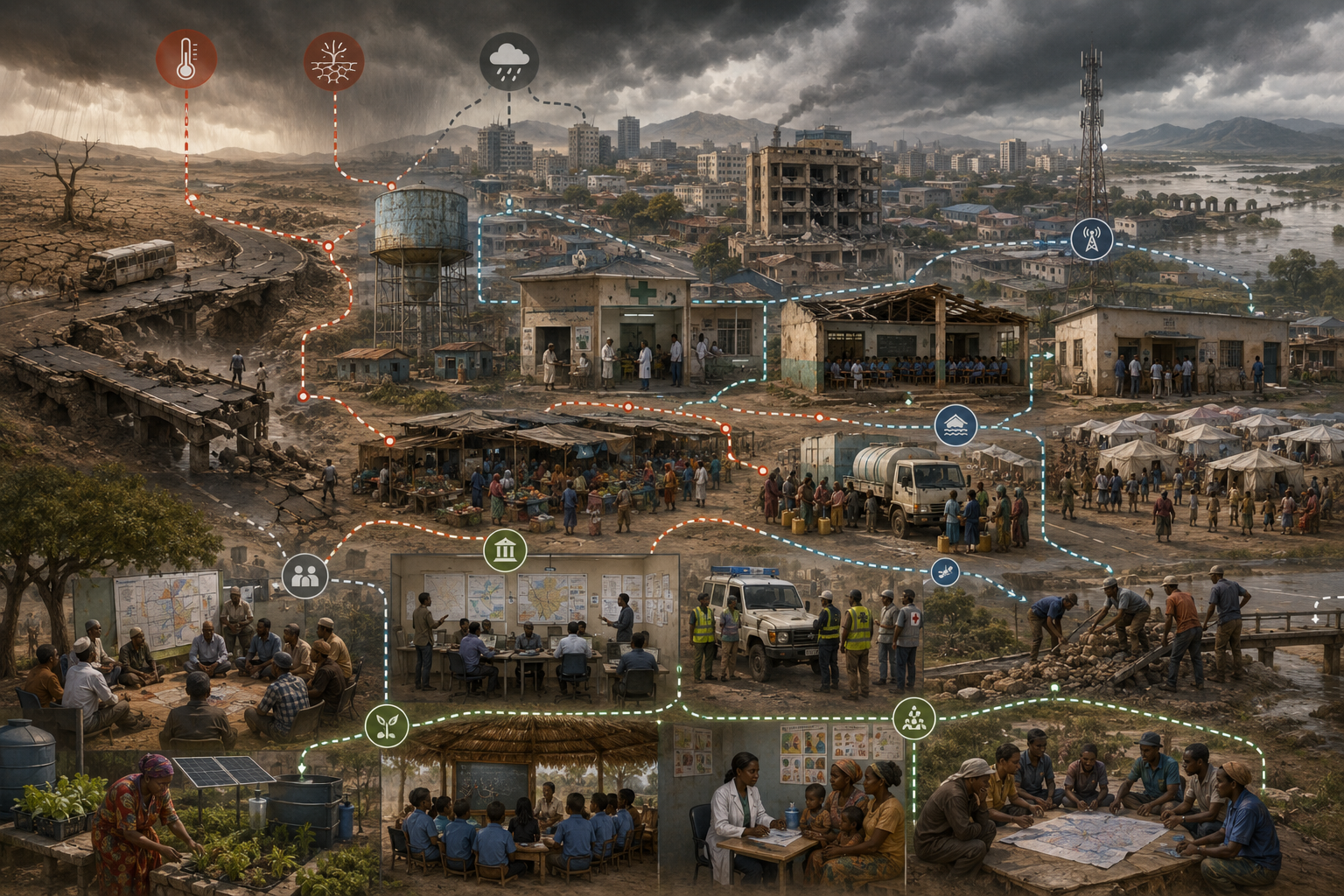
Conflict, fragility, and resilience under stress belong together because violent conflict is rarely only a security problem, and fragility is rarely only institutional weakness. Conflict degrades the public systems needed to manage risk. Fragility emerges where exposure to risk exceeds the capacity of states, communities, institutions, and social systems to manage, absorb, or mitigate those risks. Resilience under stress depends on whether governance, service delivery, local legitimacy, public finance, infrastructure, early warning, social protection, and community networks remain strong enough to prevent crisis from widening into system breakdown.
Conflict becomes system-degrading when it interrupts the institutions that sustain continuity: health services, schools, water systems, food markets, roads, civil registration, local administration, courts, public finance, emergency response, and trusted communication. Governance failure becomes dangerous when institutions lose the ability to coordinate across stress, maintain legitimacy, deliver basic services, and prevent grievances from hardening into violence. The most severe breakdowns occur when conflict, weak governance, poverty, displacement, environmental stress, disaster risk, and public distrust reinforce one another.
Main Library
Publications
Article Map
Risk & Resilience
Related Topic
Sustainable Development
Related Topic
Planetary Boundaries
Related Topic
Systems Thinking
This article builds on What Is Risk and Resilience in Sustainable Systems? by examining what happens when institutional capacity, legitimacy, and service continuity are weakened under conflict pressure. It connects closely with Social Vulnerability and Risk Distribution, Compound Climate Events and Cascading Social Risk, Water Security, Drought, Flood, and Resilience, and Food System Fragility and Resilience, because conflict and fragility often turn climate, water, food, health, and infrastructure shocks into cascading social crises.
The central argument is that resilience in fragile and conflict-affected settings cannot be reduced to restoring security alone. Security matters, but durable resilience also depends on core government functions, local governance, service continuity, trusted institutions, inclusive recovery, livelihood protection, displacement support, social protection, and the ability to manage overlapping risks before they become mutually reinforcing breakdowns.
Why Conflict, Fragility, and Resilience Matter
Conflict, fragility, and resilience matter because many of the deepest development reversals occur where violence and weak governance interact. Conflict damages infrastructure, interrupts services, displaces people, weakens markets, fragments authority, and diverts public resources from long-term investment into emergency response or militarized control. Fragility reduces the capacity of institutions and communities to anticipate, absorb, adapt to, and recover from stress. When both are present, the result is not only insecurity; it is widening systemic vulnerability.
Fragility should be understood as a multidimensional condition. It can be political, economic, environmental, security-related, societal, and human at the same time. A place may face weak public finance, poor service delivery, distrust in institutions, exposure to climate hazards, food insecurity, displacement, criminal violence, and limited local governance capacity all at once. These dimensions reinforce one another. Security problems can become food problems. Food problems can become legitimacy problems. Legitimacy problems can become governance problems. Governance problems can become further security problems.
This is why conflict cannot be treated only as a battlefield event. It is also a breakdown in the systems that allow societies to coordinate under stress. Roads close, clinics lose staff, public employees go unpaid, schools shut down, water systems fail, local markets fragment, and public records disappear. People may survive the direct violence only to face hunger, disease, displacement, lost documentation, interrupted education, and long-term exclusion from recovery.
Resilience under stress therefore requires more than rebuilding damaged assets after conflict. It requires strengthening the ability of institutions and communities to preserve essential functions while under pressure. That includes service continuity, legitimate authority, local problem-solving, inclusive public finance, social protection, early warning, dispute resolution, and trust. A society is resilient not because it avoids all conflict or stress, but because it retains enough legitimate coordinating capacity to keep stress from becoming irreversible breakdown.
What Fragility Means
Fragility refers to a condition in which exposure to risk exceeds the resilience capacity of a state, system, community, or institution to manage, absorb, or mitigate that risk. It is not synonymous with poverty, conflict, or weak government alone, though it often overlaps with all three. Fragility is a relationship between pressure and capacity.
A fragile system may appear functional under normal conditions but fail under stress. Public agencies may exist, but lack money, staffing, trust, data, local reach, or legal authority. Infrastructure may operate, but without maintenance or redundancy. Markets may function, but collapse quickly when roads close or prices rise. Health systems may provide routine care, but fail under displacement, epidemic pressure, violence, or supply shortages. Local institutions may mediate disputes, but become overwhelmed when conflict, climate, and livelihood stress converge.
Fragility is also spatially uneven. National institutions may function in capitals while rural, border, peri-urban, or marginalized regions experience very different levels of service, security, and public trust. Some communities may rely on customary authorities, local councils, armed groups, religious institutions, NGOs, mutual aid, or informal governance to meet needs when formal systems are absent or contested. Resilience analysis must therefore avoid assuming that the state is equally present everywhere.
Fragility is dynamic. It can deepen through repeated shocks, unequal recovery, corruption, exclusion, austerity, climate stress, forced displacement, or conflict recurrence. It can also be reduced through inclusive institutions, credible service delivery, fair public finance, accountable local governance, livelihood support, social protection, disaster-risk reduction, peacebuilding, and public trust. The question is not whether a place is permanently fragile. The question is what systems are producing fragility and what capacities can reduce it.
This distinction matters ethically. Fragility should not be used as a label that blames people or places for their condition. It should be used to identify where risk is concentrated and where institutions, public investment, and international support must be redesigned to reduce unequal exposure and strengthen resilience.
Conflict as Systemic Risk
Conflict is systemic risk because it damages the relationships among institutions, services, infrastructure, livelihoods, public trust, and social order. A conflict event may begin as political violence, armed confrontation, criminal violence, insurgency, repression, intercommunal conflict, or civil war. But its consequences move through the full system.
Conflict can interrupt food supply chains, damage roads, prevent farmers from planting, restrict market access, disrupt water systems, close schools, displace health workers, weaken disease surveillance, reduce tax revenue, and increase public debt. It can also fragment authority. When people no longer know which institution can protect them, resolve disputes, provide services, or distribute aid fairly, legitimacy declines and parallel authorities may gain influence.
Conflict also changes time horizons. Households focus on survival. Businesses reduce investment. Public agencies postpone maintenance. Skilled workers flee. Young people lose education. Farmers sell assets. Health conditions go untreated. Infrastructure deteriorates. What begins as emergency adaptation can become long-term vulnerability.
The systemic nature of conflict is especially visible in cascading failures. A bridge closure may prevent food from reaching markets. Food scarcity may raise prices. Price increases may increase household debt and grievance. Grievance may deepen distrust. Distrust may reduce compliance with public guidance. Weak compliance may undermine emergency response. A single disruption can move through many systems because the systems are connected.
Resilience under conflict therefore requires protecting critical functions, not merely ending immediate violence. That means safeguarding health systems, water systems, food access, documentation, education, local administration, communication channels, public finance, and community protection. The purpose is to prevent conflict from turning every other risk into a deeper crisis.
Governance Failure and Core Functions
Governance failure does not mean that every institution disappears. It means that institutions no longer perform core coordinating, protective, administrative, and service functions reliably enough to sustain legitimacy and continuity under stress. The state may still exist formally, but public capacity becomes uneven, contested, extractive, absent, or distrusted.
Core government functions matter because they are the machinery of resilience. Public financial management determines whether resources can be mobilized and allocated under stress. Civil service systems determine whether public workers can keep operating. Local governance determines whether national decisions reach communities. Aid coordination determines whether external support reinforces or bypasses public capacity. Security sector management determines whether protection is legitimate or predatory. Civil registration and documentation determine whether people can access rights, aid, education, property, and mobility.
When these functions weaken, even strong policy language may fail in practice. A government may have a disaster plan but lack local staff, vehicles, data, trust, or money to implement it. A health policy may exist but fail because clinics are damaged, workers unpaid, supply chains broken, and patients displaced. A social protection program may exist but exclude people who lost documents or live outside official registries.
Governance failure also produces uncertainty. People cannot plan when rules change unpredictably, services are unreliable, corruption is common, and protection depends on status or connection. This uncertainty lowers adaptive capacity. Households, firms, farmers, and local institutions may avoid long-term investment because the system no longer feels trustworthy.
Resilient governance is therefore not simply a matter of stronger central authority. It requires legitimate authority, accountable administration, local reach, fair service delivery, inclusive public finance, anti-corruption safeguards, meaningful participation, and the ability to coordinate across levels of government and society. Under stress, legitimacy becomes as important as capacity. Institutions must be able to act, but they must also be believed.
Services, Legitimacy, and Public Trust
Public services are one of the most important links between governance and resilience. Water, sanitation, health care, education, civil registration, social protection, local dispute resolution, transport, electricity, and emergency response are not only technical services. They are the everyday ways people encounter institutions. When services work fairly, they can strengthen legitimacy. When they fail repeatedly or unequally, they can deepen grievance.
In fragile and conflict-affected settings, service continuity is often difficult but essential. Clinics may lose staff or supplies. Schools may close or become unsafe. Water systems may be damaged. Local administrators may flee. Records may be destroyed. Aid may be distributed unevenly. Public employees may go unpaid. These failures are not merely administrative; they affect whether people see institutions as protective, indifferent, predatory, or absent.
Trust matters because resilience depends on cooperation. People are more likely to follow warnings, evacuate, vaccinate, share information, participate in planning, and use public services when they trust the institutions communicating with them. When trust collapses, even technically sound programs may fail. Communities may rely on informal networks, local leaders, religious institutions, armed actors, NGOs, or mutual aid instead.
Legitimacy is not created by service delivery alone. It also depends on fairness, voice, rights, accountability, and recognition. A service may be delivered, but if it is delivered selectively, corruptly, violently, or without respect, it may not build trust. Resilience requires institutions that protect people with dignity, not merely institutions that distribute goods.
Service continuity should therefore be treated as resilience infrastructure. Keeping clinics open, water flowing, schools functioning, records protected, and social assistance accessible can prevent deeper breakdown. The question is not only how to rebuild after collapse, but how to keep essential functions alive while stress is unfolding.
Local Governance and Hybrid Authority
Local governance is central to resilience because conflict and fragility are experienced in specific places. National strategies matter, but people encounter risk through municipalities, districts, villages, neighborhoods, customary institutions, service providers, local civil society, and community networks. Local actors often know where roads fail, which families are displaced, which water points are unsafe, which groups are excluded, and which warnings will be trusted.
In fragile settings, authority is often hybrid. Formal state institutions may coexist with customary authorities, religious leaders, community committees, NGOs, armed groups, private providers, humanitarian agencies, and informal networks. Some of these actors may protect communities; others may exploit them. Resilience planning must therefore understand the real governance landscape rather than assuming a clean institutional hierarchy.
Local governance can reduce fragility when it provides accessible dispute resolution, trusted communication, inclusive planning, local service coordination, community participation, and early identification of stress. It can also deepen fragility if local authorities are exclusionary, captured, abusive, corrupt, or aligned with violence. Local legitimacy must therefore be examined, not assumed.
A resilient approach supports local capacity without abandoning national responsibility. Local systems need resources, legal recognition, training, data, and protection. National systems need to provide fiscal support, standards, rights protections, and coordination. International actors need to avoid bypassing local institutions in ways that weaken long-term capacity, while also avoiding support for abusive or exclusionary structures.
The challenge is multi-scalar. Community networks may be strong but unable to repair major infrastructure. National ministries may have formal authority but weak local reach. Humanitarian agencies may provide short-term services but lack legitimacy for long-term governance. Resilience under stress requires connecting these scales without pretending that one level can solve fragility alone.
Displacement, Livelihoods, and Cumulative Harm
Conflict and fragility often produce displacement, and displacement can deepen system breakdown. People may flee violence, persecution, drought, flood, food insecurity, economic collapse, or a combination of pressures. Once displaced, they may lose housing, land, documents, livelihoods, schools, healthcare, social networks, voting access, and legal protection. Displacement is therefore not only movement. It is a reorganization of vulnerability.
Livelihood disruption is one of the main pathways through which conflict becomes long-term fragility. Farmers may lose land access, seeds, tools, livestock, irrigation, or market routes. Traders may lose transport corridors. Workers may lose wages, documentation, or safe mobility. Small businesses may lose customers, credit, and inventory. Public workers may go unpaid or flee. As livelihoods collapse, households sell assets, take on debt, reduce food intake, withdraw children from school, or migrate again.
Cumulative harm is especially important. A household may survive conflict, then face food inflation, then illness, then displacement, then loss of documents, then exclusion from aid. Each stress reduces capacity for the next. Fragility therefore deepens not only through single dramatic events, but through stacked losses that narrow options over time.
Cumulative harm also affects institutions. Public agencies lose staff, records, revenue, buildings, equipment, and legitimacy. Schools lose students and teachers. Health systems lose supply chains and trust. Local governments lose tax bases and administrative continuity. The longer fragility persists, the harder it becomes to restore normal coordination.
Resilience under stress must therefore protect livelihoods, documentation, mobility, social protection, and recovery rights. Displaced people should not be treated as temporary exceptions to governance. They are part of the system’s resilience challenge. If displacement is mismanaged, it can become a long-term driver of exclusion, poverty, grievance, and instability.
Climate, Disaster Risk, and Conflict Settings
Climate and disaster risk become more dangerous in fragile and conflict-affected settings because the institutions needed to manage hazards are often weakened. Floods, droughts, heatwaves, storms, disease outbreaks, and food shocks are harder to anticipate, communicate, absorb, and recover from when governance is fragmented, infrastructure damaged, trust low, and displacement widespread.
This does not mean climate change mechanically causes conflict. The stronger argument is that climate and environmental stress can interact with governance weakness, livelihood fragility, exclusion, inequality, resource pressure, displacement, and political instability. A drought may not produce violence by itself, but it can worsen food insecurity, debt, migration, and grievance in settings where institutions cannot respond fairly. A flood may not produce conflict by itself, but it can expose unequal protection, weak recovery, or contested authority.
Disaster risk reduction is also more difficult in conflict settings. State-centered frameworks may assume that public institutions have the reach, legitimacy, and capacity to manage risk. In fragile contexts, that assumption may not hold. Local authorities may be contested. Data may be incomplete. Infrastructure may be inaccessible. Humanitarian access may be restricted. Communities may distrust official warnings. Armed actors may control territory. These conditions require more flexible, politically aware risk governance.
Climate adaptation must therefore be conflict-sensitive and fragility-aware. Adaptation projects should avoid worsening land disputes, exclusion, displacement, or resource capture. Water projects should consider local power. Food programs should consider market effects and group tensions. Infrastructure projects should consider who is protected and who remains exposed. Nature-based solutions should respect rights and avoid dispossession.
The deeper lesson is that resilience tools are not portable without context. Early warning, social protection, infrastructure investment, climate adaptation, and disaster-risk reduction all depend on governance conditions. In fragile contexts, resilience design must begin with the reality of contested authority, unequal trust, and degraded public capacity.
Early Warning and Anticipatory Action
Early warning and anticipatory action are essential in fragile and conflict-affected settings, but they are also harder to implement there. A warning system requires monitoring, data, communication channels, trusted messengers, local interpretation, accessible language, disability inclusion, transport options, shelters, response capacity, and follow-through. Conflict can weaken every part of that chain.
A technically accurate warning may fail if people do not receive it, cannot act on it, or do not trust the source. A flood warning does not help if roads are blocked, bridges destroyed, shelters unsafe, or armed groups restrict movement. A drought warning does not help if social protection cannot scale, food markets are disrupted, or local authorities lack resources. A heat warning does not help if people cannot access cooling, water, healthcare, or safe shelter.
Anticipatory action therefore requires linking forecasts to resources. Information must trigger practical support: cash transfers, food assistance, water distribution, evacuation transport, health outreach, livestock support, school protection, shelter preparation, and infrastructure safeguards. Without pre-arranged action, early warning becomes early knowledge without early protection.
Fragile settings also require trusted local communication. Communities may rely on radio, religious leaders, local committees, health workers, mutual aid networks, customary authorities, women’s groups, youth groups, or humanitarian partners more than central agencies. Warning systems should use channels that people trust and understand. They must also account for language, disability, literacy, gender, mobility, and fear of authorities.
Early warning is therefore not only a technical system. It is a governance system. Its success depends on whether knowledge, trust, authority, finance, logistics, and local capacity are connected before disaster arrives. In fragile settings, anticipatory action can save lives, but only if it is designed around the actual social and political conditions in which people live.
Toward Resilience Under Stress
Resilience under stress requires strengthening the systems that prevent conflict, fragility, and disaster risk from reinforcing one another. It begins with core governance functions: public finance, civil service continuity, local administration, security sector accountability, aid coordination, and service delivery. These functions may sound bureaucratic, but they determine whether plans become action.
Second, resilience requires service continuity. Health, water, sanitation, education, food access, documentation, social protection, local dispute resolution, and communication must be protected before, during, and after conflict. Services are not only development outputs. They are stabilizing systems that help preserve dignity, trust, and social continuity.
Third, resilience requires local legitimacy. Communities must be able to shape decisions that affect protection, aid, reconstruction, adaptation, and recovery. Local governance should not be romanticized, but it should be taken seriously. Real resilience often depends on local actors who understand social networks, risks, grievances, and practical constraints.
Fourth, resilience requires prevention. Waiting for collapse is costly and unjust. Fragility-informed systems should monitor governance stress, service disruption, displacement, food insecurity, climate hazards, conflict signals, and public trust. They should support anticipatory action before crisis hardens into breakdown.
Fifth, resilience requires justice. Conflict and fragility often concentrate harm among people already facing poverty, marginalization, displacement, discrimination, disability exclusion, gendered violence, or environmental exposure. Recovery that ignores these inequalities may restore institutions while leaving the underlying drivers of fragility intact.
Finally, resilience under stress requires humility. External actors cannot build legitimacy by technical design alone. Resilience must be grounded in context, history, local power, rights, and long-term accountability. The goal is not merely to make fragile systems return to a prior condition. It is to reduce the conditions that made them fragile in the first place.
Mathematical Lens: Conflict, Fragility, and Resilience Under Stress
Conflict, fragility, and resilience under stress can be represented as relationships among conflict intensity, governance capacity, service continuity, legitimacy, institutional reach, social vulnerability, displacement pressure, livelihood stress, disaster exposure, and recovery capacity. Let \(C_i\) represent conflict intensity for system or region \(i\), \(G_i\) governance capacity, \(S_i\) service continuity, \(L_i\) institutional legitimacy, \(A_i\) administrative reach, \(V_i\) social vulnerability, \(D_i\) displacement pressure, \(P_i\) livelihood pressure, \(H_i\) hazard or disaster exposure, and \(R_i\) recovery capacity.
A fragility pressure score can be written as:
F_i = f_1C_i + f_2V_i + f_3D_i + f_4P_i + f_5H_i
\]
Interpretation: Fragility pressure rises when conflict, vulnerability, displacement, livelihood stress, and hazard exposure accumulate.
A governance resilience score can be represented as:
Q_i = q_1G_i + q_2S_i + q_3L_i + q_4A_i + q_5R_i
\]
Interpretation: Governance resilience increases when institutions retain capacity, services continue, legitimacy remains credible, administrative reach is preserved, and recovery systems are accessible.
A conflict-amplified systemic risk score can be written as:
K_i = F_i(1 + \alpha C_i)(1 – \beta Q_i)
\]
Interpretation: Systemic risk increases when conflict amplifies existing fragility and decreases when governance resilience is strong enough to contain stress.
A service breakdown score can be represented as:
B_i = \max(0, E_i – S_i)
\]
Interpretation: A service breakdown gap appears when essential-service demand and disruption exceed service-continuity capacity.
A legitimacy erosion score can be written as:
Z_i = z_1B_i + z_2U_i + z_3X_i – z_4T_i
\]
Interpretation: Legitimacy erosion rises when service breakdown, unequal treatment, and exclusion increase, and falls when public trust is sustained.
A resilience-under-stress gap can then be represented as:
\Delta_i = \max(0, K_i + B_i + Z_i – Q_i)
\]
Interpretation: A resilience gap appears when conflict-amplified systemic risk, service breakdown, and legitimacy erosion exceed governance resilience.
| Term | Meaning | Interpretive role |
|---|---|---|
| \(F_i\) | Fragility pressure | Represents conflict, vulnerability, displacement, livelihood stress, and hazard exposure. |
| \(Q_i\) | Governance resilience | Represents institutional capacity, service continuity, legitimacy, administrative reach, and recovery capacity. |
| \(K_i\) | Conflict-amplified systemic risk | Represents the way conflict multiplies wider system stress. |
| \(B_i\) | Service breakdown gap | Represents unmet essential-service demand under disruption. |
| \(Z_i\) | Legitimacy erosion | Represents declining trust produced by service failure, unequal treatment, and exclusion. |
| \(\Delta_i\) | Resilience-under-stress gap | Identifies where conflict-amplified risk and governance failure exceed the system’s ability to preserve continuity. |
This mathematical lens is not meant to reduce conflict, legitimacy, or governance to a single number. It clarifies the structure of analysis: conflict becomes systemically dangerous when it amplifies fragility faster than governance, services, legitimacy, and recovery capacity can contain it.
Advanced Python Workflow: Fragility and Governance Breakdown Diagnostics
The following Python workflow models conflict, fragility, and resilience under stress as relationships among conflict intensity, governance capacity, service continuity, legitimacy, administrative reach, social vulnerability, displacement pressure, livelihood stress, hazard exposure, recovery capacity, public trust, inequality pressure, and repeated disruption.
from pathlib import Path
import numpy as np
import pandas as pd

BASE_DIR = Path("articles/conflict-fragility-and-resilience-under-stress")
DATA_FILE = BASE_DIR / "data" / "conflict_fragility_resilience_panel.csv"
OUTPUT_DIR = BASE_DIR / "outputs"


def load_data():
    df = pd.read_csv(DATA_FILE)

    numeric_cols = [
        col for col in df.columns
        if col not in {"system_id", "system_name", "region", "fragility_context"}
    ]

    for col in numeric_cols:
        if ((df[col] < 0) | (df[col] > 1)).any():
            raise ValueError(f"{col} must be scaled between 0 and 1.")

    return df


def score_systems(df):
    scored = df.copy()

    scored["fragility_pressure"] = (
        0.24 * scored["conflict_intensity"]
        + 0.20 * scored["social_vulnerability"]
        + 0.18 * scored["displacement_pressure"]
        + 0.18 * scored["livelihood_stress"]
        + 0.20 * scored["hazard_exposure"]
    )

    scored["governance_resilience"] = (
        0.24 * scored["governance_capacity"]
        + 0.22 * scored["service_continuity"]
        + 0.20 * scored["institutional_legitimacy"]
        + 0.18 * scored["administrative_reach"]
        + 0.16 * scored["recovery_capacity"]
    )

    scored["conflict_amplified_systemic_risk"] = (
        scored["fragility_pressure"]
        * (1 + 0.45 * scored["conflict_intensity"])
        * (1 - 0.35 * scored["governance_resilience"])
    )

    scored["service_breakdown_gap"] = np.maximum(
        0,
        scored["essential_service_demand"] - scored["service_continuity"],
    )

    scored["legitimacy_erosion"] = (
        0.30 * scored["service_breakdown_gap"]
        + 0.26 * scored["inequality_pressure"]
        + 0.24 * scored["institutional_exclusion"]
        - 0.20 * scored["public_trust"]
    ).clip(0, 1.5)

    scored["resilience_under_stress_gap"] = np.maximum(
        0,
        scored["conflict_amplified_systemic_risk"]
        + scored["service_breakdown_gap"]
        + scored["legitimacy_erosion"]
        - scored["governance_resilience"],
    )

    scored["diagnostic_priority"] = np.select(
        [
            scored["conflict_intensity"] > 0.72,
            scored["service_continuity"] < 0.42,
            scored["institutional_legitimacy"] < 0.42,
            scored["administrative_reach"] < 0.42,
            scored["displacement_pressure"] > 0.70,
            scored["resilience_under_stress_gap"] > 0.75,
        ],
        [
            "conflict_prevention_and_protection",
            "restore_essential_service_continuity",
            "repair_legitimacy_and_public_trust",
            "strengthen_administrative_reach",
            "protect_displaced_people_and_livelihoods",
            "close_resilience_under_stress_gap",
        ],
        default="monitor_and_strengthen_fragility_resilience",
    )

    return scored.sort_values(
        ["resilience_under_stress_gap", "conflict_amplified_systemic_risk"],
        ascending=False,
    ).reset_index(drop=True)


def main():
    OUTPUT_DIR.mkdir(parents=True, exist_ok=True)

    raw = load_data()
    scored = score_systems(raw)

    region_summary = (
        scored.groupby("region")
        .agg(
            systems=("system_id", "count"),
            mean_fragility_pressure=("fragility_pressure", "mean"),
            mean_governance_resilience=("governance_resilience", "mean"),
            mean_systemic_risk=("conflict_amplified_systemic_risk", "mean"),
            mean_service_gap=("service_breakdown_gap", "mean"),
            mean_resilience_gap=("resilience_under_stress_gap", "mean"),
        )
        .reset_index()
        .sort_values("mean_resilience_gap", ascending=False)
    )

    scored.to_csv(OUTPUT_DIR / "conflict_fragility_resilience_scores.csv", index=False)
    region_summary.to_csv(OUTPUT_DIR / "conflict_fragility_region_summary.csv", index=False)

    print(scored.round(3).to_string(index=False))
    print(region_summary.round(3).to_string(index=False))


if __name__ == "__main__":
    main()
This workflow operationalizes the article’s central claim: conflict becomes systemically dangerous when it amplifies fragility faster than governance, service continuity, legitimacy, administrative reach, and recovery capacity can contain it. It separates fragility pressure from governance resilience so the analysis does not treat fragile contexts as deficient alone; it identifies which capacities can reduce breakdown.
Advanced R Workflow: Conflict-Fragility Dashboarding
The following R workflow creates dashboard-ready outputs for comparing fragility pressure, governance resilience, conflict-amplified systemic risk, service breakdown gaps, legitimacy erosion, resilience-under-stress gaps, regional summaries, context summaries, and long-format visualization data.
library(readr)
library(dplyr)
library(tidyr)

base_dir <- "articles/conflict-fragility-and-resilience-under-stress"
data_file <- file.path(base_dir, "data", "conflict_fragility_resilience_panel.csv")
output_dir <- file.path(base_dir, "outputs")

dir.create(output_dir, recursive = TRUE, showWarnings = FALSE)

systems <- read_csv(data_file, show_col_types = FALSE)

score_systems <- function(df) {
  df %>%
    mutate(
      fragility_pressure =
        0.24 * conflict_intensity +
        0.20 * social_vulnerability +
        0.18 * displacement_pressure +
        0.18 * livelihood_stress +
        0.20 * hazard_exposure,

      governance_resilience =
        0.24 * governance_capacity +
        0.22 * service_continuity +
        0.20 * institutional_legitimacy +
        0.18 * administrative_reach +
        0.16 * recovery_capacity,

      conflict_amplified_systemic_risk =
        fragility_pressure *
        (1 + 0.45 * conflict_intensity) *
        (1 - 0.35 * governance_resilience),

      service_breakdown_gap =
        pmax(0, essential_service_demand - service_continuity),

      legitimacy_erosion =
        pmin(
          1.5,
          pmax(
            0,
            0.30 * service_breakdown_gap +
            0.26 * inequality_pressure +
            0.24 * institutional_exclusion -
            0.20 * public_trust
          )
        ),

      resilience_under_stress_gap =
        pmax(
          0,
          conflict_amplified_systemic_risk +
          service_breakdown_gap +
          legitimacy_erosion -
          governance_resilience
        ),

      diagnostic_priority = case_when(
        conflict_intensity > 0.72 ~
          "conflict_prevention_and_protection",
        service_continuity < 0.42 ~
          "restore_essential_service_continuity",
        institutional_legitimacy < 0.42 ~
          "repair_legitimacy_and_public_trust",
        administrative_reach < 0.42 ~
          "strengthen_administrative_reach",
        displacement_pressure > 0.70 ~
          "protect_displaced_people_and_livelihoods",
        resilience_under_stress_gap > 0.75 ~
          "close_resilience_under_stress_gap",
        TRUE ~
          "monitor_and_strengthen_fragility_resilience"
      )
    ) %>%
    arrange(desc(resilience_under_stress_gap), desc(conflict_amplified_systemic_risk))
}

scored <- score_systems(systems)

region_summary <- scored %>%
  group_by(region) %>%
  summarise(
    systems = n(),
    mean_fragility_pressure = mean(fragility_pressure),
    mean_governance_resilience = mean(governance_resilience),
    mean_systemic_risk = mean(conflict_amplified_systemic_risk),
    mean_service_gap = mean(service_breakdown_gap),
    mean_resilience_gap = mean(resilience_under_stress_gap),
    .groups = "drop"
  ) %>%
  arrange(desc(mean_resilience_gap))

context_summary <- scored %>%
  group_by(fragility_context) %>%
  summarise(
    systems = n(),
    mean_conflict_intensity = mean(conflict_intensity),
    mean_service_continuity = mean(service_continuity),
    mean_legitimacy = mean(institutional_legitimacy),
    mean_fragility_pressure = mean(fragility_pressure),
    mean_resilience_gap = mean(resilience_under_stress_gap),
    .groups = "drop"
  ) %>%
  arrange(desc(mean_resilience_gap))

dashboard_long <- scored %>%
  select(
    system_id,
    system_name,
    region,
    fragility_context,
    fragility_pressure,
    governance_resilience,
    conflict_amplified_systemic_risk,
    service_breakdown_gap,
    legitimacy_erosion,
    resilience_under_stress_gap
  ) %>%
  pivot_longer(
    cols = c(
      fragility_pressure,
      governance_resilience,
      conflict_amplified_systemic_risk,
      service_breakdown_gap,
      legitimacy_erosion,
      resilience_under_stress_gap
    ),
    names_to = "metric",
    values_to = "value"
  )

write_csv(scored, file.path(output_dir, "r_conflict_fragility_resilience_scores.csv"))
write_csv(region_summary, file.path(output_dir, "r_region_summary.csv"))
write_csv(context_summary, file.path(output_dir, "r_context_summary.csv"))
write_csv(dashboard_long, file.path(output_dir, "r_dashboard_long.csv"))

print(scored)
print(region_summary)
print(context_summary)
The R workflow complements the Python workflow by producing dashboard-oriented outputs. It is especially useful for comparing conflict-affected regions, fragile governance contexts, displacement corridors, climate-conflict zones, service-continuity systems, and institutional-recovery priorities. A production version could connect to conflict-event data, displacement records, public-service continuity indicators, fiscal data, local governance assessments, early-warning systems, food security data, infrastructure status, and recovery-program outcomes.
Engineering Extensions in the GitHub Repository
The accompanying repository can extend the article beyond conceptual explanation into reproducible conflict-fragility and governance-resilience analysis. The article folder is designed around a synthetic fragility indicator panel, advanced Python diagnostics, advanced R dashboarding, SQL schema scaffolding, scenario outputs, uncertainty analysis, documentation, and extensible scoring logic.
The article body foregrounds Python and R because they are accessible languages for data analysis, scenario modeling, uncertainty analysis, and dashboard preparation. Additional languages can strengthen the repository where they serve a real analytical purpose. SQL can support structured records for systems, conflict events, governance indicators, service continuity, displacement, recovery programs, source provenance, and auditability. Go can support lightweight scoring services. Rust can support reliable command-line validation tools. C and C++ can support compact numerical kernels for fragility-risk scoring. Fortran can support numerical resilience-gap calculations and legacy scientific-computing workflows where useful.
The deeper purpose of the repository is not to turn conflict or governance legitimacy into false precision. It is to make assumptions visible. By separating conflict intensity, governance capacity, service continuity, legitimacy, administrative reach, social vulnerability, displacement, livelihood stress, hazard exposure, recovery capacity, inequality, and public trust, the workflow allows users to inspect how final interpretations are produced.
GitHub Repository
Complete Code Repository
The full code directory for this article, including advanced Python diagnostics, advanced R dashboard workflow, synthetic conflict-fragility data, SQL schema, scenario outputs, uncertainty analysis, documentation, and systems-level extensions, is available on GitHub.
Common Misunderstandings
A common misunderstanding is that conflict is only a security problem. Conflict is also a governance, service-delivery, livelihood, displacement, public-health, infrastructure, and legitimacy problem.
Another misunderstanding is that fragility means a state has simply failed. Fragility is better understood as exposure to risk combined with insufficient resilience capacity to manage, absorb, or mitigate that risk.
A third misunderstanding is that restoring order is the same as building resilience. Order without legitimacy, fair service delivery, rights protection, and local trust may suppress symptoms while leaving fragility intact.
A fourth misunderstanding is that local governance is automatically resilient. Local institutions may be trusted and adaptive, but they can also be captured, exclusionary, underfunded, or threatened. Local legitimacy must be examined rather than assumed.
A fifth misunderstanding is that climate and disaster risk can be managed separately from conflict. In fragile contexts, hazards, displacement, food insecurity, weak services, and contested authority often interact.
A final misunderstanding is that resilience means returning to pre-conflict conditions. If those conditions produced exclusion, grievance, and weak governance, resilience requires transformation rather than restoration alone.
Conclusion
Conflict, fragility, and resilience under stress must be understood as a systems problem. Conflict damages the institutions needed to manage risk, while fragility increases the likelihood that shocks will spread across services, infrastructure, livelihoods, public health, food systems, water systems, displacement, and trust. Governance failure does not simply accompany breakdown; it helps determine whether stress can be contained.
The central lesson is that resilience in fragile and conflict-affected settings depends on preserving legitimate coordination under pressure. Core government functions, service continuity, local governance, public trust, recovery capacity, social protection, early warning, and livelihood support are not secondary to security. They are the systems that prevent insecurity from becoming wider social collapse.
The computational workflows attached to this article extend that argument into practice. They separate fragility pressure, governance resilience, conflict-amplified systemic risk, service breakdown gaps, legitimacy erosion, and resilience-under-stress gaps. They show why some systems require conflict prevention and protection, some require essential-service continuity, some require legitimacy repair, some require stronger administrative reach, and some require stronger protection for displaced people and livelihoods.
Resilience under stress is not simply the ability to endure conflict. It is the ability to prevent conflict, governance failure, and cascading risk from destroying the institutional and social conditions that make recovery possible.
Return to the Risk & Resilience knowledge series.
Related Reading
- Risk & Resilience
- What Is Risk and Resilience in Sustainable Systems?
- Social Vulnerability and Risk Distribution
- Compound Climate Events and Cascading Social Risk
- Water Security, Drought, Flood, and Resilience
- Food System Fragility and Resilience
- Ecosystem Resilience and Natural Buffers
- Nature-Based Solutions, Ecosystem Buffers, and Resilience
- Sustainable Development
- Systems Thinking
Further Reading
- Organisation for Economic Co-operation and Development (2025) States of Fragility 2025. Available at: https://www.oecd.org/en/publications/states-of-fragility-2025_81982370-en.html.
- Organisation for Economic Co-operation and Development (2025) The State of Fragility in 2025. Available at: https://www.oecd.org/en/publications/states-of-fragility-2025_81982370-en/full-report/the-state-of-fragility-in-2025_7cb5662b.html.
- United Nations Development Programme (2025) Strengthening Centres of Government in Fragile and Conflict-Affected Settings. Available at: https://www.undp.org/publications/strengthening-centres-government-fragile-and-conflict-affected-settings.
- United Nations Development Programme (n.d.) Local Governance in Fragile and Conflict-Affected Settings. Available at: https://www.undp.org/publications/local-governance-fragile-and-conflict-affected-settings.
- United Nations Development Programme (n.d.) Governance for Peace: Securing the Social Contract. Available at: https://www.undp.org/publications/governance-peace-securing-social-contract.
- United Nations Office for Disaster Risk Reduction (2019) Disaster Risk Reduction in Contexts of Fragility and Armed Conflict. Available at: https://www.undrr.org/publication/disaster-risk-reduction-contexts-fragility-and-armed-conflict-review-emerging-evidence.
- United Nations Office for Disaster Risk Reduction (2025) Early Warning Systems and Early Action in Fragile, Conflict-Affected and Violent Contexts. Available at: https://www.undrr.org/publication/documents-and-publications/early-warning-systems-and-early-action-fragile-conflict.
- World Bank (n.d.) Fragility, Conflict and Violence. Available at: https://www.worldbank.org/ext/en/topic/fragility-conflict-and-violence.
- World Bank Group (2020) World Bank Group Strategy for Fragility, Conflict, and Violence 2020–2025. Available at: https://www.worldbank.org/en/topic/fragilityconflictviolence/publication/world-bank-group-strategy-for-fragility-conflict-and-violence-2020-2025.
References
- Organisation for Economic Co-operation and Development (2025) States of Fragility 2025. Available at: https://www.oecd.org/en/publications/states-of-fragility-2025_81982370-en.html.
- Organisation for Economic Co-operation and Development (2025) The State of Fragility in 2025. Available at: https://www.oecd.org/en/publications/states-of-fragility-2025_81982370-en/full-report/the-state-of-fragility-in-2025_7cb5662b.html.
- United Nations Development Programme (2025) Strengthening Centres of Government in Fragile and Conflict-Affected Settings. Available at: https://www.undp.org/publications/strengthening-centres-government-fragile-and-conflict-affected-settings.
- United Nations Development Programme (n.d.) Local Governance in Fragile and Conflict-Affected Settings. Available at: https://www.undp.org/publications/local-governance-fragile-and-conflict-affected-settings.
- United Nations Development Programme (n.d.) Governance for Peace: Securing the Social Contract. Available at: https://www.undp.org/publications/governance-peace-securing-social-contract.
- United Nations Office for Disaster Risk Reduction (2019) Disaster Risk Reduction in Contexts of Fragility and Armed Conflict. Available at: https://www.undrr.org/publication/disaster-risk-reduction-contexts-fragility-and-armed-conflict-review-emerging-evidence.
- United Nations Office for Disaster Risk Reduction (2025) Early Warning Systems and Early Action in Fragile, Conflict-Affected and Violent Contexts. Available at: https://www.undrr.org/publication/documents-and-publications/early-warning-systems-and-early-action-fragile-conflict.
- World Bank (n.d.) Fragility, Conflict and Violence. Available at: https://www.worldbank.org/ext/en/topic/fragility-conflict-and-violence.
- World Bank Group (2020) World Bank Group Strategy for Fragility, Conflict, and Violence 2020–2025. Available at: https://www.worldbank.org/en/topic/fragilityconflictviolence/publication/world-bank-group-strategy-for-fragility-conflict-and-violence-2020-2025.