Psychology

Psychology explores the cognitive, emotional, and social processes that shape human behavior. The discipline examines how individuals perceive information, form beliefs, make decisions, interact with others, and respond to complex environments.

Modern psychological research spans multiple domains, including cognitive psychology, behavioral economics, social psychology, and positive psychology. Together, these fields provide insights into decision-making, motivation, learning, and the social dynamics that influence collective behavior.

Understanding psychological processes is essential for designing effective institutions, policies, and communication strategies. Behavioral insights help explain why individuals and groups respond to incentives, social norms, and institutional structures in ways that often diverge from purely rational models.

Psychology therefore plays an important role in fields ranging from public policy and organizational leadership to sustainability governance and technological design.

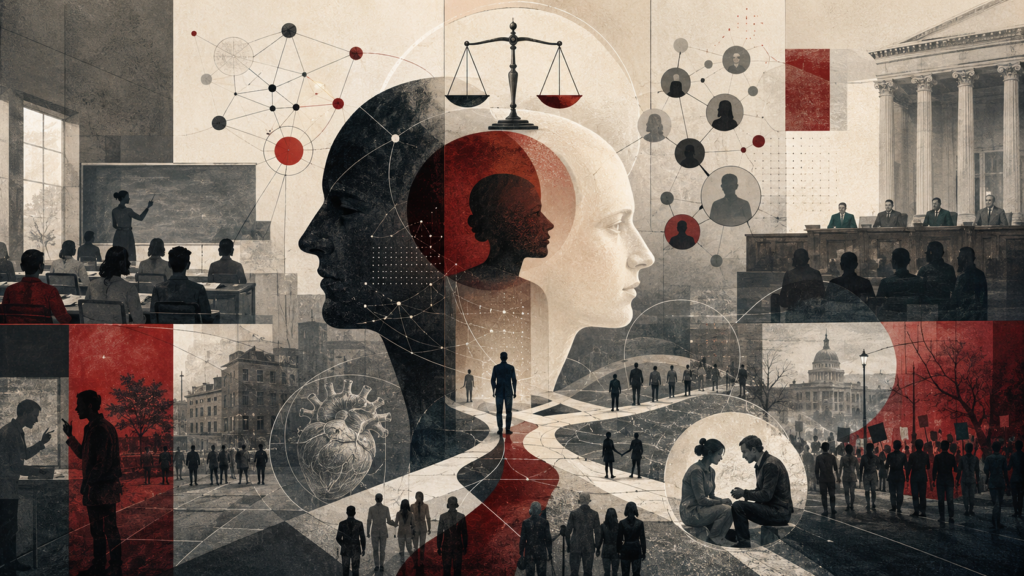
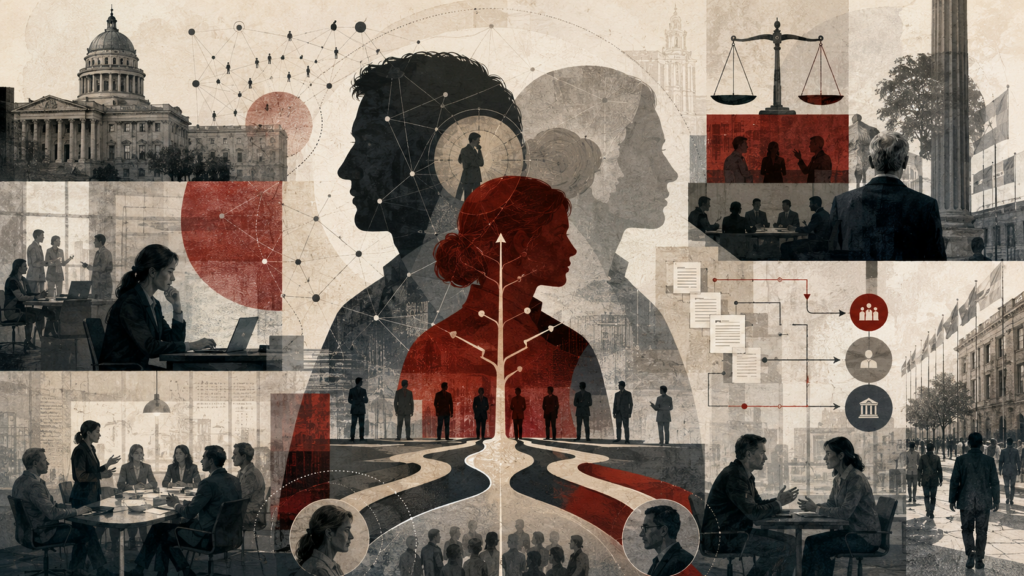
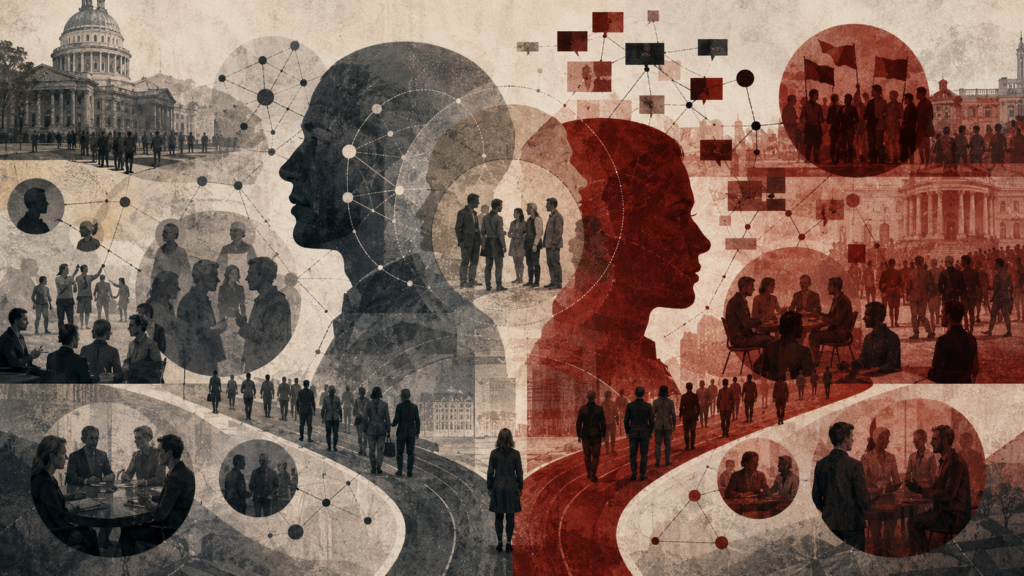
Editorial illustration of social identity and moral polarization, showing opposing human profiles, clustered groups, civic architecture, branching pathways, crowd scenes, and social-network diagrams.

Social Identity, Group Life, and Moral Polarization

Social identity, group life, and moral polarization reveal that moral judgment is never wholly private. People reason as members of groups, parties, professions, movements, and publics, and those identities shape who is trusted, what counts as harm, what feels like betrayal, and which norms seem sacred or negotiable. This article examines how group identity reorganizes moral perception, how ingroup favoritism and threat intensify polarization, and how norms, media environments, and institutions can transform ordinary disagreement into hardened moral conflict. Its central claim is that polarization is not simply a matter of different opinions. It is a morally charged restructuring of social reality through identity, loyalty, and antagonistic group life.

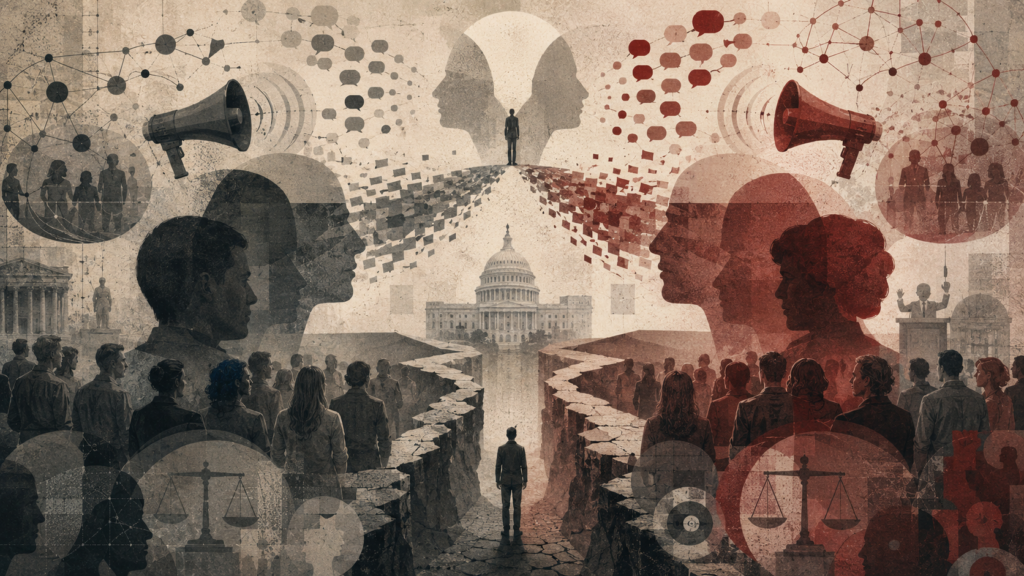
Editorial illustration of cross-cultural moral psychology, showing diverse human profiles, community gatherings, a world-map motif, justice scales, intergenerational care, dialogue, and global connection networks.

Cross-Cultural Moral Psychology

Cross-cultural moral psychology examines how moral judgment, norm enforcement, fairness, harm perception, obligation, and blame vary across societies while still drawing on shared human capacities for norm learning, social evaluation, cooperation, and the interpretation of harm. This article argues that the strongest contemporary view lies between naive universalism and crude relativism. Moral life is neither identical everywhere nor so fragmented that comparison becomes meaningless. Instead, different cultures organize overlapping human capacities through different priorities, institutions, narratives, and social practices. By examining harm, fairness, loyalty, authority, development, group obligation, meta-norms, and cross-cultural disagreement, the article shows how shared moral architecture can generate genuinely different moral worlds.

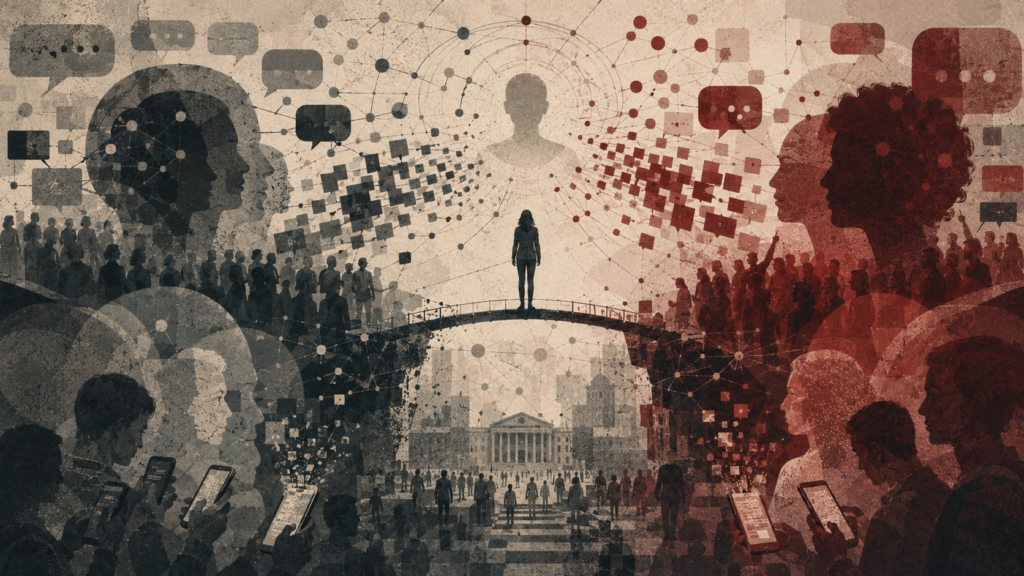
Editorial illustration of moral disagreement and pluralism, showing diverse people in dialogue, overlapping profiles, civic spaces, justice scales, community gatherings, and intersecting social worlds.

Moral Disagreement and the Psychology of Pluralism

Moral disagreement is one of the deepest and most persistent facts of human life. People disagree not only about policies and institutions, but about loyalty, fairness, purity, dignity, justice, freedom, care, and what it means to treat others well. This article examines moral disagreement through the lens of value pluralism and moral psychology, distinguishing pluralism from relativism while showing how moral conflict can arise from different value weightings, social identities, emotional saliences, and cultural frameworks rather than from simple bad faith alone. It argues that disagreement often reflects the genuinely plural structure of moral life and that a serious psychology of pluralism must explain both why sincere people diverge and how institutions can sustain common life under conditions of unresolved moral difference.

Editorial illustration of punishment, forgiveness, and moral repair, showing justice scales, separated figures, prison imagery, reconciliation scenes, community dialogue, and people restoring a shared space.

Punishment, Forgiveness, and Moral Repair

Punishment, forgiveness, and moral repair are three distinct responses to wrongdoing that often overlap in practice but should not be confused in theory. Punishment imposes sanction in response to wrong; forgiveness changes the victim’s or community’s moral stance without necessarily erasing blame; moral repair concerns the broader restoration of damaged relations, recognition, and shared norms after harm. This article draws on moral philosophy and contemporary moral psychology to distinguish these responses and examine how they interact through retribution, deterrence, apology, atonement, restorative justice, reconciliation, and post-wrong repair. Its central claim is that genuine moral repair usually requires more than punishment alone and more than forgiveness alone. It often depends on acknowledgment, restitution, accountability, and the rebuilding of a morally intelligible relationship after the breach.

Editorial illustration of responsibility and moral accountability, showing human figures, justice scales, civic institutions, courtroom scenes, public assemblies, decision pathways, and networks of blame.

Responsibility, Blame, and Moral Accountability

Responsibility, blame, and moral accountability are tightly connected but not identical. Moral responsibility concerns whether an agent is a fitting target of praise or blame under relevant conditions of control and knowledge. Blame is a moral response to wrongdoing or to something negatively significant in a person’s conduct, while accountability is the broader social and institutional practice of requiring agents to answer for what they have done and, where appropriate, repair or submit to sanction. This article examines those distinctions through philosophy and moral psychology, connecting answerability, excuse, wrongness, blame judgment, willful ignorance, standing to blame, and institutional accountability. It argues that moral life is most clearly understood when responsibility, blame, and accountability are treated as related but non-identical layers of moral response.

Editorial illustration of justice, fairness, and distributive moral judgment, showing balanced scales, diverse communities, civic institutions, inequality diagrams, aid distribution, and pathways of public responsibility.

Justice, Fairness, and Distributive Moral Judgment

Justice, fairness, and distributive moral judgment concern one of the deepest moral questions in social life: how benefits, burdens, opportunities, and respect should be shared among persons. This article examines distributive moral judgment as the meeting point of normative justice theory and empirical moral psychology. It explores equality, equity, need, desert, inequity aversion, developmental fairness, self-interest bias, group membership, and institutional distribution. The central claim is that fairness judgments are plural rather than simple: people draw on multiple distributive principles, often shifting among them depending on context, social meaning, and stake. Understanding justice therefore requires both philosophical clarity about what ought to govern distribution and psychological insight into how human beings actually reason about fairness.

Editorial illustration of moral failure, showing divided human profiles, masks, pointing figures, isolated people, civic institutions, fractured pathways, and networked social judgment.

Hypocrisy, Dehumanization, and the Psychology of Moral Failure

Hypocrisy and dehumanization are two of the most dangerous mechanisms in moral life because they allow people to preserve the appearance of principle while narrowing who counts as a full object of moral concern. Hypocrisy applies unequal standards to similar cases, excusing in the self or ingroup what is condemned in others. Dehumanization lowers the standing of those harmed by those double standards, making exclusion, cruelty, and indifference easier to justify. This article examines how these two processes reinforce one another in interpersonal life, group conflict, politics, and institutions. It argues that some of the most serious forms of moral failure do not arise from rejecting morality outright, but from selectively distributing moral regard while continuing to speak in universal moral language.

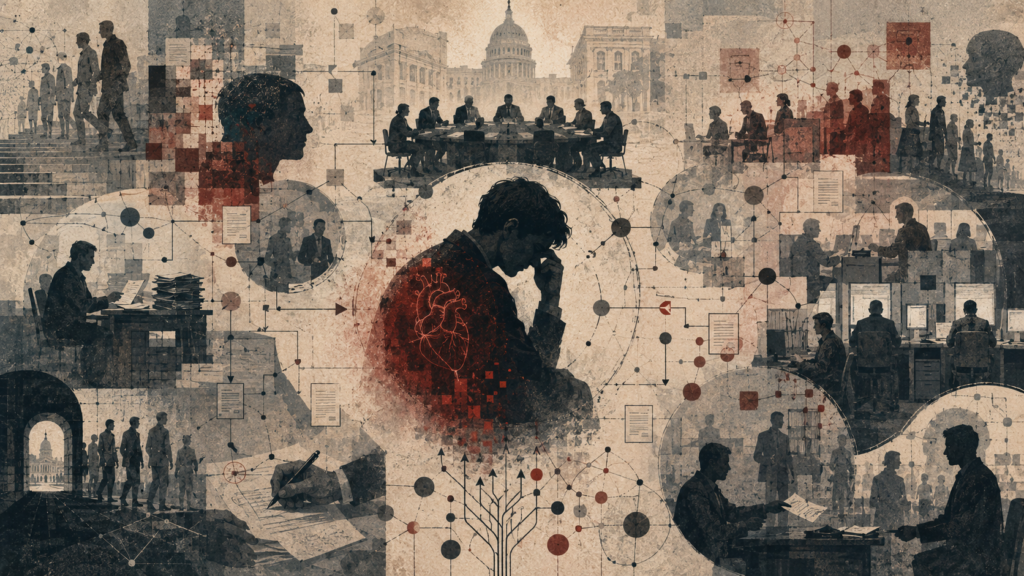
Editorial illustration of moral disengagement, showing fragmented human profiles, institutional settings, shadowed groups, cracked pathways, bureaucracy, social networks, and fractured moral identity.

Moral Disengagement and the Psychology of Ethical Failure

Moral disengagement helps explain how people can participate in wrongdoing without fully experiencing themselves as wrongdoers. Rather than openly rejecting morality, they often preserve a decent self-image by cognitively restructuring harmful conduct through moral justification, euphemistic language, advantageous comparison, responsibility shifting, harm minimization, and dehumanization. This article examines Bandura’s foundational framework and shows how these mechanisms operate not only in individual moral failure but also in organizational life, where bureaucracy, hierarchy, and institutional language can normalize ethical distance. It argues that ethical failure often depends less on the absence of morality than on the ability to deactivate moral self-censure while continuing to see oneself as reasonable, necessary, or even virtuous.

Editorial illustration of personality, character, and moral life, showing diverse human profiles, branching life paths, dialogue scenes, justice scales, civic institutions, and symbolic inner landscapes.

Personality, Character, and Individual Differences in Moral Life

Personality, character, and individual differences in moral life are related but distinct ways of understanding why moral behavior varies across persons. Personality concerns broader dispositional structure; character concerns morally valenced patterns such as honesty, justice, compassion, and self-command; and individual-difference research provides the wider empirical frame for studying moral identity, self-interest bias, ideological style, and context-sensitive variation in conduct. This article argues that the strongest contemporary view is plural rather than reductionist. Moral life is shaped by broad personality structure, morally specific dispositions, self-regulatory identity, situational pressures, and socially patterned differences in how harm, fairness, and obligation are construed. The result is a layered account of moral individuality that is empirically grounded without collapsing persons into static moral types.

Scroll to Top