
Last Updated May 28, 2026
Moral psychology in organizations and institutions examines how ethical attention, judgment, motivation, responsibility, silence, courage, conformity, and wrongdoing are shaped not only by individual character, but by roles, incentives, hierarchy, culture, procedures, and system design. This field is essential because much of modern moral life takes place inside organized settings: workplaces, bureaucracies, professions, schools, hospitals, governments, nonprofits, media systems, universities, corporations, public agencies, and civic institutions that distribute authority and structure decision-making.
A serious account of organizational moral psychology must therefore resist reducing ethics to private conscience alone. Institutions do not merely host moral agents. They actively shape what people notice, what they ignore, what they justify, what they fear, what they are rewarded for doing, what they are punished for saying, and what they believe they are permitted or required to do. The same person may behave differently under different organizational conditions not because their moral core has vanished, but because attention, accountability, incentives, identity, fear, and social meaning have been reorganized by the surrounding system.
This article argues that moral psychology in organizations matters because organized life can make wrongdoing ordinary, courage costly, silence rational, accountability diffuse, and ethical fading administratively normal. But institutions can also be designed to support integrity: by protecting dissent, clarifying responsibility, aligning incentives with mission, making harms visible, strengthening ethical climate, and ensuring that official values are reinforced by actual power, practice, and consequence.
Main Library
Publications
Article Map
Moral Psychology
Related Topic
Organizational Psychology
Related Topic
Institutional Psychology
Related Topic
Ethics & Moral Philosophy
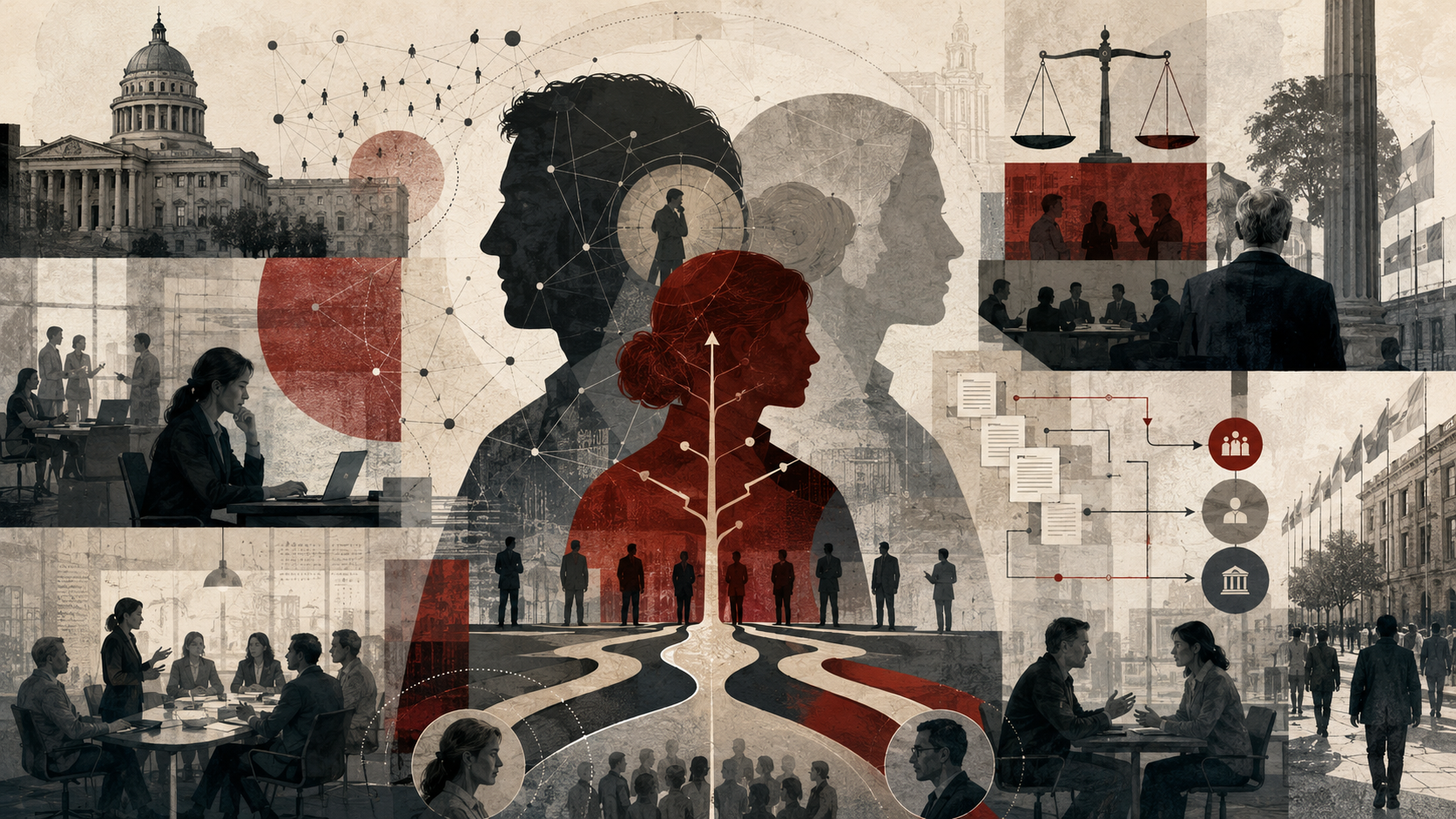
Organizations are morally consequential because they shape both action and interpretation. They define roles, set expectations, allocate authority, reward behavior, establish reporting lines, create norms of speech and silence, determine what data are measured, and decide which harms are treated as urgent, manageable, irrelevant, or invisible. Ethical conduct inside institutions therefore cannot be understood only by asking whether individuals are virtuous or corrupt. It also requires asking what the system makes easy, what it makes difficult, what it makes thinkable, and what it makes costly.
This is the central insight of organizational moral psychology: institutions organize moral perception. They can widen attention to human consequences, or they can narrow attention to targets, compliance, efficiency, reputation, growth, loyalty, or risk avoidance. They can make responsibility vivid, or they can distribute it until no one feels answerable. They can protect moral courage, or they can punish it. They can cultivate shared integrity, or they can normalize ethical drift while preserving the language of mission and values.
What Moral Psychology in Organizations Is
Moral psychology in organizations studies how morally relevant thought and action are shaped inside structured social systems. It asks how people make decisions under role obligations, how norms spread, how accountability is distributed, how misconduct is rationalized, how silence becomes normalized, how ethical attention fades, how courage becomes possible, and how institutions can either support or erode integrity. It is therefore not only about business ethics in the narrow sense. It is about how organized life shapes moral agency.
This broader perspective matters because institutions concentrate power, information, incentives, procedures, identity, resources, and legitimacy in ways that individuals do not control on their own. A person acting inside an organization often acts through formal role structure, performance systems, reporting lines, shared narratives, technology, professional expectations, and implicit norms about what the organization is for. Moral judgment in such settings is therefore partly personal and partly systemic.
Organizational moral psychology asks questions that private moral psychology alone cannot answer. Why do decent people participate in harmful systems? Why do employees remain silent when they see misconduct? Why do formal ethics codes fail when incentive systems reward the opposite behavior? Why do teams normalize questionable practices? Why do leaders preserve self-image while enabling harm? Why do bureaucracies convert human suffering into administrative abstraction? Why do institutions drift away from their stated mission while continuing to sound morally serious?
The answer is not that individuals no longer matter. Rather, individuals act inside moral architectures. Roles shape attention. Hierarchies shape obedience. Incentives shape priorities. Cultures shape what feels normal. Metrics shape what counts. Procedures shape what becomes visible. Legal risk shapes candor. Reputation management shapes truth. Organizational systems do not abolish moral agency, but they condition how that agency is exercised.
| Level of analysis | What it studies | Why it matters morally |
|---|---|---|
| Individual | Conscience, empathy, moral identity, courage, bias, self-interest | Explains why people differ in ethical sensitivity, resistance, and rationalization. |
| Role | Formal duties, task boundaries, professional expectations, authority limits | Shows how people interpret what they are responsible for noticing or doing. |
| Team | Group norms, loyalty, silence, peer pressure, shared justification | Explains how local cultures normalize or challenge wrongdoing. |
| Organization | Incentives, hierarchy, reporting systems, metrics, leadership, culture | Reveals how ethical risk is designed into ordinary operations. |
| Institutional field | Industry norms, regulation, professional standards, market pressure, public trust | Shows how broader systems shape what organizations treat as possible or necessary. |
Why Organizations Matter Morally
Organizations matter morally because they structure some of the most significant choices in social life: hiring and exclusion, compensation and inequality, workplace safety, patient care, educational opportunity, product risk, data use, environmental harm, truth and concealment, public service, disciplinary systems, political influence, resource allocation, and the distribution of burdens across workers, clients, patients, students, citizens, and communities. Much of what people experience as private morality is mediated by institutional action.
Organizations also matter because they shape perception. They determine who is visible, what is measured, what is rewarded, what is punished, who is believed, whose complaint is taken seriously, which harms count as incidents, and which outcomes are dismissed as unfortunate but acceptable. If a system rewards speed over care, obedience over candor, output over safety, short-term gain over long-term responsibility, or loyalty over truth, moral distortion can become normalized without requiring every participant to be individually malicious.
The moral significance of organizations is therefore not limited to scandal. Many ethical failures are ordinary, incremental, and routinized. A hospital may gradually normalize unsafe staffing. A school may normalize exclusionary discipline. A platform may normalize attention-maximizing outrage. A company may normalize misleading claims because everyone calls them “positioning.” A bureaucracy may normalize denial because the form requires it. In such cases, wrongdoing does not always appear as a dramatic breach. It appears as how the system works.
Organizations also influence moral courage. A person’s willingness to speak up depends not only on their character, but on whether the institution protects dissent, whether supervisors listen, whether retaliation is likely, whether peers will support them, whether reporting channels are trusted, and whether past warnings led to change. Courage is personal, but its likelihood is institutional.
| Organizational domain | Moral stakes | Typical institutional risk |
|---|---|---|
| Healthcare | Care, safety, dignity, truth, triage, consent | Scarcity, productivity pressure, documentation burden, institutional betrayal |
| Education | Development, inclusion, fairness, discipline, opportunity | Testing pressure, unequal resources, exclusionary routines, silence about harm |
| Technology | Privacy, bias, manipulation, surveillance, social harm | Scale, speed, opacity, engagement incentives, diffusion of responsibility |
| Government | Rights, public trust, coercive power, resource allocation | Bureaucratic distance, politicization, procedural indifference, many-hands problems |
| Business | Labor, truth, safety, environment, market power | Profit pressure, capture, greenwashing, ethics-washing, mission drift |
Roles, Routines, and Moral Attention
One of the first institutional effects on moral life is the shaping of attention through role. Roles simplify complexity by telling people what their task is, what falls inside their authority, which outcomes they are responsible for, and what is treated as someone else’s domain. This can be useful and necessary. Organizations could not function if every person had to reconsider every moral implication from scratch at every moment. But role structure can also narrow moral vision.
People become less likely to ask broader questions when routines define what is relevant and what is not. A claims adjuster may focus on eligibility rules rather than human need. A content moderator may focus on policy categories rather than social harm. A salesperson may focus on conversion rather than customer vulnerability. A manager may focus on performance targets rather than the moral consequences of pressure. A researcher may focus on publishable results rather than broader social implications.
Routines intensify this effect by turning repeated decisions into normal procedure. Once a questionable action is embedded in workflow, forms, metrics, scripts, approvals, or handoffs, it may stop feeling like a fresh moral choice at all. Institutions often do not suppress morality directly. They render ethical salience less vivid by reorganizing daily practice. The more routine a practice becomes, the less it may be experienced as morally optional.
This is why role design is morally important. A role can include accountability for downstream consequences, or it can define those consequences as outside the job. It can encourage discretion, or it can punish judgment. It can require contact with affected people, or it can hide them behind dashboards. It can invite escalation of ethical concerns, or it can treat escalation as inefficiency. Moral attention is not only a private mental state. It is shaped by what work asks people to see.
| Role feature | Ethical benefit | Ethical risk |
|---|---|---|
| Task clarity | Helps people understand responsibilities | Can narrow concern to only what is formally assigned. |
| Routine workflow | Supports consistency and efficiency | Can normalize harmful action through repetition. |
| Specialization | Allows expertise and scale | Can fragment responsibility and hide system-level consequences. |
| Role distance | Protects boundaries and reduces overload | Can weaken empathy for those affected by decisions. |
| Discretion | Allows context-sensitive ethical judgment | Can become arbitrary if not accountable. |
Hierarchy, Authority, and Ethical Obedience
Hierarchy is morally important because it changes how agency is experienced. In formal chains of command, subordinates may feel that they are implementing decisions rather than owning them, while leaders may treat downstream harms as operational consequences rather than morally personal ones. This creates space for displacement of responsibility: each actor sees only a partial role and therefore only a partial burden of answerability.
Hierarchy can coordinate action, clarify authority, preserve accountability, and prevent chaos. But it can also suppress dissent and weaken ethical perception. When authority is concentrated and dissent is costly, employees may comply publicly even when they recognize moral problems privately. Ethical obedience then becomes less a sign of conviction than a product of fear, dependence, ambiguity, career risk, and the desire not to jeopardize standing or livelihood.
Authority also shapes what feels real. If leaders frame a decision as necessary, strategic, legal, compliant, or already settled, subordinates may feel pressure to accept that framing. The moral question becomes translated into an operational question: “How do we execute this?” rather than “Should this be done?” That shift is one of the central mechanisms through which organizations convert moral judgment into compliance behavior.
Leadership therefore carries special moral responsibility. Leaders do not merely make decisions; they define the moral climate in which others interpret decisions. They signal whether ethical concerns are welcome or inconvenient, whether candor is valued or punished, whether loyalty means truthfulness or obedience, and whether harm to less powerful stakeholders will be acknowledged or rationalized.
| Hierarchical dynamic | Moral effect | Organizational warning sign |
|---|---|---|
| Command obedience | Subordinates treat instructions as reducing personal responsibility | “I was just following orders” becomes normal language. |
| Upward silence | Bad news does not travel honestly to leadership | Leaders hear reassurance while problems worsen. |
| Downward displacement | Front-line workers absorb consequences of decisions made above them | Those with least power face those most harmed. |
| Loyalty pressure | Criticism is framed as betrayal | Employees learn to protect the organization’s image over its integrity. |
| Authority shielding | Powerful actors evade scrutiny | Ethics rules apply downward but not upward. |
Incentives, Performance Pressure, and Moral Narrowing
Incentives are among the most powerful organizational influences on moral behavior. They tell people what the system actually values, regardless of official rhetoric. When rewards are tied narrowly to output, revenue, growth, speed, retention, loyalty, ranking, publication count, productivity, or short-term performance, moral attention may contract around those targets. People begin to frame choices primarily in instrumental terms rather than ethical terms.
This narrowing is often gradual rather than dramatic. A person may not consciously decide to ignore ethics. Instead, they become increasingly practiced at asking the instrumental question first: Will this work? Will this help us win? Will this satisfy the metric? Will this protect the team? Will this keep leadership happy? Will this avoid trouble? Over time, the moral dimensions of the decision can fade into the background, not because they are denied in principle, but because they are no longer foregrounded in practice.
Performance pressure is especially dangerous when paired with ambiguity. If official rules prohibit wrongdoing but real incentives reward it, employees learn the contradiction. They may infer that leadership wants results and prefers not to know too much about how those results are achieved. This produces plausible deniability at the top and ethical strain below. The organization can maintain clean language while rewarding dirty practice.
Incentives also shape moral imagination. If success is defined narrowly, people may stop imagining better forms of success. A care organization may become obsessed with throughput. A university may become obsessed with rankings. A news organization may become obsessed with attention. A platform may become obsessed with engagement. A company may become obsessed with growth. In each case, the institution may continue to speak of values while its systems teach members what matters more.
| Incentive pattern | What it rewards | Ethical risk |
|---|---|---|
| Revenue-only targets | Sales, growth, conversion, market capture | Customer vulnerability, truth, and long-term harm may be ignored. |
| Speed metrics | Throughput, volume, fast closure | Care, accuracy, and human context may be sacrificed. |
| Ranking systems | Competition among peers or units | Collaboration, candor, and fairness may weaken. |
| Reputation protection | Image management and avoidance of embarrassment | Misconduct may be hidden rather than repaired. |
| Loyalty rewards | Agreement, silence, and internal alignment | Dissent and ethical warning may be punished. |
Culture, Climate, and Shared Norms
Organizational culture shapes moral life through shared assumptions about what is normal, admirable, risky, embarrassing, or career-limiting. Culture is not only what an institution says about itself. It is what members learn from repeated interaction about who gets protected, what misconduct is tolerated, how criticism is received, which rules are symbolic, what success really means, and what kinds of people rise, stall, or disappear.
Climate is the more immediate felt environment of those patterns. It influences whether people expect fairness, retaliation, care, neglect, integrity, gamesmanship, candor, or silence. Even formal ethics systems can fail when informal culture communicates the opposite lesson. In such settings, workers often learn that the official code is ceremonial while real success depends on unspoken rules.
Culture operates through small signals as much as formal policy. Who gets promoted after cutting corners? Who is praised for “doing whatever it takes”? Who is dismissed as difficult after raising concerns? Who is protected after misconduct? Who is asked to be more “practical”? Who is told that ethical concerns are not “business-minded”? Who is quietly excluded from important meetings? These signals teach moral norms more powerfully than posters, values statements, or annual training.
Shared norms can also support integrity. A strong ethical culture makes it normal to ask uncomfortable questions, report concerns, correct errors, admit uncertainty, protect affected stakeholders, and slow down when consequences are serious. In such cultures, ethics is not a department. It is part of how the organization thinks, speaks, measures, promotes, and responds under pressure.
| Cultural signal | Integrity-supporting version | Integrity-eroding version |
|---|---|---|
| Promotion | Leaders with candor, care, competence, and accountability rise | High performers are promoted despite harmful conduct. |
| Conflict | Dissent is treated as information | Dissent is treated as disloyalty. |
| Error | Mistakes are disclosed, studied, and repaired | Mistakes are hidden, blamed, or spun. |
| Metrics | Numbers are interpreted with ethical context | Numbers become substitutes for moral judgment. |
| Power | Powerful actors are more accountable, not less | Power protects itself from scrutiny. |
Ethical Fading and Bounded Ethicality
One of the most useful concepts in organizational moral psychology is ethical fading: the process by which the ethical dimensions of a decision recede from view because attention is fixed on some other frame such as profitability, competition, efficiency, loyalty, compliance, innovation, growth, or strategic necessity. Closely related is bounded ethicality, the broader idea that people can act unethically while still believing themselves to be decent and compliant because their moral perception is limited by framing, habit, role, and situational pressure.
These concepts matter because wrongdoing in organizations is often not experienced by participants as obvious wrongdoing. People do not always say, “I am choosing the unethical option.” More often, they tell themselves that they are solving a business problem, following procedure, protecting the team, serving the client, optimizing the metric, complying with leadership, or doing what the situation requires. Ethical failure can therefore arise from narrowed awareness as well as deliberate malice.
Ethical fading is especially likely when language becomes sanitized. “Reducing headcount” can hide the lived reality of job loss. “Optimizing engagement” can hide addiction or manipulation. “Managing reputational risk” can hide truth suppression. “Improving efficiency” can hide reduced care. “Strategic ambiguity” can hide deception. “Eligibility enforcement” can hide denial of needed support. When moral language is replaced by technical language, ethical attention can weaken.
Bounded ethicality does not excuse harm. It explains how harm can be committed by people who preserve a positive self-concept. This is one of the most important lessons for institutional design. If people are capable of ethical blindness under pressure, then organizations must not rely solely on personal virtue. They need structures that keep moral dimensions visible: stakeholder review, ethical pause points, transparency, independent oversight, protected voice, and accountability for consequences.
| Organizational frame | What it foregrounds | What may fade ethically |
|---|---|---|
| Performance | Targets, output, productivity, rankings | Fairness, safety, care, truth, long-term harm |
| Compliance | Formal rule-following | Whether the rule itself produces unjust or harmful outcomes |
| Loyalty | Team protection and internal alignment | Duty to affected stakeholders outside the group |
| Innovation | Speed, novelty, disruption | Precaution, consent, accountability, public consequences |
| Risk management | Legal exposure and reputational protection | Truth, repair, admission of harm, justice for victims |
Diffusion of Responsibility and Bureaucratic Distance
Organizations often diffuse responsibility across layers, departments, committees, software systems, legal review, vendors, policies, and sequential approvals. This makes large systems workable, but it also makes moral accountability harder to experience directly. When many people each do a small part of a harmful process, no one person may feel fully responsible, even when the collective outcome is serious and foreseeable.
Diffusion of responsibility is not merely a psychological curiosity. It is an institutional condition. A product harms users, but engineering built only one feature, legal approved the language, marketing wrote the campaign, leadership set the targets, compliance signed off, and customer support receives the complaints. A public agency denies needed support, but the front-line worker follows eligibility rules, the software applies thresholds, legislators set the budget, managers monitor throughput, and leadership reports efficiency. Responsibility is everywhere and nowhere.
Bureaucratic distance deepens the problem by separating decision-makers from those affected by their decisions. If harm is statistical, delayed, outsourced, automated, aggregated, or filtered through reports rather than direct encounter, moral response may weaken. Bureaucracies can therefore produce a form of ethical abstraction in which people continue to perform competently while losing vivid contact with the human meaning of what they help produce.
This is one reason moral injury, institutional betrayal, and organizational ethics overlap. Workers closest to affected people may carry the emotional and moral burden of decisions made elsewhere. Leaders may remain insulated from the consequences of policies they impose. The system can then distribute authority upward and moral pain downward. A morally serious institution must close this distance by making consequences visible to those with power.
| Diffusion mechanism | How responsibility becomes obscured | Integrity safeguard |
|---|---|---|
| Sequential approval | Each actor approves only part of the process | Require whole-system consequence review. |
| Committee decisions | Responsibility is attributed to the group but owned by no one | Record dissent, ownership, and accountable decision authority. |
| Technical systems | Software output appears to decide | Maintain human accountability for design, use, and override. |
| Outsourcing | Harm is displaced to vendors, contractors, or partners | Preserve responsibility for downstream effects. |
| Metrics aggregation | Human consequences become numbers | Pair quantitative indicators with qualitative stakeholder review. |
Silence, Speaking Up, and Moral Courage
Moral life in organizations depends heavily on whether people can speak up. Many harmful systems persist not because everyone endorses them, but because enough people remain silent. Silence may result from fear of retaliation, uncertainty, fatigue, pluralistic ignorance, cynicism about whether anything will change, loyalty pressure, career dependence, or the sense that moral concern is professionally risky or socially unwelcome.
Silence is rarely just the absence of speech. It is often actively produced by organizational conditions. Employees learn from what happens to others. If people who raise concerns are ignored, sidelined, mocked, overloaded, labeled negative, excluded from advancement, or pushed out, the organization teaches silence without needing to say so. If those who conceal problems are rewarded for keeping things smooth, the organization teaches concealment.
Moral courage therefore has an institutional dimension. It is not only a trait of brave individuals. It depends on whether reporting channels are trusted, whether criticism is protected, whether leaders reward candor, whether peers support truth-telling, and whether speaking up leads to meaningful response rather than symbolic acknowledgment followed by quiet punishment.
A mature organization does not simply tell people to speak up. It proves that speaking up matters. It documents concerns, investigates patterns, protects reporters, responds visibly, and changes conditions. It distinguishes bad-faith disruption from good-faith warning without using that distinction to silence inconvenient truth. It treats ethical dissent as intelligence, not as disloyalty.
| Reason for silence | Organizational source | Integrity response |
|---|---|---|
| Fear of retaliation | Past punishment, insecure employment, powerful targets | Credible anti-retaliation protections and independent reporting routes |
| Pluralistic ignorance | People privately disagree but assume others accept the norm | Structured forums where concerns can be voiced safely |
| Cynicism | Prior reports produced no change | Visible follow-through and accountability for unresolved patterns |
| Loyalty pressure | Criticism framed as betrayal | Define loyalty as truthfulness to mission and affected stakeholders |
| Ambiguity | Unclear standards or uncertain evidence | Ethical consultation, escalation pathways, and decision support |
Institutional Corruption and Purpose Distortion
Institutions can become morally compromised through corruption in a broader sense than outright bribery or fraud. An institution may be corrupted when its processes, purposes, or role-based norms are bent away from the ends that justify its authority. In that sense, institutional corruption is not just private vice inside an organization. It is a distortion of what the institution is for.
This matters because organizations often continue to function smoothly even when their moral purpose has drifted. The procedures remain intact, the reporting continues, the formal legitimacy persists, and many participants still believe they are serving the institution well. Yet if the underlying purpose has been redirected toward narrow private gain, image management, capture, self-protection, domination, political pressure, or financial extraction, the system may be ethically degraded while appearing administratively normal.
Purpose distortion is often gradual. A university shifts from education to prestige competition. A hospital shifts from care to throughput and billing. A public agency shifts from service to risk avoidance. A nonprofit shifts from mission to donor management. A media organization shifts from informing the public to maximizing outrage. A technology platform shifts from connection to attention capture. In each case, institutional language may remain morally attractive while practical incentives move elsewhere.
Institutional corruption is especially difficult to confront because members can sincerely identify with the institution’s stated values while participating in systems that undermine them. This creates cognitive and moral tension. People may defend the institution because they believe in what it should be, even as current practices betray that purpose. Moral psychology helps explain how loyalty, identity, and self-justification make purpose distortion hard to see from within.
| Institutional purpose | Distortion pressure | Corrupting outcome |
|---|---|---|
| Care | Throughput, revenue, liability avoidance | Patients become cases, costs, or risks rather than persons. |
| Education | Ranking, testing, branding, credential competition | Learning is subordinated to metrics and prestige. |
| Public service | Political optics, budget pressure, bureaucratic self-protection | Citizens become administrative burdens. |
| Journalism | Engagement, speed, outrage, audience capture | Truth-seeking yields to attention competition. |
| Technology | Growth, scale, engagement, data extraction | User welfare and public harm become secondary to platform expansion. |
Individual Differences Inside Systems
Individual differences still matter in organizations. People vary in moral identity, empathy, self-interest bias, courage, tolerance for ambiguity, sensitivity to unfairness, willingness to dissent, need for belonging, obedience to authority, and susceptibility to rationalization. These differences help explain why not everyone responds to the same institutional pressure in the same way. Some rationalize quickly. Some resist. Some comply while troubled. Some remain silent. Some become whistleblowers. Some become reformers. Some become enforcers of the norm.
But a strong institutional analysis avoids treating individual differences as the whole story. Even highly conscientious people can drift in corrupt systems, and even flawed people can behave more responsibly in settings structured by clear accountability, humane purpose, and strong ethical norms. Moral psychology in organizations is therefore interactionist: it studies persons-in-systems rather than persons or systems alone.
This point is crucial because organizations often individualize failure after harm occurs. They blame a bad apple, a rogue employee, a poor fit, a misunderstanding, or a training gap. Sometimes individuals are indeed culpable. But if many people saw the problem, if incentives rewarded the behavior, if leadership ignored warnings, if reporting channels failed, if retaliation silenced dissent, or if metrics normalized the practice, then the moral failure is systemic as well as personal.
Individual virtue remains important, but it is not an adequate institutional strategy. Organizations need people of integrity, but they also need systems that support integrity when it is costly. A system that depends on heroic dissent for basic ethical functioning is already morally fragile.
| Individual factor | Potential contribution | System interaction |
|---|---|---|
| Moral identity | Increases concern with being a decent, responsible person | Can be strengthened or weakened by group norms and incentives. |
| Empathy | Makes human consequences vivid | Can be blunted by distance, overload, abstraction, or role pressure. |
| Courage | Supports dissent and truth-telling | Depends on protection, peer support, and credible reporting pathways. |
| Conformity | Supports coordination and belonging | Can normalize unethical practice when group norms drift. |
| Self-interest bias | Protects status, security, and advancement | Becomes dangerous when incentives reward ethical blindness. |
Designing for Accountability and Integrity
If institutions shape moral behavior, then design matters ethically. Accountability structures, reporting channels, role clarity, auditability, transparency, norm reinforcement, protection for dissent, stakeholder visibility, and alignment between stated purpose and actual incentives all affect whether integrity is likely to be practiced or merely advertised. Good institutional design does not eliminate human weakness, but it reduces the opportunities for ordinary weakness to become normalized organizational failure.
Integrity in organizations depends less on inspirational slogans than on repeated structural signals. People learn what the institution truly values by watching what happens when targets conflict, when powerful actors are criticized, when vulnerable stakeholders are harmed, when legal compliance is insufficient, when ethical concerns become inconvenient, and when truth threatens reputation. The real moral architecture of an institution is revealed under pressure.
Designing for integrity requires making ethical salience durable. That means building systems that force attention to affected stakeholders, create friction before high-risk decisions, require explanation for exceptions, preserve records of dissent, protect internal warning, and ensure that responsibility cannot disappear into committees or software. It also means treating ethics as operational rather than ornamental: embedded in incentives, promotion criteria, budgeting, product design, governance, quality review, and leadership evaluation.
Accountability must also be symmetrical. If front-line workers are disciplined for failures produced by leadership decisions, the institution is not accountable; it is scapegoating downward. If powerful actors can violate norms without consequence, the ethics system becomes symbolic. If misconduct is handled privately to protect reputation, the organization teaches that image outranks truth. Integrity requires that responsibility track power.
| Design principle | Practical form | Ethical effect |
|---|---|---|
| Make harm visible | Stakeholder review, qualitative evidence, consequence audits | Prevents abstraction from hiding human effects. |
| Clarify responsibility | Named decision owners, escalation paths, audit trails | Reduces diffusion and many-hands evasion. |
| Protect voice | Independent reporting, anti-retaliation enforcement, follow-through | Makes moral courage less personally dangerous. |
| Align incentives | Promotion and compensation tied to integrity, safety, care, and trust | Prevents values from being contradicted by reward systems. |
| Review purpose drift | Regular mission-integrity assessments | Detects institutional corruption before it becomes normal. |
Mathematical Lens: Modeling Moral Decision-Making in Organizations
Moral decision-making in organizations can be modeled as the joint effect of individual and institutional variables. Let \(M_i\) represent the morally relevant decision tendency of person \(i\):
M_i = f(E_i, R_i, C_i, P_i)
\]
Interpretation: Moral decision tendency is modeled as a function of ethical sensitivity, role constraint, cultural climate, and performance pressure. This captures the idea that moral action in institutions is not reducible to character alone.
where \(E_i\) is ethical sensitivity, \(R_i\) is role constraint, \(C_i\) is cultural climate, and \(P_i\) is performance pressure. This model foregrounds the interaction between personal moral perception and institutional structure.
A more explicit organizational-risk model can be written as:
U_i = \sigma(\alpha P_i + \beta H_i + \gamma D_i – \lambda A_i)
\]
Interpretation: The probability of unethical action rises with performance pressure, hierarchy intensity, and diffusion of responsibility, and falls when accountability is strong.
where \(U_i\) is the probability of unethical action, \(\sigma\) is the logistic transformation, \(P_i\) is performance pressure, \(H_i\) is hierarchy intensity, \(D_i\) is diffusion of responsibility, and \(A_i\) is accountability strength. As pressure, hierarchy, and diffusion rise, unethical risk increases unless countered by robust accountability.
At the institutional level, moral integrity can be modeled as:
I_g = \theta_1 T_g + \theta_2 S_g + \theta_3 W_g – \theta_4 K_g
\]
Interpretation: Institutional integrity rises with transparency, speak-up protection, and value alignment, and falls with corruption or capture pressure.
where \(I_g\) is institutional integrity for organization \(g\), \(T_g\) is transparency, \(S_g\) is speak-up protection, \(W_g\) is value alignment between mission and incentives, and \(K_g\) is corruption or capture pressure. This formulation highlights that institutional morality depends on system properties, not only on the virtue of individual members.
A purpose-drift model can also be written as:
PD_g = \omega_1 X_g + \omega_2 Q_g + \omega_3 L_g – \omega_4 R_g
\]
Interpretation: Purpose drift increases with external capture pressure, metric fixation, and loyalty pressure, and decreases when mission review, public accountability, and ethical governance are strong.
where \(PD_g\) is purpose drift, \(X_g\) is external capture pressure, \(Q_g\) is metric fixation, \(L_g\) is loyalty pressure, and \(R_g\) is regular mission-integrity review. This model is useful because organizational wrongdoing often emerges not from one bad decision, but from a gradual realignment of institutional purpose.
| Model term | Meaning | Organizational interpretation |
|---|---|---|
| \(E_i\) | Ethical sensitivity | Capacity to notice morally relevant features of a decision. |
| \(R_i\) | Role constraint | Degree to which formal duties narrow perceived responsibility. |
| \(C_i\) | Cultural climate | Local norms about candor, fairness, care, retaliation, and integrity. |
| \(P_i\) | Performance pressure | Pressure to meet targets that may crowd out ethical attention. |
| \(D_i\) | Diffusion of responsibility | Extent to which answerability is spread across people and procedures. |
| \(A_i\) | Accountability strength | Clarity, enforceability, and fairness of responsibility systems. |
| \(W_g\) | Value alignment | Degree to which incentives match the institution’s stated purpose. |
| \(K_g\) | Corruption or capture pressure | Forces that redirect the institution away from its legitimate purpose. |
R Workflow: Modeling Ethical Decision-Making in Organizations
The following R workflow simulates ethical sensitivity, role constraint, cultural climate, performance pressure, hierarchy intensity, diffusion of responsibility, accountability strength, value alignment, speak-up protection, and corruption pressure. It then estimates their relationship to unethical action and institutional integrity. The dataset is synthetic and intended for reproducible article support, not empirical claims about real organizations.
# Moral Psychology in Organizations and Institutions
# Synthetic R workflow for modeling ethical decision-making in organizations.
# Educational and reproducible research scaffold only.

suppressPackageStartupMessages({
  library(tidyverse)
  library(broom)
})

set.seed(42)

# ------------------------------------------------------------
# 1. Set up output folders
# ------------------------------------------------------------

dir.create("outputs", showWarnings = FALSE)
dir.create("outputs/tables", recursive = TRUE, showWarnings = FALSE)
dir.create("outputs/figures", recursive = TRUE, showWarnings = FALSE)

# ------------------------------------------------------------
# 2. Simulate organizational moral variables
# ------------------------------------------------------------

n <- 2400

df <- tibble(
  employee_id = 1:n,
  ethical_sensitivity = rnorm(n, 0, 1),
  role_constraint = rnorm(n, 0, 1),
  cultural_climate = rnorm(n, 0, 1),
  performance_pressure = rnorm(n, 0, 1),
  hierarchy_intensity = rnorm(n, 0, 1),
  diffusion_responsibility = rnorm(n, 0, 1),
  accountability_strength = rnorm(n, 0, 1),
  speak_up_protection = rnorm(n, 0, 1),
  value_alignment = rnorm(n, 0, 1),
  corruption_pressure = rnorm(n, 0, 1)
) %>%
  mutate(
    moral_decision_tendency =
      0.35 * ethical_sensitivity -
      0.25 * role_constraint +
      0.30 * cultural_climate -
      0.30 * performance_pressure +
      0.25 * speak_up_protection +
      0.25 * value_alignment +
      rnorm(n, 0, 0.8),

    unethical_latent =
      0.35 * performance_pressure +
      0.25 * hierarchy_intensity +
      0.30 * diffusion_responsibility -
      0.40 * accountability_strength -
      0.25 * cultural_climate -
      0.20 * speak_up_protection -
      0.25 * value_alignment +
      0.30 * corruption_pressure +
      rnorm(n, 0, 0.8),

    unethical_probability = plogis(unethical_latent),
    unethical_action = if_else(unethical_probability >= 0.5, 1, 0),

    institutional_integrity =
      0.30 * accountability_strength +
      0.30 * speak_up_protection +
      0.30 * value_alignment +
      0.20 * cultural_climate -
      0.30 * corruption_pressure -
      0.20 * diffusion_responsibility +
      rnorm(n, 0, 0.8)
  )

# ------------------------------------------------------------
# 3. Estimate unethical action model
# ------------------------------------------------------------

model_unethical <- glm(
  unethical_action ~ performance_pressure + hierarchy_intensity +
    diffusion_responsibility + accountability_strength + cultural_climate +
    speak_up_protection + value_alignment + corruption_pressure,
  data = df,
  family = binomial()
)

unethical_summary <- tidy(model_unethical, conf.int = TRUE, exponentiate = TRUE)
unethical_fit <- glance(model_unethical)

print(unethical_summary)
print(unethical_fit)

# ------------------------------------------------------------
# 4. Estimate institutional integrity model
# ------------------------------------------------------------

model_integrity <- lm(
  institutional_integrity ~ accountability_strength + speak_up_protection +
    value_alignment + cultural_climate + corruption_pressure +
    diffusion_responsibility,
  data = df
)

integrity_summary <- tidy(model_integrity, conf.int = TRUE)

print(integrity_summary)

# ------------------------------------------------------------
# 5. Prediction grid across pressure and accountability
# ------------------------------------------------------------

pred_grid <- expand_grid(
  performance_pressure = seq(-2, 2, length.out = 100),
  accountability_strength = c(-1, 0, 1),
  hierarchy_intensity = 0,
  diffusion_responsibility = 0,
  cultural_climate = 0,
  speak_up_protection = 0,
  value_alignment = 0,
  corruption_pressure = 0
)

pred_grid$predicted_unethical_prob <- predict(
  model_unethical,
  newdata = pred_grid,
  type = "response"
)

pred_grid <- pred_grid %>%
  mutate(
    accountability_label = case_when(
      accountability_strength == -1 ~ "Low accountability",
      accountability_strength == 0 ~ "Average accountability",
      TRUE ~ "High accountability"
    )
  )

# ------------------------------------------------------------
# 6. Summarize by accountability band
# ------------------------------------------------------------

accountability_summary <- df %>%
  mutate(
    accountability_band = ntile(accountability_strength, 4),
    accountability_band = factor(
      accountability_band,
      labels = c("Low", "Lower-middle", "Upper-middle", "High")
    )
  ) %>%
  group_by(accountability_band) %>%
  summarize(
    mean_unethical_prob = mean(unethical_probability),
    unethical_rate = mean(unethical_action),
    mean_pressure = mean(performance_pressure),
    mean_diffusion = mean(diffusion_responsibility),
    mean_integrity = mean(institutional_integrity),
    mean_value_alignment = mean(value_alignment),
    .groups = "drop"
  )

print(accountability_summary)

# ------------------------------------------------------------
# 7. Plot predicted unethical action
# ------------------------------------------------------------

plot_unethical <- ggplot(
  pred_grid,
  aes(x = performance_pressure, y = predicted_unethical_prob)
) +
  geom_line(linewidth = 1) +
  facet_wrap(~ accountability_label) +
  labs(
    title = "Predicted Unethical Action in Organizations",
    subtitle = "Performance pressure raises risk, but accountability changes the curve",
    x = "Performance pressure",
    y = "Probability of unethical action"
  ) +
  theme_minimal(base_size = 12)

print(plot_unethical)

# ------------------------------------------------------------
# 8. Export outputs
# ------------------------------------------------------------

write_csv(df, "outputs/tables/moral_psychology_organizations_simulated_data.csv")
write_csv(unethical_summary, "outputs/tables/moral_psychology_organizations_unethical_model.csv")
write_csv(unethical_fit, "outputs/tables/moral_psychology_organizations_unethical_model_fit.csv")
write_csv(integrity_summary, "outputs/tables/moral_psychology_organizations_integrity_model.csv")
write_csv(accountability_summary, "outputs/tables/moral_psychology_organizations_accountability_summary.csv")
write_csv(pred_grid, "outputs/tables/moral_psychology_organizations_predictions.csv")

ggsave(
  filename = "outputs/figures/predicted_unethical_action_by_accountability.png",
  plot = plot_unethical,
  width = 10,
  height = 6,
  dpi = 300
)
This workflow is useful because it keeps institutional structure visible instead of attributing ethical failure only to bad individuals. It models unethical action as the product of pressure, hierarchy, diffusion, accountability, climate, value alignment, speak-up protection, and corruption pressure. It also models institutional integrity separately, making clear that ethical systems must be designed, measured, protected, and repaired.
Python Workflow: Simulating Moral Risk in Institutional Systems
The Python workflow below simulates how pressure, hierarchy, diffusion, climate, value alignment, speak-up protection, corruption pressure, and accountability interact to shape organizational ethical risk. The example uses synthetic data for reproducible demonstration and should not be interpreted as an assessment of real employees or real institutions.
# Moral Psychology in Organizations and Institutions
# Python workflow for synthetic organizational ethical-risk modeling.
# Educational and reproducible research scaffold only.

from pathlib import Path

import numpy as np
import pandas as pd

np.random.seed(42)

# ------------------------------------------------------------
# 1. Set up output folders
# ------------------------------------------------------------

output_tables = Path("outputs/tables")
output_tables.mkdir(parents=True, exist_ok=True)

# ------------------------------------------------------------
# 2. Simulate organizational moral variables
# ------------------------------------------------------------

n = 2600

df = pd.DataFrame({
    "employee_id": np.arange(1, n + 1),
    "ethical_sensitivity": np.random.normal(0, 1, n),
    "role_constraint": np.random.normal(0, 1, n),
    "cultural_climate": np.random.normal(0, 1, n),
    "performance_pressure": np.random.normal(0, 1, n),
    "hierarchy_intensity": np.random.normal(0, 1, n),
    "diffusion_responsibility": np.random.normal(0, 1, n),
    "accountability_strength": np.random.normal(0, 1, n),
    "speak_up_protection": np.random.normal(0, 1, n),
    "value_alignment": np.random.normal(0, 1, n),
    "corruption_pressure": np.random.normal(0, 1, n)
})

# ------------------------------------------------------------
# 3. Generate moral decision tendency
# ------------------------------------------------------------

df["moral_decision_tendency"] = (
    0.35 * df["ethical_sensitivity"] -
    0.25 * df["role_constraint"] +
    0.30 * df["cultural_climate"] -
    0.30 * df["performance_pressure"] +
    0.25 * df["speak_up_protection"] +
    0.25 * df["value_alignment"] +
    np.random.normal(0, 0.8, n)
)

# ------------------------------------------------------------
# 4. Generate unethical action probability
# ------------------------------------------------------------

unethical_latent = (
    0.35 * df["performance_pressure"] +
    0.25 * df["hierarchy_intensity"] +
    0.30 * df["diffusion_responsibility"] -
    0.40 * df["accountability_strength"] -
    0.25 * df["cultural_climate"] -
    0.20 * df["speak_up_protection"] -
    0.25 * df["value_alignment"] +
    0.30 * df["corruption_pressure"] +
    np.random.normal(0, 0.8, n)
)

df["unethical_probability"] = 1 / (1 + np.exp(-unethical_latent))
df["unethical_action"] = (df["unethical_probability"] >= 0.5).astype(int)

# ------------------------------------------------------------
# 5. Generate institutional integrity score
# ------------------------------------------------------------

df["institutional_integrity"] = (
    0.30 * df["accountability_strength"] +
    0.30 * df["speak_up_protection"] +
    0.30 * df["value_alignment"] +
    0.20 * df["cultural_climate"] -
    0.30 * df["corruption_pressure"] -
    0.20 * df["diffusion_responsibility"] +
    np.random.normal(0, 0.8, n)
)

# ------------------------------------------------------------
# 6. Summarize by accountability band
# ------------------------------------------------------------

df["accountability_band"] = pd.qcut(
    df["accountability_strength"],
    q=4,
    labels=["Low", "Lower-middle", "Upper-middle", "High"]
)

summary = (
    df.groupby("accountability_band", observed=False)
      .agg(
          mean_unethical_prob=("unethical_probability", "mean"),
          unethical_rate=("unethical_action", "mean"),
          mean_pressure=("performance_pressure", "mean"),
          mean_diffusion=("diffusion_responsibility", "mean"),
          mean_integrity=("institutional_integrity", "mean"),
          mean_value_alignment=("value_alignment", "mean")
      )
      .reset_index()
)

print(summary)

# ------------------------------------------------------------
# 7. Scenario grid across pressure and accountability
# ------------------------------------------------------------

scenario_rows = []

for pressure in np.linspace(-2, 2, 41):
    for accountability in [-1, 0, 1]:
        for diffusion in [-1, 0, 1]:
            latent = (
                0.35 * pressure +
                0.25 * 0 +
                0.30 * diffusion -
                0.40 * accountability -
                0.25 * 0 -
                0.20 * 0 -
                0.25 * 0 +
                0.30 * 0
            )

            prob = 1 / (1 + np.exp(-latent))

            scenario_rows.append({
                "performance_pressure": pressure,
                "accountability_strength": accountability,
                "diffusion_responsibility": diffusion,
                "predicted_unethical_probability": prob
            })

scenario_df = pd.DataFrame(scenario_rows)

print(scenario_df.head(12))

# ------------------------------------------------------------
# 8. Identify high-risk synthetic cases
# ------------------------------------------------------------

high_risk_cases = (
    df.sort_values("unethical_probability", ascending=False)
      .head(25)
      .reset_index(drop=True)
)

# ------------------------------------------------------------
# 9. Export outputs
# ------------------------------------------------------------

df.to_csv(output_tables / "moral_psychology_organizations_python.csv", index=False)
summary.to_csv(output_tables / "moral_psychology_organizations_summary.csv", index=False)
scenario_df.to_csv(output_tables / "moral_psychology_organizations_scenarios.csv", index=False)
high_risk_cases.to_csv(
    output_tables / "moral_psychology_organizations_high_risk_cases.csv",
    index=False
)

print("Synthetic organizational moral-risk data written to:", output_tables)
This workflow is useful because it shows how ethical risk can emerge from ordinary organizational variables rather than from extraordinary pathology alone. It also allows readers to inspect how accountability and diffusion change predicted risk under different levels of performance pressure. The point is not to score real employees, but to make the moral-psychological structure of institutional risk explicit and reproducible.
In a full article repository, this Python workflow can be extended into notebooks, SQL schema, synthetic datasets, validation notes, organizational-risk documentation, and additional language examples. R can support statistical modeling and visualization; Python can support simulation and data pipelines; SQL can preserve structured scenario metadata; Julia can support system-level simulations; and C, C++, Fortran, Go, and Rust can support reproducible command-line tools, validation utilities, and computational demonstrations.
GitHub Repository
The companion repository for this article provides a reproducible code scaffold for modeling ethical sensitivity, role constraint, cultural climate, performance pressure, hierarchy intensity, diffusion of responsibility, accountability strength, speak-up protection, value alignment, corruption pressure, unethical action probability, and institutional integrity.
Complete Code Repository
This article’s companion repository includes reproducible workflows, synthetic datasets, model documentation, computational examples, and outputs for exploring how organizations shape moral attention, ethical decision-making, accountability, silence, corruption risk, and institutional integrity.
View the Full GitHub Repository
The repository structure should support a full research workflow rather than a single script. The article folder can include language-specific examples in python, r, julia, sql, c, cpp, fortran, go, and rust, along with data, docs, notebooks, and outputs. This structure makes the article reproducible, inspectable, and extensible for readers who want to move from conceptual argument to analytical demonstration.
Conclusion
Moral psychology in organizations and institutions shows that ethical life is structured as much by systems as by souls. People act through roles, under incentives, inside hierarchies, amid climates of silence or candor, and within institutions whose purposes may be upheld, distorted, captured, or betrayed. Ethical conduct in such settings cannot be understood fully if we ask only what kind of person an employee is in isolation.
The strongest view is therefore institutional and psychological at once. Organizations shape moral attention, responsibility, courage, rationalization, and self-understanding. They can produce integrity, drift, silence, corruption, or repair depending on how authority, incentives, accountability, culture, and purpose are arranged. Understanding that structure is essential if institutions are to become not merely efficient, but morally trustworthy.
This does not mean individuals are powerless. It means that moral agency is exercised within conditions that can either support or deform it. People can resist, speak, reform, document, refuse, and build better norms. But institutions that depend on individual heroism to prevent routine harm have already failed at moral design. Integrity should not require exceptional courage every day just to preserve basic responsibility.
A morally serious organization therefore asks more than whether its people are ethical. It asks whether its systems help people remain ethical under pressure. It asks whether incentives match mission, whether dissent is protected, whether harms are visible, whether leaders are accountable, whether metrics distort purpose, whether powerful actors are subject to the same standards, and whether the institution can acknowledge and repair harm. Moral psychology in organizations matters because modern life is organized life, and organized life can either strengthen conscience or teach people how to ignore it.
Related articles
- Moral Disengagement and the Psychology of Ethical Failure
- Responsibility, Blame, and Moral Accountability
- Moral Injury, Bureaucracy, and Distributed Responsibility
- Social Identity, Group Life, and Moral Polarization
- Hypocrisy, Dehumanization, and the Psychology of Moral Failure
- Personality, Character, and Individual Differences in Moral Life
- Justice, Fairness, and Distributive Moral Judgment
- Moral Perception, Salience, and the Psychology of Ethical Attention
Further reading
- Kouchaki, M. and Smith, I.H. (2025) ‘Moral Decision-Making in Organizations’, Annual Review of Organizational Psychology and Organizational Behavior, 12, pp. 45–72. Available at: https://www.annualreviews.org/content/journals/10.1146/annurev-orgpsych-110622-045715.
- Doris, J.M. (2022) ‘Moral Psychology: Empirical Approaches’, in The Stanford Encyclopedia of Philosophy. Available at: https://plato.stanford.edu/entries/moral-psych-emp/.
- Miller, S. (2017) ‘Corruption’, in The Stanford Encyclopedia of Philosophy. Available at: https://plato.stanford.edu/entries/corruption/.
- Miller, S. (2019) ‘Social Institutions’, in The Stanford Encyclopedia of Philosophy. Available at: https://plato.stanford.edu/entries/social-institutions/.
- Ethics Unwrapped, University of Texas at Austin (n.d.) ‘Ethical Fading’. Available at: https://ethicsunwrapped.utexas.edu/glossary/ethical-fading.
- Beyer, F. et al. (2017) ‘Beyond self-serving bias: diffusion of responsibility reduces generosity and increases punishment in competitive contexts’, Scientific Reports, 7, 7482. Available at: https://pmc.ncbi.nlm.nih.gov/articles/PMC5390744/.
References
- Beyer, F. et al. (2017) ‘Beyond self-serving bias: diffusion of responsibility reduces generosity and increases punishment in competitive contexts’, Scientific Reports, 7, 7482. Available at: https://pmc.ncbi.nlm.nih.gov/articles/PMC5390744/.
- Doris, J.M. (2022) ‘Moral Psychology: Empirical Approaches’, in The Stanford Encyclopedia of Philosophy. Available at: https://plato.stanford.edu/entries/moral-psych-emp/.
- Ethics Unwrapped, University of Texas at Austin (n.d.) ‘Ethical Fading’. Available at: https://ethicsunwrapped.utexas.edu/glossary/ethical-fading.
- Kouchaki, M. and Smith, I.H. (2025) ‘Moral Decision-Making in Organizations’, Annual Review of Organizational Psychology and Organizational Behavior, 12, pp. 45–72. Available at: https://www.annualreviews.org/content/journals/10.1146/annurev-orgpsych-110622-045715.
- Miller, S. (2017) ‘Corruption’, in The Stanford Encyclopedia of Philosophy. Available at: https://plato.stanford.edu/entries/corruption/.
- Miller, S. (2019) ‘Social Institutions’, in The Stanford Encyclopedia of Philosophy. Available at: https://plato.stanford.edu/entries/social-institutions/.