Psychology

Psychology explores the cognitive, emotional, and social processes that shape human behavior. The discipline examines how individuals perceive information, form beliefs, make decisions, interact with others, and respond to complex environments.

Modern psychological research spans multiple domains, including cognitive psychology, behavioral economics, social psychology, and positive psychology. Together, these fields provide insights into decision-making, motivation, learning, and the social dynamics that influence collective behavior.

Understanding psychological processes is essential for designing effective institutions, policies, and communication strategies. Behavioral insights help explain why individuals and groups respond to incentives, social norms, and institutional structures in ways that often diverge from purely rational models.

Psychology therefore plays an important role in fields ranging from public policy and organizational leadership to sustainability governance and technological design.

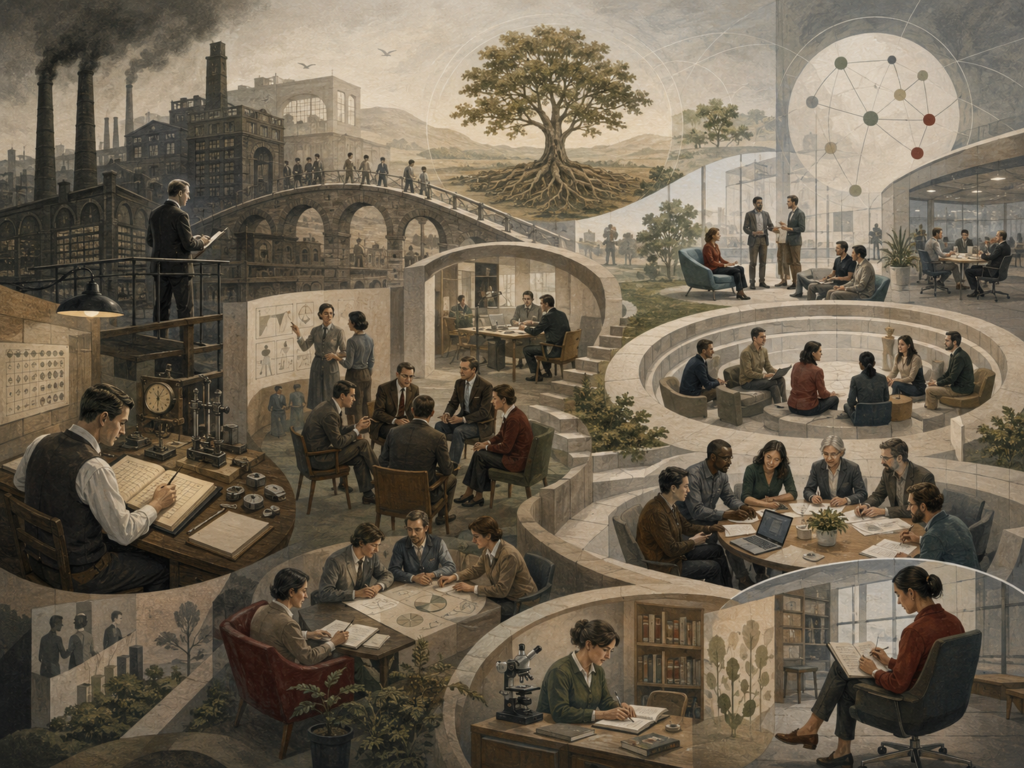
Restrained institutional illustration showing the historical evolution of organizational psychology from industrial-era workplaces to modern collaborative, research-based organizational systems.

The Evolution of Organizational Psychology

The evolution of organizational psychology traces how the study of work moved from early concerns with efficiency, selection, testing, and performance measurement toward a broader science of motivation, leadership, teams, culture, fairness, well-being, technology, and institutional responsibility. What began as an applied effort to fit people to jobs and improve productivity gradually expanded into a deeper study of how organizations shape human behavior and how people shape institutions in return. The field’s history reveals an ongoing tension between administrative utility and human consequence: psychological knowledge can support better selection, training, and performance systems, but it can also be used to classify, monitor, exclude, or intensify work. At its strongest, organizational psychology connects evidence, ethics, systems thinking, and human dignity to help institutions become more effective without becoming less humane.

Detailed institutional illustration of organizational psychology, showing people collaborating, researching, mentoring, and meeting across a university-like organizational environment.

What Is Organizational Psychology?

Organizational psychology is the scientific study of how people think, feel, behave, coordinate, lead, decide, and adapt inside formal organizations. It examines work not simply as a collection of tasks, roles, procedures, or performance targets, but as a human system shaped by motivation, leadership, culture, communication, trust, fairness, psychological safety, conflict, decision-making, power, and institutional design. The field connects individual psychology with team dynamics and organizational systems, asking how work environments influence engagement, learning, cooperation, well-being, and performance. It also studies how institutions can become more effective without becoming less humane. By examining job design, leadership behavior, team coordination, culture, change, incentives, and employee experience together, organizational psychology offers a disciplined way to understand how people and organizations shape one another.

Editorial illustration of overlapping human silhouettes, civic institutions, social networks, ethical scales, and branching pathways representing moral judgment, empathy, justice, polarization, and collective responsibility.

Why Moral Psychology Matters Today

Moral psychology matters today because the moral pressures of contemporary life are no longer confined to private conscience or abstract ethical theory. Questions of harm, fairness, blame, trust, development, polarization, institutional responsibility, and moral injury now unfold inside technologically amplified, organizationally complex, and culturally plural environments. This article explains why the field has become so important across politics, education, organizations, digital life, and public accountability. Drawing on current review literature, it argues that moral psychology matters not because it replaces ethics or politics, but because it makes them more realistic by showing how people actually perceive, judge, learn, cooperate, condemn, and suffer under modern conditions.

Editorial illustration of moral psychology research methods, showing experimental observation, developmental stages, measurement forms, ethical scales, decision diagrams, and data analysis.

Methods in Moral Psychology: Experiment, Development, and Measurement

Methods in moral psychology determine what the field can legitimately claim about moral judgment, blame, norm learning, development, and ethical intuition. This article maps the field’s major methodological foundations by bringing experiment, developmental design, and measurement strategy into one framework. It argues that moral psychology is methodologically plural by necessity: experiments provide causal leverage, developmental research reveals emergence and change across the lifespan, and measurement work clarifies what constructs such as wrongness, blame, norm sensitivity, and moral identity actually mean in empirical practice. The central claim is that the field is strongest when researchers treat construct validity, developmental perspective, and experimental control as complementary rather than competing priorities.

Editorial illustration of a moral psychology experiment with participants, researchers, response buttons, branching ethical-choice paths, justice scales, observation windows, and abstract data diagrams.

Experimental Moral Psychology and the Study of Ethical Intuition

Experimental moral psychology studies how people make moral judgments under controlled conditions, using dilemmas, vignettes, blame tasks, and process models to investigate the relation between intuition, reflection, norm sensitivity, and consequence sensitivity. This article examines the field as a research program rather than a single theory, tracing the shift from philosophical case analysis to laboratory design, the influence of social intuitionist approaches, the centrality and limits of sacrificial dilemmas, and the methodological importance of process dissociation and related models. Its central claim is that ethical intuition is real but heterogeneous: moral judgments are shaped not by one simple “gut feeling,” but by multiple interacting processes involving norm perception, outcome assessment, intentionality, excuse, and culturally situated background assumptions.

Editorial illustration of divided political groups, opposing human profiles, propaganda megaphones, echo-chamber networks, civic institutions, and a widening social rift.

Moral Psychology, Propaganda, and Political Polarization

Moral psychology, propaganda, and political polarization belong together because propaganda does not merely spread falsehood. It shapes trust, threat perception, group identity, and moral salience, helping citizens interpret politics through emotionally and morally charged narratives about corruption, betrayal, danger, and legitimacy. This article examines propaganda beyond simple deception, showing how it works through ideology, selective exposure, repetition, networked outrage, and the construction of moral enemies. It argues that polarization becomes more durable when propaganda reorganizes not only what people believe, but how they perceive opponents, institutions, and the boundaries of civic concern. The central claim is that democratic vulnerability is not only informational. It is moral and epistemic, rooted in the fragmentation of shared trust and the hardening of antagonistic public worlds.

Editorial illustration of social-media outrage, showing divided crowds, smartphone users, speech bubbles, network diagrams, overlapping profiles, message fragments, and a central figure bridging polarized groups.

Social Media, Outrage, and Networked Moral Life

Social media has transformed moral life by making outrage more visible, more shareable, more rewarded, and more deeply entangled with identity, audience, and algorithmic amplification. This article examines how platforms reshape moral attention, encourage the public expression of outrage, distort perceived norms, intensify intergroup conflict, and facilitate both accountability and dehumanization. Drawing on recent review work in moral psychology and communication, it argues that networked moral life is neither simply moral progress nor moral decline. Instead, it is a reorganization of moral judgment under conditions of speed, virality, social feedback, and persistent public visibility. The same systems that help expose abuse and mobilize collective action can also reward performative condemnation, misinformation, and extreme norm signaling.

Editorial illustration of a distressed figure surrounded by bureaucratic offices, documents, committees, approval flows, institutional architecture, and networks of distributed responsibility.

Moral Injury, Bureaucracy, and Distributed Responsibility

Moral injury, bureaucracy, and distributed responsibility describe a distinctive moral condition of modern institutional life. People can be wounded not only by direct transgression, but by participating in, witnessing, or being unable to stop harms that emerge through hierarchy, policy, scarcity, proceduralism, and fragmented accountability. This article examines moral injury beyond its original military frame and argues that bureaucratic systems can generate deep conflicts between professional duty, institutional rule, and personal conscience. Drawing on the moral injury literature, scholarship on bureaucratic indifference, and the classic “many hands” problem, it shows how organizations can intensify moral burden while obscuring where responsibility lies. The result is a morally charged account of how conscience can be strained, betrayed, and injured inside systems that spread agency widely enough to make no one feel fully answerable.

Editorial illustration of moral psychology in organizations, showing overlapping human profiles, meeting rooms, civic buildings, decision pathways, hierarchy diagrams, justice scales, and institutional networks.

Moral Psychology in Organizations and Institutions

Moral psychology in organizations and institutions examines how ethical attention, judgment, courage, silence, responsibility, and wrongdoing are shaped by roles, incentives, hierarchy, culture, procedures, and system design. Rather than treating ethics as a purely private matter of individual conscience, this article argues that organizations actively structure what people notice, ignore, justify, fear, and believe they are permitted to do. Drawing on organizational psychology, moral psychology, and institutional theory, it explores role-based attention, authority, performance pressure, ethical fading, diffusion of responsibility, silence, institutional corruption, and the design of accountability systems. The central claim is that ethical conduct in organizations cannot be understood adequately without analyzing the institutional environments that shape moral agency itself.

Scroll to Top