
Last Updated May 28, 2026
Moral psychology matters today because contemporary life repeatedly forces people to judge harm, fairness, blame, responsibility, loyalty, dignity, punishment, trust, and obligation under conditions of technological acceleration, institutional complexity, political polarization, cross-cultural contact, and institutional strain. The field studies human functioning in moral contexts and asks how empirical findings about judgment, character, motivation, emotion, responsibility, disagreement, and repair should inform larger ethical reflection.
That makes moral psychology unusually important in the present moment. It helps explain not only why individuals disagree about right and wrong, but why publics polarize, why institutions drift ethically, why social media amplifies outrage, why development and culture shape judgment, and why people can suffer moral injury under systems that fragment responsibility. Recent research shows that moral judgment varies across cultures and politics while still drawing on shared cognitive elements such as perceived harm, intention, causation, suffering, fairness, agency, and blame. Moral learning and decision-making also change across the lifespan, while organizational settings systematically shape ethical judgment, silence, compliance, and moral failure.
The central argument of this article is that moral psychology matters because moral life is not only a matter of abstract principle. It is also a matter of attention, emotion, identity, interpretation, social belonging, institutional design, technological mediation, and human vulnerability. Societies cannot understand polarization, institutional failure, digital outrage, educational formation, accountability, moral injury, or ethical repair if they misunderstand how human beings actually perceive, judge, excuse, condemn, care, learn, and act.
Main Library
Publications
Article Map
Moral Psychology
Related Topic
Ethics & Moral Philosophy
Related Topic
Social Psychology
Related Topic
Organizational Psychology
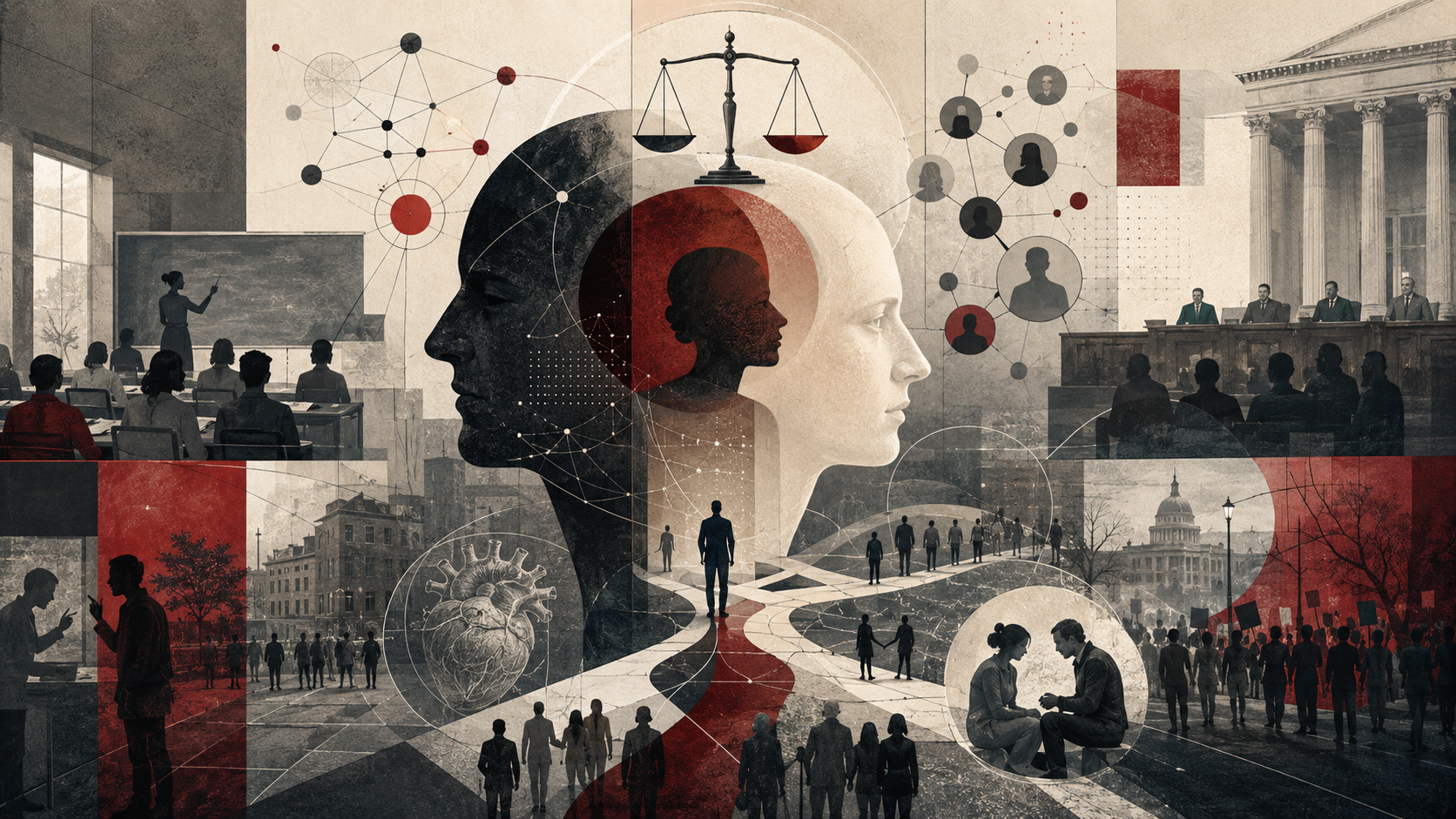
Moral psychology is especially important now because moral problems increasingly unfold across systems rather than isolated private choices. People judge events at digital speed, evaluate distant harms through mediated images, assign blame inside complex institutions, interpret disagreement through group identity, and try to preserve a sense of moral coherence under conditions of uncertainty, inequality, crisis, and public distrust. The field matters because it helps explain how moral life works when ethical judgment is distributed across persons, platforms, organizations, professions, publics, and institutions.
What It Means to Say Moral Psychology Matters
To say that moral psychology matters is to say that understanding moral life requires more than abstract ethical theory or raw behavioral description alone. People do not simply apply principles like machines, nor do they drift through social life without norms, emotions, identities, or judgments. They perceive, interpret, justify, excuse, condemn, cooperate, rationalize, and learn. Moral psychology matters because it investigates those processes directly.
This matters now because public life is saturated with morally charged conflict. Questions of justice, inequality, political legitimacy, institutional trust, punishment, technology, care, and collective risk all depend partly on how human beings actually process moral situations. If those processes are ignored, ethical debate becomes thinner and public diagnosis becomes less realistic.
Moral psychology also matters because moral life often begins before explicit reasoning. People notice some harms and miss others. They interpret intention before they calculate consequence. They feel anger, empathy, disgust, guilt, shame, gratitude, or resentment before they produce formal justification. They judge character, trustworthiness, loyalty, cruelty, hypocrisy, and responsibility through patterns of perception that are shaped by memory, identity, social norms, culture, power, and institutional setting.
That does not make moral life irrational. It makes it human. Moral judgment is often a layered process in which perception, emotion, intuition, reasoning, identity, and social context interact. The danger comes when people pretend that morality is either pure rational calculation or mere subjective feeling. Moral psychology matters because it studies the full structure: how human beings become capable of moral attention, how they justify moral claims, how they fail, and how they sometimes repair what has been broken.
| Moral-psychological process | What it helps explain | Why it matters today |
|---|---|---|
| Moral perception | How people notice harm, injustice, vulnerability, and obligation | Many social harms remain invisible until attention is morally organized. |
| Moral emotion | How guilt, shame, empathy, disgust, anger, and compassion shape judgment | Public life is increasingly driven by emotionally charged moral narratives. |
| Responsibility attribution | How people assign blame, excuse, agency, intention, and accountability | Modern harms often occur through institutions, systems, and distributed action. |
| Moral identity | How morality becomes part of selfhood, belonging, and aspiration | People defend moral self-images even while rationalizing inconsistency or harm. |
| Social moral life | How groups, institutions, and cultures shape moral norms | Polarization, conformity, digital outrage, and institutional silence all depend on social context. |
A Field Between Psychology and Ethics
Moral psychology matters in part because it is an interdisciplinary bridge field. Empirical moral psychology draws on both the resources of the human sciences and the conceptual resources of philosophical ethics. That makes it unusually valuable for linking descriptive findings about how people judge and behave to normative questions about what they ought to do.
This bridging role is especially important today because many contemporary arguments fail precisely at that junction. Some rely on moral theory while ignoring how actual agents perceive, misperceive, and respond under real conditions. Others rely on behavioral findings while assuming that description alone can answer normative questions. Moral psychology matters because it keeps those domains in contact without collapsing one into the other.
The distinction is crucial. Psychology can help explain why people punish, forgive, rationalize, empathize, scapegoat, conform, cooperate, or disengage. It can explain how moral development unfolds, how organizational incentives shape ethical decision-making, how political identity influences moral judgment, and how online platforms amplify outrage. But psychological description alone cannot decide what justice requires, what dignity demands, what punishment is legitimate, or what obligations institutions owe to those they affect.
Moral psychology is strongest when it accepts both sides of this boundary. It refuses to treat human beings as abstract moral calculators detached from development, emotion, culture, power, and institutions. But it also refuses to treat empirical pattern as moral justification. People may naturally favor their own group, but that does not make favoritism just. People may feel disgust, but disgust does not automatically establish wrongness. People may blame quickly, but blame still requires moral evaluation.
The field therefore improves ethical reasoning by making it less naive. It shows that moral judgment is vulnerable to bias, group loyalty, motivated reasoning, status incentives, fatigue, trauma, and institutional pressure. It also shows that moral capacities can be cultivated through education, practice, social support, institutional design, accountability, and repair. Moral psychology matters because it connects ethical seriousness with realistic human understanding.
Why It Matters in Everyday Life
Moral psychology matters in everyday life because ordinary experience is full of morally structured judgments: when people blame or excuse others, negotiate fairness, decide whether to help, evaluate intentions, interpret hypocrisy, or react to harm. These are not rare philosophical moments. They are routine features of friendships, families, workplaces, schools, neighborhoods, and public encounters.
The field helps explain why these everyday judgments are often unstable or conflict-ridden. People can sincerely care about fairness and still rationalize self-interest; care about responsibility and still diffuse blame; value honesty and still excuse allies. Moral psychology matters because it provides a framework for understanding those tensions rather than treating them as random inconsistency.
Everyday moral life depends on interpretation. A late apology may be read as sincere repair or strategic self-protection. A harsh comment may be read as cruelty, frustration, honesty, or misunderstanding. A failure to help may be read as selfishness, fear, incapacity, or ignorance. Moral psychology helps explain why such judgments differ: people infer intention, weigh harm, interpret relationship history, assess character, and compare behavior against social norms.
It also explains why people often experience ordinary conflict as morally charged. Disagreements are rarely only about events. They are about recognition, trust, dignity, fairness, loyalty, obligation, and whether one’s experience has been taken seriously. A person who feels harmed often wants more than a factual correction. They may want acknowledgment. They may want responsibility. They may want changed behavior. They may want assurance that the relationship or institution still has moral meaning.
Everyday life also reveals the gap between moral aspiration and moral conduct. People may want to be generous but become defensive. They may value humility but seek status. They may value fairness but protect their advantage. They may oppose cruelty but join ridicule. Moral psychology matters because it shows that ethical life requires not only values, but attention, practice, courage, self-regulation, social support, and the ability to repair failure without collapsing into denial or shame.
Why It Matters for Politics and Public Life
Moral psychology matters today especially in politics because moral judgments vary across cultures and politics while still being organized by shared cognitive elements, including perceptions of harm constructed from intention, causation, and suffering. That means political conflict is not merely a clash of disconnected opinions. It often reflects deeper differences in salience, interpretation, group identity, and threat perception.
This is one reason the field is so relevant to democratic life. Polarization, propaganda, and networked outrage all depend partly on predictable moral-psychological processes: how people sort into groups, whom they trust, what they interpret as threat, and how they evaluate opponents. Without moral psychology, public analysis of polarization stays too superficial, focusing on opinions without understanding the moral and emotional structures that sustain them.
Political conflict often becomes difficult because people disagree not only about policy, but about what counts as harm, whose suffering is credible, which institutions deserve trust, what histories matter, and who is responsible for collective injury. One public may interpret a policy as protection; another may interpret it as domination. One group may interpret protest as moral courage; another may interpret it as disorder. One side may see reform as justice; another may see it as threat. Moral psychology helps explain why such disagreements are emotionally intense: they are tied to identity, belonging, dignity, memory, and perceived moral order.
The field also clarifies why misinformation and propaganda often work through moral channels. They do not merely provide false facts. They organize fear, disgust, resentment, loyalty, humiliation, blame, and perceived threat. They tell people who is innocent, who is corrupt, who is dangerous, who deserves sympathy, and who deserves punishment. Moral psychology matters because it shows how public belief can be shaped through moral emotion and group identity, not only through evidence.
For democratic life, this has practical implications. A society cannot repair polarization only by providing more information. Information matters, but people evaluate evidence through trust, identity, emotion, and moral framing. Democratic repair requires institutions, media practices, educational systems, and civic cultures that reduce dehumanization, protect shared reality, make disagreement governable, and preserve the possibility of mutual recognition.
Why It Matters for Organizations and Institutions
Moral psychology matters for organizations because modern ethical life is largely institutional. Recent review work on moral decision-making in organizations emphasizes that decisions are shaped by factors such as intuition, reflection, social influence, culture, incentives, and organizational context, not just by private virtue in isolation.
This is crucial today because many serious harms are produced through systems rather than solitary actors. Organizations shape what people notice, what they ignore, what they feel permitted to do, and how responsibility is distributed. Moral psychology matters because it explains how silence, ethical fading, bounded ethicality, and distorted incentive structures can produce misconduct or moral injury even among people who do not think of themselves as bad actors.
Organizations are moral environments. Their reporting systems, reward structures, leadership signals, status hierarchies, time pressures, metrics, professional norms, compliance routines, and informal cultures shape ethical attention. A workplace can make harm visible or invisible. It can reward candor or punish dissent. It can distribute responsibility clearly or diffuse it across committees, roles, procedures, and technical systems. It can encourage people to see clients, patients, students, workers, or citizens as persons, or reduce them to outputs, cases, numbers, risks, tickets, or liabilities.
This is why institutional harm is often morally confusing. People inside organizations may not experience themselves as cruel or corrupt. They may experience themselves as following procedure, meeting targets, protecting the organization, satisfying superiors, avoiding conflict, or doing what everyone else does. Moral psychology helps explain how ordinary role behavior can become ethically dangerous when incentives, hierarchy, fear, and fragmentation weaken moral attention.
The field also matters for leadership. Ethical leadership is not only a matter of declaring values. It involves shaping conditions under which people can notice harm, speak truthfully, resist pressure, interpret responsibility clearly, and repair mistakes. Leaders influence moral climate through what they reward, what they ignore, whom they protect, how they respond to dissent, and whether they treat ethical concerns as central or inconvenient.
| Institutional pattern | Moral-psychological risk | Practical implication |
|---|---|---|
| Diffused responsibility | No single person feels accountable for harm | Clarify ownership, escalation paths, and duty of care. |
| Metric fixation | People optimize targets while ignoring moral consequences | Pair performance measures with ethical review and qualitative feedback. |
| Silence and fear | People notice problems but avoid speaking | Protect dissent, whistleblowing, and psychological safety. |
| Ethical fading | Moral questions become technical or procedural questions | Name moral stakes explicitly in decision processes. |
| Role fragmentation | People perform narrow tasks without seeing systemic harm | Build cross-functional accountability and harm visibility. |
Moral psychology does not replace law, governance, compliance, or professional ethics. It shows why those structures must be designed around actual human tendencies: conformity, fear, loyalty, rationalization, fatigue, status pressure, moral blindness, and the need for recognition, accountability, and repair.
Why It Matters for Development and Education
Moral psychology matters for development because moral learning does not appear fully formed. Research on moral learning and decision-making across the lifespan shows that these capacities differ from infancy to older adulthood and are shaped by changes in values, theory of mind, guilt, fairness, empathy, social experience, and moral emotion.
This makes the field highly relevant for education, parenting, and civic formation. If moral judgment, fairness, empathy, and norm learning develop over time, then the moral quality of institutions that teach children and support adults becomes central. Moral psychology matters because it helps identify how capacities are acquired, how they change, and where interventions or environments may strengthen or weaken them.
Moral education cannot be reduced to rule memorization. Children and adolescents learn not only what rules exist, but why rules matter, whom rules protect, when authority is legitimate, how harm feels, how fairness is negotiated, and how responsibility is shared. They learn through direct instruction, modeling, peer interaction, discipline, story, ritual, institutional practice, and exposure to fairness or unfairness in everyday life.
This means moral development is shaped by credibility. A school that teaches respect while humiliating students sends a conflicted moral message. A family that preaches honesty while rewarding manipulation teaches more than it intends. A public institution that invokes dignity while practicing exclusion undermines moral trust. Moral psychology matters because it shows that people learn morality not only through words, but through environments.
The field also expands the view of moral development beyond childhood. Adults continue to develop morally through work, caregiving, grief, conflict, public responsibility, leadership, trauma, community life, institutional betrayal, and encounters with moral difference. Moral learning continues when people confront failure, revise assumptions, repair harm, or assume responsibility for others. A mature society therefore needs moral education not only in schools, but in professions, institutions, civic life, and public culture.
Why It Matters for Cross-Cultural Understanding
Moral psychology matters now because contemporary life is cross-cultural. Moral judgments differ across cultures and politics, but they also share recurring concerns with harm, intention, causation, suffering, care, fairness, obligation, authority, dignity, loyalty, purity, reciprocity, and responsibility. This means moral difference is real, but not unintelligible.
That matters for global politics, migration, pluralistic democracies, comparative ethics, education, healthcare, international organizations, and any institution operating across diverse populations. Moral psychology helps people distinguish between genuine moral pluralism, local norm variation, and sheer mutual caricature. In a world where conflict is often intensified by moral misunderstanding, that explanatory power is practically important.
Cross-cultural moral psychology is especially valuable because it resists two opposite errors. The first error is assuming that one’s own moral intuitions are simply universal common sense. The second is assuming that moral difference makes understanding impossible. The field shows that cultures may organize moral concern differently while still drawing on recognizable human concerns: suffering, care, obligation, fairness, status, authority, loyalty, dignity, purity, reciprocity, and responsibility.
The field also needs to attend to power. Moral difference is not always encountered under equal conditions. Colonial history, racism, religious marginalization, caste, gender hierarchy, migration status, economic dependency, and political domination shape which moral voices are treated as authoritative and which are dismissed as backward, irrational, excessive, or uncivil. Moral psychology matters because it can help make those patterns visible while still preserving the possibility of shared ethical reasoning.
In public institutions, cross-cultural moral psychology encourages humility. It asks decision-makers to examine whether their assumptions about autonomy, family, obligation, dignity, authority, harm, care, punishment, or repair are culturally narrow. It also asks communities to distinguish between respecting difference and tolerating domination. Moral psychology cannot solve these dilemmas alone, but it helps clarify why plural moral life requires interpretation, historical awareness, and ethical seriousness.
Why It Matters for Accountability and Responsibility
Moral psychology matters because modern societies constantly assign responsibility: in law, workplace oversight, public scandal, healthcare, politics, education, technology, and ordinary interpersonal life. Empirical approaches to moral responsibility help clarify how people interpret agency, intention, control, ignorance, excuse, blame, and accountability.
This is deeply relevant now because systems of accountability are under pressure everywhere. People disagree about blame, excuse, institutional responsibility, and who should answer for harms produced by complex organizations or collective actions. Moral psychology matters because it helps explain how people interpret agency, intention, control, ignorance, excuse, and blame rather than assuming those judgments are transparent or uniform.
Responsibility becomes especially difficult when harm is distributed across systems. A person may follow a rule, a manager may enforce a policy, an algorithm may sort cases, a contractor may implement a decision, a committee may approve a process, and an institution may produce harm without any single actor experiencing full ownership. Moral psychology helps explain how responsibility disappears in such arrangements, how people justify participation, and why publics often struggle to decide where blame belongs.
The field also clarifies why accountability must include more than punishment. Punishment may be necessary in some cases, but moral repair often also requires truth-telling, acknowledgment, apology, restitution, compensation, changed policy, institutional reform, and prevention. People harmed by institutions often want more than procedure. They want recognition that what happened mattered, that responsibility has been named, and that the conditions that produced harm will change.
Moral psychology also helps explain why accountability fails. People protect self-image. Groups protect insiders. Institutions protect legitimacy. Leaders avoid liability. Publics seek scapegoats. Systems hide causal chains. Moral outrage may demand punishment before investigation, while bureaucratic procedure may delay recognition until trust collapses. The field matters because it gives societies a more realistic vocabulary for blame, excuse, responsibility, and repair.
Why It Matters for Technology and Networked Life
Moral psychology matters today because digital platforms have changed moral experience itself. Social media and networked communication can amplify moralized content, outrage, status seeking, reputational punishment, and intergroup conflict while also enabling accountability, mutual aid, documentation of harm, and collective action. In other words, networked environments reshape how moral attention, social reward, and public condemnation work.
This makes moral psychology essential for understanding contemporary information environments. People are now asked to judge moral events at scale, under speed, virality, visibility, and algorithmic selection. The field matters because it explains why outrage spreads, why norms become distorted, why online life intensifies moral performance, and why technological systems can amplify both prosocial mobilization and dehumanizing exclusion.
Digital life changes moral judgment in several ways. It increases exposure to distant suffering while reducing context. It rewards speed before reflection. It turns moral expression into visible social performance. It creates incentives for condemnation, alignment, ridicule, and identity signaling. It compresses complex histories into emotionally charged fragments. It also enables people to expose abuse, organize solidarity, challenge institutional silence, and mobilize public concern across distance.
Artificial intelligence and automated decision systems add another layer. Moral judgment increasingly interacts with systems that classify risk, prioritize visibility, recommend content, screen applicants, detect misconduct, allocate resources, or simulate human interaction. These systems do not eliminate moral responsibility. They redistribute it across designers, users, organizations, vendors, regulators, and publics. Moral psychology helps explain how people assign trust, agency, blame, and legitimacy to technical systems that are often presented as neutral.
The field is therefore central to technology ethics. Ethical technology cannot be designed only around abstract principles or legal compliance. It must account for human attention, incentive sensitivity, status seeking, social comparison, empathy fatigue, moral outrage, dehumanization, authority bias, group loyalty, and the tendency to treat automated outputs as objective even when they embody social choices.
Why It Matters for Moral Injury and Human Flourishing
Moral psychology matters because moral life is not only about judgment. It is also about suffering, injury, meaning, and repair. Moral injury describes a functionally impairing problem involving moral emotions, beliefs, and behaviors that can arise from transgressive acts, victimization, betrayal, or witnessing inhumanity.
This matters now because many people experience moral strain not just in war, but in healthcare, public service, organizational life, education, caregiving, political crisis, and institutional failure. Moral psychology helps explain how conscience can be wounded, how betrayal by institutions matters, and why repair requires more than individual resilience. In this sense, the field matters not only for analyzing conduct, but for understanding what kind of social conditions support or damage human flourishing.
Moral injury is important because it shows that ethical life is embodied and psychologically consequential. People can suffer when they believe they have violated their own moral commitments, when they are forced to participate in systems they regard as wrong, when they witness preventable harm, or when trusted authorities betray fundamental obligations. Shame, guilt, anger, grief, numbness, alienation, and loss of meaning can all become part of moral suffering.
This expands the significance of moral psychology beyond judgment and disagreement. The field helps explain why institutional betrayal can be so damaging, why apology and accountability matter, why moral repair requires recognition as well as treatment, and why people need communities and institutions that support conscience rather than merely demanding performance.
The concept of moral injury also warns against individualizing every ethical wound. A burned-out nurse, whistleblower, soldier, teacher, public servant, content moderator, caregiver, or employee may be experiencing not merely stress, but moral strain created by impossible demands, institutional neglect, or repeated exposure to preventable harm. Moral psychology matters because it gives language to these injuries without reducing them to private weakness.
Human flourishing depends not only on satisfaction, achievement, or psychological adaptation. It also depends on the ability to live with moral coherence: to act without chronic betrayal of conscience, to trust institutions enough to participate in them, to repair harm when failure occurs, and to belong to communities where dignity and responsibility remain meaningful.
What Moral Psychology Can and Cannot Do
Moral psychology matters, but it has limits. It can explain how people judge, why they disagree, how institutions shape behavior, how moral capacities develop, and how culture and politics structure moral life. It cannot by itself settle every normative question. The field can affect ethical theory, legal reasoning, institutional design, education, and public life, but it does not replace ethics altogether.
That limitation is actually part of its value. The field matters because it improves moral and political reasoning by making it more realistic, more self-aware, and less naive about agency, bias, development, and context. It does not eliminate the need for normative judgment. It helps make such judgment better informed.
Moral psychology can show that people are susceptible to motivated reasoning, selective empathy, status incentives, conformity, fear, moral licensing, disgust, dehumanization, authority pressure, and responsibility diffusion. It can show that environments shape conduct. It can show that people respond differently to identifiable victims than to statistical harms, differently to allies than to opponents, and differently to visible harm than to diffuse systemic harm. These findings matter because they reveal where moral judgment is fragile.
But empirical findings do not automatically tell a society what justice requires. They do not by themselves determine what rights should be protected, what punishment is legitimate, what duties institutions owe, what forgiveness means, or how competing values should be ranked. Those questions still require ethical, legal, political, philosophical, religious, and civic reasoning.
The best use of moral psychology is therefore neither cynicism nor manipulation. It should not be used merely to exploit moral emotions, engineer compliance, manipulate outrage, or reduce ethics to behavioral prediction. Its deeper value lies in helping people and institutions become more responsible: more aware of bias, more attentive to harm, more careful with blame, more realistic about systems, and more capable of repair.
Mathematical Lens: Why Moral Psychology Has System-Level Importance
The contemporary importance of moral psychology can be modeled as the joint influence of several domains in which moral processes shape outcomes. Let \(S_t\) represent the social significance of moral psychology at time \(t\):
S_t = \alpha P_t + \beta O_t + \gamma D_t + \delta C_t + \eta T_t + \mu M_t
\]
where \(P_t\) is political polarization, \(O_t\) organizational moral risk, \(D_t\) developmental moral learning, \(C_t\) cross-cultural moral variation, \(T_t\) technology-mediated moral amplification, and \(M_t\) moral injury burden. This equation reflects the broad claim that moral cognition is consequential across politics, organizations, lifespan development, culture, technology, and clinical or institutional contexts.
The model is not meant to reduce morality to a single score. It is a conceptual systems model. Its purpose is to show that moral psychology becomes more important when multiple domains of moral pressure intensify at the same time. In a relatively stable setting, moral psychology may appear to be a specialized academic field. In a highly networked, polarized, institutionally complex, technologically mediated society, it becomes a practical framework for understanding how moral life is shaped at scale.
A more focused model of moral-judgment relevance in public life can be written as:
J_i = f(H_i, F_i, R_i, G_i, E_i)
\]
where \(H_i\) is harm perception, \(F_i\) fairness sensitivity, \(R_i\) responsibility attribution, \(G_i\) group identity, and \(E_i\) epistemic trust. This captures why the field matters: those dimensions help structure political conflict, institutional action, blame, public trust, and everyday ethics.
A developmental extension can be written as:
M_i(t+1) = M_i(t) + \lambda L_i + \phi S_i – \rho X_i
\]
where \(M_i(t)\) is moral capacity over time, \(L_i\) is learning, \(S_i\) is socialization support, and \(X_i\) is morally corrosive pressure or distortion. This reflects the idea that moral learning and decision-making change over time and are shaped by social conditions rather than existing in static form.
These models are intentionally simple. Their purpose is not to capture the whole of moral life, but to clarify how moral psychology can operate at multiple levels. Moral judgment is individual, but not only individual. It is developmental, social, institutional, cultural, and technological. When these layers interact, moral psychology becomes a systems science of ethical agency.
| Model term | Interpretive meaning | Article relevance |
|---|---|---|
| \(P_t\) | Political polarization | Explains why group identity and moralized threat shape public conflict. |
| \(O_t\) | Organizational moral risk | Explains how institutions structure attention, silence, responsibility, and failure. |
| \(D_t\) | Developmental moral learning | Explains why moral capacities must be formed over time. |
| \(C_t\) | Cross-cultural moral variation | Explains why moral difference requires interpretation rather than caricature. |
| \(T_t\) | Technology-mediated moral amplification | Explains why platforms reshape outrage, attention, blame, and moral visibility. |
| \(M_t\) | Moral injury burden | Explains why ethical life includes suffering, betrayal, conscience, and repair. |
R Workflow: Modeling the Contemporary Relevance of Moral Psychology
The following R workflow simulates a social system in which politics, organizations, development, culture, technology, and moral injury jointly influence why moral psychology matters in practice. The dataset is synthetic and intended for conceptual demonstration, reproducible teaching, and article-level analytical scaffolding.
# Why Moral Psychology Matters Today
# R workflow for synthetic systems-level modeling
# Educational and reproducible research scaffold only.

library(tidyverse)
library(broom)

set.seed(42)

# ------------------------------------------------------------
# 1. Simulate domain-level relevance variables
# ------------------------------------------------------------

n <- 2400

df <- tibble(
  political_polarization = rnorm(n, 0, 1),
  organizational_risk = rnorm(n, 0, 1),
  developmental_moral_learning = rnorm(n, 0, 1),
  cross_cultural_variation = rnorm(n, 0, 1),
  technology_amplification = rnorm(n, 0, 1),
  moral_injury_burden = rnorm(n, 0, 1)
) %>%
  mutate(
    moral_psychology_significance =
      0.25 * political_polarization +
      0.20 * organizational_risk +
      0.15 * developmental_moral_learning +
      0.15 * cross_cultural_variation +
      0.15 * technology_amplification +
      0.20 * moral_injury_burden +
      rnorm(n, 0, 0.8)
  )

# ------------------------------------------------------------
# 2. Estimate significance model
# ------------------------------------------------------------

model_significance <- lm(
  moral_psychology_significance ~ political_polarization +
    organizational_risk +
    developmental_moral_learning +
    cross_cultural_variation +
    technology_amplification +
    moral_injury_burden,
  data = df
)

model_summary <- tidy(model_significance, conf.int = TRUE)
model_fit <- glance(model_significance)

print(summary(model_significance))
print(model_summary)
print(model_fit)

# ------------------------------------------------------------
# 3. Prediction grid across polarization and tech amplification
# ------------------------------------------------------------

pred_grid <- expand_grid(
  political_polarization = seq(-2, 2, length.out = 100),
  technology_amplification = c(-1, 0, 1),
  organizational_risk = 0,
  developmental_moral_learning = 0,
  cross_cultural_variation = 0,
  moral_injury_burden = 0
)

pred_grid$predicted_significance <- predict(
  model_significance,
  newdata = pred_grid
)

pred_grid <- pred_grid %>%
  mutate(
    tech_label = case_when(
      technology_amplification == -1 ~ "Low technology amplification",
      technology_amplification == 0 ~ "Average technology amplification",
      TRUE ~ "High technology amplification"
    )
  )

# ------------------------------------------------------------
# 4. Summarize simulated domain profiles
# ------------------------------------------------------------

domain_summary <- df %>%
  mutate(
    significance_band = ntile(moral_psychology_significance, 4),
    significance_band = factor(
      significance_band,
      labels = c("Low", "Lower-middle", "Upper-middle", "High")
    )
  ) %>%
  group_by(significance_band) %>%
  summarize(
    mean_polarization = mean(political_polarization),
    mean_organizational_risk = mean(organizational_risk),
    mean_developmental_learning = mean(developmental_moral_learning),
    mean_cross_cultural_variation = mean(cross_cultural_variation),
    mean_technology_amplification = mean(technology_amplification),
    mean_moral_injury = mean(moral_injury_burden),
    .groups = "drop"
  )

print(domain_summary)

# ------------------------------------------------------------
# 5. Plot predicted significance
# ------------------------------------------------------------

plot_predicted_significance <- ggplot(
  pred_grid,
  aes(x = political_polarization, y = predicted_significance)
) +
  geom_line(linewidth = 1) +
  facet_wrap(~ tech_label) +
  labs(
    title = "Predicted Contemporary Significance of Moral Psychology",
    subtitle = "Polarization and digital amplification make moral-psychological insight more consequential",
    x = "Political polarization",
    y = "Predicted significance"
  ) +
  theme_minimal(base_size = 12)

print(plot_predicted_significance)

# ------------------------------------------------------------
# 6. Export outputs
# ------------------------------------------------------------

dir.create("outputs", showWarnings = FALSE)
dir.create("outputs/tables", recursive = TRUE, showWarnings = FALSE)
dir.create("outputs/figures", recursive = TRUE, showWarnings = FALSE)

write_csv(df, "outputs/tables/why_moral_psychology_matters_simulated_data.csv")
write_csv(model_summary, "outputs/tables/why_moral_psychology_matters_model.csv")
write_csv(domain_summary, "outputs/tables/why_moral_psychology_matters_domain_summary.csv")
write_csv(pred_grid, "outputs/tables/why_moral_psychology_matters_predictions.csv")

ggsave(
  filename = "outputs/figures/predicted_moral_psychology_significance.png",
  plot = plot_predicted_significance,
  width = 10,
  height = 6,
  dpi = 300
)
This workflow is useful because it treats the relevance of moral psychology as a multi-domain social phenomenon rather than a purely academic claim. It also shows how article-level computational scaffolds can support conceptual clarity: the model makes assumptions explicit, generates reproducible synthetic data, produces interpretable outputs, and creates a basis for later extensions in organizational ethics, polarization, moral injury, development, and digital moral life.
Python Workflow: Simulating Moral-Psychological Pressure Across Domains
The Python workflow below simulates how several contemporary domains combine to increase the practical importance of moral psychology. Like the R workflow, it uses synthetic data for teaching, modeling, and reproducible demonstration. The goal is not to produce empirical claims from simulated data, but to clarify how political, organizational, developmental, cultural, technological, and moral-injury pressures can be represented in an auditable analytical structure.
# Why Moral Psychology Matters Today
# Python workflow for synthetic systems-level modeling
# Educational and reproducible research scaffold only.

from pathlib import Path

import numpy as np
import pandas as pd

np.random.seed(42)

# ------------------------------------------------------------
# 1. Set up output paths
# ------------------------------------------------------------

output_tables = Path("outputs/tables")
output_tables.mkdir(parents=True, exist_ok=True)

# ------------------------------------------------------------
# 2. Simulate domain-level relevance variables
# ------------------------------------------------------------

n = 2600

df = pd.DataFrame({
    "political_polarization": np.random.normal(0, 1, n),
    "organizational_risk": np.random.normal(0, 1, n),
    "developmental_moral_learning": np.random.normal(0, 1, n),
    "cross_cultural_variation": np.random.normal(0, 1, n),
    "technology_amplification": np.random.normal(0, 1, n),
    "moral_injury_burden": np.random.normal(0, 1, n)
})

# ------------------------------------------------------------
# 3. Generate significance score
# ------------------------------------------------------------

df["moral_psychology_significance"] = (
    0.25 * df["political_polarization"] +
    0.20 * df["organizational_risk"] +
    0.15 * df["developmental_moral_learning"] +
    0.15 * df["cross_cultural_variation"] +
    0.15 * df["technology_amplification"] +
    0.20 * df["moral_injury_burden"] +
    np.random.normal(0, 0.8, n)
)

# ------------------------------------------------------------
# 4. Summarize by significance band
# ------------------------------------------------------------

df["significance_band"] = pd.qcut(
    df["moral_psychology_significance"],
    q=4,
    labels=["Low", "Lower-middle", "Upper-middle", "High"]
)

summary = (
    df.groupby("significance_band", observed=False)
      .agg(
          mean_polarization=("political_polarization", "mean"),
          mean_org_risk=("organizational_risk", "mean"),
          mean_developmental_learning=("developmental_moral_learning", "mean"),
          mean_cross_cultural_variation=("cross_cultural_variation", "mean"),
          mean_technology_amplification=("technology_amplification", "mean"),
          mean_moral_injury=("moral_injury_burden", "mean"),
          mean_significance=("moral_psychology_significance", "mean")
      )
      .reset_index()
)

print(summary)

# ------------------------------------------------------------
# 5. Scenario grid across polarization and moral injury
# ------------------------------------------------------------

scenario_rows = []

for polarization in np.linspace(-2, 2, 41):
    for organizational_risk in [-1, 0, 1]:
        for injury in [-1, 0, 1]:
            significance = (
                0.25 * polarization +
                0.20 * organizational_risk +
                0.15 * 0 +
                0.15 * 0 +
                0.15 * 0 +
                0.20 * injury
            )

            scenario_rows.append({
                "political_polarization": polarization,
                "organizational_risk": organizational_risk,
                "moral_injury_burden": injury,
                "predicted_significance": significance
            })

scenario_df = pd.DataFrame(scenario_rows)

print(scenario_df.head(12))

# ------------------------------------------------------------
# 6. Identify high-pressure moral-psychological contexts
# ------------------------------------------------------------

high_pressure = (
    df.sort_values("moral_psychology_significance", ascending=False)
      .head(25)
      .reset_index(drop=True)
)

print(high_pressure.head())

# ------------------------------------------------------------
# 7. Export outputs
# ------------------------------------------------------------

df.to_csv(output_tables / "why_moral_psychology_matters_python.csv", index=False)
summary.to_csv(output_tables / "why_moral_psychology_matters_summary.csv", index=False)
scenario_df.to_csv(output_tables / "why_moral_psychology_matters_scenarios.csv", index=False)
high_pressure.to_csv(output_tables / "why_moral_psychology_matters_high_pressure_cases.csv", index=False)
This workflow is useful because it shows how several contemporary pressures can jointly raise the explanatory and practical importance of moral psychology. It also helps readers see why the field cannot be confined to individual judgment alone. Moral psychology has system-level relevance because moral life is shaped by politics, organizations, culture, development, technology, and injury at the same time.
In a full article repository, this Python workflow can be extended into notebooks, SQL schema, documentation, synthetic datasets, validation notes, and additional language examples. R can support statistical modeling and visualization; Python can support simulation and data pipelines; SQL can preserve structured data and provenance; Julia can support mathematical simulation; C, C++, Fortran, Go, and Rust can support reproducible command-line tools, validation utilities, and computational demonstrations.
GitHub Repository
The companion repository for this article provides a reproducible code scaffold for modeling the contemporary relevance of moral psychology across politics, institutions, development, culture, technology, and moral injury. The repository is designed to support synthetic data generation, statistical modeling, simulation, documentation, and article-level computational examples across multiple languages.
This article’s companion repository includes reproducible workflows, synthetic datasets, model documentation, computational examples, and outputs for exploring why moral psychology matters as a systems-level field of ethical agency, institutional accountability, moral development, digital life, and human flourishing.
The repository structure should support a full research workflow rather than a single script. The article folder can include language-specific examples in python, r, julia, sql, c, cpp, fortran, go, and rust, along with data, docs, notebooks, and outputs. This structure makes the article reproducible, inspectable, and extensible for readers who want to move from conceptual argument to analytical demonstration.
Conclusion
Moral psychology matters today because the moral challenges of contemporary life are inseparable from the ways human beings actually perceive, judge, learn, cooperate, excuse, condemn, and suffer. The field helps explain why morality differs across cultures and politics while retaining shared structures, why moral learning changes across the lifespan, why organizations shape ethical action, and why modern systems can generate moral injury as well as disagreement.
The strongest reason it matters, then, is not that it replaces ethics, politics, law, religion, education, or philosophy. It matters because it makes all of them more realistic. A society trying to understand polarization, institutional failure, digital outrage, development, or accountability without moral psychology will miss too much about how moral life actually works.
The field also matters because it preserves a serious account of human agency without romanticizing it. People are capable of care, justice, courage, honesty, responsibility, forgiveness, and repair. They are also capable of rationalization, hypocrisy, cruelty, avoidance, dehumanization, and moral blindness. Moral psychology helps explain both truths at once.
In that sense, moral psychology is not only a field of study. It is a discipline of self-understanding. It asks how people become morally attentive, how they lose that attention, how institutions support or distort responsibility, how moral emotions shape public life, and how repair remains possible after harm. In a century defined by technological acceleration, institutional distrust, ecological risk, political fragmentation, and moral exhaustion, those questions are not peripheral. They are central to the future of humane societies.
Related articles
- Methods in Moral Psychology: Experiment, Development, and Measurement
- Experimental Moral Psychology and the Study of Ethical Intuition
- Cross-Cultural Moral Psychology
- Moral Psychology in Organizations and Institutions
- Social Identity, Group Life, and Moral Polarization
- Social Media, Outrage, and Networked Moral Life
- Responsibility, Blame, and Moral Accountability
- Moral Disagreement and the Psychology of Pluralism
Further reading
- Doris, J.M. (2022) ‘Moral Psychology: Empirical Approaches’, in The Stanford Encyclopedia of Philosophy. Available at: https://plato.stanford.edu/entries/moral-psych-emp/.
- Gray, K. and Pratt, S. (2025) ‘Morality in Our Mind and Across Cultures and Politics’, Annual Review of Psychology, 76, pp. 663–691. Available at: https://www.annualreviews.org/content/journals/10.1146/annurev-psych-020924-124236.
- Lockwood, P.L., van den Bos, W. and Dreher, J.-C. (2025) ‘Moral Learning and Decision-Making Across the Lifespan’, Annual Review of Psychology, 76, pp. 475–500. Available at: https://www.annualreviews.org/content/journals/10.1146/annurev-psych-021324-060611.
- Kouchaki, M. and Smith, I.H. (2025) ‘Moral Decision-Making in Organizations’, Annual Review of Organizational Psychology and Organizational Behavior, 12, pp. 45–72. Available at: https://www.annualreviews.org/content/journals/10.1146/annurev-orgpsych-110622-045715.
- Litz, B.T. and Kerig, P.K. (2025) ‘Moral Injury: An Overview of Conceptual, Definitional, and Treatment Issues’, Annual Review of Clinical Psychology. Available at: https://www.annualreviews.org/content/journals/10.1146/annurev-clinpsy-081423-022604.
References
- Doris, J.M. (2022) ‘Moral Psychology: Empirical Approaches’, in The Stanford Encyclopedia of Philosophy. Available at: https://plato.stanford.edu/entries/moral-psych-emp/.
- Gray, K. and Pratt, S. (2025) ‘Morality in Our Mind and Across Cultures and Politics’, Annual Review of Psychology, 76, pp. 663–691. Available at: https://www.annualreviews.org/content/journals/10.1146/annurev-psych-020924-124236.
- Kouchaki, M. and Smith, I.H. (2025) ‘Moral Decision-Making in Organizations’, Annual Review of Organizational Psychology and Organizational Behavior, 12, pp. 45–72. Available at: https://www.annualreviews.org/content/journals/10.1146/annurev-orgpsych-110622-045715.
- Litz, B.T. and Kerig, P.K. (2025) ‘Moral Injury: An Overview of Conceptual, Definitional, and Treatment Issues’, Annual Review of Clinical Psychology. Available at: https://www.annualreviews.org/content/journals/10.1146/annurev-clinpsy-081423-022604.
- Lockwood, P.L., van den Bos, W. and Dreher, J.-C. (2025) ‘Moral Learning and Decision-Making Across the Lifespan’, Annual Review of Psychology, 76, pp. 475–500. Available at: https://www.annualreviews.org/content/journals/10.1146/annurev-psych-021324-060611.
- Sripada, C. (2025) ‘Empirical Approaches to Moral Responsibility’, in The Stanford Encyclopedia of Philosophy. Available at: https://plato.stanford.edu/entries/moral-responsibility-empirical/.