
Last Updated May 28, 2026
Moral injury, bureaucracy, and distributed responsibility belong together because some of the deepest moral wounds in modern life do not arise only from private vice, battlefield trauma, or direct cruelty. They arise when people are trapped inside organized systems that require, normalize, conceal, or fragment harmful action in ways that strain conscience, corrode agency, and make no one feel fully answerable. Moral injury names the lasting psychological, social, and sometimes spiritual damage that can follow exposure to morally injurious conditions. Bureaucracy names one of the major institutional forms through which those conditions are often organized. Distributed responsibility names the way agency is spread across roles, procedures, chains of command, software systems, approval flows, committees, policies, and organizational routines so that moral burden is widely produced but unevenly owned.
This article argues that moral injury in institutional settings often emerges not only from committing, witnessing, or failing to prevent obvious wrongdoing, but from inhabiting systems where one’s moral standards are repeatedly violated, overridden, or rendered unusable by policy, hierarchy, scarcity, proceduralism, organizational opacity, retaliation risk, or institutional indifference. In such settings, people may feel implicated without feeling empowered, responsible without being in control, ashamed without having authored the whole harm, and betrayed without being able to identify a single clear locus of blame.
That is why bureaucracy and distributed responsibility matter morally. They help explain how organizations can wound conscience while obscuring where responsibility lies. A person may know that harm is being done, may participate in a small part of the process, may recognize that the system is morally compromised, and yet may lack the practical authority to stop it. The injury is not merely stress. It is the experience of moral agency being trapped inside institutional machinery that converts conscience into compliance, care into procedure, and responsibility into a problem passed from office to office.
Main Library
Publications
Article Map
Moral Psychology
Related Topic
Organizational Psychology
Related Topic
Institutional Psychology
Related Topic
Ethics & Moral Philosophy
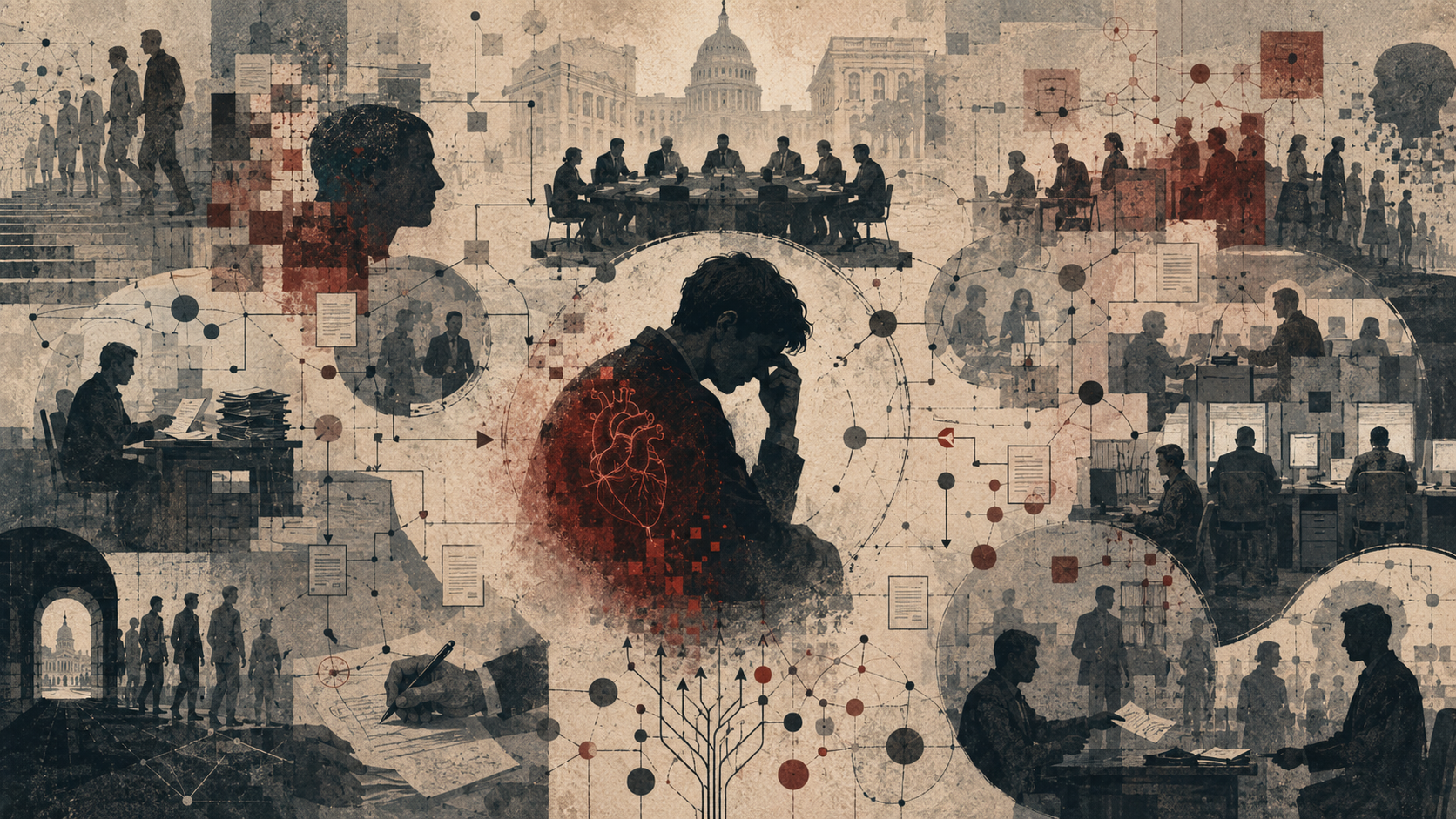
Moral injury is often discussed as an individual wound, but institutional moral injury cannot be understood by looking only at individual vulnerability. It requires attention to systems of work, authority, role obligation, moral constraint, professional identity, organizational silence, and the difficulty of locating responsibility in complex institutions. People can be morally injured by what they do, what they witness, what they are prevented from doing, what they are ordered to normalize, and what trusted institutions refuse to acknowledge.
Bureaucracy is therefore not morally neutral background. It is a moral environment. It determines which claims are legible, whose suffering receives recognition, who may exercise discretion, which rules override care, where accountability is recorded, and whether dissent is protected or punished. Distributed responsibility further complicates this terrain because institutional harms often emerge from many small actions that are individually partial but collectively decisive. A moral psychology of modern institutions must therefore study not only personal conscience, but the organizational forms that strain, fragment, and sometimes betray it.
What Moral Injury, Bureaucracy, and Distributed Responsibility Are
Moral injury refers to the enduring psychological, social, and sometimes spiritual distress that can follow exposure to events or conditions that violate a person’s moral beliefs, values, professional commitments, or expectations about what should and should not be done. In contemporary clinical and interdisciplinary work, moral injury is increasingly understood not only as the aftermath of personal transgression, but also as a response to betrayal, witnessing harm, being prevented from acting according to conscience, or being forced to participate in morally compromising situations. Litz and Kerig describe moral injury as a potential clinical problem involving impairing moral emotions, beliefs, behaviors, and adverse beliefs about personal or collective humanity, meaning, and purpose. See Litz and Kerig (2025).
Bureaucracy, in this context, is not merely paperwork or administration. It is a structured way of organizing roles, decisions, resources, rules, authority, recordkeeping, eligibility, discretion, and accountability. Bureaucracy makes modern institutions possible, but it also shapes how moral responsibility is perceived and exercised. It can protect fairness through rule-governed process, but it can also convert human suffering into categories, files, denials, queues, metrics, case numbers, workflows, and compliance routines.
Distributed responsibility refers to the way accountability is spread across many actors, procedures, offices, technologies, and decision points. A harmful outcome may result from policy design, budget allocation, software architecture, managerial priorities, front-line discretion, professional norms, legal constraint, institutional culture, and silence. No single actor may appear to cause the whole harm, yet many contribute materially to it. Responsibility is not absent; it is dispersed, fragmented, and difficult to use.
Together, these concepts describe a moral condition in which serious harms are socially produced through systems that dilute agency while intensifying implication. The morally injured person may feel trapped in the gap between participation and power: implicated enough to suffer, but not empowered enough to prevent, repair, or fully name the harm.
| Concept | Core meaning | Institutional significance |
|---|---|---|
| Moral injury | Lasting distress after moral violation, betrayal, or morally injurious exposure | Shows how conscience, identity, trust, and meaning can be harmed by institutional conditions. |
| Bureaucracy | Rule-based organization of roles, resources, authority, procedures, and records | Structures which harms are visible, which claims are recognized, and how discretion is used. |
| Distributed responsibility | Diffusion of agency and accountability across many actors and procedures | Makes harm collectively produced but difficult to own, contest, or repair. |
| Institutional betrayal | Violation of trust by an authority, organization, profession, or system | Intensifies injury because the source of moral failure is the institution meant to uphold purpose. |
| Many-hands problem | Difficulty assigning responsibility when many actors contribute to one outcome | Explains how accountability can vanish inside procedural complexity. |
Why These Concepts Belong Together
These concepts belong together because many institutional harms are neither fully personal nor fully anonymous. They occur through systems in which people participate in limited roles, often under constraint, while still experiencing themselves as morally implicated in outcomes they did not wholly design or control. This creates a distinctive moral tension: one may feel responsible enough to suffer, but not powerful enough to prevent or repair the harm.
This tension is especially visible in professional life. Workers may be required to implement policies they believe are harmful, deny care they believe is necessary, ration support they know is inadequate, enforce procedures they consider unjust, manipulate records to satisfy metrics, remain silent to protect employment, or comply with systems that punish dissent. In such settings, bureaucracy does not eliminate morality. It intensifies it by forcing conflict between professional duty, organizational rule, and personal conscience.
The bureaucratic worker may experience a double bind. If they obey the rule, they may violate conscience. If they resist the rule, they may be punished, isolated, or replaced by someone else who will implement it. If they escalate concerns, they may encounter procedural indifference. If they leave, the system may continue unchanged. These conditions can produce guilt, shame, anger, helplessness, disgust, betrayal, grief, and alienation from one’s profession or institution.
Distributed responsibility deepens the injury because harm becomes difficult to confront directly. Everyone may be “just doing their job,” following policy, processing a case, applying a rule, meeting a target, or complying with constraints. Yet the cumulative outcome may betray the moral purpose of the institution. In this way, distributed responsibility can function as both an organizational reality and a psychological wound: the person sees the harm but cannot find the place where responsibility can be effectively held.
| Institutional condition | Moral pressure on the worker | Possible injury pathway |
|---|---|---|
| Rule-conscience conflict | Required action violates professional or personal moral standards | Guilt, shame, moral distress, alienation from role |
| Scarcity constraint | Worker cannot provide care, support, safety, or justice at an adequate level | Helplessness, grief, chronic ethical strain |
| Distributed responsibility | Many actors contribute to harm, but no one fully owns it | Confusion, implication without agency, many-hands burden |
| Institutional betrayal | Trusted authority or profession violates its moral purpose | Betrayal, loss of trust, professional disillusionment |
| Retaliation risk | Speaking up threatens employment, status, belonging, or safety | Silencing, moral isolation, intensified injury |
Moral Injury Beyond the Military Frame
Moral injury was first developed most prominently in military-related literatures, but recent reviews emphasize that it now extends well beyond that frame into healthcare, public service, humanitarian work, education, social services, policing, law, organizational life, and other workplace contexts. Litz and Kerig’s 2025 overview describes moral injury as arising from diverse morally harmful experiences and emphasizes its conceptual, definitional, assessment, and treatment implications. Molendijk’s interdisciplinary review argues that current theory needs stronger attention to contextual dimensions, including the social, organizational, political, existential, and spiritual environments within which moral injury is sustained.
This expansion matters because it changes how the phenomenon is understood. In organizational settings, moral injury may arise less from a single extraordinary act than from chronic exposure to structured contradiction: being required to violate one’s standards repeatedly, to witness preventable harm, to function inside systems that betray the ends of one’s profession, or to recognize that moral failure is built into normal operations rather than exceptional deviation.
The workplace frame also highlights a crucial distinction: moral injury is not reducible to burnout. Burnout often refers to exhaustion, depersonalization, and reduced sense of efficacy under chronic work stress. Moral injury involves a deeper rupture in moral trust, self-understanding, professional purpose, or conscience. A nurse may be burned out from workload, but morally injured by being unable to provide safe care because of staffing decisions. A social worker may be exhausted by caseloads, but morally injured by repeatedly denying support to people whose need is real. A public servant may be stressed by bureaucracy, but morally injured by enforcing a policy they believe violates the institution’s stated public purpose.
Extending moral injury beyond the military frame does not mean stretching the concept until every workplace frustration counts as injury. It means recognizing that modern institutions can produce morally injurious conditions through policy, scarcity, hierarchy, professional contradiction, and betrayal. The key question is not simply whether a worker is stressed, but whether their moral agency, identity, trust, or conscience has been repeatedly violated or rendered unusable by institutional conditions.
Bureaucracy as a Moral Environment
Bureaucracy is often imagined as morally neutral procedure, but recent scholarship shows it is deeply moral in practice. Talia Shiff’s 2024 review argues that bureaucrats are not mere technocrats mechanically implementing policy. They draw on, contest, and apply moral schemas while delegating rights, resources, and punishments, especially when codified regulations conflict with moral values.
This insight is crucial for moral psychology. Bureaucracies do not suspend moral judgment; they channel it. They decide whose claims are recognized, which harms are administratively legible, what forms of suffering count, where discretion is permitted, and how human need is translated into categories, eligibility criteria, risk scores, forms, denials, approvals, queues, and exceptions. When people work inside such systems, they are not outside morality. They are often forced to mediate between rule and conscience under conditions that may themselves be morally injurious.
Bureaucracy can protect moral goods. It can prevent arbitrary favoritism, create records, impose procedural fairness, allocate scarce resources consistently, and make institutions more predictable. But bureaucracy can also obscure moral reality. It can hide suffering behind classification, make harmful outcomes appear merely procedural, and transform moral choice into technical compliance. The same administrative form that protects fairness in one context can produce indifference in another.
For workers, this creates a morally ambiguous environment. They may be told that the rule is neutral, the process is standardized, the decision is not personal, and the system is working as designed. Yet they may see that the human consequence is severe, unjust, preventable, or contrary to the institution’s moral purpose. The injury occurs when the worker must repeatedly act as if procedure has settled what conscience still experiences as unresolved.
| Bureaucratic feature | Moral function | Moral risk |
|---|---|---|
| Rules | Support consistency, fairness, and predictability | Can override morally necessary discretion. |
| Forms and categories | Make cases administratively legible | Can erase context, dignity, and complexity. |
| Metrics | Track performance, workload, and outcomes | Can displace care, truth, judgment, and professional purpose. |
| Hierarchy | Clarifies authority and escalation | Can suppress voice and diffuse accountability downward. |
| Procedural distance | Creates role boundaries and institutional scale | Can normalize moral distance from human consequence. |
The Problem of Many Hands
Dennis Thompson’s classic “problem of many hands” remains indispensable for understanding moral injury in modern organizations. In “Moral Responsibility of Public Officials: The Problem of Many Hands”, Thompson argues that many different officials contribute in many different ways to decisions and policies, making it difficult to ascribe moral responsibility to any one official. He also argues that simple appeals to hierarchy or collective responsibility can distort rather than solve the problem.
The importance of this problem for moral injury is straightforward. If harmful action is collectively produced while no individual feels fully accountable, then workers may be left carrying moral burden without corresponding moral clarity. They may know that something wrong is happening, may feel implicated in it, and may still find that institutional structure blocks both decisive refusal and clear assignment of responsibility. This is precisely the kind of environment in which injury to conscience can deepen.
The many-hands problem appears in hospitals, welfare offices, schools, prisons, immigration systems, insurance systems, corporations, universities, militaries, technology firms, and public agencies. A harmful decision may emerge from a policy written elsewhere, a budget set by leadership, a software rule created by a vendor, a compliance directive interpreted by legal counsel, a manager’s productivity target, and a front-line worker’s constrained implementation. Each actor may plausibly say: I did not create the whole harm. Yet the harm exists because many partial actions fit together.
For moral psychology, the problem is not only accountability theory. It is lived experience. Workers can experience moral implication without usable responsibility. They may be asked to absorb the human pain of a decision while being denied the authority to change the conditions that produced it. They may face clients, patients, students, applicants, or citizens directly, while the people with greater structural power remain distant from the consequences. This can make front-line roles morally injurious even when formal responsibility lies elsewhere.
| Many-hands condition | How accountability is obscured | Moral-injury relevance |
|---|---|---|
| Fragmented decision chain | Each actor controls only a small part of the process | Workers feel implicated but cannot alter the whole harm. |
| Procedural compliance | Harm is framed as rule-following rather than moral choice | Conscience is subordinated to process. |
| Hierarchical distance | Leaders design conditions but front-line workers face consequences | Moral burden is displaced downward. |
| Technical mediation | Algorithms, software, or forms appear to decide | Responsibility becomes hidden behind systems. |
| Collective omission | No one actively causes the harm alone, but no one interrupts it | Failure to repair becomes normalized. |
Distributed Responsibility and Moral Implication
Distributed responsibility does not mean responsibility disappears. It means moral implication is spread across positions, procedures, authorizations, omissions, technologies, and institutional routines in ways that make both agency and accountability harder to interpret. In organizations, an outcome may depend on a chain of approvals, resource constraints, software rules, professional norms, managerial choices, legal risk, political pressure, and tacit expectations. No single participant causes the whole, yet many contribute materially to it.
This matters because moral injury often attaches not only to direct action but to implication in systems of harm. A person may experience guilt, shame, anger, or betrayal not because they personally authored the entire wrong, but because they participated in, enabled, witnessed, normalized, or failed to interrupt a process they took to be morally corrupting. The psychological burden can be intense precisely because distributed systems make the line between agency and helplessness difficult to draw.
In distributed systems, people often encounter a morally destabilizing ambiguity: “I did not choose this policy, but I carried it out.” “I did not design the workflow, but I used it.” “I did not create the shortage, but I rationed care.” “I did not write the algorithm, but I relied on its output.” “I did not want the harm, but I participated in the procedure that produced it.” These are not excuses that eliminate moral concern; they are the lived structure of many institutional roles.
Moral implication can therefore exceed formal culpability. A worker may not be blameworthy in the strict sense, yet may still feel wounded by participation. This distinction is vital. If institutions respond by saying “you are not personally responsible,” they may miss the actual injury. The worker may not be asking to be blamed. They may be asking for the institution to acknowledge that the system required them to live inside a morally compromising role.
| Type of responsibility | Meaning | Why it matters for moral injury |
|---|---|---|
| Causal responsibility | Contribution to the outcome | Workers may contribute partially without controlling the whole process. |
| Role responsibility | Duties attached to a position | Formal duties may conflict with moral or professional commitments. |
| Moral responsibility | Answerability for wrongdoing, negligence, or omission | May be difficult to assign when many hands contribute. |
| Political responsibility | Responsibility for shared systems and public institutions | Expands attention beyond individual blame to structural repair. |
| Experiential implication | Felt involvement in harm even without full culpability | Often central to moral injury and professional distress. |
Betrayal, Conscience, and Institutional Power
Betrayal is a recurring component in moral injury literature. The U.S. Department of Veterans Affairs’ National Center for PTSD notes that moral injury can arise not only from acting or witnessing actions that violate one’s values, but also from betrayal by leadership, others in positions of power, or peers. In organizational contexts, this dimension is especially important because workers often enter professions with explicit moral commitments and expectations about institutional purpose.
When such institutions subordinate care, truth, safety, justice, education, public service, or human dignity to metrics, scarcity, political optics, liability avoidance, hierarchy, reputation management, or self-protection, workers may experience not merely stress but betrayal. The injury is not only that one suffered under pressure. It is that an authority or system one depended on to uphold moral purpose instead required, normalized, or concealed its violation.
Institutional betrayal is especially painful because it breaks trust at the level of meaning. A healthcare worker may believe the hospital exists to care for patients; a teacher may believe the school exists to educate children; a civil servant may believe the agency exists to serve the public; a caseworker may believe the system exists to protect vulnerable people. When the institution betrays those purposes, the person may feel betrayed not only by leaders but by the moral identity of the role itself.
Power intensifies betrayal because the institution often controls the conditions under which workers may speak, refuse, document, or repair. A worker may know something is wrong, but may depend on the organization for employment, licensing, references, insurance, legal protection, professional belonging, or access to the people they serve. The result is not simply disagreement with management. It is a structural vulnerability in which conscience is placed under institutional power.
Moral Distress, Moral Stress, and Moral Injury
Recent literature carefully distinguishes moral distress, moral stress, and moral injury while also recognizing their overlap. Moral distress often refers to the experience of knowing what ethically appropriate action would be but being constrained from taking it. Moral stress can refer more broadly to ongoing ethical pressure, strain, or conflict. Moral injury names a deeper or more lasting wound that can follow morally injurious events, betrayal, or repeated violation of conscience.
This distinction matters because not every ethically painful workplace experience should be labeled moral injury. A worker may experience frustration, disagreement, regret, or acute distress without enduring the deeper rupture associated with moral injury. But the distinction should not be used to minimize structural harm. Repeated moral distress under conditions of unchangeable constraint, betrayal, scarcity, retaliation risk, and institutional failure may become precisely the chronic terrain out of which deeper injury emerges.
In bureaucratic settings, moral distress often becomes moral injury when it is combined with repetition, powerlessness, and betrayal. A single difficult decision may be painful. A recurring system that forces the same kind of violation while denying its moral meaning can be injurious. The worker does not merely face a hard case; they come to see that the organization depends on their continued participation in cases that violate the moral purpose of the work.
It is also important not to individualize moral distress too quickly. If many workers in an institution report similar ethical suffering, the issue is unlikely to be only personal fragility. It may be evidence of structural contradiction. A serious institutional response should ask what workers are being required to do, what they are prevented from doing, whose suffering is being normalized, and whether existing rules make morally adequate action impossible.
| Concept | Typical focus | Institutional question |
|---|---|---|
| Moral stress | Ongoing ethical pressure or conflict | What recurring conditions produce ethical strain? |
| Moral distress | Knowing what should be done but being constrained from doing it | What blocks morally appropriate action? |
| Moral injury | Lasting wound to conscience, trust, identity, or meaning after moral violation or betrayal | What institutional conditions repeatedly violate moral agency? |
| Burnout | Exhaustion, depersonalization, reduced efficacy | How do workload, resources, and organizational culture affect capacity? |
| Institutional betrayal | Failure of trusted organizations to protect, acknowledge, or repair harm | How did the institution violate the trust attached to its purpose? |
Healthcare, Public Service, and Client-Serving Bureaucracies
Healthcare has become one of the clearest civilian settings for studying moral injury. Clinicians often enter the profession with strong commitments to care, beneficence, safety, honesty, and patient dignity. Yet they may work inside systems where staffing levels, insurance rules, productivity targets, corporatized incentives, fragmented responsibility, and resource scarcity prevent them from upholding professional standards. In such contexts, moral injury may arise not because clinicians lack resilience, but because their moral commitments are repeatedly violated by the conditions of care.
Public service and client-serving bureaucracies raise similar issues. Front-line state actors, caseworkers, educators, social-service workers, parole officers, housing officials, immigration personnel, and eligibility workers often mediate between codified regulations and human need. Shiff’s account of bureaucratic moral logics is especially useful here because it emphasizes that bureaucrats manage moral schemas while allocating rights, resources, and punishments on behalf of the state.
Client-serving bureaucracies are morally intense because workers encounter concrete human need while applying abstract rules. A person may need housing, food, safety, healthcare, education, disability support, legal recognition, or protection from violence. The worker may recognize the urgency, but the system may offer only denial codes, eligibility thresholds, waiting lists, documentation requirements, or sanction procedures. The worker becomes the face of a system whose limitations they may not control.
This structure can produce moral injury in two directions. Clients may experience institutional betrayal when the system that should protect them becomes indifferent or punitive. Workers may experience moral injury when they are required to administer that indifference while seeing its effects directly. A serious moral psychology of bureaucracy must therefore attend to both sides: the people harmed by institutions and the workers morally strained by carrying out institutional procedures.
| Setting | Common bureaucratic conflict | Moral-injury risk |
|---|---|---|
| Healthcare | Care standards conflict with staffing, insurance, productivity, or scarcity | Clinicians feel unable to provide morally adequate care. |
| Social services | Human need exceeds eligibility rules and available support | Workers deny or ration help they believe is necessary. |
| Education | Student needs conflict with testing regimes, discipline rules, or resource gaps | Teachers experience betrayal of educational purpose. |
| Criminal justice | Procedural roles conflict with fairness, rehabilitation, or dignity | Workers participate in systems they may see as harmful or unjust. |
| Immigration and welfare systems | Eligibility, enforcement, and documentation rules determine access to survival goods | Front-line workers mediate between law, vulnerability, and conscience. |
Bureaucratic Indifference and Moral Distance
Bureaucratic indifference is morally dangerous because it converts concrete human need into administratively processed categories. A person becomes a case, a claim, a risk score, a billing code, a compliance issue, a denial, a queue position, or a performance unit. This transformation may be necessary for institutional scale, but it can also create moral distance. The danger is that procedure begins to absorb the human meaning of the situation.
Shiff’s review highlights how morality and organizational practice intersect on the front lines of the state, including how bureaucratic practices can function as covers for immorality and how moral categorizations are rendered visible or invisible in practice. This is central to moral injury because workers may be asked to process suffering in forms that suppress its moral urgency. The worker is not necessarily indifferent, but the system may require them to behave as if the procedural category is more real than the person in front of them.
Over time, this can produce moral compartmentalization. Workers may learn to detach emotionally to survive. They may stop asking questions that cannot be acted on. They may treat exceptions as threats to workflow. They may become fluent in organizational language that hides moral meaning. This adaptation may protect short-term functioning, but it can also wound professional identity. A person may begin to feel that the job requires them to become someone they do not want to be.
Moral distance also protects leadership. The people who design policies, allocate resources, or set metrics may never face the individuals harmed by those decisions. The front-line worker absorbs the emotional impact of refusal, denial, rationing, or delay, while the higher-level decision remains abstract. Bureaucratic distance can therefore distribute moral pain downward while preserving institutional innocence upward.
Leadership, Accountability, and Institutional Courage
If institutions can injure morally, they can also prevent or mitigate such injury. Leadership matters because moral injury in bureaucratic settings is not only an individual mental-health problem. It is a governance problem. Institutions shape whether workers have discretion, voice, staffing, escalation pathways, ethical consultation, transparent decision-making, and credible repair. They also determine whether moral concerns are treated as evidence of system failure or as inconvenience, negativity, disloyalty, or personal weakness.
Institutional courage is the opposite of institutional betrayal. It involves acknowledging harm, protecting voice, investigating honestly, accepting responsibility, supporting those harmed, and changing the conditions that produced injury. An institution with courage does not merely offer wellness resources after forcing workers into morally untenable conditions. It asks whether policies, incentives, resource allocations, workflows, and leadership decisions are producing moral harm.
Accountability clarity is especially important. When workers know who is responsible for decisions, where concerns can be escalated, how exceptions can be made, and how harmful patterns are reviewed, moral burden becomes more usable. When accountability is unclear, workers may feel abandoned inside the system. They may carry the human consequence of decisions without access to the authority that made those decisions.
Leadership can also reduce moral injury by protecting ethical voice. Workers must be able to name moral conflict without retaliation. This requires more than suggestion boxes or formal ethics statements. It requires credible channels, visible follow-through, protection against punishment, and leaders who do not confuse loyalty with silence. Moral injury deepens when people are made to participate in harm and then prevented from speaking truthfully about it.
| Institutional practice | Protective function | Failure mode |
|---|---|---|
| Accountability clarity | Shows who can change harmful conditions | Responsibility disappears into committees and procedures. |
| Protected voice | Allows workers to raise moral concerns without retaliation | Dissent is punished as disloyalty or negativity. |
| Ethical discretion | Permits context-sensitive response to human need | Rules override conscience even in exceptional cases. |
| Resource honesty | Names scarcity as institutional or political choice | Workers are blamed for failures produced by under-resourcing. |
| Repair capacity | Acknowledges harm and changes systems | Wellness rhetoric substitutes for structural correction. |
Repair, Prevention, and Systemic Response
Because workplace moral injury is often structurally produced, prevention and repair cannot rely on resilience training alone. Resilience may help people endure difficulty, but it cannot repair a system that repeatedly requires morally injurious action. If moral injury arises from institutional betrayal, scarcity, role constraint, distributed responsibility, retaliation risk, or organizational opacity, then the response must include institutional change.
Repair begins with acknowledgment. Institutions must be willing to name the moral nature of harm rather than translating everything into stress, workload, conflict management, or communication issues. Workers need truthful recognition that the institution has placed them in morally compromising conditions. Clients, patients, students, citizens, and communities harmed by bureaucratic systems also need acknowledgment that procedural harm is still harm.
Prevention requires redesign. Institutions should map where moral conflict occurs, identify bottlenecks where responsibility becomes unusable, examine how metrics distort purpose, protect dissent, clarify decision authority, create exception pathways, and review recurring harms as evidence of system failure. Ethical consultation should not be an ornamental process; it should have practical influence over policy, staffing, resource allocation, workflow, and accountability.
Repair also requires redistributing moral burden. Front-line workers should not be left alone to carry the human consequences of decisions made elsewhere. Leaders must face the effects of their policies. Committees must own outcomes, not only recommendations. Organizations must preserve records that make accountability visible. Distributed responsibility should be acknowledged, mapped, and governed rather than used as a fog in which responsibility disappears.
The most important prevention principle is this: institutions should not pathologize workers for injuries the system itself continues to produce. Counseling, peer support, chaplaincy, reflective supervision, rest, and clinical care can be valuable, but they are insufficient if the organization keeps generating the same moral conflict. Moral repair must be both personal and structural.
Mathematical Lens: Modeling Moral Injury Under Bureaucratic Conditions
Moral injury in organizations can be modeled as a function of moral conflict, constrained agency, distributed responsibility, and institutional betrayal. Let \(MI_i\) represent the moral injury risk of person \(i\):
MI_i = f(C_i, B_i, D_i, V_i)
\]
Interpretation: Moral injury risk is modeled as a function of conscience conflict, institutional betrayal, distributed responsibility, and exposure to morally injurious events or conditions.
where \(C_i\) is conscience conflict, \(B_i\) is betrayal by authority or institution, \(D_i\) is distributed responsibility or agency fragmentation, and \(V_i\) is exposure to morally injurious events or conditions. This formulation is consistent with current reviews that treat moral injury as arising from morally harmful exposure, betrayal, and context-sensitive institutional conditions.
A bureaucracy-specific risk model can be written as:
MI_i = \alpha R_i + \beta S_i + \gamma O_i – \lambda A_i
\]
Interpretation: Moral injury risk increases with rule-conscience conflict, scarcity, and organizational opacity, and decreases when accountability clarity makes agency and responsibility more usable.
where \(R_i\) is rule-conscience conflict, \(S_i\) is scarcity or resource constraint, \(O_i\) is organizational opacity, and \(A_i\) is accountability clarity. This represents the intuition that moral injury rises when workers face moral conflict, lack adequate resources, and cannot identify where responsibility lies.
Distributed responsibility can also be modeled as a diffusion term:
DR_g = 1 – \max(\omega_1,\omega_2,\dots,\omega_n)
\]
Interpretation: Distributed-responsibility pressure rises when no single actor bears a large share of practically usable responsibility. This is an analytic rendering of the many-hands problem rather than a sourced formal equation.
where \(\omega_k\) represents the proportion of practically usable responsibility borne by actor \(k\) in organization \(g\). As no single actor bears a large share of actionable responsibility, distributed-responsibility pressure rises, increasing the likelihood of “many hands” conditions that obscure accountability while preserving implication.
A repair-sensitive institutional model can be written as:
MI_i = \sigma(\theta_1 C_i + \theta_2 B_i + \theta_3 D_i + \theta_4 S_i + \theta_5 O_i – \theta_6 A_i – \theta_7 P_i – \theta_8 Q_i)
\]
Interpretation: Moral injury risk rises with conscience conflict, betrayal, distributed responsibility, scarcity, and opacity, and is dampened by accountability clarity, protected voice, and repair capacity.
where \(P_i\) is protected voice and \(Q_i\) is repair capacity. This model makes explicit that institutions can reduce moral injury risk not by denying moral conflict, but by making responsibility, voice, and repair practically available.
| Model term | Meaning | Institutional implication |
|---|---|---|
| \(C_i\) | Conscience conflict | Signals conflict between moral standards and required action. |
| \(B_i\) | Institutional betrayal | Captures violation of trust by leadership, authority, or system purpose. |
| \(D_i\) | Distributed responsibility | Represents agency fragmentation and many-hands pressure. |
| \(S_i\) | Scarcity constraint | Shows how resource limits can prevent morally adequate action. |
| \(O_i\) | Organizational opacity | Captures unclear decision pathways and hidden accountability. |
| \(A_i\) | Accountability clarity | Reduces ambiguity by clarifying authority and responsibility. |
| \(P_i\) | Protected voice | Represents the ability to raise ethical concerns without retaliation. |
| \(Q_i\) | Repair capacity | Represents the institution’s ability to acknowledge harm and change conditions. |
R Workflow: Modeling Moral Injury, Bureaucracy, and Distributed Responsibility
The following R workflow simulates conscience conflict, institutional betrayal, distributed responsibility, morally injurious exposure, scarcity constraint, accountability clarity, organizational opacity, protected voice, and repair capacity. It then estimates synthetic moral injury risk and generates a prediction grid across institutional betrayal, accountability clarity, and distributed responsibility.
# Moral Injury, Bureaucracy, and Distributed Responsibility
# Synthetic R workflow for institutional moral-risk modeling.
# Educational and reproducible research scaffold only.

suppressPackageStartupMessages({
  library(tidyverse)
  library(broom)
})

set.seed(42)

# ------------------------------------------------------------
# 1. Set up output folders
# ------------------------------------------------------------

dir.create("outputs", showWarnings = FALSE)
dir.create("outputs/tables", recursive = TRUE, showWarnings = FALSE)
dir.create("outputs/figures", recursive = TRUE, showWarnings = FALSE)

# ------------------------------------------------------------
# 2. Simulate institutional moral-injury variables
# ------------------------------------------------------------

n <- 2400

df <- tibble(
  worker_id = 1:n,
  conscience_conflict = rnorm(n, 0, 1),
  institutional_betrayal = rnorm(n, 0, 1),
  distributed_responsibility = rnorm(n, 0, 1),
  morally_injurious_exposure = rnorm(n, 0, 1),
  scarcity_constraint = rnorm(n, 0, 1),
  accountability_clarity = rnorm(n, 0, 1),
  organizational_opacity = rnorm(n, 0, 1),
  protected_voice = rnorm(n, 0, 1),
  repair_capacity = rnorm(n, 0, 1)
) %>%
  mutate(
    many_hands_pressure =
      0.50 * distributed_responsibility +
      0.35 * organizational_opacity -
      0.25 * accountability_clarity,

    moral_injury_latent =
      0.30 * conscience_conflict +
      0.30 * institutional_betrayal +
      0.25 * distributed_responsibility +
      0.30 * morally_injurious_exposure +
      0.20 * scarcity_constraint +
      0.20 * organizational_opacity -
      0.25 * accountability_clarity -
      0.20 * protected_voice -
      0.20 * repair_capacity +
      rnorm(n, 0, 0.8),

    moral_injury_risk = plogis(moral_injury_latent),
    elevated_moral_injury = if_else(moral_injury_risk >= 0.5, 1, 0)
  )

# ------------------------------------------------------------
# 3. Estimate moral injury model
# ------------------------------------------------------------

model_mi <- glm(
  elevated_moral_injury ~ conscience_conflict + institutional_betrayal +
    distributed_responsibility + morally_injurious_exposure +
    scarcity_constraint + organizational_opacity +
    accountability_clarity + protected_voice + repair_capacity,
  data = df,
  family = binomial()
)

mi_summary <- tidy(model_mi, conf.int = TRUE, exponentiate = TRUE)
mi_fit <- glance(model_mi)

print(mi_summary)
print(mi_fit)

# ------------------------------------------------------------
# 4. Prediction grid across betrayal, accountability, and distribution
# ------------------------------------------------------------

pred_grid <- expand_grid(
  institutional_betrayal = seq(-2, 2, length.out = 100),
  accountability_clarity = c(-1, 0, 1),
  distributed_responsibility = c(-1, 0, 1),
  conscience_conflict = 0,
  morally_injurious_exposure = 0,
  scarcity_constraint = 0,
  organizational_opacity = 0,
  protected_voice = 0,
  repair_capacity = 0
)

pred_grid$predicted_mi_risk <- predict(
  model_mi,
  newdata = pred_grid,
  type = "response"
)

pred_grid <- pred_grid %>%
  mutate(
    accountability_label = case_when(
      accountability_clarity == -1 ~ "Low accountability clarity",
      accountability_clarity == 0 ~ "Average accountability clarity",
      TRUE ~ "High accountability clarity"
    ),
    distribution_label = case_when(
      distributed_responsibility == -1 ~ "Low distributed responsibility",
      distributed_responsibility == 0 ~ "Average distributed responsibility",
      TRUE ~ "High distributed responsibility"
    )
  )

# ------------------------------------------------------------
# 5. Summarize by accountability clarity
# ------------------------------------------------------------

accountability_summary <- df %>%
  mutate(
    accountability_band = ntile(accountability_clarity, 4),
    accountability_band = factor(
      accountability_band,
      labels = c("Low", "Lower-middle", "Upper-middle", "High")
    )
  ) %>%
  group_by(accountability_band) %>%
  summarize(
    mean_mi_risk = mean(moral_injury_risk),
    elevated_rate = mean(elevated_moral_injury),
    mean_betrayal = mean(institutional_betrayal),
    mean_distribution = mean(distributed_responsibility),
    mean_many_hands_pressure = mean(many_hands_pressure),
    mean_repair_capacity = mean(repair_capacity),
    .groups = "drop"
  )

print(accountability_summary)

# ------------------------------------------------------------
# 6. Plot predicted risk
# ------------------------------------------------------------

plot_predicted_risk <- ggplot(
  pred_grid,
  aes(x = institutional_betrayal, y = predicted_mi_risk)
) +
  geom_line(linewidth = 1) +
  facet_grid(distribution_label ~ accountability_label) +
  labs(
    title = "Predicted Moral Injury Risk in Bureaucratic Settings",
    subtitle = "Institutional betrayal raises risk, especially when accountability is unclear and responsibility is distributed",
    x = "Institutional betrayal",
    y = "Predicted moral injury risk"
  ) +
  theme_minimal(base_size = 12)

print(plot_predicted_risk)

# ------------------------------------------------------------
# 7. Export outputs
# ------------------------------------------------------------

write_csv(df, "outputs/tables/moral_injury_bureaucracy_simulated_data.csv")
write_csv(mi_summary, "outputs/tables/moral_injury_bureaucracy_model.csv")
write_csv(mi_fit, "outputs/tables/moral_injury_bureaucracy_model_fit.csv")
write_csv(pred_grid, "outputs/tables/moral_injury_bureaucracy_predictions.csv")
write_csv(accountability_summary, "outputs/tables/moral_injury_bureaucracy_accountability_summary.csv")

ggsave(
  filename = "outputs/figures/predicted_moral_injury_risk_bureaucracy.png",
  plot = plot_predicted_risk,
  width = 12,
  height = 8,
  dpi = 300
)
This workflow is useful because it models moral injury as institutionally structured rather than as a purely private trait-level vulnerability. It separates moral pressure variables from institutional dampeners, showing how accountability clarity, protected voice, and repair capacity can reduce modeled risk even when betrayal and distributed responsibility are present.
Python Workflow: Simulating Institutional Moral Risk
The Python workflow below simulates how betrayal, scarcity, distributed responsibility, organizational opacity, protected voice, repair capacity, and accountability clarity interact to shape moral injury risk in bureaucratic systems. The example uses synthetic data for reproducible demonstration and should not be interpreted as a clinical, occupational, or organizational assessment tool.
# Moral Injury, Bureaucracy, and Distributed Responsibility
# Python workflow for synthetic institutional moral-risk modeling.
# Educational and reproducible research scaffold only.

from pathlib import Path

import numpy as np
import pandas as pd

np.random.seed(42)

# ------------------------------------------------------------
# 1. Set up output folders
# ------------------------------------------------------------

output_tables = Path("outputs/tables")
output_tables.mkdir(parents=True, exist_ok=True)

# ------------------------------------------------------------
# 2. Simulate institutional moral-injury variables
# ------------------------------------------------------------

n = 2600

df = pd.DataFrame({
    "worker_id": np.arange(1, n + 1),
    "conscience_conflict": np.random.normal(0, 1, n),
    "institutional_betrayal": np.random.normal(0, 1, n),
    "distributed_responsibility": np.random.normal(0, 1, n),
    "morally_injurious_exposure": np.random.normal(0, 1, n),
    "scarcity_constraint": np.random.normal(0, 1, n),
    "accountability_clarity": np.random.normal(0, 1, n),
    "organizational_opacity": np.random.normal(0, 1, n),
    "protected_voice": np.random.normal(0, 1, n),
    "repair_capacity": np.random.normal(0, 1, n)
})

# ------------------------------------------------------------
# 3. Create many-hands pressure index
# ------------------------------------------------------------

df["many_hands_pressure"] = (
    0.50 * df["distributed_responsibility"] +
    0.35 * df["organizational_opacity"] -
    0.25 * df["accountability_clarity"]
)

# ------------------------------------------------------------
# 4. Generate moral injury risk
# ------------------------------------------------------------

latent = (
    0.30 * df["conscience_conflict"] +
    0.30 * df["institutional_betrayal"] +
    0.25 * df["distributed_responsibility"] +
    0.30 * df["morally_injurious_exposure"] +
    0.20 * df["scarcity_constraint"] +
    0.20 * df["organizational_opacity"] -
    0.25 * df["accountability_clarity"] -
    0.20 * df["protected_voice"] -
    0.20 * df["repair_capacity"] +
    np.random.normal(0, 0.8, n)
)

df["moral_injury_risk"] = 1 / (1 + np.exp(-latent))
df["elevated_moral_injury"] = (df["moral_injury_risk"] >= 0.5).astype(int)

# ------------------------------------------------------------
# 5. Summarize by accountability band
# ------------------------------------------------------------

df["accountability_band"] = pd.qcut(
    df["accountability_clarity"],
    q=4,
    labels=["Low", "Lower-middle", "Upper-middle", "High"]
)

summary = (
    df.groupby("accountability_band", observed=False)
      .agg(
          mean_mi_risk=("moral_injury_risk", "mean"),
          elevated_rate=("elevated_moral_injury", "mean"),
          mean_betrayal=("institutional_betrayal", "mean"),
          mean_distribution=("distributed_responsibility", "mean"),
          mean_many_hands_pressure=("many_hands_pressure", "mean"),
          mean_repair_capacity=("repair_capacity", "mean")
      )
      .reset_index()
)

print(summary)

# ------------------------------------------------------------
# 6. Build scenario grid
# ------------------------------------------------------------

scenario_rows = []

for betrayal in np.linspace(-2, 2, 41):
    for accountability in [-1, 0, 1]:
        for distribution in [-1, 0, 1]:
            for repair in [-1, 0, 1]:
                scenario_latent = (
                    0.30 * 0 +
                    0.30 * betrayal +
                    0.25 * distribution +
                    0.30 * 0 +
                    0.20 * 0 +
                    0.20 * 0 -
                    0.25 * accountability -
                    0.20 * 0 -
                    0.20 * repair
                )

                risk = 1 / (1 + np.exp(-scenario_latent))

                scenario_rows.append({
                    "institutional_betrayal": betrayal,
                    "accountability_clarity": accountability,
                    "distributed_responsibility": distribution,
                    "repair_capacity": repair,
                    "predicted_moral_injury_risk": risk
                })

scenario_df = pd.DataFrame(scenario_rows)

print(scenario_df.head(12))

# ------------------------------------------------------------
# 7. Identify high-risk synthetic cases
# ------------------------------------------------------------

high_risk_cases = (
    df.sort_values("moral_injury_risk", ascending=False)
      .head(25)
      .reset_index(drop=True)
)

# ------------------------------------------------------------
# 8. Export outputs
# ------------------------------------------------------------

df.to_csv(output_tables / "moral_injury_bureaucracy_python.csv", index=False)
summary.to_csv(output_tables / "moral_injury_bureaucracy_summary.csv", index=False)
scenario_df.to_csv(output_tables / "moral_injury_bureaucracy_scenarios.csv", index=False)
high_risk_cases.to_csv(
    output_tables / "moral_injury_bureaucracy_high_risk_cases.csv",
    index=False
)

print("Synthetic institutional moral risk data written to:", output_tables)
This workflow is useful because it treats bureaucracy as a moral environment that can magnify or mitigate injury depending on how responsibility, voice, accountability, opacity, and repair are structured. It also makes clear that institutional moral injury should not be reduced to individual weakness: the model places moral risk in the interaction between conscience and organizational form.
In a full article repository, this Python workflow can be extended into notebooks, SQL schema, synthetic datasets, validation notes, responsibility-mapping tools, and additional language examples. R can support statistical modeling and visualization; Python can support simulation and data pipelines; SQL can preserve structured scenario metadata; Julia can support many-hands diffusion modeling; and C, C++, Fortran, Go, and Rust can support reproducible command-line tools, validation utilities, and computational demonstrations.
GitHub Repository
The companion repository for this article provides a reproducible code scaffold for modeling conscience conflict, institutional betrayal, distributed responsibility, morally injurious exposure, scarcity constraint, accountability clarity, organizational opacity, protected voice, repair capacity, and moral injury risk.
The repository structure should support a full research workflow rather than a single script. The article folder can include language-specific examples in python, r, julia, sql, c, cpp, fortran, go, and rust, along with data, docs, notebooks, and outputs. This structure makes the article reproducible, inspectable, and extensible for readers who want to move from conceptual argument to analytical demonstration.
Conclusion
Moral injury, bureaucracy, and distributed responsibility belong together because modern institutions often generate moral harms through fragmentation rather than direct personal authorship. Workers may be wounded by participating in, witnessing, or being unable to stop harms that emerge through policy, scarcity, role constraint, betrayal, opacity, retaliation risk, and the diffusion of accountability across many hands. Current moral-injury scholarship increasingly recognizes these contextual and occupational dimensions, while studies of bureaucracy and organizational responsibility clarify how such systems structure moral experience.
The strongest response is therefore not to psychologize moral injury away from institutions, nor to treat bureaucracy as morally neutral administration. Conscience can be wounded by system design. Responsibility can be spread so widely that no one feels fully answerable even while many feel implicated. Understanding that structure is essential if organizations are to prevent moral injury rather than merely manage its aftermath.
Institutional moral injury requires institutional repair. This means naming betrayal, clarifying accountability, protecting voice, redesigning harmful procedures, reducing preventable scarcity, creating meaningful discretion, and ensuring that those with structural power face the human consequences of their decisions. It also means refusing to treat wellness programming as a substitute for moral governance. Workers do not only need coping tools; they need organizations that do not repeatedly require them to violate conscience as a condition of doing their jobs.
The deeper lesson is that moral agency is not only individual. It is organized. Bureaucracies can make responsibility visible or invisible, usable or unusable, shared or evaded. They can protect dignity or convert suffering into administrative noise. A morally serious institution must therefore ask not only whether individuals are resilient, but whether its systems allow people to remain morally whole while doing necessary work.
Related articles
- Moral Psychology in Organizations and Institutions
- Moral Disengagement and the Psychology of Ethical Failure
- Responsibility, Blame, and Moral Accountability
- Punishment, Forgiveness, and Moral Repair
- Hypocrisy, Dehumanization, and the Psychology of Moral Failure
- Social Identity, Group Life, and Moral Polarization
- Care, Empathy, and Relational Moral Life
- Moral Injury and the Psychology of Transgression
Further reading
- Litz, B.T. and Kerig, P.K. (2025) ‘Moral Injury: An Overview of Conceptual, Definitional, Assessment, and Treatment Issues’, Annual Review of Clinical Psychology. Available at: https://www.annualreviews.org/content/journals/10.1146/annurev-clinpsy-081423-022604.
- Molendijk, T. (2022) ‘Contextual dimensions of moral injury: An interdisciplinary review’, Military Psychology, 34(6), pp. 742–753. Available at: https://pmc.ncbi.nlm.nih.gov/articles/PMC10013561/.
- Shiff, T. (2024) ‘Moral Logics of Bureaucratic Indifference’, Annual Review of Law and Social Science, 20, pp. 1–15. Available at: https://www.annualreviews.org/content/journals/10.1146/annurev-lawsocsci-041922-032616.
- Thompson, D.F. (1980) ‘Moral Responsibility of Public Officials: The Problem of Many Hands’, American Political Science Review, 74(4), pp. 905–916. Available at: https://www.cambridge.org/core/journals/american-political-science-review/article/moral-responsibility-of-public-officials-the-problem-of-many-hands/39DD3FAB7BF7DC7A242407143674F22B.
- Margolis, J.D. and Walsh, J.P. (2001) ‘Responsibility in Organizational Context’, Business Ethics Quarterly, 11(3), pp. 431–454. Available at: https://www.cambridge.org/core/journals/business-ethics-quarterly/article/responsibility-in-organizational-context/3BA0B957B9AC1FCF7CC71F85DB2550BC.
References
- Litz, B.T. and Kerig, P.K. (2025) ‘Moral Injury: An Overview of Conceptual, Definitional, Assessment, and Treatment Issues’, Annual Review of Clinical Psychology. Available at: https://www.annualreviews.org/content/journals/10.1146/annurev-clinpsy-081423-022604.
- Margolis, J.D. and Walsh, J.P. (2001) ‘Responsibility in Organizational Context’, Business Ethics Quarterly, 11(3), pp. 431–454. Available at: https://www.cambridge.org/core/journals/business-ethics-quarterly/article/responsibility-in-organizational-context/3BA0B957B9AC1FCF7CC71F85DB2550BC.
- Molendijk, T. (2022) ‘Contextual dimensions of moral injury: An interdisciplinary review’, Military Psychology, 34(6), pp. 742–753. Available at: https://pmc.ncbi.nlm.nih.gov/articles/PMC10013561/.
- Shiff, T. (2024) ‘Moral Logics of Bureaucratic Indifference’, Annual Review of Law and Social Science, 20, pp. 1–15. Available at: https://www.annualreviews.org/content/journals/10.1146/annurev-lawsocsci-041922-032616.
- Thompson, D.F. (1980) ‘Moral Responsibility of Public Officials: The Problem of Many Hands’, American Political Science Review, 74(4), pp. 905–916. Available at: https://www.cambridge.org/core/journals/american-political-science-review/article/moral-responsibility-of-public-officials-the-problem-of-many-hands/39DD3FAB7BF7DC7A242407143674F22B.