
Last Updated May 20, 2026
Intergroup conflict refers to tension, competition, mistrust, exclusion, or hostility between social groups. Within social psychology, the study of intergroup conflict examines how group identity, resource competition, perceived threat, stereotypes, status anxiety, institutional legitimacy, and collective narratives can turn ordinary group difference into rivalry, polarization, and antagonism.
Conflict between groups is not simply the sum of private dislike between individuals. It is shaped by how people categorize themselves and others, how groups compete for resources or recognition, how institutions distribute power, how leaders frame threat, and how social norms reward loyalty or retaliation. A person may have no direct personal grievance against an outgroup member and still participate in hostility because the conflict has become organized through identity, status, threat, and group expectation.
A serious treatment of intergroup conflict must therefore connect psychology to structure. Realistic conflict theory explains how competition over scarce resources can produce hostility. Social identity theory explains why group membership itself can become emotionally and morally charged. Threat theory explains how material danger, symbolic anxiety, status loss, and perceived injustice intensify conflict. Contact theory and cooperative-goal research explain why carefully structured interaction can reduce hostility, but only under the right conditions. Together these frameworks show that intergroup conflict is not inevitable, but neither is it superficial. It is one of the core mechanisms through which social boundaries become politically, morally, and institutionally consequential.
Main Library
Publications
Article Map
Social Psychology
Related Topic
Stewardship & Ethics
Related Topic
Behavioral Economics
Related Topic
Institutions & Governance
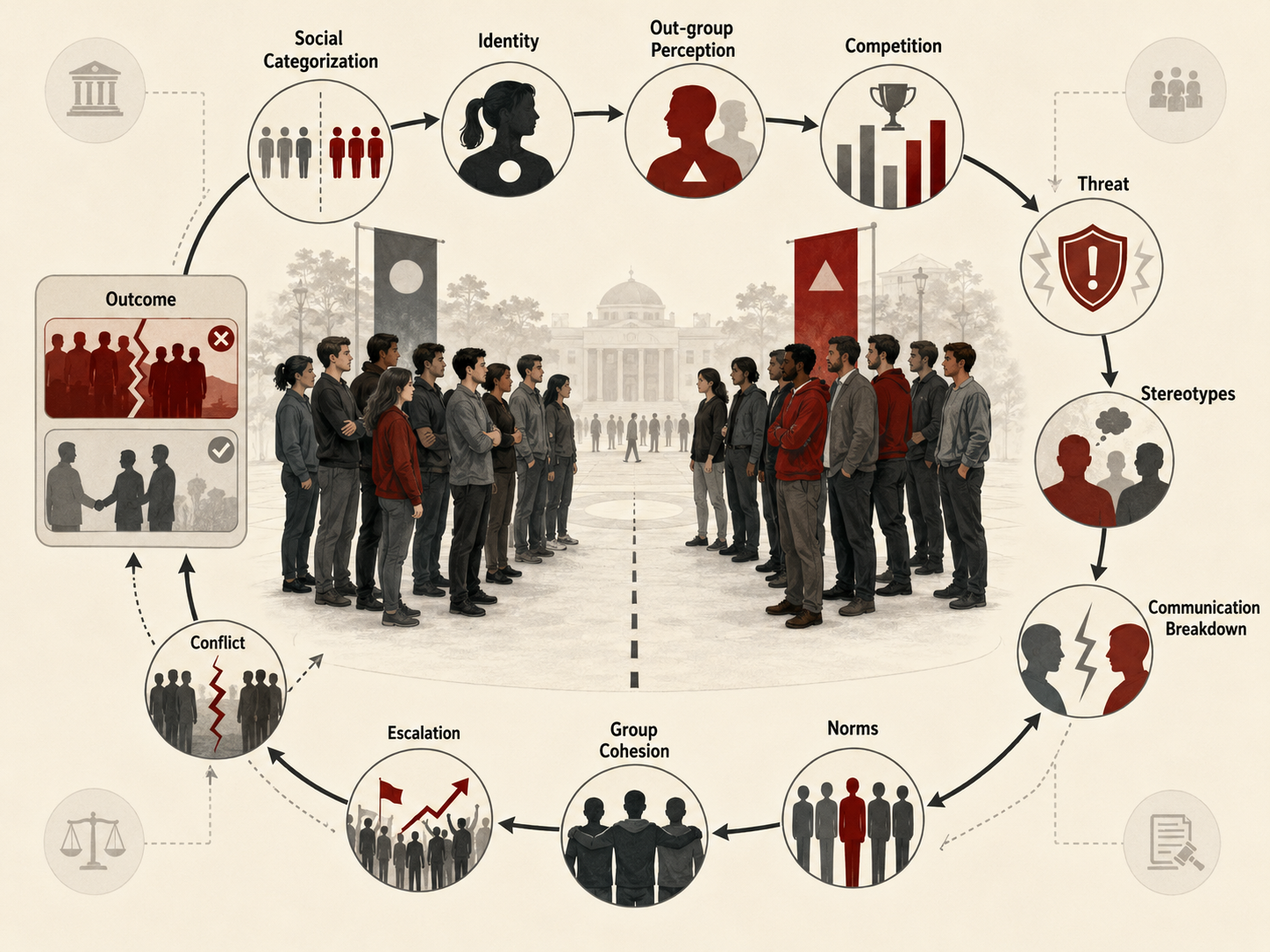
Intergroup conflict connects directly to social identity theory, in-group bias, stereotypes, prejudice, and discrimination, implicit bias, group polarization, groupthink, social norms, the contact hypothesis, collective action and social change, and moral disengagement. These frameworks explain how group boundaries become psychologically meaningful, how hostility escalates, and how institutions can either intensify or reduce conflict.
What is intergroup conflict?
Intergroup conflict occurs when members of one group perceive another group as a rival, threat, obstacle, exploiter, enemy, or illegitimate competitor. The conflict may involve material resources, political authority, status, territory, identity, cultural recognition, religious meaning, organizational control, historical memory, or moral legitimacy.
The groups involved may be ethnic communities, religious groups, political parties, social classes, nations, departments, professions, schools, neighborhoods, online communities, activist movements, or organizational factions. What matters psychologically is not only the objective difference between groups, but the social meaning attached to that difference.
Intergroup conflict can range from mild distrust to severe violence. It may appear as stereotyping, avoidance, ridicule, exclusion, discrimination, harassment, retaliation, institutional bias, segregation, political polarization, collective aggression, or organized violence. It may be explicit and openly hostile, or it may be embedded quietly in procedures, language, norms, resource allocation, and institutional culture.
Importantly, intergroup conflict does not require every member of a group to hate every member of another group. Conflict can persist through shared narratives, institutional incentives, status hierarchies, competitive structures, and norms of loyalty. Individuals may feel pressure to side with their group even when they personally prefer moderation.
Social psychology therefore studies intergroup conflict as a group-level process with individual, relational, institutional, and cultural dimensions. It asks how people come to experience “us” and “them” as socially consequential categories, and why those categories sometimes become the basis for fear, resentment, exclusion, and aggression.
Why intergroup conflict matters
Intergroup conflict matters because many of the most consequential social problems are organized around group boundaries. Racism, sectarianism, nationalism, partisan hostility, class conflict, organizational rivalry, xenophobia, ethnic violence, religious conflict, caste hierarchy, gender backlash, anti-immigrant politics, workplace factionalism, and online harassment all involve group-based perception and action.
Social psychology is especially valuable because it shows how conflict can emerge even when individual hostility is not the starting point. People can become hostile when groups are placed in competition, when identity becomes salient, when threat narratives circulate, when leaders frame another group as dangerous, when institutions reward loyalty over fairness, or when repeated interaction produces distrust.
Intergroup conflict also matters because it can become self-reinforcing. Hostility produces threat perception; threat perception justifies further hostility. Stereotypes reduce empathy; reduced empathy permits harsher treatment. Exclusion produces resentment; resentment confirms the outgroup’s supposed hostility. Polarized groups discuss the conflict internally and emerge more extreme.
Understanding intergroup conflict is therefore not only a matter of explaining prejudice. It is also a matter of understanding escalation, institutional breakdown, democratic instability, organizational failure, and violence prevention.
The practical stakes are high. If conflict is framed only as ignorance, solutions may overemphasize information. If it is framed only as contact failure, solutions may place groups together without changing status or incentives. If it is framed only as individual prejudice, solutions may ignore institutional structures. A serious treatment must integrate identity, competition, threat, power, history, and institutional design.
Major theoretical explanations
Social psychologists have developed several major frameworks to explain why intergroup conflict emerges and persists. The most important include realistic conflict theory, social identity theory, integrated threat theory, contact theory, relative deprivation theory, stereotype-content models, intergroup emotions theory, and models of dehumanization and moral disengagement.
Realistic conflict theory emphasizes competition over scarce resources, rewards, jobs, territory, political influence, institutional control, or status. Conflict increases when groups believe that one group’s gain is another group’s loss.
Social identity theory emphasizes the psychological importance of group membership. People derive part of their self-concept from groups, and group status can become tied to self-esteem, belonging, and dignity.
Threat theories distinguish different forms of perceived threat. Realistic threat concerns material welfare, safety, and power. Symbolic threat concerns values, culture, identity, morality, religion, or way of life. Status threat concerns perceived loss of rank or recognition.
Contact theory examines when interaction between groups reduces prejudice and hostility. Contact is most effective under conditions of equal status, cooperation, common goals, and institutional support.
Relative deprivation theory explains conflict through perceived unfair disadvantage or blocked entitlement. Groups may become hostile when they believe they are receiving less than they deserve relative to another group.
Dehumanization and moral disengagement frameworks explain how outgroups become easier to harm when they are portrayed as less human, less moral, dangerous, corrupt, polluted, parasitic, or undeserving.
These perspectives are complementary. Many real conflicts involve material competition, identity threat, historical grievance, institutional asymmetry, norm enforcement, and symbolic narratives at the same time.
Realistic conflict theory
Realistic conflict theory proposes that hostility between groups arises when groups compete for scarce resources or incompatible goals. The theory is strongly associated with Muzafer Sherif and colleagues, whose experimental work showed that competition can quickly transform neutral groups into rivals.
The core idea is simple: when groups perceive their interests as zero-sum, antagonism becomes more likely. If one group believes that jobs, land, funding, institutional authority, political power, territory, or recognition are threatened by another group, the outgroup can become a target of resentment and blame.
Realistic conflict theory is powerful because it places conflict in social structure rather than only in personality. People do not need to begin with deep prejudice for conflict to develop. Competitive conditions can produce negative stereotypes, mistrust, loyalty pressure, and hostility.
The theory also helps explain why institutional design matters. If systems allocate rewards in winner-take-all ways, force groups to compete for scarce goods, or communicate that one group’s gain necessarily means another’s loss, conflict becomes more likely. Conversely, if systems create shared goals, fair procedures, and opportunities for mutual benefit, conflict may weaken.
Realistic conflict theory does not explain every conflict. Many conflicts involve symbolic threat, identity anxiety, historical domination, propaganda, and status hierarchy. But it remains essential because material competition often provides the structural fuel that identity narratives ignite.
The Robbers Cave experiment
The Robbers Cave experiment is one of the most famous studies in the history of intergroup-conflict research. Sherif and colleagues studied boys at a summer camp who were divided into separate groups. The groups first developed internal cohesion, names, norms, and identity. When placed into competition for prizes, they quickly developed hostility, negative stereotypes, and antagonistic behavior toward the rival group.
The study became influential because it showed how quickly group identity and competition can generate conflict. The boys were not selected because they had preexisting hostility toward one another. The experimental structure created group boundaries and competitive goals, and hostility followed.
Robbers Cave is equally important because it showed a route toward de-escalation. Simple contact was not enough. Bringing the groups together without changing the competitive structure did not automatically resolve hostility. What reduced conflict was the introduction of superordinate goals: shared objectives that neither group could achieve alone and that required cooperation.
Examples included tasks where the boys had to work together to solve a shared problem. These cooperative challenges changed the structure of interaction. The outgroup was no longer only a rival; it became a necessary partner in achieving a shared goal.
The study has limitations and should not be treated uncritically. It involved a specific population, a controlled setting, and methodological features that would be approached differently today. But its core lesson remains important: group conflict is shaped by the structure of goals. Competitive goals can produce hostility; shared goals can support cooperation.
Social identity and intergroup conflict
Social identity theory, developed by Henri Tajfel and John Turner, provides a second major explanation for intergroup conflict. It argues that individuals derive part of their self-concept from group membership. Because group membership contributes to identity, people are motivated to view their ingroup positively relative to outgroups.
This helps explain why conflict can emerge even without direct resource competition. If a group’s status, dignity, legitimacy, or distinctiveness is threatened, members may experience that threat personally. A criticism of the group can feel like a criticism of the self. A loss of status can feel like humiliation. An outgroup gain can feel threatening even when no material resource is directly lost.
Social identity theory also explains why group boundaries can intensify perception. People tend to accentuate differences between groups and similarities within groups. They may see the ingroup as diverse, moral, complex, and justified, while seeing the outgroup as homogeneous, suspicious, dangerous, or morally deficient.
Identity can be protective and meaningful. It gives people belonging, memory, solidarity, and dignity. The problem is not group identity itself. The problem arises when identity becomes organized around superiority, threat, humiliation, exclusion, or zero-sum comparison.
Intergroup conflict often becomes most intense when material competition and identity threat reinforce each other. A dispute over resources becomes a dispute over dignity. A policy disagreement becomes a battle over who “we” are. A status shift becomes an existential threat. Social identity theory helps explain why such conflicts are emotionally powerful and difficult to resolve through facts alone.
Minimal groups and the power of categorization
Minimal-group research shows that even arbitrary group distinctions can produce ingroup favoritism. In these studies, people are assigned to groups based on trivial or meaningless criteria, yet they often allocate more resources or favorable treatment to members of their assigned group.
The importance of this research is not that all group conflict is arbitrary. Many real conflicts are shaped by deep histories of violence, domination, inequality, and material struggle. The point is that categorization itself can become psychologically powerful. Once people think in terms of “us” and “them,” perception and evaluation can shift.
Minimal-group findings help explain why group labels can become consequential even before conflict is severe. A classroom team, workplace department, political faction, online community, or organizational unit can develop loyalty, pride, suspicion, and rivalry simply through repeated categorization and comparison.
However, minimal-group research must be interpreted carefully. It does not imply that real conflicts are merely cognitive mistakes. Historical oppression, economic inequality, territorial struggle, and institutional exclusion cannot be reduced to arbitrary categorization. Minimal-group research shows the psychological readiness of categorization; it does not replace structural analysis.
The lesson is that group boundaries are not neutral. Even small distinctions can become meaningful when combined with comparison, competition, status, reward, or threat.
Realistic threat, symbolic threat, and status threat
Threat is one of the most important drivers of intergroup conflict. Groups become hostile not only when they are objectively harmed, but when they perceive another group as threatening material security, identity, status, values, or legitimacy.
Realistic threat involves perceived danger to resources, safety, jobs, territory, political power, institutional control, or physical security. It is closely related to realistic conflict theory.
Symbolic threat involves perceived danger to values, culture, morality, religion, language, traditions, gender roles, national identity, or way of life. Symbolic threat can be powerful even when material competition is limited.
Status threat involves perceived loss of rank, recognition, prestige, demographic dominance, or social authority. Groups may become hostile when they believe their relative position is declining, even if their absolute material conditions have not worsened.
These threats often overlap. Immigration debates, for example, may combine realistic threat narratives about jobs, symbolic threat narratives about culture, and status threat narratives about national identity. Workplace conflicts may combine competition over promotion, symbolic threat to professional identity, and status threat between departments.
Threat perception is especially dangerous when amplified by leaders, media systems, rumors, or institutional signals. Once an outgroup is framed as a threat to survival, dignity, morality, or identity, harsh treatment becomes easier to justify.
Reducing conflict therefore requires more than telling groups not to hate. It requires understanding what kind of threat is being perceived, whether that perception is accurate, who benefits from amplifying it, and what institutional changes can make coexistence credible.
Stereotypes, dehumanization, and group perception
Stereotypes simplify group perception by assigning generalized traits to outgroup members. In intergroup conflict, stereotypes often become threat narratives. The outgroup is not merely different; it is portrayed as dangerous, disloyal, immoral, lazy, aggressive, parasitic, corrupt, backward, arrogant, uncivilized, or undeserving.
Stereotypes reduce complexity. They allow people to interpret ambiguous behavior in hostile ways. If an ingroup member behaves badly, the behavior may be treated as an exception. If an outgroup member behaves badly, the behavior may be treated as evidence of group character.
Dehumanization is more severe. It involves seeing outgroup members as less fully human, less capable of feeling, less moral, less civilized, or less deserving of protection. Dehumanization makes cruelty easier because it reduces empathy and weakens moral restraint.
Intergroup conflict often relies on moral asymmetry. The ingroup is seen as defensive, rational, victimized, and justified. The outgroup is seen as aggressive, irrational, threatening, and blameworthy. This asymmetry allows each side to interpret its own harmful actions as necessary while interpreting the outgroup’s actions as proof of bad character.
Research on stereotype content is useful here because outgroups may be evaluated along dimensions such as warmth and competence. Groups seen as cold and competent may evoke envy and suspicion. Groups seen as cold and incompetent may evoke contempt. Different stereotype profiles can produce different forms of hostility, exclusion, or paternalism.
Reducing conflict requires challenging not only inaccurate beliefs but also the emotional and moral functions stereotypes serve within group identity.
Intergroup emotions, fear, anger, and resentment
Intergroup conflict is emotional. Fear, anger, humiliation, resentment, contempt, disgust, envy, grief, pride, and moral outrage can all shape how groups interpret one another.
Fear often emerges when an outgroup is perceived as dangerous or unpredictable. It can produce avoidance, defensive aggression, surveillance, exclusion, or support for restrictive policy. Anger often emerges when the outgroup is seen as responsible for harm or injustice. It can produce confrontation, punishment, retaliation, or collective action. Contempt and disgust can produce dehumanization and moral exclusion.
Resentment is especially important in status conflict. Groups may feel that they have been displaced, disrespected, ignored, mocked, or denied recognition. Political entrepreneurs can mobilize resentment by telling groups that their losses are caused by an outgroup and that restoring dignity requires conflict.
Humiliation can be particularly destabilizing. When a group experiences defeat, ridicule, domination, or loss of face, conflict can become organized around restoration of status or revenge. This helps explain why symbolic injuries can sustain conflict long after a material dispute has changed.
Intergroup emotions are not only individual feelings. They are socially organized. Groups teach members what to feel, who to blame, what events to remember, what losses matter, and what forms of anger are legitimate. Conflict narratives become emotional scripts.
Any effort to reduce intergroup conflict must therefore address emotion as well as belief. Facts alone rarely dissolve fear, humiliation, or moral outrage when those emotions are tied to identity and collective memory.
Formalizing intergroup conflict
Intergroup conflict can be represented as a function of material competition, identity salience, perceived threat, stereotypes, legitimacy, and cooperative contact. Let conflict intensity be \(C\), resource competition \(R\), identity salience \(I\), symbolic threat \(T_s\), realistic threat \(T_r\), status threat \(T_{st}\), contact quality \(K\), and institutional legitimacy \(L\):
C_i^*=\beta_0+\beta_1R_i+\beta_2I_i+\beta_3T_{s,i}+\beta_4T_{r,i}+\beta_5T_{st,i}-\beta_6K_i-\beta_7L_i
\]
Interpretation: Conflict propensity rises with competition, identity salience, symbolic threat, realistic threat, and status threat, but falls with high-quality contact and institutional legitimacy.
Hostility can be modeled as a probability or intensity score:
P(H_i=1)=\operatorname{logit}^{-1}(C_i^*)
\]
Interpretation: The probability of hostile response increases as latent conflict propensity rises.
Escalation can be expressed dynamically. If hostile interaction increases future threat perception, then:
T_{t+1}=T_t+\lambda H_t-\delta K_t-\omega G_t
\]
Interpretation: Threat at the next time step rises with hostile interaction \(H_t\), but can fall with contact quality \(K_t\) and shared goal salience \(G_t\).
Conflict intensity can then respond to threat, retaliation norms, and institutional legitimacy:
C_{t+1}=C_t+\alpha T_{t+1}+\rho N_t-\mu L_t
\]
Interpretation: Conflict intensifies when threat and retaliation norms rise, and weakens when legitimacy and trusted institutions constrain escalation.
Conflict reduction through superordinate goals can be represented as a countervailing process:
C_{t+1}=C_t-\phi S_t-\nu K_t-\eta Q_t-\mu L_t
\]
Interpretation: Conflict declines when superordinate goals \(S_t\), high-quality contact \(K_t\), equal status \(Q_t\), and legitimacy \(L_t\) are strong.
Support for exclusion can be modeled as a function of threat and dehumanization:
E_i^*=\gamma_0+\gamma_1T_{s,i}+\gamma_2T_{r,i}+\gamma_3D_i+\gamma_4Z_i-\gamma_5L_i
\]
Interpretation: Exclusionary support rises with symbolic threat, realistic threat, dehumanization \(D\), and zero-sum perception \(Z\), but falls when institutions are perceived as legitimate.
These models are simplified, but they clarify a central point: intergroup conflict is not produced by one variable alone. It emerges when competition, identity, threat, stereotypes, retaliation norms, and weak legitimacy reinforce one another.
Escalation dynamics
Intergroup conflict often escalates through feedback loops. A hostile act by one group increases perceived threat in the other group. That perceived threat justifies retaliation. Retaliation confirms the first group’s belief that the outgroup is dangerous. Each side then experiences its own actions as defensive and the other side’s actions as aggressive.
Several mechanisms drive escalation:
- attribution bias, where ingroup harm is explained situationally and outgroup harm is explained dispositionally;
- group polarization, where internal discussion shifts members toward more extreme positions;
- loyalty pressure, where moderation is treated as betrayal;
- threat inflation, where outgroup danger is exaggerated;
- moral disengagement, where harm against the outgroup is justified;
- retaliation norms, where failure to respond is treated as weakness;
- institutional failure, where no trusted authority can adjudicate conflict fairly.
Escalation also changes group leadership. In conflict settings, hardline voices may gain status because they appear strong, loyal, or clear. Moderates may be marginalized as naïve, weak, disloyal, or compromised. This shifts the internal reward structure of the group.
Over time, conflict can become self-sustaining. Groups remember harms selectively, commemorate grievances, teach threat narratives, and build institutions around suspicion. The conflict becomes part of identity.
De-escalation therefore requires more than a single apology, fact-check, meeting, or dialogue session. It requires changing the feedback loops that reward hostility and punish cooperation.
Institutions, legitimacy, and conflict structure
Institutions can either intensify or reduce intergroup conflict. Courts, schools, workplaces, legislatures, media systems, police agencies, universities, religious organizations, platforms, and international bodies all shape whether groups experience competition as fair, whether grievances are heard, and whether conflict can be resolved without escalation.
Legitimacy is central. When groups believe institutions are fair, accountable, responsive, and procedurally trustworthy, conflict is more likely to remain manageable. When institutions are seen as biased, corrupt, humiliating, captured, or unresponsive, groups may turn toward antagonism, withdrawal, resistance, or retaliation.
Institutions shape conflict through several pathways:
- resource allocation;
- representation and voice;
- status recognition;
- procedural fairness;
- conflict-resolution mechanisms;
- equal protection;
- public narratives;
- sanctioning of violence or discrimination;
- rules for participation;
- norms of accountability.
Institutional design matters because intergroup conflict is not only a psychological reaction. It is often a response to lived structures. If one group is systematically excluded, exploited, surveilled, or denied voice, calls for “reducing conflict” can become morally hollow unless institutions address the underlying injustice.
Good institutions reduce conflict not by suppressing disagreement, but by making disagreement governable. They provide fair procedures, credible accountability, shared rules, and protections against domination.
Media, algorithms, and conflict amplification
Modern intergroup conflict is often amplified by media systems and digital platforms. Algorithmic feeds can intensify exposure to outrage, threat narratives, humiliation, mockery, and extreme ingroup signaling. Groups may encounter one another not through ordinary members, but through the most provocative examples selected for attention.
This can produce distorted norm perception. Members may believe the outgroup is more extreme, hostile, irrational, or dangerous than it actually is because the platform repeatedly presents high-conflict examples. The outgroup becomes represented by its most inflammatory voices.
Digital systems also reward identity performance. Public displays of loyalty, outrage, denunciation, and moral certainty can gain attention, status, and belonging. Ambivalence, nuance, or cross-group empathy may be punished as betrayal.
Conflict entrepreneurs can exploit these dynamics. They frame events as existential threats, identify scapegoats, circulate stereotypes, and portray compromise as surrender. When institutional trust is low, such narratives become especially powerful.
Online conflict is not separate from offline conflict. It shapes perception, mobilization, policy attitudes, harassment, protest, and violence risk. Studying intergroup conflict today requires attention to platform design, algorithmic amplification, network structure, misinformation, identity signaling, and moderation norms.
Conflict amplification is not inevitable, but it is designed into many attention systems. If outrage is rewarded, outrage becomes normative.
Organizational and workplace conflict
Intergroup conflict is not limited to ethnic, political, or national groups. It also appears inside organizations. Departments, professions, teams, unions, management groups, technical specialists, regional offices, academic disciplines, and status groups can develop rivalry, mistrust, and antagonistic narratives.
Organizational conflict often combines realistic competition with identity. Departments may compete for budget, recognition, authority, personnel, or strategic influence. Over time, these material conflicts become cultural: “engineering does not understand customers,” “marketing exaggerates,” “management does not respect frontline workers,” “headquarters ignores the field.”
Such narratives may contain real grievances, but they can also harden into stereotypes. Groups stop communicating directly and begin interpreting each other through hostile assumptions. Mistakes by the outgroup are treated as evidence of character; mistakes by the ingroup are excused as context.
Workplace intergroup conflict is especially dangerous when formal structures reward silo behavior. If departments are evaluated only by local metrics, cooperation becomes costly. If leaders encourage rivalry, conflict becomes institutionalized. If grievances lack fair channels, resentment grows.
Reducing organizational conflict requires cross-functional goals, fair resource allocation, shared metrics, psychological safety, legitimate leadership, transparent decision-making, and structured cooperation. Team-building alone is rarely enough if the incentive structure remains competitive.
Political polarization and identity conflict
Political conflict becomes especially intense when partisan identity becomes fused with moral identity, social identity, cultural identity, or perceived existential threat. In such conditions, political opponents are not merely wrong. They are seen as dangerous, immoral, corrupt, anti-national, anti-religious, anti-democratic, or hostile to the group’s way of life.
Partisan conflict often involves both material and symbolic dimensions. Groups may disagree over economic policy, taxation, immigration, policing, education, religion, gender, race, climate, or national memory. But these disagreements become more volatile when they are framed as battles over identity and status.
Political polarization is intensified by social sorting. When political identity aligns with geography, religion, race, class, media consumption, education, lifestyle, and friendship networks, outgroup contact decreases and stereotypes harden. People encounter the other side mainly through hostile media portrayals or online conflict.
Group polarization can then make each camp more extreme. Internal discussion among like-minded members can intensify threat perception and moral certainty. Moderation becomes socially costly.
Reducing political intergroup conflict requires more than civility appeals. It requires institutions that reduce zero-sum stakes, media environments that do not reward outrage, electoral systems that do not incentivize demonization, and civic norms that distinguish disagreement from dehumanization.
Ethnic, national, and international conflict
Ethnic, national, and international conflicts often involve the most severe forms of intergroup hostility. These conflicts may involve territory, sovereignty, historical memory, colonialism, occupation, state violence, displacement, nationalism, religious identity, language, resource control, and collective trauma.
Social psychology contributes important tools for understanding these conflicts, but it cannot explain them alone. Severe conflict is embedded in history, law, political economy, military power, state institutions, propaganda, and international relations. Psychological mechanisms matter, but they operate within material and political structures.
In such conflicts, identity narratives often become intergenerational. Groups inherit stories of victimization, heroism, betrayal, resistance, humiliation, and loss. These narratives shape what members perceive as justice, compromise, surrender, or betrayal.
Dehumanization and moral exclusion are especially dangerous in severe conflict. When an outgroup is portrayed as less human, inherently violent, or collectively guilty, ordinary moral restraints weaken. Violence can be reframed as defense, purification, revenge, liberation, or necessity.
Conflict reduction in these settings requires safety, justice, recognition, accountability, and institutional transformation. Contact may help under some conditions, but contact without equality, security, rights, or justice may intensify harm.
A careful social-psychological analysis should therefore avoid false symmetry. Some conflicts involve domination, occupation, apartheid, ethnic cleansing, or structural violence. In those cases, reducing hostility cannot mean asking oppressed groups to accept injustice. It must include changes to the structures that produce conflict.
Reducing intergroup conflict
Research suggests several routes for reducing intergroup conflict, but none are simple. The most important include structured contact, superordinate goals, equal status, institutional support, cross-group cooperation, shared identity, perspective taking, reduction of threat, fair procedures, and accountability for harm.
Conflict reduction works best when it changes the structure of interaction. If groups remain in zero-sum competition, dialogue alone may fail. If one group has far greater power, contact may reproduce hierarchy. If institutions are not trusted, official reconciliation may be dismissed as symbolic. If grievances are real, appeals to harmony may feel like silencing.
Effective conflict reduction often requires:
- reducing material competition where possible;
- creating shared goals that require cooperation;
- ensuring equal status in contact settings;
- protecting participants from humiliation or domination;
- building credible institutional support;
- addressing historical and structural grievances;
- reducing misinformation and threat amplification;
- supporting cross-group relationships over time;
- creating norms against dehumanization;
- rewarding cooperation rather than escalation.
Reducing conflict does not mean erasing difference. Groups may retain distinct identities, interests, memories, and claims. The goal is not sameness. The goal is to make coexistence, disagreement, and cooperation possible without dehumanization or violence.
Contact, equal status, and cooperative conditions
The contact hypothesis, associated with Gordon Allport and later tested extensively by Thomas Pettigrew, Linda Tropp, and others, argues that intergroup contact can reduce prejudice under certain conditions. The classic conditions are equal status, common goals, intergroup cooperation, and support from authorities, laws, or institutions.
These conditions matter because contact is not automatically beneficial. Unequal, competitive, superficial, humiliating, or hostile contact may reinforce stereotypes. If one group dominates the interaction, the contact may confirm inequality. If groups compete during contact, hostility may increase. If institutions fail to support fair interaction, vulnerable groups may bear the cost.
High-quality contact can reduce conflict through several mechanisms. It can increase knowledge of the outgroup, reduce anxiety, increase empathy, weaken stereotypes, create cross-group friendship, and make group boundaries less threatening. It can also help people see outgroup members as complex individuals rather than symbols.
Contact can be direct or indirect. Extended contact — knowing that ingroup members have positive relationships with outgroup members — can sometimes reduce prejudice. Imagined contact and mediated contact may also have effects, though usually weaker than sustained, meaningful interaction.
The practical lesson is that contact must be designed. Simply putting groups in the same room is not enough. The interaction must be safe, equal, cooperative, supported, and meaningful.
Superordinate goals and shared fate
Superordinate goals are shared objectives that cannot be achieved by one group alone. They require cooperation across group boundaries. The Robbers Cave experiment showed that such goals can reduce hostility because they change the meaning of the outgroup: the rival becomes a necessary partner.
Superordinate goals work by shifting incentives and identity. Instead of “our group versus their group,” the situation becomes “both groups must succeed together.” This can create a broader shared identity without requiring smaller group identities to disappear.
Examples include disaster response, shared infrastructure repair, public-health campaigns, joint scientific projects, peacebuilding initiatives, cross-functional organizational goals, environmental restoration, and community safety efforts. In each case, the task must be genuinely interdependent. If one group can succeed alone, the goal is not truly superordinate.
Superordinate goals are strongest when paired with equal status and institutional support. If one group dominates the shared project, cooperation may reproduce hierarchy. If credit is unequal, resentment may grow. If the task is symbolic rather than consequential, the intervention may feel superficial.
Shared fate can be powerful, but it must be credible. Groups must believe that cooperation is necessary, fair, and beneficial. Otherwise, appeals to unity may be dismissed as rhetoric.
Justice, power, and asymmetry
One of the most important cautions in intergroup-conflict research is that not all conflicts are symmetrical. Some conflicts involve unequal power, historical domination, structural violence, racial hierarchy, colonialism, occupation, gendered coercion, caste oppression, or institutional exclusion. Treating both sides as equally responsible for “conflict” can obscure injustice.
Social psychology must therefore distinguish between conflict and oppression. A dominant group’s discomfort with losing privilege is not the same as a marginalized group’s resistance to exclusion. A state’s violence is not equivalent to a community’s protest against it. A workplace leader’s complaint about “division” may mask the fact that employees are challenging discrimination.
This does not mean psychological processes are irrelevant. All groups can develop biased perceptions, threat narratives, and retaliatory norms. But moral and institutional analysis must ask who has power, who controls resources, who defines legitimacy, who is harmed, and whose grievances are ignored.
Conflict reduction without justice can become pacification. It may ask harmed groups to reconcile without accountability. It may prioritize order over dignity. It may treat anger as the problem while ignoring the conditions that produced it.
A serious treatment of intergroup conflict must therefore integrate conflict reduction with justice. The goal is not merely lower hostility. The goal is fairer structures that make coexistence possible without domination.
Intergroup conflict in the architecture of social influence
Within the broader architecture of social influence, intergroup conflict operates at the point where identity, competition, norms, threat, and collective judgment converge. Social identity theory explains why group membership matters psychologically. In-group bias explains why trust and loyalty become selectively distributed. Social norms explain how conflict narratives are maintained. Group polarization explains how internal discussion can harden attitudes. Moral disengagement explains how groups justify harm.
Intergroup conflict brings these mechanisms together. A group boundary becomes salient. The outgroup is perceived as threatening. Stereotypes simplify perception. Norms reward loyalty. Polarization intensifies certainty. Institutions fail to mediate fairly. Conflict becomes self-reinforcing.
This is why intergroup conflict is not an isolated topic. It is one of the central ways social psychology connects individual perception to collective order. It explains how ordinary categorization can become exclusion, how competition can become hostility, and how identity can become a basis for cooperation or violence.
Read alongside the contact hypothesis and collective action, intergroup conflict also shows that group boundaries can be transformed. The same forces that produce hostility — identity, norms, shared goals, and institutions — can also be redesigned to support cooperation, solidarity, and justice.
Limits and interpretive cautions
Intergroup conflict is a powerful framework, but it must be used carefully.
- Do not reduce structural injustice to mutual misunderstanding.
- Do not treat unequal groups as automatically symmetrical parties.
- Do not assume contact is beneficial without equal status, cooperation, and institutional support.
- Do not interpret resistance by oppressed groups as merely prejudice or hostility.
- Do not assume that all group identity is dangerous.
- Do not ignore material competition while focusing only on identity.
- Do not ignore symbolic threat while focusing only on resources.
- Do not confuse temporary calm with reconciliation.
- Do not treat de-escalation as a substitute for accountability.
- Do not detach psychological analysis from history, law, political economy, or institutional power.
The strongest explanations integrate levels of analysis. Individual emotions matter. Group identities matter. Material resources matter. Media systems matter. Institutions matter. History matters. Intergroup conflict becomes most dangerous when these levels reinforce one another.
Interpretive caution is especially important in public writing. Saying that two groups are “in conflict” can obscure who has power and who is harmed. A careful account should name competition, threat, identity, and bias while also asking whether the conflict is rooted in domination, dispossession, or exclusion.
Social psychology can explain escalation, but explanation should not become moral equivalence. Understanding why hostility develops is not the same as excusing harm.
Measurement, data, and research design
Intergroup-conflict research uses laboratory experiments, minimal-group paradigms, field studies, surveys, longitudinal panels, vignette experiments, public-goods games, contact interventions, organizational network data, media analysis, political-behavior data, and computational simulations.
Key variables include:
- participant, group, outgroup, dyad, session, scenario, and site identifiers;
- experimental condition;
- context type;
- resource competition;
- zero-sum perception;
- identity salience;
- group identification;
- status threat;
- symbolic threat;
- realistic threat;
- stereotype endorsement;
- outgroup warmth;
- outgroup competence;
- intergroup anxiety;
- perceived injustice;
- dehumanization;
- perceived legitimacy;
- institutional trust;
- norm of retaliation;
- group polarization;
- hostility score;
- aggression intention;
- avoidance intention;
- support for exclusion;
- support for cooperation;
- contact quality;
- equal status;
- common goal salience;
- institutional support;
- cooperative task success;
- response time.
Strong designs should distinguish competition from threat. Groups may compete materially without experiencing symbolic threat, or they may feel symbolic threat without direct resource competition. Researchers should measure both.
Contact studies should distinguish contact quantity from contact quality. Frequent contact can worsen conflict if it is unequal, competitive, humiliating, or unsupported. Measures should include equal status, cooperation, institutional support, anxiety, empathy, and perceived legitimacy.
Escalation studies should include time. Cross-sectional hostility scores are useful, but conflict is dynamic. Longitudinal designs can show whether threat precedes hostility, hostility precedes threat, contact reduces anxiety, or institutional events change legitimacy.
Finally, studies should include power and history. Variables such as group status, institutional control, history of harm, discrimination, segregation, or violence are not background details. They shape the meaning of conflict.
R code for intergroup conflict research
The following R workflow models hostility, aggression, exclusion, cooperation, and response time as functions of resource competition, zero-sum perception, identity salience, threat, stereotypes, dehumanization, contact quality, equal status, superordinate goals, institutional support, and legitimacy.
# Install packages if needed:
# pak::pak(c("tidyverse", "lme4", "lmerTest", "emmeans", "broom.mixed", "performance"))

library(tidyverse)
library(lme4)
library(lmerTest)
library(emmeans)
library(broom.mixed)
library(performance)

# Expected columns:
# participant, session_id, group_id, outgroup_id, dyad_id,
# scenario_id, site_id, condition, context_type, trial,
# resource_competition, zero_sum_perception, identity_salience,
# group_identification, status_threat, symbolic_threat,
# realistic_threat, stereotype_endorsement, outgroup_warmth,
# outgroup_competence, intergroup_anxiety, perceived_injustice,
# dehumanization, perceived_legitimacy, institutional_trust,
# norm_of_retaliation, group_polarization, hostility_score,
# aggression_intention, avoidance_intention, support_for_exclusion,
# support_for_cooperation, contact_quality, equal_status,
# common_goal_salience, institutional_support,
# cooperative_task_success, response_time_ms

dat <- read_csv("intergroup_conflict_trials.csv") %>%
  mutate(
    participant = factor(participant),
    session_id = factor(session_id),
    group_id = factor(group_id),
    outgroup_id = factor(outgroup_id),
    dyad_id = factor(dyad_id),
    scenario_id = factor(scenario_id),
    site_id = factor(site_id),
    condition = factor(condition),
    context_type = factor(context_type),
    material_conflict_index = (
      resource_competition +
      zero_sum_perception +
      realistic_threat
    ) / 3,
    identity_threat_index = (
      identity_salience +
      group_identification +
      status_threat +
      symbolic_threat
    ) / 4,
    dehumanization_exclusion_index = (
      stereotype_endorsement +
      dehumanization +
      support_for_exclusion / 10
    ) / 3,
    cooperative_contact_index = (
      contact_quality +
      equal_status +
      common_goal_salience +
      institutional_support
    ) / 4,
    legitimacy_index = (
      perceived_legitimacy +
      institutional_trust
    ) / 2,
    log_response_time = log(response_time_ms)
  )

summary_table <- dat %>%
  group_by(condition, context_type) %>%
  summarise(
    n = n(),
    participants = n_distinct(participant),
    groups = n_distinct(group_id),
    dyads = n_distinct(dyad_id),
    mean_hostility = mean(hostility_score, na.rm = TRUE),
    mean_aggression = mean(aggression_intention, na.rm = TRUE),
    mean_avoidance = mean(avoidance_intention, na.rm = TRUE),
    mean_exclusion = mean(support_for_exclusion, na.rm = TRUE),
    mean_cooperation = mean(support_for_cooperation, na.rm = TRUE),
    mean_material_conflict = mean(material_conflict_index, na.rm = TRUE),
    mean_identity_threat = mean(identity_threat_index, na.rm = TRUE),
    mean_dehumanization_exclusion = mean(dehumanization_exclusion_index, na.rm = TRUE),
    mean_contact = mean(cooperative_contact_index, na.rm = TRUE),
    mean_legitimacy = mean(legitimacy_index, na.rm = TRUE),
    mean_response_time = mean(response_time_ms, na.rm = TRUE),
    .groups = "drop"
  )

print(summary_table)

hostility_model <- lmer(
  hostility_score ~
    material_conflict_index +
    identity_threat_index +
    stereotype_endorsement +
    outgroup_warmth +
    outgroup_competence +
    intergroup_anxiety +
    perceived_injustice +
    dehumanization +
    norm_of_retaliation +
    group_polarization +
    cooperative_contact_index +
    legitimacy_index +
    cooperative_task_success +
    condition +
    context_type +
    (1 | participant) +
    (1 | group_id) +
    (1 | outgroup_id) +
    (1 | dyad_id) +
    (1 | scenario_id) +
    (1 | site_id),
  data = dat,
  REML = FALSE
)

summary(hostility_model)
emmeans(hostility_model, ~ condition)

aggression_model <- lmer(
  aggression_intention ~
    hostility_score +
    norm_of_retaliation +
    dehumanization +
    perceived_injustice +
    material_conflict_index +
    identity_threat_index +
    legitimacy_index +
    cooperative_contact_index +
    condition +
    context_type +
    (1 | participant) +
    (1 | dyad_id) +
    (1 | scenario_id) +
    (1 | site_id),
  data = dat,
  REML = FALSE
)

summary(aggression_model)

exclusion_model <- lmer(
  support_for_exclusion ~
    hostility_score +
    symbolic_threat +
    realistic_threat +
    status_threat +
    dehumanization +
    stereotype_endorsement +
    legitimacy_index +
    cooperative_contact_index +
    condition +
    context_type +
    (1 | participant) +
    (1 | dyad_id) +
    (1 | scenario_id) +
    (1 | site_id),
  data = dat,
  REML = FALSE
)

summary(exclusion_model)

cooperation_model <- lmer(
  support_for_cooperation ~
    cooperative_contact_index +
    common_goal_salience +
    equal_status +
    institutional_support +
    legitimacy_index +
    cooperative_task_success +
    hostility_score +
    zero_sum_perception +
    condition +
    context_type +
    (1 | participant) +
    (1 | dyad_id) +
    (1 | scenario_id) +
    (1 | site_id),
  data = dat,
  REML = FALSE
)

summary(cooperation_model)

response_time_model <- lmer(
  log_response_time ~
    hostility_score +
    intergroup_anxiety +
    symbolic_threat +
    realistic_threat +
    cooperative_contact_index +
    legitimacy_index +
    condition +
    context_type +
    (1 | participant) +
    (1 | dyad_id) +
    (1 | scenario_id) +
    (1 | site_id),
  data = dat %>% filter(response_time_ms >= 150),
  REML = FALSE
)

summary(response_time_model)

condition_summary <- dat %>%
  group_by(condition) %>%
  summarise(
    n = n(),
    mean_hostility = mean(hostility_score, na.rm = TRUE),
    mean_aggression = mean(aggression_intention, na.rm = TRUE),
    mean_exclusion = mean(support_for_exclusion, na.rm = TRUE),
    mean_cooperation = mean(support_for_cooperation, na.rm = TRUE),
    mean_contact = mean(cooperative_contact_index, na.rm = TRUE),
    mean_legitimacy = mean(legitimacy_index, na.rm = TRUE),
    .groups = "drop"
  )

write_csv(summary_table, "intergroup_conflict_summary.csv")
write_csv(condition_summary, "intergroup_conflict_condition_summary.csv")

write_csv(
  tidy(hostility_model, effects = "fixed", conf.int = TRUE),
  "intergroup_conflict_hostility_coefficients.csv"
)

ggplot(
  condition_summary,
  aes(x = reorder(condition, mean_hostility), y = mean_hostility, group = 1)
) +
  geom_line() +
  geom_point() +
  coord_flip() +
  labs(
    title = "Mean intergroup hostility by condition",
    x = "Condition",
    y = "Mean hostility score"
  ) +
  theme_minimal()
This workflow supports intergroup-conflict research by separating material competition, identity threat, symbolic threat, realistic threat, dehumanization, retaliation norms, contact quality, legitimacy, exclusion, aggression, cooperation, and escalation risk.
Python code for intergroup conflict research
The Python workflow below parallels the R analysis and adds simulation logic for escalation, contact intervention, superordinate goals, legitimacy, and retaliation norms.
import numpy as np
import pandas as pd
import statsmodels.formula.api as smf
import matplotlib.pyplot as plt

# Expected columns:
# participant, session_id, group_id, outgroup_id, dyad_id,
# scenario_id, site_id, condition, context_type, trial,
# resource_competition, zero_sum_perception, identity_salience,
# group_identification, status_threat, symbolic_threat,
# realistic_threat, stereotype_endorsement, outgroup_warmth,
# outgroup_competence, intergroup_anxiety, perceived_injustice,
# dehumanization, perceived_legitimacy, institutional_trust,
# norm_of_retaliation, group_polarization, hostility_score,
# aggression_intention, avoidance_intention, support_for_exclusion,
# support_for_cooperation, contact_quality, equal_status,
# common_goal_salience, institutional_support,
# cooperative_task_success, response_time_ms

df = pd.read_csv("intergroup_conflict_trials.csv")

for col in [
    "participant",
    "session_id",
    "group_id",
    "outgroup_id",
    "dyad_id",
    "scenario_id",
    "site_id",
    "condition",
    "context_type"
]:
    df[col] = df[col].astype("category")

df["material_conflict_index"] = (
    df["resource_competition"]
    + df["zero_sum_perception"]
    + df["realistic_threat"]
) / 3

df["identity_threat_index"] = (
    df["identity_salience"]
    + df["group_identification"]
    + df["status_threat"]
    + df["symbolic_threat"]
) / 4

df["dehumanization_exclusion_index"] = (
    df["stereotype_endorsement"]
    + df["dehumanization"]
    + df["support_for_exclusion"] / 10
) / 3

df["cooperative_contact_index"] = (
    df["contact_quality"]
    + df["equal_status"]
    + df["common_goal_salience"]
    + df["institutional_support"]
) / 4

df["legitimacy_index"] = (
    df["perceived_legitimacy"]
    + df["institutional_trust"]
) / 2

df["log_response_time"] = np.log(df["response_time_ms"])

summary_table = (
    df.groupby(["condition", "context_type"], observed=True)
    .agg(
        n=("participant", "size"),
        participants=("participant", "nunique"),
        groups=("group_id", "nunique"),
        dyads=("dyad_id", "nunique"),
        mean_hostility=("hostility_score", "mean"),
        mean_aggression=("aggression_intention", "mean"),
        mean_avoidance=("avoidance_intention", "mean"),
        mean_exclusion=("support_for_exclusion", "mean"),
        mean_cooperation=("support_for_cooperation", "mean"),
        mean_material_conflict=("material_conflict_index", "mean"),
        mean_identity_threat=("identity_threat_index", "mean"),
        mean_contact=("cooperative_contact_index", "mean"),
        mean_legitimacy=("legitimacy_index", "mean"),
    )
    .reset_index()
)

print(summary_table)

hostility_model = smf.ols(
    "hostility_score ~ material_conflict_index + identity_threat_index "
    "+ stereotype_endorsement + outgroup_warmth + outgroup_competence "
    "+ intergroup_anxiety + perceived_injustice + dehumanization "
    "+ norm_of_retaliation + group_polarization "
    "+ cooperative_contact_index + legitimacy_index "
    "+ cooperative_task_success + condition + context_type",
    data=df,
)

hostility_result = hostility_model.fit(
    cov_type="cluster",
    cov_kwds={"groups": df["participant"]}
)

print(hostility_result.summary())

aggression_model = smf.ols(
    "aggression_intention ~ hostility_score + norm_of_retaliation "
    "+ dehumanization + perceived_injustice "
    "+ material_conflict_index + identity_threat_index "
    "+ legitimacy_index + cooperative_contact_index "
    "+ condition + context_type",
    data=df,
)

aggression_result = aggression_model.fit(
    cov_type="cluster",
    cov_kwds={"groups": df["participant"]}
)

print(aggression_result.summary())

exclusion_model = smf.ols(
    "support_for_exclusion ~ hostility_score + symbolic_threat "
    "+ realistic_threat + status_threat + dehumanization "
    "+ stereotype_endorsement + legitimacy_index "
    "+ cooperative_contact_index + condition + context_type",
    data=df,
)

exclusion_result = exclusion_model.fit(
    cov_type="cluster",
    cov_kwds={"groups": df["participant"]}
)

print(exclusion_result.summary())

cooperation_model = smf.ols(
    "support_for_cooperation ~ cooperative_contact_index "
    "+ common_goal_salience + equal_status + institutional_support "
    "+ legitimacy_index + cooperative_task_success "
    "+ hostility_score + zero_sum_perception "
    "+ condition + context_type",
    data=df,
)

cooperation_result = cooperation_model.fit(
    cov_type="cluster",
    cov_kwds={"groups": df["participant"]}
)

print(cooperation_result.summary())

def simulate_escalation(n_cases=10000, seed=42):
    rng = np.random.default_rng(seed)
    rows = []

    scenarios = [
        "competition_only",
        "identity_threat",
        "polarization",
        "contact_intervention",
        "superordinate_goal",
        "low_legitimacy"
    ]

    for scenario in scenarios:
        for _ in range(n_cases):
            conflict = {
                "competition_only": 55,
                "identity_threat": 62,
                "polarization": 70,
                "contact_intervention": 42,
                "superordinate_goal": 40,
                "low_legitimacy": 66
            }[scenario] + rng.normal(0, 6)

            threat = {
                "competition_only": 6.5,
                "identity_threat": 8.5,
                "polarization": 8.0,
                "contact_intervention": 4.0,
                "superordinate_goal": 4.2,
                "low_legitimacy": 7.0
            }[scenario] + rng.normal(0, 0.8)

            contact = {
                "contact_intervention": 8.0,
                "superordinate_goal": 7.5
            }.get(scenario, 2.5) + rng.normal(0, 0.8)

            common_goal = {
                "superordinate_goal": 9.0,
                "contact_intervention": 6.5
            }.get(scenario, 2.5) + rng.normal(0, 0.8)

            legitimacy = {
                "low_legitimacy": 2.5,
                "contact_intervention": 7.0,
                "superordinate_goal": 7.5
            }.get(scenario, 4.5) + rng.normal(0, 0.8)

            retaliation = {
                "polarization": 8.5,
                "identity_threat": 7.0,
                "low_legitimacy": 7.0
            }.get(scenario, 5.0) + rng.normal(0, 0.8)

            for period in range(1, 16):
                hostile_interaction = np.clip(
                    0.55 * conflict
                    + 3.0 * threat
                    + 2.5 * retaliation
                    - 2.8 * contact
                    - 2.5 * common_goal
                    - 2.5 * legitimacy
                    + rng.normal(0, 5),
                    0,
                    100
                )

                threat = np.clip(
                    threat
                    + 0.020 * hostile_interaction
                    - 0.22 * contact
                    - 0.22 * common_goal
                    - 0.15 * legitimacy
                    + rng.normal(0, 0.25),
                    0,
                    10
                )

                conflict = np.clip(
                    conflict
                    + 0.25 * hostile_interaction
                    + 2.5 * threat
                    + 1.5 * retaliation
                    - 3.0 * contact
                    - 3.2 * common_goal
                    - 2.0 * legitimacy
                    + rng.normal(0, 5),
                    0,
                    100
                )

                rows.append({
                    "scenario": scenario,
                    "period": period,
                    "conflict_intensity": conflict,
                    "perceived_threat": threat,
                    "contact_quality": contact,
                    "common_goal_salience": common_goal,
                    "institutional_legitimacy": legitimacy,
                    "norm_of_retaliation": retaliation,
                    "hostile_interaction": hostile_interaction,
                })

    simulation = pd.DataFrame(rows)

    simulation_summary = (
        simulation.groupby(["scenario", "period"])
        .agg(
            mean_conflict=("conflict_intensity", "mean"),
            mean_threat=("perceived_threat", "mean"),
            mean_hostility=("hostile_interaction", "mean"),
        )
        .reset_index()
    )

    return simulation, simulation_summary

simulation, simulation_summary = simulate_escalation()

print(simulation_summary.tail())

condition_summary = (
    df.groupby("condition", observed=True)
    .agg(
        mean_hostility=("hostility_score", "mean"),
        mean_aggression=("aggression_intention", "mean"),
        mean_exclusion=("support_for_exclusion", "mean"),
        mean_cooperation=("support_for_cooperation", "mean"),
        mean_contact=("cooperative_contact_index", "mean"),
    )
    .reset_index()
)

fig, ax = plt.subplots(figsize=(8, 5))

ordered = condition_summary.sort_values("mean_hostility")
ax.plot(
    ordered["mean_hostility"],
    ordered["condition"].astype(str),
    marker="o"
)

ax.set_xlabel("Mean hostility score")
ax.set_ylabel("Condition")
ax.set_title("Mean intergroup hostility by condition")
plt.tight_layout()
plt.show()

summary_table.to_csv("intergroup_conflict_summary.csv", index=False)
condition_summary.to_csv("intergroup_conflict_condition_summary.csv", index=False)
simulation.to_csv("intergroup_escalation_simulation.csv", index=False)
simulation_summary.to_csv("intergroup_escalation_simulation_summary.csv", index=False)
This Python workflow supports intergroup-conflict research by modeling hostility, aggression, avoidance, exclusion, cooperation, contact intervention, superordinate goals, legitimacy, and escalation dynamics over time.
Research data architecture
Intergroup-conflict research often depends on relational data: participants, groups, outgroups, dyads, scenarios, sites, conditions, context types, resource competition, zero-sum perception, identity salience, status threat, symbolic threat, realistic threat, stereotypes, outgroup warmth, outgroup competence, intergroup anxiety, perceived injustice, dehumanization, legitimacy, institutional trust, retaliation norms, group polarization, hostility, aggression, avoidance, exclusion, cooperation, contact quality, equal status, common goals, institutional support, cooperative task success, and response time.
Rather than embedding executable database code directly in the WordPress article body, the companion GitHub repository includes the full SQL schema and example queries for researchers who want to reproduce or extend the data model.
The research data model is designed to support questions such as:
- Does resource competition predict hostility after accounting for identity threat?
- Does symbolic threat predict exclusion more strongly than realistic threat?
- Does dehumanization predict aggression intention?
- Does contact quality reduce hostility only when equal status is present?
- Do superordinate goals increase support for cooperation?
- Does institutional legitimacy reduce escalation risk?
- Does group polarization increase retaliation norms?
- Do high-risk cases combine threat, dehumanization, and low legitimacy?
- Does cooperative task success reduce hostility across repeated interaction?
The GitHub repository contains the full database schema, example analytical queries, validation logic, and reproducible data workflow. Keeping executable SQL in GitHub avoids WordPress hosting restrictions while preserving the technical infrastructure for readers who want to inspect or reuse the model.
View the SQL research data architecture in GitHub.
GitHub repository
The companion repository provides reusable code and research scaffolding for studying intergroup conflict, including workflows for realistic conflict, social identity, resource competition, zero-sum perception, status threat, symbolic threat, realistic threat, stereotypes, dehumanization, contact quality, superordinate goals, legitimacy, escalation dynamics, exclusion, aggression, and conflict reduction.
Complete Code Repository
Access the full companion repository for this article, including reproducible analysis materials and multi-language code workflows for intergroup-conflict research.
Why intergroup conflict matters for social psychology
Intergroup conflict matters because it shows how social boundaries become emotionally, morally, and institutionally powerful. People do not only respond to others as individuals. They respond through categories of “us” and “them,” through histories of competition and grievance, through perceived threats to identity and status, and through norms that define loyalty, betrayal, danger, and justice.
Social psychology helps explain why conflict can emerge quickly, why it can escalate, and why it can persist even when individuals are tired of it. Realistic conflict theory shows the role of competition. Social identity theory shows the role of group-based self-concept. Threat research shows how fear and status anxiety intensify hostility. Contact theory and superordinate-goal research show that conflict can be reduced when interaction is structured around equality, cooperation, shared purpose, and institutional support.
But intergroup conflict cannot be understood only as perception. Power, history, law, political economy, and institutional structure matter. Some conflicts are rooted in domination and injustice, not simply misunderstanding. A serious treatment must therefore combine psychological explanation with moral and institutional analysis.
Read alongside social identity theory, in-group bias, social norms, group polarization, the contact hypothesis, Institutions & Governance, and Stewardship & Ethics, intergroup conflict becomes more than a topic of prejudice. It becomes a framework for understanding how societies fracture, how institutions fail or repair trust, and how cooperation can be rebuilt without denying justice.
Related articles
- Social Psychology
- Social Identity Theory
- In-Group Bias
- Stereotypes, Prejudice, and Discrimination
- Implicit Bias
- Group Polarization
- Groupthink
- Social Norms
- The Contact Hypothesis
- Collective Action and Social Change
- Moral Disengagement
- Institutions & Governance
- Stewardship & Ethics
Further reading
- American Psychological Association (2018) ‘Intergroup conflict’, APA Dictionary of Psychology. Available at: https://dictionary.apa.org/intergroup-conflict.
- Allport, G.W. (1954) The Nature of Prejudice. Cambridge, MA: Addison-Wesley. Available at: https://archive.org/details/natureofprejudic00allp.
- Bornstein, G. (2003) ‘Intergroup conflict: Individual, group, and collective interests’, Personality and Social Psychology Review, 7(2), pp. 129–145. Available at: https://doi.org/10.1207/S15327957PSPR0702_129-145.
- Brewer, M.B. (1999) ‘The psychology of prejudice: Ingroup love and outgroup hate?’, Journal of Social Issues, 55(3), pp. 429–444. Available at: https://doi.org/10.1111/0022-4537.00126.
- Fiske, S.T., Cuddy, A.J.C., Glick, P. and Xu, J. (2002) ‘A model of (often mixed) stereotype content: Competence and warmth respectively follow from perceived status and competition’, Journal of Personality and Social Psychology, 82(6), pp. 878–902. Available at: https://doi.org/10.1037/0022-3514.82.6.878.
- Hewstone, M., Rubin, M. and Willis, H. (2002) ‘Intergroup bias’, Annual Review of Psychology, 53, pp. 575–604. Available at: https://doi.org/10.1146/annurev.psych.53.100901.135109.
- Pettigrew, T.F. and Tropp, L.R. (2006) ‘A meta-analytic test of intergroup contact theory’, Journal of Personality and Social Psychology, 90(5), pp. 751–783. Available at: https://doi.org/10.1037/0022-3514.90.5.751.
- Riek, B.M., Mania, E.W. and Gaertner, S.L. (2006) ‘Intergroup threat and outgroup attitudes: A meta-analytic review’, Personality and Social Psychology Review, 10(4), pp. 336–353. Available at: https://doi.org/10.1207/s15327957pspr1004_4.
- Rusch, H. (2022) ‘Modelling behaviour in intergroup conflicts: A review of micro- and macro-level models’, Philosophical Transactions of the Royal Society B, 377(1851). Available at: https://pmc.ncbi.nlm.nih.gov/articles/PMC8977652/.
- Sherif, M., Harvey, O.J., White, B.J., Hood, W.R. and Sherif, C.W. (1961) Intergroup Conflict and Cooperation: The Robbers Cave Experiment. Norman: University Book Exchange. Available at: https://archive.org/details/intergroupconfli00univ.
- Stephan, W.G. and Stephan, C.W. (2000) ‘An integrated threat theory of prejudice’, in Oskamp, S. (ed.) Reducing Prejudice and Discrimination. Mahwah, NJ: Lawrence Erlbaum, pp. 23–45. Available at: https://psycnet.apa.org/record/2000-07199-002.
- Tajfel, H. and Turner, J.C. (1979) ‘An integrative theory of intergroup conflict’, in Austin, W.G. and Worchel, S. (eds.) The Social Psychology of Intergroup Relations. Monterey, CA: Brooks/Cole, pp. 33–47. Available at: https://archive.org/details/socialpsychology0000unse_f9v1.
- Tajfel, H. and Turner, J.C. (1986) ‘The social identity theory of intergroup behavior’, in Worchel, S. and Austin, W.G. (eds.) Psychology of Intergroup Relations. Chicago: Nelson-Hall, pp. 7–24. Available at: https://ia800601.us.archive.org/21/items/15341_Readings/15341_Readings/Intergroup_Conflict/Tajfel_%26_Turner_Psych_of_Intergroup_Relations_CH1_Social_Identity_Theory_text.pdf.
References
- American Psychological Association (2018) ‘Intergroup conflict’, APA Dictionary of Psychology. Available at: https://dictionary.apa.org/intergroup-conflict.
- Allport, G.W. (1954) The Nature of Prejudice. Cambridge, MA: Addison-Wesley. Available at: https://archive.org/details/natureofprejudic00allp.
- Bornstein, G. (2003) ‘Intergroup conflict: Individual, group, and collective interests’, Personality and Social Psychology Review, 7(2), pp. 129–145. Available at: https://doi.org/10.1207/S15327957PSPR0702_129-145.
- Brewer, M.B. (1999) ‘The psychology of prejudice: Ingroup love and outgroup hate?’, Journal of Social Issues, 55(3), pp. 429–444. Available at: https://doi.org/10.1111/0022-4537.00126.
- Fiske, S.T., Cuddy, A.J.C., Glick, P. and Xu, J. (2002) ‘A model of (often mixed) stereotype content: Competence and warmth respectively follow from perceived status and competition’, Journal of Personality and Social Psychology, 82(6), pp. 878–902. Available at: https://doi.org/10.1037/0022-3514.82.6.878.
- Hewstone, M., Rubin, M. and Willis, H. (2002) ‘Intergroup bias’, Annual Review of Psychology, 53, pp. 575–604. Available at: https://doi.org/10.1146/annurev.psych.53.100901.135109.
- Pettigrew, T.F. and Tropp, L.R. (2006) ‘A meta-analytic test of intergroup contact theory’, Journal of Personality and Social Psychology, 90(5), pp. 751–783. Available at: https://doi.org/10.1037/0022-3514.90.5.751.
- Riek, B.M., Mania, E.W. and Gaertner, S.L. (2006) ‘Intergroup threat and outgroup attitudes: A meta-analytic review’, Personality and Social Psychology Review, 10(4), pp. 336–353. Available at: https://doi.org/10.1207/s15327957pspr1004_4.
- Rusch, H. (2022) ‘Modelling behaviour in intergroup conflicts: A review of micro- and macro-level models’, Philosophical Transactions of the Royal Society B, 377(1851). Available at: https://pmc.ncbi.nlm.nih.gov/articles/PMC8977652/.
- Sherif, M., Harvey, O.J., White, B.J., Hood, W.R. and Sherif, C.W. (1961) Intergroup Conflict and Cooperation: The Robbers Cave Experiment. Norman: University Book Exchange. Available at: https://archive.org/details/intergroupconfli00univ.
- Stephan, W.G. and Stephan, C.W. (2000) ‘An integrated threat theory of prejudice’, in Oskamp, S. (ed.) Reducing Prejudice and Discrimination. Mahwah, NJ: Lawrence Erlbaum, pp. 23–45. Available at: https://psycnet.apa.org/record/2000-07199-002.
- Tajfel, H. and Turner, J.C. (1979) ‘An integrative theory of intergroup conflict’, in Austin, W.G. and Worchel, S. (eds.) The Social Psychology of Intergroup Relations. Monterey, CA: Brooks/Cole, pp. 33–47. Available at: https://archive.org/details/socialpsychology0000unse_f9v1.
- Tajfel, H. and Turner, J.C. (1986) ‘The social identity theory of intergroup behavior’, in Worchel, S. and Austin, W.G. (eds.) Psychology of Intergroup Relations. Chicago: Nelson-Hall, pp. 7–24. Available at: https://ia800601.us.archive.org/21/items/15341_Readings/15341_Readings/Intergroup_Conflict/Tajfel_%26_Turner_Psych_of_Intergroup_Relations_CH1_Social_Identity_Theory_text.pdf.