
Last Updated May 28, 2026
The Scientific Revolution and the rise of physical law mark one of the decisive transformations in the history of knowledge because they changed nature from something interpreted primarily through inherited authority, qualitative categories, and teleological explanation into something increasingly investigated through mathematics, experiment, instruments, and general laws. Between the sixteenth and seventeenth centuries, European natural philosophy was reorganized around new standards of evidence, new mathematical methods, new observational technologies, and new conceptions of motion, force, celestial order, and explanation. The shift was not instantaneous, uniform, or simple, but it helped form the intellectual architecture of modern physics.
This transformation mattered because it changed not only what educated people believed about the world, but what counted as knowledge of the world. Galileo’s work on motion and telescopic astronomy, Kepler’s mathematical laws of planetary motion, and Newton’s synthesis of mechanics and gravitation helped establish a new vision of nature as intelligible through universal principles that could be expressed mathematically and tested against observation. Physics emerged from this transformation not merely as a collection of discoveries, but as a disciplined search for law-governed structure in the material world.
This article develops The Scientific Revolution and the Rise of Physical Law as a historical foundations piece within the Physics knowledge series. It explains how the Scientific Revolution changed methods, concepts, instruments, and standards of explanation; how astronomy and mechanics helped displace older Aristotelian frameworks; how “law” became a central category of natural knowledge; and why Newton’s synthesis became so influential in defining what modern physics would become. It uses the current Physics series format: mathematics-aware, computation-aware, historically grounded, and scholarly without letting the technical workflow overwhelm the historical argument.
Main Library
Publications
Article Map
Physics
Related Topic
Mathematics
Related Topic
Data Systems & Analytics
Related Topic
Astronomy
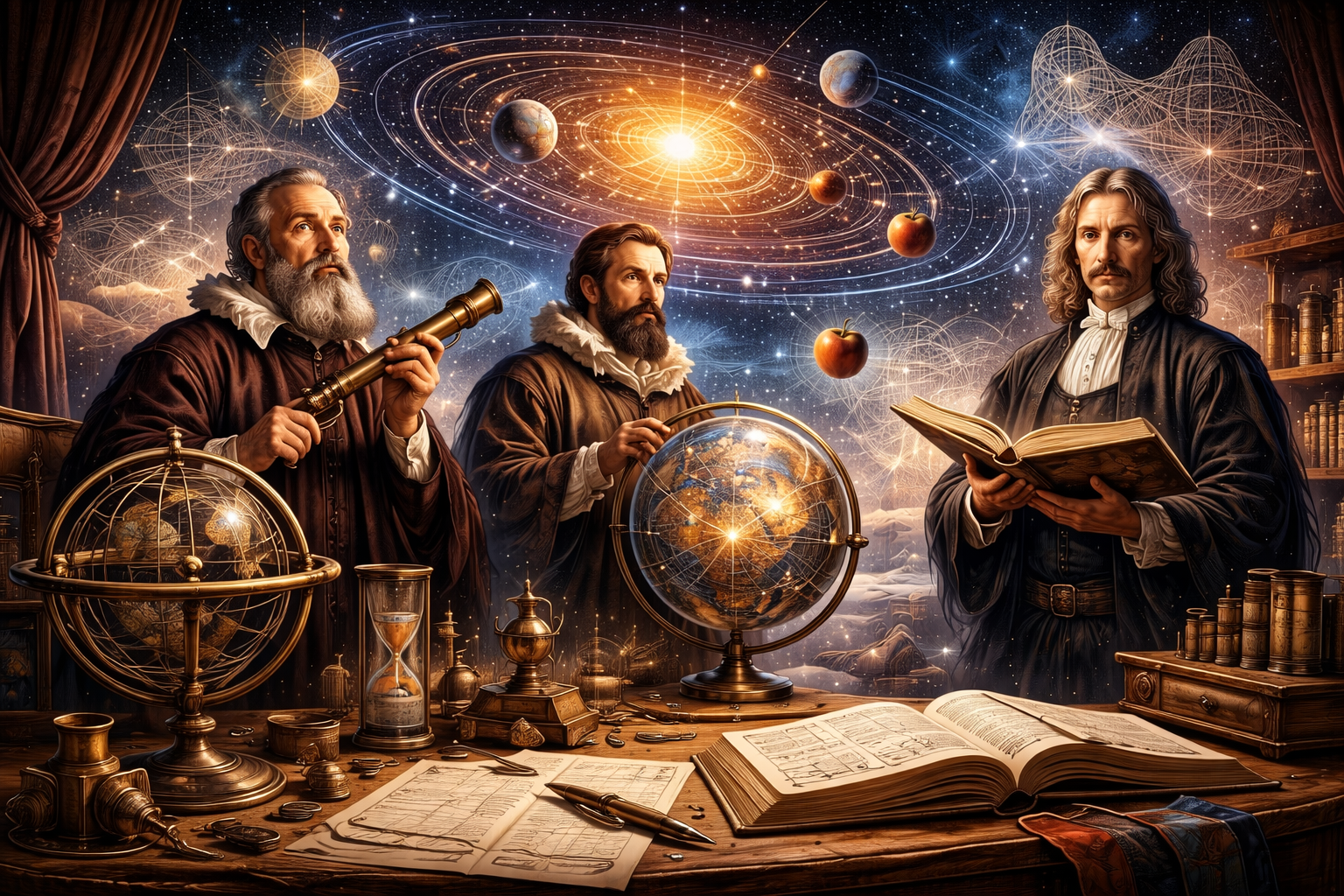
Why the Scientific Revolution Matters
The Scientific Revolution matters because it helped create the intellectual form of modern physics. It did not invent curiosity about nature, mathematics, astronomy, or observation from nothing. Ancient, medieval, Islamic, Indian, Chinese, and other scholarly traditions all contributed to the long history of natural inquiry. But the sixteenth and seventeenth centuries brought together mathematical astronomy, experimental practice, improved instruments, mechanical explanation, and skepticism toward inherited authority in ways that profoundly reshaped European natural philosophy.
The resulting conception of science emphasized quantified motion, mathematical law, instrument-aided observation, experimentally disciplined knowledge, and a willingness to revise inherited frameworks when they failed to account for evidence. This is why the period remains foundational. Many assumptions now associated with physics—that nature is law-governed, that mathematics is its most precise language, that experiment can arbitrate competing claims, and that the same principles may govern Earth and the heavens—were consolidated during this era rather than inherited in finished form.
The Scientific Revolution also matters because it changed the meaning of explanation. A satisfying account of motion, light, matter, or celestial order increasingly had to do more than fit an inherited philosophical system. It had to connect observable phenomena to general principles, mathematical relations, and reproducible forms of reasoning. This reorientation made possible the later development of mechanics, thermodynamics, electromagnetism, relativity, quantum theory, and modern computational physics.
Before the Revolution: Aristotelian Nature and Scholastic Frameworks
Before the Scientific Revolution, much learned discussion of nature in Europe operated within Aristotelian and scholastic frameworks. These traditions were intellectually sophisticated and often systematic, but they tended to explain motion, change, and cosmic order in terms different from those later associated with modern physics. The heavens and Earth were often treated as distinct domains. Natural motion was interpreted through tendencies, places, qualities, and purposes. Mathematics was important in astronomy and optics, but it did not yet occupy the same universal explanatory role that it would later assume in physical theory.
This older framework did not collapse because it was intellectually primitive. It was displaced because new astronomical evidence, new mathematical methods, new instruments, and new mechanical ideas gradually made alternative explanations more powerful. The rise of physical law required a different kind of question. Instead of asking only what kind of thing a body is, what natural place it seeks, or what purpose its motion serves, the new science increasingly asked: how does it move, according to what measurable relation, under what conditions, and with what mathematical regularity?
This distinction is central. The Scientific Revolution was not only a change in facts. It was a reorganization of explanatory standards. The meaning of nature itself shifted from a hierarchy of qualities and purposes toward a domain of measurable processes, mathematical relations, and lawful interactions.
Copernicus and the Reordering of the Heavens
Nicolaus Copernicus is often treated as an early turning point because heliocentrism reordered the geometry of the cosmos and destabilized inherited cosmological assumptions. In the older geocentric picture, Earth occupied the center of the cosmic structure. Copernicus proposed that Earth should instead be understood as a moving planet orbiting the Sun. Even before a new mechanics was fully developed, this reorganization forced astronomy toward new mathematical and observational questions.
The Copernican shift mattered because it removed Earth from its privileged immobility. Once Earth itself could be treated as a moving body, the possibility arose that terrestrial and celestial motion might be understood within one physical framework. That possibility was not fully realized by Copernicus, but his work opened the conceptual path later developed by Kepler, Galileo, and Newton.
The revolution in astronomy was therefore not simply a better charting of planets. It was a transformation in the imagined architecture of the cosmos. The heavens were no longer a separate realm of perfect circular motion detached from the mechanics of earthly bodies. They became part of a single physical problem: how bodies move in space according to intelligible principles.
Kepler and the Mathematization of Planetary Motion
Johannes Kepler helped transform astronomy by replacing older circular ideals with mathematically precise laws of planetary motion. His first law stated that planets move in elliptical orbits with the Sun at one focus. His second law stated that a line from planet to Sun sweeps out equal areas in equal times. His third law related orbital period to orbital size. These laws mattered not only because they fit planetary data, but because they showed that celestial motion could be described through exact mathematical regularities rather than by inherited ideals of perfect circularity.
Kepler’s laws were not yet Newtonian mechanics. They did not explain planetary motion through a universal force law. Yet they were indispensable to the rise of physical law because they demonstrated that the heavens were quantitatively ordered. The old question of cosmic arrangement became a question of mathematical relation. Planetary motion could be written as law.
Kepler therefore represents a crucial stage in the history of physics: the conversion of astronomical pattern into mathematical structure. Newton would later show why Kepler’s relations followed from a deeper dynamical theory, but Kepler had already made clear that celestial motion could be disciplined by precise mathematical form.
Galileo, Experiment, Motion, and the Book of Nature
Galileo Galilei stands near the center of the Scientific Revolution because he changed both astronomy and physics. His telescopic observations challenged inherited cosmology by revealing features incompatible with a simple picture of perfect, unchanging heavens: mountains on the Moon, moons orbiting Jupiter, phases of Venus, and celestial phenomena that complicated older models. The telescope mattered not merely as a device, but as a new epistemic instrument. It extended observation beyond unaided sense and made visible a world that inherited authority had not fully anticipated.
Galileo’s importance, however, was not limited to astronomy. He also helped create a new science of motion. By treating falling bodies, acceleration, projectile motion, and idealized mechanical behavior mathematically, he shifted natural philosophy toward a new union of abstraction, measurement, experiment, and geometry. The famous idea that the “book of nature” is written in mathematical language captures this larger transformation: nature was increasingly understood as something whose intelligibility depended on quantitative form.
Galileo also made idealization central to physical reasoning. Real bodies fall through air, encounter friction, and resist perfect measurement. Yet by abstracting from complicating factors, one can identify a lawful pattern. This was one of the great methodological innovations of early modern physics. An idealized model could be false in literal detail and still reveal a deeper structure of motion.
The Rise of Mechanical Explanation
The Scientific Revolution encouraged a mechanical image of nature. Rather than interpreting natural processes primarily through purposes or intrinsic tendencies, many early modern thinkers increasingly explained them through matter in motion, force, impact, pressure, extension, inertia, and mathematically describable interaction. Nature became more machine-like in the sense that physical processes could be explained through structured relations among bodies rather than through hidden purposes.
This mechanical image was not uniform. Descartes, Galileo, Huygens, Boyle, Newton, and others differed sharply in their views of matter, motion, forces, space, and explanation. Still, the broad shift was decisive. A world conceived as structured by lawful interaction was more amenable to mathematical analysis than a world organized primarily by qualitative essences and final causes.
The rise of mechanical explanation also changed the status of invisibility. A cause did not need to be directly visible to be scientifically meaningful, but it had to be connected to observable consequences through disciplined reasoning. This tension would become especially important in Newton’s theory of gravitation, where mathematical success coexisted with philosophical debate over action at a distance.
Newton and the Synthesis of Celestial and Terrestrial Law
Isaac Newton is often treated as the culminating figure of the Scientific Revolution because he brought terrestrial mechanics and celestial astronomy into one mathematical framework. His Philosophiæ Naturalis Principia Mathematica, first published in 1687, formulated laws of motion and universal gravitation in a way that made it possible to understand falling bodies, projectiles, moons, planets, tides, and orbital motion as parts of a unified physical order.
This was one of the decisive achievements in the history of science. The same gravitational principle that explains why bodies fall near Earth could also explain why the Moon remains in orbit and why planets follow Keplerian patterns. Newton’s synthesis did not merely add one discovery to another. It revealed that terrestrial and celestial phenomena could be derived from common principles.
The Principia became exemplary because it showed what physical law could do. It connected mathematical definitions, axioms or laws of motion, geometrical reasoning, empirical astronomy, and explanatory unification. It did not end debate, and later physics would revise Newtonian mechanics in profound ways. But Newton established a model of physical theory whose ambition remains recognizable: express general principles mathematically, connect them to observation, and show how apparently different phenomena follow from a common structure.
What Physical Law Came to Mean
One of the most important outcomes of the Scientific Revolution was the rise of law as a central category in natural knowledge. A physical law came to mean a general, mathematically expressible, empirically grounded principle describing how physical systems behave. The concept did not emerge fully formed at once, and its theological, philosophical, and metaphysical meanings were complex. But by the end of the Newtonian synthesis, law had become one of the defining concepts of physics.
This matters because physical law became the bridge between mathematical regularity and natural order. Nature was increasingly imagined not just as intelligible, but as governed by general principles that could be discovered, formalized, and tested. A law was not merely a pattern seen once. It was a relation that claimed generality across cases, systems, and scales.
Modern physics has complicated this idea. Quantum theory, statistical mechanics, relativity, chaos, effective field theories, and complex systems have all changed how physicists understand law, probability, symmetry, approximation, and emergence. Yet the basic inheritance of the Scientific Revolution remains: physics seeks general structures that make observable phenomena intelligible through mathematical and empirical constraint.
Mathematics, Instruments, and the New Science
The rise of physical law depended not only on ideas but also on instruments and practices. Telescopes, improved clocks, lenses, geometrical diagrams, printed tables, increasingly careful astronomical observations, and new experimental arrangements all helped transform natural knowledge. Instruments extended the senses. Mathematics organized what instruments revealed. Experiment created controlled contexts in which claims about nature could be tested.
Galileo’s telescope is one of the most famous examples, but the broader point is methodological. The Scientific Revolution created a new alliance among instrument, calculation, and theory. Observations became more powerful when they could be measured. Measurements became more meaningful when they could be related mathematically. Mathematical relations became more authoritative when they could be tested against observation.
This alliance remains central to physics. Modern particle accelerators, gravitational-wave detectors, space telescopes, atomic clocks, climate sensors, and laboratory instruments all extend the same pattern. Physics is not simply a set of ideas about nature. It is a material practice of measurement, instrumentation, computation, and inference.
The Scientific Revolution and the Modern Image of Physics
The modern image of physics as a science of universal law, mathematical precision, and experimentally accountable explanation owes much to the Scientific Revolution. The idea that the same formal principles might apply across multiple scales and domains is one of its central inheritances. Newtonian mechanics would later be revised by relativity and quantum theory, but the deeper image of physics as law-seeking and mathematically structured remained.
The Scientific Revolution also created a durable ideal of unification. Kepler’s planetary laws, Galileo’s terrestrial motion, and Newton’s mechanics together demonstrated that separate domains of experience could be gathered into a more general explanatory system. Later physics repeatedly pursued the same aspiration: the unification of electricity and magnetism, the relation between thermodynamics and statistical mechanics, the search for quantum field theories, and the continuing effort to reconcile gravity with quantum theory.
This is why the Scientific Revolution belongs in a physics series not only as historical background, but as the historical formation of a style of knowledge still recognizable today. It helped define what it means for physical explanation to be mathematical, empirical, law-governed, instrumentally mediated, and open to revision.
Mathematical Lens
A mathematics-first view of the Scientific Revolution begins with the elevation of quantitative relation over qualitative description. Galileo formulated lawlike descriptions of accelerated motion. Kepler described planetary motion through exact orbital relations. Newton expressed force, motion, and gravitation in mathematical form and showed how a single framework could connect terrestrial and celestial phenomena.
Galilean free fall can be summarized schematically as:
s \propto t^2
\]
Interpretation: Distance traveled in idealized free fall grows in proportion to the square of elapsed time.
In modern notation for constant acceleration from rest, this becomes:
s = \frac{1}{2}gt^2
\]
Interpretation: Under constant gravitational acceleration near Earth, distance fallen from rest is determined by \(g\) and the square of time.
Kepler’s third law relates orbital period to semi-major axis:
T^2 \propto a^3
\]
Interpretation: For bodies orbiting the same central mass, the square of orbital period scales with the cube of orbital size.
For bodies orbiting the same central mass, this can be written in normalized form as:
T = a^{3/2}
\]
Interpretation: In normalized units, orbital period grows as the semi-major axis raised to the three-halves power.
Newton’s second law, in later standard notation, relates force, mass, and acceleration:
F = ma
\]
Interpretation: Force relates interaction to mass and acceleration, making motion a dynamical consequence of physical interaction.
Newtonian gravitation relates gravitational force to mass and distance:
F = G\frac{m_1m_2}{r^2}
\]
Interpretation: Gravitational attraction increases with mass and decreases with the square of separation distance.
These equations belong to different stages of development and should not be collapsed into one historical moment. But together they show the emerging character of physical law: general, mathematical, measurable, and capable of linking observed motion to explanatory structure.
Variables, Units, and Interpretation
The rise of physical law also required a more disciplined relationship among variables, units, and interpretation. In modern notation, the symbols used above have the following meanings:
| Symbol | Meaning | Typical Unit | Role in Physical Law |
|---|---|---|---|
| \(s\) | Distance traveled under acceleration | meter, \(m\) | Connects motion to measurable displacement |
| \(t\) | Time | second, \(s\) | Allows motion to be expressed as change over duration |
| \(g\) | Gravitational acceleration near Earth | \(m/s^2\) | Connects falling motion to gravitational field strength |
| \(T\) | Orbital period | year or second | Measures time required for one orbit |
| \(a\) | Semi-major axis | astronomical unit or meter | Measures orbital size in Kepler-style relations |
| \(F\) | Force | newton, \(N\) | Connects interaction to acceleration or gravitational attraction |
| \(m\), \(m_1\), \(m_2\) | Mass | kilogram, \(kg\) | Measures inertia and gravitational source in Newtonian mechanics |
| \(r\) | Separation distance | meter, \(m\) | Determines gravitational force through inverse-square scaling |
| \(G\) | Gravitational constant | \(N\,m^2/kg^2\) | Sets the strength of Newtonian gravitational attraction |
Modern notation can make the past look cleaner than it was. Galileo, Kepler, and Newton did not all write equations in the same symbolic form used in contemporary textbooks. The point is not to impose modern notation anachronistically, but to clarify the mathematical relationships that later physics inherited, standardized, and extended.
Worked Example: Kepler, Galileo, and Newton in One Line of Development
A useful way to understand the rise of physical law is to see Kepler, Galileo, and Newton as successive moments in one development. Kepler provided precise mathematical regularities for planetary motion. Galileo helped create a mathematical and experimental science of terrestrial motion. Newton then showed that the same general framework could explain both. The result was not merely a collection of laws, but a new ideal of explanation through unification.
Kepler’s third law describes a regularity in planetary orbits:
T^2 \propto a^3
\]
Interpretation: Planetary motion could be expressed as a quantitative relation between orbital size and orbital period.
Galileo’s work on falling bodies helped establish that terrestrial motion could be treated through mathematical relations such as:
s = \frac{1}{2}gt^2
\]
Interpretation: Falling motion could be represented as a measurable relation between distance, acceleration, and time.
Newton then supplied a dynamical framework in which acceleration could be related to force:
F = ma
\]
Interpretation: Motion could be explained dynamically by relating acceleration to force and mass.
and gravitational attraction could be treated as a universal inverse-square interaction:
F = G\frac{m_1m_2}{r^2}
\]
Interpretation: A single mathematical gravitational law could connect falling bodies, planetary motion, and celestial mechanics.
This line of development illustrates one of the great achievements of physics: the integration of different lawful domains into a more general order. The rise of physical law was not simply the accumulation of isolated discoveries. It was the emergence of unification as an explanatory ideal.
Computational Modeling
Although the Scientific Revolution predates modern computation, its law-seeking style is naturally suited to computational reconstruction. Equations such as \(s = \frac{1}{2}gt^2\), \(T^2 \propto a^3\), and \(F = Gm_1m_2/r^2\) can be plotted, fitted, simulated, and compared with data. Computation helps make visible what early modern mathematical physics made possible: the transformation of physical relations into reproducible models.
The article body includes only selected Python and R workflows so the historical argument remains readable. The accompanying repository expands the same material into deeper computational infrastructure: Kepler-style scaling, Galileo free-fall tables, Newtonian gravitational calculations, two-body simulation examples, log-log regression, SQL metadata, reproducibility documentation, Julia numerical simulation, C++ and Fortran performance-oriented code, Rust utilities, and C-style instrumentation examples.
Python Workflow: Kepler-Style Scaling and Free-Fall Law
The following Python workflow shows two lawlike relations associated with the Scientific Revolution: Kepler-style orbital scaling and Galilean free fall. It is intentionally compact, fully commented, and designed to illustrate how mathematical law becomes reproducible computation.
"""
Kepler-Style Scaling and Galilean Free-Fall Modeling

This workflow illustrates two mathematical relations central to the
rise of physical law:

1. Kepler-style orbital scaling:
       T = a^(3/2)
   in normalized units for bodies orbiting the same central mass.

2. Galilean free fall from rest under constant acceleration:
       s = 0.5 * g * t^2

Variables:
    a = semi-major axis in normalized orbital units
    T = orbital period in normalized time units
    g = gravitational acceleration near Earth in meters per second squared
    t = time in seconds
    s = distance fallen in meters
"""

import numpy as np
import pandas as pd


GRAVITY_M_PER_S2 = 9.80665


def kepler_period_normalized(semi_major_axis_normalized: np.ndarray) -> np.ndarray:
    """
    Compute normalized orbital period using Kepler-style scaling.

    Parameters
    ----------
    semi_major_axis_normalized:
        Semi-major axis in normalized units.

    Returns
    -------
    np.ndarray
        Orbital period in normalized units.
    """
    return semi_major_axis_normalized ** 1.5


def free_fall_distance(time_s: np.ndarray) -> np.ndarray:
    """
    Compute ideal free-fall distance from rest near Earth.

    Parameters
    ----------
    time_s:
        Time in seconds.

    Returns
    -------
    np.ndarray
        Distance fallen in meters.
    """
    return 0.5 * GRAVITY_M_PER_S2 * time_s**2


def main() -> None:
    """
    Generate simple reproducible tables for two early physical laws.
    """
    semi_major_axis = np.linspace(0.5, 5.0, 10)
    orbital_period = kepler_period_normalized(semi_major_axis)

    kepler_table = pd.DataFrame(
        {
            "semi_major_axis_normalized": semi_major_axis,
            "orbital_period_normalized": orbital_period,
        }
    )

    time_s = np.linspace(0.0, 5.0, 11)
    distance_m = free_fall_distance(time_s)

    free_fall_table = pd.DataFrame(
        {
            "time_s": time_s,
            "distance_m": distance_m,
        }
    )

    print("Kepler-style orbital scaling")
    print(kepler_table.round(5).to_string(index=False))

    print("\nGalilean free-fall model")
    print(free_fall_table.round(5).to_string(index=False))


if __name__ == "__main__":
    main()
This workflow is simple, but it captures a central feature of the Scientific Revolution: a physical claim becomes more powerful when it can be expressed as a general mathematical relation, evaluated across cases, and compared with observed or simulated values.
R Workflow: Log-Log Scaling and Model Fit
R is useful for showing how lawlike scaling can be analyzed statistically. Kepler’s third law implies that \(T^2 \propto a^3\), or equivalently \(T \propto a^{3/2}\). On a log-log scale, this becomes a linear relationship with slope near \(1.5\) in normalized units.
# Log-Log Scaling and Model Fit
#
# This workflow illustrates how a Kepler-style power law can be
# represented as a linear model after logarithmic transformation.
#
# Kepler-style relation:
#   T = a^(3/2)
#
# Log form:
#   log(T) = 1.5 * log(a)
#
# Variables:
#   a = semi-major axis in normalized orbital units
#   T = orbital period in normalized time units

library(tibble)
library(dplyr)

kepler_data <- tibble(
  semi_major_axis_normalized = seq(0.5, 5.0, by = 0.25)
) %>%
  mutate(
    orbital_period_normalized = semi_major_axis_normalized^(3 / 2),
    log_axis = log(semi_major_axis_normalized),
    log_period = log(orbital_period_normalized)
  )

kepler_fit <- lm(log_period ~ log_axis, data = kepler_data)

fit_summary <- tibble(
  estimated_intercept = coef(kepler_fit)[1],
  estimated_scaling_exponent = coef(kepler_fit)[2],
  expected_scaling_exponent = 1.5
)

print(fit_summary)
print(summary(kepler_fit))
This workflow demonstrates how mathematical law, data representation, and statistical modeling can reinforce one another. A scaling law can be expressed symbolically, generated computationally, transformed statistically, and checked through estimated model parameters.
GitHub Repository
The article body includes only selected computational examples so the historical and conceptual argument remains readable. The full repository contains the expanded computational infrastructure: Python modeling workflows, R scaling analysis, Julia two-body simulation, C++ numerical integration, Fortran orbital modeling examples, SQL experiment and model metadata, Rust computational utilities, C instrumentation-style examples, reproducible sample data, and documentation.
Complete Code Repository
The full code distribution for this article, including selected article examples and advanced research-grade computational infrastructure for Kepler-style orbital scaling, Galilean free-fall modeling, Newtonian gravitational calculation, numerical simulation workflows, structured experiment metadata, reproducibility documentation, and performance-oriented scientific computing, is available on GitHub.
From Natural Philosophy to Physics
The Scientific Revolution and the rise of physical law belong at the beginning of the physics story because they helped define what physics would become. The mathematization of nature, the increasing authority of experiment, the new role of instruments, the displacement of older cosmologies, and Newton’s synthesis of motion and gravitation together created an enduring model of how physical knowledge should work.
This does not mean that later physics simply repeated the seventeenth century. Relativity changed the meaning of space, time, mass, and gravity. Quantum theory changed the meaning of measurement, probability, and microscopic state. Statistical mechanics changed the relation between microscopic dynamics and macroscopic law. Modern computational physics changed the practical scale at which physical systems could be modeled. Yet all of these later transformations inherited the central ambition that the Scientific Revolution helped establish: to understand nature through disciplined relations among mathematics, measurement, observation, experiment, and law.
The topic therefore matters beyond history. It explains how the search for universal physical law became one of the defining ambitions of modern science.
Related Articles
- Physics
- What Is Physics?
- Measurement, Mathematics, and the Structure of Physical Inquiry
- Experiment, Instruments, and the Material Practice of Physics
- Motion, Force, and the Foundations of Classical Mechanics
- Gravitation, Orbits, and Celestial Mechanics
- Symmetry, Law, and the Search for Physical Order
- Physics and the Philosophy of Reality
Further Reading
- Dear, P. (2001) Revolutionizing the Sciences: European Knowledge and Its Ambitions, 1500–1700. Princeton: Princeton University Press.
- Feynman, R.P., Leighton, R.B. and Sands, M. (1963) The Feynman Lectures on Physics. California Institute of Technology. Available at: https://www.feynmanlectures.caltech.edu/ (Accessed: 24 April 2026).
- Janiak, A. (2006) Newton’s Philosophy. Stanford Encyclopedia of Philosophy. Available at: https://plato.stanford.edu/entries/newton-philosophy/ (Accessed: 24 April 2026).
- Miller, D.M. (2005) Galileo Galilei. Stanford Encyclopedia of Philosophy. Available at: https://plato.stanford.edu/entries/galileo/ (Accessed: 24 April 2026).
- Nickles, T. (2009) Scientific Revolutions. Stanford Encyclopedia of Philosophy. Available at: https://plato.stanford.edu/entries/scientific-revolutions/ (Accessed: 24 April 2026).
- NASA (2024) Orbits and Kepler’s Laws. Available at: https://science.nasa.gov/solar-system/orbits-and-keplers-laws/ (Accessed: 24 April 2026).
- Smith, G. (2007) Newton’s Philosophiae Naturalis Principia Mathematica. Stanford Encyclopedia of Philosophy. Available at: https://plato.stanford.edu/entries/newton-principia/ (Accessed: 24 April 2026).
- Westfall, R.S. (1971) The Construction of Modern Science: Mechanisms and Mechanics. Cambridge: Cambridge University Press.
References
- Carroll, J.W. (2003) Laws of Nature. Stanford Encyclopedia of Philosophy. Available at: https://plato.stanford.edu/entries/laws-of-nature/ (Accessed: 24 April 2026).
- Encyclopaedia Britannica (n.d.) Scientific Revolution. Available at: https://www.britannica.com/science/Scientific-Revolution (Accessed: 24 April 2026).
- Encyclopaedia Britannica (n.d.) Scientific Revolution: Physics. Available at: https://www.britannica.com/science/Scientific-Revolution/Physics (Accessed: 24 April 2026).
- Janiak, A. (2006) Newton’s Philosophy. Stanford Encyclopedia of Philosophy. Available at: https://plato.stanford.edu/entries/newton-philosophy/ (Accessed: 24 April 2026).
- Library of Congress (n.d.) Philosophiae Naturalis Principia Mathematica. Available at: https://www.loc.gov/resource/gdcwdl.wdl_17842/ (Accessed: 24 April 2026).
- Miller, D.M. (2005) Galileo Galilei. Stanford Encyclopedia of Philosophy. Available at: https://plato.stanford.edu/entries/galileo/ (Accessed: 24 April 2026).
- NASA (2024) Orbits and Kepler’s Laws. Available at: https://science.nasa.gov/solar-system/orbits-and-keplers-laws/ (Accessed: 24 April 2026).
- Nickles, T. (2009) Scientific Revolutions. Stanford Encyclopedia of Philosophy. Available at: https://plato.stanford.edu/entries/scientific-revolutions/ (Accessed: 24 April 2026).
- Royal Society (2014) Principia. Available at: https://royalsociety.org/blog/2014/07/principia/ (Accessed: 24 April 2026).
- Smith, G. (2007) Newton’s Philosophiae Naturalis Principia Mathematica. Stanford Encyclopedia of Philosophy. Available at: https://plato.stanford.edu/entries/newton-principia/ (Accessed: 24 April 2026).