Natural Science

Natural Science examines the physical and living world through the systematic study of matter, energy, life, Earth systems, and the broader universe. It seeks to explain the structures, processes, laws, and transformations that govern the natural order, from the smallest physical interactions to the largest planetary and cosmic systems.

This field brings together disciplines that investigate how nature is organized, how change occurs, and how physical and biological systems develop across time and scale. It includes the study of material composition, chemical transformation, living organisms, planetary processes, celestial phenomena, and the environmental conditions that sustain or constrain life.

Natural Science plays a foundational role in human knowledge because it provides disciplined methods for understanding reality beyond opinion, intuition, or custom. By clarifying how the natural world functions, it shapes scientific reasoning, technological development, environmental awareness, and humanity’s broader understanding of life, matter, and the universe.

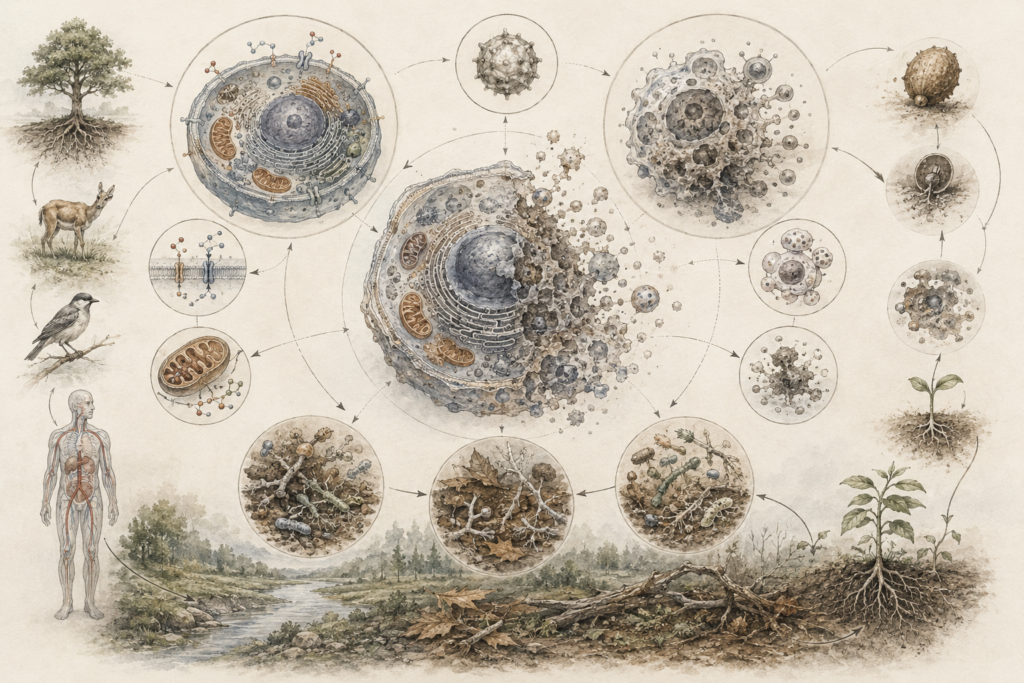
Research-grade biology illustration showing living cells, cellular breakdown, viruses, seeds, seedlings, decomposition, soil microbes, fungi, plants, animals, and human physiology connected through cycles of life, death, decay, and renewal.

Life, Death, and the Problem of Biological Definition

Life, death, and the problem of biological definition examine one of the most difficult questions in biology: what distinguishes living systems from nonliving matter, what counts as death in organisms and cells, and why biological definition becomes unstable at the margins of viruses, dormancy, reproduction, and evolutionary change. This article explores how biology has tried to define life through organization, metabolism, responsiveness, reproduction, heredity, and the capacity for evolution, while also showing why no single checklist fully resolves the problem. It also considers the scientific significance of borderline cases such as viruses, dormant seeds, spores, and metabolically reduced organisms, showing why the meaning of life matters for biology, medicine, bioethics, origin-of-life research, and astrobiology.
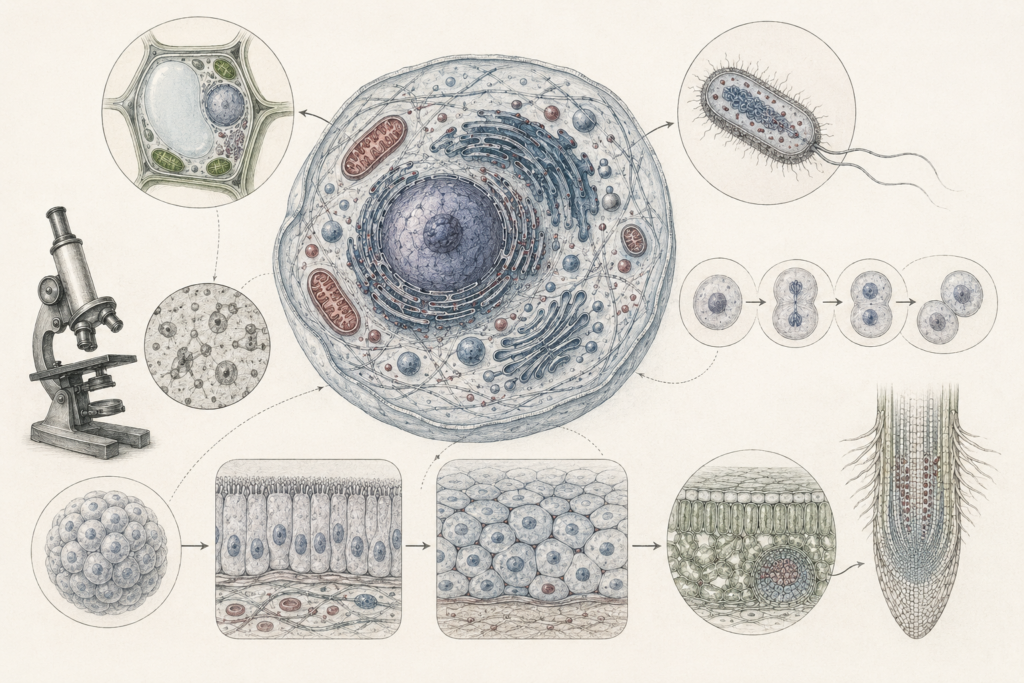
Research-grade cell biology illustration showing a eukaryotic cell, plant cell, bacterial cell, cell division, microscope, tissues, root tip, membranes, organelles, and multicellular organization.

Cell Theory and the Basic Unit of Life

Cell theory and the basic unit of life examine one of the foundational principles of modern biology: that the cell is the basic structural, functional, and organizational unit of living systems. This article explores how cell theory emerged from microscopy, anatomy, and early modern biological thought, and how it became one of the core frameworks through which biology understands living order, development, heredity, physiology, and disease. It also extends classical cell theory into quantitative cell biology through growth models, diffusion equations, and practical R and Python workflows, showing how modern cell biology treats the cell not only as a structural unit but also as a measurable, modelable, and experimentally tractable system.

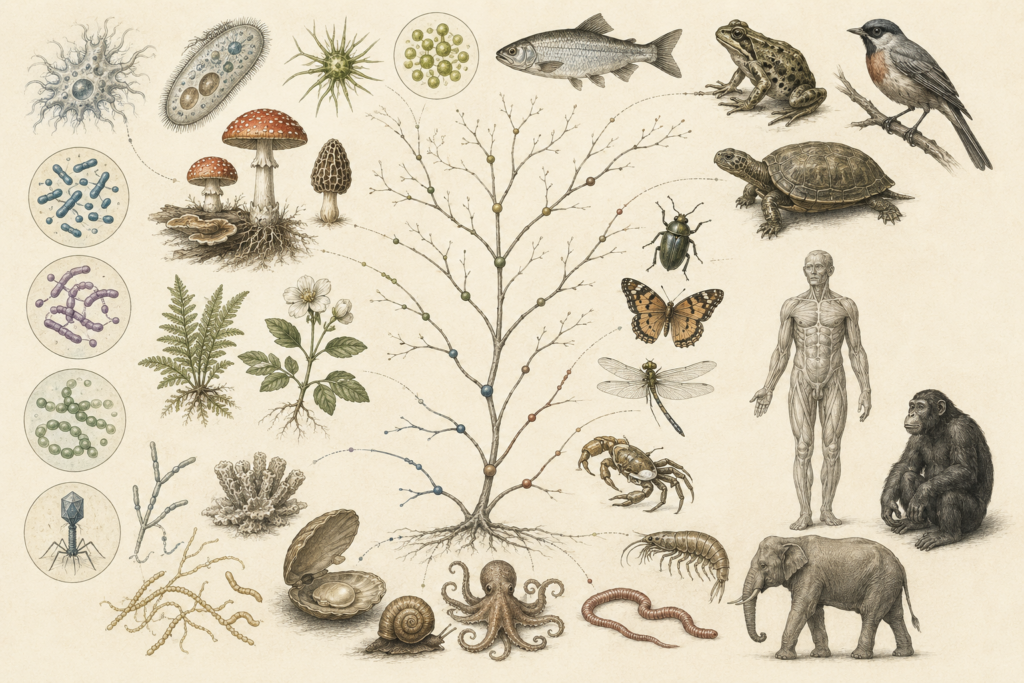
Research-grade taxonomy illustration showing a branching tree of life with microbes, protists, fungi, plants, invertebrates, fish, amphibians, reptiles, birds, mammals, humans, and subtle classification pathways.

Classification, Taxonomy, and the Ordering of Life

Classification, taxonomy, and the ordering of life examine how biology identifies, names, compares, and organizes living beings into meaningful frameworks of relation, distinction, and descent. This article explores the development and significance of taxonomy, from early descriptive systems and the Linnaean tradition to modern phylogenetics, molecular systematics, and evolutionary classification. It also shows why taxonomy remains foundational to biology by making biodiversity scientifically intelligible through naming, comparison, ancestry, and the continuing refinement of biological order through morphology, genetics, ecology, and deep time.

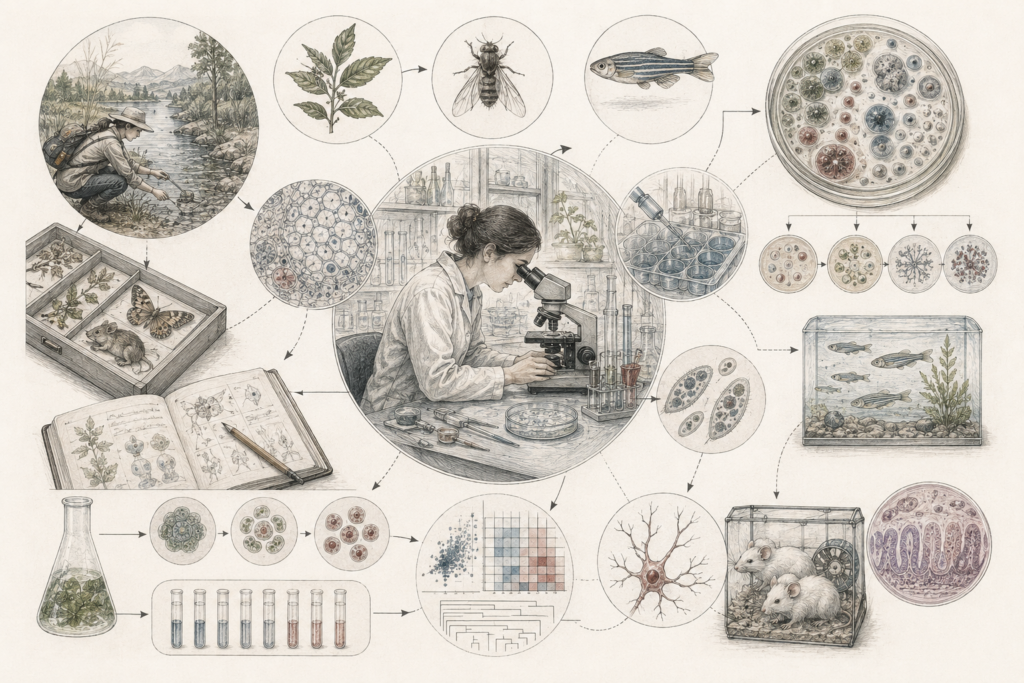
Research-grade biology illustration showing field observation, laboratory microscopy, specimen study, controlled experiments, cell cultures, model organisms, aquatic systems, notebooks, test tubes, data matrices, and biological analysis.

Observation, Experiment, and the Methods of Biological Inquiry

Observation, experiment, and the methods of biological inquiry explore how biology builds knowledge about living systems through careful description, comparison, measurement, hypothesis testing, fieldwork, laboratory investigation, historical reconstruction, and increasingly quantitative and computational analysis. This article examines the principal methods through which biologists study life across scales, from cells and genes to organisms, populations, ecosystems, and evolutionary history. It also shows why biological inquiry is methodologically plural, requiring observation, experiment, statistical inference, modeling, and computational workflows to understand living systems under real conditions of variation, complexity, and change.

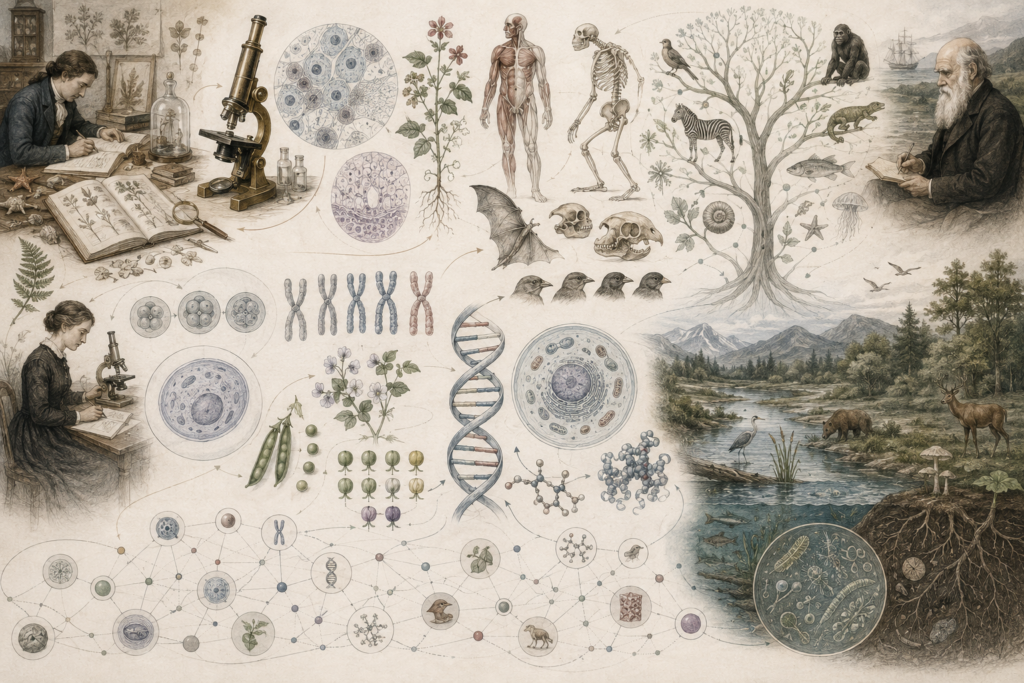
Research-grade history of biology illustration showing microscopes, field notebooks, botanical specimens, anatomy, cell theory, heredity, DNA, evolution, phylogeny, ecology, microbes, and landscapes connected through the development of modern biological science

The Rise of Modern Biological Thought

The rise of modern biological thought traces how the study of life moved from descriptive natural history and inherited philosophical speculation into a systematic scientific inquiry grounded in observation, classification, experiment, cell theory, evolution, heredity, and the emerging analysis of living systems across scales. This article examines the major intellectual transformations that made modern biology possible, including the shift from early natural history and anatomy to taxonomy, microscopy, cell theory, Darwinian evolution, genetics, and molecular biology. It also explores how modern biological thought became increasingly historical, empirical, and quantitative, allowing life to be understood not only as a static order of forms but as a dynamic process shaped by inheritance, variation, environment, and deep evolutionary time.

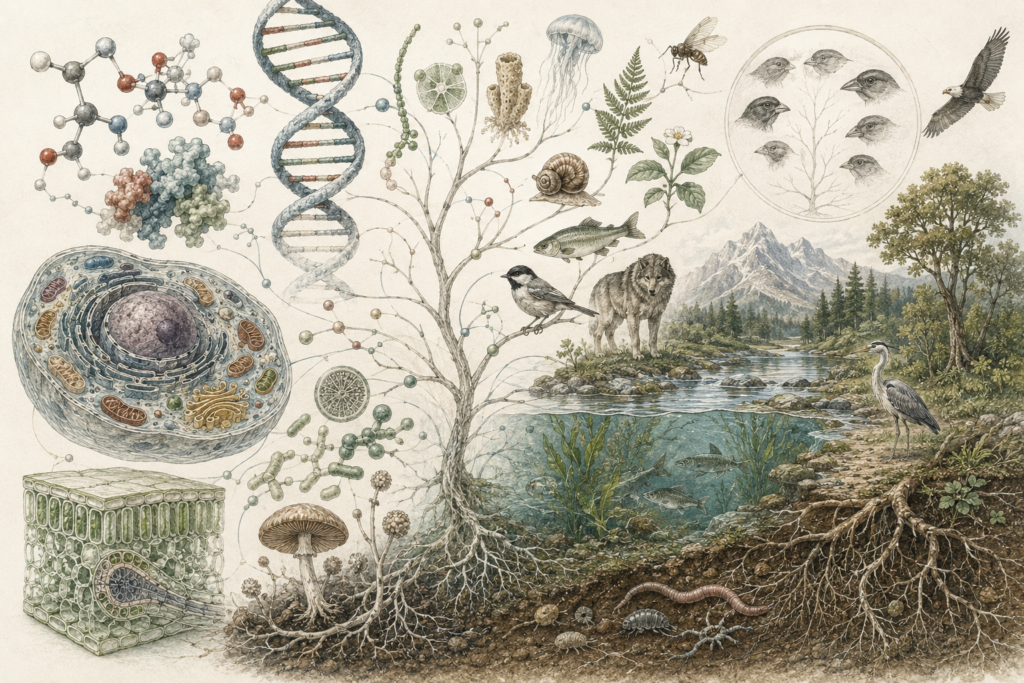
Research-grade biology illustration showing DNA, biomolecules, cells, plant tissues, fungi, microbes, soil roots, aquatic systems, animals, ecosystems, and evolutionary relationships connected across living systems.

What Is Biology? Life, Evolution, and Living Systems

What Is Biology? explores biology as the science of life across scales, from molecules and cells to organisms, populations, ecosystems, and the evolutionary history of living systems across deep time. This article examines what makes biology distinct among the natural sciences, including its concern with living organization, heredity, development, metabolism, adaptation, interaction, and the conditions that sustain life on Earth. It also introduces biology as a field that is not only observational and experimental but increasingly historical, quantitative, and computational, showing how modern biological understanding draws on evolution, ecology, statistics, modeling, and tools such as R and Python to interpret the complexity of living systems.

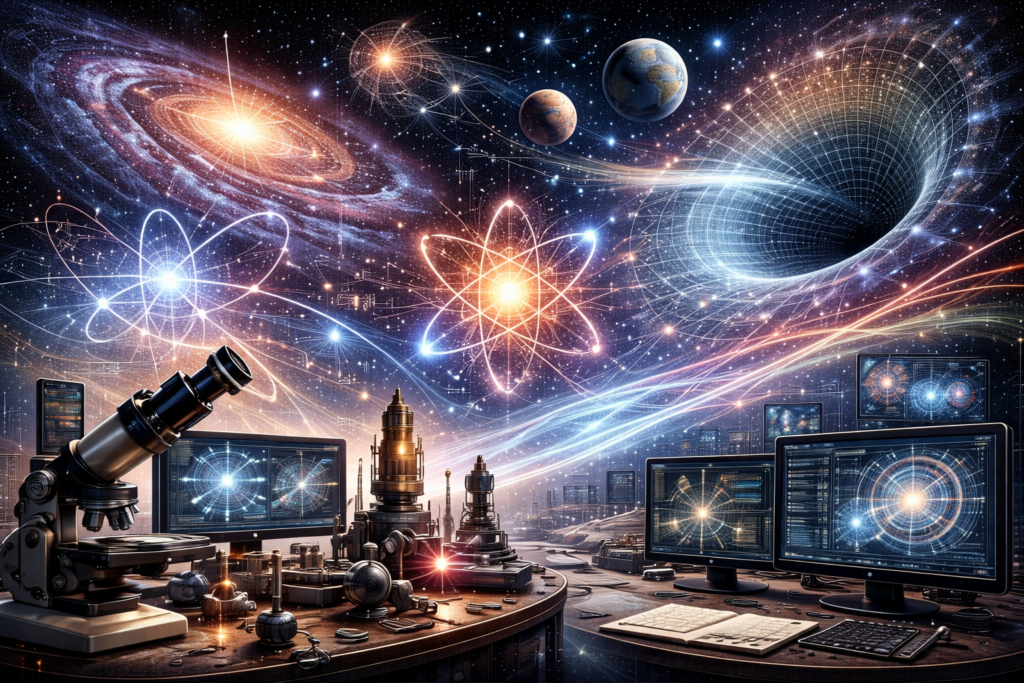
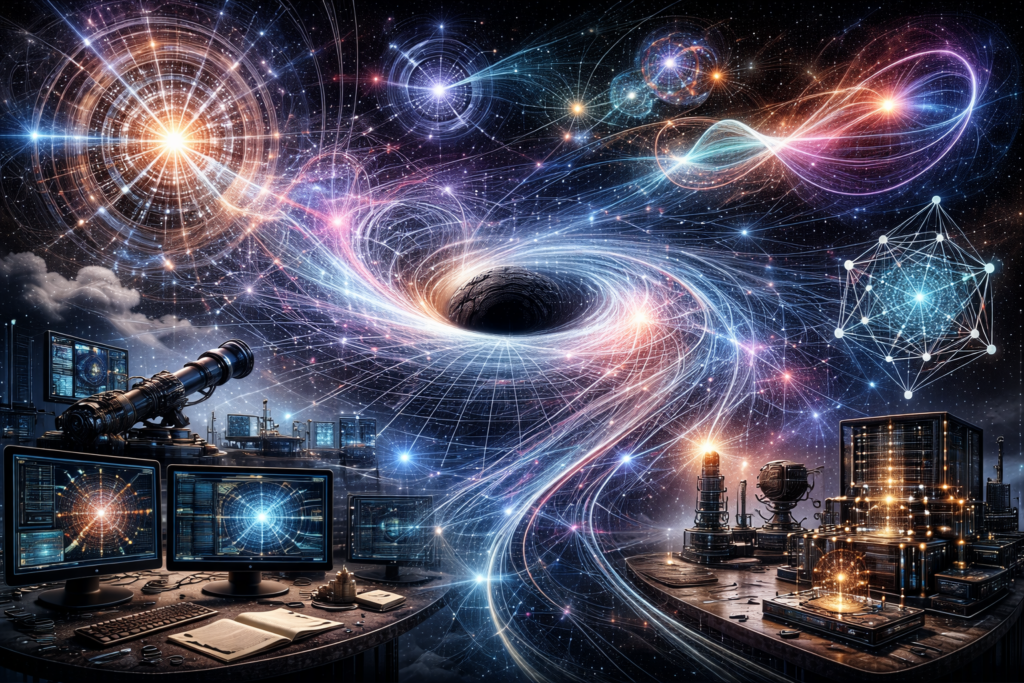
Editorial illustration of physics featuring scientific instruments, atomic and field-like structures, cosmic systems, curved spacetime imagery, and computational analysis displays.

What Is Physics?

Physics is the disciplined study of matter, energy, motion, fields, measurement, and structure across scales, from subatomic particles to galaxies. This article introduces physics as more than a list of topics: it is a way of knowing built from measurement, mathematics, experiment, modeling, uncertainty, and computation. It explains why units, constants, and standards matter; how physical laws connect measurable quantities; how theory and experiment interact; and how branches such as mechanics, thermodynamics, electromagnetism, relativity, quantum theory, condensed matter, particle physics, and cosmology form a connected field. The article also introduces a computational physics lens through selected Python and R workflows, with expanded research-style code available through the accompanying GitHub repository.

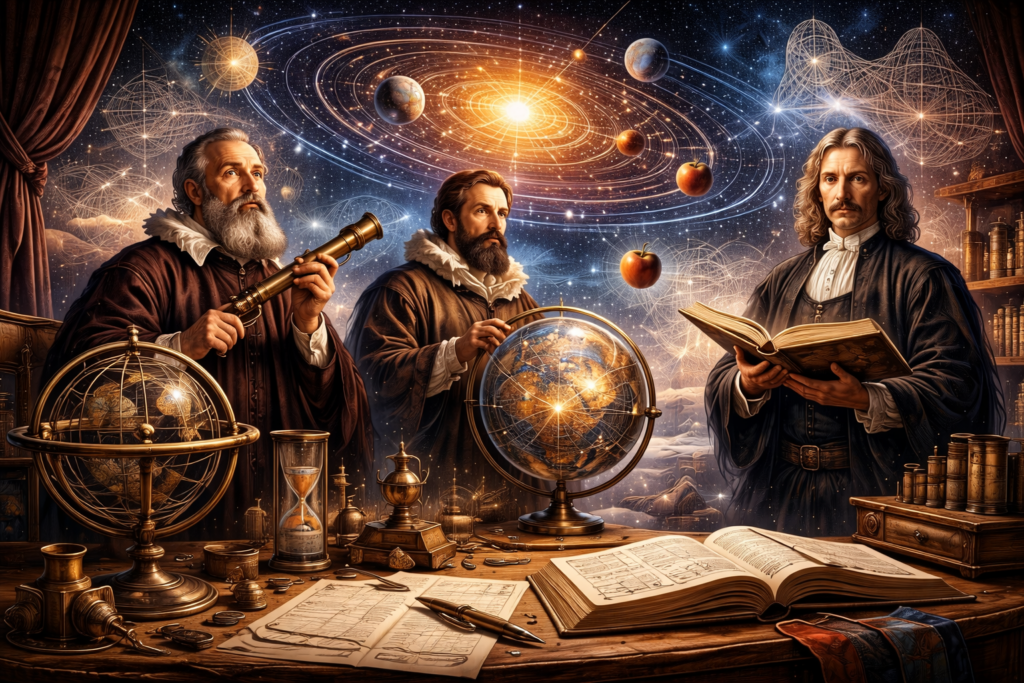
Editorial illustration of the Scientific Revolution featuring early modern scientific instruments, astronomical models, manuscripts, telescopic observation, planetary motion imagery, and a study-like setting associated with the rise of physical law.

The Scientific Revolution and the Rise of Physical Law

The Scientific Revolution transformed natural philosophy into the law-seeking structure that made modern physics possible. This article examines how early modern science moved from inherited authority and qualitative explanation toward mathematics, experiment, instruments, and universal physical law. It traces the shift from Aristotelian and scholastic frameworks through Copernicus’s heliocentric reordering, Kepler’s mathematical laws of planetary motion, Galileo’s experimental science of motion, and Newton’s synthesis of terrestrial and celestial mechanics. The article explains why physical law became central to scientific explanation, how mathematics and instrumentation reshaped knowledge, and why the legacy of the Scientific Revolution still defines physics as a discipline of measurement, modeling, evidence, and theoretical unification.

Editorial illustration of physics and the philosophy of reality featuring a warped spacetime structure, quantum-like interference patterns, geometric relational networks, observatory-style instruments, and computational analysis displays.

Physics and the Philosophy of Reality

Physics and the philosophy of reality explores what modern physical theory implies about the nature of the world, asking whether fields, particles, spacetime, wavefunctions, laws, and symmetries are best understood as real features of nature, structural descriptions, or theory-dependent models of an underlying reality. This article examines scientific realism, structural realism, laws of nature, causation, determinism, spacetime ontology, quantum interpretation, gauge structure, holism, and the limits of current physical explanation to show how physics does more than describe measurable phenomena: it also reshapes how reality itself can be conceived. It brings together mechanics, relativity, quantum theory, field theory, and philosophy of science to show that modern physics is not only a technical account of the universe but also a profound challenge to common-sense metaphysics and a continuing source of philosophical humility.

Scroll to Top