
Last Updated May 18, 2026
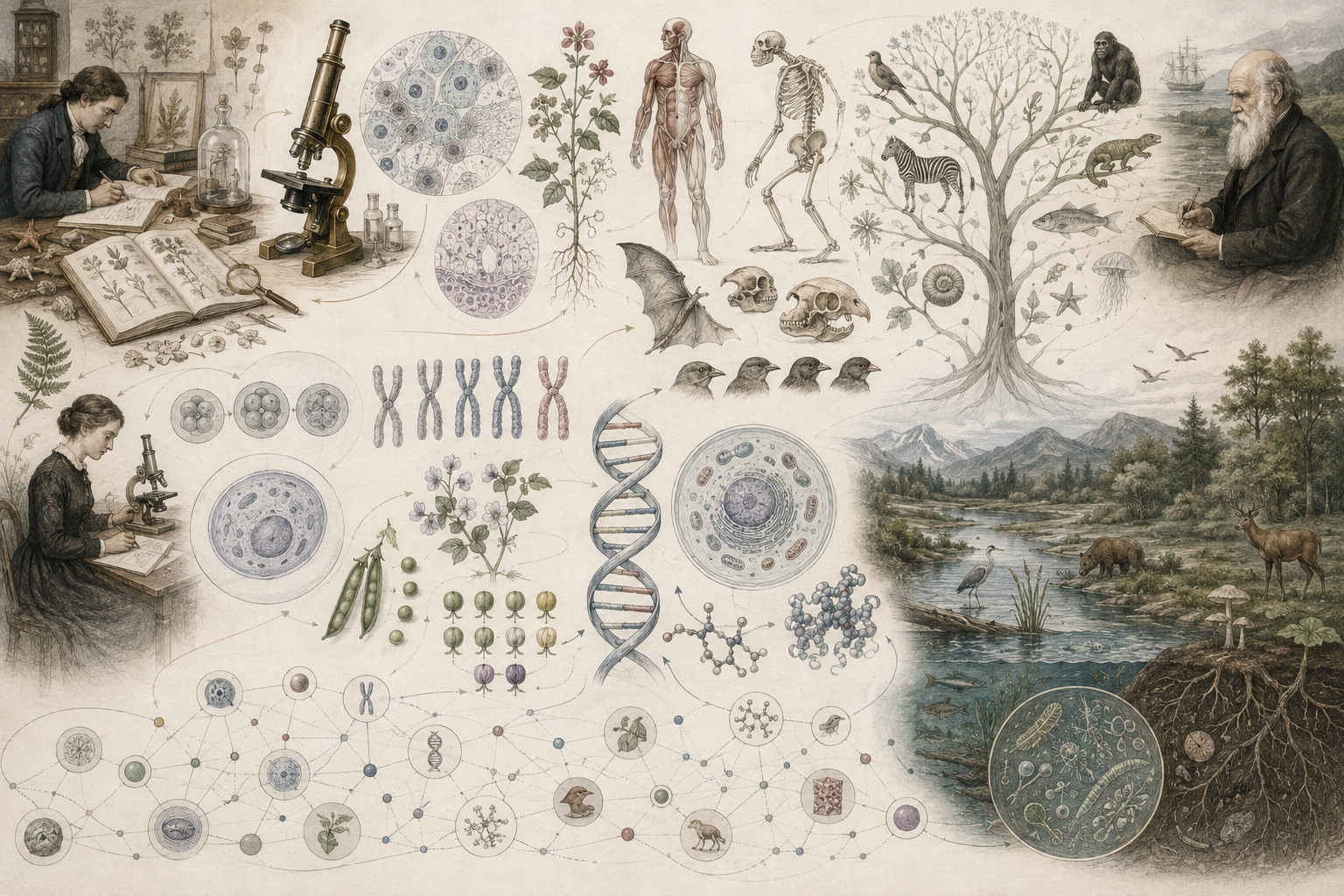
The rise of modern biological thought traces how the study of life moved from descriptive natural history, inherited philosophical speculation, and theological classification into a systematic scientific inquiry grounded in observation, taxonomy, experiment, microscopy, cell theory, evolution, heredity, molecular biology, ecology, and the increasingly quantitative analysis of living systems across scales. Modern biology did not simply accumulate more facts about organisms. It changed what counted as biological explanation. Life came to be understood as organized, cellular, historical, inherited, variable, adaptive, ecological, molecular, and increasingly measurable.
This article develops The Rise of Modern Biological Thought as a foundational intellectual history within the Biology knowledge series. It follows the major conceptual transformations that made modern biology possible: the shift from fixed kinds to historical lineages, from surface description to cellular organization, from vital force to material process, from inherited doctrine to experiment, from static classification to evolutionary relationship, from visible traits to heredity, and from organism-centered observation to molecular, ecological, and computational systems analysis.
Main Library
Publications
Article Map
Biology
Related Topic
Chemistry
Related Topic
Earth Science
Related Topic
Environmental Science
The article also treats modern biology as an institutional and ethical history. Natural history, taxonomy, specimen collection, colonial exploration, botanical gardens, museum archives, and global classification systems helped build modern biology, but they were also shaped by unequal power, extraction, slavery, empire, and the marginalization of Indigenous and local knowledge. A responsible account of modern biology must therefore explain both the scientific achievements of biology and the historical conditions under which biological knowledge was gathered, named, classified, preserved, and controlled.
The article extends that history into a biotechnology and computational frame. Modern biological thought created the foundations for genomics, bioinformatics, microbial screening, assay development, synthetic biology, molecular diagnostics, ecological monitoring, environmental sequencing, data-driven biological engineering, and reproducible scientific workflows. In that sense, modern biology made life measurable, comparable, modelable, manipulable, and increasingly auditable.
Before modern biology
Modern biology did not emerge all at once. For much of human history, reflection on living beings belonged to a wider field that combined philosophy, medicine, agriculture, theology, practical observation, animal husbandry, herbal knowledge, and local ecological experience. Ancient thinkers described animals, plants, generation, nutrition, disease, bodily function, and reproduction, but their understanding of life was often shaped by broader metaphysical assumptions about purpose, hierarchy, form, and cosmic order. Living beings were frequently interpreted as occupying stable places within an ordered world rather than as historical populations shaped by descent, variation, environment, and time.
These earlier traditions were not without insight. Classical naturalists made careful observations about anatomy, reproduction, and classification. Medical traditions preserved substantial knowledge of bodies, disease, plants, minerals, and therapeutic practice. Agricultural communities accumulated practical understanding of heredity, domestication, seasonality, soil, weather, and animal behavior. Indigenous and local ecological knowledge often contained detailed place-based understanding of species, habitats, migration, medicinal plants, ecological relationships, and environmental change. The problem was not the absence of knowledge, but the absence of a fully modern scientific framework capable of integrating observation, experiment, classification, historical inference, and material mechanism.
What distinguishes modern biological thought is not simply that it accumulated more facts. It transformed the way life was approached. Living systems came to be studied as material, organized, observable, comparable, historical, variable, and experimentally investigable realities. This shift required new instruments, new institutions, new classifications, new forms of evidence, and new concepts. It also required the gradual abandonment of explanations that treated life as fixed essence, static hierarchy, or inscrutable vital force.
Modern biology therefore emerged through conceptual reorientation. Life became a subject of disciplined inquiry rather than inherited speculation alone. Organisms became comparable. Bodies became anatomically investigable. Cells became visible. Species became historical. Heredity became measurable. Molecules became explanatory. Populations became statistical. Ecosystems became systems of interaction. This is the long transformation that made biology modern.
Natural history and the ordering of life
One of the major foundations of modern biology was the rise of natural history. Early modern scholars, collectors, illustrators, physicians, gardeners, anatomists, explorers, and taxonomists gathered, described, compared, and classified plants and animals on an expanding scale. This work created the empirical archive from which modern biology would grow. It also revealed a central problem: the living world contained far more diversity than inherited classification schemes could easily organize.
Natural history mattered because it trained biology in comparison. Rather than treating living beings as isolated curiosities, natural historians sought regularity in form, resemblance, difference, geographic distribution, reproduction, and use. Botanical gardens, herbaria, cabinets of curiosity, anatomical collections, field notebooks, illustrated plates, and museum specimens became infrastructures of biological memory. They allowed organisms collected in different places to be compared, named, ordered, and revisited.
Classification imposed structure on biological diversity. Taxonomy made it possible to communicate about organisms with greater precision, organize knowledge across languages and regions, and build cumulative records. Linnaean nomenclature, with its binomial system and hierarchical ranks, provided a durable language for biological naming. Although originally developed within a pre-evolutionary worldview, it created a framework that later evolutionary biology could reinterpret historically.
This stage in the rise of modern biological thought still emphasized description more than mechanism, but it was indispensable. Before biology could explain life scientifically, it first had to confront the breadth of living diversity. Natural history provided the observational and classificatory foundation on which later theories of cell structure, heredity, evolution, ecology, and molecular biology would build.
Classification, empire, and the politics of biological order
The history of modern biology also has to be read through power. Natural history expanded alongside European colonial exploration, plantation economies, maritime trade, imperial mapping, missionary networks, botanical extraction, and museum collection. Many specimens that became central to European scientific classification were gathered from colonized lands, often through labor systems and knowledge networks that were not recognized equally. Local experts, enslaved people, Indigenous guides, healers, farmers, collectors, and translators frequently contributed to biological knowledge without receiving naming authority, institutional credit, or control over the specimens and knowledge taken from their communities.
This does not invalidate taxonomy or natural history, but it complicates their history. The ordering of life was not merely a neutral intellectual project. It was also bound to systems that classified land, people, plants, animals, and resources for purposes of control, commerce, medicine, agriculture, and empire. Botanical gardens could be sites of scientific study and imperial acclimatization. Museums could preserve biodiversity and also embody extraction. Taxonomic names could stabilize knowledge and also reflect unequal authority.
A rigorous history of modern biological thought must therefore hold two truths together. First, taxonomy, natural history, and specimen-based science made modern biology possible. Second, the institutions that built this knowledge were shaped by global inequalities. Contemporary biology inherits both the scientific value of these archives and the ethical responsibility to confront their histories.
This matters today in debates about biodiversity data sovereignty, specimen repatriation, benefit sharing, Indigenous ecological knowledge, colonial collections, decolonizing taxonomy, and equitable conservation science. Modern biology’s future credibility depends partly on whether it can acknowledge how its archives were built while making biological knowledge more open, accountable, and just.
Microscopy, anatomy, and the invisible world of life
The rise of modern biological thought depended on new ways of seeing. Anatomy transformed understanding of bodily structure by moving inquiry away from abstract speculation and toward direct examination. Dissection, comparative anatomy, physiology, and more precise visual description revealed that living bodies had internal structures that could be studied systematically. Organs, tissues, circulation, respiration, digestion, reproduction, and bodily organization increasingly became objects of empirical investigation.
Microscopy deepened this transformation by opening a world previously hidden from unaided vision. The discovery of microscopic structures, cells, microorganisms, spermatozoa, blood cells, tissues, and eventually organelles altered older assumptions about the scale and composition of life. Organisms could no longer be understood solely in terms of visible anatomy. The living world now included invisible forms, minute organization, and underlying structures that demanded new explanatory frameworks.
These developments changed what counted as evidence. Biology could no longer rely only on surface appearance, classical authority, or inherited doctrine. It had to attend to fine structure, unseen processes, and instrument-mediated observation. The visible organism was no longer the whole story. Life had depth, scale, and hidden organization.
Microscopy also reshaped disease, reproduction, development, and ecology. Microbes became visible as biological agents. Tissues could be compared. Development could be studied at finer levels. Environmental samples could reveal microscopic life. Later, microscopy would support cell theory, germ theory, histology, embryology, immunology, pathology, marine plankton studies, and modern cell biology. New instruments did not merely sharpen vision. They transformed biological imagination.
Cell theory and the new concept of living organization
Cell theory marked one of the decisive turning points in the emergence of modern biology. It established that living organisms are composed of cells, that cells are fundamental units of structure and function, and that new cells arise from preexisting cells. This idea reoriented biological thought by shifting attention from whole-organism description alone to the underlying organizational basis of living systems. Plants, animals, fungi, microbes, and tissues could now be understood through a common cellular framework.
The significance of cell theory went far beyond microscopy. It suggested that life had a repeatable organizational logic. Growth, development, disease, repair, reproduction, and heredity could be studied at the cellular level. The organism remained important, but the cell became a privileged level of explanation. Biology gained a unit that linked structure and function, visible organism and microscopic process, individuality and continuity.
Cell theory also helped dissolve older distinctions that treated various forms of life as fundamentally separate in kind. Beneath diversity, biology found common organization. The cell became a conceptual bridge between botany and zoology, between physiology and pathology, between development and heredity, and later between molecular biology and organismal life.
Once life was understood cellularly, new questions became possible. How do cells arise? How do they divide? How do they differentiate? How do they coordinate metabolism, growth, signaling, and function? How do cellular failures produce disease? How do cellular lineages preserve continuity? Cell theory turned biology into a more unified science by providing a common substrate through which living organization could be studied scientifically.
Darwin and the historical transformation of biology
If cell theory gave biology a new account of living organization, evolutionary theory gave it a new account of living history. The Darwinian revolution transformed biology by showing that species were not fixed entities placed once and for all into a static order. They were historical populations shaped by descent, variation, selection, inheritance, environment, and time.
With Darwin, biology became irreversibly historical. Traits could be understood as inherited and modified rather than simply given. Similarities among organisms could be interpreted as evidence of common ancestry. Adaptation became a process rather than a sign of fixed design. Diversity became intelligible as the branching outcome of evolutionary change rather than as a timeless catalog of separate forms.
The importance of this transformation cannot be overstated. Evolution unified biology by linking anatomy, natural history, biogeography, development, variation, paleontology, and ecology within a single explanatory framework. It showed that life could not be understood adequately without history. Present living forms were legible only in the light of prior transformation.
Darwin’s theory also changed classification. Taxonomy was no longer merely the arrangement of similar forms. It increasingly became the reconstruction of relationship. Organisms were grouped not only because they resembled one another, but because resemblance might reveal descent. Modern phylogenetics, comparative genomics, and the tree-of-life framework extend this historical transformation into the molecular and computational age.
Heredity, genetics, and the modern synthesis
The next major transformation in modern biological thought came through the study of heredity. Evolution explained that species changed, but biology still needed a clearer account of how traits were transmitted across generations. Genetics supplied this missing dimension. Heredity became something that could be studied systematically, mathematically, and experimentally rather than inferred only from resemblance.
Mendelian inheritance provided a formal way to think about traits, segregation, dominance, and recombination. Later, population genetics linked inheritance to evolutionary change by analyzing how allele frequencies shift across generations. The modern synthesis brought together natural selection, Mendelian genetics, mutation, recombination, population structure, and statistical reasoning in a way that strengthened biology’s theoretical coherence.
This integration was decisive because it made evolution mathematically explicit. Evolution was no longer understood only at the level of visible traits and natural history. It could also be studied through inheritance, mutation, recombination, and population-level change. Biology moved further away from essentialist categories and closer to a science of variation, transmission, probability, and dynamic change.
The modern synthesis also made clear that biological explanation had to operate across scales. Genes mattered, but genes acted within organisms, populations, environments, and histories. Evolution became a theory of both inheritance and context. This multi-scale orientation remains central to contemporary biology.
Molecular biology and the deepening of life science
Twentieth-century biology deepened further with the rise of molecular biology. If cell theory had revealed the basic unit of life and genetics had clarified heredity, molecular biology sought to explain the mechanisms through which hereditary information is stored, copied, expressed, regulated, and translated into biological function. The study of DNA, RNA, proteins, enzymes, chromosomes, gene regulation, and molecular signaling opened a new scale of biological explanation.
This development did not replace older biological fields, but it changed them profoundly. Development, physiology, genetics, microbiology, medicine, immunology, neuroscience, and evolutionary biology were all transformed by the ability to investigate molecular mechanisms. Biology became more mechanistic in one sense, but also more integrative, because molecular explanation had to be linked back to cells, tissues, organisms, populations, and ecosystems.
Molecular biology also accelerated the expansion of biological data. Sequencing, genomics, transcriptomics, proteomics, structural biology, and computational biology made it possible to study life at scales far beyond traditional manual methods. Biology increasingly became a science not only of observation and experiment, but also of information, code, networks, databases, algorithms, and reproducible analysis.
This is one of the great paradoxes of modern biology. The deeper biology moved into molecular detail, the more it needed systems-level thinking. Genes do not act in isolation. Proteins function in networks. Cells respond to environments. Phenotypes emerge from interactions. Molecular biology therefore expanded both reductionist power and integrative necessity.
Ecology, microbiology, and the systems turn
Modern biological thought also expanded through ecology and microbiology. Ecology showed that organisms cannot be fully understood apart from their environments, interactions, resources, competitors, predators, symbionts, pathogens, and physical conditions. Microbiology revealed that much of life is microscopic, metabolically diverse, environmentally powerful, and essential to planetary processes. Together, ecology and microbiology pushed biology beyond organism-centered description toward systems of interaction.
Ecology transformed life science by making relation central. Organisms became nodes in networks of energy flow, nutrient cycling, competition, cooperation, disturbance, succession, and feedback. Populations could be modeled. Communities could be compared. Ecosystems could be studied as dynamic systems. Conservation biology later emerged from this recognition that living systems are vulnerable to human transformation at population, habitat, ecosystem, and planetary scales.
Microbiology transformed biology by revealing the hidden majority of life. Microbes drive decomposition, nitrogen fixation, carbon cycling, methane production, disease, symbiosis, fermentation, biotechnology, and host-associated microbiomes. Molecular tools later revealed microbial diversity far beyond what culture-based methods could detect. The biosphere became newly visible as a microbial and ecological system.
This systems turn matters because modern biology increasingly treats life as interaction across scales: molecular networks inside cells, cells inside organisms, organisms inside populations, populations inside ecosystems, and ecosystems inside planetary systems. Modern biological thought is therefore not only cellular, evolutionary, and molecular. It is also ecological and systemic.
Biotechnology as an extension of modern biological thought
Biotechnology is one of the clearest downstream consequences of modern biological thought. Once life became legible in terms of cells, heredity, molecular mechanisms, variation, evolution, and measurable process, living systems could be investigated not only for description but also for controlled intervention, engineered use, and reproducible application. Biotechnology is not external to biology. It is one expression of how modern biology operationalizes knowledge.
Genomics, fermentation, microbial screening, cell culture, gene editing, protein engineering, assay systems, biomarker pipelines, environmental sequencing, synthetic biology, biosensors, molecular diagnostics, and computational bioinformatics all depend on the intellectual transformations described above. Without taxonomy, samples cannot be identified. Without cell theory, cellular behavior cannot be localized. Without heredity and genetics, variation cannot be traced. Without molecular biology, mechanisms cannot be manipulated. Without quantitative modeling, biological systems cannot be scaled, compared, and optimized with rigor.
This is especially relevant to sustainability-facing science. Environmental biotechnology, microbial remediation, bio-based materials, biosurveillance, agricultural biology, wastewater monitoring, conservation genomics, ecosystem restoration, and climate adaptation all depend on methods that emerged from modern biology’s redefinition of life as measurable, analyzable, historical, and relational.
Biotechnology also intensifies the ethical stakes of modern biology. To understand living systems is increasingly to gain the power to intervene in them. That power can be used for medicine, conservation, restoration, food security, and environmental repair, but it can also be used for extraction, surveillance, inequity, ecological harm, or biological risk. Modern biological thought therefore carries practical responsibility.
Mathematical lens
Modern biological thought became more than descriptive in part because it became quantitative. Once growth, heredity, variation, selection, and molecular information were formalized, biology could move from verbal narrative toward mathematical expression, statistical estimation, and computational reproducibility. This quantitative layer is now indispensable in population biology, genetics, genomics, ecology, biotechnology, epidemiology, and systems biology.
A simple model of population growth during an unconstrained phase is:
Interpretation: Exponential growth describes population change when per-capita growth rate remains constant and limiting factors are ignored.
where \(N_0\) is the initial population size, \(r\) is the per-capita growth rate, and \(t\) is time. This type of model became important because modern biology increasingly interpreted life through change across time rather than as a static inventory of forms.
If constraints matter, logistic growth is often more realistic:
Interpretation: Logistic growth represents population increase under carrying-capacity limitation.
where \(K\) is the carrying capacity. These models connect directly to ecology, microbial growth, biotechnology, conservation biology, and evolutionary thinking because they quantify the conditions under which living populations expand, stabilize, or decline.
The modern synthesis made biology more explicitly mathematical by shifting attention toward population-level change. A simple allele-frequency relation is:
Interpretation: In a two-allele model, allele frequencies sum to one.
where \(p\) and \(q\) are the frequencies of two alleles at a locus. Under Hardy-Weinberg assumptions, genotype frequencies are expected to follow:
Interpretation: Hardy-Weinberg expectations connect allele frequencies to genotype frequencies under idealized population conditions.
These expressions do not capture all of evolutionary biology, but they are historically important because they show how modern biological thought moved from essentialist categories toward population thinking, statistical expectation, and dynamic change.
If two alleles differ in fitness, a simple recurrence can express allele-frequency change:
Interpretation: Allele frequency in the next generation depends on genotype frequencies, genotype fitnesses, and mean population fitness.
where \(p’\) is the allele frequency in the next generation, \(w_{AA}\) and \(w_{Aa}\) are genotype fitnesses, and \(\bar{w}\) is mean population fitness. This formalism helps show why the modern synthesis was so important: it made evolutionary change measurable as change in population composition across generations.
Molecular biology also made life computational. A simple sequence similarity score can be written as:
Interpretation: Sequence similarity decreases as the number of differing aligned positions increases.
where \(d\) is the number of differing aligned positions and \(L\) is sequence length. This simple relation underlies more complex workflows in genomics, phylogenetics, microbial identification, and bioinformatics.
Variables, units, and historical interpretation
Modern biology became powerful partly because it learned how to connect historical change, population structure, heredity, and molecular information to measurable quantities. The table below summarizes several variables used in introductory quantitative biology and explains why they matter historically.
| Symbol or Term | Meaning | Typical Unit or Scale | Historical and Biological Interpretation |
|---|---|---|---|
| \(N\) | Population size | individuals, cells, colonies, organisms, or measured abundance proxy | Allowed biology to analyze populations as changing quantities rather than static categories |
| \(N_0\) | Initial population size | same as \(N\) | Starting condition for growth, decline, experimental culture, or ecological monitoring |
| \(t\) | Time | seconds, hours, days, years, or generations | Central to modern biology because life is historical, developmental, and evolutionary |
| \(r\) | Per-capita growth rate | per unit time | Quantifies biological increase under specified conditions |
| \(K\) | Carrying capacity | same as \(N\) | Represents environmental limitation in population and ecological models |
| \(p, q\) | Allele frequencies | proportions from 0 to 1 | Made heredity and evolution measurable at the population level |
| \(p’\) | Next-generation allele frequency | proportion from 0 to 1 | Represents evolutionary change across generations |
| \(w\) | Fitness | relative reproductive success or survival contribution | Connects inheritance, selection, and population change |
| \(\bar{w}\) | Mean population fitness | relative fitness scale | Normalizes genotype contributions in allele-frequency change models |
| \(d\) | Sequence differences | count of aligned positions | Represents molecular difference between aligned biological sequences |
| \(L\) | Sequence length | base pairs, amino acids, or aligned positions | Defines the denominator for simple molecular comparison |
| \(S\) | Sequence similarity | proportion from 0 to 1 | Represents molecular resemblance in bioinformatics and comparative biology |
The table illustrates a major shift in biological thought. Modern biology did not abandon natural history, anatomy, or field observation. It added quantitative structures that allowed living systems to be compared, modeled, and interpreted across time and scale.
Worked example: growth rate and doubling time
Suppose a population begins at \(N_0=100\) and grows to \(N=708\) after 10 time units. Under the exponential model:
Interpretation: Exponential growth relates population size to initial abundance, growth rate, and time.
Substituting the known values gives:
Interpretation: The observed population change can be used to estimate the growth rate.
Dividing both sides by 100:
Interpretation: The population has increased by a factor of 7.08 over the observation period.
Taking the natural logarithm of both sides:
Interpretation: The estimated per-time-unit growth rate is approximately 0.1957.
The doubling time is:
Interpretation: At this estimated growth rate, the population doubles approximately every 3.54 time units.
This simple calculation turns biological change into a parameter that can be compared across populations, environments, treatments, or historical scenarios. It also shows why quantitative biology became so important. Biological change is not only something to describe. It can be estimated, compared, modeled, and tested.
Computational modeling
Computational modeling helps clarify the rise of modern biological thought because many of the field’s decisive transformations involved making life more measurable and comparable. Population growth became an estimated process. Heredity became a probabilistic structure. Selection became a change in population composition. Molecular sequence became analyzable information. Ecology became a science of systems, flows, and interactions.
The examples below use R and Python to model growth, Hardy-Weinberg expectations, logistic dynamics, and simple sequence similarity. These are deliberately compact examples, but they point toward the larger computational infrastructure of contemporary biology: genomic pipelines, ecological monitoring systems, population simulations, sequence databases, reproducible notebooks, provenance-aware SQL schemas, and multi-language scientific-computing workflows.
The purpose is not to flatten biological history into equations. It is to show how modern biological thought increasingly joined concept, measurement, history, and computation. Biology became modern partly by learning how to preserve the complexity of life while making selected processes explicit enough to test, compare, and reproduce.
R workflow: growth rate and Hardy-Weinberg expectations
R is especially useful for statistical biology because it supports model fitting, tabular summaries, reproducible analysis, and transparent reporting. The following workflow estimates an exponential growth rate from population data and calculates Hardy-Weinberg genotype expectations.
# Growth Rate and Hardy-Weinberg Expectations
#
# This workflow demonstrates two historically important quantitative
# moves in modern biological thought:
#
#   1. Treat biological growth as an estimable process.
#   2. Treat heredity as a population-level expectation.
#
# These examples can be adapted for microbial growth, cell culture,
# ecological populations, fermentation, early tumor-growth approximations,
# or introductory population-genetics workflows.

library(tibble)
library(dplyr)

# ------------------------------------------------------------
# 1. Estimate exponential growth rate from population data
# ------------------------------------------------------------

growth_data <- tibble(
  time = c(0, 2, 4, 6, 8, 10),
  population = c(100, 148, 219, 324, 479, 708)
)

growth_model <- lm(log(population) ~ time, data = growth_data)

growth_summary <- tibble(
  estimated_growth_rate = coef(growth_model)[["time"]],
  estimated_initial_population = exp(coef(growth_model)[["(Intercept)"]]),
  doubling_time = log(2) / estimated_growth_rate,
  r_squared_log_space = summary(growth_model)$r.squared
)

growth_predictions <- growth_data %>%
  mutate(
    predicted_population = exp(predict(growth_model)),
    residual_log_scale = resid(growth_model)
  )

# ------------------------------------------------------------
# 2. Hardy-Weinberg genotype expectations
# ------------------------------------------------------------

allele_frequency_p <- 0.7
allele_frequency_q <- 1 - allele_frequency_p

genotype_expectations <- tibble(
  genotype = c("AA", "Aa", "aa"),
  expected_frequency = c(
    allele_frequency_p^2,
    2 * allele_frequency_p * allele_frequency_q,
    allele_frequency_q^2
  )
)

# ------------------------------------------------------------
# 3. Compact output tables
# ------------------------------------------------------------

print(round(growth_summary, 5))
print(round(growth_predictions, 3))
print(round(genotype_expectations, 4))
This R example shows how historically central biological ideas—growth through time and inheritance across generations—can be turned into interpretable quantities. Growth becomes an estimated rate. Heredity becomes a set of population-level expectations. Both moves are central to the rise of modern biological thought.
Python workflow: logistic growth, inheritance, and sequence similarity
Python is especially useful for simulation, data pipelines, bioinformatics, numerical modeling, and reproducible workflow design. The following workflow computes logistic growth trajectories, Hardy-Weinberg genotype expectations, and simple aligned sequence similarity.
"""
Modern Biological Thought: Computational Scaffolding

This workflow demonstrates three quantitative transformations
associated with modern biology:

1. Population growth becomes a modelable process.
2. Heredity becomes a population-level expectation.
3. Molecular comparison becomes computable sequence information.

The examples are intentionally compact, but the same structure can
be extended into ecology, genomics, biotechnology, evolutionary
simulation, and reproducible biological data pipelines.
"""

from __future__ import annotations

import numpy as np
import pandas as pd

def logistic_growth(
    time: np.ndarray,
    initial_population: float,
    growth_rate: float,
    carrying_capacity: float,
) -> np.ndarray:
    """
    Calculate a logistic growth trajectory.

    Parameters
    ----------
    time:
        Array of time values.
    initial_population:
        Starting population size.
    growth_rate:
        Per-capita growth rate.
    carrying_capacity:
        Carrying capacity of the environment.

    Returns
    -------
    np.ndarray
        Population size at each time point.
    """
    if initial_population <= 0:
        raise ValueError("Initial population must be positive.")
    if carrying_capacity <= 0:
        raise ValueError("Carrying capacity must be positive.")
    if initial_population > carrying_capacity:
        raise ValueError("Initial population should not exceed carrying capacity.")

    return carrying_capacity / (
        1.0
        + ((carrying_capacity - initial_population) / initial_population)
        * np.exp(-growth_rate * time)
    )

def hardy_weinberg(p: float) -> dict[str, float]:
    """
    Return Hardy-Weinberg genotype expectations for allele frequency p.
    """
    if p < 0 or p > 1:
        raise ValueError("Allele frequency p must be between 0 and 1.")

    q = 1.0 - p

    return {
        "AA": p**2,
        "Aa": 2.0 * p * q,
        "aa": q**2,
    }

def sequence_similarity(seq1: str, seq2: str) -> float:
    """
    Calculate simple aligned sequence similarity.

    The two sequences must already be aligned and equal length.
    """
    if len(seq1) != len(seq2):
        raise ValueError("Sequences must be aligned and equal length.")

    differences = sum(a != b for a, b in zip(seq1, seq2))

    return 1.0 - differences / len(seq1)

def main() -> None:
    """
    Run compact examples for growth, inheritance, and sequence comparison.
    """
    time = np.linspace(0, 20, 300)

    scenarios = {
        "baseline": {"N0": 100, "r": 0.35, "K": 2000},
        "resource_limited": {"N0": 100, "r": 0.25, "K": 900},
        "high_growth": {"N0": 100, "r": 0.50, "K": 2500},
    }

    growth_rows = []

    for scenario, params in scenarios.items():
        population = logistic_growth(
            time=time,
            initial_population=params["N0"],
            growth_rate=params["r"],
            carrying_capacity=params["K"],
        )

        growth_rows.append(
            pd.DataFrame(
                {
                    "scenario": scenario,
                    "time": time,
                    "population": population,
                    "growth_rate": params["r"],
                    "carrying_capacity": params["K"],
                }
            )
        )

    growth_df = pd.concat(growth_rows, ignore_index=True)

    genotype_expectations = hardy_weinberg(0.7)

    reference_sequences = {
        "reference_A": "ATGCTAGCTAAC",
        "reference_B": "ATGCTAGCTATC",
        "reference_C": "ATGCCAGCTATC",
    }

    query_sequence = "ATGCTAGCTATC"

    similarity_rows = []

    for name, sequence in reference_sequences.items():
        similarity_rows.append(
            {
                "reference": name,
                "similarity": sequence_similarity(query_sequence, sequence),
            }
        )

    similarity_df = pd.DataFrame(similarity_rows).sort_values(
        "similarity",
        ascending=False,
    )

    print("Logistic growth sample:")
    print(growth_df.head(12).round(3).to_string(index=False))

    print("\nHardy-Weinberg genotype expectations:")
    for genotype, value in genotype_expectations.items():
        print(genotype, round(value, 4))

    print("\nAligned sequence similarity:")
    print(similarity_df.round(4).to_string(index=False))

if __name__ == "__main__":
    main()
This Python workflow connects modern biological thought to contemporary data-rich life science. Logistic growth shows how population change can be simulated. Hardy-Weinberg expectations show how heredity can be formalized at the population level. Sequence similarity shows how biological comparison can operate at the molecular level, forming a bridge to genomics, bioinformatics, microbial identification, and phylogenetic analysis.
GitHub repository
The article body includes compact R and Python examples so the historical and scientific argument remains readable. The full repository expands those examples into a more rigorous computational history-of-biology workflow, including growth modeling, logistic simulation, Hardy-Weinberg genotype expectations, allele-frequency change under selection, sequence similarity, central-dogma scaffolds, milestone datasets, SQL provenance structures, validation notes, reproducible data files, and full-stack scientific-computing examples across Python, R, Julia, Fortran, Rust, Go, C, C++, SQL, and notebooks.
Limits, ethics, and the responsibility of biological knowledge
The rise of modern biological thought produced extraordinary explanatory power, but it also produced new responsibilities. Biology’s modern history includes medicine, conservation, ecology, genetics, and molecular discovery. It also includes eugenics, racialized misuse of evolutionary ideas, extractive natural history, unethical experimentation, environmental harm, biological weapons research, and unequal access to the benefits of biological knowledge. A mature account of modern biology cannot treat scientific progress as morally automatic.
This does not mean rejecting modern biology. It means understanding that knowledge and power developed together. Once life became measurable, classifiable, and manipulable, biological knowledge could support healing, agriculture, conservation, and restoration. It could also support surveillance, domination, exclusion, extraction, and harm. The ethical question is not whether biology should know less, but how biological knowledge should be generated, governed, shared, and used.
Modern biology also faces epistemic limits. Molecular explanation does not automatically explain ecosystems. Laboratory findings may not scale to field conditions. Genetic information does not determine destiny in simple ways. Classification systems can obscure as well as reveal. Models can clarify processes but also hide assumptions. Computational workflows can produce precision without understanding if data quality, context, and uncertainty are neglected.
The responsibility of modern biological thought is therefore methodological, ethical, and institutional. It must maintain rigor while acknowledging complexity. It must preserve evidence while confronting histories of exclusion. It must build biotechnology and biological data systems that are transparent, accountable, and oriented toward human and ecological flourishing.
Why modern biological thought matters
The rise of modern biological thought matters because it changed humanity’s understanding of life and of itself. It displaced fixed hierarchies with dynamic history, replaced surface description with deeper organization, revealed continuity among living beings, and made life intelligible as process, inheritance, interaction, and transformation. It showed that living systems are not static objects but organized, evolving, vulnerable, and relational systems.
This transformation reshaped practical life. Modern medicine, public health, agriculture, conservation, genetics, biotechnology, environmental monitoring, and ecological restoration all depend on the intellectual breakthroughs that made modern biology possible. Without modern biological thought, there would be no coherent science of microbes, no robust theory of heredity, no evolutionary framework for biodiversity, no molecular basis for understanding disease, and no computational infrastructure for genomics or systems biology.
At the same time, the modern biological worldview imposes responsibility. To understand life more deeply is to acquire greater power over living systems. That power can be used for healing, stewardship, restoration, and protection, but also for manipulation, extraction, and harm. The history of biological thought is therefore not only a history of scientific progress. It is also a history of expanded consequence.
Conclusion
The rise of modern biological thought marks one of the great transformations in human knowledge. Over centuries, the study of life moved from philosophical speculation and descriptive natural history toward a complex science grounded in observation, classification, anatomy, microscopy, cell theory, evolution, heredity, molecular explanation, ecology, and computational analysis. Along the way, biology became empirical, historical, comparative, quantitative, and increasingly data-rich.
What emerged from this transformation was not merely a larger body of facts about organisms. It was a new way of understanding life itself: as organized, material, cellular, dynamic, inherited, evolving, ecological, and deeply relational. Modern biology made it possible to see continuity beneath diversity, history within form, process within apparent stability, and molecular information within living function.
That intellectual transformation continues. Biology is still changing as genomics, systems biology, environmental monitoring, biotechnology, artificial intelligence, and reproducible computation reshape how life is studied. But the central achievement remains clear: modern biological thought made life scientifically thinkable in a new way.
Related articles
- Biology
- What Is Biology?
- Biology and the Scientific Understanding of Living Order
- Observation, Experiment, and the Methods of Biological Inquiry
- Classification, Taxonomy, and the Ordering of Life
- Cell Theory and the Basic Unit of Life
- Life, Death, and the Problem of Biological Definition
- Evolution and the History of Life
- Population Genetics and the Mathematics of Inheritance
- Molecular Biology and the Flow of Genetic Information
Further reading
- Alberts, B. et al. (2002) Molecular Biology of the Cell. 4th edn. New York: Garland Science. Available at: https://www.ncbi.nlm.nih.gov/books/NBK21054/
- Bowler, P.J. (2003) Evolution: The History of an Idea. 3rd edn. Berkeley: University of California Press.
- Cooper, G.M. (2000) The Cell: A Molecular Approach. 2nd edn. Sunderland, MA: Sinauer Associates. Available at: https://www.ncbi.nlm.nih.gov/books/NBK9839/
- Darwin, C. (1859) On the Origin of Species by Means of Natural Selection. London: John Murray. Darwin Online. Available at: https://darwin-online.org.uk/contents.html#origin
- Mayr, E. (1982) The Growth of Biological Thought: Diversity, Evolution, and Inheritance. Cambridge, MA: Harvard University Press.
- Mendel, G. (1866) ‘Versuche über Pflanzen-Hybriden’, Verhandlungen des naturforschenden Vereines in Brünn, 4, pp. 3–47. Available at: https://www.esp.org/foundations/genetics/classical/gm-65.pdf
- Smocovitis, V.B. (1996) Unifying Biology: The Evolutionary Synthesis and Evolutionary Biology. Princeton: Princeton University Press.
- Watson, J.D. and Crick, F.H.C. (1953) ‘Molecular structure of nucleic acids: A structure for deoxyribose nucleic acid’, Nature, 171, pp. 737–738. Available at: https://doi.org/10.1038/171737a0
References
- Alberts, B. et al. (2002) Molecular Biology of the Cell. 4th edn. New York: Garland Science. Available at: https://www.ncbi.nlm.nih.gov/books/NBK21054/
- Bowler, P.J. (2003) Evolution: The History of an Idea. 3rd edn. Berkeley: University of California Press.
- Cooper, G.M. (2000) The Cell: A Molecular Approach. 2nd edn. Sunderland, MA: Sinauer Associates. Available at: https://www.ncbi.nlm.nih.gov/books/NBK9839/
- Darwin, C. (1859) On the Origin of Species by Means of Natural Selection. London: John Murray. Darwin Online. Available at: https://darwin-online.org.uk/contents.html#origin
- Hardy, G.H. (1908) ‘Mendelian proportions in a mixed population’, Science, 28(706), pp. 49–50. Available at: https://doi.org/10.1126/science.28.706.49
- Mayr, E. (1982) The Growth of Biological Thought: Diversity, Evolution, and Inheritance. Cambridge, MA: Harvard University Press.
- Mendel, G. (1866) ‘Versuche über Pflanzen-Hybriden’, Verhandlungen des naturforschenden Vereines in Brünn, 4, pp. 3–47. Available at: https://www.esp.org/foundations/genetics/classical/gm-65.pdf
- OpenStax (2018) ‘Evolution and the origin of species’, in Biology 2e. Available at: https://openstax.org/books/biology-2e/pages/18-introduction
- OpenStax (2018) ‘Genes and proteins’, in Biology 2e. Available at: https://openstax.org/books/biology-2e/pages/15-introduction
- Schleiden, M.J. (1838) ‘Beiträge zur Phytogenesis’, Archiv für Anatomie, Physiologie und wissenschaftliche Medicin, pp. 137–176.
- Schwann, T. (1839) Mikroskopische Untersuchungen über die Übereinstimmung in der Struktur und dem Wachstum der Tiere und Pflanzen. Berlin: Sander.
- Smocovitis, V.B. (1996) Unifying Biology: The Evolutionary Synthesis and Evolutionary Biology. Princeton: Princeton University Press.
- Watson, J.D. and Crick, F.H.C. (1953) ‘Molecular structure of nucleic acids: A structure for deoxyribose nucleic acid’, Nature, 171, pp. 737–738. Available at: https://doi.org/10.1038/171737a0
- Weinberg, W. (1908) ‘Über den Nachweis der Vererbung beim Menschen’, Jahreshefte des Vereins für vaterländische Naturkunde in Württemberg, 64, pp. 368–382.