
Last Updated May 28, 2026
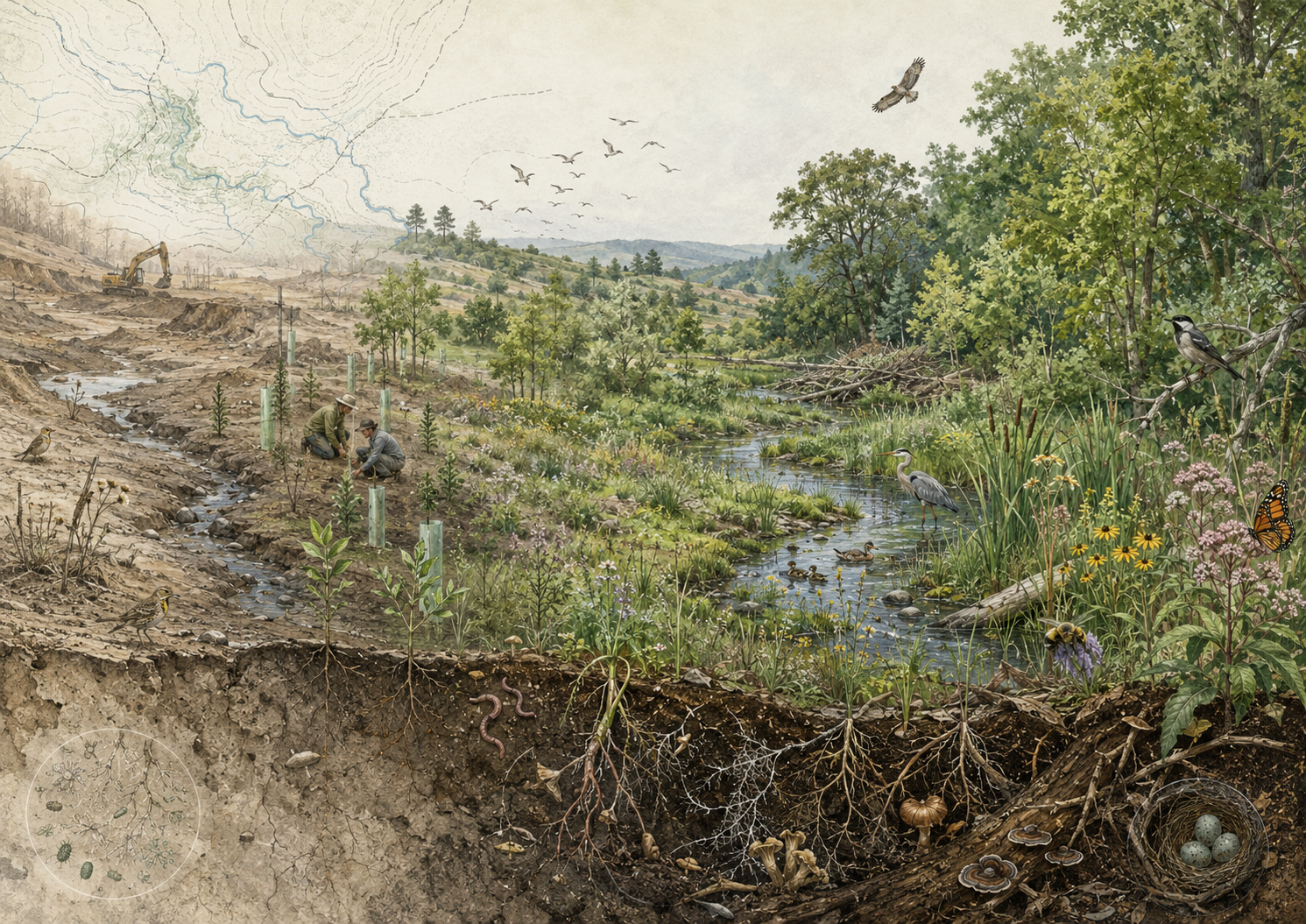
Restoration ecology and the repair of living systems examine how damaged ecosystems can recover structure, function, biodiversity, resilience, and ecological process through deliberate intervention, assisted regeneration, disturbance repair, hydrological recovery, soil rebuilding, species reintroduction, long-term monitoring, and ecological stewardship. Restoration ecology is central to modern biology because the living world is now shaped not only by natural succession and disturbance, but also by extraction, fragmentation, pollution, hydrological alteration, invasive species, climate change, biodiversity loss, and systemic ecological simplification. In such a world, ecology cannot remain satisfied with describing decline alone. It must also ask how damaged systems recover, what can be repaired, what cannot be fully restored, how trajectories can be redirected, and how ecological integrity can be rebuilt under changed historical conditions.
This article develops restoration ecology as a biological science of repair. It examines degradation, reference conditions, succession, resilience, ecosystem function, species interaction, hydrology, soils, microbial recovery, rewilding, adaptive management, climate-adapted restoration, ecological monitoring, governance, justice, and long-term stewardship. It situates restoration within wider systems of conservation biology, biodiversity science, landscape ecology, marine biology, freshwater biology, plant biology, soil biology, microbiology, agroecology, forestry, disease ecology, environmental health, and Earth-system change.
Main Library
Publications
Article Map
Biology
Related Topic
Environmental Science
Related Topic
Earth Science
Related Topic
Chemistry
The article is written for ecologists, marine biologists, freshwater scientists, environmental-health readers, biodiversity experts, computational biologists, restoration practitioners, conservation planners, and research biologists who need a rigorous account of how ecological repair is conceptualized, implemented, measured, modeled, and limited under real conditions of historical change.
The article also extends restoration ecology into quantitative and computational biology through recovery trajectories, ecological indicators, intervention scenarios, disturbance-pressure comparisons, coupled vegetation–soil–function models, R workflows, Python workflows, SQL provenance structures, and a linked full-stack GitHub repository containing Python, R, Julia, Fortran, Rust, Go, C, C++, SQL, notebooks, data files, and reproducibility documentation.
What restoration ecology studies
Restoration ecology is the scientific study of how degraded, damaged, or destroyed ecosystems recover and how ecological repair can be guided, accelerated, measured, or made more durable through intervention. Its subject is not only return, but reorganization. It asks what ecological components have been lost, which processes remain intact, which thresholds have been crossed, which feedbacks now hold the system in a degraded state, and what forms of recovery are still biologically possible under current and anticipated conditions.
This makes restoration ecology different from generic environmental management. It is not satisfied with surface improvement alone. It is concerned with whether living systems regain ecological structure, functional processes, regenerative capacity, and resilience across time. A restored wetland, forest, reef, river, prairie, peatland, savanna, estuary, or coastal marsh is not restored merely because it looks more “natural” than before. It must recover some combination of hydrological function, nutrient cycling, habitat complexity, recruitment, trophic interaction, microbial process, soil structure, and community organization.
For research biologists, restoration ecology matters because it turns ecological science toward one of the most difficult contemporary questions: how living systems recover after historical damage without pretending that time can simply be reversed.
Why repair became a central ecological question
Restoration became central because degradation is no longer exceptional. Habitat conversion, overexploitation, pollution, damming, coastal hardening, erosion, nutrient loading, altered fire regimes, invasive species, soil depletion, deforestation, wetland drainage, river channelization, coral bleaching, and climate change have produced vast ecological systems in which passive protection alone is insufficient. In many places, the question is no longer whether systems should be protected before they are damaged, but whether damaged systems can be repaired after crucial ecological relations have already been broken.
This matters because ecology cannot remain only a science of intact systems. Modern ecology must also address partial recovery, assisted regeneration, altered baselines, human-dominated landscapes, novel ecosystems, and the practical limits of repair. Restoration ecology therefore emerged not as a secondary applied specialty, but as a necessary extension of ecological science under conditions of widespread planetary disruption.
For research biologists, the significance is methodological as much as moral. Restoration turns ecology into an intervention science. It tests what ecological theory means when landscapes, watersheds, reefs, soils, rivers, estuaries, forests, and coastal systems have already been transformed.
Degradation, disturbance, and the loss of ecological integrity
Restoration begins with the recognition that degradation is more than visible damage. Ecological systems can lose integrity through altered hydrology, nutrient overload, salinization, erosion, fragmentation, trophic simplification, soil compaction, pollution, oxygen decline, invasive dominance, microbial disruption, disrupted recruitment, altered disturbance regimes, or the loss of ecological engineers even when some visible biomass remains. Degradation is therefore often a loss of ecological organization rather than a simple subtraction of surface cover.
This matters because a system may appear present while its processes are failing. A river may still flow while floodplain connectivity is broken. A grassland may still be green while forb diversity, pollinators, fire dynamics, and soil structure have collapsed. A reef may still stand while coral cover, carbonate production, recruitment, and fish assemblages decline. A forest may retain canopy cover while regeneration, seed dispersal, understory diversity, and soil function are damaged. Restoration ecology therefore treats degradation as functional and relational loss rather than mere visual decline.
For research biologists, this is crucial. Repair requires understanding what has actually been lost: species, processes, connectivity, structure, disturbance regime, microbial function, trophic interaction, or resilience. Different kinds of degradation require different kinds of restoration.
Reference conditions, historical baselines, and moving targets
Restoration has often been guided by the idea of a reference ecosystem: a historical or relatively intact system used to inform restoration goals. Reference conditions can help identify likely species composition, hydrology, disturbance regime, soil characteristics, structural patterns, and ecosystem processes. They remain useful because restoration requires some ecological model of what function, composition, and process might look like in a less degraded state.
But reference conditions are not simple blueprints. Historical baselines may be incomplete, politically contested, ecologically altered, or no longer fully attainable under changed climates, land use, disturbance regimes, species pools, and hydrological systems. Many ecosystems now exist under moving targets rather than stable historical return points. Restoration therefore requires judgment about what should be recovered, what can still be recovered, what must be adapted, and what kinds of ecological integrity are possible under future conditions.
For research biologists, this makes restoration an exercise in historically informed but forward-looking ecology. Reference conditions are guides, not absolutes. They help define direction, but they do not eliminate the need for ecological judgment, monitoring, adaptation, and ethical decision-making.
Succession, regeneration, and recovery trajectories
Restoration ecology is deeply tied to succession because ecological recovery often proceeds through staged reassembly rather than immediate completion. Colonization, facilitation, inhibition, competition, recruitment, disturbance filtering, dispersal limitation, soil development, microbial succession, and trophic reorganization all shape the path by which recovery unfolds. A restored site is not a finished object at the moment of planting, seeding, hydrological reconnection, or engineering intervention. It is the starting point of a recovery trajectory.
This matters because restoration is temporal. Systems may pass through unstable stages, overshoot, stall, or diverge. Early recovering systems are often vulnerable to invasion, erosion, nutrient pulses, recruitment failure, herbivory, drought, salinity stress, or hydrological instability. Recovery is therefore not simply a matter of “putting back” missing components. It is a process of guiding ecological succession under uncertain conditions.
For research biologists, trajectory thinking is especially important because it makes restoration measurable through time. The question is not only what a site looks like now, but whether it is moving toward greater integrity, stability, ecological function, and regenerative capacity.
Soils, hydrology, and the material foundations of restoration
Many restoration projects succeed or fail on material foundations rather than on planting design alone. Soils regulate nutrient retention, microbial activity, root establishment, water infiltration, carbon storage, organic matter formation, seed-bank persistence, and structural support. Hydrology determines saturation, flow pulses, groundwater recharge, floodplain connection, salinity, residence time, sediment transport, erosion, and oxygen dynamics. Where soils are compacted, contaminated, stripped, salinized, biologically depleted, or disconnected from hydrological processes, ecological recovery may be severely constrained.
This matters because restoration is not only about species lists. It is about rebuilding the physical and biogeochemical conditions under which species can establish, interact, reproduce, and persist. Wetland restoration, river restoration, peatland restoration, coastal marsh recovery, mine-land rehabilitation, mangrove recovery, grassland reconstruction, and forest regeneration all depend on getting the material template right.
For research biologists, this is one of restoration ecology’s most important lessons: living systems recover through matter, water, sediment, chemistry, and microbial process as much as through visible vegetation and fauna.
Species reassembly, community structure, and functional repair
Restoration often involves the reassembly of species and ecological roles. In some settings this means passive recolonization once major stressors are removed. In others it requires active revegetation, seeding, translocation, reintroduction, structural habitat creation, assisted migration, or the restoration of ecological engineers. But the biological aim is not simply to maximize species count. It is to rebuild community structure, trophic relations, functional roles, and regenerative processes.
This matters because the loss of one nitrogen fixer, pollinator guild, mycorrhizal partner, grazer, predator, detritivore, canopy former, foundation species, or ecosystem engineer can alter system recovery disproportionately. Restoration ecology therefore asks not only which species are absent, but which interactions and functions have been broken.
For research biologists, this makes restoration ecology deeply continuous with community ecology and biodiversity science. Repair is often less about recreating exact composition than about restoring the ecological structure through which living systems function.
Invasive species, disturbance regimes, and the problem of novel systems
Many restoration efforts confront systems that are not merely degraded versions of earlier states, but reorganized into novel configurations. Invasive species may dominate biomass, alter soil chemistry, change fire frequency, disrupt pollination, simplify habitat structure, alter hydrology, or produce feedbacks that prevent native recovery. Disturbance regimes may have shifted so strongly that former communities can no longer reassemble without continual intervention. Climate change may further destabilize historical restoration targets.
This matters because restoration ecology must distinguish among repair, management, adaptation, and acceptance of ecological novelty. Some systems can be steered toward partial reassembly of former function. Others may require hybrid goals focused on resilience, habitat value, process recovery, cultural value, or damage reduction rather than full compositional return.
For research biologists, this is one of restoration’s hardest conceptual problems. Ecological repair often occurs not in a world of pristine return, but in landscapes of hybrid conditions, irreversible change, and partial recovery.
Rewilding, reintroduction, and trophic restoration
Some restoration efforts focus not only on plants, soils, or hydrology, but on re-establishing trophic processes through rewilding and species reintroduction. Herbivores, predators, ecosystem engineers, scavengers, pollinators, and seed dispersers can all restructure ecosystem dynamics. When lost, their absence may create trophic simplification, altered vegetation structure, nutrient reorganization, recruitment failure, or weakened regenerative processes.
This matters because ecological repair is sometimes impossible without restoring interaction networks rather than habitat alone. Reintroducing a top predator, restoring large herbivory, rebuilding oyster reefs, restoring beaver-mediated hydrology, or re-establishing pollinator networks can alter entire systems through process restoration rather than species count alone.
For research biologists, rewilding is most scientifically interesting when framed as trophic and process restoration rather than symbolic species return. The central question is whether lost ecological work is being restored.
Freshwater, marine, coastal, and terrestrial restoration
Restoration ecology differs across environmental realms. Freshwater restoration often centers on flow regimes, connectivity, channel structure, riparian recovery, sediment transport, nutrient loading, dissolved oxygen, floodplain reconnection, and aquatic community response. Marine and coastal restoration may focus on coral recruitment, oyster reef formation, seagrass meadows, mangrove recovery, salt marsh hydrology, shoreline stability, estuarine function, and blue carbon dynamics. Terrestrial restoration often involves fire regimes, soil recovery, vegetation structure, invasive control, erosion reduction, seed dispersal, and trophic reassembly.
This matters because ecological repair is always medium-specific. Water movement, salinity, substrate, oxygen dynamics, hydrodynamics, propagule dispersal, soil structure, and disturbance regime play different roles in marine, freshwater, and terrestrial systems. Restoration science must therefore remain ecologically situated rather than assuming one generic restoration template.
For research biologists, this is one reason restoration is such a rich field. It forces ecological theory to become specific to habitat, process, and material condition.
Microbial, soil, and plant dimensions of ecological repair
Much of ecological repair happens below the visible surface. Soil microbes, fungi, decomposers, rhizosphere communities, biocrusts, nutrient-transforming bacteria, and plant–microbe symbioses all influence whether restored systems become self-sustaining. Plant physiology, seed-bank dynamics, root architecture, litter inputs, nutrient demand, stress tolerance, and mycorrhizal association also shape whether restored communities stabilize or fail.
This matters because restoration cannot be reduced to planting visible vegetation and assuming function will follow automatically. Microbial communities regulate decomposition, nitrogen transformations, phosphorus mobilization, disease suppression, root establishment, soil aggregation, and organic matter formation. Fungal networks influence plant nutrition and soil development. The belowground system is often decisive.
For research biologists, this makes restoration ecology continuous with microbiology, plant biology, and soil science. Repair is as much biochemical and subterranean as it is landscape-scale and visible.
Restoration, resilience, and climate-adapted recovery
Restoration increasingly operates under climate instability. Heat, drought, altered precipitation, shifting species ranges, acidification, salinity intrusion, wildfire intensification, storm surge, sea-level rise, and changing disturbance frequencies mean that restored systems must often be built for future resilience rather than exact historical replication. A site restored to a historically familiar composition may still fail if its hydrology, temperature regime, salinity exposure, or disturbance context has fundamentally changed.
This matters because restoration goals must often include adaptive capacity, redundancy, response diversity, and climate tolerance rather than only compositional resemblance to the past. Resilience in restoration is not simply survival through one event. It is the capacity of a system to continue functioning and reorganizing without catastrophic collapse under recurrent stress.
For research biologists, climate-adapted restoration makes restoration ecology a future-facing science. The aim is not nostalgia. It is durable ecological function under changing conditions.
Monitoring, evidence, and adaptive management
Restoration without monitoring remains largely aspirational. Ecological repair must be evaluated through evidence: vegetation recruitment, species turnover, hydrological recovery, nutrient retention, sediment stabilization, microbial activity, trophic return, habitat use, reproductive success, carbon accumulation, water quality, and long-term resilience. Because restoration trajectories are uncertain, adaptive management becomes central. Interventions are treated as hypotheses to be tested and revised rather than fixed one-time solutions.
This matters because restoration projects often fail not from poor intention, but from weak feedback. Systems may appear improved in the short term while remaining unstable in the long term. Monitoring therefore turns restoration into a scientific learning process rather than a symbolic act.
For research biologists, this is one of restoration ecology’s strongest methodological features. It is an experimental science of ecological repair under real conditions, where management and evidence must remain coupled.
Ethics, governance, and the politics of repair
Restoration is never purely technical. Decisions about what to restore, whose land or water is being altered, whose knowledge is used, which species are prioritized, and what counts as success are all ethical and political as well as ecological. Indigenous stewardship, local knowledge, land tenure, cultural landscapes, community access, treaty rights, environmental justice, and historical injustice can all shape restoration outcomes and legitimacy.
This matters because ecological repair occurs within institutions, histories, and power structures. A scientifically informed restoration that ignores local governance, rights, or social meaning may fail socially and ecologically alike. Restoration ecology therefore increasingly recognizes that repair is not just about ecosystem mechanics, but also about participation, justice, and long-horizon stewardship.
For research biologists, this does not diminish the science. It clarifies the conditions under which science is applied meaningfully and responsibly.
Quantitative restoration ecology: math, R, and Python
Restoration ecology becomes most useful when recovery is treated quantitatively rather than as a vague visual impression. Monitoring data, recovery indicators, intervention records, disturbance histories, and functional metrics can be organized into trajectories that ask whether ecological condition is improving, stalling, or diverging. A simple conceptual way to express ecological recovery is as a trajectory toward a target state:
\frac{dR}{dt}=k(T-R)
\]
Interpretation: \(R\) is current restoration state, \(T\) is target functional condition, and \(k\) is the recovery-rate constant. The model captures the broad idea that recovery depends on the gap between present condition and desired condition, but real restoration requires more ecological structure.
A more ecologically meaningful expression might treat recovery as the joint result of recruitment, survival, process restoration, and continued stress:
\frac{dX}{dt}=G+C+H-L
\]
Interpretation: \(X\) is ecological condition, \(G\) is biological growth or regeneration, \(C\) is connectivity or colonization, \(H\) is habitat or hydrological improvement, and \(L\) is continuing loss from disturbance, stress, or degradation. Restoration succeeds when gains exceed continuing ecological loss.
For multi-component restoration, a compact systems form can be written as:
\frac{dV}{dt}=aS-bV-cD
\]
Interpretation: Vegetation structure \(V\) changes through restoration input \(S\), vegetation loss, and continuing disturbance pressure \(D\).
\frac{dM}{dt}=pV+qB-rM
\]
Interpretation: Soil or microbial recovery \(M\) changes through vegetation contribution, belowground support \(B\), and microbial or soil loss.
\frac{dF}{dt}=uV+vM-wD
\]
Interpretation: Functional integrity \(F\) depends on vegetation structure, soil or microbial recovery, and ongoing disturbance pressure. The point is not that one universal system exists, but that restoration often involves coupled aboveground, belowground, and functional trajectories.
Worked example: simple recovery rate
Suppose a restoration site currently has ecological condition \(R=40\) on a 0–100 index, target \(T=80\), and recovery constant \(k=0.1\). Then:
\frac{dR}{dt}=0.1(80-40)=4
\]
Interpretation: Under the simplified model, the site improves at four condition units per time step. Real restoration still asks whether recruitment, hydrology, soils, microbial processes, and disturbance all support continued improvement over time.
These models remain compact enough for an article, but they move toward the kinds of workflows restoration scientists and computational ecologists actually use: coupled recovery variables, scenario comparison, functional thresholds, disturbance-pressure screening, monitoring indicators, and explicit treatment of continuing degradation rather than one simple recovery curve alone.
R and Python workflows
The following examples are compact article-level workflows. The full GitHub repository expands them into richer multi-language implementations with SQL provenance, validation notes, coupled restoration models, scenario comparison, monitoring tables, and reproducible computational ecology scaffolding.
R example: coupled vegetation, soil, and functional recovery
# Coupled restoration model in R
#
# This workflow models three recovery indicators:
# - vegetation structure (V)
# - soil or microbial recovery (M)
# - functional integrity (F)
#
# The model is intentionally compact. It is designed for
# scenario thinking, not as a universal restoration equation.

dt <- 0.05
time <- seq(0, 50, by = dt)

# Parameters
a <- 0.8    # seeding or planting support
b <- 0.15   # vegetation loss rate
c <- 0.20   # disturbance effect on vegetation
p <- 0.10   # vegetation contribution to soils
q <- 0.25   # belowground support input
r <- 0.12   # soil or microbial loss rate
u <- 0.08   # vegetation contribution to function
v <- 0.10   # soil contribution to function
w <- 0.18   # disturbance effect on function

S <- 1.0    # restoration input
B <- 0.8    # belowground support
D <- 0.5    # continuing disturbance pressure

V <- numeric(length(time))
M <- numeric(length(time))
F <- numeric(length(time))

# Initial degraded state
V[1] <- 10
M[1] <- 8
F[1] <- 6

for (t in 2:length(time)) {
  dV <- a * S - b * V[t - 1] - c * D
  dM <- p * V[t - 1] + q * B - r * M[t - 1]
  dF <- u * V[t - 1] + v * M[t - 1] - w * D

  V[t] <- max(0, V[t - 1] + dV * dt)
  M[t] <- max(0, M[t - 1] + dM * dt)
  F[t] <- max(0, F[t - 1] + dF * dt)
}

recovery_df <- data.frame(time = time, V = V, M = M, F = F)

tail(round(recovery_df, 3), 10)
This R workflow is more useful than a simple linear recovery line because it treats restoration as a coupled systems process involving vegetation, soils, microbial recovery, and functional integrity under continuing disturbance. A research biologist could adapt it for wetlands, grasslands, forests, reefs, peatlands, mined lands, river corridors, or restoration trials in which aboveground and belowground recovery do not proceed at the same pace.
Python example: comparative restoration scenarios and recovery screening
import numpy as np
import pandas as pd


def simulate_restoration(
    V0=10,
    M0=8,
    F0=6,
    a=0.8,
    b=0.15,
    c=0.20,
    p=0.10,
    q=0.25,
    r=0.12,
    u=0.08,
    v=0.10,
    w=0.18,
    S=1.0,
    B=0.8,
    D=0.5,
    T=50,
    dt=0.05,
):
    """
    Simulate a compact restoration trajectory model.

    V = vegetation structure
    M = soil or microbial recovery
    F = functional integrity
    S = restoration effort
    B = belowground support
    D = continuing disturbance pressure
    """
    time = np.arange(0, T + dt, dt)

    V = np.zeros(len(time))
    M = np.zeros(len(time))
    F = np.zeros(len(time))

    V[0], M[0], F[0] = V0, M0, F0

    for t in range(1, len(time)):
        dV = a * S - b * V[t - 1] - c * D
        dM = p * V[t - 1] + q * B - r * M[t - 1]
        dF = u * V[t - 1] + v * M[t - 1] - w * D

        V[t] = max(0, V[t - 1] + dV * dt)
        M[t] = max(0, M[t - 1] + dM * dt)
        F[t] = max(0, F[t - 1] + dF * dt)

    return {
        "final_V": V[-1],
        "final_M": M[-1],
        "final_F": F[-1],
        "peak_F": F.max(),
    }


scenarios = {
    "low_effort_high_disturbance": {"S": 0.7, "D": 0.8},
    "moderate_effort_moderate_disturbance": {"S": 1.0, "D": 0.5},
    "high_effort_low_disturbance": {"S": 1.4, "D": 0.2},
    "soil_limited_recovery": {"S": 1.1, "D": 0.4, "B": 0.3},
}

rows = []

for name, params in scenarios.items():
    result = simulate_restoration(**params)
    result["scenario"] = name
    rows.append(result)

df = pd.DataFrame(rows)

df["restoration_class"] = np.where(
    df["final_F"] >= 12,
    "strong-recovery",
    np.where(df["final_F"] >= 8, "partial-recovery", "stalled"),
)

print(df.round(3).to_string(index=False))
This Python workflow compares multiple restoration regimes rather than presenting one idealized trajectory. It allows the reader to examine how restoration effort, disturbance pressure, and belowground limitation alter long-term functional recovery. That makes it adaptable to restoration planning, scenario screening, experimental design, and comparative evaluation across sites.
Python example: monitoring indicators and recovery scoring
import pandas as pd

monitoring = pd.DataFrame(
    {
        "site": ["wetland_A", "wetland_A", "wetland_A", "wetland_B", "wetland_B", "wetland_B"],
        "year": [1, 3, 5, 1, 3, 5],
        "native_cover": [0.35, 0.52, 0.68, 0.28, 0.41, 0.49],
        "soil_organic_matter": [0.18, 0.24, 0.31, 0.15, 0.18, 0.22],
        "hydrology_score": [0.45, 0.62, 0.74, 0.38, 0.50, 0.57],
        "invasive_pressure": [0.40, 0.28, 0.19, 0.52, 0.49, 0.45],
    }
)

monitoring["recovery_index"] = (
    0.30 * monitoring["native_cover"]
    + 0.25 * monitoring["soil_organic_matter"]
    + 0.30 * monitoring["hydrology_score"]
    + 0.15 * (1 - monitoring["invasive_pressure"])
)

summary = (
    monitoring.sort_values(["site", "year"])
    .groupby("site")
    .tail(1)
    .loc[:, ["site", "year", "recovery_index"]]
)

summary["status"] = pd.cut(
    summary["recovery_index"],
    bins=[0, 0.45, 0.65, 1.0],
    labels=["stalled", "partial-recovery", "strong-recovery"],
)

print(summary.round(3).to_string(index=False))
This monitoring scaffold shows how restoration assessment can combine multiple indicators into a transparent recovery index. A production workflow would document indicator definitions, units, weights, uncertainty, field methods, sampling effort, and governance decisions behind any scoring system.
GitHub repository
The article body includes compact R and Python examples so the ecological and scientific argument remains readable. The full repository expands those examples into a broader computational restoration ecology workflow, including coupled vegetation–soil–function recovery models, restoration intervention scenarios, disturbance-pressure comparisons, monitoring indicator tables, SQL provenance structures, and full-stack computational scaffolding across Python, R, Julia, Fortran, Rust, Go, C, C++, SQL, and notebooks.
Why this matters for scientific work
Restoration ecology matters across conservation biology, landscape ecology, marine biology, freshwater science, forestry, soil science, microbial ecology, plant science, agroecology, and climate adaptation because each of these fields increasingly confronts damaged systems that require more than protection alone. For ecologists, restoration turns theory into intervention and lets community assembly, succession, hydrology, disturbance, and resilience be studied through real-world repair. For marine biologists, it clarifies how reefs, seagrasses, mangroves, estuaries, and oyster systems recover through coupled biological and physical processes. For medical and environmental-health readers, it shows how ecological repair affects water quality, pathogen exposure, heat buffering, contamination dynamics, and human environmental risk.
For computational and biotechnology-oriented readers, restoration ecology demonstrates why modern biology increasingly depends on monitoring systems, trajectory analysis, scenario modeling, sensor data, geospatial observation, microbial analysis, ecological indicators, and reproducible computational workflows. For research biologists more broadly, restoration ecology provides one of the strongest contemporary frameworks for linking organismal biology, ecological theory, environmental change, and long-horizon stewardship.
This is one reason restoration ecology now matters so deeply. It is not only about repairing damaged places. It is about learning how living systems regain function, and under what conditions that recovery remains biologically real rather than cosmetically apparent.
Conclusion
Restoration ecology and the repair of living systems show that ecological damage is neither always final nor easily reversible. Recovery depends on whether soils, hydrology, biodiversity, community structure, trophic relations, microbial processes, and resilience can be reassembled or reactivated under changed conditions. Restoration is therefore not the simple return of nature once human pressure is removed. It is the difficult scientific work of rebuilding the conditions under which ecological life can resume organized function.
To understand restoration ecology is therefore to understand one of modern biology’s most consequential tasks: how damaged living systems recover, why some fail to recover, and what forms of intervention can help repair ecological integrity without pretending that history can be fully undone. That is why restoration ecology now stands near the center of ecological science, conservation practice, adaptive management, and the larger project of living responsibly within damaged but still recoverable worlds.
Related articles
- Biology
- Ecology and the Interdependence of Life
- Population Dynamics and Ecological Modeling
- Populations, Communities, and Ecosystem Dynamics
- Biodiversity and the Structure of Living Systems
- Conservation Biology and the Protection of Life
- Biogeochemical Cycles and the Conditions of Habitability
- The Biosphere and Planetary Life Support Systems
- Biomes, Habitats, and the Geography of Life
Further reading
- Gann, G.D. et al. (2019) International Principles and Standards for the Practice of Ecological Restoration. 2nd edn. Society for Ecological Restoration. Available at: https://www.ser.org/page/serstandards/international-standards-for-the-practice-of-ecological-restoration.htm
- United Nations Decade on Ecosystem Restoration (n.d.) About the UN Decade. Available at: https://www.decadeonrestoration.org/about-un-decade
- International Union for Conservation of Nature (n.d.) Ecosystem Restoration Resources. Available at: https://www.iucn.org/our-work/topic/ecosystem-restoration
- Palmer, M.A., Zedler, J.B. and Falk, D.A. (2016) Foundations of Restoration Ecology. 2nd edn. Washington, DC: Island Press. Publisher information available at: https://islandpress.org/books/foundations-restoration-ecology
- Clewell, A.F. and Aronson, J. (2013) Ecological Restoration: Principles, Values, and Structure of an Emerging Profession. 2nd edn. Washington, DC: Island Press.
- Hobbs, R.J. and Norton, D.A. (1996) ‘Towards a conceptual framework for restoration ecology’, Restoration Ecology, 4(2), pp. 93–110.
- Suding, K.N. (2011) ‘Toward an era of restoration in ecology’, Science, 332(6035), pp. 1392–1393.
- Temperton, V.M., Hobbs, R.J., Nuttle, T. and Halle, S. (eds.) (2004) Assembly Rules and Restoration Ecology. Washington, DC: Island Press.
- Society for Ecological Restoration (n.d.) Restoration Ecology. Available at: https://onlinelibrary.wiley.com/journal/1526100x
- UN Environment Programme and Food and Agriculture Organization of the United Nations (n.d.) UN Decade on Ecosystem Restoration. Available at: https://www.decadeonrestoration.org/
References
- Clewell, A.F. and Aronson, J. (2013) Ecological Restoration: Principles, Values, and Structure of an Emerging Profession. 2nd edn. Washington, DC: Island Press.
- Gann, G.D. et al. (2019) International Principles and Standards for the Practice of Ecological Restoration. 2nd edn. Society for Ecological Restoration. Available at: https://www.ser.org/page/serstandards/international-standards-for-the-practice-of-ecological-restoration.htm
- Hobbs, R.J. and Norton, D.A. (1996) ‘Towards a conceptual framework for restoration ecology’, Restoration Ecology, 4(2), pp. 93–110.
- Holl, K.D. and Aide, T.M. (2011) ‘When and where to actively restore ecosystems?’, Forest Ecology and Management, 261(10), pp. 1558–1563.
- International Union for Conservation of Nature (n.d.) Ecosystem Restoration. Available at: https://www.iucn.org/our-work/topic/ecosystem-restoration
- Lake, P.S. (2001) ‘On the maturing of restoration: linking ecological research and restoration’, Ecological Management & Restoration, 2(2), pp. 110–115.
- Palmer, M.A., Zedler, J.B. and Falk, D.A. (2016) Foundations of Restoration Ecology. 2nd edn. Washington, DC: Island Press. Publisher information available at: https://islandpress.org/books/foundations-restoration-ecology
- Society for Ecological Restoration (n.d.) International Standards for the Practice of Ecological Restoration. Available at: https://www.ser.org/page/serstandards/international-standards-for-the-practice-of-ecological-restoration.htm
- Suding, K.N. (2011) ‘Toward an era of restoration in ecology’, Science, 332(6035), pp. 1392–1393.
- Temperton, V.M., Hobbs, R.J., Nuttle, T. and Halle, S. (eds.) (2004) Assembly Rules and Restoration Ecology. Washington, DC: Island Press.
- United Nations Decade on Ecosystem Restoration (n.d.) About the UN Decade. Available at: https://www.decadeonrestoration.org/about-un-decade
- Young, T.P. (2000) ‘Restoration ecology and conservation biology’, Biological Conservation, 92(1), pp. 73–83.
- Zedler, J.B. (2000) ‘Progress in wetland restoration ecology’, Trends in Ecology & Evolution, 15(10), pp. 402–407.