
Last Updated May 28, 2026
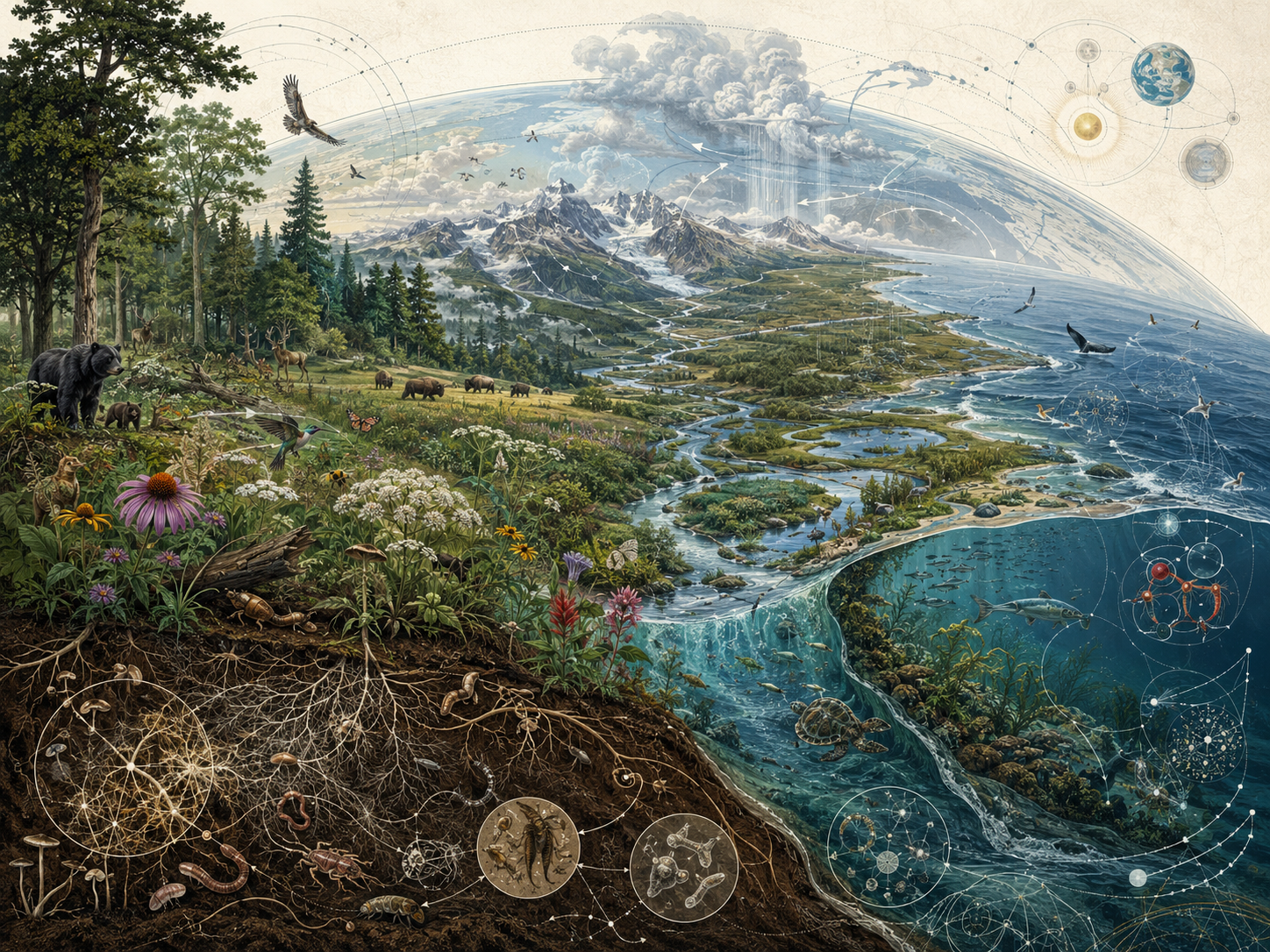
The biosphere and planetary life support systems examine how Earth’s living layer interacts with atmosphere, oceans, soils, freshwater, climate, biodiversity, and biogeochemical cycles to sustain the conditions under which complex life can persist. The biosphere is not simply the sum of all organisms. It is the planetary domain in which life reshapes energy flow, nutrient circulation, gas exchange, water movement, soil formation, food-web structure, ecological resilience, and climate feedback across scales ranging from microbes and plankton to forests, reefs, wetlands, grasslands, shelf seas, and continental landscapes. To study the biosphere seriously is therefore to study life as an Earth-system force: not only as something that inhabits a planet, but as something that helps regulate the conditions of planetary habitability.
The biosphere is one of biology’s most important systems concepts because it links organismal life, ecology, evolution, Earth-system science, climate regulation, biodiversity, environmental health, and sustainability into one shared frame. It shows why living systems cannot be understood only as local communities or isolated species. Forests exchange carbon and water with the atmosphere. Oceans absorb heat and carbon while sustaining marine food webs. Wetlands transform nutrients and buffer floods. Soils store carbon, regulate water, and host microbial processes that sustain fertility. Phytoplankton influence oxygen production and global carbon cycling. Biodiversity supports resilience, ecological function, and adaptive capacity. The biosphere is therefore both a biological system and a planetary infrastructure.
Main Library
Publications
Article Map
Biology
Related Topic
Environmental Science
Related Topic
Earth Science
Related Topic
Chemistry
The article is written for ecologists, marine biologists, freshwater scientists, environmental-health readers, computational biology readers, biodiversity experts, Earth-system scientists, and research biologists who need a biosphere-scale frame for linking organismal, ecological, planetary, and computational processes.
The article also extends biosphere science into quantitative and computational biology through carbon-balance models, functional-integrity indices, disturbance scenarios, Monte Carlo uncertainty modeling, Earth-observation workflows, R examples, Python examples, SQL provenance structures, and a linked full-stack GitHub repository containing Python, R, Julia, Fortran, Rust, Go, C, C++, SQL, notebooks, data files, and reproducibility documentation.
What the biosphere is
The biosphere is the planetary domain of life. In the most basic sense, it includes all living organisms and the parts of land, water, sediment, soil, and atmosphere with which they are dynamically engaged. But that simple definition is not enough for serious scientific use. The biosphere is not merely a layer in which organisms happen to occur. It is the integrated totality of living processes through which Earth’s biological systems interact with climate, chemistry, hydrology, geology, and energy flow.
This matters because the biosphere is both bounded and distributed. It is bounded because life occupies a finite planetary envelope. It is distributed because living processes extend through forests, soils, coral reefs, shelf seas, estuaries, peatlands, grasslands, wetlands, aquifers, sediments, rivers, lakes, microbial mats, polar systems, and the lower atmosphere. The biosphere is therefore not reducible to scenic ecosystems, charismatic biodiversity, or visible vegetation. It includes the microbial, chemical, physiological, and metabolic processes that make planetary life possible in the first place.
The biosphere also operates across scales. A microbial process in soil can influence nitrogen availability for plant growth. Plant growth can shape carbon storage and evapotranspiration. Evapotranspiration can affect regional climate and rainfall. Marine phytoplankton can influence ocean carbon uptake and atmospheric gas exchange. Wetlands can alter nutrient flows, methane release, flood timing, and habitat structure. These processes are local in their mechanisms but planetary in their cumulative significance.
For scientists, the key point is that “biosphere” is a systems concept. It is useful precisely because it moves beyond isolated organisms or local habitats and asks how life functions as a planetary whole.
The biosphere as an Earth system
The biosphere cannot be understood in isolation from the rest of the Earth system. It is coupled to the atmosphere through gas exchange, aerosols, evapotranspiration, oxygen, carbon dioxide, methane, and nitrogen compounds. It is coupled to the hydrosphere through evaporation, runoff, infiltration, freshwater flows, salinity, aquatic productivity, and ocean circulation. It is coupled to the geosphere through soils, weathering, sediments, mineral constraints, and tectonically shaped landscapes. It is coupled to the cryosphere through ice-albedo interactions, permafrost carbon, cold-region ecology, meltwater patterns, and ecological limits in polar and alpine systems. Life depends on these spheres, but it also changes them.
This reciprocal structure is one of the article’s central themes. Life is not a passive occupant of pre-existing conditions. Terrestrial vegetation alters albedo, evapotranspiration, surface roughness, soil formation, fire regimes, and carbon exchange. Phytoplankton influence ocean productivity, carbon cycling, and oxygen generation. Soil microbes mediate decomposition, nitrogen turnover, greenhouse gas fluxes, and organic matter stabilization. Wetlands transform hydrology and redox chemistry. Reef builders alter physical habitat and coastal structure. Forests influence rainfall recycling and watershed function. Through these and many other mechanisms, the biosphere becomes part of planetary regulation.
This is why Earth-system science increasingly treats the biosphere as a dynamic component of planetary stability rather than a secondary consequence of it. The biosphere is not only affected by climate, water, geology, and chemistry. It helps shape the behavior of climate, water, chemistry, and habitability. When living systems are degraded, the effects are therefore not confined to biodiversity loss alone. They can alter carbon cycling, hydrology, nutrient flows, food systems, disease ecology, and climate feedback.
For research biologists, this means biosphere science is not an abstraction above biology. It is biology expanded to the planetary scale.
Planetary life support systems
The phrase “planetary life support systems” is useful when used carefully. It refers to the coupled ecological and Earth-system processes that maintain the conditions required for complex life, including primary production, oxygen generation, carbon uptake, freshwater renewal, nutrient cycling, soil formation, climate buffering, food-web continuity, biodiversity maintenance, and ecological recovery after disturbance. These are not separate services arranged side by side. They are overlapping functions of a living planet.
What makes them “life support” is not that they benefit humans alone. It is that they support the broader persistence of living systems. Forests regulate water and climate while providing habitat and carbon storage. Oceans absorb heat, exchange gases, support immense food webs, and drive major portions of global primary production. Wetlands filter water, transform nutrients, buffer floods, store carbon, and support biodiversity. Soils store carbon, retain water, sustain plant growth, and host much of the microbial machinery behind biogeochemical cycling. Grasslands stabilize soils, support herbivore systems, store belowground carbon, and mediate fire and grazing dynamics. Coral reefs, seagrass meadows, mangroves, and salt marshes protect coasts while supporting marine life.
These systems are best understood not as a checklist but as a network of dependencies. When one major component degrades, the effects often propagate through others. Deforestation can alter rainfall, soil erosion, biodiversity, carbon storage, fire dynamics, and disease exposure. Wetland loss can affect water quality, flood risk, bird habitat, carbon storage, and nutrient cycling. Ocean warming can alter fisheries, reefs, oxygen dynamics, food webs, and carbon uptake. Soil degradation can reduce agricultural productivity, water retention, biodiversity, and carbon storage at the same time.
A planetary life support framing therefore clarifies an important scientific point: the biosphere is not merely valuable because it contains life. It is valuable because it maintains the conditions that allow life to continue.
Primary production and the foundation of the living world
Planetary life support begins with primary production. Photosynthetic organisms capture energy and convert inorganic carbon into biomass, forming the base of most food webs. This includes terrestrial plants, marine phytoplankton, freshwater algae, cyanobacteria, seagrasses, macroalgae, and other primary producers. Without this productivity, higher trophic systems would collapse, oxygen generation would decline, and much of the biosphere’s role in carbon regulation would disappear.
Primary production also sets the pace for many other processes. It influences carbon storage, nutrient demand, evapotranspiration, detrital pathways, soil organic matter formation, root activity, microbial metabolism, food-web structure, and habitat complexity. In marine systems, phytoplankton productivity shapes food-web architecture from zooplankton to fisheries and marine mammals. In terrestrial systems, vegetation structure determines canopy climate, erosion resistance, water retention, root-zone dynamics, and the physical template for many species interactions.
The spatial distribution of primary production also matters. Tropical forests, boreal forests, grasslands, wetlands, croplands, upwelling zones, estuaries, and oceanic phytoplankton systems all contribute differently to biosphere function. Some systems store large amounts of carbon in biomass. Others store carbon belowground. Some systems support intense seasonal productivity. Others maintain slow but persistent productivity under nutrient constraints. The biosphere’s productivity is therefore not one uniform planetary process, but a mosaic of biological energy capture shaped by climate, nutrients, water, disturbance, and evolutionary history.
This is why primary producers are not merely the “first step” of food webs. They are among the principal regulators of planetary metabolism.
The biosphere and climate regulation
The biosphere participates in climate regulation through multiple pathways. Vegetation takes up carbon dioxide, stores carbon in biomass and soils, and influences land-atmosphere exchange through evapotranspiration, albedo, canopy structure, and surface roughness. Marine systems absorb carbon through both physical and biological pathways, with phytoplankton productivity playing a major role in moving carbon through the ocean system. Soil microbes, peatlands, wetlands, forests, grasslands, and sediments all influence whether carbon is stored, released, oxidized, buried, or returned to the atmosphere.
But climate regulation is not identical with carbon storage alone. The biosphere also affects clouds, hydrology, local and regional temperature regimes, fire patterns, disturbance recovery, aerosol formation, and heat exchange. Forests can cool landscapes through evapotranspiration while also altering albedo. Wetlands can store carbon while also releasing methane under certain conditions. Fire can release stored carbon but also maintain some ecosystems that depend on periodic burning. Soil degradation can reduce carbon storage and water retention simultaneously. Biosphere-climate interactions are therefore not simple one-way relationships.
This matters because climate change is not only an external pressure imposed on living systems. It is also modified by living systems. A degraded biosphere may absorb less carbon, retain less water, recover more slowly from disturbance, support less biodiversity, and amplify climate-related risks. Deforestation, wetland loss, coral decline, permafrost thaw, soil erosion, peatland drainage, marine deoxygenation, and biome shifts therefore matter not just because biomass is removed, but because biosphere-climate feedbacks are altered.
For ecologists and Earth-system scientists, the point is that the biosphere does not sit downstream from climate alone. It is part of climate’s functioning structure.
Water, freshwater, and hydrological support
The biosphere is deeply involved in the movement, storage, timing, and quality of water. Vegetation affects infiltration, runoff, canopy interception, groundwater recharge, evapotranspiration, erosion, and rainfall recycling. Wetlands regulate hydrological timing and nutrient transformation. Freshwater ecosystems link watersheds to floodplains, lakes, estuaries, aquifers, and coastal systems. Soil biota influence porosity, aggregation, infiltration, and water retention. The biosphere therefore supports hydrological function not only through consumption of water, but through structuring how water moves.
Freshwater is especially important because it represents a narrow but indispensable fraction of planetary water availability. Rivers, aquifers, lakes, wetlands, snowmelt-fed systems, groundwater-dependent ecosystems, riparian corridors, and floodplains all participate in the maintenance of freshwater accessibility and ecological continuity. Disruption of these systems affects agriculture, biodiversity, public health, fisheries, sediment movement, nutrient cycling, and regional climate patterns alike.
A planetary life support framing makes clear that water is not simply a resource in storage. It is part of an active biosphere-linked circulation. Forests can influence atmospheric moisture. Wetlands can slow flood pulses and filter nutrients. Soil organic matter can retain water and support drought resilience. Riparian vegetation can regulate stream temperature and habitat quality. Estuaries can mediate nutrient and sediment flows between land and sea.
For freshwater scientists and environmental-health readers, the biosphere’s hydrological role is especially important. Water quality, vector ecology, food production, flood risk, drought exposure, and ecological resilience all depend on biological structure. A watershed stripped of vegetation, soil function, wetlands, and biodiversity is not merely less beautiful. It is less capable of regulating water as a life-support process.
Biodiversity, functional integrity, and resilience
The biosphere’s capacity to support life depends not only on the presence of organisms, but on the structure and diversity of ecological roles. Biodiversity matters because ecological systems are built through differences in function, response, and interaction. Some species fix nitrogen. Others decompose lignin, engineer sediments, transfer nutrients, move seeds, regulate herbivores, stabilize soils, filter water, build reefs, form canopy structure, or maintain microbial symbioses. Functional diversity helps ecological systems absorb shock, recover from disturbance, and maintain key processes under changing conditions.
This is one reason why recent work on biosphere integrity has become so important. The issue is not just how many species are lost, but whether the functional structure of living systems is being eroded beyond levels compatible with stable planetary operation. A biosphere with greatly diminished diversity may still contain life, but it may no longer regulate water, carbon, nutrients, disease dynamics, food webs, or resilience in the same way.
Resilience depends partly on redundancy and partly on difference. If multiple species perform similar ecological functions but respond differently to drought, heat, disease, salinity, disturbance, or predation, the system may be more likely to maintain function under stress. If diversity collapses into simplified communities dominated by a few generalists, invasive species, or stress-tolerant organisms, the system may remain biologically active while losing functional depth.
For biodiversity experts, the biosphere is therefore not merely a container of species richness. It is a functional system whose integrity matters at planetary scale.
Oceans, coasts, and planetary metabolism
Any serious account of the biosphere has to be oceanic. The ocean is not a peripheral domain but one of the central engines of planetary life support. Marine primary production contributes enormously to global carbon uptake and oxygen generation. Shelf systems, reefs, mangroves, salt marshes, seagrass beds, estuaries, upwelling zones, polar seas, and pelagic food webs all participate in planetary metabolism through nutrient transformation, habitat provision, carbon processing, oxygen dynamics, and fisheries support.
Coastal systems are especially important because they connect terrestrial, freshwater, sedimentary, and marine processes. They are also among the most biologically productive and heavily pressured environments in the biosphere. Nutrient over-enrichment, acidification, warming, deoxygenation, sediment disruption, overfishing, plastic pollution, and habitat conversion can quickly propagate through these systems, altering nursery functions, food webs, biogeochemical dynamics, and coastal protection.
Marine systems also reveal why biosphere science must be three-dimensional and dynamic. Plankton move with currents. Fish migrate across political boundaries. Carbon moves through surface waters, deep waters, sediments, and food webs. Oxygen minimum zones can expand. Coral reefs can bleach under thermal stress. Kelp forests can shift under warming and grazing pressure. Mangroves and salt marshes can migrate or drown depending on sediment supply and sea-level rise. Marine conservation and biosphere science therefore require both biological and physical understanding.
For marine biologists, the biosphere is not just “life in the sea.” It is the set of coupled ocean-coast-land processes through which marine systems become indispensable to the functioning of the whole planet.
Soils, microbes, and the hidden infrastructure of life
Much of planetary life support is hidden. Soils and microbes form one of the biosphere’s least visible but most consequential infrastructures. Soil systems host immense microbial diversity and mediate decomposition, nutrient mineralization, nitrogen transformation, phosphorus mobilization, carbon storage, water retention, root symbiosis, soil aggregation, and trace gas exchange. Microbial communities in sediments, wetlands, aquifers, rhizospheres, peatlands, permafrost, and the ocean interior are equally important to planetary cycling.
This hidden infrastructure is especially relevant for scientists because it reminds us that the biosphere’s most decisive processes are often not visually dominant. Forests and reefs matter, but so do microbial redox pathways, fungal nutrient exchange, soil organic matter stabilization, benthic remineralization, methane oxidation, nitrogen fixation, nitrification, denitrification, and plankton turnover. A biosphere perspective that ignores these hidden processes becomes scenic rather than scientific.
Soils are also living archives of ecological history. They contain organic matter, minerals, microbes, roots, fungal networks, invertebrates, water, and chemical gradients shaped over time by climate, vegetation, land use, disturbance, and geology. Soil degradation can therefore weaken multiple life-support functions at once: fertility, carbon storage, water retention, biodiversity, plant productivity, and resilience to drought or flood. Similarly, microbial disruption can alter nutrient cycling, disease suppression, greenhouse gas fluxes, and ecosystem recovery.
The life support function of the biosphere is therefore inseparable from the metabolic labor of organisms that are often tiny, diffuse, and difficult to observe directly.
The biosphere in medicine and environmental health
The biosphere also matters for medicine and environmental health because health risks are ecologically mediated. Habitat change, biodiversity loss, warming, altered hydrology, nutrient loading, air pollution, soil degradation, food-system disruption, and land-use conversion can influence vector distributions, host-reservoir dynamics, harmful algal blooms, water contamination, wildfire smoke exposure, heat stress, nutritional security, and pathogen transmission pathways. Environmental health is therefore partly a biosphere problem.
This does not mean the biosphere should be romanticized as uniformly protective. Ecological systems can also host pathogens, toxins, allergens, and exposure pathways. The scientific point is subtler: human health is entangled with biosphere structure. The degradation of ecosystems, soils, coasts, hydrological systems, and biodiversity can alter disease ecologies and exposure conditions in ways that become clinically and socially important.
A biosphere perspective also helps explain why environmental health cannot be limited to toxicology or clinical medicine alone. Water quality depends on watershed structure. Heat exposure depends partly on vegetation, land cover, and urban ecology. Food security depends on soils, pollinators, climate stability, fisheries, and agricultural biodiversity. Zoonotic disease risk is shaped by land use, wildlife trade, livestock systems, habitat fragmentation, and changing human-animal contact. Respiratory risk can be affected by wildfire regimes, vegetation change, dust, and climate.
For medical professionals and environmental-health readers, the biosphere is relevant not as metaphorical background, but as part of the environmental architecture of risk.
The biosphere in computational and observational science
The biosphere has become increasingly measurable through Earth observation, biodiversity informatics, large ecological databases, remote sensing, field sensor networks, environmental DNA, flux towers, ocean observing systems, and coupled modeling. Satellite-derived vegetation indices, chlorophyll measurements, land-cover maps, fire products, evapotranspiration estimates, biomass maps, biodiversity occurrence records, trait databases, species distribution models, acoustic monitoring, camera traps, and Earth-system models all contribute to a more explicit understanding of biospheric change.
For computational biology and Earth-system science, this is one of the most important developments in contemporary biology. The biosphere is no longer studied only through local field systems. It is also studied as a data-rich, modelable planetary domain. This allows scientists to ask not only what ecosystems are doing now, but how biosphere structure is shifting across time, where functional integrity may be declining, how disturbance propagates through regions, and how large-scale ecological patterns relate to climate, hydrology, land use, and ocean conditions.
Computational biosphere science therefore sits at the intersection of ecology, remote sensing, modeling, data infrastructure, and Earth-system prediction. It requires careful attention to scale. A satellite pixel is not a species observation. A vegetation index is not biodiversity. A carbon-flux estimate is not ecosystem integrity. A global model is not a local field site. Yet all of these forms of evidence can become scientifically powerful when connected through transparent methods, uncertainty analysis, validation, and ecological interpretation.
For research biologists, this creates both opportunity and responsibility. The biosphere can now be monitored at extraordinary scale, but only if the data are interpreted with biological precision.
Biosphere integrity, planetary boundaries, and system risk
The planetary boundaries framework has made biosphere integrity a central systems-level concern. In that framing, the biosphere is not just one environmental topic among many. It is one of the core processes linked to the stability of the Earth system as a whole. When biosphere integrity declines, the risks are not confined to local biodiversity loss. They include weakened resilience, altered biogeochemical cycling, reduced buffering capacity, diminished ecosystem function, and a reduced ability of living systems to sustain the conditions on which human and nonhuman life depend.
This framing is especially powerful because it connects biodiversity, land systems, freshwater, climate, nutrient flows, ocean chemistry, and novel entities rather than treating them as isolated problems. It suggests that the biosphere is part of the planet’s operating fabric. If enough of that fabric is degraded, the problem is no longer simply conservation in the narrow sense. It becomes systemic instability.
Biosphere integrity is difficult to measure because no single number can capture the full structure of life. Species richness, extinction rate, functional diversity, genetic diversity, habitat intactness, ecosystem productivity, trophic structure, connectivity, and resilience all describe different dimensions of biosphere condition. The measurement challenge is therefore not a weakness of the concept. It reflects the complexity of the system itself.
For scientists, this is an important conceptual shift: from counting losses to understanding structural risk. Biodiversity decline is not only a tragedy of disappearance. It is also a weakening of the living systems that help regulate the planet.
Quantitative Earth-system thinking: mathematics, R, and Python
A biosphere article meant to be useful to scientists should move beyond conceptual balance equations and into forms that can be extended for research, monitoring, and scenario analysis. At the broadest level, the biosphere can be treated as a coupled stock-flow system in which productivity, respiration, disturbance, hydrology, nutrient limitation, and carbon exchange interact through time.
\frac{dB}{dt}=\text{NPP}-R_h-D-L+G
\]
Interpretation: \(B\) is biosphere functional biomass or biologically active carbon, \(\text{NPP}\) is net primary production, \(R_h\) is heterotrophic respiration, \(D\) is disturbance-related loss, \(L\) is externally forced loss such as land-use conversion or chronic degradation, and \(G\) is recovery or regrowth. The expression makes clear that biosphere structure is not static presence but dynamic turnover.
A second useful form links atmospheric carbon, land uptake, and ocean uptake:
\frac{dC_{atm}}{dt}=E_{anth}+E_{dist}-U_{land}-U_{ocean}
\]
Interpretation: \(C_{atm}\) is atmospheric carbon burden, \(E_{anth}\) is anthropogenic emissions, \(E_{dist}\) is disturbance-driven biospheric release, \(U_{land}\) is land uptake, and \(U_{ocean}\) is ocean uptake. In this framing, the biosphere is one of the principal mediating systems that determines how much carbon remains in the atmosphere and how much is taken up, transformed, stored, or later re-released.
For ecosystem and Earth-system work, however, even this is often too coarse. Biosphere function is usually better treated as a coupled system of states, drivers, and constraints. A simple research-facing functional integrity expression might be written as:
FI_t=f(P_t,W_t,N_t,H_t,C_t,D_t,Q_t)
\]
Interpretation: \(FI_t\) is functional integrity at time \(t\), \(P_t\) is productivity, \(W_t\) is water regulation, \(N_t\) is nutrient retention or cycling efficiency, \(H_t\) is habitat complexity, \(C_t\) is ecological connectivity, \(D_t\) is disturbance pressure, and \(Q_t\) is biodiversity or community-condition signal. The point is not that one universal function exists, but that biosphere integrity can be operationalized as a composite state depending on multiple ecological processes rather than a single biodiversity or biomass proxy.
Worked example: net atmospheric carbon increment
Suppose annual anthropogenic emissions are \(E_{anth}=11.0\), disturbance release is \(E_{dist}=0.8\), land uptake is \(U_{land}=3.2\), and ocean uptake is \(U_{ocean}=2.7\), expressed in a simplified common carbon unit. Then:
\frac{dC_{atm}}{dt}=11.0+0.8-3.2-2.7=5.9
\]
Interpretation: The simplified result means that 5.9 units remain as a net atmospheric increment after land and ocean uptake. The value is not a full carbon-cycle model, but it shows why biosphere function matters: changes in land uptake, ocean uptake, or disturbance release can alter atmospheric carbon outcomes even when anthropogenic emissions remain the same.
R and Python workflows
The following examples are compact article-level workflows. The full GitHub repository expands them into richer multi-language implementations with SQL provenance, validation notes, carbon-uptake scenarios, functional-integrity screening, disturbance-pressure sensitivity analysis, biosphere indicator tables, and Earth-observation scaffolding.
R example: Monte Carlo biosphere carbon-uptake scenario model
# Monte Carlo biosphere carbon-uptake scenario model
#
# This workflow simulates uncertain land and ocean uptake under changing
# disturbance pressure. It is designed as a compact research-style prototype,
# not as a full Earth-system model.

set.seed(123)

simulate_biosphere <- function(
  years = 50,
  n_sims = 1000,
  emissions_start = 11.0,       # stylized annual emissions
  emissions_growth = 0.01,      # annual emissions growth rate
  land_uptake_mean = 3.2,
  land_uptake_sd = 0.5,
  ocean_uptake_mean = 2.7,
  ocean_uptake_sd = 0.3,
  disturbance_mean = 0.6,       # wildfire, drought, land-use release, etc.
  disturbance_sd = 0.25,
  shock_prob = 0.08,
  shock_mult = 1.8
) {
  net_atm <- matrix(NA_real_, nrow = years, ncol = n_sims)

  for (sim in seq_len(n_sims)) {
    for (year in seq_len(years)) {
      emissions_t <- emissions_start * (1 + emissions_growth)^(year - 1)

      land_uptake_t <- max(0, rnorm(1, land_uptake_mean, land_uptake_sd))
      ocean_uptake_t <- max(0, rnorm(1, ocean_uptake_mean, ocean_uptake_sd))
      disturbance_t <- max(0, rnorm(1, disturbance_mean, disturbance_sd))

      # Episodic disturbance shock such as wildfire, drought, pest outbreak,
      # peatland release, or land-use pulse.
      if (runif(1) < shock_prob) {
        disturbance_t <- disturbance_t * shock_mult
      }

      net_atm[year, sim] <- emissions_t + disturbance_t -
        land_uptake_t - ocean_uptake_t
    }
  }

  list(
    net_atm = net_atm,
    yearly_mean = rowMeans(net_atm),
    yearly_q05 = apply(net_atm, 1, quantile, probs = 0.05),
    yearly_q95 = apply(net_atm, 1, quantile, probs = 0.95)
  )
}

res <- simulate_biosphere()

years <- seq_len(nrow(res$net_atm))

plot(
  years,
  res$yearly_mean,
  type = "l",
  lwd = 2,
  xlab = "Year",
  ylab = "Net atmospheric carbon increment",
  main = "Monte Carlo Biosphere Carbon-Uptake Scenario"
)

lines(years, res$yearly_q05, lty = 2)
lines(years, res$yearly_q95, lty = 2)

cat("Final year mean:", round(tail(res$yearly_mean, 1), 3), "\n")
cat("Final year 5th percentile:", round(tail(res$yearly_q05, 1), 3), "\n")
cat("Final year 95th percentile:", round(tail(res$yearly_q95, 1), 3), "\n")
This R workflow is more useful than a linear uptake sketch because it introduces uncertainty, disturbance shocks, and probabilistic envelopes around biosphere-mediated carbon outcomes. A research biologist, ecosystem ecologist, or Earth-system modeler could adapt it to compare forest dieback scenarios, peatland release risk, restoration trajectories, land-use alternatives, ocean-uptake uncertainty, or regional carbon-budget sensitivity.
Python example: functional integrity and early-warning screening framework
import numpy as np
import pandas as pd

# Example ecological units: sites, ecoregions, watersheds, coastal zones,
# marine systems, or restoration landscapes.
biosphere_units = pd.DataFrame(
    {
        "unit": ["A", "B", "C", "D", "E"],
        "primary_production": [0.86, 0.73, 0.61, 0.91, 0.67],
        "water_regulation": [0.82, 0.69, 0.58, 0.88, 0.63],
        "nutrient_retention": [0.79, 0.70, 0.49, 0.85, 0.57],
        "habitat_complexity": [0.91, 0.64, 0.42, 0.94, 0.55],
        "connectivity": [0.84, 0.51, 0.38, 0.90, 0.48],
        "disturbance_pressure": [0.24, 0.41, 0.72, 0.18, 0.56],
        "biodiversity_signal": [0.88, 0.66, 0.44, 0.92, 0.59],
    }
)

# Functional integrity score.
# Positive indicators increase functional integrity. Disturbance pressure
# reduces integrity because it represents stress, damage, or instability.
biosphere_units["functional_integrity"] = (
    0.20 * biosphere_units["primary_production"]
    + 0.18 * biosphere_units["water_regulation"]
    + 0.18 * biosphere_units["nutrient_retention"]
    + 0.18 * biosphere_units["habitat_complexity"]
    + 0.12 * biosphere_units["connectivity"]
    + 0.14 * biosphere_units["biodiversity_signal"]
    - 0.20 * biosphere_units["disturbance_pressure"]
)

# Simple warning categories.
conditions = [
    biosphere_units["functional_integrity"] >= 0.70,
    (biosphere_units["functional_integrity"] >= 0.50)
    & (biosphere_units["functional_integrity"] < 0.70),
    biosphere_units["functional_integrity"] < 0.50,
]

labels = ["stable-to-watch", "stressed", "high-risk"]

biosphere_units["risk_class"] = np.select(
    conditions,
    labels,
    default="unknown",
)

# Sensitivity to a rising disturbance-pressure scenario.
biosphere_units["functional_integrity_plus_disturbance"] = (
    0.20 * biosphere_units["primary_production"]
    + 0.18 * biosphere_units["water_regulation"]
    + 0.18 * biosphere_units["nutrient_retention"]
    + 0.18 * biosphere_units["habitat_complexity"]
    + 0.12 * biosphere_units["connectivity"]
    + 0.14 * biosphere_units["biodiversity_signal"]
    - 0.20 * (biosphere_units["disturbance_pressure"] + 0.10)
)

biosphere_units["delta_if_disturbance_rises"] = (
    biosphere_units["functional_integrity_plus_disturbance"]
    - biosphere_units["functional_integrity"]
)

print(
    biosphere_units[
        [
            "unit",
            "functional_integrity",
            "risk_class",
            "functional_integrity_plus_disturbance",
            "delta_if_disturbance_rises",
        ]
    ].round(3).to_string(index=False)
)
This Python workflow is useful because it treats biosphere-related condition as a composite research variable rather than a single proxy and introduces a simple scenario test for rising disturbance pressure. It can be extended with remote-sensing products, eDNA signals, flux data, species turnover metrics, land-cover transitions, freshwater indicators, or marine biogeochemical measurements. For research biologists and computational readers, that makes the section closer to a genuine screening framework than a didactic example.
Python example: biosphere indicator provenance table
import pandas as pd

indicator_metadata = pd.DataFrame(
    {
        "indicator": [
            "primary_production",
            "water_regulation",
            "nutrient_retention",
            "habitat_complexity",
            "connectivity",
            "disturbance_pressure",
            "biodiversity_signal",
        ],
        "possible_data_source": [
            "satellite vegetation or chlorophyll product",
            "watershed hydrology or evapotranspiration estimate",
            "water-quality and nutrient-retention monitoring",
            "field survey, LiDAR, reef survey, or habitat map",
            "landscape/seascape connectivity model",
            "fire, drought, land-use, storm, or pollution record",
            "species, trait, eDNA, acoustic, or camera-trap dataset",
        ],
        "needs_validation": [
            True,
            True,
            True,
            True,
            True,
            True,
            True,
        ],
        "recommended_check": [
            "compare with field productivity measurements",
            "compare with streamflow, soil moisture, and local hydrology",
            "compare with nutrient sampling and process studies",
            "compare with field structural complexity measures",
            "compare with movement, dispersal, or genetic evidence",
            "compare with independent disturbance records",
            "compare with taxonomic and functional biodiversity surveys",
        ],
    }
)

print(indicator_metadata.to_string(index=False))
This small provenance scaffold is important because biosphere-scale analysis can become misleading when composite indicators are treated as self-explanatory. A serious workflow should record where each indicator came from, what it measures, what it does not measure, and how it has been validated.
These examples are deliberately compact, but they point toward the kinds of workflows scientists actually use: stochastic simulation, uncertainty envelopes, composite integrity indices, disturbance scenarios, data provenance, remote-sensing integration, and extensible code structures rather than single-line arithmetic demonstrations.
GitHub repository
The article body includes compact R and Python examples so the ecological and scientific argument remains readable. The full repository expands those examples into a broader computational biosphere science workflow, including carbon-uptake scenarios, functional-integrity screening, disturbance-pressure sensitivity analysis, biosphere indicator tables, SQL provenance structures, Earth-observation scaffolding, and full-stack scientific-computing examples across Python, R, Julia, Fortran, Rust, Go, C, C++, SQL, and notebooks.
The full code distribution for this article, including selected article examples, expanded computational workflows, reproducible data structures, provenance documentation, and full-stack scientific-computing scaffolding, is available on GitHub.
Why this article matters for scientific work
For ecologists, this article provides a biosphere-scale frame for understanding how local systems participate in global structure. A forest plot, grassland transect, coral reef survey, microbial soil assay, freshwater monitoring site, or restoration experiment is never only local. Each is part of wider flows of carbon, water, nutrients, energy, disturbance, and biodiversity. Biosphere science gives ecologists a way to connect detailed field knowledge to planetary process.
For marine biologists, the article makes clear that ocean productivity, coastal habitats, plankton dynamics, marine food webs, and ocean biogeochemistry are central rather than supplemental to planetary life support. For freshwater scientists, it connects rivers, lakes, wetlands, floodplains, and aquifers to land systems, biodiversity, nutrient movement, and environmental health. For soil scientists and microbiologists, it emphasizes that some of the biosphere’s most important functions occur below the visible surface through microbial metabolism, organic matter cycling, and root-soil interactions.
For medical and environmental-health readers, the article clarifies that ecological degradation can alter exposure, disease pathways, air quality, water quality, food systems, heat risk, and environmental conditions relevant to health. For computational and biotechnology-oriented readers, it shows why biosphere science increasingly depends on large-scale observation, spatial analysis, data integration, reproducible modeling, and coupled computational workflows rather than on isolated case studies alone.
For research biologists more broadly, the biosphere situates organismal, ecological, evolutionary, and Earth-system processes within one shared planetary framework. It makes it easier to connect field observations, lab-based findings, remote-sensing data, biodiversity records, and large-scale biosphere inference.
The biosphere is a unifying concept precisely because it allows these different scientific vantage points to meet without collapsing into one another. It provides a shared language for thinking about life as planetary structure.
Conclusion
The biosphere is not simply the domain where life exists. It is the active, dynamic, and deeply interconnected planetary layer through which life helps sustain the conditions of life. Through primary production, gas exchange, nutrient cycling, hydrological regulation, habitat formation, biodiversity maintenance, soil development, microbial metabolism, climate feedback, and recovery after disturbance, the biosphere participates directly in the functioning of Earth as a habitable world.
To understand the biosphere well is therefore to move beyond the image of a thin living skin on the surface of a passive planet. The biosphere is part of the planet’s life support architecture. It connects forests to clouds, plankton to oxygen, soils to fertility, reefs to coasts, microbes to chemistry, biodiversity to resilience, and ecological integrity to planetary stability. When that architecture is degraded, the risk is not only to particular ecosystems or species. It is to the stability of the living world as an integrated system.
This is why the biosphere remains one of biology’s most important scientific concepts. It reveals that life is not merely located on Earth. Life participates in Earth’s functioning. The protection of the biosphere is therefore not only a conservation concern, a climate concern, a health concern, or a sustainability concern. It is a biological question at planetary scale: whether the systems that make life possible can continue to support life through time.
Related articles
- Biology
- Ecology and the Interdependence of Life
- Populations, Communities, and Ecosystem Dynamics
- Biodiversity and the Structure of Living Systems
- Biogeochemical Cycles and the Conditions of Habitability
- Biomes, Habitats, and the Geography of Life
- Conservation Biology and the Protection of Life
- Restoration Ecology and the Repair of Living Systems
Further reading
- NASA Earth Science (2025) Biosphere. Available at: https://science.nasa.gov/earth-science/research/biosphere/
- NASA Earthdata (n.d.) Biosphere. Available at: https://www.earthdata.nasa.gov/topics/biosphere
- NASA Ames Research Center (2026) Biospheric Science Branch. Available at: https://www.nasa.gov/earth-science-at-ames/who-we-are/biospheric-science/
- IPBES (2019) Global Assessment Report on Biodiversity and Ecosystem Services. Available at: https://www.ipbes.net/global-assessment
- NOAA Global Ocean Monitoring and Observing (n.d.) Ocean Carbon and Biogeochemistry. Available at: https://globalocean.noaa.gov/the-ocean/ocean-carbon-biogeochemistry/
- NOAA National Centers for Environmental Information (n.d.) Ocean Carbon and Acidification Data System. Available at: https://www.ncei.noaa.gov/products/ocean-carbon-acidification-data-system
- Richardson, K. et al. (2023) ‘Earth beyond six of nine planetary boundaries’, Science Advances, 9(37), eadh2458. Available at: https://www.science.org/doi/10.1126/sciadv.adh2458
- Stockholm Resilience Centre (n.d.) Planetary Boundaries. Available at: https://www.stockholmresilience.org/research/planetary-boundaries.html
- Rockström, J. et al. (2009) ‘A safe operating space for humanity’, Nature, 461, pp. 472–475. Available at: https://doi.org/10.1038/461472a
- Steffen, W. et al. (2015) ‘Planetary boundaries: Guiding human development on a changing planet’, Science, 347(6223), 1259855. Available at: https://doi.org/10.1126/science.1259855
References
- Falkowski, P.G., Barber, R.T. and Smetacek, V. (1998) ‘Biogeochemical controls and feedbacks on ocean primary production’, Science, 281(5374), pp. 200–206. Available at: https://doi.org/10.1126/science.281.5374.200
- Field, C.B., Behrenfeld, M.J., Randerson, J.T. and Falkowski, P. (1998) ‘Primary production of the biosphere: Integrating terrestrial and oceanic components’, Science, 281(5374), pp. 237–240. Available at: https://doi.org/10.1126/science.281.5374.237
- IPBES (2019) Global Assessment Report on Biodiversity and Ecosystem Services. Available at: https://www.ipbes.net/global-assessment
- IPBES (2019) Summary for Policymakers of the Global Assessment Report on Biodiversity and Ecosystem Services. Available at: https://files.ipbes.net/ipbes-web-prod-public-files/inline/files/ipbes_global_assessment_report_summary_for_policymakers.pdf
- NASA Earth Science (2025) Biosphere. Available at: https://science.nasa.gov/earth-science/research/biosphere/
- NASA Earthdata (n.d.) Biosphere. Available at: https://www.earthdata.nasa.gov/topics/biosphere
- NASA Ames Research Center (2026) Biospheric Science Branch. Available at: https://www.nasa.gov/earth-science-at-ames/who-we-are/biospheric-science/
- NOAA (n.d.) Basics of the Carbon Cycle and the Greenhouse Effect. Available at: https://www.noaa.gov/basics-of-carbon-cycle-and-greenhouse-effect
- NOAA Global Ocean Monitoring and Observing (n.d.) Ocean Carbon and Biogeochemistry. Available at: https://globalocean.noaa.gov/the-ocean/ocean-carbon-biogeochemistry/
- NOAA National Centers for Environmental Information (n.d.) Ocean Carbon and Acidification Data System. Available at: https://www.ncei.noaa.gov/products/ocean-carbon-acidification-data-system
- Richardson, K. et al. (2023) ‘Earth beyond six of nine planetary boundaries’, Science Advances, 9(37), eadh2458. Available at: https://www.science.org/doi/10.1126/sciadv.adh2458
- Rockström, J. et al. (2009) ‘A safe operating space for humanity’, Nature, 461, pp. 472–475. Available at: https://doi.org/10.1038/461472a
- Schimel, D.S. (1995) ‘Terrestrial ecosystems and the carbon cycle’, Global Change Biology, 1(1), pp. 77–91. Available at: https://doi.org/10.1111/j.1365-2486.1995.tb00008.x
- Steffen, W. et al. (2015) ‘Planetary boundaries: Guiding human development on a changing planet’, Science, 347(6223), 1259855. Available at: https://doi.org/10.1126/science.1259855
- Stockholm Resilience Centre (n.d.) Planetary Boundaries. Available at: https://www.stockholmresilience.org/research/planetary-boundaries.html
- Stockholm Resilience Centre (2024) Earth beyond six of nine planetary boundaries. Available at: https://www.stockholmresilience.org/publications/publications/2024-10-12-earth-beyond-six-of-nine-planetary-boundaries.html