
Last Updated May 28, 2026
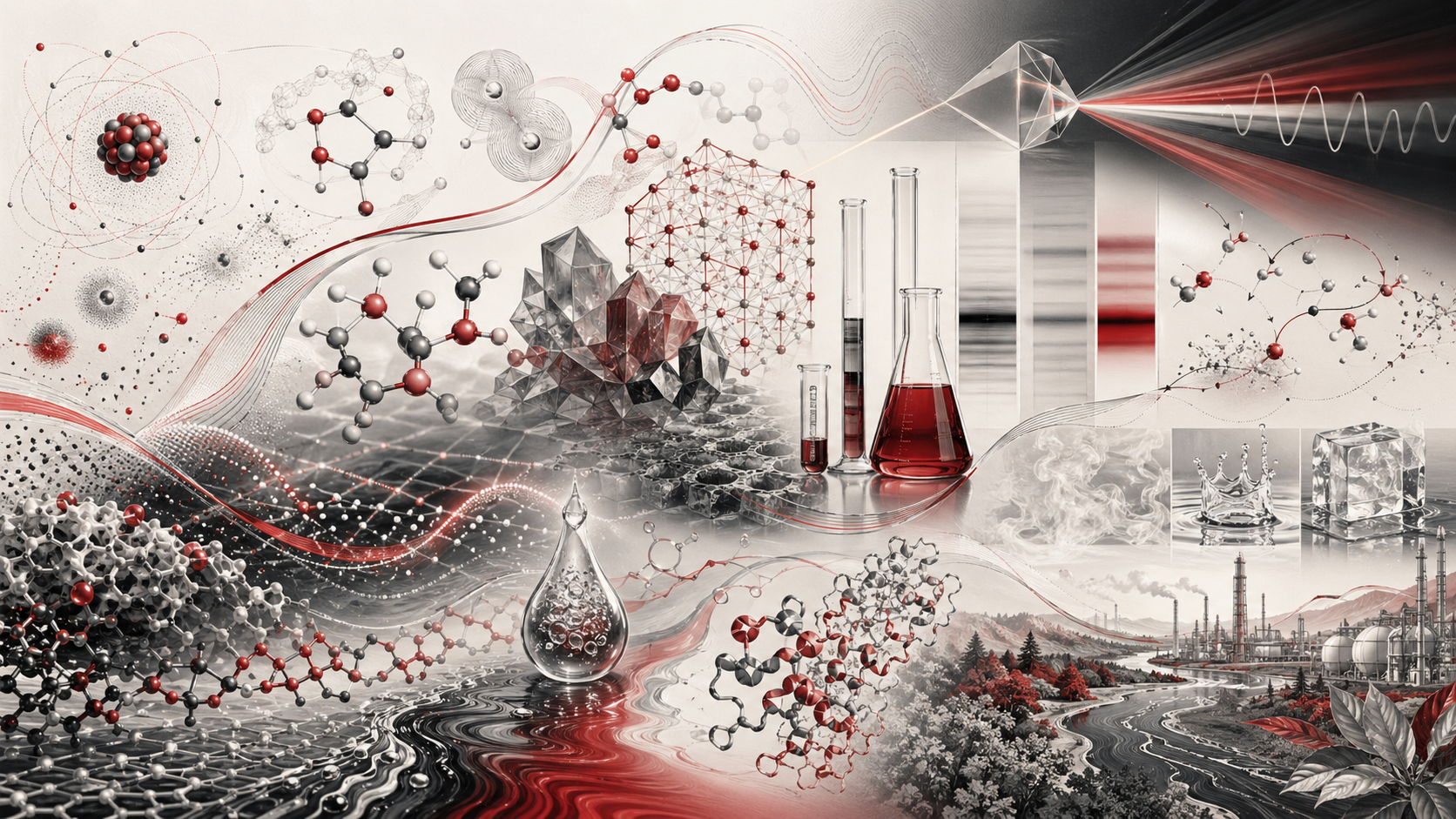
Chemistry is the science of matter, structure, interaction, measurement, and transformation. It asks what substances are made of, how atoms combine, why molecules have particular shapes and properties, how reactions occur, how energy is stored or released, how matter can be identified and measured, and how chemical knowledge can be used to understand life, materials, environments, technologies, and industrial systems.
At its simplest, chemistry studies matter and the changes matter can undergo. But that simple definition opens onto one of the most powerful intellectual frameworks in the natural sciences. Chemistry explains why water behaves differently from methane, why metals conduct electricity, why proteins fold, why batteries store energy, why acids corrode, why medicines bind to biological targets, why pollutants persist, why catalysts matter, why materials fail, and why invisible molecular structure gives rise to visible material behavior.
The central thesis of this article is that chemistry is the science of material possibility. It explains not only what matter is, but what matter can become. It connects composition to structure, structure to properties, properties to transformation, transformation to measurement, and measurement to evidence. Chemistry makes the material world intelligible by showing how atoms, electrons, bonds, energy, and molecular organization produce the substances and systems that shape life, technology, environment, health, and civilization.
Main Library
Publications
Article Map
Chemistry
Related Topic
Astronomy
Related Topic
Physics
Related Topic
Biology
Why Chemistry Matters
Chemistry matters because human life is material life. Bodies, medicines, food, water, air, soils, fuels, batteries, plastics, metals, minerals, pigments, fertilizers, semiconductors, pollutants, proteins, DNA, membranes, and atmospheric gases are all chemical systems. To understand them requires attention to composition, structure, bonding, energy, transformation, and measurement.
Chemistry explains why substances have the properties they do. It explains why sodium metal reacts violently with water while sodium ions are essential electrolytes, why carbon can form diamonds, graphite, proteins, fuels, polymers, and pharmaceuticals, why oxygen supports combustion and respiration, why nitrogen gas is relatively inert but nitrogen compounds can be biologically and industrially powerful, and why small molecular changes can transform a medicine, toxin, material, or environmental contaminant.
Chemistry also matters because it gives human beings the power to transform matter. That power can heal disease, purify water, store renewable energy, make durable materials, detect contamination, improve agriculture, and support modern medicine. It can also produce pollution, toxicity, persistent waste, environmental injustice, and dangerous industrial systems when chemical capability is separated from responsibility.
A mature understanding of chemistry therefore requires both technical depth and ethical awareness. Chemistry is not merely the science of useful substances. It is the science of material transformation under conditions of power, risk, scale, and consequence. It asks how matter behaves, but also how chemical knowledge should be governed when its effects move through bodies, watersheds, workplaces, supply chains, ecosystems, and future generations.
Chemistry is one of the central sciences because it sits at the point where invisible molecular structure becomes visible material consequence. It allows people to understand the substances they breathe, drink, ingest, manufacture, regulate, discard, and depend on.
Chemistry as the Study of Matter and Change
Chemistry is commonly defined as the study of matter and the changes matter undergoes. Matter is anything that has mass and occupies space. Chemical change occurs when substances are transformed through the rearrangement of atoms, bonds, electrons, ions, or molecular structures.
This definition is simple, but it is not shallow. Matter includes gases, liquids, solids, plasmas, solutions, crystals, polymers, metals, minerals, proteins, membranes, pollutants, medicines, and engineered materials. Chemical change includes combustion, corrosion, fermentation, acid-base reactions, oxidation-reduction, polymerization, crystallization, precipitation, catalysis, metabolism, electrochemical charging, atmospheric reactions, biochemical transformation, and industrial synthesis.
Chemistry therefore studies two closely related questions:
- What is matter made of? This concerns atoms, elements, molecules, ions, compounds, mixtures, phases, and materials.
- How does matter change? This concerns reactions, energy, rates, mechanisms, equilibrium, electron transfer, proton transfer, catalysis, and environmental or biological transformation.
Chemical explanation is powerful because it links visible properties to invisible structure. A color, smell, melting point, toxicity, conductivity, solubility, reactivity, viscosity, volatility, durability, or biological effect often depends on atomic and molecular arrangements that cannot be seen directly. Chemistry makes those hidden structures knowable through measurement, theory, experiment, representation, and evidence.
This means chemistry is not simply a catalogue of substances. It is a way of reasoning from composition to behavior. When a chemist studies a substance, the question is not only what it is called, but what atoms it contains, how those atoms are arranged, how electrons are distributed, what interactions dominate, what transformations are possible, what measurements support the claim, and under what conditions the substance behaves differently.
Chemistry is therefore a science of material identity and material change at the same time. It asks what matter is, what matter does, and what matter can become.
Atoms, Elements, and the Material World
Chemistry begins with atoms and elements. An atom is the smallest ordinary unit of an element that retains the chemical identity of that element. Elements are defined by atomic number: the number of protons in the nucleus. Carbon has six protons, oxygen has eight, sodium has eleven, iron has twenty-six, and gold has seventy-nine.
The periodic table organizes elements according to atomic structure and recurring chemical behavior. This makes it one of the great intellectual achievements of science. It does not merely list substances. It reveals patterns: alkali metals, alkaline earth metals, transition metals, halogens, noble gases, lanthanides, actinides, periodic trends, valence behavior, atomic radius, ionization energy, electronegativity, oxidation states, and chemical reactivity.
Atoms become chemically significant because of electrons. Electrons determine bonding, reactivity, molecular shape, oxidation state, spectroscopy, electrical behavior, and many material properties. Chemistry therefore depends on quantum structure, but it expresses that structure through chemical categories: bonds, orbitals, charges, ions, oxidation states, functional groups, coordination environments, electron density, and molecular geometry.
The material world is not random. It is structured through recurring chemical relationships among elements, electrons, nuclei, and energy. Sodium and potassium show related behavior because of periodic organization. Oxygen and sulfur share family relationships while also differing in size, electronegativity, bonding, and biological role. Carbon is unusually generative because it forms stable covalent bonds with itself and many other elements, enabling chains, rings, biomolecules, polymers, fuels, materials, and medicines.
Elemental identity is only the beginning. Chemical form matters deeply. Sodium metal, sodium chloride, sodium hydroxide, and sodium ions in blood are not interchangeable chemical realities. Carbon in diamond, graphite, methane, carbon dioxide, glucose, proteins, plastics, or atmospheric soot behaves differently because structure, bonding, phase, and context matter.
Chemistry studies the patterned diversity that emerges when a finite set of elements forms an immense range of substances, structures, and transformations.
Molecules, Bonds, and Structure
Molecules are organized groups of atoms held together by chemical bonds. Bonds are not physical sticks between atoms, but structured interactions involving electrons and nuclei. The way atoms are connected and arranged determines molecular behavior.
Chemical bonding includes several major forms:
- Ionic bonding: attraction between oppositely charged ions.
- Covalent bonding: sharing of electron density between atoms.
- Metallic bonding: collective electron behavior in metallic solids.
- Coordinate bonding: electron-pair donation into an available orbital, especially important in coordination chemistry.
- Intermolecular forces: attractions among molecules, including hydrogen bonding, dipole interactions, ion-dipole interactions, and dispersion forces.
Molecular structure matters because small structural differences can produce major functional differences. Structural isomers may have the same formula but different connectivity. Stereoisomers may have the same connectivity but different three-dimensional arrangement. Functional groups can determine acidity, solubility, reactivity, biological binding, volatility, toxicity, stability, and environmental persistence.
A molecule is therefore not merely a formula. \(C_2H_6O\) can represent ethanol or dimethyl ether, two compounds with very different properties. Chemical formulas count atoms, but chemical structures explain behavior.
This is one reason chemistry is so visually and conceptually distinctive. It represents matter through formulas, structures, models, mechanisms, spectra, reaction schemes, orbital diagrams, phase diagrams, molecular graphs, and spatial reasoning. Chemistry teaches that matter’s behavior depends not only on what atoms are present, but on how they are arranged and how electrons are distributed.
Structure also extends beyond isolated molecules. Ionic solids form lattices. Metals form crystalline or amorphous structures with delocalized electrons. Polymers form chains, networks, fibers, films, gels, and composites. Proteins fold into functional three-dimensional structures. Minerals and semiconductors depend on crystal structure, defects, dopants, surfaces, and interfaces.
Chemistry is therefore a science of structure at multiple scales: atomic, molecular, supramolecular, crystalline, macromolecular, interfacial, and material.
Chemical Reactions and Transformation
Chemical reactions transform substances by rearranging atoms, bonds, electrons, ions, or molecular structures. Reactants become products. Bonds break and form. Electrons move. Protons transfer. Energy is absorbed or released. Molecular architecture changes.
A reaction is often written as a balanced equation:
aA + bB \rightarrow cC + dD
\]
Interpretation: \(A\) and \(B\) are reactants, \(C\) and \(D\) are products, and the coefficients express stoichiometric relationships that preserve atoms and charge.
A balanced equation expresses conservation: matter is reorganized, not created from nothing. But a chemical equation is only the beginning. Chemistry also asks:
- What is the reaction mechanism?
- How fast does the reaction occur?
- What energy barrier must be crossed?
- Does equilibrium favor products or reactants?
- Can a catalyst change the pathway?
- What conditions control selectivity, yield, and safety?
- What byproducts, waste, or hazards are produced?
- What measurements support the proposed transformation?
Chemical transformation is central to life and civilization. Metabolism is chemical transformation. Photosynthesis is chemical transformation. Combustion, corrosion, fermentation, digestion, drug metabolism, water treatment, industrial synthesis, battery charging, atmospheric oxidation, and polymer curing are all chemical transformations.
Reaction mechanisms make chemical transformation intelligible. They describe the sequence of bond changes, electron movement, intermediates, transition states, proton transfers, radical pathways, coordination steps, surface interactions, or catalytic cycles through which reactants become products.
Chemistry is therefore a science of becoming: how matter changes from one state, composition, or structure into another. It asks not only what exists, but what transformations are possible, probable, controllable, useful, hazardous, reversible, or irreversible.
Energy, Equilibrium, and Rate
Chemical change depends on energy. Some reactions release energy; others require energy input. Some are thermodynamically favorable but slow. Others proceed rapidly under the right conditions. Chemistry therefore distinguishes among thermodynamics, equilibrium, and kinetics.
Thermodynamics asks whether a transformation is energetically favorable. Gibbs free energy is central:
\Delta G = \Delta H – T\Delta S
\]
Interpretation: Gibbs free energy change depends on enthalpy change, temperature, and entropy change.
A negative \(\Delta G\) under specified conditions indicates thermodynamic favorability, but not necessarily speed. This distinction is crucial. Thermodynamics describes direction and possibility; kinetics describes rate and pathway.
Equilibrium describes dynamic balance. In a reversible reaction, reactants and products can interconvert. At equilibrium, forward and reverse reaction rates are equal, even though molecules continue to react. The equilibrium constant expresses the relative abundance of products and reactants at equilibrium.
Kinetics asks how fast reactions occur. A reaction may be favorable but slow because it has a high activation energy. Catalysts lower activation barriers or provide alternative pathways, increasing reaction rates without being consumed overall.
The Arrhenius equation expresses the temperature dependence of many rate constants:
k = Ae^{-E_a/(RT)}
\]
Interpretation: The rate constant \(k\) depends on a pre-exponential factor \(A\), activation energy \(E_a\), gas constant \(R\), and temperature \(T\).
This distinction matters throughout chemistry. Diamond is thermodynamically less stable than graphite under ordinary conditions, but it does not spontaneously turn into graphite because the kinetic barrier is high. Food may spoil through chemical and biological reactions, but cooling slows reaction rates. Industrial chemistry often depends on catalysts that make useful reactions fast, selective, and economically viable.
Chemistry is therefore not only about possibility. It is about pathway, rate, energy, equilibrium, and control.
Measurement, Evidence, and Chemical Knowledge
Chemistry depends on measurement. A chemical claim must be supported by evidence: mass, concentration, purity, spectra, chromatograms, melting points, reaction yields, pH, conductivity, elemental composition, molecular structure, thermodynamic data, kinetic data, or instrument response.
Chemical measurement is not trivial. Substances must be sampled, prepared, separated, detected, calibrated, and interpreted. Instruments must be validated. Results require uncertainty estimates. Standards and reference materials allow measurements to be compared across laboratories.
Several kinds of measurement are central to chemistry:
- Mass measurement: balances, gravimetry, and stoichiometric calculation.
- Volume and concentration: solutions, titration, molarity, and dilution.
- Spectroscopy: interaction of matter with light or electromagnetic radiation.
- Chromatography: separation of mixtures into components.
- Mass spectrometry: detection of ions by mass-to-charge ratio.
- Electrochemical measurement: potential, current, redox behavior, and sensors.
- Thermal analysis: heat flow, phase transitions, and material behavior.
- Structural methods: crystallography, microscopy, NMR, diffraction, and scattering techniques.
Chemical evidence often depends on converging methods. A compound may be synthesized, purified by chromatography, characterized by NMR spectroscopy, confirmed by mass spectrometry, analyzed for elemental composition, tested for melting point, and compared against literature or reference data. Chemistry builds confidence through disciplined measurement.
This is why organizations, standards, and reference systems matter. Chemistry requires shared terminology, units, reference data, standards, and conventions. Without them, chemical knowledge would not travel reliably across laboratories, industries, countries, or regulatory systems.
Measurement also gives chemistry its accountability. A substance is not identified because a label says so. A reaction is not complete because it appears complete. A contaminant is not absent because it is invisible. Chemical knowledge must be measured, calibrated, interpreted, and preserved through records that others can examine.
Chemistry Between Physics, Biology, and Earth Systems
Chemistry sits between physics, biology, Earth science, environmental science, medicine, engineering, and materials science. It is often called a central science because it links fundamental physical principles to complex material systems.
Physics helps explain the forces, energy, quantum behavior, thermodynamic constraints, and electromagnetic interactions underlying matter. Chemistry translates those principles into the behavior of atoms, molecules, reactions, materials, and substances. It asks how physical laws become material properties and chemical transformations.
Biology depends on chemistry because living systems are molecular systems. Enzymes, membranes, DNA, RNA, proteins, metabolites, hormones, neurotransmitters, pigments, ion gradients, and cellular signals are chemical phenomena organized by life. Biochemistry shows that life does not escape chemistry; it arranges chemistry into self-maintaining, information-bearing, energy-transforming systems.
Earth systems depend on chemistry as well. Atmospheric composition, ocean acidification, mineral weathering, nutrient cycles, soil fertility, pollutant transport, greenhouse gases, aerosols, and water quality all require chemical interpretation. Environmental risk is often chemical risk: exposure, persistence, toxicity, solubility, bioaccumulation, degradation, and transformation.
Engineering and technology depend on chemistry because materials must be designed, processed, tested, and controlled. Batteries, semiconductors, solar cells, alloys, polymers, catalysts, coatings, sensors, pharmaceuticals, fertilizers, adhesives, membranes, and fuels are all chemical achievements.
Chemistry therefore connects the small and the large: electrons to materials, molecules to medicine, reactions to industry, pollutants to ecosystems, and atoms to civilization. It is central not because it is more important than other sciences, but because material questions pass through chemical structure and transformation again and again.
Major Branches of Chemistry
Chemistry includes several major branches, though the boundaries often overlap. These branches are not isolated silos. They are ways of organizing a field whose problems frequently cross molecular, material, biological, environmental, computational, and industrial boundaries.
Organic chemistry studies carbon-based compounds, functional groups, stereochemistry, reaction mechanisms, synthesis, and molecular structure. It is central to pharmaceuticals, polymers, fuels, biological molecules, dyes, solvents, surfactants, agrochemicals, and industrial chemistry.
Inorganic chemistry studies metals, minerals, coordination compounds, catalysts, solid-state systems, organometallics, and the chemistry of elements beyond carbon-centered frameworks. It is essential to catalysis, materials, geochemistry, bioinorganic systems, energy technologies, and electronic materials.
Physical chemistry uses thermodynamics, kinetics, quantum theory, spectroscopy, statistical mechanics, and mathematical reasoning to explain chemical behavior at a theoretical level. It gives chemistry many of its most general models of energy, rate, structure, and equilibrium.
Analytical chemistry studies the identification, separation, measurement, calibration, and quantification of chemical substances. It is essential to environmental monitoring, pharmaceuticals, forensics, food safety, water quality, materials testing, and laboratory quality systems.
Biochemistry studies the molecular basis of life: proteins, nucleic acids, enzymes, lipids, carbohydrates, metabolism, membranes, cellular regulation, and molecular recognition. It links chemistry to biology, medicine, neuroscience, agriculture, and biotechnology.
Materials chemistry studies the design and behavior of polymers, ceramics, composites, nanomaterials, semiconductors, surfaces, interfaces, and functional materials. It connects chemistry to devices, infrastructure, energy systems, manufacturing, and engineering performance.
Environmental chemistry studies chemical substances and transformations in air, water, soil, organisms, and ecosystems. It examines pollutants, nutrients, natural organic matter, atmospheric reactions, water treatment, contaminant fate, exposure, and environmental risk.
Computational chemistry uses algorithms, simulation, molecular modeling, quantum chemistry, cheminformatics, and data science to study chemical structure and behavior. It supports property prediction, reaction modeling, materials discovery, molecular design, and interpretation of experimental data.
Green chemistry and sustainable chemistry focus on designing chemical products and processes that reduce waste, toxicity, energy use, persistence, exposure, and environmental harm. They ask how chemical capability can be aligned with long-term responsibility.
Together, these branches show that chemistry is not one narrow subject. It is a broad framework for understanding matter wherever composition, structure, interaction, measurement, and transformation matter.
Chemistry as a Quantitative and Computational Science
Chemistry has always been quantitative. Stoichiometry counts atoms and moles. Analytical chemistry measures concentration and uncertainty. Thermodynamics calculates energy and equilibrium. Kinetics models rates. Electrochemistry relates potential, charge, and chemical change. Quantum chemistry describes molecular structure through mathematical approximations.
Modern chemistry is also computational. Chemical research increasingly uses code to process instrument data, simulate molecular systems, search chemical databases, model reaction networks, predict properties, design materials, and make workflows reproducible.
Computational chemistry and chemical data science include:
- molecular modeling;
- quantum chemistry;
- molecular dynamics;
- cheminformatics;
- spectroscopy data processing;
- chromatography and mass-spectrometry workflows;
- reaction-network simulation;
- environmental fate modeling;
- chemical risk modeling;
- materials discovery;
- laboratory metadata and provenance systems;
- machine learning for structure-property relationships;
- automated synthesis planning and reaction informatics.
Computational tools do not replace laboratory chemistry. They extend it. A simulation is useful only when assumptions are clear, methods are validated, and results are interpreted chemically. A dataset is powerful only when its origin, uncertainty, and limitations are understood. A machine-learning model is credible only when its training data, domain of applicability, uncertainty, and chemical meaning are examined.
Chemistry is increasingly a science of matter and data together. The strongest chemical work connects experimental evidence, theoretical models, computational workflows, and transparent provenance. A chemical claim becomes stronger when another researcher can inspect the data, understand the assumptions, reproduce the calculation, and compare the result with measured reality.
The computational future of chemistry therefore depends not only on faster algorithms, but on better evidence discipline: units, metadata, reference data, uncertainty, validation, interpretability, and reproducibility.
Chemistry and Responsibility
Chemistry gives human beings the power to transform matter at scale. That power is not ethically neutral. It can produce medicines, clean water, fertilizers, batteries, materials, diagnostic tools, and environmental monitoring systems. It can also produce toxic exposures, industrial disasters, persistent pollutants, plastic waste, unsafe workplaces, and chemical risks that last for generations.
Responsible chemistry asks how substances are designed, produced, used, measured, regulated, and discarded. It asks whether chemical processes minimize waste, energy use, toxicity, persistence, and exposure. It asks who benefits from chemical innovation and who bears chemical risk. It asks how laboratory safety, industrial governance, environmental regulation, public health, and community accountability should shape the use of chemical power.
Green chemistry and sustainable chemistry emerged from this recognition. They do not reject chemistry. They ask chemistry to become more intelligent, safer, less wasteful, and more accountable. A future-oriented chemistry must therefore combine molecular creativity with ecological responsibility.
Responsibility also requires chemical literacy beyond the laboratory. Communities exposed to contaminated water, industrial emissions, hazardous waste, unsafe products, or occupational chemicals need evidence that is understandable, trustworthy, and actionable. Chemical data should not be locked inside technical systems that obscure public consequence.
Chemistry’s responsibility is therefore both scientific and civic. It must create knowledge, but it must also ask how chemical knowledge affects bodies, ecosystems, workers, communities, and future conditions of life.
Chemistry as Public Knowledge
Chemistry often appears technical, but it is deeply public. Drinking-water standards, air-quality measurements, food labels, pharmaceutical quality, workplace exposure limits, climate models, pesticide rules, industrial permits, product safety, and environmental cleanup all depend on chemical knowledge.
This means chemistry must be communicable. A concentration must have units. A hazard must specify chemical form, dose, exposure route, and context. A pollutant must be measured with methods that can withstand scrutiny. A material claim must be supported by evidence. A regulatory threshold must be tied to measurement and interpretation.
Public chemical knowledge also requires humility. A chemical detected in a sample is not automatically a health crisis. A chemical below a reporting limit is not necessarily absent. A hazard classification is not the same as exposure assessment. A laboratory result is not meaningful without sampling context, method, uncertainty, and decision criteria.
At the same time, chemistry should not be used to delay responsibility by demanding impossible certainty. Environmental and public-health decisions often require action under uncertainty. Chemical evidence must therefore be interpreted with scientific rigor and moral seriousness. Measurement, uncertainty, and precaution belong together.
Chemistry becomes public knowledge when it helps societies understand material risks, benefits, transformations, and responsibilities. It is not only a laboratory discipline. It is part of how communities make decisions about water, air, food, medicine, materials, waste, energy, and environmental futures.
Mathematical Lens: What Chemistry Studies
Several mathematical ideas clarify what chemistry studies. Amount of substance is:
n = \frac{m}{M}
\]
Interpretation: Amount of substance \(n\) equals sample mass \(m\) divided by molar mass \(M\).
Concentration is:
C = \frac{n}{V}
\]
Interpretation: Molar concentration \(C\) equals amount of substance \(n\) divided by solution volume \(V\).
A stoichiometric relationship is:
\frac{n_A}{a} = \frac{n_B}{b}
\]
Interpretation: Amounts of substances \(A\) and \(B\) relate through their stoichiometric coefficients \(a\) and \(b\) in a balanced reaction.
Gibbs free energy is:
\Delta G = \Delta H – T\Delta S
\]
Interpretation: Free energy change relates enthalpy, entropy, and temperature.
For the reaction:
aA+bB \rightleftharpoons cC+dD
\]
Interpretation: A reversible reaction can reach dynamic equilibrium between reactants and products.
An introductory concentration-based equilibrium expression is:
K = \frac{[C]^c[D]^d}{[A]^a[B]^b}
\]
Interpretation: In simplified contexts, the equilibrium constant relates product and reactant concentrations raised to their stoichiometric powers. More rigorous treatments use activities.
The Arrhenius equation is:
k = Ae^{-E_a/(RT)}
\]
Interpretation: Reaction rate constants often depend on temperature and activation energy.
pH is:
\mathrm{pH} = -\log_{10}(a_{\mathrm{H}^+})
\]
Interpretation: pH is rigorously defined using hydrogen ion activity; introductory contexts often approximate it with concentration.
The Beer-Lambert law is:
A = \varepsilon lc
\]
Interpretation: Absorbance \(A\) depends on molar absorptivity \(\varepsilon\), path length \(l\), and concentration \(c\) under appropriate conditions.
These equations do not exhaust chemistry. They show why chemistry is quantitative: matter can be counted, measured, transformed, modeled, and compared. Chemical understanding depends on knowing what the equation represents, what assumptions it makes, what units apply, and what evidence supports its use.
Computational Workflows for Introductory Chemistry
Computational workflows can make introductory chemistry more transparent. A workflow can calculate moles, concentration, dilution, pH, first-order kinetics, calibration curves, Beer-Lambert estimates, stoichiometric ratios, reaction yields, and uncertainty summaries. It can also preserve data provenance, assumptions, units, and review notes.
Useful introductory chemistry workflows include:
- mass-to-mole calculators;
- molar concentration tables;
- dilution planning tools;
- stoichiometric ratio calculators;
- first-order kinetics simulations;
- pH approximation tables;
- Beer-Lambert calibration models;
- replicate measurement summaries;
- simple uncertainty records;
- chemical evidence registers;
- laboratory metadata and provenance files.
For students, researchers, and educators, computational chemistry workflows should preserve four distinctions:
- Formula versus structure: a molecular formula counts atoms, but structure explains behavior.
- Signal versus evidence: an instrument response becomes chemical evidence only through calibration and interpretation.
- Model versus system: equations simplify chemical systems and must be used within their assumptions.
- Computation versus chemistry: code can calculate values, but chemical meaning depends on units, context, validation, and evidence.
The examples below use synthetic educational data. They do not validate real laboratory methods, certify analytical results, approve environmental compliance, establish pharmaceutical quality, or replace professional chemical review. They demonstrate how introductory chemical ideas can be represented, audited, and communicated responsibly.
Python Example: Moles, Concentration, Dilution, Kinetics, and Provenance
The following Python example uses synthetic educational data to calculate amount of substance, molarity, dilution planning, first-order kinetics, pH approximation, Beer-Lambert calibration, and provenance outputs. Real laboratory workflows require validated methods, uncertainty, calibration records, reference materials, and review.
from pathlib import Path
import json
import math
import platform
import sys

import numpy as np
import pandas as pd


# Synthetic introductory chemistry workflow.
# Educational example only; not for laboratory certification,
# environmental compliance, medical decisions, pharmaceutical quality,
# or professional chemical review.


def require_columns(data: pd.DataFrame, required: list[str], table_name: str) -> None:
    """Raise an error if required columns are missing."""
    missing = [column for column in required if column not in data.columns]
    if missing:
        raise ValueError(f"{table_name} is missing required columns: {missing}")


def moles_from_mass(mass_g: float, molar_mass_g_mol: float) -> float:
    """Calculate amount of substance in moles."""
    if molar_mass_g_mol <= 0:
        raise ValueError("Molar mass must be positive.")
    return mass_g / molar_mass_g_mol


def molarity(moles: float, volume_l: float) -> float:
    """Calculate molarity in mol/L."""
    if volume_l <= 0:
        raise ValueError("Volume must be positive.")
    return moles / volume_l


def dilution_stock_volume(
    stock_concentration: float,
    target_concentration: float,
    final_volume: float
) -> float:
    """Use C1V1 = C2V2 to calculate required stock volume."""
    if stock_concentration <= 0:
        raise ValueError("Stock concentration must be positive.")
    return (target_concentration * final_volume) / stock_concentration


solutions = pd.DataFrame(
    {
        "substance": ["sodium_chloride", "glucose", "copper_sulfate_pentahydrate"],
        "mass_g": [5.844, 9.000, 2.495],
        "molar_mass_g_mol": [58.44, 180.156, 249.685],
        "final_volume_l": [0.500, 0.250, 0.100],
    }
)

require_columns(
    solutions,
    ["substance", "mass_g", "molar_mass_g_mol", "final_volume_l"],
    "solutions",
)

solutions["amount_mol"] = solutions.apply(
    lambda row: moles_from_mass(row["mass_g"], row["molar_mass_g_mol"]),
    axis=1,
)

solutions["concentration_mol_l"] = solutions.apply(
    lambda row: molarity(row["amount_mol"], row["final_volume_l"]),
    axis=1,
)

dilutions = pd.DataFrame(
    {
        "solution": ["A", "B", "C"],
        "stock_concentration_mol_l": [1.0, 0.5, 2.0],
        "target_concentration_mol_l": [0.10, 0.05, 0.25],
        "final_volume_ml": [100.0, 250.0, 50.0],
    }
)

dilutions["stock_volume_ml"] = dilutions.apply(
    lambda row: dilution_stock_volume(
        row["stock_concentration_mol_l"],
        row["target_concentration_mol_l"],
        row["final_volume_ml"],
    ),
    axis=1,
)

kinetics = pd.DataFrame(
    {
        "time_min": np.arange(0, 25, 5),
    }
)

initial_concentration = 1.0
rate_constant_min_inverse = 0.15

kinetics["concentration_mol_l"] = (
    initial_concentration
    * np.exp(-rate_constant_min_inverse * kinetics["time_min"])
)

ph_examples = pd.DataFrame(
    {
        "solution": ["acid_A", "acid_B", "acid_C"],
        "hydrogen_concentration_mol_l": [1.0e-2, 1.0e-5, 3.2e-4],
    }
)

ph_examples["ph_approximation"] = -np.log10(
    ph_examples["hydrogen_concentration_mol_l"]
)

calibration = pd.DataFrame(
    {
        "standard_id": ["STD_0", "STD_1", "STD_2", "STD_3", "STD_4", "STD_5"],
        "concentration_mol_l": [0.00, 0.02, 0.04, 0.06, 0.08, 0.10],
        "absorbance": [0.000, 0.115, 0.230, 0.348, 0.459, 0.575],
    }
)

require_columns(
    calibration,
    ["concentration_mol_l", "absorbance"],
    "calibration",
)

slope, intercept = np.polyfit(
    calibration["concentration_mol_l"],
    calibration["absorbance"],
    deg=1,
)

predicted_absorbance = slope * calibration["concentration_mol_l"] + intercept
residuals = calibration["absorbance"] - predicted_absorbance

r_squared = 1.0 - (
    np.sum(residuals**2)
    / np.sum((calibration["absorbance"] - calibration["absorbance"].mean()) ** 2)
)

unknown_absorbance = 0.402
estimated_concentration = (unknown_absorbance - intercept) / slope

calibration_summary = pd.DataFrame(
    [
        {
            "model": "absorbance = slope * concentration + intercept",
            "slope": slope,
            "intercept": intercept,
            "r_squared": r_squared,
            "unknown_absorbance": unknown_absorbance,
            "estimated_unknown_concentration_mol_l": estimated_concentration,
            "range_note": "estimate assumes the unknown lies within the validated calibration range",
        }
    ]
)

stoichiometry = pd.DataFrame(
    {
        "reaction": ["2H2 + O2 -> 2H2O"],
        "hydrogen_mol_available": [4.0],
        "oxygen_mol_required": [2.0],
        "water_mol_theoretical": [4.0],
        "interpretation": [
            "two moles of hydrogen react with one mole of oxygen to form two moles of water"
        ],
    }
)

review_notes = pd.DataFrame(
    [
        {
            "review_item": "moles_and_concentration",
            "status": "educational",
            "note": "molar masses and volumes use simplified example values",
        },
        {
            "review_item": "dilution",
            "status": "idealized",
            "note": "assumes ideal mixing and no transfer loss",
        },
        {
            "review_item": "kinetics",
            "status": "first_order_model",
            "note": "model does not prove a real mechanism",
        },
        {
            "review_item": "pH",
            "status": "introductory_approximation",
            "note": "uses concentration rather than activity",
        },
        {
            "review_item": "calibration",
            "status": "synthetic_linear_model",
            "note": "real calibration requires residual review, uncertainty, and validated range",
        },
        {
            "review_item": "stoichiometry",
            "status": "balanced_reaction_scaffold",
            "note": "assumes the reaction equation and conditions are appropriate",
        },
    ]
)

output_dir = Path("outputs")
output_dir.mkdir(exist_ok=True)

solutions.to_csv(output_dir / "synthetic_solutions_moles_concentration.csv", index=False)
dilutions.to_csv(output_dir / "synthetic_dilution_planning.csv", index=False)
kinetics.to_csv(output_dir / "synthetic_first_order_kinetics.csv", index=False)
ph_examples.to_csv(output_dir / "synthetic_ph_examples.csv", index=False)
calibration.to_csv(output_dir / "synthetic_beer_lambert_calibration.csv", index=False)
calibration_summary.to_csv(output_dir / "synthetic_calibration_summary.csv", index=False)
stoichiometry.to_csv(output_dir / "synthetic_stoichiometry_example.csv", index=False)
review_notes.to_csv(output_dir / "synthetic_intro_chemistry_review_notes.csv", index=False)

manifest = {
    "workflow": "synthetic_introductory_chemistry_workflow",
    "data_type": "synthetic educational chemistry records",
    "equations": [
        "n = m / M",
        "C = n / V",
        "C1 * V1 = C2 * V2",
        "[A](t) = [A]0 * exp(-k*t)",
        "pH approximated as -log10([H+])",
        "Beer-Lambert calibration: A = slope*c + intercept",
        "stoichiometric ratios from balanced reaction coefficients",
    ],
    "cautions": [
        "Synthetic educational data only.",
        "Not suitable for laboratory certification.",
        "pH approximation does not model activity.",
        "Calibration requires validated range, uncertainty, and diagnostics.",
        "Computational outputs require chemical interpretation.",
    ],
    "python_version": sys.version,
    "platform": platform.platform(),
    "numpy_version": np.__version__,
    "pandas_version": pd.__version__,
    "output_files": [
        "outputs/synthetic_solutions_moles_concentration.csv",
        "outputs/synthetic_dilution_planning.csv",
        "outputs/synthetic_first_order_kinetics.csv",
        "outputs/synthetic_ph_examples.csv",
        "outputs/synthetic_beer_lambert_calibration.csv",
        "outputs/synthetic_calibration_summary.csv",
        "outputs/synthetic_stoichiometry_example.csv",
        "outputs/synthetic_intro_chemistry_review_notes.csv",
        "outputs/introductory_chemistry_manifest.json",
    ],
}

with (output_dir / "introductory_chemistry_manifest.json").open(
    "w",
    encoding="utf-8"
) as file:
    json.dump(manifest, file, indent=2)

print("Solutions: moles and concentration")
print("----------------------------------")
print(solutions.round(6).to_string(index=False))

print("\nDilution planning")
print("-----------------")
print(dilutions.round(6).to_string(index=False))

print("\nFirst-order kinetics")
print("--------------------")
print(kinetics.round(6).to_string(index=False))

print("\npH examples")
print("-----------")
print(ph_examples.round(6).to_string(index=False))

print("\nCalibration summary")
print("-------------------")
print(calibration_summary.round(6).to_string(index=False))

print("\nStoichiometry")
print("-------------")
print(stoichiometry.to_string(index=False))

print("\nReview notes")
print("------------")
print(review_notes.to_string(index=False))
This workflow demonstrates introductory chemistry evidence discipline rather than certified analysis. It separates solution calculations, dilution planning, kinetics, pH approximation, calibration, stoichiometry, review notes, and provenance. A real workflow would add validated methods, uncertainty budgets, reference materials, raw data, laboratory records, and independent review.
R Example: Beer-Lambert Calibration, pH, and Replicate Review
The following R example uses synthetic educational data to fit a Beer-Lambert-style calibration curve, estimate an unknown concentration, calculate simplified pH values, and summarize replicate precision. In real workflows, calibration diagnostics, uncertainty, valid range, activity effects, and quality-control records must be documented.
# Synthetic introductory chemistry scaffold.
# Educational example only; not for laboratory certification,
# environmental compliance, medical decisions, pharmaceutical quality,
# or professional chemical review.

calibration <- data.frame(
  concentration_mol_l = c(0.00, 0.02, 0.04, 0.06, 0.08, 0.10),
  absorbance = c(0.000, 0.115, 0.230, 0.348, 0.459, 0.575)
)

calibration_model <- lm(absorbance ~ concentration_mol_l, data = calibration)

unknown_absorbance <- 0.402

estimated_concentration <-
  (unknown_absorbance - coef(calibration_model)[["(Intercept)"]]) /
  coef(calibration_model)[["concentration_mol_l"]]

calibration_summary <- data.frame(
  slope = coef(calibration_model)[["concentration_mol_l"]],
  intercept = coef(calibration_model)[["(Intercept)"]],
  r_squared = summary(calibration_model)$r.squared,
  unknown_absorbance = unknown_absorbance,
  estimated_concentration_mol_l = estimated_concentration,
  note = "synthetic linear calibration; real methods require validation"
)

solutions <- data.frame(
  solution = c("acid_A", "acid_B", "acid_C"),
  hydrogen_concentration_mol_l = c(1e-2, 1e-5, 3.2e-4)
)

solutions$pH_approximation <-
  -log10(solutions$hydrogen_concentration_mol_l)

replicates <- data.frame(
  replicate = 1:6,
  measured_mass_g = c(1.0032, 1.0028, 1.0035, 1.0030, 1.0029, 1.0034)
)

replicate_summary <- data.frame(
  replicate_count = nrow(replicates),
  mean_mass_g = mean(replicates$measured_mass_g),
  sample_standard_deviation_g = sd(replicates$measured_mass_g),
  relative_standard_deviation_percent =
    100 * sd(replicates$measured_mass_g) / mean(replicates$measured_mass_g)
)

kinetics <- data.frame(
  time_min = seq(0, 20, by = 5)
)

initial_concentration <- 1.0
rate_constant_min_inverse <- 0.15

kinetics$concentration_mol_l <-
  initial_concentration * exp(-rate_constant_min_inverse * kinetics$time_min)

review_notes <- data.frame(
  review_item = c(
    "Beer-Lambert calibration",
    "pH approximation",
    "replicate precision",
    "first-order kinetics",
    "responsible use"
  ),
  status = c(
    "synthetic linear model",
    "introductory concentration approximation",
    "precision summary only",
    "educational kinetic model",
    "not for certified reporting"
  ),
  note = c(
    "real calibration requires residual review, uncertainty, and valid range",
    "activity effects are not modeled",
    "precision does not establish trueness",
    "kinetic fit does not prove mechanism",
    "examples are teaching scaffolds only"
  )
)

dir.create("outputs", showWarnings = FALSE)

write.csv(
  calibration,
  file = "outputs/r_beer_lambert_calibration.csv",
  row.names = FALSE
)

write.csv(
  calibration_summary,
  file = "outputs/r_calibration_summary.csv",
  row.names = FALSE
)

write.csv(
  solutions,
  file = "outputs/r_ph_examples.csv",
  row.names = FALSE
)

write.csv(
  replicates,
  file = "outputs/r_replicate_measurements.csv",
  row.names = FALSE
)

write.csv(
  replicate_summary,
  file = "outputs/r_replicate_summary.csv",
  row.names = FALSE
)

write.csv(
  kinetics,
  file = "outputs/r_first_order_kinetics.csv",
  row.names = FALSE
)

write.csv(
  review_notes,
  file = "outputs/r_introductory_chemistry_review_notes.csv",
  row.names = FALSE
)

sink("outputs/r_introductory_chemistry_report.txt")
cat("Synthetic Introductory Chemistry Report\n")
cat("=======================================\n\n")
cat("Calibration model summary:\n")
print(summary(calibration_model))
cat("\nCalibration summary:\n")
print(calibration_summary)
cat("\npH examples:\n")
print(solutions)
cat("\nReplicate summary:\n")
print(replicate_summary)
cat("\nFirst-order kinetics:\n")
print(kinetics)
cat("\nReview notes:\n")
print(review_notes)
cat("\nResponsible-use note:\n")
cat("Synthetic educational data only. Real chemistry workflows require validated methods, units, uncertainty, traceability, and review.\n")
sink()

print(calibration_summary)
print(solutions)
print(replicate_summary)
print(kinetics)
print(review_notes)
This scaffold shows how R can support introductory calibration, pH approximation, replicate review, kinetic modeling, and responsible-use notes. The central issue is not the language but the evidence chain. Chemical outputs should remain connected to units, assumptions, valid ranges, calibration records, and interpretation limits.
SQL Example: Introductory Chemistry Evidence Register
Introductory chemistry becomes more reliable when substances, formulas, reactions, measurements, calibration records, model assumptions, computational outputs, and interpretation claims are traceable. A simple evidence register can preserve the context needed to audit basic chemical workflows.
CREATE TABLE chemical_substance (
    substance_id TEXT PRIMARY KEY,
    substance_name TEXT NOT NULL,
    formula_text TEXT,
    substance_type TEXT,
    phase_description TEXT,
    source_or_reference_uri TEXT,
    substance_review_status TEXT,
    notes TEXT
);

CREATE TABLE chemical_formula_component (
    component_id TEXT PRIMARY KEY,
    substance_id TEXT NOT NULL,
    element_symbol TEXT NOT NULL,
    atom_count REAL,
    atomic_weight_used REAL,
    mass_contribution REAL,
    component_review_status TEXT,
    FOREIGN KEY (substance_id) REFERENCES chemical_substance(substance_id)
);

CREATE TABLE chemical_reaction (
    reaction_id TEXT PRIMARY KEY,
    reaction_name TEXT NOT NULL,
    reaction_equation TEXT,
    reaction_type TEXT,
    thermodynamic_context TEXT,
    kinetic_context TEXT,
    reaction_review_status TEXT,
    notes TEXT
);

CREATE TABLE reaction_species (
    reaction_species_id TEXT PRIMARY KEY,
    reaction_id TEXT NOT NULL,
    substance_id TEXT NOT NULL,
    role TEXT,
    stoichiometric_coefficient REAL,
    amount_mol REAL,
    mass_g REAL,
    species_review_status TEXT,
    FOREIGN KEY (reaction_id) REFERENCES chemical_reaction(reaction_id),
    FOREIGN KEY (substance_id) REFERENCES chemical_substance(substance_id)
);

CREATE TABLE solution_preparation (
    solution_id TEXT PRIMARY KEY,
    substance_id TEXT NOT NULL,
    mass_g REAL,
    molar_mass_g_mol REAL,
    amount_mol REAL,
    final_volume_l REAL,
    concentration_mol_l REAL,
    preparation_method TEXT,
    preparation_review_status TEXT,
    FOREIGN KEY (substance_id) REFERENCES chemical_substance(substance_id)
);

CREATE TABLE calibration_model (
    calibration_id TEXT PRIMARY KEY,
    analyte_substance_id TEXT,
    calibration_type TEXT,
    response_variable TEXT,
    concentration_unit TEXT,
    slope REAL,
    intercept REAL,
    r_squared REAL,
    valid_range_low REAL,
    valid_range_high REAL,
    calibration_review_status TEXT,
    FOREIGN KEY (analyte_substance_id) REFERENCES chemical_substance(substance_id)
);

CREATE TABLE measurement_result (
    result_id TEXT PRIMARY KEY,
    substance_id TEXT,
    reaction_id TEXT,
    calibration_id TEXT,
    measured_quantity TEXT,
    measured_value REAL,
    measured_unit TEXT,
    uncertainty_value REAL,
    uncertainty_unit TEXT,
    method_description TEXT,
    result_review_status TEXT,
    FOREIGN KEY (substance_id) REFERENCES chemical_substance(substance_id),
    FOREIGN KEY (reaction_id) REFERENCES chemical_reaction(reaction_id),
    FOREIGN KEY (calibration_id) REFERENCES calibration_model(calibration_id)
);

CREATE TABLE kinetic_model (
    kinetic_model_id TEXT PRIMARY KEY,
    reaction_id TEXT NOT NULL,
    model_type TEXT,
    rate_constant_value REAL,
    rate_constant_unit TEXT,
    initial_concentration REAL,
    concentration_unit TEXT,
    time_unit TEXT,
    model_assumption TEXT,
    kinetic_review_status TEXT,
    FOREIGN KEY (reaction_id) REFERENCES chemical_reaction(reaction_id)
);

CREATE TABLE thermodynamic_model (
    thermodynamic_model_id TEXT PRIMARY KEY,
    reaction_id TEXT NOT NULL,
    delta_g_value REAL,
    delta_g_unit TEXT,
    delta_h_value REAL,
    delta_h_unit TEXT,
    delta_s_value REAL,
    delta_s_unit TEXT,
    temperature_k REAL,
    equilibrium_constant REAL,
    standard_state_description TEXT,
    thermodynamic_review_status TEXT,
    FOREIGN KEY (reaction_id) REFERENCES chemical_reaction(reaction_id)
);

CREATE TABLE computational_workflow (
    workflow_id TEXT PRIMARY KEY,
    workflow_name TEXT NOT NULL,
    workflow_type TEXT,
    script_uri TEXT,
    data_uri TEXT,
    software_name TEXT,
    software_version TEXT,
    units_policy TEXT,
    provenance_review_status TEXT
);

CREATE TABLE chemistry_interpretation_claim (
    claim_id TEXT PRIMARY KEY,
    substance_id TEXT,
    reaction_id TEXT,
    result_id TEXT,
    workflow_id TEXT,
    claim_text TEXT,
    claim_type TEXT,
    confidence_level TEXT,
    limitation_notes TEXT,
    review_status TEXT,
    FOREIGN KEY (substance_id) REFERENCES chemical_substance(substance_id),
    FOREIGN KEY (reaction_id) REFERENCES chemical_reaction(reaction_id),
    FOREIGN KEY (result_id) REFERENCES measurement_result(result_id),
    FOREIGN KEY (workflow_id) REFERENCES computational_workflow(workflow_id)
);

SELECT
    substance.substance_name,
    substance.formula_text,
    substance.substance_type,
    component.element_symbol,
    component.atom_count,
    reaction.reaction_name,
    reaction.reaction_equation,
    species.role,
    species.stoichiometric_coefficient,
    solution.amount_mol,
    solution.concentration_mol_l,
    calibration.calibration_type,
    calibration.slope,
    calibration.intercept,
    calibration.valid_range_low,
    calibration.valid_range_high,
    result.measured_quantity,
    result.measured_value,
    result.measured_unit,
    kinetic.model_type AS kinetic_model_type,
    kinetic.rate_constant_value,
    thermo.delta_g_value,
    thermo.equilibrium_constant,
    workflow.workflow_name,
    workflow.software_name,
    claim.claim_type,
    claim.confidence_level,
    CASE
        WHEN substance.substance_review_status IS NOT NULL
             AND substance.substance_review_status != 'pass'
            THEN 'substance review required'
        WHEN component.component_review_status IS NOT NULL
             AND component.component_review_status != 'pass'
            THEN 'formula component review required'
        WHEN reaction.reaction_review_status IS NOT NULL
             AND reaction.reaction_review_status != 'pass'
            THEN 'reaction review required'
        WHEN species.species_review_status IS NOT NULL
             AND species.species_review_status != 'pass'
            THEN 'reaction species review required'
        WHEN solution.preparation_review_status IS NOT NULL
             AND solution.preparation_review_status != 'pass'
            THEN 'solution preparation review required'
        WHEN calibration.calibration_review_status IS NOT NULL
             AND calibration.calibration_review_status != 'pass'
            THEN 'calibration review required'
        WHEN result.result_review_status IS NOT NULL
             AND result.result_review_status != 'pass'
            THEN 'measurement result review required'
        WHEN kinetic.kinetic_review_status IS NOT NULL
             AND kinetic.kinetic_review_status != 'pass'
            THEN 'kinetic model review required'
        WHEN thermo.thermodynamic_review_status IS NOT NULL
             AND thermo.thermodynamic_review_status != 'pass'
            THEN 'thermodynamic model review required'
        WHEN workflow.provenance_review_status IS NOT NULL
             AND workflow.provenance_review_status != 'pass'
            THEN 'workflow provenance review required'
        WHEN claim.review_status IS NOT NULL
             AND claim.review_status != 'reviewed'
            THEN 'interpretation claim review required'
        ELSE 'standard review'
    END AS introductory_chemistry_review_status
FROM chemical_substance substance
LEFT JOIN chemical_formula_component component
    ON substance.substance_id = component.substance_id
LEFT JOIN reaction_species species
    ON substance.substance_id = species.substance_id
LEFT JOIN chemical_reaction reaction
    ON species.reaction_id = reaction.reaction_id
LEFT JOIN solution_preparation solution
    ON substance.substance_id = solution.substance_id
LEFT JOIN calibration_model calibration
    ON substance.substance_id = calibration.analyte_substance_id
LEFT JOIN measurement_result result
    ON substance.substance_id = result.substance_id
LEFT JOIN kinetic_model kinetic
    ON reaction.reaction_id = kinetic.reaction_id
LEFT JOIN thermodynamic_model thermo
    ON reaction.reaction_id = thermo.reaction_id
LEFT JOIN chemistry_interpretation_claim claim
    ON substance.substance_id = claim.substance_id
LEFT JOIN computational_workflow workflow
    ON claim.workflow_id = workflow.workflow_id
ORDER BY introductory_chemistry_review_status, substance.substance_name, reaction.reaction_name;
The purpose of this register is to keep introductory chemistry attached to evidence. A chemical claim should preserve substance identity, formula assumptions, reaction equation, stoichiometry, solution preparation, calibration model, measurement result, kinetic model, thermodynamic model, computational workflow, provenance, and interpretation review. Chemistry becomes stronger when its evidence trail is structured.
GitHub Repository
The companion repository for this article can support reproducible workflows for introductory chemistry calculations, solution preparation, dilution planning, stoichiometry, kinetics, pH approximation, Beer-Lambert calibration, measurement review, SQL evidence registers, provenance documentation, and responsible interpretation.
Complete Code Repository
The full code distribution for this article, including selected introductory chemistry examples, expanded computational workflows, reproducible data structures, provenance documentation, stoichiometry and solution-calculation scaffolds, pH and kinetics examples, calibration workflows, SQL evidence registers, and scientific-computing infrastructure, is available on GitHub.
Limits, Uncertainty, and Responsible Interpretation
Chemistry is powerful, but chemical interpretation must be careful. A formula does not fully specify structure. A structure does not fully specify behavior under every condition. A reaction equation does not reveal a mechanism by itself. A thermodynamically favorable reaction may be kinetically slow. A measured signal is not meaningful without calibration. A chemical hazard depends on form, dose, exposure, persistence, and context.
Introductory chemistry often uses simplified models. These are necessary for learning, but they have limits. Ideal solutions are not always ideal. pH depends rigorously on activity, not only concentration. Equilibrium expressions require attention to standard states and activities. Kinetic models may fit data without proving mechanism. Beer-Lambert behavior can fail at high concentration, with scattering, chemical change, or instrumental limitations.
Uncertainty is also unavoidable. Chemical results depend on sampling, mass measurement, volume delivery, reagent purity, instrument calibration, matrix effects, temperature, method choice, data processing, and interpretation. A number without units, uncertainty, method, or context is not enough for serious chemical reasoning.
Computational chemistry has its own limits. A script can calculate values correctly from flawed assumptions. A simulation can be precise but not chemically appropriate. A machine-learning model can predict outside its valid domain. A database can contain incomplete metadata. Chemical computation must therefore be tied to evidence, validation, and domain knowledge.
The examples associated with this article are synthetic and educational. They do not validate real laboratory methods, certify analytical results, approve environmental compliance, establish pharmaceutical quality, or replace professional chemical review. They are designed to show how chemical ideas can be structured and audited.
Responsible chemical interpretation should match claim strength to evidence. A strong chemical claim should specify substance identity, structure, form, conditions, method, units, uncertainty, data source, assumptions, and limits whenever possible.
Conclusion
Chemistry is the science of matter and transformation. It explains what substances are made of, how atoms combine, why molecules have structure, how reactions occur, how energy shapes change, how substances can be measured, and how material systems become useful, hazardous, stable, reactive, biological, environmental, or technological.
Its importance lies in its ability to connect invisible molecular structure with visible material consequence. Chemistry explains the substance of the world: air, water, soil, medicines, food, materials, fuels, pollutants, bodies, and technologies. It teaches that matter is not inert background, but structured possibility.
Chemistry matters now because many central challenges of the twenty-first century are chemical problems as well as social, ecological, and technological problems. Climate change involves atmospheric chemistry, energy chemistry, combustion, aerosols, carbon dioxide, methane, and materials. Clean water depends on water chemistry, contaminant detection, treatment, disinfection, and monitoring. Food systems depend on soil chemistry, fertilizers, nutrients, pesticides, food chemistry, and biochemistry. Medicine depends on molecular recognition, synthesis, formulation, metabolism, and analytical quality control. Energy transition depends on batteries, catalysts, photovoltaics, hydrogen systems, fuels, and materials.
At the same time, chemical risks are everywhere: PFAS, heavy metals, microplastics, solvents, pesticides, air pollutants, industrial waste, endocrine disruptors, occupational exposures, and poorly governed supply chains. Understanding chemistry is therefore not only useful for scientists. It is part of public literacy in a material world shaped by chemical decisions.
To ask “What is chemistry?” is therefore to ask how the material world becomes knowable, measurable, transformable, and responsible. Chemistry is the science of matter becoming meaningful through structure, evidence, and change.
Related articles
- The Chemical Revolution and the Rise of Modern Chemistry
- Measurement, Quantification, and the Experimental Basis of Chemistry
- Chemical Metrology, Standards, and Reference Materials
- Atoms, Elements, and the Periodic Organization of Matter
- The Periodic Table and the Logic of Chemical Classification
- Chemical Bonding and Molecular Structure
- Stoichiometry and the Quantitative Language of Reactions
- Chemical Thermodynamics and Energetics
- Chemical Kinetics and Reaction Mechanisms
- Analytical Chemistry and the Identification of Matter
- Computational Chemistry and Molecular Modeling
- Green Chemistry, Responsibility, and Sustainable Transformation
Further reading
- American Chemical Society (n.d.) Chemistry Is Everywhere. Available at: https://www.acs.org/education/whatischemistry/everywhere.html
- American Chemical Society (n.d.) Green Chemistry & Sustainability. Available at: https://www.acs.org/greenchemistry.html
- Atkins, P., de Paula, J. and Keeler, J. (2018) Atkins’ Physical Chemistry. 11th edn. Oxford: Oxford University Press. Available at: https://global.oup.com/academic/product/atkins-physical-chemistry-9780198769866
- Brown, T.L., LeMay, H.E., Bursten, B.E., Murphy, C.J., Woodward, P.M. and Stoltzfus, M.W. (2018) Chemistry: The Central Science. 14th edn. Harlow: Pearson. Available at: https://www.pearson.com/en-us/subject-catalog/p/chemistry-the-central-science/P200000006848
- International Union of Pure and Applied Chemistry (n.d.) Compendium of Chemical Terminology: The Gold Book. Available at: https://goldbook.iupac.org/
- National Institute of Standards and Technology (n.d.) NIST Chemistry WebBook. Available at: https://webbook.nist.gov/chemistry/
- National Library of Medicine (n.d.) PubChem. Available at: https://pubchem.ncbi.nlm.nih.gov/
- Royal Society of Chemistry (n.d.) Periodic Table. Available at: https://periodic-table.rsc.org/
- Zumdahl, S.S. and Zumdahl, S.A. (2014) Chemistry. 9th edn. Belmont, CA: Brooks/Cole.
References
- American Chemical Society (n.d.) Chemistry Is Everywhere. Available at: https://www.acs.org/education/whatischemistry/everywhere.html
- American Chemical Society (n.d.) Green Chemistry & Sustainability. Available at: https://www.acs.org/greenchemistry.html
- Atkins, P., de Paula, J. and Keeler, J. (2018) Atkins’ Physical Chemistry. 11th edn. Oxford: Oxford University Press. Available at: https://global.oup.com/academic/product/atkins-physical-chemistry-9780198769866
- Brown, T.L., LeMay, H.E., Bursten, B.E., Murphy, C.J., Woodward, P.M. and Stoltzfus, M.W. (2018) Chemistry: The Central Science. 14th edn. Harlow: Pearson. Available at: https://www.pearson.com/en-us/subject-catalog/p/chemistry-the-central-science/P200000006848
- International Union of Pure and Applied Chemistry (n.d.) Compendium of Chemical Terminology: The Gold Book. Available at: https://goldbook.iupac.org/
- International Union of Pure and Applied Chemistry (n.d.) Periodic Table of Elements. Available at: https://iupac.org/what-we-do/periodic-table-of-elements/
- International Union of Pure and Applied Chemistry (n.d.) What We Do. Available at: https://iupac.org/what-we-do/
- National Institute of Standards and Technology (n.d.) NIST Chemistry WebBook. Available at: https://webbook.nist.gov/chemistry/
- National Institute of Standards and Technology (n.d.) Standard Reference Materials. Available at: https://www.nist.gov/srm
- National Library of Medicine (n.d.) PubChem. Available at: https://pubchem.ncbi.nlm.nih.gov/
- Royal Society of Chemistry (n.d.) About Us. Available at: https://www.rsc.org/about-us
- Royal Society of Chemistry (n.d.) Periodic Table. Available at: https://periodic-table.rsc.org/
- Zumdahl, S.S. and Zumdahl, S.A. (2014) Chemistry. 9th edn. Belmont, CA: Brooks/Cole.