
Last Updated May 28, 2026
The Chemical Revolution transformed chemistry from a mixed tradition of alchemy, pharmacy, metallurgy, pneumatic experiment, and substance classification into a modern quantitative science of matter, reaction, measurement, conservation, and systematic nomenclature. It did not happen because one experiment suddenly replaced the past. It emerged through a long reorganization of chemical thought in the eighteenth century, especially around combustion, gases, elements, mass balance, oxygen theory, and the language used to name substances.
The central thesis of this article is that modern chemistry arose when chemical change became measurable, when gases became substances rather than mysterious “airs,” when combustion was reinterpreted as combination rather than release, when nomenclature began to encode composition, and when the balance became one of chemistry’s most important instruments of truth.
The Chemical Revolution matters because it established many of the assumptions that still organize chemistry today: matter is conserved in chemical reactions, substances can be named systematically, elements are chemically basic substances under a given theory of decomposition, reactions can be represented quantitatively, and chemical knowledge depends on measurement, not merely sensory description or inherited doctrine.
Main Library
Publications
Article Map
Chemistry
Related Topic
Natural Science
Related Topic
Mathematical Modeling
Related Topic
Data Systems & Analytics
Why the Chemical Revolution Matters
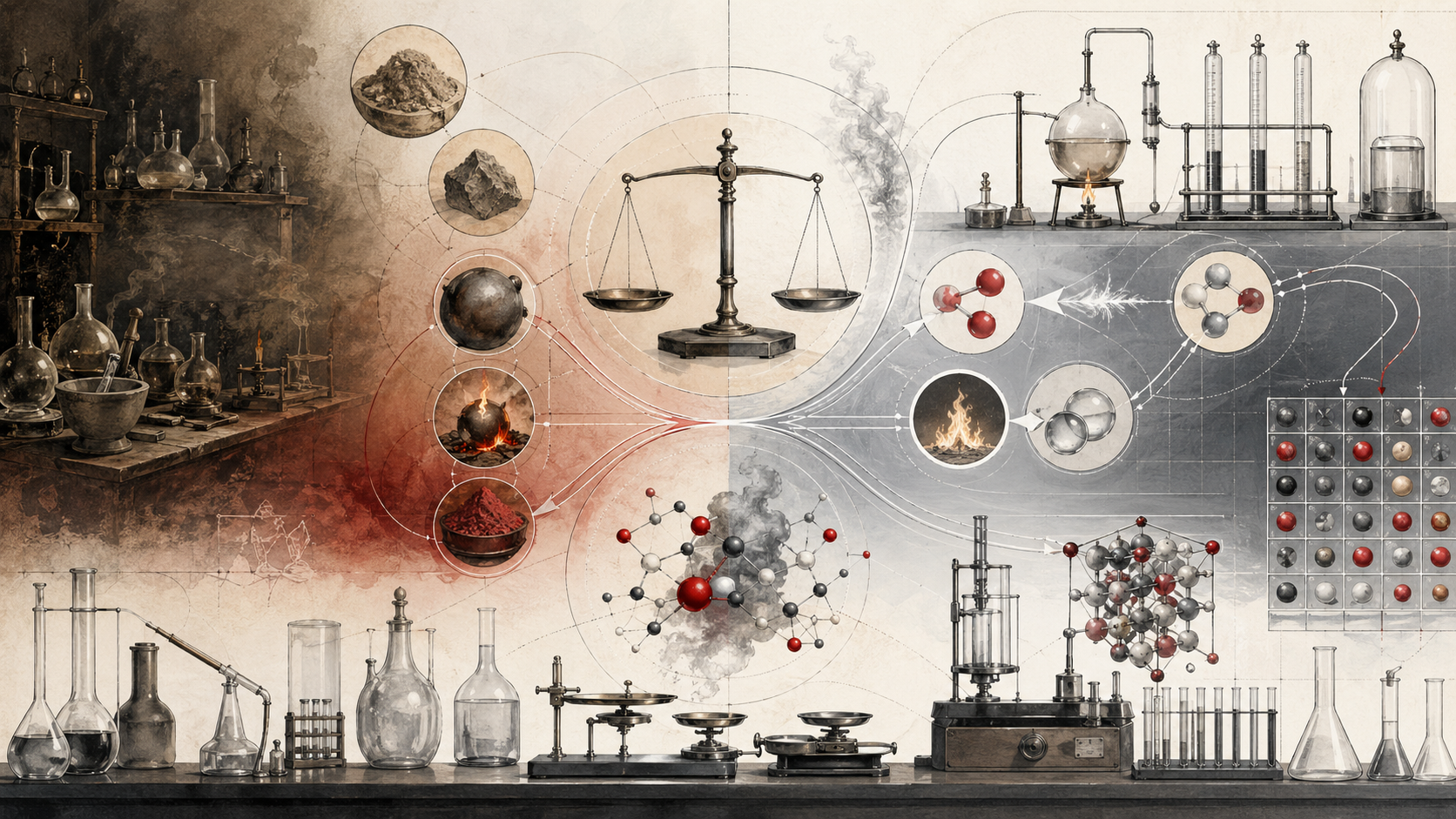
The Chemical Revolution matters because it changed what counted as chemical explanation. Before the late eighteenth century, chemical knowledge often depended on qualitative description, artisanal practice, pharmaceutical tradition, alchemical language, and theories of hidden principles such as phlogiston. After the revolution, chemistry increasingly depended on mass balance, controlled experiment, composition, gas measurement, systematic nomenclature, and a clearer distinction between elements and compounds.
The revolution did not make chemistry instantly complete. Many later developments were still needed: atomic theory, electrochemistry, thermodynamics, structural organic chemistry, spectroscopy, the periodic table, quantum chemistry, and modern analytical instrumentation. Yet the Chemical Revolution created a new discipline in which chemical change could be treated as a measurable transformation of matter.
Its significance can be summarized through several transformations:
- Combustion was reinterpreted. Burning was no longer explained as the release of phlogiston, but as chemical combination with oxygen.
- Mass balance became central. Chemical reactions were understood through conservation and quantitative accounting.
- Gases became chemical substances. Air was no longer a single classical element but a mixture containing distinct gases.
- Nomenclature became systematic. Chemical names began to encode composition and relationships among substances.
- Elements were redefined operationally. An element became a substance not yet decomposed by chemical analysis, rather than one of the ancient four elements.
- Laboratory instruments gained epistemic authority. The balance, closed vessel, gas apparatus, and written record became part of chemical proof.
The Chemical Revolution therefore did not merely add new facts. It reorganized the logic of chemistry. It changed how chemists asked questions, designed experiments, interpreted gases, named substances, and accounted for matter.
Chemistry Before the Revolution
Before chemistry became a modern scientific discipline, chemical knowledge existed in many overlapping traditions. Alchemists, apothecaries, metallurgists, dyers, glassmakers, miners, physicians, natural philosophers, and artisans all developed practical knowledge about substances. They worked with metals, minerals, acids, salts, pigments, medicines, alcohols, gases, combustion, fermentation, distillation, calcination, crystallization, sublimation, and extraction.
This earlier chemistry was not simply irrational or primitive. It contained careful observation, experimental skill, practical technique, and material knowledge. Many early chemists and artisans were skilled experimentalists, even when their theoretical frameworks differed sharply from modern chemistry. Techniques such as distillation, precipitation, alloying, mineral processing, and pharmaceutical extraction provided a material foundation that later chemistry inherited.
Yet pre-revolutionary chemistry lacked a stable conceptual structure. Substances were often classified by sensory properties, origins, uses, reactions with familiar reagents, or inherited names. The language of chemistry varied across regions and traditions. Names could be confusing, metaphorical, artisanal, or historically inherited. The same substance could have multiple names, and different substances could be confused through naming conventions.
Chemistry also lacked a fully modern understanding of gases. Air was often treated as a single element-like medium rather than a mixture. Gases released during reactions were difficult to collect, weigh, and characterize. Combustion was understood through phlogiston theory, which explained burning as the release of a fire-like principle rather than the uptake of oxygen.
The Chemical Revolution emerged when these inherited frameworks became inadequate to explain increasingly precise experimental evidence. It was not simply a replacement of superstition by science. It was a reorganization of practical chemical knowledge into a quantitative, public, reproducible, and conceptually disciplined science of matter.
Alchemy, Artisanship, and Early Experiment
Alchemy is often caricatured as the failed pursuit of gold, but its historical role is more complicated. Alchemical traditions preserved and developed laboratory techniques, apparatus, recipes, symbolic systems, and experimental practices that later chemistry inherited. Alchemists investigated metals, acids, salts, minerals, distillation, transmutation, purification, and the transformation of substances.
Artisanal practices also mattered. Metallurgy required knowledge of ores, furnaces, reduction, alloys, slags, and impurities. Dyeing required control of color, mordants, fibers, and chemical treatment. Pharmacy required extraction, purification, dosage, and preparation of medicines. Glassmaking, ceramics, brewing, soapmaking, tanning, mining, and pigment production all involved practical chemical knowledge.
The rise of modern chemistry therefore did not begin from nothing. It emerged from a material culture of manipulation, observation, measurement, and practice. The difference was not that earlier practitioners lacked skill. The difference was that modern chemistry reorganized that skill around systematic theory, public experiment, measurement, standardized language, and a new understanding of matter.
This historical continuity matters because scientific revolutions rarely erase the past completely. They reinterpret it. The Chemical Revolution transformed inherited practices into a new framework of chemical knowledge. It also changed whose practices were recognized as scientific. Artisans, instrument makers, assistants, translators, collectors, and practitioners contributed to chemical knowledge even when later histories centered only a small number of famous theorists.
A historically serious account of the Chemical Revolution must therefore acknowledge both rupture and continuity. New theories displaced older ones, but they did so by drawing on older techniques, substances, apparatus, and experimental habits.
Phlogiston Theory and Combustion
Phlogiston theory was one of the dominant eighteenth-century explanations of combustion and calcination. In simplified form, it held that combustible substances contained a principle called phlogiston that was released during burning. Metals were thought to contain phlogiston, and when heated they produced calxes, now understood as metal oxides. Burning was interpreted as loss.
This theory had explanatory power in its own context. It connected combustion, metal calcination, reduction, and fuel behavior. It provided a common language for phenomena that seemed related. It was not foolish in the sense of being random. It was a theory built to organize known facts.
Its problem was that increasingly precise measurement created contradictions. When metals were heated in air, their calxes often weighed more than the original metal. If combustion and calcination involved the loss of phlogiston, why did mass increase? Some defenders of phlogiston proposed that phlogiston had negative weight or that the surrounding air played a complex role, but such explanations became increasingly strained.
Lavoisier’s alternative reframed the problem. Instead of asking what was lost from the burning substance, he asked what was gained from the air. Combustion became combination rather than release. This change in direction was revolutionary because it transformed the meaning of the same experimental facts.
The conflict between phlogiston theory and oxygen theory therefore reveals something important about scientific change. Facts do not always speak in isolation. They are interpreted within theoretical systems. A gain in mass during calcination could be treated as an anomaly, an exception, a complication, or a decisive clue depending on the structure of explanation around it.
The Chemical Revolution changed that structure. It made mass gain in oxidation a central piece of evidence rather than a problem to be explained away.
Pneumatic Chemistry and the Discovery of Gases
The Chemical Revolution depended heavily on pneumatic chemistry, the eighteenth-century study of gases. Earlier chemistry struggled with gases because they were difficult to isolate, collect, weigh, and identify. Improved apparatus made it possible to collect gases over water or mercury, study their properties, and distinguish different “airs.”
Several figures were crucial. Joseph Black studied carbon dioxide, then called “fixed air.” Henry Cavendish studied hydrogen, often called “inflammable air.” Joseph Priestley isolated oxygen, though he interpreted it within phlogiston theory as “dephlogisticated air.” Carl Wilhelm Scheele also prepared oxygen independently. These discoveries showed that air was not a single simple substance.
The study of gases changed chemistry because gases could no longer be treated as incidental vapors escaping reaction vessels. They were chemical participants. They could combine, react, support combustion, extinguish flames, be produced by metals and acids, be absorbed by solutions, or be transformed into liquids and solids under appropriate conditions.
Pneumatic chemistry also changed laboratory practice. It required new vessels, troughs, tubes, balances, seals, collection methods, and quantitative techniques. The gas apparatus became a tool for making invisible matter visible to measurement. Gases could be named, collected, compared, reacted, and incorporated into chemical accounting.
Lavoisier’s achievement was not simply the isolation of oxygen. Others had prepared oxygen before him. His larger contribution was interpretive and systematic: he used gas chemistry, balances, combustion experiments, and nomenclature to reorganize the theory of chemical change.
The Chemical Revolution therefore depended on a new material infrastructure for studying air-like substances. Once gases entered chemistry as measurable matter, the old categories of air, fire, and hidden principles became increasingly unstable.
Lavoisier, Measurement, and the Balance
Lavoisier’s chemistry was grounded in measurement. The balance was not merely a laboratory tool; it was an epistemic instrument. It allowed chemical transformation to be tracked through mass.
A reaction that appears to destroy or create matter can be reinterpreted when all reactants and products are accounted for. Gases escaping a vessel, oxygen entering from air, water vapor condensing, or residues forming in a closed system all become part of the chemical ledger. The balance makes the invisible accountable.
This emphasis on measurement distinguished Lavoisier’s work. He repeatedly used closed vessels, careful weighing, and quantitative comparison to show that mass was conserved in chemical operations. The shift was methodological as much as theoretical. Chemistry became a science of accounting for matter.
Measurement also changed the status of theory. A theory of combustion could no longer be judged only by whether it sounded plausible or fit traditional categories. It had to account for changes in mass, gas volumes, residues, and reaction products. Theoretical language had to answer to measured evidence.
In this sense, the Chemical Revolution was a revolution in trust. Chemistry learned to trust the balance over inherited categories. But this trust was not blind. It depended on apparatus, technique, closed systems, careful records, and interpretation. A balance could reveal conservation only when the experimental system was designed to keep track of matter.
The legacy of this methodological shift remains central to chemistry. Every balanced equation, yield calculation, mass-balance model, analytical result, and environmental inventory inherits the idea that chemical claims must account for matter.
Oxygen Theory and the Reinterpretation of Combustion
Oxygen theory reinterpreted combustion as chemical combination with oxygen. In modern terms, many combustion reactions involve oxidation, though the modern concept of oxidation has expanded beyond direct oxygen addition to include electron transfer. In the eighteenth-century context, the crucial point was that combustion involved a component of air rather than the escape of phlogiston.
A simplified combustion reaction can be written as:
C + O_2 \rightarrow CO_2
\]
Interpretation: Carbon combines with oxygen to form carbon dioxide; the product mass reflects the combined mass of carbon and oxygen.
If oxygen from the air is not included in the accounting, the reaction appears mysterious. If oxygen is included, the increase in product mass becomes intelligible. Combustion is no longer understood as a substance losing a fire-like principle. It becomes a process of chemical combination.
This reinterpretation affected metals as well. Metal calcination could be understood as combination with oxygen:
2Mg + O_2 \rightarrow 2MgO
\]
Interpretation: Magnesium oxide weighs more than magnesium alone because oxygen has been incorporated into the product.
The oxide weighs more than the original metal because oxygen has been added. What phlogiston theory treated as loss could be reinterpreted as gain. The same phenomenon had a different meaning under a different theoretical structure.
Lavoisier’s oxygen theory was not perfect in every detail. He believed oxygen was the acid-forming principle, a view later shown to be incorrect. But his broader framework successfully displaced phlogiston and helped establish modern chemical reasoning.
The enduring lesson is not that one eighteenth-century theory was final. It is that chemical explanation became tied to composition, reaction, and measurable material accounting.
Conservation of Mass and Chemical Accounting
The conservation of mass became one of the defining principles of modern chemistry. In a closed chemical system, the total mass before reaction equals the total mass after reaction. Matter is rearranged, not created or destroyed.
In simplified form:
\sum m_{\mathrm{reactants}} = \sum m_{\mathrm{products}}
\]
Interpretation: In a closed system, total reactant mass equals total product mass.
This principle changed chemistry because it made reactions accountable. Every atom had to go somewhere. If a solid gained mass, something must have been added. If a gas escaped, the system was not closed. If a product seemed missing, the experimental design was incomplete or the reaction pathway was misunderstood.
Conservation of mass also prepared chemistry for stoichiometry. Balanced equations became more than symbolic descriptions. They expressed quantitative relationships among reactants and products. The mole concept, atomic theory, and later chemical equations would build on this foundation.
This was a major step in chemistry’s modernization. A reaction was no longer just a visible change: flame, color, precipitate, gas, odor, heat, residue. It became a measurable transformation of matter governed by conservation.
Conservation also created a moral and institutional habit that remains relevant. Matter does not vanish because it leaves the visible system. Waste streams, emissions, residues, solvents, pollutants, and byproducts must be accounted for. The chemical ledger may extend beyond the laboratory vessel into the environment, body, supply chain, or atmosphere.
The Chemical Revolution therefore helped create a discipline of accountability that remains central to laboratory chemistry, environmental chemistry, industrial chemistry, and public chemical responsibility.
Water, Air, and the Reclassification of Substances
The Chemical Revolution transformed the status of water and air. In classical thought, water and air had often been treated as elements. Eighteenth-century gas chemistry showed that air was a mixture, not a single substance. Experiments on hydrogen and oxygen showed that water could be formed from gases and decomposed into them.
This mattered conceptually. If water could be synthesized and decomposed, it was not an element in the modern chemical sense. It was a compound. Air, likewise, was not a simple element but a mixture containing distinct gases, including oxygen and nitrogen.
The formation of water can be represented as:
2H_2 + O_2 \rightarrow 2H_2O
\]
Interpretation: Water can be represented as a compound formed from hydrogen and oxygen rather than as a classical element.
The reclassification of water and air was a deep challenge to inherited categories. It showed that everyday substances could be chemically complex. What seemed simple to the senses could be compound under analysis. What seemed invisible or insubstantial could be chemically specific.
Chemistry therefore changed the meaning of “simple.” A substance was not simple because it appeared uniform, common, or anciently recognized. It was simple if chemical analysis had not decomposed it into more basic substances. This operational definition was central to modern chemical thinking.
The implications reached far beyond water and air. Once substances were classified by decomposition, composition, and reaction evidence, chemistry could build a more systematic material order. Elements, compounds, mixtures, gases, salts, oxides, acids, and bases could be organized through experimental relationships rather than inherited philosophical categories.
Nomenclature and the Language of Modern Chemistry
The Chemical Revolution was also a revolution in language. Chemical names before the late eighteenth century were often inconsistent, historical, artisanal, or metaphorical. Names did not reliably encode composition. A chemist learning substances had to memorize a confusing vocabulary of traditional names.
The 1787 Méthode de nomenclature chimique, associated with Guyton de Morveau, Lavoisier, Berthollet, and Fourcroy, helped systematize chemical naming. The new nomenclature aimed to make names more rational, compositional, and teachable. Chemical language was no longer only a memory system. It became an analytical system.
This mattered because names guide thought. A name that encodes composition encourages a chemist to think structurally. A name that distinguishes oxides, acids, salts, and elements helps organize reactions and relationships among substances. A standardized nomenclature allows chemical knowledge to travel across laboratories, countries, textbooks, industries, and generations.
Modern IUPAC nomenclature is much more elaborate than the eighteenth-century system, but the basic impulse remains: chemical names should not be arbitrary labels. They should support clarity, reproducibility, and shared understanding.
The Chemical Revolution therefore shows that science depends not only on instruments and experiments, but also on language. To rename substances was to reorganize chemical reality. A new naming system made it easier to teach the new chemistry, reproduce experiments, compare results, classify compounds, and build institutional consensus.
Nomenclature is sometimes treated as a technical detail, but in chemistry it is part of the infrastructure of knowledge. A chemical name can carry assumptions about composition, oxidation state, functional group, structure, class, or reaction relationship. Language becomes a tool of scientific ordering.
Elements, Compounds, and the New Chemical Order
Lavoisier’s Traité élémentaire de chimie included a table of simple substances, often described as one of the first modern lists of chemical elements. Some entries were later rejected, including light and caloric, but the conceptual shift was decisive. Elements were not the ancient four elements of earth, air, fire, and water. They were substances not yet decomposed by chemical analysis.
This was an operational definition. It did not claim eternal finality. A substance counted as simple if current chemical methods could not break it down further. Later science could revise the list. That openness was a strength: chemical classification became tied to evidence and analysis.
The distinction between elements and compounds became central to modern chemistry. Elements combine to form compounds. Compounds can often be decomposed into elements or simpler substances. Mixtures can be separated physically or analytically. Chemical reactions rearrange components rather than violating conservation.
This new chemical order made the material world legible. It allowed chemists to classify substances according to composition and transformation rather than appearance, tradition, or vague principle. Chemistry became a science of material structure.
The operational definition of element also prepared the way for later revision. Dalton’s atomic theory, Mendeleev’s periodic table, nuclear chemistry, isotopes, and quantum chemistry would eventually transform what “element” meant. But the Chemical Revolution created the disciplined habit of treating elemental classification as an evidence-based chemical question.
The new chemical order was therefore dynamic. It allowed chemistry to become systematic without becoming closed. Classification could change when decomposition methods, instruments, theories, or evidence changed.
The Chemical Revolution as a Change in Method
The Chemical Revolution is often told as a theory change: phlogiston was replaced by oxygen theory. That is true, but incomplete. The revolution was also a change in method.
Several methodological changes mattered:
- Closed-system reasoning: reactions had to account for all substances entering and leaving the system.
- Mass balance: quantitative weighing became central to chemical explanation.
- Gas collection: gases became measurable reactants and products.
- Systematic nomenclature: chemical language became more standardized and compositional.
- Operational classification: elements were defined through analytical practice.
- Public pedagogy: textbooks and nomenclature helped institutionalize the new chemistry.
- Instrumental accountability: balances, vessels, and gas apparatus helped transform sensory observation into measurable evidence.
- Record-based reproducibility: chemical claims increasingly depended on procedures that others could understand and repeat.
This methodological transformation is why the Chemical Revolution remains important. It did not simply replace one vocabulary with another. It created a new standard for chemical knowledge: measure, account, name, classify, and reproduce.
Modern chemistry still depends on this standard. A result must be measured. A compound must be characterized. A reaction must be balanced. A method must be reproducible. A name must communicate. A claim must survive evidence.
The Chemical Revolution therefore gave chemistry a new discipline of proof. Chemical explanation became accountable to instruments, quantities, and shared language.
Instruments, Institutions, and Public Chemical Knowledge
The rise of modern chemistry required more than individual insight. It required instruments, institutions, publications, correspondence networks, teaching practices, translations, academies, workshops, and public demonstrations. Chemical knowledge had to circulate before it could stabilize.
Instruments played a central role. Precision balances, sealed vessels, gas collection apparatus, furnaces, thermometers, pneumatic troughs, and glassware changed what chemists could observe and measure. They also changed what chemists trusted. A carefully weighed closed-system experiment could challenge a long-standing theory more effectively than sensory description alone.
Institutions also mattered. Academies, laboratories, publishers, educational reforms, and state-supported scientific projects helped make the new chemistry visible. Nomenclature was not only a conceptual reform; it was a pedagogical and institutional project. Textbooks carried the new language into classrooms. Translations carried it across linguistic borders. Laboratory practices trained students to think quantitatively.
This public and institutional dimension complicates simple heroic accounts of the Chemical Revolution. Lavoisier was central, but the revolution depended on a wider world of collaborators, critics, instrument makers, assistants, translators, teachers, and readers. Scientific change requires communities that can reproduce, debate, standardize, and teach new methods.
The Chemical Revolution also reminds us that scientific knowledge is material. It depends on objects: balances, bottles, furnaces, vessels, reagents, printed books, tables, diagrams, and samples. A new theory becomes powerful when it can be embodied in practice.
The history of modern chemistry is therefore also the history of the infrastructures that made chemical evidence public.
Limits, Complexities, and Historical Cautions
The Chemical Revolution should not be reduced to a heroic myth in which one genius simply defeated error. Lavoisier was crucial, but he worked within a broader community of chemists, instrument makers, translators, collaborators, critics, and predecessors. Priestley, Scheele, Cavendish, Black, Berthollet, Fourcroy, Guyton de Morveau, and many others were part of the transformation.
Nor was the new chemistry immediately perfect. Lavoisier’s theory of acids was mistaken. Caloric theory later disappeared. Atomic theory was not yet fully developed. Chemical structure, valence, thermodynamics, and quantum chemistry came later. The periodic table was a nineteenth-century achievement. Modern chemistry emerged through successive reorganizations, not one single event.
It is also important to recognize the social and political context. Lavoisier was a scientist, administrator, reformer, and tax official in pre-revolutionary France. He was executed during the French Revolution in 1794. The history of modern chemistry is therefore entangled with institutions, state power, taxation, war, education, industry, and social upheaval.
The phrase “Chemical Revolution” is useful, but it should not obscure continuity. Earlier chemistry contributed techniques, substances, apparatus, and experimental questions. The revolution transformed inherited practices rather than creating chemistry from nothing.
Historical caution also means avoiding presentism. It is easy to judge earlier theories only by modern correctness. A better historical approach asks what problems those theories solved, what evidence they organized, what instruments were available, and why certain interpretations became persuasive or unstable. Phlogiston theory was eventually displaced, but it was not meaningless within its own intellectual setting.
A mature account of the Chemical Revolution therefore treats it as a transformation in theory, method, language, instruments, institutions, and evidence—not as a simple story of ignorance replaced by truth.
Legacy for Modern Chemistry
The Chemical Revolution’s legacy is visible throughout modern chemistry. Every balanced equation inherits the idea that matter must be accounted for. Every chemical name inherits the demand that language support systematic understanding. Every laboratory balance inherits the belief that measurement can discipline theory. Every calibration curve and reference material extends the revolution’s commitment to quantitative comparability.
The revolution also reshaped the relationship between chemistry and evidence. Chemical knowledge became less dependent on inherited categories and more dependent on controlled experiment, measurable quantities, and reproducible procedures. This shift made later developments possible: atomic theory, stoichiometry, electrochemistry, thermodynamics, spectroscopy, analytical chemistry, industrial chemistry, and molecular science.
The legacy is also ethical and civic. Conservation of matter is not only a laboratory principle. It informs how modern societies should think about pollution, waste, emissions, resource extraction, climate chemistry, and industrial byproducts. Substances do not disappear because they leave the immediate field of view. They move, transform, accumulate, dilute, react, or persist.
In this sense, the Chemical Revolution still matters because modern societies struggle with chemical accountability. Plastics, greenhouse gases, PFAS, heavy metals, pharmaceuticals, fertilizers, solvents, pesticides, and industrial emissions all require chemical accounting. The lesson of the balance remains urgent: matter must be traced.
The Chemical Revolution gave chemistry a modern scientific foundation. The contemporary challenge is to extend that foundation into responsible chemical systems, environmental governance, open data, reproducible measurement, and public accountability.
Mathematical Lens: The Chemical Revolution
The Chemical Revolution can be understood mathematically as a shift toward mass balance, stoichiometric accounting, and closed-system reasoning. Conservation of mass is:
\sum m_{\mathrm{reactants}} = \sum m_{\mathrm{products}}
\]
Interpretation: In a closed chemical system, total reactant mass equals total product mass.
Mass gain in oxidation can be represented as:
m_{\mathrm{oxide}} = m_{\mathrm{metal}} + m_{\mathrm{oxygen}}
\]
Interpretation: A metal oxide can weigh more than the original metal because oxygen has been incorporated from the surrounding environment.
Combustion of carbon can be represented as:
C + O_2 \rightarrow CO_2
\]
Interpretation: Combustion is represented as chemical combination with oxygen rather than release of phlogiston.
Formation of water can be represented as:
2H_2 + O_2 \rightarrow 2H_2O
\]
Interpretation: Water is represented as a compound formed from hydrogen and oxygen.
A stoichiometric ratio is:
\frac{n_A}{a} = \frac{n_B}{b}
\]
Interpretation: Amounts of substances \(A\) and \(B\) relate through their coefficients \(a\) and \(b\) in a balanced chemical equation.
Mass fraction is:
w_i = \frac{m_i}{m_{\mathrm{total}}}
\]
Interpretation: The mass fraction \(w_i\) of component \(i\) supports compositional analysis and material accounting.
A simplified closed-system balance can be expressed as:
m_{\mathrm{initial}} – m_{\mathrm{final}} = 0
\]
Interpretation: A properly closed system should show no net mass loss or gain after accounting for all chemical products and phases.
These equations show why the Chemical Revolution was not only conceptual. It was quantitative. Chemistry became modern when reaction became accountable through mass, proportion, closed-system reasoning, and evidence.
Computational Workflows for Historical Chemical Accounting
Computational workflows can make the Chemical Revolution’s quantitative logic visible. A workflow can represent historical reaction examples, mass-conservation checks, oxygen uptake, gas stoichiometry, nomenclature mappings, old-to-modern substance names, source metadata, and evidence provenance.
Useful workflows include conservation-of-mass tables, oxidation mass-gain calculators, combustion stoichiometry demonstrations, hydrogen-oxygen water-formation models, old-to-modern nomenclature registers, timeline databases, apparatus inventories, source-citation tables, and SQL evidence systems for historical chemical claims.
For researchers and educators, historical chemistry workflows should preserve four distinctions:
- Historical term versus modern substance: “fixed air,” “inflammable air,” and “dephlogisticated air” require careful mapping to modern terms.
- Experiment versus interpretation: Priestley and Lavoisier could observe related phenomena while interpreting them differently.
- Mass balance versus modern atomic theory: eighteenth-century conservation reasoning preceded fully developed atomic and molecular theory.
- Hero narrative versus collective transformation: Lavoisier was central, but the revolution involved many people, practices, instruments, and institutions.
The examples below use synthetic educational data. They do not reconstruct exact historical experiments, certify historical quantities, or replace archival scholarship. They demonstrate how mass accounting, oxidation, gas stoichiometry, nomenclature mapping, and historical evidence can be structured for reproducible teaching and research workflows.
Python Example: Mass Conservation, Oxidation, Gas Stoichiometry, and Provenance
The following Python example uses synthetic educational data to model conservation of mass, metal oxidation, combustion, water formation, old-to-modern nomenclature mapping, and provenance outputs. It is a teaching scaffold, not a reconstruction of exact historical experiments.
from pathlib import Path
import json
import platform
import sys

import numpy as np
import pandas as pd


# Synthetic Chemical Revolution workflow.
# Educational example only.
# This script illustrates mass accounting, oxidation, gas stoichiometry,
# nomenclature mapping, and provenance for historical chemistry teaching.
# It does not reconstruct exact eighteenth-century experiments.


def require_columns(data: pd.DataFrame, required: list[str], table_name: str) -> None:
    """Raise an error if required columns are missing."""
    missing = [column for column in required if column not in data.columns]
    if missing:
        raise ValueError(f"{table_name} is missing required columns: {missing}")


reactions = pd.DataFrame(
    {
        "reaction": [
            "carbon_combustion",
            "magnesium_oxidation",
            "water_formation",
            "mercury_calx_reduction",
        ],
        "reactant_mass_g": [44.0, 40.3, 36.0, 216.6],
        "product_mass_g": [44.0, 40.3, 36.0, 216.6],
        "historical_theme": [
            "combustion_as_combination",
            "metal_calcination_as_oxygen_uptake",
            "water_as_compound",
            "calx_as_compound",
        ],
    }
)

require_columns(
    reactions,
    ["reaction", "reactant_mass_g", "product_mass_g"],
    "reactions",
)

reactions["mass_difference_g"] = (
    reactions["product_mass_g"] - reactions["reactant_mass_g"]
)
reactions["conserved_within_tolerance"] = reactions["mass_difference_g"].abs() < 1e-9

oxidation = pd.DataFrame(
    {
        "metal": ["magnesium", "iron", "copper"],
        "metal_mass_g": [24.305, 55.845, 63.546],
        "oxygen_mass_g": [16.000, 16.000, 16.000],
        "oxide_example": ["MgO", "FeO_simplified", "CuO_simplified"],
    }
)

oxidation["oxide_mass_g"] = (
    oxidation["metal_mass_g"] + oxidation["oxygen_mass_g"]
)
oxidation["oxygen_mass_fraction"] = (
    oxidation["oxygen_mass_g"] / oxidation["oxide_mass_g"]
)
oxidation["percent_mass_gain_from_oxygen"] = (
    oxidation["oxygen_mass_g"] / oxidation["metal_mass_g"] * 100.0
)

combustion = pd.DataFrame(
    {
        "reaction": ["C + O2 -> CO2"],
        "carbon_mass_g": [12.011],
        "oxygen_mass_g": [31.998],
    }
)

combustion["carbon_dioxide_mass_g"] = (
    combustion["carbon_mass_g"] + combustion["oxygen_mass_g"]
)
combustion["oxygen_mass_fraction_in_product"] = (
    combustion["oxygen_mass_g"] / combustion["carbon_dioxide_mass_g"]
)

water_formation = pd.DataFrame(
    {
        "reaction": ["2H2 + O2 -> 2H2O"],
        "hydrogen_mass_g": [4.032],
        "oxygen_mass_g": [31.998],
    }
)

water_formation["water_mass_g"] = (
    water_formation["hydrogen_mass_g"] + water_formation["oxygen_mass_g"]
)
water_formation["oxygen_mass_fraction_in_water"] = (
    water_formation["oxygen_mass_g"] / water_formation["water_mass_g"]
)

nomenclature = pd.DataFrame(
    {
        "older_name": [
            "fixed air",
            "inflammable air",
            "dephlogisticated air",
            "calx of mercury",
            "vitriolic acid",
            "marine acid",
        ],
        "modern_name": [
            "carbon dioxide",
            "hydrogen",
            "oxygen",
            "mercury oxide",
            "sulfuric acid",
            "hydrochloric acid",
        ],
        "conceptual_shift": [
            "gas as chemical substance",
            "gas as chemical substance",
            "oxygen theory",
            "oxide as compound",
            "acid nomenclature",
            "acid nomenclature",
        ],
        "mapping_caution": [
            "context-dependent historical term",
            "context-dependent historical term",
            "Priestley interpreted within phlogiston theory",
            "modern composition-based name",
            "older acid terminology",
            "older acid terminology",
        ],
    }
)

figures = pd.DataFrame(
    {
        "figure": [
            "Antoine-Laurent Lavoisier",
            "Joseph Priestley",
            "Henry Cavendish",
            "Carl Wilhelm Scheele",
            "Joseph Black",
            "Guyton de Morveau",
            "Claude Louis Berthollet",
            "Antoine-Francois de Fourcroy",
        ],
        "associated_theme": [
            "oxygen theory and mass balance",
            "dephlogisticated air and pneumatic chemistry",
            "inflammable air and water formation",
            "independent preparation of oxygen",
            "fixed air",
            "systematic nomenclature",
            "chemical nomenclature and affinity",
            "chemical nomenclature and pedagogy",
        ],
        "interpretive_note": [
            "central but not solitary figure",
            "observed oxygen but retained phlogiston interpretation",
            "important gas chemistry contributor",
            "oxygen prepared independently",
            "carbon dioxide studies",
            "coauthor of nomenclature reform",
            "coauthor of nomenclature reform",
            "coauthor of nomenclature reform",
        ],
    }
)

timeline = pd.DataFrame(
    {
        "year": [1754, 1766, 1774, 1777, 1787, 1789, 1794],
        "event": [
            "Black studies fixed air",
            "Cavendish studies inflammable air",
            "Priestley isolates oxygen-like gas",
            "Lavoisier develops oxygen theory of combustion",
            "Methode de nomenclature chimique published",
            "Lavoisier publishes Traite elementaire de chimie",
            "Lavoisier executed during the French Revolution",
        ],
        "historical_caution": [
            "date simplified for teaching",
            "date simplified for teaching",
            "interpretation differed from later oxygen theory",
            "oxygen theory developed across several works",
            "collective nomenclature project",
            "included some later-rejected simple substances",
            "political context matters",
        ],
    }
)

review_notes = pd.DataFrame(
    [
        {
            "review_item": "mass_conservation",
            "status": "synthetic",
            "note": "examples illustrate closed-system reasoning, not exact historical measurements",
        },
        {
            "review_item": "oxidation_mass_gain",
            "status": "educational",
            "note": "shows oxygen incorporation as mass gain",
        },
        {
            "review_item": "nomenclature_mapping",
            "status": "historically_cautious",
            "note": "older terms are context-dependent and should not be mapped mechanically",
        },
        {
            "review_item": "historical_figures",
            "status": "collective_history",
            "note": "avoids reducing the Chemical Revolution to a one-person story",
        },
        {
            "review_item": "timeline",
            "status": "teaching_scaffold",
            "note": "dates and events require source review for scholarly work",
        },
    ]
)

output_dir = Path("outputs")
output_dir.mkdir(exist_ok=True)

reactions.to_csv(output_dir / "synthetic_mass_conservation_examples.csv", index=False)
oxidation.to_csv(output_dir / "synthetic_oxidation_mass_gain.csv", index=False)
combustion.to_csv(output_dir / "synthetic_carbon_combustion.csv", index=False)
water_formation.to_csv(output_dir / "synthetic_water_formation.csv", index=False)
nomenclature.to_csv(output_dir / "synthetic_nomenclature_mapping.csv", index=False)
figures.to_csv(output_dir / "synthetic_historical_figures.csv", index=False)
timeline.to_csv(output_dir / "synthetic_chemical_revolution_timeline.csv", index=False)
review_notes.to_csv(output_dir / "synthetic_chemical_revolution_review_notes.csv", index=False)

manifest = {
    "workflow": "synthetic_chemical_revolution_workflow",
    "data_type": "synthetic educational historical chemistry records",
    "equations": [
        "sum(m_reactants) = sum(m_products)",
        "m_oxide = m_metal + m_oxygen",
        "C + O2 -> CO2",
        "2H2 + O2 -> 2H2O",
        "mass_fraction = component_mass / total_mass",
    ],
    "cautions": [
        "Synthetic educational data only.",
        "Not a reconstruction of exact historical experiments.",
        "Historical nomenclature mappings are context-dependent.",
        "Historical interpretation requires primary sources and specialist scholarship.",
        "The Chemical Revolution should not be reduced to a single heroic narrative.",
    ],
    "python_version": sys.version,
    "platform": platform.platform(),
    "numpy_version": np.__version__,
    "pandas_version": pd.__version__,
    "output_files": [
        "outputs/synthetic_mass_conservation_examples.csv",
        "outputs/synthetic_oxidation_mass_gain.csv",
        "outputs/synthetic_carbon_combustion.csv",
        "outputs/synthetic_water_formation.csv",
        "outputs/synthetic_nomenclature_mapping.csv",
        "outputs/synthetic_historical_figures.csv",
        "outputs/synthetic_chemical_revolution_timeline.csv",
        "outputs/synthetic_chemical_revolution_review_notes.csv",
        "outputs/chemical_revolution_manifest.json",
    ],
}

with (output_dir / "chemical_revolution_manifest.json").open(
    "w",
    encoding="utf-8"
) as file:
    json.dump(manifest, file, indent=2)

print("Mass conservation examples")
print("--------------------------")
print(reactions.to_string(index=False))

print("\nOxidation mass gain")
print("-------------------")
print(oxidation.round(4).to_string(index=False))

print("\nCombustion")
print("----------")
print(combustion.round(4).to_string(index=False))

print("\nWater formation")
print("---------------")
print(water_formation.round(4).to_string(index=False))

print("\nNomenclature mapping")
print("--------------------")
print(nomenclature.to_string(index=False))

print("\nHistorical figures")
print("------------------")
print(figures.to_string(index=False))

print("\nReview notes")
print("------------")
print(review_notes.to_string(index=False))
This workflow demonstrates historical chemical accounting rather than certified historical reconstruction. It separates mass conservation, oxidation, combustion, water formation, nomenclature mapping, historical figures, timeline records, review notes, and provenance. A real scholarly workflow would add primary-source excerpts, archival metadata, edition information, translation status, historiographic interpretation, and source-critical review.
R Example: Mass Balance, Oxidation, and Nomenclature Mapping
The following R example uses synthetic educational data to summarize conservation of mass, oxidation mass gain, old-to-modern nomenclature mapping, and historical review notes. It is intended for teaching and reproducible documentation, not as a substitute for historical scholarship.
# Synthetic Chemical Revolution scaffold.
# Educational example only.
# This is not a reconstruction of exact eighteenth-century experiments.

reactions <- data.frame(
  reaction = c(
    "carbon_combustion",
    "magnesium_oxidation",
    "water_formation",
    "mercury_calx_reduction"
  ),
  reactant_mass_g = c(44.0, 40.3, 36.0, 216.6),
  product_mass_g = c(44.0, 40.3, 36.0, 216.6),
  historical_theme = c(
    "combustion_as_combination",
    "metal_calcination_as_oxygen_uptake",
    "water_as_compound",
    "calx_as_compound"
  )
)

reactions$mass_difference_g <-
  reactions$product_mass_g - reactions$reactant_mass_g

reactions$conserved_within_tolerance <-
  abs(reactions$mass_difference_g) < 1e-9

oxidation <- data.frame(
  metal = c("magnesium", "iron", "copper"),
  metal_mass_g = c(24.305, 55.845, 63.546),
  oxygen_mass_g = c(16.000, 16.000, 16.000),
  oxide_example = c("MgO", "FeO_simplified", "CuO_simplified")
)

oxidation$oxide_mass_g <-
  oxidation$metal_mass_g + oxidation$oxygen_mass_g

oxidation$oxygen_mass_fraction <-
  oxidation$oxygen_mass_g / oxidation$oxide_mass_g

oxidation$percent_mass_gain_from_oxygen <-
  100 * oxidation$oxygen_mass_g / oxidation$metal_mass_g

nomenclature <- data.frame(
  older_name = c(
    "fixed air",
    "inflammable air",
    "dephlogisticated air",
    "calx of mercury",
    "vitriolic acid",
    "marine acid"
  ),
  modern_name = c(
    "carbon dioxide",
    "hydrogen",
    "oxygen",
    "mercury oxide",
    "sulfuric acid",
    "hydrochloric acid"
  ),
  conceptual_shift = c(
    "gas as chemical substance",
    "gas as chemical substance",
    "oxygen theory",
    "oxide as compound",
    "acid nomenclature",
    "acid nomenclature"
  ),
  caution = c(
    "context-dependent historical term",
    "context-dependent historical term",
    "Priestley interpreted within phlogiston theory",
    "modern composition-based name",
    "older acid terminology",
    "older acid terminology"
  )
)

timeline <- data.frame(
  year = c(1754, 1766, 1774, 1777, 1787, 1789, 1794),
  event = c(
    "Black studies fixed air",
    "Cavendish studies inflammable air",
    "Priestley isolates oxygen-like gas",
    "Lavoisier develops oxygen theory of combustion",
    "Methode de nomenclature chimique published",
    "Lavoisier publishes Traite elementaire de chimie",
    "Lavoisier executed during the French Revolution"
  ),
  caution = c(
    "date simplified for teaching",
    "date simplified for teaching",
    "interpretation differed from later oxygen theory",
    "oxygen theory developed across several works",
    "collective nomenclature project",
    "included some later-rejected simple substances",
    "political context matters"
  )
)

review_notes <- data.frame(
  review_item = c(
    "mass conservation",
    "oxidation mass gain",
    "nomenclature mapping",
    "timeline",
    "historical interpretation"
  ),
  status = c(
    "synthetic",
    "educational",
    "context-dependent",
    "teaching scaffold",
    "requires source review"
  ),
  note = c(
    "examples illustrate closed-system reasoning",
    "oxygen incorporation explains product mass gain",
    "older terms should not be mapped mechanically",
    "dates and events require scholarly checking",
    "primary sources and historiography should guide interpretation"
  )
)

dir.create("outputs", showWarnings = FALSE)

write.csv(
  reactions,
  file = "outputs/r_mass_conservation_examples.csv",
  row.names = FALSE
)

write.csv(
  oxidation,
  file = "outputs/r_oxidation_mass_gain.csv",
  row.names = FALSE
)

write.csv(
  nomenclature,
  file = "outputs/r_nomenclature_mapping.csv",
  row.names = FALSE
)

write.csv(
  timeline,
  file = "outputs/r_chemical_revolution_timeline.csv",
  row.names = FALSE
)

write.csv(
  review_notes,
  file = "outputs/r_chemical_revolution_review_notes.csv",
  row.names = FALSE
)

sink("outputs/r_chemical_revolution_report.txt")
cat("Synthetic Chemical Revolution Scaffold Report\n")
cat("=============================================\n\n")
cat("Mass conservation examples:\n")
print(reactions)
cat("\nOxidation mass gain:\n")
print(oxidation)
cat("\nNomenclature mapping:\n")
print(nomenclature)
cat("\nTimeline:\n")
print(timeline)
cat("\nReview notes:\n")
print(review_notes)
cat("\nResponsible-use note:\n")
cat("Synthetic educational data only. Historical interpretation requires primary sources, edition awareness, translation review, and historiographic context.\n")
sink()

print(reactions)
print(oxidation)
print(nomenclature)
print(timeline)
print(review_notes)
This scaffold shows how R can support historical chemistry tables, mass-balance examples, nomenclature mapping, and source-review notes. The central issue is not the language but the evidence chain. Historical chemical interpretation should remain connected to primary sources, translation choices, historiography, and caution about retrospective terminology.
SQL Example: Chemical Revolution Evidence Register
The Chemical Revolution can be studied as a structured evidence system: historical figures, experiments, instruments, gases, reactions, nomenclature reforms, publications, interpretations, source editions, and modern mappings. A simple evidence register can preserve the context needed to audit historical chemical claims.
CREATE TABLE historical_source (
    source_id TEXT PRIMARY KEY,
    author_name TEXT,
    source_title TEXT NOT NULL,
    publication_year INTEGER,
    source_type TEXT,
    language TEXT,
    edition_or_translation TEXT,
    source_uri TEXT,
    source_review_status TEXT,
    notes TEXT
);

CREATE TABLE historical_figure (
    figure_id TEXT PRIMARY KEY,
    figure_name TEXT NOT NULL,
    birth_year INTEGER,
    death_year INTEGER,
    role_description TEXT,
    associated_theme TEXT,
    figure_review_status TEXT,
    notes TEXT
);

CREATE TABLE chemical_revolution_event (
    event_id TEXT PRIMARY KEY,
    event_year INTEGER,
    event_name TEXT NOT NULL,
    event_description TEXT,
    location_description TEXT,
    associated_source_id TEXT,
    event_review_status TEXT,
    FOREIGN KEY (associated_source_id) REFERENCES historical_source(source_id)
);

CREATE TABLE historical_substance_term (
    term_id TEXT PRIMARY KEY,
    historical_name TEXT NOT NULL,
    modern_name TEXT,
    modern_formula TEXT,
    term_context TEXT,
    mapping_confidence TEXT,
    mapping_caution TEXT,
    source_id TEXT,
    term_review_status TEXT,
    FOREIGN KEY (source_id) REFERENCES historical_source(source_id)
);

CREATE TABLE apparatus_record (
    apparatus_id TEXT PRIMARY KEY,
    apparatus_name TEXT NOT NULL,
    apparatus_type TEXT,
    use_description TEXT,
    associated_event_id TEXT,
    source_id TEXT,
    apparatus_review_status TEXT,
    FOREIGN KEY (associated_event_id) REFERENCES chemical_revolution_event(event_id),
    FOREIGN KEY (source_id) REFERENCES historical_source(source_id)
);

CREATE TABLE experiment_record (
    experiment_id TEXT PRIMARY KEY,
    experiment_name TEXT NOT NULL,
    figure_id TEXT,
    event_id TEXT,
    experiment_theme TEXT,
    experimental_description TEXT,
    closed_system_flag TEXT,
    gas_collection_flag TEXT,
    balance_used_flag TEXT,
    source_id TEXT,
    experiment_review_status TEXT,
    FOREIGN KEY (figure_id) REFERENCES historical_figure(figure_id),
    FOREIGN KEY (event_id) REFERENCES chemical_revolution_event(event_id),
    FOREIGN KEY (source_id) REFERENCES historical_source(source_id)
);

CREATE TABLE reaction_accounting_record (
    reaction_record_id TEXT PRIMARY KEY,
    experiment_id TEXT NOT NULL,
    modern_reaction_text TEXT,
    reactant_mass_g REAL,
    product_mass_g REAL,
    mass_difference_g REAL,
    conservation_interpretation TEXT,
    oxygen_uptake_flag TEXT,
    accounting_review_status TEXT,
    FOREIGN KEY (experiment_id) REFERENCES experiment_record(experiment_id)
);

CREATE TABLE interpretation_record (
    interpretation_id TEXT PRIMARY KEY,
    experiment_id TEXT,
    figure_id TEXT,
    interpretation_framework TEXT,
    interpretation_text TEXT,
    modern_commentary TEXT,
    confidence_level TEXT,
    interpretation_review_status TEXT,
    FOREIGN KEY (experiment_id) REFERENCES experiment_record(experiment_id),
    FOREIGN KEY (figure_id) REFERENCES historical_figure(figure_id)
);

CREATE TABLE nomenclature_reform_record (
    nomenclature_id TEXT PRIMARY KEY,
    historical_name TEXT,
    proposed_systematic_name TEXT,
    modern_name TEXT,
    reform_theme TEXT,
    source_id TEXT,
    nomenclature_review_status TEXT,
    FOREIGN KEY (source_id) REFERENCES historical_source(source_id)
);

CREATE TABLE historiographic_claim (
    claim_id TEXT PRIMARY KEY,
    claim_text TEXT NOT NULL,
    claim_type TEXT,
    primary_source_id TEXT,
    secondary_source_id TEXT,
    confidence_level TEXT,
    limitation_notes TEXT,
    review_status TEXT,
    FOREIGN KEY (primary_source_id) REFERENCES historical_source(source_id),
    FOREIGN KEY (secondary_source_id) REFERENCES historical_source(source_id)
);

SELECT
    event.event_year,
    event.event_name,
    figure.figure_name,
    source.source_title,
    source.publication_year,
    term.historical_name,
    term.modern_name,
    term.modern_formula,
    apparatus.apparatus_name,
    experiment.experiment_name,
    experiment.experiment_theme,
    experiment.closed_system_flag,
    experiment.gas_collection_flag,
    experiment.balance_used_flag,
    reaction.modern_reaction_text,
    reaction.reactant_mass_g,
    reaction.product_mass_g,
    reaction.mass_difference_g,
    reaction.conservation_interpretation,
    interpretation.interpretation_framework,
    interpretation.modern_commentary,
    nomenclature.proposed_systematic_name,
    claim.claim_type,
    claim.confidence_level,
    CASE
        WHEN source.source_review_status IS NOT NULL
             AND source.source_review_status != 'pass'
            THEN 'source review required'
        WHEN figure.figure_review_status IS NOT NULL
             AND figure.figure_review_status != 'pass'
            THEN 'historical figure review required'
        WHEN event.event_review_status IS NOT NULL
             AND event.event_review_status != 'pass'
            THEN 'event review required'
        WHEN term.term_review_status IS NOT NULL
             AND term.term_review_status != 'pass'
            THEN 'historical term review required'
        WHEN apparatus.apparatus_review_status IS NOT NULL
             AND apparatus.apparatus_review_status != 'pass'
            THEN 'apparatus review required'
        WHEN experiment.experiment_review_status IS NOT NULL
             AND experiment.experiment_review_status != 'pass'
            THEN 'experiment review required'
        WHEN reaction.accounting_review_status IS NOT NULL
             AND reaction.accounting_review_status != 'pass'
            THEN 'reaction accounting review required'
        WHEN interpretation.interpretation_review_status IS NOT NULL
             AND interpretation.interpretation_review_status != 'pass'
            THEN 'interpretation review required'
        WHEN nomenclature.nomenclature_review_status IS NOT NULL
             AND nomenclature.nomenclature_review_status != 'pass'
            THEN 'nomenclature review required'
        WHEN claim.review_status IS NOT NULL
             AND claim.review_status != 'reviewed'
            THEN 'historiographic claim review required'
        ELSE 'standard review'
    END AS historical_chemistry_review_status
FROM chemical_revolution_event event
LEFT JOIN historical_source source
    ON event.associated_source_id = source.source_id
LEFT JOIN experiment_record experiment
    ON event.event_id = experiment.event_id
LEFT JOIN historical_figure figure
    ON experiment.figure_id = figure.figure_id
LEFT JOIN historical_substance_term term
    ON source.source_id = term.source_id
LEFT JOIN apparatus_record apparatus
    ON event.event_id = apparatus.associated_event_id
LEFT JOIN reaction_accounting_record reaction
    ON experiment.experiment_id = reaction.experiment_id
LEFT JOIN interpretation_record interpretation
    ON experiment.experiment_id = interpretation.experiment_id
LEFT JOIN nomenclature_reform_record nomenclature
    ON source.source_id = nomenclature.source_id
LEFT JOIN historiographic_claim claim
    ON source.source_id = claim.primary_source_id
ORDER BY historical_chemistry_review_status, event.event_year, figure.figure_name, experiment.experiment_name;
The purpose of this register is to keep historical chemical interpretation attached to evidence. A claim about the Chemical Revolution should preserve source identity, publication date, language, edition, translation, historical terminology, experimental apparatus, reaction accounting, interpretation framework, nomenclature context, and historiographic review. Historical chemistry becomes stronger when its evidence trail is structured.
GitHub Repository
The companion repository for this article can support reproducible workflows for mass-conservation examples, oxidation mass-gain tables, gas-reaction stoichiometry, old-to-modern nomenclature mapping, historical timeline records, source metadata, SQL evidence registers, provenance documentation, and responsible historical interpretation.
Complete Code Repository
The full code distribution for this article, including selected Chemical Revolution examples, expanded computational workflows, reproducible data structures, provenance documentation, mass-balance and oxidation scaffolds, historical nomenclature mapping, SQL evidence registers, and scientific-computing infrastructure, is available on GitHub.
Limits, Uncertainty, and Responsible Historical Interpretation
The Chemical Revolution is powerful as an organizing concept, but it must be used carefully. Historical change was not instantaneous, uniform, or reducible to a single experiment. Lavoisier was central, but he was not alone. Priestley, Scheele, Cavendish, Black, Guyton de Morveau, Berthollet, Fourcroy, instrument makers, assistants, translators, publishers, and institutions all contributed to the transformation.
Historical terminology also requires caution. “Fixed air,” “inflammable air,” “dephlogisticated air,” “calx,” “vitriol,” and other historical terms do not always map mechanically onto modern substances. Their meaning depends on context, apparatus, theory, translation, and experimental practice. A modern chemical formula can clarify, but it can also flatten historical complexity.
Modern chemistry should also avoid treating phlogiston theory as simply foolish. The theory organized many observations before oxygen theory displaced it. Its failure became clear through changing experimental practices, better gas chemistry, mass measurement, and new interpretation. Understanding why phlogiston was plausible helps reveal how scientific theories work within available evidence and instruments.
There are also limits in Lavoisier’s own framework. His theory of acids was incorrect. Caloric theory did not survive. His list of simple substances included entities later removed from chemical element lists. Atomic theory, electrochemistry, periodicity, valence, thermodynamics, and quantum structure were still to come. The Chemical Revolution founded modern chemistry, but it did not finish it.
Historical interpretation should therefore match claim strength to evidence. A responsible account should distinguish primary sources, later translations, retrospective interpretation, textbook simplification, and historiographic debate. It should acknowledge both rupture and continuity.
The computational examples associated with this article are synthetic and educational. They do not reconstruct exact historical experiments, certify historical quantities, or replace archival scholarship. They are designed to show how historical chemical accounting can be structured, not to reduce history to spreadsheets.
Responsible historical chemistry should treat the Chemical Revolution as a transformation in theory, measurement, language, instruments, and institutions—not as a simple story of one correct theory defeating one incorrect theory overnight.
Conclusion
The Chemical Revolution gave chemistry a new foundation. It replaced older explanatory systems with a quantitative, measured, systematic science of matter and transformation. It reinterpreted combustion, made gases chemically intelligible, placed the balance at the center of chemical truth, formalized conservation of mass, reorganized chemical nomenclature, and helped redefine elements and compounds.
Its legacy is not merely historical. Modern chemistry still depends on the disciplines it helped establish: careful measurement, mass balance, systematic naming, experimental control, reproducible evidence, and the belief that chemical change can be understood through the structured transformation of matter.
The rise of modern chemistry was therefore not only a change in theory. It was a change in how human beings learned to see matter: not as a collection of mysterious substances, but as a measurable, nameable, transformable order.
The Chemical Revolution matters now because modern societies still struggle with chemical accountability. Pollutants, industrial emissions, greenhouse gases, pharmaceuticals, plastics, fertilizers, solvents, PFAS, heavy metals, pesticides, and waste streams all require chemical accounting. Substances do not disappear because they leave a factory, drain, exhaust pipe, or consumer product. They move, transform, persist, dilute, accumulate, or react.
In that sense, the Chemical Revolution’s deepest lesson remains urgent: matter must be accounted for. What enters a system leaves in some form. Chemical responsibility begins with chemical accounting.
Related articles
- What Is Chemistry?
- Measurement, Quantification, and the Experimental Basis of Chemistry
- Chemical Metrology, Standards, and Reference Materials
- Atoms, Elements, and the Periodic Organization of Matter
- Stoichiometry and the Quantitative Language of Reactions
- Chemical Bonding and Molecular Structure
- The Periodic Table and the Logic of Chemical Classification
- Analytical Chemistry and the Identification of Matter
- Green Chemistry, Responsibility, and Sustainable Transformation
- Natural Science
Further reading
- American Chemical Society (n.d.) The Chemical Revolution of Antoine-Laurent Lavoisier. Available at: https://www.acs.org/education/whatischemistry/landmarks/lavoisier.html
- Science History Institute (n.d.) Antoine-Laurent Lavoisier. Available at: https://www.sciencehistory.org/education/scientific-biographies/antoine-laurent-lavoisier/
- Lavoisier, A.-L. (1789) Traité élémentaire de chimie. Paris: Cuchet. Digital edition available at: https://www.biodiversitylibrary.org/item/118874
- Lavoisier, A.-L. (1790) Elements of Chemistry. Translated by Robert Kerr. Edinburgh: William Creech. Available at: https://archive.org/details/elementschemist00unkngoog
- Lefèvre, W. (2018) ‘The Méthode de nomenclature chimique (1787)’, Ambix, 65(1), pp. 1–9. Available at: https://pubmed.ncbi.nlm.nih.gov/29318939/
- Golinski, J. (1992) Science as Public Culture: Chemistry and Enlightenment in Britain, 1760–1820. Cambridge: Cambridge University Press. Available at: https://www.cambridge.org/core/books/science-as-public-culture/2B02B5768BC0C040581069575899716F
- Holmes, F.L. (1985) Lavoisier and the Chemistry of Life: An Exploration of Scientific Creativity. Madison: University of Wisconsin Press. Available at: https://uwpress.wisc.edu/books/0280.htm
- Bowler, P.J. and Morus, I.R. (2005) Making Modern Science: A Historical Survey. Chicago: University of Chicago Press. Available at: https://press.uchicago.edu/ucp/books/book/chicago/M/bo3534750.html
References
- American Chemical Society (n.d.) The Chemical Revolution of Antoine-Laurent Lavoisier. Available at: https://www.acs.org/education/whatischemistry/landmarks/lavoisier.html
- Bowler, P.J. and Morus, I.R. (2005) Making Modern Science: A Historical Survey. Chicago: University of Chicago Press. Available at: https://press.uchicago.edu/ucp/books/book/chicago/M/bo3534750.html
- Golinski, J. (1992) Science as Public Culture: Chemistry and Enlightenment in Britain, 1760–1820. Cambridge: Cambridge University Press. Available at: https://www.cambridge.org/core/books/science-as-public-culture/2B02B5768BC0C040581069575899716F
- Holmes, F.L. (1985) Lavoisier and the Chemistry of Life: An Exploration of Scientific Creativity. Madison: University of Wisconsin Press. Available at: https://uwpress.wisc.edu/books/0280.htm
- International Union of Pure and Applied Chemistry (n.d.) Compendium of Chemical Terminology: The Gold Book. Available at: https://goldbook.iupac.org/
- Lavoisier, A.-L. (1789) Traité élémentaire de chimie. Paris: Cuchet. Digital edition available at: https://www.biodiversitylibrary.org/item/118874
- Lavoisier, A.-L. (1790) Elements of Chemistry. Translated by Robert Kerr. Edinburgh: William Creech. Available at: https://archive.org/details/elementschemist00unkngoog
- Lefèvre, W. (2018) ‘The Méthode de nomenclature chimique (1787)’, Ambix, 65(1), pp. 1–9. Available at: https://pubmed.ncbi.nlm.nih.gov/29318939/
- National Institute of Standards and Technology (n.d.) NIST Chemistry WebBook. Available at: https://webbook.nist.gov/chemistry/
- Priestley, J. (1775) ‘An Account of Further Discoveries in Air’, Philosophical Transactions of the Royal Society of London, 65, pp. 384–394. Available at: https://royalsocietypublishing.org/doi/10.1098/rstl.1775.0039
- Royal Society Publishing (2015) ‘Gases, God and the balance of nature: a commentary on Priestley (1772) “Observations on different kinds of air”’, Philosophical Transactions of the Royal Society A, 373. Available at: https://royalsocietypublishing.org/doi/10.1098/rsta.2014.0229
- Science History Institute (n.d.) Antoine-Laurent Lavoisier. Available at: https://www.sciencehistory.org/education/scientific-biographies/antoine-laurent-lavoisier/
- Science History Institute (2008) Revolutionary Instruments: Lavoisier’s Tools as Objets d’Art. Available at: https://www.sciencehistory.org/stories/magazine/revolutionary-instruments-lavoisiers-tools-as-objets-dart/