
Last Updated May 28, 2026
Animal biology and the organization of complex life examine how multicellular heterotrophic organisms build tissues, organs, body plans, sensory systems, physiological regulation, and coordinated behaviors through development, ecology, and evolutionary history. Animals are central to biology because they represent one of the most consequential expressions of multicellular organization: living systems in which specialized cells are integrated into tissues, tissues into organs, organs into coordinated bodies, and bodies into ecologically active organisms capable of sensation, movement, predation, symbiosis, reproduction, and environmental transformation.
Animal biology is therefore not simply the study of familiar creatures. It is the study of how complex multicellular organization becomes functionally coherent under real conditions of energy constraint, developmental contingency, ecological interaction, physiological stress, disease exposure, and evolutionary change. Animals reveal how bodies are built, how tissues cooperate, how behavior emerges from sensory and neural coordination, how body size structures energy demand, how life histories shape population dynamics, and how organisms become active participants in ecosystems rather than passive occupants of habitat.
Main Library
Publications
Article Map
Biology
Related Topic
Developmental Biology
Related Topic
Physiology
Related Topic
Ecology
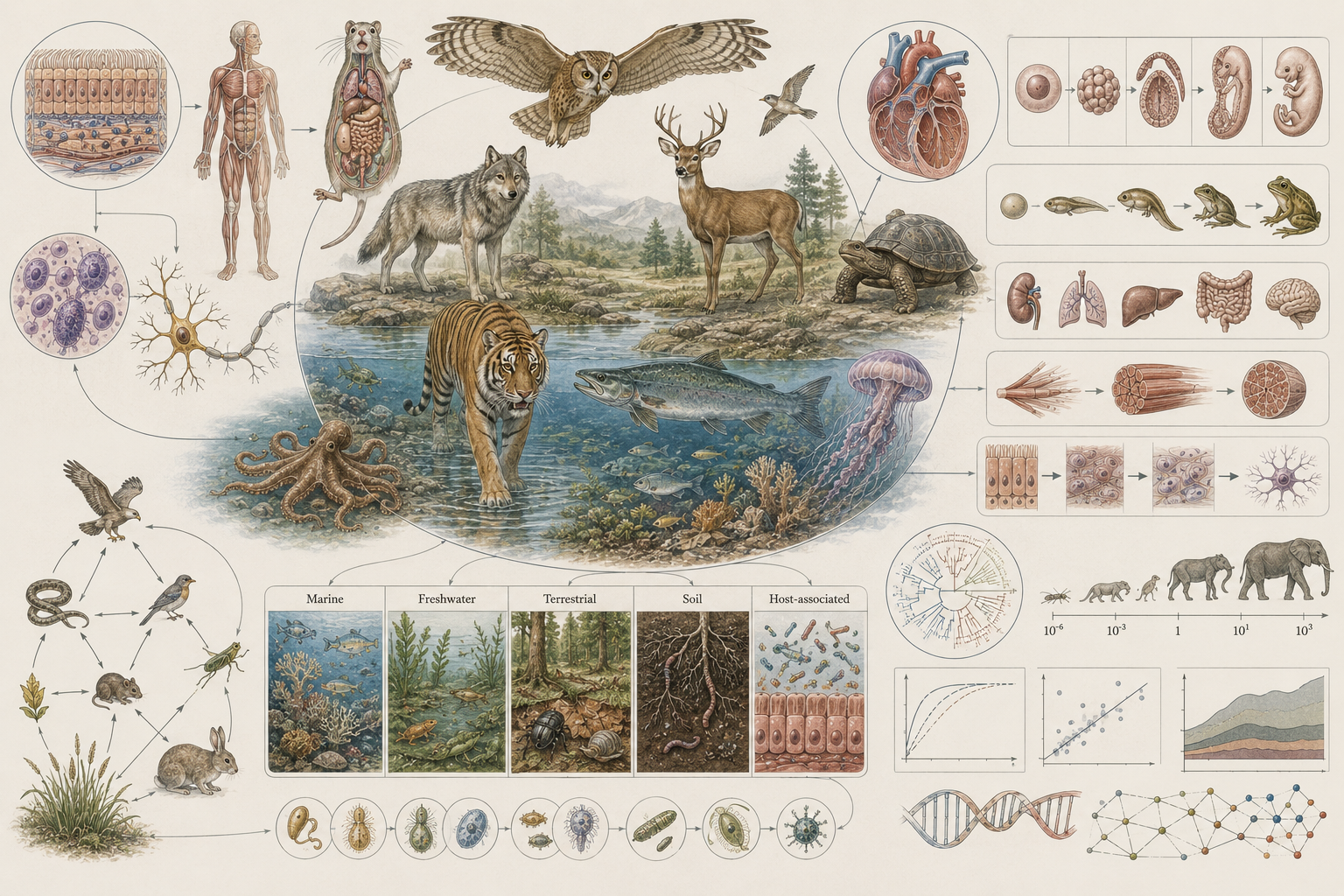
This article develops animal biology as a scale-spanning framework for understanding complex life. It examines metazoan multicellularity, tissue organization, organ systems, body plans, symmetry, development, muscle and nerve, sensory systems, digestion, circulation, respiration, physiology, behavior, food webs, marine and freshwater animal systems, soil and terrestrial animal worlds, symbiosis, disease ecology, conservation, biodiversity, model organisms, comparative biology, genomics, systems biology, and computational modeling.
The article is written for zoologists, ecologists, marine biologists, freshwater scientists, soil ecologists, medical and environmental-health readers, computational biology readers, biodiversity experts, conservation planners, wildlife biologists, disease ecologists, systems biologists, comparative physiologists, developmental biologists, and research biologists who need a rigorous account of how animal organization emerges, persists, adapts, fails, and reshapes living systems.
The article also extends animal biology into quantitative and computational biology through allometric scaling, metabolic demand, logistic population growth, survival and hazard models, stage-structured projection, trait-based risk screening, R workflows, Python workflows, SQL provenance structures, and a linked full-stack GitHub repository containing Python, R, Julia, Fortran, Rust, Go, C, C++, SQL, notebooks, data files, and reproducibility documentation.
What animals are
Animals are multicellular eukaryotes whose cells are typically embedded in extracellular matrices rich in collagen, organized into integrated bodies, and developmentally patterned through regulated cell differentiation and tissue interaction. They are generally heterotrophic and rely on ingestion, internal processing of organic matter, coordinated movement or fluid handling, and physiological regulation to live in environments structured by pursuit, avoidance, exchange, competition, cooperation, and environmental response.
This matters because animal life differs from plant and fungal life not only in diet but in organization. Animals are not simply clusters of cells consuming other organisms. They are multicellular systems built for integration across tissues, organs, signaling pathways, and whole-body behavior. Even where mobility is limited or secondarily reduced, animal bodies are organized around controlled internal coordination: muscle contraction, electrical signaling, endocrine regulation, developmental patterning, immune defense, reproductive timing, and environmental sensing.
Animal biology therefore begins with a fundamental fact: animals are not merely many-celled. They are coordinated multicellular systems in which specialization is inseparable from integration. That is why animal biology sits near the center of comparative life science. It studies one of the major ways complexity becomes biologically operative.
Metazoa and the rise of multicellular complexity
The animals, or metazoans, represent one of the major transitions in the history of life. Their emergence required more than increased size. It required reliable cell adhesion, regulated development, lineage differentiation, communication across tissues, and functional division of labor sustained across the lifetime of an organism. In evolutionary terms, this is one of life’s great organizational achievements: the transformation of cellular collectives into bodies with structured axes, internal compartments, reproducible developmental programs, and ecologically consequential behavior.
This transition matters because multicellular complexity is not a mere accumulation of parts. It is the emergence of coordinated architecture. In animals, cellular specialization eventually produced epithelia, muscle, nerve, secretory systems, immune functions, sensory structures, and reproductive tissues operating within one organismal whole. Even early-diverging animal lineages illuminate this transition by showing that multicellular organization emerged stepwise and that familiar vertebrate-like complexity is only one branch of a much deeper metazoan history.
Animal biology is therefore also a study of emergent complexity. The metazoan body is one of life’s major experiments in turning many cells into one functioning organism, and that experiment continues to shape ecological systems, developmental theory, comparative physiology, evolutionary developmental biology, and modern biomedical science.
Tissues, organs, and the hierarchy of animal organization
One of the defining features of animal biology is hierarchical organization. Similar cells form tissues, tissues cooperate to form organs, and organs interact within organ systems that support the organism as a whole. This nested organization matters because complex animal life depends on specialization with coordination. Epithelia protect and regulate surfaces. Connective tissues support, bind, and transmit force. Muscle generates movement. Nervous tissue integrates information and coordinates response. Blood and circulatory tissues transport oxygen, nutrients, wastes, hormones, and immune cells.
This arrangement is not merely descriptive anatomy. It is the logic of animal function. A heart is meaningful only within circulation; lungs or gills only within gas exchange and metabolic demand; kidneys only within fluid and ion regulation; gonads only within developmental timing and reproductive ecology; brains only within bodies that sense, move, and act. Animal biology is thus a science of coordinated levels. No tissue or organ is fully understandable in isolation from the systems in which it operates.
The organization of complex life therefore depends on nested structure under dynamic constraint. This is why comparative anatomy, physiology, developmental biology, and systems biology converge so naturally in animal science. Complexity in animals is not just a matter of many parts. It is a matter of regulated interdependence among levels of organization.
Muscle, nerve, and the animal mode of life
Animals are especially distinctive because of the evolutionary importance of muscle and nerve. Muscle makes force available to the organism. Nervous systems make distributed sensing, signal integration, and coordinated response possible across the body. Together, these systems support the animal mode of life: active engagement with the environment through movement, sensation, timing, and behavior.
This matters because movement changes biological possibility. Animals can pursue food, escape predators, seek mates, build shelters, migrate across ecosystems, alter habitats, and modulate exposure to stress through locomotion and behavior. Nervous integration extends this capacity by coordinating perception, action, memory, and physiological state. Even relatively simple nervous systems create the possibility of rapid whole-organism response to environmental gradients, threat, opportunity, and social interaction.
The animal mode of life is therefore dynamic rather than merely structural. Unlike many primary producers, animals generally meet the world through active exchange. This does not mean all animals are highly mobile or behaviorally elaborate, but it does mean that animal organization is deeply shaped by the demands of coordinated action in time. That is why Behavior, Communication, and Biological Strategy and Neurobiology and the Organization of Living Response sit so close to the center of animal biology.
Body plans, symmetry, and the architecture of form
Animal life is structured through body plans. Different phyla are organized through recurring large-scale patterns of symmetry, tissue arrangement, segmentation, appendages, gut organization, developmental axes, and skeletal support. This matters because animal form is not an arbitrary accumulation of features. It is patterned architecture with evolutionary history and functional consequence.
Bilateral symmetry supports directional locomotion, cephalization, and differentiated anterior-posterior organization. Segmentation can support modular complexity, repeated structures, and region-specific specialization. Radial or diffuse organization suits different ecological and physiological strategies. Limbs, mouths, sensory organs, reproductive structures, and defensive surfaces are not isolated traits but parts of whole-body design. Morphology in animals is therefore one of the principal ways function becomes possible.
Animal biology is inseparable from morphology because form constrains what an organism can eat, where it can move, how it can reproduce, how it exchanges gases, and how it interacts with predators, symbionts, and physical environments. Body plans are thus not static templates. They are evolved scaffolds through which ecology, development, and physiology become organismally real.
Development, differentiation, and animal life cycles
Complex animal organization arises through development. Early embryonic cells differentiate into distinct lineages, tissues are patterned across body axes, organs are built through morphogenesis, and many animals pass through larval, juvenile, metamorphic, or adult stages with markedly different ecologies and physiological demands. Development matters because animal form is produced historically within the lifetime of the organism rather than appearing as a static final design.
A nervous system, digestive tract, musculature, skeleton, immune repertoire, or reproductive system emerges through regulated developmental processes linking gene expression, signaling gradients, cell interactions, tissue mechanics, and environmental inputs. Development is therefore not merely a preparatory stage before biology “really begins.” It is one of the main ways animal complexity is constructed and constrained.
This makes animal biology inseparable from Development, Differentiation, and the Making of Organisms and from Reproduction, Life Cycles, and Biological Continuity. Complex life is organized developmentally before it is expressed ecologically. This is especially important for marine biologists, conservation practitioners, and disease ecologists, because larval dispersal, metamorphosis, juvenile bottlenecks, and developmental stress often determine population persistence and recovery.
Digestion, circulation, respiration, and animal physiology
Animal physiology depends on internal organization sufficient to move matter, energy, and signals through the body. Digestive systems break down food into absorbable components. Circulatory systems transport gases, nutrients, wastes, hormones, and immune cells. Respiratory surfaces support gas exchange. Excretory systems regulate chemical balance and remove metabolic waste. Endocrine systems coordinate growth, reproduction, metabolism, and stress response. These systems vary enormously across taxa, but their functional logic is consistent: multicellular heterotrophs require coordinated internal transport and regulation.
This matters because animal complexity is energetically expensive and physiologically fragile. Tissues must be maintained, muscles fueled, nerves supplied, reproductive effort supported, and thermal, osmotic, and chemical conditions kept within viable ranges. Physiology is therefore not an added layer on top of anatomy. It is the continuous process that keeps anatomy alive under changing conditions.
Animal biology thus belongs closely with Metabolism, Energy, and Biological Function and Physiology and the Regulation of Living Systems. Complex bodies depend on continuous management of energy, fluid balance, nutrient flow, gas exchange, temperature, waste removal, and interaction with the external environment. Physiological failure is often the immediate mechanism through which ecological stress, disease, and environmental change become lethal.
Behavior, sensation, and the coordination of animal life
Animals are organisms of behavior. They sense gradients, recognize prey and predators, respond to social cues, navigate landscapes, choose habitats, defend territories, rear young, migrate seasonally, and in many cases learn from experience. Sensory systems and nervous integration therefore belong near the center of animal biology because they determine how anatomical and physiological capacities are actually deployed in the world.
This matters because complex life is not only structural. It is temporal, interactive, and strategic. Behavior allows animals to alter the conditions under which they feed, reproduce, avoid danger, cooperate, compete, and survive. Organisms with similar anatomy may occupy radically different ecological roles because of behavioral differences alone. Migration, foraging strategy, mate choice, parental care, sociality, and timing of activity all shape survival and ecological consequence.
Animal organization is therefore physiological, anatomical, and behavioral at once. The animal body is built not just to exist but to act. That is why behavioral ecology, neurobiology, and disease ecology often converge: what an animal does changes its exposure, reproductive output, trophic role, and likelihood of recovery under environmental stress.
Animals, ecology, and the dynamics of food webs
Animals occupy central positions in ecological networks because they consume, transform, transport, and redistribute biomass produced elsewhere in the biosphere. Herbivores connect primary production to higher trophic levels. Carnivores and omnivores restructure prey populations and trophic cascades. Detritivores recycle organic matter. Pollinators, dispersers, scavengers, filter feeders, bioturbators, and ecosystem engineers reshape the physical and reproductive structure of ecological communities.
This matters because animal biology cannot be understood apart from ecology. Animals alter nutrient cycling, community composition, disturbance regimes, seed movement, grazing pressure, decomposition, and even carbon storage indirectly through food-web dynamics. Large vertebrates may structure landscapes through movement and consumption, but invertebrates, zooplankton, benthic feeders, soil fauna, and reef-building animals are just as important in many systems. The ecological force of animals lies not only in charisma or size but in functional position.
Animal life therefore belongs within ecosystems just as strongly as plant life does, though from a different trophic and functional position. In that sense, this article complements Plant Biology and the Life of Primary Producers, Ecology and the Interdependence of Life, and Population Dynamics and Ecological Modeling. Animal biology is relational from the outset because animals are major pathways through which energy and ecological influence move.
Marine, freshwater, soil, and terrestrial animal worlds
Animal biology unfolds across radically different physical environments. Marine animals must manage buoyancy, salinity, oxygen gradients, current, pressure, temperature, depth, and often complex trophic webs structured by fluid movement. Freshwater animals face hydrologic fragmentation, oxygen variability, temperature instability, nutrient pulses, pollutant exposure, and basin isolation. Soil animals inhabit environments structured by pore space, detritus, microbes, moisture, mineral particles, and root systems. Terrestrial animals must manage desiccation, structural support, locomotion under gravity, thermal stress, and patchy resource landscapes.
This matters because animal complexity is always ecologically situated. A fish, worm, mollusk, bird, coral polyp, insect, amphibian, reptile, mammal, nematode, crustacean, and echinoderm all solve the general problem of coordinated multicellular life, but they do so under very different material constraints. Body plan, sensory system, reproduction, respiration, locomotion, and behavior are all shaped by the physical medium in which life unfolds.
For marine biologists, limnologists, soil ecologists, agroecologists, reef scientists, and terrestrial ecologists, this means that environmental medium is not background context. It is a central determinant of animal organization, adaptation, and vulnerability. Animal biology is therefore both general and deeply context-specific, and sustainability-adjacent science cannot afford to isolate organismal form from hydrology, habitat structure, oxygen regimes, temperature, salinity, pressure, substrate, or disturbance.
Animals, symbiosis, disease, and relational biology
Animals do not live alone. Many are deeply entangled with symbionts, microbiomes, parasites, pathogens, commensals, and mutualists. Gut communities influence digestion, immunity, and development. Skin and mucosal microbiota alter barrier function and disease risk. Parasites shape life histories, immune allocation, behavior, and selection. Mutualistic partners may support defense, nutrition, camouflage, or reproduction. These interactions tie animal biology directly to Coevolution, Symbiosis, and the Dynamics of Mutual Change, Microbiology and the Hidden Majority of Life, and Immunology and Biological Defense.
This matters because complex life is relationally organized. Some animal capacities are partly scaffolded by associated microbes or shaped by long histories of host-pathogen interaction. Disease ecology, in turn, depends on animal bodies as hosts, vectors, reservoirs, and participants in transmission networks. A population’s health cannot always be inferred from host genetics or habitat alone; it may depend on microbiome stability, parasite burden, immune state, environmental exposure, climate-sensitive shifts in transmission, and behavioral contact networks.
Animal biology is therefore not just the study of discrete organisms. It is also the study of biological partnerships, infections, dependencies, and conflicts that alter how organisms function, persist, and evolve. This is especially important for wildlife disease, conservation medicine, zoonotic risk, and environmental-health science, where animal decline may be driven by interacting pressures rather than one isolated cause.
Conservation, biodiversity, and systems risk
Animals matter profoundly for conservation because they are major components of biodiversity and major drivers of ecosystem function. They disperse seeds, pollinate plants, regulate prey populations, recycle nutrients, engineer habitats, and connect landscapes through movement. Migratory species, apex predators, insect communities, reef builders, filter feeders, decomposers, and soil fauna all sustain ecological processes across scales.
This matters because animal decline is not only a loss of species counts. It is often a loss of ecological function, evolutionary history, and system-level resilience. When pollinator communities collapse, plant reproduction shifts. When top predators disappear, trophic cascades can intensify. When freshwater invertebrates decline, nutrient processing and food-web transfer weaken. When soil fauna are lost, decomposition, aggregation, and belowground interaction change. Conservation biology must therefore treat animals as both lineages and processes: organisms with histories, but also actors in living systems.
Animal biology is central to biodiversity science precisely because animals often reveal ecological breakdown early and dramatically, while also helping maintain integrity when systems remain intact. This links the subject directly to Biodiversity and the Structure of Living Systems and Restoration Ecology and the Repair of Living Systems. Animal conservation is not separate from systems thinking. It is one of its most visible tests.
Comparative biology, model organisms, and biomedical relevance
Animal biology is foundational to modern biomedical science because many core developmental, physiological, cellular, and behavioral processes are studied in animal model systems. Comparative work across sponges, cnidarians, worms, insects, fish, amphibians, birds, rodents, and primates has revealed both conserved mechanisms and lineage-specific innovations in development, immunity, metabolism, neurobiology, toxicology, regeneration, aging, and disease.
This matters because animal bodies provide experimentally tractable systems for studying differentiation, organogenesis, immune function, metabolism, behavior, aging, and pathological disruption. Comparative animal biology helps scientists distinguish general biological principles from clade-specific adaptations. It also helps identify where extrapolation is justified and where it is misleading.
Biomedical relevance therefore does not reduce animal biology to laboratory utility, but it does show how deeply animal organization informs life science as a whole. For medical professionals and translational researchers, the value of comparative animal biology lies in disciplined comparison: knowing what is conserved, what differs, and how organismal context shapes mechanism.
Genomics, systems biology, and computational relevance
Animal biology increasingly depends on genomics, transcriptomics, proteomics, cell atlases, advanced imaging, biomechanical modeling, phylogenomics, movement ecology, life-history analysis, and comparative systems analysis. These methods matter because complex life must now be studied across scales at once: genes, cells, tissues, organs, whole organisms, populations, and ecosystems. Molecular fingerprinting and cell-type mapping have made it possible to compare developmental programs, tissue diversity, and evolutionary innovation in ways unavailable to earlier biology.
This matters because complex life is not fully legible from morphology alone, nor from sequence alone. Systems biology helps reveal how developmental programs generate body plans, how signaling networks coordinate physiology, how metabolic state interacts with tissue function, and how organismal traits scale up into ecological performance. Computational methods also allow researchers to integrate movement data, physiological measurements, life-history schedules, survival outcomes, and environmental stressors in unified analytical frameworks.
Animal biology is therefore one of the clearest domains in which morphology, development, physiology, ecology, and computation converge. For computational biologists and systems scientists, animals provide analytically rich systems in which integration itself is the object of study.
Quantitative animal biology: mathematics, R, and Python
Animal biology is deeply quantitative because body size, energy use, growth, movement, demographic change, survival, life history, and ecological impact can often be represented mathematically. The goal of modeling is not to flatten the animal world into a few elegant formulas, but to clarify scaling, trade-offs, thresholds, recovery trajectories, and comparative dynamics that matter for real biological reasoning.
Allometric scaling and metabolic demand
One widely used allometric form relates metabolic rate to body mass:
B=B_0M^{3/4}
\]
Interpretation: \(B\) is metabolic rate, \(B_0\) is a normalization constant, and \(M\) is body mass. This is useful because many aspects of animal physiology scale nonlinearly with body size rather than proportionally. Larger animals generally use more total energy, but not in direct linear proportion to mass. Mass-specific metabolic demand often declines as size increases, with broad implications for feeding ecology, movement, life history, thermoregulation, and carrying capacity.
Population growth under limitation
At organismal and ecological scales, animal populations are often modeled with logistic growth:
\frac{dN}{dt}=rN\left(1-\frac{N}{K}\right)
\]
Interpretation: \(N\) is population size, \(r\) is intrinsic growth rate, and \(K\) is carrying capacity. This is useful because animal populations are constrained by food, habitat, predation, disease, territory, reproductive bottlenecks, and environmental stress. In real systems, \(K\) is dynamic rather than fixed, shifting with climate, habitat quality, hydrology, disturbance, and anthropogenic pressure.
Survival, hazard, and recovery
For conservation and disease ecology, survival dynamics are often more informative than abundance alone. A simple exponential survival form is:
S(t)=e^{-\lambda t}
\]
Interpretation: \(S(t)\) is survival probability and \(\lambda\) is an effective hazard rate. If hazard changes with exposure, body condition, infection status, thermal stress, habitat fragmentation, or pollution, then \(\lambda\) can be modeled as a function of covariates. This is useful for screening how disease, habitat degradation, or environmental extremes alter persistence over time.
Stage-structured population projection
Many animal populations cannot be modeled responsibly with a single abundance value because juveniles, subadults, and adults differ in survival and reproduction. A compact stage-structured projection is:
\mathbf{n}_{t+1}=\mathbf{A}\mathbf{n}_t
\]
Interpretation: \(\mathbf{n}_t\) is the vector of stage abundances at time \(t\), and \(\mathbf{A}\) is a projection matrix containing fertility, survival, and transition probabilities. This is especially useful when juvenile bottlenecks, delayed maturity, adult survival, or reproduction dominate recovery outcomes.
Worked example: relative metabolic scaling
Suppose we use a simplified constant \(B_0=1\). If an animal has body mass \(M=16\), then:
B=1\cdot16^{3/4}=8
\]
Interpretation: The animal’s relative metabolic rate is 8 under the simplified allometric model.
If another animal has body mass \(M=81\), then:
B=1\cdot81^{3/4}=27
\]
Interpretation: This is useful because it shows that larger animals generally use more total energy, but the increase is not linear with mass. Comparative animal biology often begins with this kind of scaling logic because many physiological and ecological differences are partially structured by size.
R and Python workflows
The following examples are compact article-level workflows. The full GitHub repository expands them into richer multi-language implementations with SQL provenance, validation notes, allometric scaling, metabolic demand, trait-based energetic screening, logistic population recovery, survival and hazard screening, stage-structured population projection, intervention comparison, and reproducible computational animal-biology scaffolding.
R example: allometry, comparative physiology, and trait screening
# Quantitative animal biology workflow in R
#
# This workflow compares allometric metabolic scaling across species
# and screens trait-based energetic demand.
#
# It is a teaching scaffold, not a calibrated conservation model.

library(dplyr)
library(tidyr)

animals <- tibble(
  species = c("shrew", "sparrow", "rabbit", "fox", "deer", "seal"),
  body_mass_kg = c(0.01, 0.03, 1.5, 6.0, 80.0, 150.0),
  habitat = c(
    "terrestrial",
    "terrestrial",
    "terrestrial",
    "terrestrial",
    "terrestrial",
    "marine"
  )
)

B0 <- 4.2

animals <- animals %>%
  mutate(
    metabolic_rate = B0 * body_mass_kg^(0.75),
    mass_specific_rate = metabolic_rate / body_mass_kg,
    relative_exposure_risk = case_when(
      habitat == "marine" ~ 0.55,
      TRUE ~ 0.40
    ),
    energetic_stress_index =
      as.numeric(scale(mass_specific_rate)) + relative_exposure_risk
  )

print(animals %>%
  select(
    species,
    body_mass_kg,
    habitat,
    metabolic_rate,
    mass_specific_rate,
    energetic_stress_index
  ))
This R workflow is useful because it moves from a toy scaling curve to comparative energetic reasoning and simple trait screening. It can be extended with measured respiration, temperature dependence, locomotor cost, reproductive investment, or life-history traits for comparative ecology and conservation analysis.
R example: population recovery and intervention comparison
# Population recovery under habitat repair or reduced mortality.
#
# This workflow compares intervention scenarios using logistic recovery.

library(dplyr)
library(purrr)
library(tidyr)

simulate_logistic <- function(time = 0:50, N0 = 20, r = 0.12, K = 200) {
  tibble(
    time = time,
    N = K / (1 + ((K - N0) / N0) * exp(-r * time))
  )
}

scenarios <- tibble(
  scenario = c(
    "degraded_habitat",
    "partial_restoration",
    "full_restoration",
    "restoration_plus_predator_control"
  ),
  r = c(0.05, 0.08, 0.11, 0.13),
  K = c(80, 120, 180, 220)
)

results <- scenarios %>%
  mutate(
    sim = pmap(
      list(r, K),
      ~ simulate_logistic(r = ..1, K = ..2)
    )
  ) %>%
  select(scenario, sim) %>%
  unnest(sim)

summary_tbl <- results %>%
  group_by(scenario) %>%
  summarise(
    final_population = N[time == max(time)],
    recovery_ratio = final_population / max(K),
    .groups = "drop"
  )

print(summary_tbl)
This R workflow supports a common conservation question: whether population recovery is likely to remain partial under modest improvement or cross into a substantially different regime under stronger habitat repair and reduced mortality.
Python example: energy demand across species
import pandas as pd

species = {
    "small_mammal": 0.05,
    "bird": 0.5,
    "dog": 20.0,
    "deer": 80.0,
    "seal": 150.0,
}

B0 = 1.0

rows = []

for name, mass in species.items():
    metabolic_rate = B0 * (mass ** 0.75)

    rows.append(
        {
            "species": name,
            "mass_kg": mass,
            "metabolic_rate": metabolic_rate,
            "mass_specific_rate": metabolic_rate / mass,
        }
    )

df = pd.DataFrame(rows)

print(df.sort_values("mass_kg").round(4))
This Python workflow provides a compact comparative view of total versus mass-specific energetic demand across animals of very different size. It is useful as a starting point for screening ecological demand, feeding pressure, thermoregulatory constraint, or comparative physiological vulnerability.
Python example: survival screening under environmental stress
import numpy as np
import pandas as pd

def survival_curve(days=100, hazard=0.01):
    """Return an exponential survival curve."""

    time = np.arange(0, days + 1)
    survival = np.exp(-hazard * time)

    return pd.DataFrame(
        {
            "day": time,
            "survival": survival,
        }
    )

scenarios = {
    "reference": 0.005,
    "heat_stress": 0.012,
    "disease_burden": 0.018,
    "restoration_after_stress": 0.008,
}

runs = []

for name, hazard in scenarios.items():
    result = survival_curve(hazard=hazard)
    result["scenario"] = name
    runs.append(result)

results = pd.concat(runs, ignore_index=True)

summary = (
    results.groupby("scenario")
    .agg(
        survival_day_30=("survival", lambda x: x.iloc[30]),
        survival_day_100=("survival", lambda x: x.iloc[100]),
    )
    .reset_index()
)

print(summary.round(3))
This workflow supports disease ecology and conservation practice because it translates different hazard environments into directly comparable survival outcomes. It can be extended to covariate-dependent hazards, age structure, infection state, habitat quality, or treatment effects.
Python example: stage-structured population projection
import numpy as np
import pandas as pd

# Juvenile-adult stage projection matrix.
# Row 1: new juveniles produced by adults.
# Row 2: juvenile transition to adult and adult survival.

projection_matrix = np.array(
    [
        [0.0, 1.4],
        [0.35, 0.72],
    ]
)

initial_population = np.array([40, 25])  # juveniles, adults
years = 20

trajectory = [initial_population.copy()]
population = initial_population.copy()

for _ in range(years):
    population = projection_matrix @ population
    trajectory.append(population.copy())

results = pd.DataFrame(
    trajectory,
    columns=["juveniles", "adults"],
)

results["year"] = range(years + 1)
results["total_population"] = results["juveniles"] + results["adults"]

print(results.round(2))
This stage-structured workflow is more biologically realistic than a single-population curve when juvenile bottlenecks, adult survival, delayed maturity, or reproductive limitation are important. It is especially useful for wildlife population analysis and recovery planning.
These examples remain compact enough for an article, but they point toward the kinds of workflows scientists actually use: allometric comparison, trait-based screening, logistic recovery, hazard analysis, survival scenarios, stage-structured projection, and intervention comparison rather than one illustrative curve alone.
GitHub repository
The article body includes compact R and Python examples so the biological and scientific argument remains readable. The full repository expands those examples into a broader computational animal-biology workflow, including allometric scaling, metabolic demand, trait-based energetic screening, logistic population recovery, survival and hazard screening, stage-structured population projection, intervention comparison, SQL provenance structures, reproducible data files, and full-stack scientific-computing examples across Python, R, Julia, Fortran, Rust, Go, C, C++, SQL, and notebooks.
Limits, uncertainty, and modern animal thinking
Animal biology is foundational, but it should not be oversimplified. Not all animals fit one stereotyped model of mobility, behavior, or organ-system complexity. Sponges lack many structures familiar from bilaterian animals, and developmental and evolutionary work continues to show that animal complexity emerged in stages rather than all at once. Likewise, the diversity of animal life resists a single template. Some animals are sessile, some highly mobile; some have centralized nervous systems, some diffuse networks; some have elaborate organ systems, others simpler body organizations; some depend heavily on microbial partners or metamorphic transitions that complicate any static definition of the “adult organism.”
Modern animal thinking is strongest when it treats animals as a historically diversified clade rather than as one fixed type. Comparative biology, developmental evolution, ecology, and systems biology all show that complexity is not a ladder but a branching history of different solutions to multicellular coordination under different constraints. This is why modern animal biology resists overly tidy narratives of progress while still recognizing the extraordinary organizational achievements of metazoan life.
Models are useful because they clarify assumptions, expose rates, and make scenario comparison possible. But an allometric equation is not an organism, a survival curve is not a habitat, and a projection matrix is not a full conservation plan. Quantitative tools are strongest when they support biological interpretation rather than replacing it.
In that sense, animal biology exemplifies the broader strength of biology itself: a science of shared principles expressed through extraordinary variation, contingency, and relational depth.
Why this matters for scientific work
For working scientists, animal biology matters because animal systems often sit at the interface where physiology, ecology, and environmental change become visible. A population crash may reflect developmental disruption, disease burden, trophic instability, habitat fragmentation, thermal stress, reproductive failure, altered movement patterns, or physiological breakdown. A conservation problem may appear taxonomic until functional ecology reveals the loss of pollination, predation, grazing, bioturbation, filtration, or seed dispersal. A biomedical question may appear cellular until organismal context shows how tissues, behavior, immunity, life history, and environment alter outcome.
This means animal biology should often be treated as integrative infrastructure rather than as one subdiscipline among many. Ecologists need it to understand trophic dynamics and ecosystem function. Medical professionals need it to interpret disease, model systems, and physiological constraint. Conservation biologists need it because biodiversity loss is often expressed through animal declines before broader system failure becomes obvious. Computational readers need it because animal systems offer some of the clearest examples of multi-scale coordination under constraint.
The scientific importance of animal biology lies partly in this integrative force. Animals are not merely one kingdom among others. They are one of the principal ways life becomes coordinated, mobile, behaviorally expressive, and ecologically transformative.
Conclusion
Animal biology and the organization of complex life show how multicellular heterotrophic organisms build integrated bodies from specialized cells, coordinate physiology through tissues and organs, engage the world through movement and sensation, and shape ecosystems through feeding, behavior, symbiosis, disease, and ecological interaction. Animal life is one of the great outcomes of multicellular organization because it combines development, structure, metabolism, and behavior into active living systems.
To understand animal biology is therefore to understand one of the deepest organizational achievements of life. Animals are not just diverse creatures occupying habitats. They are historically evolved systems of integrated complexity. That is why animal biology remains central not only to zoology and evolutionary biology, but also to ecology, conservation, marine and freshwater biology, soil biology, disease ecology, medicine, comparative physiology, and systems biology.
Animals are thus more than one kingdom among others. They are one of the principal ways life becomes coordinated, mobile, behaviorally expressive, and ecologically transformative.
Related articles
- Biology
- Development, Differentiation, and the Making of Organisms
- Reproduction, Life Cycles, and Biological Continuity
- Physiology and the Regulation of Living Systems
- Behavior, Communication, and Biological Strategy
- Neurobiology and the Organization of Living Response
- Immunology and Biological Defense
- Metabolism, Energy, and Biological Function
- Microbiology and the Hidden Majority of Life
- Coevolution, Symbiosis, and the Dynamics of Mutual Change
- Evolution and the History of Life
- Speciation, Diversity, and the Tree of Life
- Population Dynamics and Ecological Modeling
- Biodiversity and the Structure of Living Systems
Further reading
- Brusca, R.C., Moore, W. and Shuster, S.M. (2016) Invertebrates. 3rd edn. Sunderland, MA: Sinauer Associates. Publisher information available at: https://global.oup.com/ushe/product/invertebrates-9781605353753
- Gilbert, S.F. and Barresi, M.J.F. (2020) Developmental Biology. 12th edn. New York: Oxford University Press. Publisher information available at: https://global.oup.com/academic/product/developmental-biology-9781605358222
- Hill, R.W., Wyse, G.A. and Anderson, M. (2016) Animal Physiology. 4th edn. Sunderland, MA: Sinauer Associates. Publisher information available at: https://global.oup.com/ushe/product/animal-physiology-9781605354712
- Nielsen, C. (2012) Animal Evolution: Interrelationships of the Living Phyla. 3rd edn. Oxford: Oxford University Press. Publisher information available at: https://global.oup.com/academic/product/animal-evolution-9780199606023
- Schmidt-Nielsen, K. (1984) Scaling: Why Is Animal Size So Important?. Cambridge: Cambridge University Press. Publisher information available at: https://www.cambridge.org/core/books/scaling/58CA42F02F68596983941F51A12C8AC8
- OpenStax (2018) ‘Animal Form and Function’, in Biology 2e. Available at: https://openstax.org/books/biology-2e/pages/33-1-animal-form-and-function
- OpenStax (2018) ‘Homeostasis’, in Biology 2e. Available at: https://openstax.org/books/biology-2e/pages/33-3-homeostasis
- West, G.B., Brown, J.H. and Enquist, B.J. (1997) ‘A general model for the origin of allometric scaling laws in biology’, Science, 276(5309), pp. 122–126. Available at: https://doi.org/10.1126/science.276.5309.122
- Brown, J.H., Gillooly, J.F., Allen, A.P., Savage, V.M. and West, G.B. (2004) ‘Toward a metabolic theory of ecology’, Ecology, 85(7), pp. 1771–1789. Available at: https://doi.org/10.1890/03-9000
- Jacques, F. et al. (2022) ‘Origin and evolution of animal multicellularity in the light of phylogenomics and tumor biology’, Biology Direct. Available at: https://pmc.ncbi.nlm.nih.gov/articles/PMC9381480/
References
- Bonner, J.T. (1998) ‘The origins of multicellularity’, Integrative Biology, 1(1), pp. 27–36. Available at: https://doi.org/10.1002/(SICI)1520-6602(1998)1:1%3C27::AID-INBI4%3E3.0.CO;2-6
- Brown, J.H., Gillooly, J.F., Allen, A.P., Savage, V.M. and West, G.B. (2004) ‘Toward a metabolic theory of ecology’, Ecology, 85(7), pp. 1771–1789. Available at: https://doi.org/10.1890/03-9000
- Brunet, T. (2023) ‘Cell contractility in early animal evolution’, Current Biology. Available at: https://doi.org/10.1016/j.cub.2023.07.055
- Brusca, R.C., Moore, W. and Shuster, S.M. (2016) Invertebrates. 3rd edn. Sunderland, MA: Sinauer Associates. Publisher information available at: https://global.oup.com/ushe/product/invertebrates-9781605353753
- Gilbert, S.F. and Barresi, M.J.F. (2020) Developmental Biology. 12th edn. New York: Oxford University Press. Publisher information available at: https://global.oup.com/academic/product/developmental-biology-9781605358222
- Hill, R.W., Wyse, G.A. and Anderson, M. (2016) Animal Physiology. 4th edn. Sunderland, MA: Sinauer Associates. Publisher information available at: https://global.oup.com/ushe/product/animal-physiology-9781605354712
- Jacques, F. et al. (2022) ‘Origin and evolution of animal multicellularity in the light of phylogenomics and tumor biology’, Biology Direct. Available at: https://pmc.ncbi.nlm.nih.gov/articles/PMC9381480/
- Kareiva, P. and Levin, S.A. (eds.) (2003) The Importance of Species: Perspectives on Expendability and Triage. Princeton, NJ: Princeton University Press. Publisher information available at: https://press.princeton.edu/books/paperback/9780691009711/the-importance-of-species
- LaBarbera, M. (1989) ‘Analyzing body size as a factor in ecology and evolution’, Annual Review of Ecology and Systematics, 20, pp. 97–117. Available at: https://doi.org/10.1146/annurev.es.20.110189.000525
- Nielsen, C. (2012) Animal Evolution: Interrelationships of the Living Phyla. 3rd edn. Oxford: Oxford University Press. Publisher information available at: https://global.oup.com/academic/product/animal-evolution-9780199606023
- OpenStax (2018) ‘Animal Form and Function’, in Biology 2e. Available at: https://openstax.org/books/biology-2e/pages/33-1-animal-form-and-function
- OpenStax (2018) ‘Homeostasis’, in Biology 2e. Available at: https://openstax.org/books/biology-2e/pages/33-3-homeostasis
- Schmidt-Nielsen, K. (1984) Scaling: Why Is Animal Size So Important?. Cambridge: Cambridge University Press. Publisher information available at: https://www.cambridge.org/core/books/scaling/58CA42F02F68596983941F51A12C8AC8
- West, G.B., Brown, J.H. and Enquist, B.J. (1997) ‘A general model for the origin of allometric scaling laws in biology’, Science, 276(5309), pp. 122–126. Available at: https://doi.org/10.1126/science.276.5309.122
- Wilson, E.O. (1992) The Diversity of Life. Cambridge, MA: Belknap Press of Harvard University Press. Publisher information available at: https://www.hup.harvard.edu/books/9780674212985