
Last Updated May 28, 2026
Fungi and the networks of decomposition and exchange examine how fungal life breaks down organic matter, redistributes nutrients, structures soils, mediates symbiosis, modulates disease, and links living production to material return through some of the most consequential biological processes on Earth. Fungi are not a peripheral kingdom lodged ambiguously between plants and animals. They are among the principal biological agents through which lignified tissues are opened, detrital energy pathways are sustained, root systems are extended, soil aggregates are stabilized, host physiology is altered, and ecological time is metabolized into future productivity.
For ecologists, soil scientists, forest researchers, restoration biologists, disease ecologists, environmental-health readers, marine and freshwater biologists, conservation practitioners, and computational biologists, fungi are therefore not merely taxonomic objects. They are process-bearing organisms whose growth form, enzyme systems, reproductive strategies, symbioses, and evolutionary histories shape ecosystem function across scales.
Main Library
Publications
Article Map
Biology
Related Topic
Microbiology
Related Topic
Ecology
Related Topic
Environmental Science
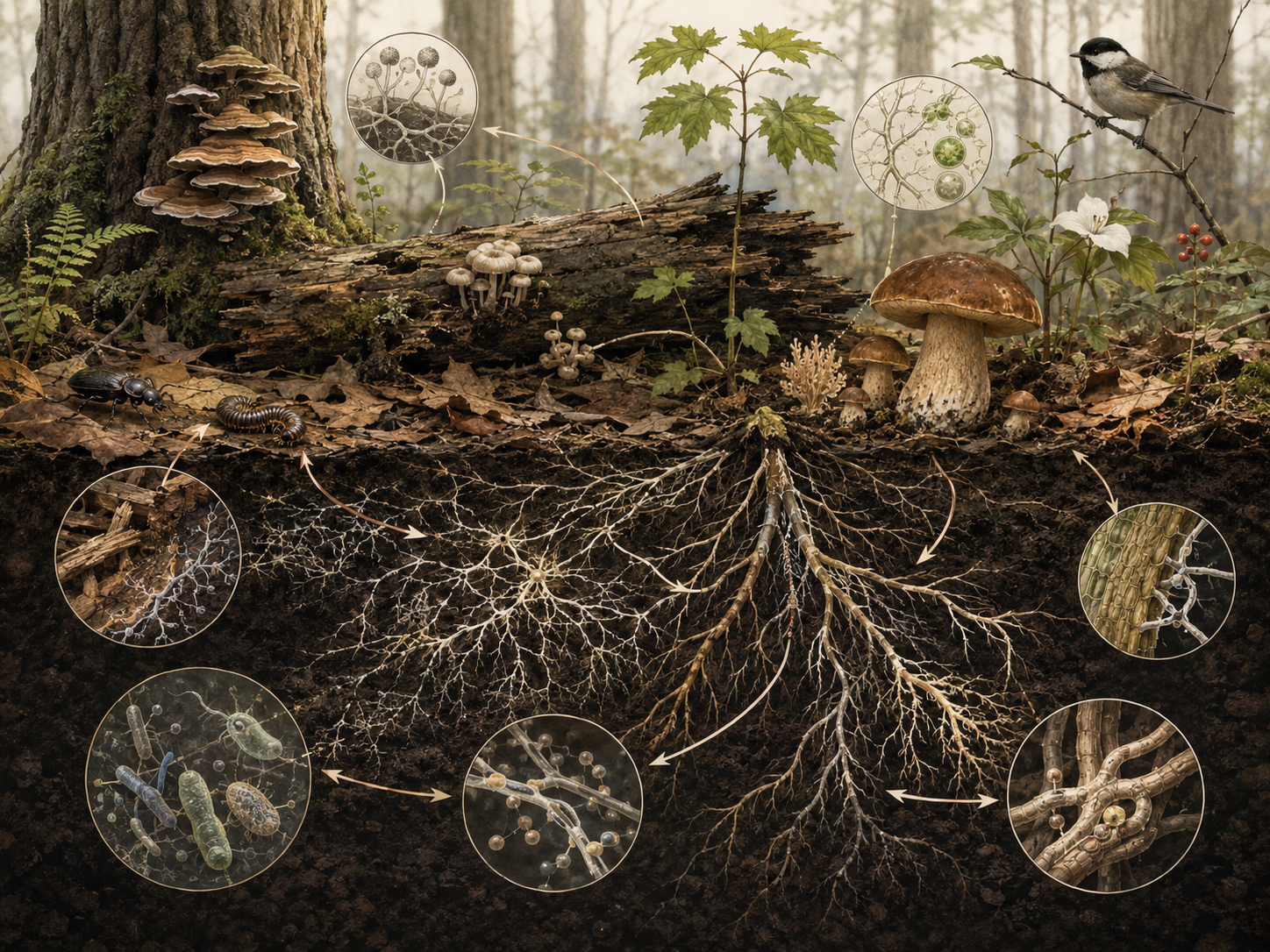
This article approaches fungi as a scientist-facing subject. It treats fungal biology not only as descriptive natural history but as a framework for analyzing decomposition kinetics, mycorrhizal allocation, community assembly, network structure, host-pathogen dynamics, disturbance response, soil recovery, and biogeochemical consequence. Fungal systems are especially important because they operate at the boundary between life and material return: they transform dead biomass into chemical availability, connect roots to nutrient pools, regulate host relationships, and create hidden architectures of exchange beneath visible ecosystems.
The article develops fungal biology as a scale-spanning framework for understanding decomposition, exchange, and ecological mediation. It examines fungal form, cell biology, extracellular digestion, hyphae, mycelium, decomposition, carbon and nutrient cycling, mycorrhizae, plant-fungal systems, soil structure, reproduction, dispersal, fungal evolution, disease ecology, aquatic fungi, agriculture, forestry, restoration, biotechnology, medical mycology, genomics, bioinformatics, systems fungal science, and quantitative modeling.
The article is written for mycologists, ecologists, soil scientists, marine biologists, freshwater scientists, medical and environmental-health readers, computational biology readers, biodiversity experts, conservation planners, restoration practitioners, agroecologists, forestry researchers, microbiologists, systems biologists, and research biologists who need a rigorous account of how fungal systems organize decomposition, exchange, disease, symbiosis, and ecosystem recovery.
The article also extends fungal biology into quantitative and computational biology through decomposition kinetics, Q10 temperature response, moisture limitation, substrate-quality modifiers, mycorrhizal cost-benefit logic, fungal biomass recovery, network-fragility metrics, R workflows, Python workflows, SQL provenance structures, and a linked full-stack GitHub repository containing Python, R, Julia, Fortran, Rust, Go, C, C++, SQL, notebooks, data files, and reproducibility documentation.
What fungi are
Fungi are eukaryotic organisms that typically acquire energy and nutrients by secreting enzymes into their surroundings and absorbing dissolved products of external digestion. That deceptively simple description carries large biological implications. Fungi are not defined merely by what they are not: not photosynthetic like plants, not ingestive like animals, not prokaryotic like bacteria. They represent a distinct evolutionary kingdom whose characteristic modes of growth, reproduction, substrate use, and ecological participation have made them indispensable to land systems and highly consequential in freshwater, coastal, host-associated, built, agricultural, and engineered environments as well.
Scientifically, fungi matter because they reveal a mode of life organized around penetration, transformation, redistribution, and persistence in spatially heterogeneous substrates. They turn structural plant tissue into accessible nutrient pools; couple dead biomass to renewed microbial and plant productivity; extend host access to patchy soil resources; form persistent latent infections and endophytic associations; generate spores capable of long-distance dispersal; and create hidden networks of transport and exchange. The visible mushroom is often only a transient reproductive structure emerging from a far larger and biologically more consequential mycelial system embedded in soil, wood, litter, roots, sediments, hosts, or built environments.
To understand fungi well is therefore to move beyond a narrow mushroom-centered view. The real biological importance of fungi lies in process. In decomposition experiments, fungal guild composition can alter carbon-use efficiency and litter turnover. In forests, ectomycorrhizal assemblages can influence nitrogen cycling, tree recruitment, and soil organic matter dynamics. In agroecosystems, arbuscular mycorrhizal fungi can affect phosphorus acquisition, drought response, soil aggregation, and crop resilience. In disease ecology, fungal pathogens can reorganize host populations and community structure. Fungal biology is therefore inseparable from ecological function, evolutionary history, biological defense, environmental change, and systems-level analysis.
Fungal form and cellular organization
At the cellular level, fungi are eukaryotes with membrane-bound organelles, dynamic cytoskeletal organization, and cell walls typically rich in chitin and glucans rather than cellulose. Their membranes commonly contain ergosterol, a biochemical feature with major biomedical relevance because many antifungal drugs target fungal sterol synthesis or membrane integrity. Yet from a broader biological perspective, the significance of fungal cell biology lies in how it supports distributed growth, polarity, substrate exploration, modular development, and environmental persistence.
Many fungi grow as polarized filaments called hyphae. Hyphal extension is concentrated at tips, where vesicle trafficking, wall synthesis, cytoskeletal organization, and local signaling enable directional invasion of substrates. Septa may partition hyphae into compartments, though cytoplasmic continuity often remains functionally important. In some groups, coenocytic organization allows multinucleate cytoplasm to extend across long stretches of growing hyphae. These traits make fungi unusually effective at exploiting patchy substrates because they can simultaneously occupy multiple microsites, route nutrients internally, and continue growth even after localized damage.
Fungal organization is therefore not only cellular but architectural. A fungal body can be a yeast-like population of unicells, a dispersed mycelial web, a host-associated endophytic system, a plant-root symbiont, a biofilm, or a differentiated fruiting structure specialized for spore release. This variability matters scientifically because form is tightly linked to ecological strategy. Yeasts excel in fluid or sugar-rich microenvironments; filamentous decomposers penetrate particulate organic matter and lignocellulosic matrices; mycorrhizal fungi optimize spatial integration between soil resource patches and host carbon supply; pathogenic fungi deploy invasive growth forms suited to host colonization. Structure and function in fungi are inseparable in ways that become visible only when fungal biology is treated as a systems problem rather than a taxonomic catalog.
Heterotrophic absorption and extracellular digestion
Unlike animals, fungi usually do not internalize intact food particles for digestion within a gut-like chamber. Instead, they release extracellular enzymes into surrounding material, depolymerize complex compounds outside the cell, and absorb the resulting soluble products. This is one of the deepest reasons fungi occupy such a central role in ecosystem metabolism. Extracellular digestion allows them to attack structurally complex, spatially extended, and chemically heterogeneous substrates such as wood, litter, dung, keratinous residues, seeds, sedimented detritus, root tissues, and host tissues.
That strategy is biologically powerful because many ecologically important substrates are not readily exploitable by organisms that depend on ingestion or simple dissolved resources. Lignocellulosic plant tissue, for example, stores a major share of terrestrial fixed carbon in forms requiring specialized oxidative and hydrolytic systems for degradation. Saprotrophic fungi possess diverse enzyme portfolios, including cellulases, hemicellulases, lignin-modifying peroxidases, laccases, proteases, and oxidative systems that allow them to participate in the staged chemical dismantling of dead biomass. White-rot fungi, brown-rot fungi, and soft-rot fungi differ markedly in their decay strategies, with consequences for carbon release, residual organic matter chemistry, wood mechanics, and downstream soil formation.
Extracellular digestion also means that fungi modify their environment as they feed. They alter pH, redox conditions, substrate porosity, microbial accessibility, moisture relations, and chemical gradients. Their physiology is therefore ecosystem engineering in miniature. In soils and litter layers, fungal foraging changes the accessibility of organic compounds to bacteria and detritivores. In host-associated settings, extracellular enzymes can mediate invasion, commensal persistence, or tissue breakdown. Fungi are not passive recipients of environmental opportunity; they are active reconfigurers of substrate worlds.
Hyphae, mycelium, and network organization
The network form of fungal life is central to its ecological and analytical importance. Hyphae branch, fuse, fragment, and reorient in response to resource availability, competitors, hosts, moisture regimes, substrate geometry, and internal physiological state. Together these threads form mycelia whose behavior is better understood in terms of distributed resource acquisition and transport than in terms of a single bounded body. Mycelia can integrate multiple nutrient patches, redistribute internal stores, maintain exploratory fronts, and allocate growth to zones of higher expected return.
For network-oriented biology, this is a striking life strategy. Fungal systems display traits analogous to transport networks, optimization problems, and adaptive spatial graphs. Their branching intensity, hyphal diameter, turnover rates, fusion dynamics, and cord formation all influence how efficiently they can explore space, resist disturbance, monopolize substrate, or maintain long-distance transport. Some wood-decay fungi construct thick rhizomorphs or cords capable of linking distinct woody resources; some mycorrhizal fungi form widespread subterranean systems associating with multiple host roots; some endophytic or pathogenic fungi remain anatomically restricted yet physiologically influential.
This network character has often been simplified in public discourse into vague claims about “wood-wide webs.” The more rigorous scientific view is more interesting. Fungal networks are not universal altruistic communication systems but context-dependent biological structures shaped by carbon economics, host identity, partner quality, competition, disturbance, moisture, and evolutionary history. Network integration can facilitate nutrient redistribution and colonization, but it can also transmit pathogens, intensify competitive suppression, or create asymmetric benefit among hosts. The scientific task is therefore not to romanticize fungal connectedness but to measure its mechanisms, contingencies, and outcomes.
Decomposition and the return of organic matter
Fungi are among the principal decomposers of the biosphere, especially in terrestrial systems where plant structural biomass dominates detrital inputs. Decomposition is not merely the disappearance of dead matter. It is a coordinated sequence of fragmentation, enzymatic depolymerization, microbial assimilation, respiration, leaching, mineralization, stabilization, and trophic transfer. Fungi are indispensable to this process because they can penetrate solid substrates, enzymatically attack recalcitrant compounds, and persist under conditions where particulate structure limits access by many other organisms.
From a scientific standpoint, decomposition must be treated as a rate process shaped by substrate chemistry, temperature, moisture, oxygen availability, nutrient stoichiometry, decomposer community composition, and the physical architecture of litter or wood. The quality of a substrate matters. Labile sugars and amino acids are processed rapidly, whereas lignin-rich or chemically defended tissues require specialized enzyme systems and often decompose more slowly. Environmental context matters just as much. Moisture limitation, freezing, anoxia, acidity, salinity shifts, nutrient imbalance, and disturbance can alter both fungal metabolism and the relative roles of fungi and bacteria in decay trajectories.
Decomposition therefore sits at the center of broader biological questions. It affects carbon residence time, soil organic matter formation, nutrient release to plants and microbes, habitat structure for invertebrates, fuel accumulation in fire-prone systems, and the speed at which disturbed ecosystems recover material cycling. This places fungal science in direct relation not only to Biogeochemical Cycles and the Conditions of Habitability but also to Biodiversity and the Structure of Living Systems and Restoration Ecology and the Repair of Living Systems, because disrupted decomposer communities can change which ecosystems persist, recover, or fail under environmental stress.
Fungi and biogeochemical circulation
Fungi are major participants in the circulation of carbon, nitrogen, phosphorus, and micronutrients. Their significance lies not simply in releasing nutrients from dead organic matter, but in determining when, where, and in what form those nutrients become biologically available. By altering mineralization rates, immobilization dynamics, enzyme investment, and the chemical character of residual organic matter, fungi influence whether nutrients are retained in biomass, released to soil solution, lost through leaching, transferred to plants, or stabilized in more persistent organic pools.
Carbon cycling offers a particularly important example. A substantial share of terrestrial primary production eventually enters detrital pathways where fungi help determine whether carbon is rapidly respired to the atmosphere, incorporated into microbial biomass, transferred to soil organic matter fractions, or physically protected within aggregates and mineral-associated pools. Fungal carbon-use efficiency, enzyme investment strategies, mycorrhizal association, and substrate preference therefore matter for Earth-system questions as much as for local ecosystem dynamics. Brown-rot and white-rot pathways, for example, differ in how they modify lignocellulosic residues and influence downstream stabilization.
Nitrogen and phosphorus dynamics are equally important. Mycorrhizal fungi can increase host access to organic and mineral nutrient pools, alter rhizosphere competition with bacteria, and shift plant nutrient limitation. Saprotrophic fungi can immobilize nitrogen in biomass during early decomposition, delaying release, or they can accelerate nutrient turnover under favorable conditions. These processes matter to agroecologists, forest ecologists, freshwater biologists studying detrital subsidies, and conservation practitioners assessing nutrient enrichment or soil depletion. Fungal biology is not peripheral to biogeochemistry; it is one of the mechanisms through which biogeochemical structure becomes ecological reality.
Mycorrhizae and resource exchange
Mycorrhizal symbioses are among the most consequential fungal-plant associations on Earth. In these partnerships, fungal hyphae extend the functional reach of root systems into soil microsites inaccessible to roots alone, increasing access to phosphorus, nitrogen, water, and micronutrients, while plants supply fungi with photosynthetically derived carbon. This exchange is not static. It is mediated by host species identity, fungal guild, soil fertility, climatic stress, developmental stage, competition, disturbance history, and the relative value of carbon and nutrients under local conditions.
The two most widely discussed forms, arbuscular mycorrhizae and ectomycorrhizae, differ substantially in structure, phylogenetic distribution, and ecological consequence. Arbuscular mycorrhizal fungi penetrate root cortical cells and are especially important across grasslands, many crops, and numerous tropical and temperate plant lineages. Ectomycorrhizal fungi form sheath-like structures around roots and are prominent in many temperate and boreal tree systems. These groups differ in enzyme repertoires, host specificity, nutrient acquisition strategies, and effects on soil carbon and nitrogen dynamics.
Scientifically, mycorrhizae are best treated as conditional exchange systems rather than universally beneficial mutualisms. Benefit depends on environmental context and partner quality. Under some nutrient conditions, carbon cost to the host may exceed benefit. Under drought, soil contamination, nutrient depletion, or restoration stress, symbiosis may alter plant performance in ways that matter for conservation and crop management. Under invasion or climatic warming, mycorrhizal mismatch can limit plant establishment. This makes mycorrhizal biology directly relevant to Coevolution, Symbiosis, and the Dynamics of Mutual Change, Plant Biology and the Life of Primary Producers, Restoration Ecology and the Repair of Living Systems, and Population Dynamics and Ecological Modeling.
Fungi, plants, and the architecture of terrestrial ecosystems
Terrestrial ecosystems are not simply plant systems supported by passive decomposers. They are plant-fungal systems in which aboveground productivity and belowground processing are tightly coupled. Plant litter quality shapes fungal guild composition; fungal decomposition and mycorrhizal function shape nutrient return to plants; fungal pathogens affect recruitment and density dependence; endophytes alter herbivory, drought response, and competitive performance; and root-associated fungi influence whether seedlings establish under stressful or degraded conditions.
In forests, this coupling is particularly strong. Wood-decay fungi regulate coarse woody debris turnover, nutrient release, cavity formation, and habitat structure. Ectomycorrhizal assemblages influence tree nutrient economy and competitive outcomes. Fungal pathogens and saprotrophs interact with insect attack, drought mortality, fire legacies, and disturbance history to shape stand dynamics. In grasslands and agroecosystems, arbuscular mycorrhizae affect root proliferation, phosphorus acquisition, soil structure, and drought tolerance, while pathogenic fungi can drive crop losses and alter community composition. In wetlands, fungal roles are shaped by hydrology, oxygen limitation, plant litter quality, and vegetation turnover.
These interactions matter because ecosystem architecture is partly fungal architecture. Vegetation patterns, regeneration windows, and the persistence of productive soils depend on fungal mediation. For biogeographers, macroecologists, landscape ecologists, and conservation practitioners, fungi complicate any view of ecosystems based only on visible plant cover. Two sites with similar vegetation may differ profoundly in function because their belowground fungal assemblages differ in diversity, abundance, trait composition, host association, or disturbance history.
Fungi, soils, and the relational world belowground
Soils are not inert substrates through which fungal hyphae merely pass. They are complex biophysical matrices in which minerals, pore geometry, moisture films, oxygen gradients, microbial competitors, protistan grazers, root exudates, detrital particles, and invertebrate disturbance all shape fungal performance. In this environment, fungi contribute to soil aggregation, pore connectivity, organic matter transformation, nutrient redistribution, and the physical organization of microbial life.
Hyphae can bind particles, enmesh organic residues, and contribute to aggregate stability directly or indirectly through associated polysaccharides, glomalin-related soil proteins, root interactions, and microbial consortia. This gives fungi a central place in soil structure, water infiltration, erosion resistance, and the microscale spatial organization of carbon and nutrients. For soil ecologists and agroecologists, these are not secondary details. They affect whether soils retain water, resist compaction, protect organic matter, and support resilient root systems under climatic variability.
Fungal life belowground is also profoundly relational. Fungi compete with bacteria for labile substrates, cooperate indirectly through cross-feeding, evade microfaunal predation, and interact chemically with neighboring microbes through antibiotics, signaling compounds, volatiles, and metabolites. The rhizosphere and detritusphere are especially dynamic because plant-derived exudates and decomposing organic matter create shifting resource mosaics. Fungal ecology in soil must therefore be treated as community ecology, microbial ecology, and biophysical ecology at once.
Reproduction, dispersal, and life history
Fungi exhibit extraordinary diversity in reproductive mode and life history. They reproduce sexually and asexually; generate spores adapted for air, water, soil, or animal dispersal; persist as resting structures; spread via clonal fragments; and shift between growth forms depending on environment or host context. This diversity matters because fungal persistence is not guaranteed by local growth alone. Colonization opportunity, dispersal timing, propagule survival, mating system, substrate availability, dormancy, and priority effects all shape which fungi appear in a site, when they establish, and how quickly they respond to disturbance.
From a population-biological perspective, fungal life histories are especially interesting because many species combine prolific propagule production with highly contingent establishment. Vast numbers of spores may disperse, but successful colonization depends on substrate availability, microclimate, competition, host presence, moisture, and disturbance regime. Some fungi specialize on ephemeral resources and rely on rapid colonization; others are associated with long-lived hosts or substrates and persist through durable mycelial networks. Pathogens may balance latent persistence with outbreak phases, while mutualists may invest in long-term host association rather than frequent turnover.
These reproductive and dispersal strategies are essential to understanding forest recovery after fire, disease emergence in crops and wildlife, post-disturbance succession, microbial biogeography, and the restoration of fungal communities in degraded soils. They also connect naturally to Reproduction, Life Cycles, and Biological Continuity and Mutation, Variation, and the Sources of Novelty, because fungal evolution often turns on recombination, mutation, genome plasticity, dispersal-mediated gene flow, and rapid adaptation under environmental pressure.
Fungi, evolution, and the history of life on land
The history of terrestrial life cannot be adequately understood without fungi. The colonization of land required not only plants capable of photosynthesis in aerial environments, but also decomposers and symbionts capable of mediating nutrient turnover, soil formation, and root-associated resource acquisition. Fungal lineages participated in the assembly of early terrestrial ecosystems and have remained integral ever since.
Evolutionarily, fungi are important because they show how multicellularity, signaling, environmental sensing, developmental complexity, and symbiosis can evolve under very different constraints from those of plants and animals. Their genomes reveal histories of enzyme innovation, symbiotic specialization, parasitic transition, host association, and adaptation to chemically diverse substrates. Their phylogenies illuminate repeated transitions among saprotrophy, mutualism, parasitism, endophytism, and lichenization. These transitions matter because ecological role is evolutionarily labile, contingent, and often reversible.
Fungi therefore belong directly to the study of macroevolution, terrestrialization, coevolutionary history, and the architecture of ecosystems. They also complicate any linear or progressivist account of life’s diversification. Much of evolutionary success lies not in dominance through size or speed, but in biochemical capacity, dispersal timing, modular growth, ecological partnership, genomic plasticity, and the ability to persist in hidden but metabolically decisive compartments of the biosphere.
Symbiosis, parasitism, and disease ecology
Fungi occupy a broad spectrum of relational roles, from mutualists and commensals to pathogens, parasites, and opportunists. Many plant-associated fungi are neither purely beneficial nor purely harmful; their effect depends on host condition, nutrient status, competitor presence, climate, tissue context, and disturbance history. Endophytic fungi may enhance stress tolerance in one environment and shift toward pathogenicity in another. Soil-borne fungal pathogens may regulate plant recruitment, shape species coexistence, and influence successional dynamics. Animal and human pathogens may remain opportunistic until host immunity is compromised or environmental exposure increases.
These dynamics make fungi crucial to disease ecology. Fungal epidemics can transform forests, agricultural systems, amphibian assemblages, bat populations, and clinical settings. Chytridiomycosis in amphibians, white-nose syndrome in bats, rust outbreaks in crops, Dutch elm disease, chestnut blight, and systemic mycoses in humans demonstrate that fungal disease is not marginal to biodiversity science or public health. It intersects with climate variability, trade networks, land-use change, wildlife stress, immune competence, host density, and environmental reservoirs.
For medical professionals, environmental-health readers, and wildlife disease ecologists, fungal organisms demand special attention because they often exploit interfaces between environment and host. Spores and propagules can persist environmentally, exposure can be patchy and difficult to monitor, and disease progression may depend on subtle host-pathogen-environment interactions. This links fungal science directly to Immunology and Biological Defense, Physiology and the Regulation of Living Systems, and Behavior, Communication, and Biological Strategy, because host defense, stress physiology, movement, social contact, and environmental exposure all help shape transmission and outcome.
Aquatic, freshwater, and coastal fungal science
Although fungi are often framed primarily as terrestrial organisms, aquatic fungal science is increasingly important for freshwater biologists, limnologists, coastal ecologists, and reef researchers. In streams and rivers, aquatic hyphomycetes and other fungi participate in leaf-litter conditioning, altering detrital palatability for invertebrates and influencing carbon and nutrient flow through food webs. In lakes and wetlands, fungal activity contributes to decomposition, parasitism, and organic matter transformation under hydrologically variable conditions. In estuarine and coastal systems, marine fungi and fungus-like decomposers participate in wood degradation, plant detritus processing, symbiosis, and disease.
Hydrology changes fungal ecology profoundly. Oxygen availability, salinity, turbulence, burial, substrate residence time, dissolved organic matter composition, and particle transport affect which fungal taxa persist and what functions dominate. Freshwater and coastal fungal assemblages may differ sharply from upland soil communities, yet they participate in analogous questions of decomposition rate, nutrient turnover, host interaction, and community response to disturbance. For environmental scientists, these systems are especially important where eutrophication, acidification, warming, altered hydroperiod, or pollutant exposure changes detrital pathways and microbial community composition.
Aquatic fungal science also broadens the conceptual reach of fungal biology. It shows that decomposition and exchange are not confined to forest floors and soils. They are distributed across streams, floodplains, marshes, mangroves, submerged wood, algal systems, coastal sediments, and host-associated aquatic systems. Fungal roles in these environments remain understudied relative to their terrestrial importance, which makes them scientifically significant frontiers for biodiversity, biogeochemistry, disease ecology, and environmental monitoring.
Agriculture, forestry, conservation, and restoration
Many practical failures in agriculture, forestry, and ecological restoration are partly fungal failures, even when they are first described in the language of poor plant establishment, declining yields, erosion, drought stress, low nutrient availability, or weak soil recovery. This is because fungal communities influence root access to nutrients and water, regulate disease pressure, structure soils, control decomposition pace, and mediate the reassembly of belowground ecological function after disturbance.
In agriculture, fungal science matters for nutrient efficiency, crop resilience, disease management, carbon retention, and soil recovery under repeated tillage or chemical disturbance. In forestry, fungi shape seedling recruitment, wood decay, stand turnover, post-disturbance regeneration, and the persistence of old-growth functions. In restoration, fungal inoculation, substrate transfer, nurse vegetation, woody residue retention, or hydrological repair may be necessary not only for visible vegetation outcomes but for the reestablishment of symbiotic and decomposer processes that make systems self-maintaining.
Conservation biology also increasingly recognizes fungi as overlooked biodiversity. Fungal taxa often have restricted ranges, host associations, substrate dependence, or specialized life histories that make them vulnerable to land-use change, pollution, altered fire regimes, nitrogen deposition, climate stress, and invasive species. Conservation planning focused only on plants and vertebrates may protect habitat incompletely, because much of ecosystem function depends on invisible fungal assemblages whose loss can weaken recovery, nutrient cycling, disease resistance, soil structure, and community stability. This places fungi in direct relation to Biodiversity and the Structure of Living Systems and Restoration Ecology and the Repair of Living Systems.
Medical, biomedical, and biotechnological relevance
Fungi matter not only in ecosystems but in medicine, biotechnology, and laboratory science. Some fungi are major human pathogens, especially in immunocompromised or otherwise vulnerable patients. Others produce antibiotics, immunosuppressive compounds, enzymes, organic acids, alcohols, fermented foods, and industrial metabolites. Yeasts such as Saccharomyces cerevisiae have served as foundational model organisms in cell biology and genetics, while filamentous fungi are used in enzyme production, biotechnology platforms, food processing, biomaterials, and secondary metabolite discovery.
From a biomedical perspective, fungi are important precisely because they are eukaryotes. Their cellular similarity to animal hosts complicates selective treatment and creates therapeutic challenges not seen with many bacterial infections. Antifungal resistance, emerging pathogens, host immune compromise, and environmentally mediated exposure all make medical mycology increasingly important. For medical professionals and public-health readers, fungal disease is not a niche issue but part of a larger pattern linking environmental disturbance, hospital systems, immune status, antimicrobial resistance, and global microbial change.
Biotechnologically, fungal metabolism remains extraordinarily valuable. Fungi can synthesize enzymes capable of degrading recalcitrant biomass, making them relevant to waste valorization, biofuel research, biomaterials, industrial ecology, and circular bioeconomy research. Their secondary metabolites remain central to drug discovery. Their growth forms and genetic systems also make them useful for synthetic biology and systems biology. Fungal science thus bridges laboratory utility, industrial application, clinical concern, and ecological consequence.
Genomics, bioinformatics, and systems-level fungal science
Modern fungal biology increasingly depends on molecular and computational tools because much fungal diversity is cryptic, uncultured, microscopic, transient, or hidden belowground. Amplicon sequencing, metagenomics, metatranscriptomics, comparative genomics, population genomics, trait-based ecological modeling, image-based network analysis, and environmental DNA now allow researchers to characterize fungal communities and functional potential in ways that observational natural history alone cannot achieve.
These methods matter because fungal presence is often easy to underestimate and fungal function is often difficult to infer from taxonomy alone. A soil sample may contain diverse mycorrhizal, saprotrophic, pathogenic, and endophytic lineages whose ecological effects depend on abundance, expression state, host context, environmental conditions, and trait composition. Similarly, fungal pathogen populations can evolve rapidly, exchange genetic material, or show strain-level differences with direct consequences for disease severity and treatment response. Computational methods make it possible to model these differences, integrate sequence and environmental data, and identify associations between community structure and ecological or clinical outcomes.
Systems-level fungal science is especially important for research biologists because fungal effects are frequently emergent. The function of a fungal assemblage cannot always be predicted from single isolates, just as the effect of a mycorrhizal inoculum cannot be inferred from fungal presence alone. Network analysis, trait-based inference, hierarchical models, occupancy models, mechanistic simulations, and reproducible computational workflows are therefore increasingly necessary. Fungal biology now sits at the intersection of field ecology, laboratory mycology, omics, bioinformatics, and quantitative systems analysis.
Quantitative fungal biology: mathematics, R, and Python
Fungal systems are especially well suited to quantitative treatment because they involve rates, thresholds, transport, branching, exchange, and response to environmental heterogeneity. The goal of modeling is not to reduce fungal biology to elegant but empty equations. It is to build analytical scaffolding for real ecological reasoning: how quickly litter disappears, when mycorrhizal benefit turns negative, how fungal guilds respond to moisture shifts, which restoration sites are likely to recover, how fungal biomass rebounds after damage, and how network fragmentation alters transport across a mycelial system.
Decomposition kinetics and environmental forcing
A first-order model is a useful starting point for litter or substrate mass loss under fungal decomposition:
\frac{dM}{dt}=-kM
\]
Interpretation: \(M\) is remaining substrate mass and \(k\) is the effective decomposition constant.
The solution is:
M(t)=M_0e^{-kt}
\]
Interpretation: \(M(t)\) is remaining mass at time \(t\), and \(M_0\) is initial mass. This model is useful but incomplete because \(k\) varies with temperature, moisture, substrate chemistry, fungal guild composition, oxygen availability, and nutrient status.
A more ecologically realistic formulation allows decomposition to depend on environmental modifiers:
\frac{dM}{dt}=-k_0 f_T(T)f_W(W)f_Q(Q)M
\]
Interpretation: \(k_0\) is the baseline decay constant, \(f_T(T)\) captures temperature sensitivity, \(f_W(W)\) moisture limitation, and \(f_Q(Q)\) substrate quality or chemical recalcitrance.
One common choice for temperature dependence is a Q10 form:
f_T(T)=Q_{10}^{(T-T_{ref})/10}
\]
Interpretation: This approximates how biological rate changes with temperature around a reference temperature \(T_{ref}\). Moisture functions may be unimodal because fungal activity declines under both extreme dryness and anoxia.
Mycorrhizal cost-benefit logic
A simple way to represent mycorrhizal exchange is to treat host net benefit as nutrient gain minus carbon cost:
B=\alpha N_f-\beta C_h
\]
Interpretation: \(N_f\) is fungal-delivered nutrient flux, \(C_h\) is host carbon allocation to the fungus, and \(\alpha\) and \(\beta\) translate these flows into host fitness or growth value. A symbiosis is beneficial when \(B>0\), neutral when \(B\approx0\), and potentially parasitic from the host perspective when \(B<0\).
More realistically, \(N_f\) depends on soil nutrient limitation and fungal foraging efficiency, while \(C_h\) depends on host photosynthetic state and fungal demand. This gives a threshold form:
\alpha N_f(\theta,E_f)>\beta C_h(P_h,D_f)
\]
Interpretation: \(\theta\) represents soil conditions, \(E_f\) fungal efficiency, \(P_h\) host photosynthetic status, and \(D_f\) fungal carbon demand. The formulation makes clear that mutualism is conditional rather than automatic.
Network efficiency and fragmentation
Because fungal transport depends on connected structure, fragmentation can be represented with graph-based metrics. One useful quantity is global efficiency:
E_G=\frac{1}{n(n-1)}\sum_{i\ne j}\frac{1}{d_{ij}}
\]
Interpretation: \(d_{ij}\) is the shortest path distance between nodes \(i\) and \(j\) in a weighted mycelial network. If a central connection fails, \(d_{ij}\) increases for many node pairs and \(E_G\) declines. This gives a tractable way to translate structural damage into transport impairment.
Worked example: environmentally modified decomposition
Suppose litter begins at \(M_0=100\) units with baseline \(k_0=0.08\). At \(T=20^\circ C\), \(T_{ref}=10^\circ C\), and \(Q_{10}=2\), the temperature multiplier is:
f_T(20)=2^{(20-10)/10}=2
\]
Interpretation: Under this Q10 assumption, decomposition-related biological activity doubles relative to the reference temperature.
If moisture conditions reduce activity to \(f_W=0.7\) and low substrate quality gives \(f_Q=0.6\), then the effective decay constant is:
k_{eff}=0.08\times2\times0.7\times0.6=0.0672
\]
Interpretation: The effective decay constant integrates baseline rate, temperature, moisture, and substrate-quality effects.
After 12 time units, remaining mass is:
M(12)=100e^{-0.0672\cdot12}\approx44.65
\]
Interpretation: This framing is biologically useful because it allows researchers to compare sites not merely by elapsed time but by the environmental and compositional drivers shaping effective decomposition rate.
R and Python workflows
The following examples are compact article-level workflows. The full GitHub repository expands them into richer multi-language implementations with SQL provenance, validation notes, decomposition kinetics, climate and moisture modifiers, fungal guild scenarios, biomass recovery, inoculation and habitat-repair screening, network-efficiency analysis, restoration-priority scoring, and reproducible computational fungal-biology scaffolding.
R example: fungal decomposition, carbon release, and site comparison
# Quantitative fungal ecology workflow in R
#
# This compact workflow compares litter decomposition under changing
# temperature, moisture, substrate quality, and fungal functional composition.
#
# It is a teaching scaffold, not a calibrated ecosystem-carbon model.

library(dplyr)
library(tidyr)
library(purrr)

# Temperature response using Q10 logic.
f_temp_q10 <- function(temp, tref = 10, q10 = 2) {
  q10 ^ ((temp - tref) / 10)
}

# Unimodal moisture response:
# fungal activity declines under both drought and saturation.
f_moisture <- function(m, m_opt = 0.6, sigma = 0.22) {
  exp(-((m - m_opt)^2) / (2 * sigma^2))
}

# Substrate quality multiplier:
# higher lignin:N ratio means lower decomposability.
f_quality <- function(lignin_n, slope = 0.03) {
  exp(-slope * lignin_n)
}

# Functional-guild modifier.
guild_effect <- function(guild) {
  case_when(
    guild == "white_rot" ~ 1.20,
    guild == "brown_rot" ~ 0.95,
    guild == "mixed_saprotroph" ~ 1.00,
    guild == "disturbance_simplified" ~ 0.72,
    TRUE ~ 1.00
  )
}

# Decomposition trajectory for one site.
decomp_curve <- function(
  M0,
  k0,
  temp,
  moisture,
  lignin_n,
  guild,
  time_steps = 0:24
) {
  k_eff <- k0 *
    f_temp_q10(temp) *
    f_moisture(moisture) *
    f_quality(lignin_n) *
    guild_effect(guild)

  tibble(
    time = time_steps,
    remaining_mass = M0 * exp(-k_eff * time),
    mass_lost = M0 - remaining_mass,
    cumulative_carbon_released = 0.5 * mass_lost,
    k_eff = k_eff
  )
}

# Example ecological scenarios.
sites <- tibble(
  site = c(
    "cool_conifer_forest",
    "warm_restoration_site",
    "drought_stressed_woodland",
    "nutrient_enriched_riparian"
  ),
  M0 = c(100, 100, 100, 100),
  k0 = c(0.07, 0.07, 0.07, 0.07),
  temp = c(9, 18, 22, 16),
  moisture = c(0.65, 0.58, 0.25, 0.72),
  lignin_n = c(18, 14, 20, 12),
  guild = c(
    "white_rot",
    "mixed_saprotroph",
    "disturbance_simplified",
    "white_rot"
  )
)

results <- sites %>%
  mutate(
    sim = pmap(
      list(M0, k0, temp, moisture, lignin_n, guild),
      ~ decomp_curve(..1, ..2, ..3, ..4, ..5, ..6)
    )
  ) %>%
  select(site, sim) %>%
  unnest(sim)

rate_summary <- results %>%
  group_by(site) %>%
  summarise(
    k_eff = first(k_eff),
    mass_remaining_t24 = remaining_mass[time == 24],
    carbon_released_t24 = cumulative_carbon_released[time == 24],
    half_life = log(2) / first(k_eff),
    .groups = "drop"
  )

print(round(rate_summary, 3))
This R workflow is useful because it goes beyond a toy decay curve. It creates a reproducible ecological workflow for comparing sites, estimating half-lives, and translating fungal functional composition into consequences for carbon release and litter persistence. It is readily extensible to field calibration, Bayesian fitting, mixed-effects modeling, or restoration monitoring.
Python example: fungal biomass recovery and network damage screening
import numpy as np
import pandas as pd

# ---------------------------------------------------------
# 1. Biomass recovery model under disturbance and inoculation
# ---------------------------------------------------------

def biomass_recovery(
    days=240,
    B0=5.0,
    r=0.05,
    K=80.0,
    m=0.015,
    pulse_day=None,
    pulse_size=0.0,
    dt=1.0
):
    """
    Simulate fungal biomass recovery.

    B0: initial fungal biomass
    r: intrinsic recovery rate
    K: carrying capacity under habitat conditions
    m: chronic turnover or mortality
    pulse_day: optional restoration or inoculation pulse
    pulse_size: biomass added on the pulse day
    """

    t = np.arange(0, days + dt, dt)
    B = np.zeros_like(t, dtype=float)
    B[0] = B0

    for i in range(1, len(t)):
        inoculum = (
            pulse_size
            if pulse_day is not None and abs(t[i] - pulse_day) < 1e-9
            else 0.0
        )

        dB = (
            r * B[i - 1] * (1 - B[i - 1] / K)
            - m * B[i - 1]
            + inoculum
        ) * dt

        B[i] = max(B[i - 1] + dB, 0.0)

    return pd.DataFrame({"day": t, "biomass": B})


scenarios = {
    "degraded_soil": {
        "B0": 3,
        "r": 0.035,
        "K": 45,
        "m": 0.020,
        "pulse_day": None,
        "pulse_size": 0.0
    },
    "mulch_added": {
        "B0": 3,
        "r": 0.045,
        "K": 60,
        "m": 0.018,
        "pulse_day": None,
        "pulse_size": 0.0
    },
    "inoculated": {
        "B0": 3,
        "r": 0.045,
        "K": 60,
        "m": 0.018,
        "pulse_day": 20,
        "pulse_size": 6.0
    },
    "inoculated_plus_habitat_repair": {
        "B0": 3,
        "r": 0.055,
        "K": 78,
        "m": 0.014,
        "pulse_day": 20,
        "pulse_size": 8.0
    },
}

recovery_runs = []

for name, pars in scenarios.items():
    df = biomass_recovery(**pars)
    df["scenario"] = name
    recovery_runs.append(df)

recovery_df = pd.concat(recovery_runs, ignore_index=True)

summary = (
    recovery_df.groupby("scenario")
    .agg(
        final_biomass=("biomass", "last"),
        peak_biomass=("biomass", "max")
    )
    .reset_index()
)

print(summary.round(3))

# ---------------------------------------------------------
# 2. Simple fungal network efficiency under connection loss
# ---------------------------------------------------------

def floyd_warshall(dist):
    """Compute all-pairs shortest paths for a small dense graph."""

    n = len(dist)
    d = dist.copy()

    for k in range(n):
        for i in range(n):
            for j in range(n):
                if d[i, k] + d[k, j] < d[i, j]:
                    d[i, j] = d[i, k] + d[k, j]

    return d


def global_efficiency(adj):
    """
    Compute global efficiency of a weighted transport network.

    adj: weighted adjacency matrix. A value of zero means no edge.
    """

    n = adj.shape[0]
    inf = 1e9

    dist = np.where(adj > 0, adj, inf).astype(float)
    np.fill_diagonal(dist, 0.0)

    shortest = floyd_warshall(dist)

    total = 0.0

    for i in range(n):
        for j in range(n):
            if i != j and shortest[i, j] < inf:
                total += 1.0 / shortest[i, j]

    return total / (n * (n - 1))


# Example weighted adjacency matrix for a mycelial transport network.
adjacency = np.array([
    [0, 1, 2, 0, 0, 0],
    [1, 0, 1, 2, 0, 0],
    [2, 1, 0, 1, 2, 0],
    [0, 2, 1, 0, 1, 2],
    [0, 0, 2, 1, 0, 1],
    [0, 0, 0, 2, 1, 0]
], dtype=float)

baseline_efficiency = global_efficiency(adjacency)

damaged = adjacency.copy()
damaged[2, 3] = 0
damaged[3, 2] = 0

damaged_efficiency = global_efficiency(damaged)

print("Baseline efficiency:", round(baseline_efficiency, 4))
print("Damaged efficiency:", round(damaged_efficiency, 4))
print(
    "Percent decline:",
    round(
        100 * (baseline_efficiency - damaged_efficiency) /
        baseline_efficiency,
        2
    ),
    "%"
)
This Python workflow supports two common lines of scientific reasoning. The first is recovery trajectory analysis under degraded conditions, inoculation, and habitat repair. The second is network-fragility analysis, where structural damage can be translated into changes in transport efficiency. Both are extensible to real datasets, including field biomass estimates, image-derived network graphs, soil-recovery metrics, or management decision screens.
Python example: restoration priority scoring for fungal recovery
import numpy as np
import pandas as pd

# Synthetic restoration sites with fungal-recovery indicators.
# Values are scaled between 0 and 1 for article clarity.
sites = pd.DataFrame({
    "site": ["site_A", "site_B", "site_C", "site_D", "site_E"],
    "organic_matter": [0.42, 0.68, 0.31, 0.57, 0.49],
    "woody_residue": [0.35, 0.72, 0.28, 0.60, 0.51],
    "moisture_stability": [0.48, 0.63, 0.25, 0.55, 0.44],
    "host_plant_cover": [0.50, 0.74, 0.38, 0.59, 0.46],
    "soil_disturbance": [0.70, 0.32, 0.81, 0.44, 0.58],
    "pathogen_pressure": [0.55, 0.36, 0.62, 0.41, 0.50]
})

sites["fungal_recovery_potential"] = (
    0.22 * sites["organic_matter"]
    + 0.20 * sites["woody_residue"]
    + 0.18 * sites["moisture_stability"]
    + 0.18 * sites["host_plant_cover"]
    - 0.12 * sites["soil_disturbance"]
    - 0.10 * sites["pathogen_pressure"]
)

sites["management_class"] = np.where(
    sites["fungal_recovery_potential"] >= 0.45,
    "habitat repair likely sufficient",
    np.where(
        sites["fungal_recovery_potential"] >= 0.30,
        "monitor and supplement habitat",
        "consider fungal inoculation plus habitat repair"
    )
)

print(sites.round(3).to_string(index=False))
This compact restoration-priority scaffold treats fungal recovery as an ecological systems problem rather than a simple inoculation decision. A production workflow could add fungal eDNA, microscopy, soil chemistry, vegetation surveys, substrate availability, hydrology, uncertainty intervals, and long-term monitoring outcomes.
These examples remain compact enough for an article, but they point toward the kinds of workflows scientists actually use: environmentally modified decomposition, fungal functional-guild comparisons, recovery trajectories, network-fragility analysis, restoration-priority scoring, and explicit translation of fungal process into ecological consequence.
GitHub repository
The article body includes compact R and Python examples so the biological and scientific argument remains readable. The full repository expands those examples into a broader computational fungal-biology workflow, including decomposition kinetics, climate and moisture modifiers, fungal guild scenarios, biomass recovery, inoculation and habitat-repair screening, network-efficiency analysis, restoration-priority scoring, SQL provenance structures, reproducible data files, and full-stack scientific-computing examples across Python, R, Julia, Fortran, Rust, Go, C, C++, SQL, and notebooks.
Limits, uncertainty, and modern fungal thinking
Fungi are foundational, but fungal science is full of uncertainty. Taxonomic identification from sequence data may be incomplete. Functional inference from taxonomic assignment is often probabilistic rather than definitive. Fruiting observations can misrepresent actual mycelial abundance. Experimental inoculation success may not translate into long-term establishment. Laboratory growth rate does not necessarily predict field performance under competition, moisture fluctuation, and substrate heterogeneity. Even basic ecological categories such as “saprotroph,” “mutualist,” or “pathogen” can oversimplify fungi whose roles shift across context and life stage.
This uncertainty should not weaken fungal science. It should sharpen it. The field is strongest when it integrates natural history, experimental design, omics, modeling, field observation, and careful attention to scale. A fungal process that appears local may carry landscape consequences; a pattern detected in sequence reads may require physiological validation; a restoration practice that works in one vegetation type may fail in another because fungal partners differ. Scientific seriousness in fungal biology therefore means resisting both romantic simplification and reductionist overconfidence.
Models are useful because they clarify assumptions, expose mechanisms, and make scenario comparison possible. But a decomposition equation is not a forest floor, a mycorrhizal index is not a symbiosis, and a graph metric is not the whole of mycelial life. Quantitative tools are strongest when they support biological interpretation rather than replacing it.
Modern fungal thinking increasingly treats fungi as central mediators of living systems: organisms of metabolism, spatial connection, evolutionary plasticity, ecological contingency, and material transformation. That is a stronger and more useful framing than treating them as curiosities of rot or food.
Why this matters for scientific work
For working scientists, fungi matter because they are often load-bearing variables hidden inside broader ecological, medical, agricultural, or biogeochemical questions. A restoration site may fail because compatible mycorrhizal partners are missing. A forest carbon model may perform poorly because it treats decomposition as climatically forced but biologically uniform. A disease outbreak may appear host-driven until environmental fungal reservoirs and immune interactions are considered. A soil management intervention may seem chemically sound while ignoring the fungal networks required to maintain aggregation, nutrient exchange, and substrate turnover.
This means fungal biology should often be treated as explanatory infrastructure rather than as an optional specialist layer. Ecologists need fungi to understand detrital pathways, plant performance, and nutrient retention. Marine and freshwater researchers need fungi to explain decomposition and host interaction in aquatic environments. Medical professionals need fungi to interpret exposure, opportunistic infection, antifungal resistance, and host defense. Conservation biologists need fungi to understand biodiversity not only as species counts but as functional continuity. Computational biologists need fungal systems because they offer tractable yet ecologically rich models of network growth, resource allocation, community assembly, and restoration response under uncertainty.
The scientific importance of fungi lies partly in this generality. They are not just one more taxonomic topic. They are one of the ways the living world remains materially connected.
Conclusion
Fungi and the networks of decomposition and exchange show that the biosphere depends not only on visible producers and consumers but also on expansive absorptive systems that dismantle organic matter, redistribute nutrients, regulate host interactions, shape soils, and connect death to renewed productivity. Fungi matter because they are among the principal means by which ecosystems remain metabolically open rather than materially locked.
To understand fungi is therefore to understand one of the deepest hidden foundations of terrestrial and many aquatic systems. Fungi are decomposers, symbionts, pathogens, structural agents, biochemical innovators, and ecological intermediaries. They participate in forest turnover, crop performance, soil formation, wildlife disease, human health, microbial community assembly, restoration outcomes, and long-term biogeochemical circulation. For scientists working across ecology, microbiology, medicine, restoration, forestry, agriculture, and computational biology, fungal systems are not supplemental detail. They are part of the logic by which living worlds endure, fail, and recover.
Fungi are thus more than decomposers. They are one of the principal ways the Earth remains materially and biologically connected.
Related articles
- Biology
- Ecology and the Interdependence of Life
- Microbiology and the Hidden Majority of Life
- Plant Biology and the Life of Primary Producers
- Coevolution, Symbiosis, and the Dynamics of Mutual Change
- Population Dynamics and Ecological Modeling
- Restoration Ecology and the Repair of Living Systems
- Biodiversity and the Structure of Living Systems
- Biogeochemical Cycles and the Conditions of Habitability
- Immunology and Biological Defense
- Physiology and the Regulation of Living Systems
- Reproduction, Life Cycles, and Biological Continuity
- Evolution and the History of Life
Further reading
- Boddy, L., Frankland, J.C. and van West, P. (eds.) (2008) Ecology of Saprotrophic Basidiomycetes. Amsterdam: Elsevier. Publisher information available at: https://shop.elsevier.com/books/ecology-of-saprotrophic-basidiomycetes/boddy/978-0-12-374185-1
- Deacon, J.W. (2006) Fungal Biology. 4th edn. Oxford: Blackwell Publishing. Bibliographic information available at: https://search.worldcat.org/title/62755507
- Fricker, M.D., Heaton, L.L.M., Jones, N.S. and Boddy, L. (2017) ‘The mycelium as a network’, Microbiology Spectrum, 5(3). Available at: https://journals.asm.org/doi/10.1128/microbiolspec.funk-0033-2017
- Heaton, L.L.M., López, E., Maini, P.K., Fricker, M.D. and Jones, N.S. (2012) ‘Advection, diffusion, and delivery over a network’, Physical Review E, 86(2), 021905. Available at: https://doi.org/10.1103/PhysRevE.86.021905
- Heitman, J., Howlett, B.J., Crous, P.W., Stukenbrock, E.H., James, T.Y. and Gow, N.A.R. (eds.) (2017) The Fungal Kingdom. Washington, DC: ASM Press. Publisher information available at: https://asm.org/books/the-fungal-kingdom
- Peay, K.G., Kennedy, P.G. and Talbot, J.M. (2016) ‘Dimensions of biodiversity in the Earth mycobiome’, Nature Reviews Microbiology, 14, pp. 434–447. Available at: https://pubmed.ncbi.nlm.nih.gov/27296482/
- Smith, S.E. and Read, D.J. (2008) Mycorrhizal Symbiosis. 3rd edn. London: Academic Press. Publisher information available at: https://shop.elsevier.com/books/mycorrhizal-symbiosis/smith/978-0-12-370526-6
- van der Heijden, M.G.A., Martin, F.M., Selosse, M.-A. and Sanders, I.R. (2015) ‘Mycorrhizal ecology and evolution: the past, the present, and the future’, New Phytologist, 205(4), pp. 1406–1423. Available at: https://doi.org/10.1111/nph.13288
- Watkinson, S.C., Boddy, L. and Money, N.P. (2015) The Fungi. 3rd edn. London: Academic Press. Publisher information available at: https://shop.elsevier.com/books/the-fungi/watkinson/978-0-12-382034-1
- Wurzbacher, C., Kerr, J., Grossart, H.-P. and Pscheidt, I. (2022) ‘Aquatic fungi in a changing world’, Fungal Ecology, 57, 101168. Available at: https://doi.org/10.1016/j.funeco.2022.101168
- Centers for Disease Control and Prevention (2025) Antimicrobial-Resistant Fungal Diseases. Available at: https://www.cdc.gov/fungal/antimicrobial-resistant-fungi/index.html
References
- Baldrian, P. (2017) ‘Forest microbiome: diversity, complexity and dynamics’, FEMS Microbiology Reviews, 41(2), pp. 109–130. Available at: https://doi.org/10.1093/femsre/fuw040
- Boddy, L., Frankland, J.C. and van West, P. (eds.) (2008) Ecology of Saprotrophic Basidiomycetes. Amsterdam: Elsevier. Publisher information available at: https://shop.elsevier.com/books/ecology-of-saprotrophic-basidiomycetes/boddy/978-0-12-374185-1
- Bruns, T.D. (1995) ‘Thoughts on the processes that maintain local species diversity of ectomycorrhizal fungi’, Plant and Soil, 170, pp. 63–73. Available at: https://doi.org/10.1007/BF02183055
- Centers for Disease Control and Prevention (2025) Antimicrobial-Resistant Fungal Diseases. Available at: https://www.cdc.gov/fungal/antimicrobial-resistant-fungi/index.html
- Deacon, J.W. (2006) Fungal Biology. 4th edn. Oxford: Blackwell Publishing. Bibliographic information available at: https://search.worldcat.org/title/62755507
- Fricker, M.D., Heaton, L.L.M., Jones, N.S. and Boddy, L. (2017) ‘The mycelium as a network’, Microbiology Spectrum, 5(3). Available at: https://journals.asm.org/doi/10.1128/microbiolspec.funk-0033-2017
- Frey, S.D. (2019) ‘Mycorrhizal fungi as mediators of soil organic matter dynamics’, Annual Review of Ecology, Evolution, and Systematics, 50, pp. 237–259. Available at: https://doi.org/10.1146/annurev-ecolsys-110617-062331
- Heaton, L.L.M., López, E., Maini, P.K., Fricker, M.D. and Jones, N.S. (2012) ‘Advection, diffusion, and delivery over a network’, Physical Review E, 86(2), 021905. Available at: https://doi.org/10.1103/PhysRevE.86.021905
- Heitman, J., Howlett, B.J., Crous, P.W., Stukenbrock, E.H., James, T.Y. and Gow, N.A.R. (eds.) (2017) The Fungal Kingdom. Washington, DC: ASM Press. Publisher information available at: https://asm.org/books/the-fungal-kingdom
- Peay, K.G., Kennedy, P.G. and Talbot, J.M. (2016) ‘Dimensions of biodiversity in the Earth mycobiome’, Nature Reviews Microbiology, 14, pp. 434–447. Available at: https://pubmed.ncbi.nlm.nih.gov/27296482/
- Smith, S.E. and Read, D.J. (2008) Mycorrhizal Symbiosis. 3rd edn. London: Academic Press. Publisher information available at: https://shop.elsevier.com/books/mycorrhizal-symbiosis/smith/978-0-12-370526-6
- van der Heijden, M.G.A., Bardgett, R.D. and van Straalen, N.M. (2008) ‘The unseen majority: soil microbes as drivers of plant diversity and productivity in terrestrial ecosystems’, Ecology Letters, 11(3), pp. 296–310. Available at: https://doi.org/10.1111/j.1461-0248.2007.01139.x
- van der Heijden, M.G.A., Martin, F.M., Selosse, M.-A. and Sanders, I.R. (2015) ‘Mycorrhizal ecology and evolution: the past, the present, and the future’, New Phytologist, 205(4), pp. 1406–1423. Available at: https://doi.org/10.1111/nph.13288
- Watkinson, S.C., Boddy, L. and Money, N.P. (2015) The Fungi. 3rd edn. London: Academic Press. Publisher information available at: https://shop.elsevier.com/books/the-fungi/watkinson/978-0-12-382034-1
- Wurzbacher, C., Kerr, J., Grossart, H.-P. and Pscheidt, I. (2022) ‘Aquatic fungi in a changing world’, Fungal Ecology, 57, 101168. Available at: https://doi.org/10.1016/j.funeco.2022.101168