
Last Updated May 6, 2026
Chinese legend is filled with women whose power cannot be contained by ordinary social categories. Goddesses, spirit-women, fox spirits, snake women, ghost lovers, divine mothers, heroines, female immortals, demonized queens, grieving wives, filial daughters, and compassionate saviors recur across the archive in forms that are nurturing, seductive, dangerous, redemptive, and cosmologically potent at once. These figures do not sit at the margins of the mythic imagination. They occupy some of its most charged symbolic thresholds, where household order meets desire, where the human world meets the nonhuman, where virtue meets transgression, and where grief, sovereignty, memory, and transformation become difficult to separate.
To study women in Chinese legend is therefore not simply to collect female characters. It is to examine how gendered power is imagined at points of instability: between protection and threat, motherhood and autonomy, domesticity and wildness, erotic attachment and moral danger, ritual reverence and social unease. Some of these figures are explicitly sacred, as in the sea-goddess Mazu, the creator-repairer Nüwa, the Queen Mother of the West, or the feminized devotional presence of Guanyin. Others emerge from vernacular narrative and strange-tale traditions, where feminine supernatural agency takes the form of enchantment, haunting, metamorphosis, erotic testing, moral warning, and spiritual possibility. Together they show that Chinese legend has long treated feminine power not as decorative ornament but as one of the principal ways social anxiety, ethical imagination, and sacred authority are worked out.
Series context: This article is part of the Chinese Myth, Folklore & Legend knowledge series. For the broader category structure, return to the Mythology category.
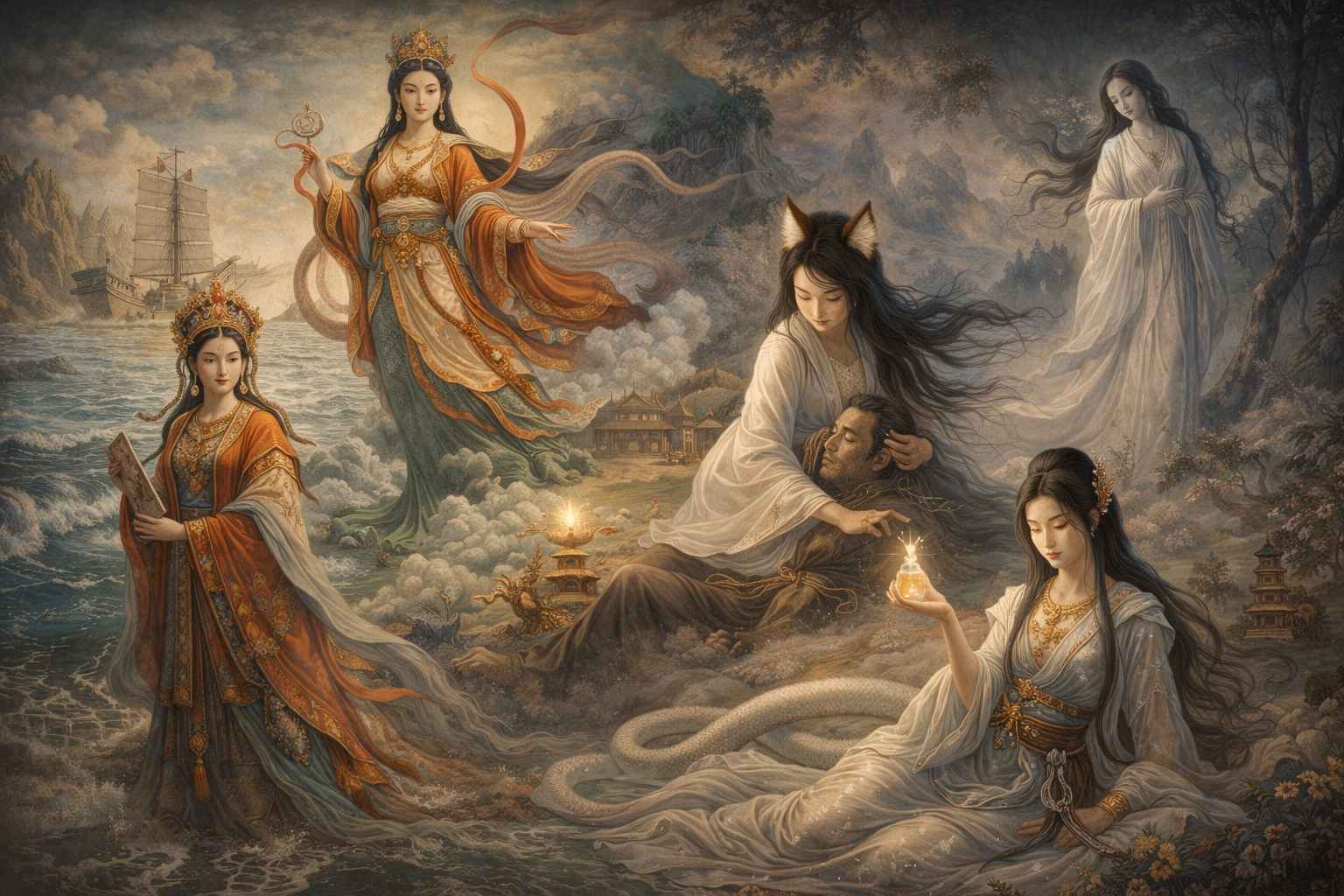
These figures are important because they resist simple classification. A goddess may protect the vulnerable but also command public ritual authority. A fox woman may be seductive, dangerous, affectionate, comic, loyal, or morally superior to the men who fear her. A snake woman may begin as a demonic being and become a tragic wife, healer, mother, and cultivated spirit. A ghost-woman may seduce the living, but she may also reveal injustice, preserve memory, or expose debts that society has failed to settle. In these traditions, female supernatural power is rarely one thing. It is a field of contradiction.
That contradiction is not accidental. Chinese legendary traditions often place feminine figures at thresholds because thresholds are where the archive tests its own moral categories. Women and female spirits mediate between body and spirit, kinship and freedom, desire and danger, grief and justice, domestic order and cosmic repair. Their power is imagined with fascination and anxiety because it exposes the instability of the very social worlds that attempt to contain it.
Gender, Power, and the Legendary Imagination
Chinese legend repeatedly imagines women as figures of mediation. They stand between heaven and earth, family and wildness, body and spirit, domestic virtue and dangerous autonomy. This is true of creator-goddesses such as Nüwa, who repairs the damaged sky in one of the foundational mythic scenes of world-restoration, but it is also true of later spirit-women whose presence unsettles the ordinary boundaries of the human realm. The recurring pattern suggests that gender in Chinese legend is not merely descriptive. It is structural: feminine figures often appear where cosmic or social order must be repaired, challenged, tested, or reimagined.
This helps explain why legendary women are so difficult to classify morally. They may be revered as protectors, feared as seducers, admired as loyal lovers, or condemned as disruptive forces. The same archive can generate maternal goddess devotion and cautionary tales of feminine enchantment without seeing a contradiction. What these stories share is an interest in female power as something that exceeds simple domestication. The feminine appears again and again at unstable borders because those borders are where the archive works hardest.
For that reason, women in Chinese legend often carry more than gendered symbolism alone. They become figures through which whole societies think about order, desire, legitimacy, grief, kinship, memory, and the permeability of the seen and unseen worlds. Their narrative force lies precisely in the fact that they cannot be comfortably reduced to one social role.
Gendered power also changes across media. A goddess in temple devotion does different work from a fox woman in a strange tale, a snake wife in opera, a demonized consort in gods-and-demons fiction, or a ghostly lover in a vernacular romance. Yet all these figures participate in a shared problem: female power appears where the ordinary social order encounters what it cannot fully master.
Threshold Figures: Human, Nonhuman, Sacred, and Dangerous
One of the most important patterns across Chinese legend is that female figures often occupy threshold states. They may be human but touched by the divine, animal but capable of human love, dead but emotionally active, demonic but morally sympathetic, maternal but sovereign, erotic but spiritually cultivated. Their power comes partly from refusing the stable categories through which society tries to name them.
This threshold position gives Chinese legend its extraordinary range of female supernatural figures. The fox spirit is animal and woman, desire and danger, deception and wisdom. White Snake is serpent and wife, cultivated being and forbidden spouse, healer and threat. The ghost lover is dead and yet emotionally present, dangerous and yet often morally revealing. Mazu is a remembered human woman who becomes divine sea-protector. Nüwa is mother, maker, and cosmic repairer. Guanyin crosses gendered devotional boundaries as a figure of compassion whose feminine form becomes central in Chinese religious life.
These figures show that femininity in the legendary archive is rarely only biological or social. It is metaphysical. Women and female spirits are repeatedly used to think about the instability of the boundary between kinds of being. They test whether the human world can recognize virtue when it appears in nonhuman form, whether love can cross species, whether memory can survive death, and whether protective authority can be imagined outside masculine sovereignty.
Their ambiguity is therefore not a weakness of the tradition. It is one of its great imaginative engines. Threshold figures keep the archive alive because they prevent moral categories from becoming too easy. They force questions that cannot be resolved by a simple distinction between good and evil, human and monster, wife and seductress, mother and goddess, spirit and person.
Goddesses, Mothers, and Protective Sovereignty
At one end of the spectrum stand female figures whose authority is protective, maternal, and publicly sacralized. Mazu is the clearest later historical example. Her cult centers on a woman who becomes, through memory and ritual devotion, one of the most powerful goddesses in Chinese religious life. This transformation is revealing. Feminine care does not remain private or domestic. It becomes communal sovereignty, maritime protection, and sacred authority distributed across temples, processions, coastal communities, diaspora networks, and collective rites.
Mazu’s power is gendered without being confined to the household. Her cult shows that the feminine can become a publicly venerated source of protection, miracle, and territorial belonging. Here female authority is not threatening because it is weak, but because it is potent enough to command ritual loyalty, shape sacred geography, and organize communal identity. What is maternal becomes cosmological, civic, and maritime.
Mythic creator and mother figures such as Nüwa belong to a deeper stratum of the same pattern. Even when later traditions frame female figures through fertility, repair, compassion, or guardianship, those roles are cosmologically significant rather than merely domestic. The mother is not only a household type. She may be a maker, restorer, savior, or protector of worlds. Female creative and protective power is therefore one of the deepest continuous lines in the archive.
Protective sovereignty also appears in less centralized forms. Local goddesses, female protectors, fertility figures, sea goddesses, mountain spirits, and mothers of divine or heroic beings may organize communities around care, blessing, fertility, rescue, healing, and territorial protection. Their authority often grows from vulnerability: storms, childbirth, illness, travel, sea-crossing, famine, grief, and danger. Female divine power answers conditions that no household can manage alone.
Nüwa: Creation, Repair, and Cosmic Motherhood
Nüwa is one of the most important female figures in early Chinese myth because her power is not merely reproductive but reparative. She is associated with creation, marriage, human origins, and, most famously, the repair of a broken cosmos. In the Huainanzi, the world has fallen into catastrophe: the four pillars collapse, the land splits, fire and flood rage, beasts devour people, and predatory birds seize the weak. Nüwa responds not by giving counsel but by remaking the conditions of life itself.
Primary Source
於是女媧煉五色石以補蒼天,斷鼇足以立四極。殺黑龍以濟冀州,積蘆灰以止淫水。Then Nüwa smelted stones of five colors to mend the blue sky, cut off the legs of the great turtle to set up the four pillars, killed the black dragon to save Jizhou, and piled reed ash to stop the overflowing waters.Huainanzi 淮南子, “Lan Ming Xun” 覽冥訓. Available at: https://ctext.org/huainanzi/lan-ming-xun
The passage presents Nüwa as a cosmic repairer whose female creative power restores the world after collapse, flood, fire, predation, and broken heavenly order.
This passage is essential because it refuses any small interpretation of female generativity. Nüwa does not simply give birth. She repairs heaven, stabilizes the earth, defeats dangerous beings, and restores survivable order. Her power is maternal in the broadest possible sense: she makes the world habitable again. In this respect, she stands at the foundation of Chinese mythic thinking about female power as world-making and world-saving.
Nüwa also complicates later assumptions about gender and public authority. Her action is cosmic, technical, martial, and salvific at once. She smelts, cuts, kills, piles, stabilizes, and repairs. Her femininity is not passive. It is practical, interventionist, and structurally necessary. The damaged world survives because a female figure acts at the scale of heaven and earth.
For the larger article, Nüwa is a crucial anchor because she shows that the archive’s gendered imagination cannot be reduced to later anxieties about seduction or domestic virtue. At its deepest mythic levels, female power appears as creative intelligence, technical repair, and cosmic restoration. Later spirit-women may be treated ambivalently, but the archive also preserves this older and more expansive image of feminine world-repair.
Mazu: Maritime Protection and Public Female Authority
Mazu represents a different form of female sacred power: not the primordial repair of the cosmos, but the public protection of communities living with risk. Her cult is rooted in the memory of Lin Moniang and the maritime communities that came to venerate her as a sea-goddess. Over time, she became one of the most influential goddesses in Chinese religious life, especially across Fujian, Taiwan, coastal China, Southeast Asia, and maritime diaspora communities.
Living Heritage Source
Mazu is described by UNESCO as “the most influential goddess of the sea in China.”UNESCO Intangible Cultural Heritage, “Mazu belief and customs.” Available at: https://ich.unesco.org/en/RL/mazu-belief-and-customs-00227
The phrase helps show how a female protector becomes a major public and communal religious power rather than a merely domestic or private figure.
Mazu’s importance lies in how female care becomes collective protection. She is invoked by sailors, fishermen, merchants, migrants, and families who depend on safe return across dangerous waters. Her temples organize pilgrimage, incense networks, processions, offerings, festival economies, and communal identity. Female sacred power here is not secluded. It moves through public space, across coasts and seas, into ritual networks that bind communities together.
This makes Mazu a model of protective sovereignty. She is maternal, but her maternity is not confined to childbirth or household care. It becomes maritime guardianship. She is compassionate, but her compassion is socially organized through temples, vows, miraculous rescue stories, processions, and regional networks. Her gendered power becomes a form of sacred infrastructure.
Mazu also challenges the assumption that female power in legend is primarily dangerous or erotic. In her cult, female authority is not contained by suspicion. It is elevated, titled, processed, worshipped, and trusted. Yet even here, power is linked to vulnerability. Mazu’s authority grows from the dangerous conditions of maritime life. She protects because the sea remains beyond human control.
Guanyin: Compassion and the Feminization of Salvific Power
Guanyin occupies a distinctive place in Chinese religious and legendary imagination because the bodhisattva’s Chinese devotional life increasingly emphasized feminine forms of compassion, rescue, and responsiveness. The figure of Guanyin cannot be reduced simply to “goddess” in a narrow mythological sense, because Guanyin belongs to Buddhist bodhisattva traditions. Yet in Chinese popular devotion, visual culture, temple practice, and storytelling, Guanyin’s feminized presence became one of the most important forms of salvific power.
This matters because Guanyin expands the field of gendered sacred authority. Compassion becomes not sentimental weakness but cosmic responsiveness. Guanyin hears cries, rescues from peril, aids the suffering, protects women and children, assists childbirth, and appears in multiple forms suited to the needs of beings. The feminine here is flexible, merciful, and active. It is a power of response.
Guanyin also shows how gender in religious image can be historically transformed. A figure with Indian Buddhist origins enters Chinese devotional culture and becomes increasingly imagined through feminine iconography, maternal compassion, white-robed presence, and domestic as well as temple devotion. This transformation reveals how Chinese religious culture could absorb, reinterpret, and feminize salvific authority according to local devotional needs.
For the study of women in Chinese legend, Guanyin is essential because she complicates the opposition between goddess and spirit-woman. She is not a fox, ghost, snake, consort, mother goddess, or local sea protector. She is a bodhisattva whose compassionate power becomes visually and ritually feminized. Her presence shows that feminine sacred power in Chinese tradition is not only native, local, or erotic. It is also transregional, Buddhist, salvific, and doctrinally deep.
The Queen Mother of the West: Immortality and Female Sovereignty
The Queen Mother of the West, or Xiwangmu, represents another major mode of female power: sovereignty over immortality, mountain realms, cosmic direction, and access to transcendent life. Her image changes across the long history of Chinese religion and literature, from earlier formidable associations to later refined visions of celestial court, peach banquets, and Daoist immortality. Across these transformations, she remains one of the most important female figures in the Chinese mythic archive.
Xiwangmu’s power is not simply maternal or protective. It is sovereign. She presides over a western realm associated with immortality, sacred mountains, divine attendants, and the peaches of long life. Her authority is spatial and cosmological: she governs a region of the mythic universe through which human beings imagine transcendence, longevity, and access to powers beyond ordinary mortality.
Her importance is especially visible in visual culture. Peaches, cranes, clouds, immortal attendants, and celestial banquets repeatedly invoke her world even when she herself is not fully narrated. This makes Xiwangmu one of the clearest examples of female mythic power surviving through motif as much as through story. Her presence can be condensed in a peach of immortality, a birthday image, a Daoist painting, or a decorative object associated with long life.
In relation to gendered power, Xiwangmu is important because she does not fit comfortably into domestic categories. She is not primarily wife, mother, lover, ghost, or seductress. She is a ruler of sacred distance. Her power lies in control over access: to immortality, to divine realms, to the boundary between mortal life and transcendent possibility. She is one of the archive’s strongest images of female cosmic authority.
Fox Spirits, Desire, and Ambiguous Feminine Agency
If goddess traditions dramatize publicly sanctioned feminine power, fox-spirit traditions often explore its unstable and ambiguous forms. Fox spirits are among the most important recurring figures in Chinese supernatural narrative because they repeatedly take on female form and enter human relationships in ways that expose anxiety around desire, autonomy, deception, intimacy, learning, class aspiration, and transformation. They can be predatory, loving, scholarly, loyal, erotic, comic, or morally complex, often all within the same broader tale tradition.
This ambiguity is precisely why fox spirits matter. They allow narratives to ask what happens when a woman’s power is not fully regulated by kinship norms, official morality, or fixed bodily identity. The fox spirit may enter the household as wife, lover, companion, or benefactor, but she always carries a remainder that cannot be fully naturalized. She is clever, transformative, and difficult to contain. In that sense, the fox spirit is one of the classic vehicles through which Chinese legend stages anxiety about female agency and fascination with it at the same time.
Strange-Tale Source
“We marvel at devils and foxes: we do not marvel at man.”Pu Songling 蒲松齡, Liaozhai zhiyi 聊齋誌異 / Strange Stories from a Chinese Studio, translated by Herbert A. Giles. Project Gutenberg edition available at: https://www.gutenberg.org/files/43629/43629-h/43629-h.htm
The line captures the strange-tale archive’s central inversion: foxes and spirits may seem marvelous, but human desire, fear, and moral blindness are often the deeper mystery.
The fox woman therefore unsettles more than the boundary between human and animal. She also unsettles the boundary between acceptable intimacy and dangerous freedom. Her symbolic force lies in precisely that tension. She may deepen human life, but she may also expose how fragile the ordinary rules governing that life really are.
Fox-spirit tales also refuse one simple moral formula. Some stories warn against male sexual weakness, deception, or demonic entanglement. Others present fox women as more loyal, intelligent, generous, or emotionally capable than human characters. Still others use the fox to expose hypocrisy in male scholarly culture, marriage systems, social ambition, and religious authority. The fox woman is powerful because she is not simply outside the moral order. She often reveals the moral order’s contradictions.
White Snake, Love, Transgression, and the Supernatural Wife
The White Snake tradition is one of the clearest examples of how Chinese legend uses a supernatural woman to think about love, virtue, motherhood, sexuality, religion, and the limits of social order. White Snake never existed in one final authoritative version; the plot changed over time and across performance traditions. Yet the figure’s cultural durability rests on a remarkably stable question: what does it mean when a woman who is also a nonhuman power seeks conjugal life, devotion, and recognition within a human world that fears and regulates her?
This question became increasingly important as the tradition developed. Later versions gave greater emotional and moral centrality to White Snake herself and intensified attention to her roles as wife and mother. That shift is revealing because it shows how legendary feminine power was reworked through changing assumptions about female virtue. White Snake is not merely a monster or temptress. She becomes a vehicle for thinking about fidelity, sacrifice, maternity, healing, cultivation, and the contradiction between moral feeling and social-religious prohibition.
The monk Fahai’s opposition to White Snake often functions as more than religious discipline. It dramatizes the conflict between classification and relationship. From one viewpoint, White Snake is a snake demon who violates the boundary between species. From another, she is a devoted wife and mother whose emotional truth exceeds the category imposed on her. The story’s power comes from the fact that neither danger nor love can fully erase the other.
This makes White Snake especially valuable for the series. She occupies the unstable middle ground between demonology and sympathy, transgression and moral seriousness. Her power is dangerous precisely because it is intimate and emotionally legible. The legend does not merely punish female supernatural agency; it also makes it tragic, admirable, and unforgettable. In White Snake, the archive shows its capacity to humanize what it also fears.
Ghosts, Revenants, and the Feminine Unsettled Dead
Female ghosts in Chinese legend add another layer to the picture. They often appear where injury, broken obligation, frustrated love, wrongful death, abandoned desire, or unresolved injustice has made the ordinary boundaries of death porous. In these stories, the feminine dead are rarely inert. They return, accuse, seduce, mourn, reward, punish, or demand recognition. The revenant woman is powerful because she exposes the incompleteness of social settlement.
Such figures also reveal that gendered power in legend is not only erotic or maternal. It can be juridical and affective at once. A female ghost may embody grievance, fidelity, longing, or vengeance, but in every case she insists that emotional and moral debts survive death. The supernatural woman is thus often a carrier of memory against systems that would prefer closure.
Ghost-women therefore occupy an especially important position in the archive. They remind the living that harm is not easily contained, that obligation exceeds biological life, and that unrecognized suffering continues to seek form. In this sense, feminine haunting often becomes a medium of moral persistence.
The ghostly woman also complicates the politics of desire. Some ghost-lover stories invite sympathy for women whose emotional lives were denied by social structures. Others warn men against dangerous attachments to beings who drain vitality or dissolve household order. Still others blur the distinction between love and peril. What matters is that the female dead remain active. They do not disappear quietly. They return as claims upon the living.
Daji, Demonized Queens, and the Politics of Blame
Not all powerful women in Chinese legend are revered or sympathetically ambiguous. Some are demonized as agents of dynastic collapse, sexual disorder, cruelty, and political corruption. Daji, especially in later gods-and-demons fiction and the Fengshen yanyi tradition, is one of the most famous examples. She becomes the fox-spirit consort whose beauty and cruelty help explain the fall of Shang and the rise of Zhou within a mythologized political order.
Daji matters because she reveals one of the most dangerous patterns in gendered legend: the blaming of political catastrophe on feminine seduction. A corrupt ruler, failed court, violent state, and collapsing dynasty can be narratively concentrated into the figure of a destructive woman. The female body becomes the explanation for political disorder. Desire becomes the language through which structural failure is personified.
At the same time, Daji cannot be read only as misogynistic scapegoat, though that dimension is real. She also belongs to a supernatural narrative system in which fox spirits, cosmic retribution, divine planning, and dynastic mandate interact. Her figure is powerful because she condenses sexuality, demonology, political violence, and historical transition. She is not merely a bad woman. She is a mythic mechanism through which a culture imagines the moral collapse of a regime.
This makes Daji useful but ethically difficult. A serious reading should recognize both the narrative force of the figure and the gender politics of blame embedded in her tradition. Demonized queens and consorts often reveal more about male anxieties concerning rule, desire, and legitimacy than about women themselves. They show how female power can be imagined as catastrophic when it appears to influence masculine sovereignty from within.
Heroines, Filial Daughters, and Ethical Memory
Women in Chinese legend also appear as heroines of loyalty, filial devotion, grief, sacrifice, and moral endurance. These figures are not always supernatural, but they often become legendary because their virtue is intensified beyond ordinary social expectation. Mulan, Meng Jiangnü, filial daughters, loyal wives, grieving widows, and women who preserve family or moral obligation under extreme conditions all belong to this wider field of ethical memory.
Such figures matter because they reveal another form of gendered power: the power to expose moral failure through suffering. A grieving woman may reveal the cruelty of war or forced labor. A filial daughter may show the moral force of kinship against institutional neglect. A woman who takes on martial or public action may expose the limits of gendered role assignment. These figures often appear virtuous by conforming to social ideals, yet their stories can also exceed those ideals by making women morally central to public memory.
Meng Jiangnü is especially revealing because her grief becomes legendary protest. Her tears at the Great Wall belong to a symbolic world in which private mourning exposes public violence. The woman’s sorrow is not merely emotional. It becomes a force that can break monumental power. This is a different kind of female agency from the goddess, fox, snake, or ghost, but it is no less important.
Heroic and filial women therefore complicate the archive’s gender politics. They may be used to reinforce normative virtue, but they can also make virtue politically disruptive. A woman who loves, mourns, or obeys too intensely may reveal the injustice of the world that demands such suffering. Ethical memory often survives through women because women are made to bear the cost of social order.
Women, Ritual Specialists, and Spirit Mediation
Chinese religious and folkloric worlds also include women as mediums, ritual specialists, devotees, singers, healers, spirit intermediaries, and transmitters of household or local tradition. These figures are harder to capture in a single mythic narrative because their power is often practical and communal rather than literary. Yet they matter deeply for the gendered archive because they show women not only as figures represented in legend, but as participants in the making and transmission of sacred life.
Spirit mediation often unsettles official categories of authority. A woman who becomes a medium or ritual voice may not hold bureaucratic, scholarly, or priestly office in the dominant sense, yet she can become socially important as a channel of divine, ancestral, ghostly, or local power. This gives gendered religious authority a different form: less textual, less institutional, but often deeply embedded in community need.
Women’s ritual roles also connect legend to healing, fertility, childbirth, protection, mourning, household safety, and communication with the dead. These are not marginal concerns. They are some of the central conditions under which people seek supernatural help. Women’s ritual labor may therefore preserve mythic relation precisely where life is most vulnerable.
This section is important because the archive of gendered power is not only about mythic women. It is also about the women who sing, mourn, pray, transmit, embody, and mediate sacred stories. A legend may be written by men, but it may be remembered, performed, or ritually activated by women. The social life of myth often depends on gendered labor that formal literary history overlooks.
Virtue, Transgression, and the Politics of Female Power
One of the deepest tensions across these traditions is the relationship between female power and normative virtue. Late imperial narratives frequently stage women or female spirits against ideals of chastity, obedience, fidelity, and proper domestic role. Yet those same narratives often grant women the greatest imaginative force precisely when they exceed those constraints. The result is not a simple opposition between “good women” and “bad women,” but a narrative field in which virtue itself is unstable and contested.
The White Snake tradition shows this clearly: female supernatural power is made sympathetic by being folded into wifehood and motherhood, yet the story never fully eliminates the unease attached to her nonhuman autonomy. Fox-spirit traditions show the same problem from another angle: the woman-spirit may be morally admirable in some respects, but her very independence from ordinary social classification makes her disruptive. In goddess traditions, the same force can be publicly sanctified rather than feared. Gendered power therefore appears across a spectrum from cultic sovereignty to erotic ambiguity to unsettled haunting.
This is why the archive remains so compelling. It does not offer one stable doctrine of femininity. Instead, it repeatedly places female power at the center of moral contradiction. Women and female spirits are made to bear the weight of competing demands: nurture and danger, fidelity and autonomy, protection and disruption, sacred legitimacy and social unease. The politics of gendered power are therefore not incidental to these legends. They are among their central dramatic engines.
These contradictions should be read critically. Many stories are shaped by male-authored, patriarchal, or elite moral frameworks that regulate women by making female desire dangerous and female virtue sacrificial. Yet the stories also preserve women’s power in forms that exceed regulation. The archive both constrains and remembers. That double movement is one of the reasons these figures remain so enduring.
Performance, Fiction, and the Remaking of Gendered Legend
Many of the most important female figures in Chinese legend changed across performance and fiction. White Snake became more emotionally sympathetic in later drama, opera, film, and popular retellings. Fox spirits shifted between danger and romance in strange tales, vernacular fiction, and modern adaptation. Mazu’s hagiography expanded through temple networks, miracle collections, ritual processions, and heritage framing. Guanyin’s gendered presence developed through devotional image, story, scripture, and popular practice. These figures did not remain fixed. They were remade.
This matters because gendered legend is often a history of adaptation. A woman who is initially monstrous may become tragic. A goddess who begins as local may become transregional. A spirit who is feared may become beloved. A heroine who is framed through obedience may become a symbol of resistance. Performance allows the emotional center of a story to shift because audience sympathy, vocal style, staging, and scene selection can change what the story seems to mean.
Opera, shadow puppetry, illustrated fiction, popular print, film, television, and animation all contributed to these afterlives. Visual form matters: White Snake’s beauty, Xiaoqing’s loyalty, Daji’s seductive danger, Guanyin’s white-robed compassion, Mazu’s maritime guardianship, and Xiwangmu’s peach banquet all became recognizable through repeated images and performances. Gendered power became public by becoming visible and repeatable.
For this reason, the study of women in Chinese legend must follow figures across media. A classical source may preserve one version, but a performance tradition may reveal a different moral emphasis. A temple image may make a goddess socially present. A film may turn an old spirit figure into a modern icon of female longing or resistance. The archive is not static. It remembers by transforming.
Source History and Interpretive Caution
A careful reading of women, spirits, and gendered power in Chinese legend must distinguish among several layers: early mythic sources, classical anomaly accounts, Buddhist and Daoist religious traditions, temple hagiography, late imperial strange tales, vernacular fiction, opera, shadow puppetry, visual culture, modern film, contemporary scholarship, and heritage documentation. These layers do not all speak in the same voice. Each frames gendered power according to its own genre, audience, and historical context.
It is especially important not to treat “Chinese legend” as if it were one unified doctrine of femininity. Nüwa’s cosmic repair, Mazu’s maritime protection, Guanyin’s compassion, Xiwangmu’s immortality, White Snake’s conjugal tragedy, fox-spirit ambiguity, ghostly grievance, Daji’s demonization, and Mulan’s heroic disguise all do different symbolic work. They belong to overlapping but distinct traditions. The fact that they are all female or feminized does not make them interchangeable.
Modern readers should also be cautious about romanticizing ambiguous figures as simple icons of liberation. Fox spirits, snake women, and ghost lovers may reveal female agency, but they often do so inside male-authored fantasies, patriarchal anxieties, and moralizing frameworks. Likewise, goddesses may embody female authority, but their cultic power does not automatically translate into social equality for ordinary women. Mythic power and social power are related, but they are not the same.
Finally, these traditions should be read with attention to both critique and wonder. Their gender politics can be restrictive, but their imaginative force is real. They preserve complex ways of thinking about desire, danger, grief, repair, protection, and transformation. The task is not to flatten them into modern slogans, but to read their contradictions carefully.
Why Women, Spirits, and Gendered Power Matter
These figures matter because they reveal how Chinese legend thinks through some of its deepest questions: who protects the vulnerable, who disrupts the household, who mediates between worlds, who bears moral memory, who repairs cosmic damage, who exposes injustice, and who exceeds the social roles available to her. Women and female spirits are often the figures through which those questions become narratively vivid. They are not peripheral to the archive. They are among its central engines of symbolic intensity.
They also matter because they resist flattening. The feminine in Chinese legend is not one thing. It can be cosmic and local, maternal and erotic, redemptive and terrifying, morally exemplary and dangerously free. What unites these figures is not a single message about women, but a recurring recognition that gendered power often appears most clearly at thresholds where order is unstable and transformation becomes possible.
For that reason, the study of women, spirits, and gendered power is not an optional subtheme within Chinese mythology. It is one of the best ways to see how the archive works: through ambiguity, layered moralization, emotional intensity, sacred authority, and the persistence of figures who cannot be entirely domesticated by the worlds that imagine them.
In these figures, the mythic imagination becomes especially transparent about its own anxieties and desires. It fears feminine autonomy and depends on feminine repair. It moralizes female desire and returns repeatedly to women as agents of transformation. It reveres goddesses while suspecting spirit-women. It disciplines wives while remembering ghostly grievance. That tension is precisely why the archive remains alive.
Related Reading
- Chinese Myth, Folklore & Legend
- Fox Spirits, Transformation, and Ambiguity in Chinese Folklore
- The White Snake Tradition and the Legend of Love, Transgression, and Cultivation
- Ghosts, Revenants, and the Moral Logic of the Unsettled Dead
- Mazu and the Sea-Goddess Traditions of Coastal China
- Nüwa: Creation, Repair, and the Human World
- The Queen Mother of the West and the Imagery of Immortality
Primary Sources
- Huainanzi 淮南子, “Lan Ming Xun” 覽冥訓. Useful as a primary source for Nüwa’s cosmic repair, five-colored stones, restoration of the sky, flood control, dragon-slaying, and female world-restoring power. Chinese Text Project edition available at: https://ctext.org/huainanzi/lan-ming-xun
- Pu Songling 蒲松齡 (n.d.) Liaozhai zhiyi 聊齋誌異 / Strange Tales from a Chinese Studio. Useful as a primary strange-tale archive for fox spirits, ghost women, supernatural intimacy, moral ambiguity, and the unstable boundary between human and nonhuman forms. Project Gutenberg edition of Herbert A. Giles’s translation available at: https://www.gutenberg.org/files/43629/43629-h/43629-h.htm
- Xu Zhonglin 許仲琳, attributed (n.d.) Fengshen yanyi 封神演義 / Investiture of the Gods. Useful as a primary vernacular-fiction source for Daji, fox-spirit demonization, gendered blame, dynastic collapse, and the mythologizing of political disorder through female seduction. Chinese Text Project edition available at: https://ctext.org/fengshen-yanyi/ens
- UNESCO Intangible Cultural Heritage (2009) “Mazu belief and customs.” Useful as primary institutional documentation of Mazu as a living female sea-goddess tradition centered on protection, miracle, ritual ceremony, oral tradition, temple networks, and communal devotion. Available at: https://ich.unesco.org/en/RL/mazu-belief-and-customs-00227
- Lin, Y. 林堯俞 and Huang, Q. 黃啟佑, attributed / compiled tradition (n.d.) Tianfei xiansheng lu 天妃顯聖錄 / Records of the Manifested Holiness of the Heavenly Consort. Useful for Mazu hagiography, miracle traditions, official titles, and the textualization of female maritime divine power. Chinese Text Project edition available at: https://ctext.org/wiki.pl?chapter=614954&if=gb
- Lin, Y. and Huang, Q. (2017) Tianfei xiansheng lu 天妃顯聖錄. Project Gutenberg public-domain Chinese text. Useful for Mazu miracle narratives, title records, and sea-goddess devotional history. Available at: https://www.gutenberg.org/ebooks/54777
- Shanhaijing 山海經 / Classic of Mountains and Seas. Useful for early mythic and geographic material associated with divine women, sacred landscapes, strange beings, and the broader symbolic environment in which figures such as Xiwangmu became important. Chinese Text Project edition available at: https://ctext.org/shan-hai-jing
- Taiping guangji 太平廣記 / Extensive Records of the Taiping Era. Useful as a major compendium preserving anomaly tales, fox stories, ghost narratives, female spirits, and supernatural traditions that shaped later legendary imagination. Chinese Text Project edition available at: https://ctext.org/taiping-guangji
- Jingshi tongyan 警世通言 / Stories to Caution the World, “Bai niangzi yongzhen Leifeng ta” 白娘子永鎮雷峰塔 / “Madame White Is Kept Forever under Thunder Peak Pagoda.” Useful as an important literary witness to the White Snake tradition’s development through vernacular fiction and moralized supernatural romance.
- Lie nü zhuan 列女傳 / Biographies of Exemplary Women. Useful as a primary source for the moralization of women’s virtue, filiality, chastity, loyalty, and exemplary female conduct in early Chinese textual tradition. Chinese Text Project edition available at: https://ctext.org/lie-nv-zhuan
Further Reading
- UNESCO Intangible Cultural Heritage (2009) “Mazu belief and customs.” Available at: https://ich.unesco.org/en/RL/mazu-belief-and-customs-00227
- Chinese Text Project (n.d.) Huainanzi 淮南子, “Lan Ming Xun” 覽冥訓. Available at: https://ctext.org/huainanzi/lan-ming-xun
- Chinese Text Project (n.d.) Shanhaijing 山海經. Available at: https://ctext.org/shan-hai-jing
- Chinese Text Project (n.d.) Fengshen yanyi 封神演義. Available at: https://ctext.org/fengshen-yanyi/ens
- Chinese Text Project (n.d.) Taiping guangji 太平廣記. Available at: https://ctext.org/taiping-guangji
- Pu, S. (n.d.) Strange Stories from a Chinese Studio. Translated by Herbert A. Giles. Project Gutenberg. Available at: https://www.gutenberg.org/files/43629/43629-h/43629-h.htm
- Lin, Y. and Huang, Q. (2017) Tianfei xiansheng lu 天妃顯聖錄. Project Gutenberg. Available at: https://www.gutenberg.org/ebooks/54777
- Balivet, A. (2019) The Many Transformations of White Snake. University of Wisconsin–Madison dissertation. Available at: https://asset.library.wisc.edu/1711.dl/MKNK5FP5V6YM79E/R/file-f7383.pdf
- Wang, S. (2017) Chinese Enchantment. University of Chicago dissertation. Available at: https://knowledge.uchicago.edu/record/216/files/Wang_uchicago_0330D_13936.pdf
- Cheng, H.-w. (2012) Women, Gender, and Sexuality in Pre-modern China. University of Washington dissertation. Available at: https://digital.lib.washington.edu/researchworks/bitstream/handle/1773/20678/Cheng_washington_0250E_10643.pdf?isAllowed=y&sequence=1
- Cass, V.H. (1999) Dangerous Women: Warriors, Grannies, and Geishas of the Ming. Lanham, MD: Rowman & Littlefield.
- Huntington, R. (2003) Alien Kind: Foxes and Late Imperial Chinese Narrative. Cambridge, MA: Harvard University Asia Center.
- Idema, W.L. (2008) The White Snake and Her Son: A Translation of The Precious Scroll of Thunder Peak with Related Texts. Indianapolis: Hackett.
- Waltner, A. (1990) Getting an Heir: Adoption and the Construction of Kinship in Late Imperial China. Honolulu: University of Hawai‘i Press.
- Yu, C.-F. (2001) Kuan-yin: The Chinese Transformation of Avalokiteśvara. New York: Columbia University Press.
- Cahill, S.E. (1993) Transcendence and Divine Passion: The Queen Mother of the West in Medieval China. Stanford: Stanford University Press.
References
- Balivet, A. (2019) The Many Transformations of White Snake. University of Wisconsin–Madison dissertation. Available at: https://asset.library.wisc.edu/1711.dl/MKNK5FP5V6YM79E/R/file-f7383.pdf
- Cahill, S.E. (1993) Transcendence and Divine Passion: The Queen Mother of the West in Medieval China. Stanford: Stanford University Press.
- Cass, V.H. (1999) Dangerous Women: Warriors, Grannies, and Geishas of the Ming. Lanham, MD: Rowman & Littlefield.
- Cheng, H.-w. (2012) Women, Gender, and Sexuality in Pre-modern China. University of Washington dissertation. Available at: https://digital.lib.washington.edu/researchworks/bitstream/handle/1773/20678/Cheng_washington_0250E_10643.pdf?isAllowed=y&sequence=1
- Chinese Text Project (n.d.) Fengshen yanyi 封神演義. Available at: https://ctext.org/fengshen-yanyi/ens
- Chinese Text Project (n.d.) Huainanzi 淮南子, “Lan Ming Xun” 覽冥訓. Available at: https://ctext.org/huainanzi/lan-ming-xun
- Chinese Text Project (n.d.) Lie nü zhuan 列女傳. Available at: https://ctext.org/lie-nv-zhuan
- Chinese Text Project (n.d.) Shanhaijing 山海經. Available at: https://ctext.org/shan-hai-jing
- Chinese Text Project (n.d.) Taiping guangji 太平廣記. Available at: https://ctext.org/taiping-guangji
- Chinese Text Project (n.d.) Tianfei xiansheng lu 天妃顯聖錄. Available at: https://ctext.org/wiki.pl?chapter=614954&if=gb
- Huntington, R. (2003) Alien Kind: Foxes and Late Imperial Chinese Narrative. Cambridge, MA: Harvard University Asia Center.
- Idema, W.L. (2008) The White Snake and Her Son: A Translation of The Precious Scroll of Thunder Peak with Related Texts. Indianapolis: Hackett.
- Lin, Y. and Huang, Q. (2017) Tianfei xiansheng lu 天妃顯聖錄. Project Gutenberg. Available at: https://www.gutenberg.org/ebooks/54777
- Pu, S. 蒲松齡 (n.d.) Strange Stories from a Chinese Studio. Translated by Herbert A. Giles. Project Gutenberg. Available at: https://www.gutenberg.org/files/43629/43629-h/43629-h.htm
- UNESCO Intangible Cultural Heritage (2009) “Mazu belief and customs.” Available at: https://ich.unesco.org/en/RL/mazu-belief-and-customs-00227
- Waltner, A. (1990) Getting an Heir: Adoption and the Construction of Kinship in Late Imperial China. Honolulu: University of Hawai‘i Press.
- Wang, S. (2017) Chinese Enchantment. University of Chicago dissertation. Available at: https://knowledge.uchicago.edu/record/216/files/Wang_uchicago_0330D_13936.pdf
- Yu, C.-F. (2001) Kuan-yin: The Chinese Transformation of Avalokiteśvara. New York: Columbia University Press.