Author name: Tariq Ahmad

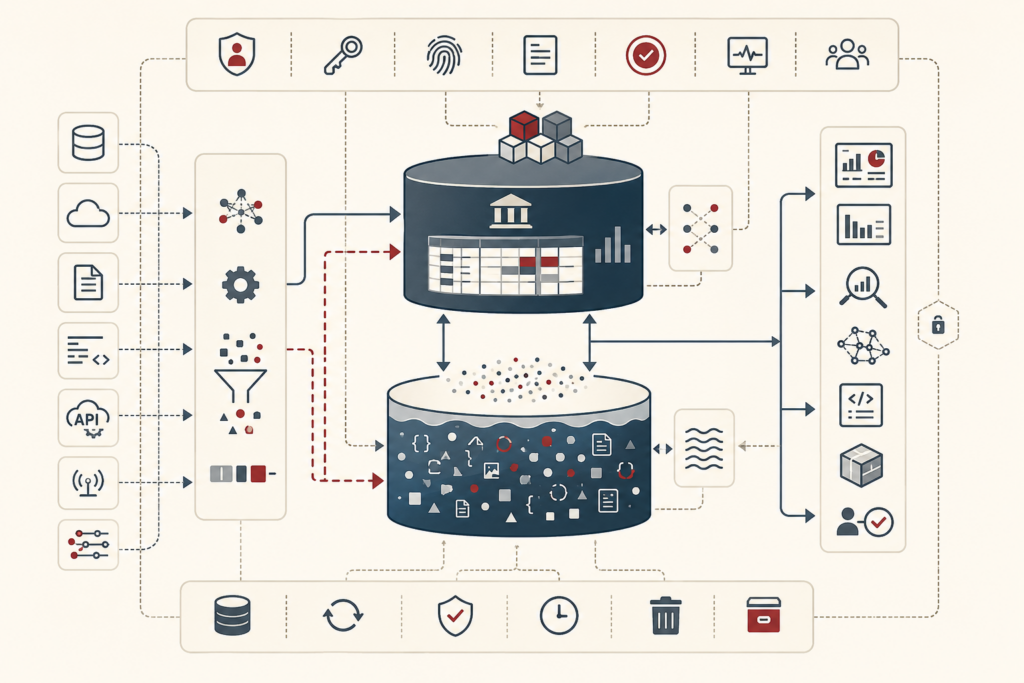
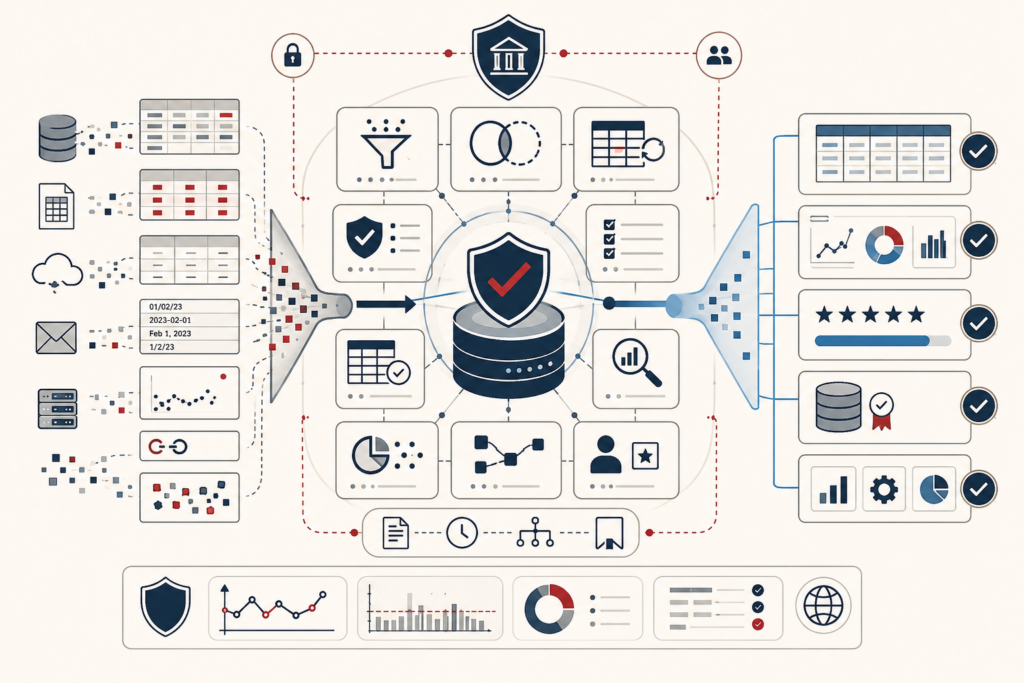
Conceptual data-systems illustration showing messy data sources being cleaned, validated, governed, monitored, and transformed into trusted datasets and analytical outputs.

Data Cleaning and Data Quality Management: Quality, Governance, and Trust

Data cleaning and data quality management determine whether data is merely available or genuinely fit for use. This article frames quality as a multidimensional governance problem, not a one-time preprocessing task: records must be profiled, validated, standardized, repaired, disclosed, monitored, and tied back to the processes that produced them. It explains why accuracy alone is insufficient and why completeness, consistency, timeliness, validity, uniqueness, interpretability, accessibility, stewardship, and root-cause analysis all shape analytical trust. The article also examines duplicate identities, survivorship rules, rejected-record quarantine, quality incidents, pipeline monitoring, quality rules, and institutional accountability. Mathematical examples and Python/R workflows show how teams can evaluate completeness, validity, uniqueness, timeliness, rule pass rates, cleaning lineage, root causes, incidents, and data-quality readiness scores.
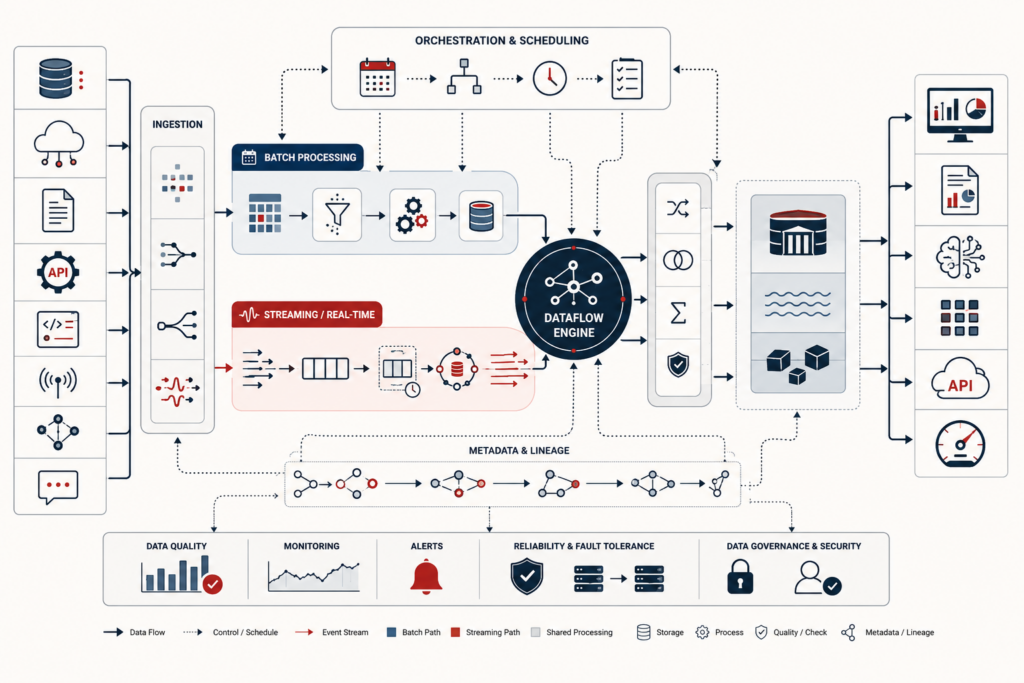
Conceptual data-systems illustration showing batch processing, streaming data, ingestion, orchestration, dataflow, metadata lineage, monitoring, governance, and downstream analytical outputs.

Data Pipelines and Data Processing Systems: Batch, Streaming, and Dataflow

Data pipelines and data processing systems are the operational machinery that turns raw, dispersed, and temporally uneven data into trusted downstream state. This article frames pipelines not as background plumbing, but as evidence infrastructure: directed dataflow graphs that ingest, validate, transform, enrich, route, monitor, replay, and serve data across batch, streaming, micro-batch, and backfill workflows. It explains why pipeline design determines whether dashboards, metrics, alerts, models, warehouses, feature stores, and data products can be trusted. The article also examines pipeline stages, DAGs, event-driven architectures, orchestration, stateful processing, windows, delivery semantics, idempotency, fault tolerance, observability, lineage, replay, and recomputation. Mathematical examples and Python/R workflows show how teams can evaluate graph topology, run health, quality gates, observability metrics, lineage edges, backfill readiness, idempotency checks, and pipeline-readiness scores.

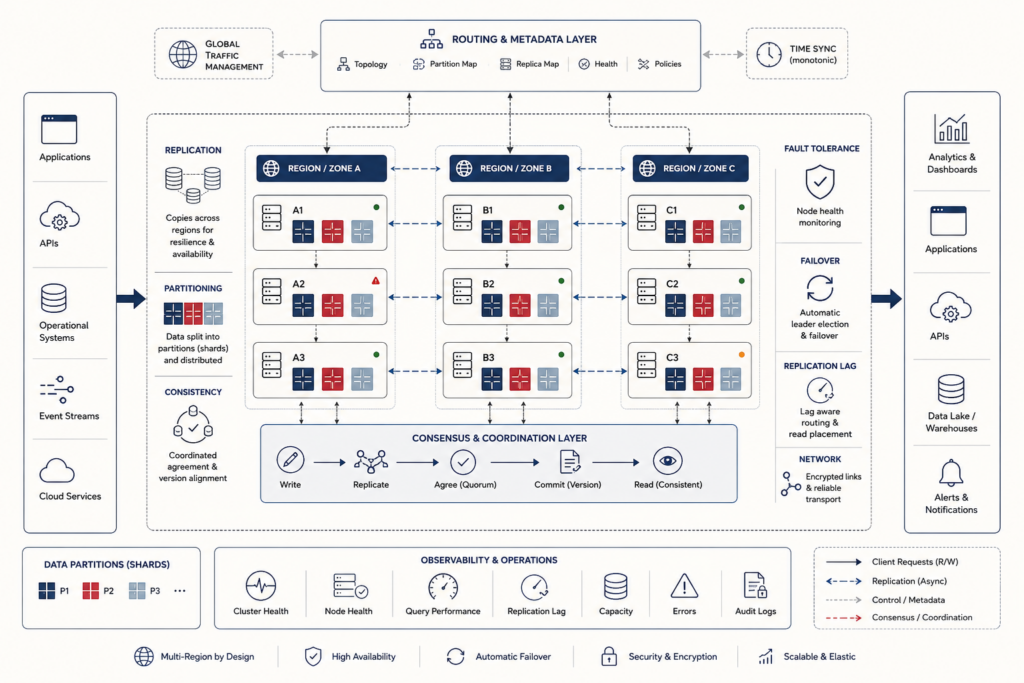
Conceptual distributed data systems illustration showing replicated data across regions, partitioned shards, routing metadata, consensus coordination, failover, consistency controls, and observability.

Distributed Data Systems: Replication, Partitioning, and Consistency

Distributed data systems preserve useful data behavior when storage, computation, and users no longer live in one place. This article frames distribution not as “bigger databases,” but as coordination under failure: the discipline of partitioning data, replicating state, routing requests, managing quorum reads and writes, handling replica lag, coordinating leaders, resolving conflicts, and recovering after partial failure. It explains why scale, availability, geographic locality, and resilience force systems beyond centralized architecture, while also creating tradeoffs among consistency, latency, durability, and availability. The article also examines CAP, quorum policies, distributed transactions, consensus, conflict resolution, CP/AP/mixed architectures, failover, observability, and auditability. Mathematical examples and Python/R workflows show how teams can evaluate shard routing, replication health, quorum intersection, replica lag, operation health, conflict resolution, consensus events, failover drills, and distributed-system readiness scores.

Conceptual data-systems illustration showing data sources flowing into governed warehouse and lake architectures with ingestion, transformation, security, lifecycle controls, and analytical outputs.

Data Warehouses and Data Lakes: Architecture, Governance, and Analytics

Data warehouses and data lakes solve different but complementary problems in modern analytics. This article frames the warehouse–lake distinction around analytical readiness: warehouses organize curated, governed, high-performance data for reporting, BI, decision support, dimensional modeling, and certified metrics, while lakes preserve raw, semi-structured, unstructured, and exploratory data for future analysis, machine learning, archival retention, and large-scale evidence management. It explains why mature data estates need both raw optionality and curated analytical state, and why lakehouse architectures emerged to combine lake flexibility with warehouse-style reliability, governance, and performance. The article also examines schema-on-write, schema-on-read, raw/bronze/silver/gold layers, dimensional models, conformed dimensions, data-swamp risk, metadata, lineage, open table formats, cost-performance tradeoffs, and workload fit. Python/R workflows show how teams can evaluate asset readiness, governance coverage, dimensional-model quality, lakehouse features, swamp risk, and estate-readiness scores.

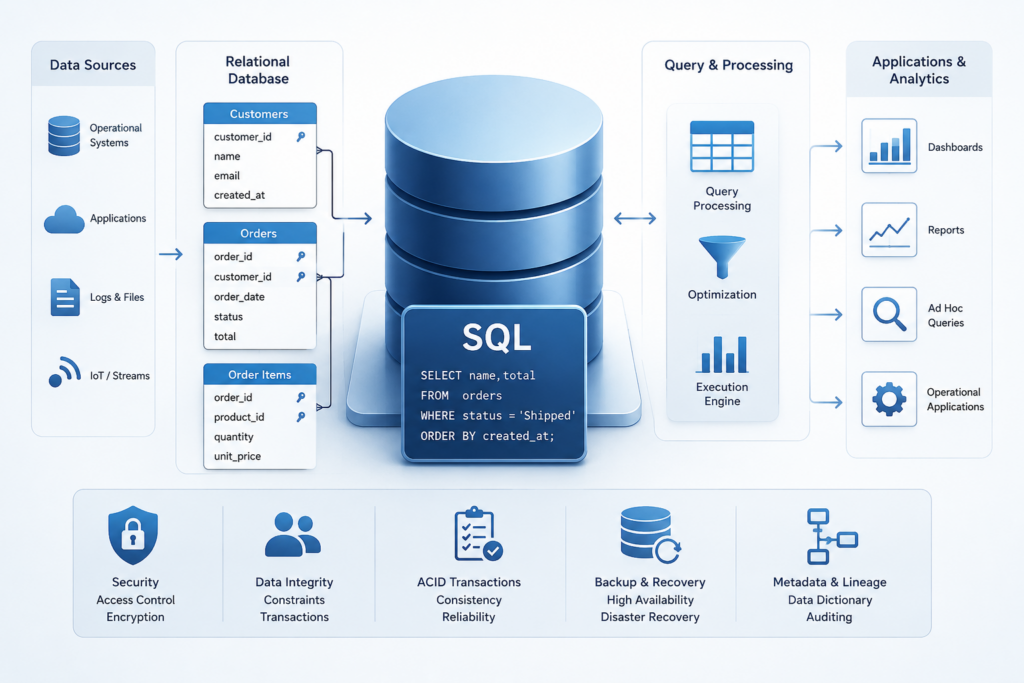
Conceptual data-systems illustration showing relational tables, SQL queries, database processing, data sources, applications, analytics outputs, security, integrity, transactions, backup, and lineage.

Relational Databases and SQL Systems

Relational databases and SQL systems remain foundational because they provide a disciplined architecture for structured institutional state. This article explains why the relational model continues to matter in modern data environments shaped by warehouses, lakes, streaming systems, document stores, graph systems, and AI infrastructure. It frames relational databases not as legacy table storage, but as systems of identity, dependency, constraint, transaction, and declarative retrieval. The article examines relations, tuples, attributes, primary keys, foreign keys, SQL, DDL, DML, joins, aggregation, constraints, transactions, normalization, indexes, query planning, access control, and modern relational system design. Mathematical examples and Python/R workflows show how teams can evaluate schema readiness, constraint coverage, query workload fit, transaction health, access governance, integrity incidents, normalization risks, and overall relational SQL readiness.

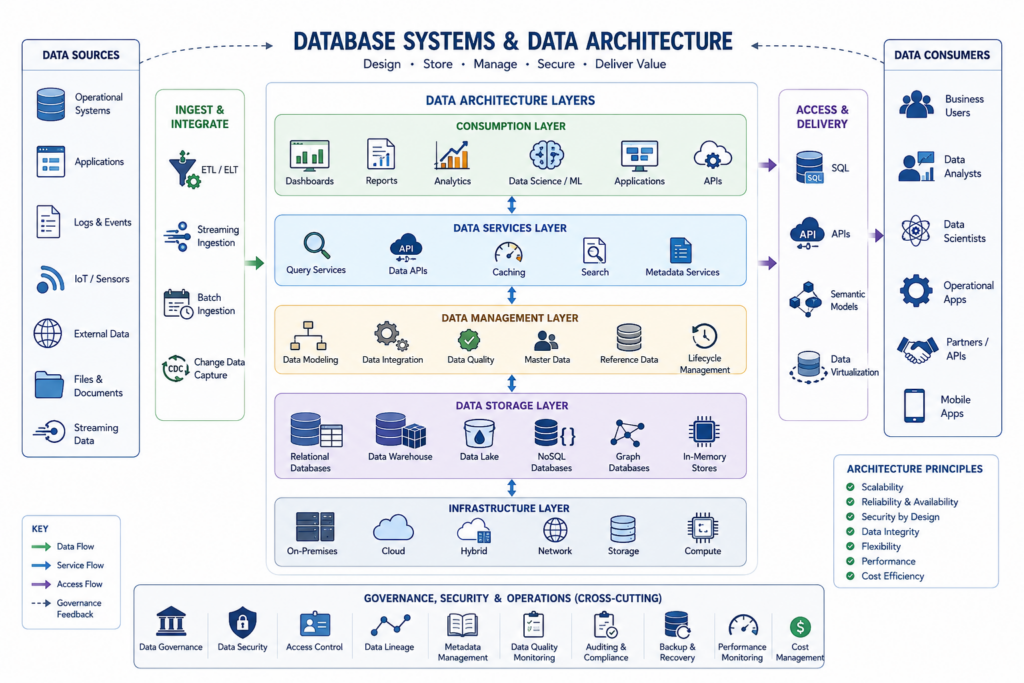
Conceptual data-systems illustration showing data sources flowing through ingestion, storage, management, services, access, governance, security, and analytical consumption layers.

Database Systems and Data Architecture

Database systems and data architecture form the structural foundation of modern information environments. This article frames databases not as passive containers, but as institutional systems of memory that define what organizations can store, retrieve, govern, audit, recover, and trust. It explains how database architecture represents entities, events, states, transactions, relationships, rules, and evidence, while broader data architecture connects operational databases, analytical stores, pipelines, warehouses, lakes, catalogs, semantic layers, governance controls, recovery plans, and AI-facing workflows. The article examines schemas, keys, constraints, normalization, query processing, indexing, operational and analytical stores, warehouse/lake/lakehouse layering, distributed databases, metadata, lineage, security, backup, recovery, retention, and data architecture for AI. Mathematical examples and Python/R workflows show how teams can evaluate system readiness, asset quality, workload fit, lineage quality, recovery posture, architecture risk, and estate-level database architecture readiness.

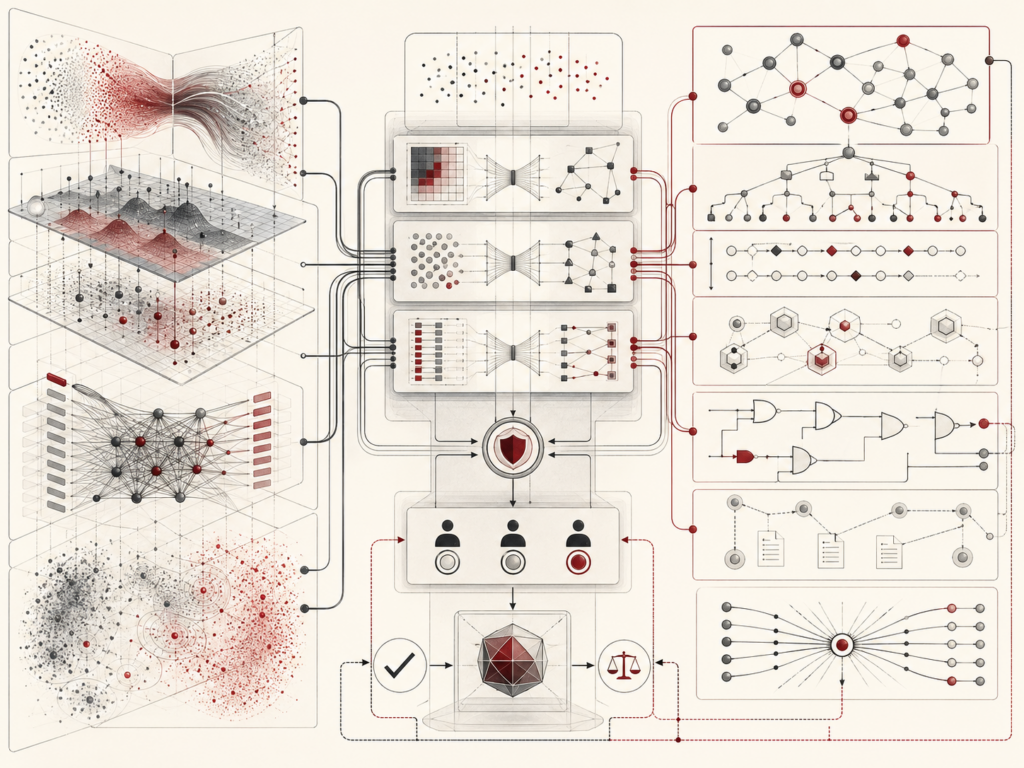
Abstract editorial illustration of hybrid AI showing neural representation layers, symbolic knowledge structures, a central integration core, verification pathways, and human oversight elements.

Hybrid AI: Symbolic + Neural Systems

Hybrid AI systems combine neural models’ ability to learn from large, noisy, high-dimensional data with symbolic AI’s ability to represent explicit knowledge, rules, constraints, ontologies, and reasoning steps. This article explains how symbolic systems, neural networks, knowledge graphs, semantic triples, rules, constraints, retrieval-augmented generation, differentiable reasoning, causal structure, planning, traceability, and governance can work together inside hybrid AI architectures. It shows why neural models are powerful for perception, language, pattern recognition, and representation learning, while symbolic systems strengthen consistency, explainability, provenance, auditability, and institutional accountability. The article also introduces mathematical lenses for neural prediction, symbolic knowledge bases, knowledge graphs, hybrid decision functions, constraint violations, retrieval grounding, and audit traces, alongside Python and R workflows for hybrid scoring, symbolic rule checks, decision-source diagnostics, and governance documentation.

Abstract editorial illustration of symbolic AI showing knowledge graphs, ontology hierarchies, rule pathways, inference traces, constraint layers, and structured reasoning architecture.

Knowledge Representation and Symbolic AI Systems

Knowledge representation and symbolic AI systems explain how intelligence can be built through explicit structures for facts, concepts, relations, rules, constraints, actions, events, and reasoning procedures. This article examines symbolic AI, the roles of knowledge representation, logic, predicates, rules, ontologies, taxonomies, semantic networks, frames, RDF-style triples, OWL-style ontologies, knowledge graphs, expert systems, action reasoning, the frame problem, nonmonotonic reasoning, governance metadata, and neuro-symbolic architectures. It shows why symbolic systems remain essential for explanation, consistency, controllability, provenance, auditability, and formal reasoning, especially in knowledge-intensive or regulated environments. The article also introduces mathematical lenses for knowledge bases, predicates, relations, entailment, semantic triples, knowledge graphs, frames, rule traces, and inferred conclusions, alongside Python and R workflows for symbolic facts, rule-based inference, knowledge graph diagnostics, and audit-friendly traceability.

Abstract editorial illustration of trustworthy AI showing a central decision core, explanation layers, user feedback loops, oversight gates, review checkpoints, and accountability pathways.

Trust, Interpretability, and User-Centered AI Systems

Trust, interpretability, and user-centered AI systems examine how artificial intelligence can be designed, explained, evaluated, and governed so people can understand outputs, calibrate reliance, contest decisions, and use AI responsibly in real contexts. This article explains calibrated trust, interpretability, explainability, user mental models, uncertainty communication, confidence, reliance, automation bias, overreliance, underreliance, accessibility, human-AI interaction, workflow integration, contestability, and accountability. It shows why technical performance alone cannot establish trustworthiness if users cannot understand limitations, inspect evidence, override outputs, or seek remedy. The article also introduces mathematical lenses for model outputs, explanations, user decisions, reliance gaps, calibration, explanation quality, and human-centered objectives, alongside Python and R workflows for trust calibration, explanation diagnostics, user reliance simulation, and overreliance/underreliance analysis.

Scroll to Top