
Last Updated May 11, 2026
Data cleaning and data quality management determine whether data is merely present or genuinely fit for use. Organizations often speak as though data becomes valuable simply by being collected, stored, and made queryable. In practice, however, data frequently arrives incomplete, inconsistent, duplicated, stale, misformatted, poorly documented, or semantically ambiguous. These defects do not remain local. They propagate through pipelines, distort metrics, weaken models, undermine trust in dashboards, and create institutional friction whenever analysts, operators, or decision-makers discover that the underlying records do not support the claims being made from them.
For that reason, data cleaning should not be reduced to a narrow preprocessing step. It is one component of a larger architecture of data quality management: the organizational and technical discipline through which data is assessed, improved, monitored, governed, and maintained over time. Classical work from the MIT Total Data Quality Management tradition emphasized that data quality is not exhausted by technical correctness alone. Data must be accurate, but also timely, complete, accessible, interpretable, and relevant to the work it is meant to support. More broadly, the influential “beyond accuracy” perspective argued that data quality should be understood from the point of view of data consumers and their actual use conditions, not only from the standpoint of intrinsic error detection.
Main Library
Publications
Article Map
Data Systems & Analytics
Related Topic
Data Pipelines
Related Topic
Data Quality & Observability
Related Topic
ETL & Transformation
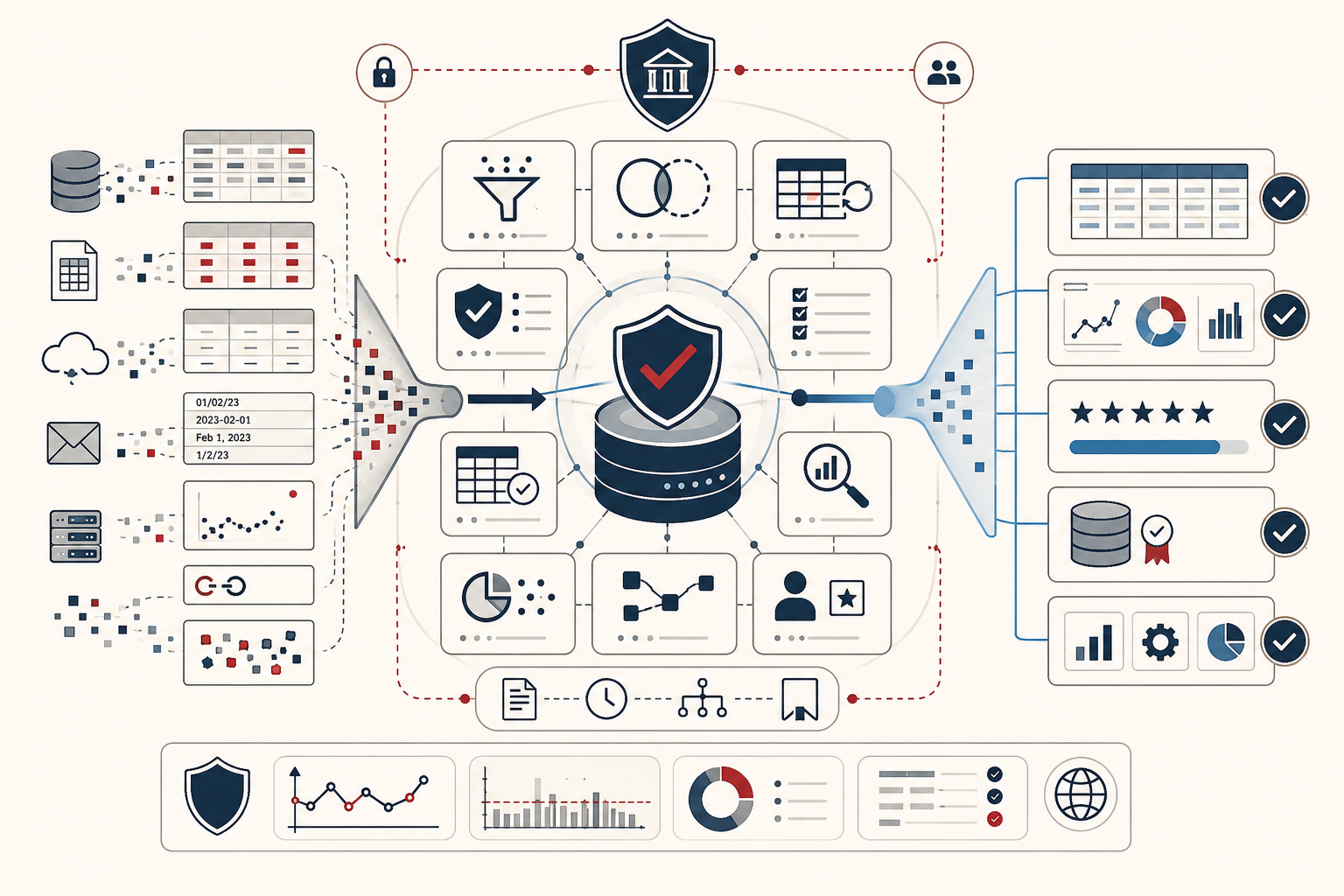
Seen in this light, data cleaning and data quality management sit at the heart of trustworthy analytics. They connect source-system design, pipeline logic, metadata, stewardship, measurement, monitoring, and downstream interpretation. Cleaning fixes defects in records. Quality management asks why those defects arose, how they should be measured, how their impact should be prioritized, and how the system can be improved so that the same defects do not recur indefinitely. A mature institution therefore does not merely clean data. It develops the capacity to understand, monitor, and govern data quality as an ongoing property of its information environment.
This article should be read alongside Data Quality Metrics and Observability, Data Pipelines and Data Processing Systems, ETL and Data Transformation Systems, Metadata, Data Catalogs, and Lineage, Data Governance, Privacy, and Security, Descriptive Analytics and Data Exploration, and Reproducible Analytics and Versioned Data Workflows. Data quality is not a side issue beneath those systems. It is one of the reasons disciplined data systems need to exist at all.
Quality as fitness for use
The strongest way to understand data quality is as fitness for use. A dataset is not high quality in the abstract simply because it contains many records, conforms to a schema, or passes a narrow technical check. It is high quality when it can responsibly support the work, decisions, analyses, models, reports, services, or public claims being built from it.
This perspective matters because different uses require different quality properties. A dataset suitable for long-horizon aggregate planning may be inadequate for real-time fraud detection. A table good enough for internal exploration may be insufficient for regulated reporting. A field that is accurate but undocumented may still be unusable for external research. A record that is complete but stale may be dangerous in operational control. Quality is therefore not a single property. It is a relationship among data, purpose, risk, interpretation, and consequence.
Data cleaning belongs inside this broader view. Cleaning improves the record. Quality management improves the system that produces, moves, interprets, and governs the record. Without quality management, cleaning becomes endless downstream repair. With quality management, defects become evidence about process, stewardship, definitions, system design, and institutional accountability.
What data cleaning and data quality management mean
Data cleaning is the process of identifying and addressing errors, inconsistencies, missing values, duplicates, formatting problems, domain violations, and other defects that reduce the usability of data. Cleaning may involve correction, standardization, validation, deduplication, imputation, enrichment, normalization, quarantining, or the removal of corrupt records. Its goal is not aesthetic tidiness. Its goal is to improve the reliability of downstream use.
Data quality management is the broader organizational discipline that evaluates whether data is fit for intended use, measures quality across defined dimensions, establishes remediation processes, assigns stewardship, embeds monitoring, and improves the lifecycle of data creation, movement, storage, transformation, and use. Cleaning is one activity inside that broader system. Quality management includes assessment, prevention, governance, monitoring, root-cause analysis, escalation, and continuous improvement.
This distinction matters because organizations often spend heavily on one-off cleaning projects while leaving upstream causes untouched. They remove duplicates today, only to recreate them tomorrow. They standardize address fields during migration, only to reintroduce inconsistency through poorly governed input forms. They repair missing values downstream while leaving source systems designed to permit the same omissions. A quality-management perspective treats defects as symptoms of information production processes rather than as isolated data-entry accidents.
Why data quality matters
Data quality matters because analytical outputs inherit the structure and limitations of their inputs. Weak-quality source data does not become trustworthy merely because it is passed through a sophisticated model, a dashboarding tool, a warehouse, a semantic layer, or a polished reporting interface. If identifiers are inconsistent, entities may be counted twice. If timestamps are wrong, trends may be misread. If fields are missing or semantically unstable, joins may distort rather than clarify. Errors at the record level become errors at the institutional level once they are aggregated, automated, operationalized, or published.
The impact is not only technical. Poor data quality increases reconciliation work, encourages shadow spreadsheets, erodes confidence in official metrics, and makes organizational coordination more difficult. When users discover that core reports conflict or that supposedly authoritative tables cannot be trusted, the cost is not just analytical inefficiency. It is a decline in institutional credibility.
This is why data quality should be treated as an organizational performance issue rather than a narrow engineering problem. Data quality affects whether information can support work, decisions, coordination, compliance, public accountability, and scientific or operational interpretation under real conditions of use. Data systems can scale storage and computation, but low-quality data scales mistrust.
Beyond accuracy: quality as contextual trustworthiness
One of the most important insights in the field is that data quality cannot be reduced to accuracy alone. A value may be accurate in a narrow sense and still be unusable because it is too late, incomplete, obscurely defined, difficult to access, represented in an incompatible unit, or poorly documented for the task at hand. Accuracy matters, but accuracy is only one dimension of quality.
This broader perspective is especially important in modern data systems because data is reused across many contexts. The same source record may feed operational dashboards, machine-learning features, compliance extracts, public reports, and long-term research archives. Each use may require different tolerances for missingness, latency, precision, interpretability, lineage, or access control. A dataset can therefore be fit for one purpose and unfit for another.
Quality as contextual trustworthiness does not mean that standards become subjective or weak. It means quality requirements must be explicitly tied to purpose, risk, and consequence. A quality rule without a use case is a technical preference. A quality rule tied to a decision, model, report, or accountability obligation becomes part of institutional evidence infrastructure.
Core dimensions of data quality
Although frameworks vary, serious discussions of data quality converge on a common insight: quality is multidimensional because data can fail in multiple ways at once. A record may be complete but inaccurate. It may be accurate but stale. It may be timely and valid yet difficult to interpret because definitions are unclear. The point of using dimensions is therefore not to generate a bureaucratic checklist, but to make quality diagnosable rather than vague.
Several dimensions recur across scholarship and practice. Accuracy concerns whether values correctly represent the phenomena they are meant to describe. Completeness concerns whether required fields, records, or observations are present. Consistency concerns agreement across records, systems, codes, and time. Timeliness concerns whether data is current enough for the use case. Validity concerns conformity to expected domains, formats, and rules. Uniqueness concerns whether entities or events are represented once rather than duplicated. Interpretability concerns whether users can understand meaning, lineage, units, and definitions. Accessibility concerns whether appropriate users can obtain and use the data responsibly.
What matters analytically is the interplay among these dimensions. A regulated reporting system may tolerate modest delay less easily than modest incompleteness. A scientific dataset may tolerate delayed publication less easily than undocumented measurement units. A customer master may prioritize uniqueness and consistency more heavily than low-latency refresh. A safety-critical operational system may prioritize timeliness, validity, and anomaly detection above descriptive completeness. Quality management becomes serious when these priorities are made explicit and tied to actual institutional use.
| Dimension | Core question | Common failure | Typical measure |
|---|---|---|---|
| Accuracy | Does the value represent the real-world condition correctly? | Wrong address, wrong date, wrong quantity, wrong classification | Error rate against authoritative reference |
| Completeness | Are required values and records present? | Missing fields, missing events, incomplete histories | Null rate, required-field coverage |
| Consistency | Do records agree across systems, time, and definitions? | Conflicting codes, incompatible units, mismatched entity states | Cross-system conformance rate |
| Timeliness | Is the data current enough for the use case? | Stale records, delayed feeds, outdated reference tables | Freshness lag, update age |
| Validity | Does the value conform to expected domains and rules? | Invalid dates, impossible amounts, malformed e-mails | Rule pass rate |
| Uniqueness | Are entities or events represented once? | Duplicate customers, repeated events, duplicate loads | Duplicate cluster rate |
| Interpretability | Can users understand the meaning, units, and provenance? | Ambiguous fields, missing data dictionary, unclear lineage | Metadata completeness, definition coverage |
| Accessibility | Can appropriate users access the data responsibly? | Unavailable data, unclear permissions, unusable formats | Access success rate, policy conformance |
Common data quality problems
Data quality problems are varied, but several types recur across operational, analytical, and integrated data environments. Missing data occurs when required values, records, or observations are absent. Duplicate entities occur when the same person, customer, asset, device, organization, or event appears multiple times under different identifiers. Inconsistent coding occurs when the same category or attribute is represented in multiple incompatible ways. Invalid values occur when data falls outside allowed domains or violates business rules. Outdated records are stale relative to the timing needs of the use case. Structural inconsistency appears when schemas, field meanings, or relationships differ across sources. Parsing and formatting defects occur when dates, units, strings, addresses, or identifiers are represented in incompatible forms.
These problems become especially severe when heterogeneous sources are integrated. Source-specific inconsistencies that were tolerable inside one application become much more damaging when those records are joined, transformed, or aggregated into shared analytical structures. One system may treat a customer as active, another as current, another as open, and another as inactive. Without governed mapping, downstream analytics may either fragment the same concept or collapse different meanings into one misleading field.
The deeper danger is that data quality problems often become invisible after transformation. A cleaned table may look authoritative even if the transformation process silently removed records, imputed uncertain values, or merged identities under weak evidence. This is why high-quality data systems need not only cleaning operations, but also rejected-record logs, issue registers, lineage, quality metrics, and stewardship decisions.
Data cleaning as detection, correction, standardization, and disclosure
Data cleaning is best understood as a sequence of diagnostic and remedial actions rather than as one uniform operation. First, defects must be detected. This may involve profiling, rule checks, anomaly detection, duplicate matching, cross-field validation, source comparison, schema inspection, or distributional review. Second, defects must be interpreted. Is a missing value the result of a system bug, a business exception, a timing lag, a user-interface design problem, or legitimate absence? Third, remediation must be chosen. This might mean correction from authoritative reference data, standardization of formats, deduplication, enrichment, removal of invalid records, or explicit flagging of unresolved uncertainty.
Cleaning often depends on normalization of representation. Names may need canonical formatting. Units may need conversion. Addresses may need standard schemas. Dates may require one consistent format and timezone logic. E-mails may need lowercasing and trimming. Phone numbers may need normalization. Categorical codes may need conformed vocabularies. These are not trivial cosmetic operations. They are what make records comparable across systems and over time.
But cleaning also has limits. Not all defects are safely correctable. Some missing values cannot be imputed without distortion. Some duplicates cannot be resolved without stronger identity evidence. Some conflicting source records cannot be reconciled automatically. Mature cleaning practice therefore distinguishes between repair and disclosure. Sometimes the right response is not to fabricate certainty, but to preserve uncertainty transparently, annotate the record, and route the issue for stewardship or review.
Entity resolution, deduplication, and survivorship
Entity resolution is one of the hardest forms of data cleaning because identity is rarely as simple as exact matching. The same customer, patient, student, asset, supplier, organization, or device may appear across multiple systems under different names, identifiers, formats, and histories. “Ada Lovelace,” “Ada L.,” and “ADA@EXAMPLE.COM” may refer to the same person, but the system must decide whether the evidence is strong enough to merge records.
Deduplication therefore has two layers. The first is matching: identifying candidate records that may represent the same entity. Matching may rely on exact keys, normalized e-mails, phone numbers, addresses, fuzzy names, probabilistic scoring, or reference identifiers. The second is survivorship: deciding which values should be retained as authoritative when records conflict. One source may be more current but less validated; another may be verified but older. One field may be authoritative in a billing system, while another is authoritative in a CRM system.
This is where cleaning becomes governance. Merging records changes institutional reality. It can affect counts, eligibility, service histories, compliance reporting, customer experience, healthcare records, and model features. Mature systems therefore document matching rules, survivorship rules, confidence levels, exceptions, and review pathways. Deduplication is not simply removing redundant rows. It is the construction of trustworthy identity under uncertainty.
From cleaning to quality management
Cleaning improves records. Quality management improves the information production system. This is where the field becomes more strategic. Organizations should identify quality requirements, assess current performance, analyze the processes that create defects, and redesign those processes so that quality improves upstream rather than only through downstream cleanup.
This shift matters because cleaning without management is reactive. The organization becomes dependent on permanent remediation layers that mask deeper dysfunction. Quality management asks how data is captured, who owns its meaning, which rules should be enforced at entry, how quality should be measured, how issues should be escalated, and how failures should feed back into system redesign.
The difference is visible in everyday practice. A cleaning script can standardize country codes from “USA” to “US.” A quality-management process asks why both values were accepted, who owns the controlled vocabulary, which systems should enforce it, how deviations should be monitored, and whether downstream users need to know that historical values were normalized. Cleaning solves an instance. Quality management changes the conditions that produce instances.
Assessment, measurement, and quality rules
Data quality management depends on assessment. Organizations need explicit ways to evaluate whether data meets required standards. Quality cannot be improved systematically if it is discussed only in general terms. Dimensions must be operationalized through measurable indicators and compared against expectations, thresholds, or benchmarks.
In practice, assessment often relies on rule-based checks and profile statistics: null rates, domain violations, duplicate rates, freshness measures, referential-integrity failures, distribution anomalies, valid formats, schema conformance, accepted-value checks, and conformance to standard vocabularies. In modern pipeline practice, these rules are often expressed as test suites or expectations: executable assertions that make implicit assumptions about data explicit and verifiable.
But quality assessment also requires thresholds and tolerances. A five percent missing rate may be acceptable in one context and catastrophic in another. A same-day lag may be irrelevant for annual planning and unacceptable for fraud detection. A duplicate record may be tolerable in exploratory research and unacceptable in benefit eligibility. Quality rules therefore have to be tied to materiality, risk, and use-case consequence rather than applied as context-free absolutes.
This also means quality measurement is both technical and managerial. Metrics reveal patterns, but they do not decide priorities by themselves. Institutions must determine what level of defect is tolerable, what level requires intervention, and what level invalidates a dataset for a particular purpose.
Root causes and process-level defects
Most recurring quality problems are not random. They arise from specific defects in upstream processes: poorly designed forms, ambiguous definitions, weak master-data controls, inconsistent source-system rules, misaligned incentives, undocumented transformations, unstable identifiers, or manual workarounds built outside governed systems. This is why sustainable quality improvement depends on root-cause analysis rather than endless remediation.
A missing e-mail field may reflect a form that makes the field optional. Invalid dates may reflect import processes without validation. Duplicate customer records may reflect the absence of master identity resolution. Stale records may reflect unclear ownership for updates. Inconsistent status codes may reflect local business vocabularies that have never been reconciled. These are not merely data defects. They are process defects made visible through data.
Root causes are often sociotechnical rather than purely technical. A field may be missing because staff are evaluated on speed rather than completeness. A value may be inconsistent because one department uses a category differently from another. A manual spreadsheet may exist because the official system does not meet an operational need. High-quality data is usually a sign of disciplined process, not just clever remediation code.
Data quality in pipelines and analytical systems
Modern data estates make quality a lifecycle issue rather than a one-time staging problem. Pipelines ingest data from multiple systems, transform it, and deliver it into warehouses, lakes, marts, dashboards, semantic layers, notebooks, and machine-learning features. At each stage, new quality risks can be introduced: schema drift, join failures, dropped records, duplicate loads, unit mismatches, temporal misalignment, stale refreshes, malformed events, broken references, or silently changed definitions.
Data cleaning must therefore be embedded into pipelines through validation, profiling, alerting, lineage, and controlled remediation rather than added as an afterthought. Raw landing layers should preserve original records. Staging layers should expose profile and validation failures. Transformation layers should enforce mappings and constraints. Serving layers should make freshness, coverage, and certification visible. Observability layers should detect when quality degrades after deployment.
This is especially important for machine learning and automated decision systems. A quality defect in features, labels, target definitions, training data, or evaluation slices can propagate into model behavior. The model may appear accurate during development while depending on biased, missing, stale, or unstable inputs. Data quality is therefore not only a reporting concern. It is part of model risk, operational reliability, and institutional accountability.
Monitoring, observability, and quality incidents
Data quality should be monitored over time because quality is not a permanent property once achieved. Source systems change. Schemas drift. Code changes. Business definitions evolve. Users enter new kinds of values. Feeds arrive late. Reference data expires. Pipelines fail partially. New downstream uses impose stricter requirements than earlier ones. Without monitoring, a dataset can degrade while still appearing technically available.
A mature quality system therefore treats failures as incidents, not as private annoyances. A quality incident should identify the dataset, rule, dimension, failed records, affected metric, severity, owner, status, and remediation path. This converts vague distrust into an actionable record. It also helps organizations learn which failures recur and which upstream processes need redesign.
Quality observability extends this logic. It monitors data freshness, volume, null rates, distribution shifts, schema changes, duplicate rates, referential integrity, row-count anomalies, and rule failures. But observability should not stop at alerts. Alerts need triage, stewardship, materiality assessment, and root-cause follow-through. A system that raises alerts but never assigns responsibility simply automates noise.
Governance, stewardship, and institutional trust
Ultimately, data quality becomes institutional when it is governed. Governance assigns responsibility for definitions, stewardship for critical datasets, escalation paths for defects, and policies for monitoring and remediation. Without stewardship, quality problems remain everybody’s problem and therefore nobody’s responsibility. Without governance, measurement does not reliably lead to action.
Institutional trust depends on this structure. Users are more likely to rely on shared data assets when there is clarity about ownership, definitions, quality controls, issue resolution, and known limitations. Trust is not produced by claims that data is “clean.” It is produced by visible systems of stewardship, assessment, remediation, and accountability.
This is also where data quality becomes inseparable from auditable analytics. A metric is only as defensible as the records, rules, and quality controls behind it. A model is only as credible as the stability, completeness, and interpretability of the data used to train or operate it. Defensible evidence requires more than cleaned tables. It requires a managed quality environment in which data defects are measurable, remediation is accountable, and uncertainty is not silently erased.
A mathematical lens for data quality management
A dataset can be represented as a collection of records and fields:
D = \{x_{ij}: i = 1,\ldots,n;\; j = 1,\ldots,p\}
\]
Interpretation: Dataset \(D\) contains \(n\) records and \(p\) fields. Quality management asks whether those values are complete, valid, consistent, timely, unique, interpretable, and fit for use.
Completeness for field \(j\) can be measured as the share of non-missing values:
C_j = 1 – \frac{1}{n}\sum_{i=1}^{n}\mathbf{1}(x_{ij}\ \text{is missing})
\]
Interpretation: Completeness \(C_j\) falls as required values are missing. It should be evaluated overall and by subgroup because missingness is often patterned.
Validity can be measured as the share of values satisfying a rule set:
V_j = \frac{1}{n}\sum_{i=1}^{n}\mathbf{1}(x_{ij} \in \Omega_j)
\]
Interpretation: Validity \(V_j\) measures whether field values fall inside allowed domain \(\Omega_j\), such as valid dates, formats, status codes, or numeric ranges.
Uniqueness for entity identifiers can be measured through duplicate rate:
U = 1 – \frac{N_{\mathrm{duplicate}}}{N_{\mathrm{records}}}
\]
Interpretation: Uniqueness \(U\) decreases when duplicate representations of entities or events appear in the dataset.
Timeliness can be represented as a freshness condition:
T_i = \mathbf{1}(t_{\mathrm{now}} – t_i \le \delta)
\]
Interpretation: A record is timely for a use case when its age is within tolerance \(\delta\). The appropriate tolerance depends on the decision being supported.
A rule pass rate compares observed quality against a threshold:
P_r = \frac{N_{\mathrm{pass},r}}{N_{\mathrm{tested},r}}
\]
Interpretation: Rule pass rate \(P_r\) tells whether records satisfy a specific quality rule. The threshold for acceptable performance should reflect risk and use-case consequence.
A data-quality readiness score can combine multiple dimensions and governance evidence:
Q_d = w_C C_d + w_V V_d + w_U U_d + w_T T_d + w_R R_d + w_G G_d
\]
Interpretation: Data-quality readiness \(Q_d\) for dataset \(d\) can combine completeness \(C_d\), validity \(V_d\), uniqueness \(U_d\), timeliness \(T_d\), remediation maturity \(R_d\), and governance coverage \(G_d\).
The purpose of this mathematical lens is not to reduce quality to a single score. It is to make quality claims explicit. Each measure should be tied to a dimension, rule, threshold, use case, owner, and consequence. A score is useful only when it makes quality more inspectable, not when it hides unresolved risk behind one number.
Python Workflow: Data Quality Profiling, Cleaning, and Readiness Scorecard
The following Python workflow demonstrates how a quality review can normalize records, apply rule checks, flag defects, detect duplicate identities, preserve cleaning lineage, summarize quality dimensions, and compute a data-quality readiness score.
#!/usr/bin/env python3
"""
Python Workflow: Data Quality Profiling, Cleaning,
and Readiness Scorecard

This compact example treats quality management as evidence infrastructure:
raw records, cleaning actions, rules, duplicate review, rejects,
root causes, incidents, lineage, and readiness scoring.
"""

from __future__ import annotations

import hashlib
import re
from collections import Counter
from dataclasses import dataclass


@dataclass
class CustomerRecord:
    record_id: str
    source_system: str
    customer_id: str
    full_name: str
    email: str
    phone: str
    country_code: str
    status: str
    signup_date: str
    lifetime_value: float


def stable_hash(text: str) -> str:
    return hashlib.sha256(text.encode("utf-8")).hexdigest()[:16]


def normalize_email(value: str) -> str:
    return value.strip().lower()


def valid_email(value: str) -> bool:
    return bool(value and re.match(r"^[^@\s]+@[^@\s]+\.[^@\s]+$", value))


def normalize_phone(value: str) -> str:
    digits = re.sub(r"\D+", "", value)

    if len(digits) == 11 and digits.startswith("1"):
        digits = digits[1:]

    return digits


def data_quality_readiness_score(
    rule_score: float,
    controlled_reject_rate: float,
    root_cause_score: float,
    incident_management: float,
    lineage_coverage: float,
    survivorship_review: float,
) -> float:
    return round(
        0.28 * rule_score
        + 0.20 * controlled_reject_rate
        + 0.16 * root_cause_score
        + 0.14 * incident_management
        + 0.12 * lineage_coverage
        + 0.10 * survivorship_review,
        3,
    )


def main() -> None:
    records = [
        CustomerRecord("r001", "crm", "C-001", "Ada Lovelace", "ada@example.com", "+1-312-555-0101", "US", "active", "2025-01-03", 1200.50),
        CustomerRecord("r002", "crm", "C-002", "Grace Hopper", "grace@example.com", "+1-312-555-0102", "US", "active", "2025-02-14", 980.00),
        CustomerRecord("r003", "billing", "B-1001", "Ada L.", "ADA@EXAMPLE.COM", "3125550101", "USA", "current", "2025-01-03", 1200.50),
        CustomerRecord("r004", "crm", "C-004", "Missing Email", "", "+1-312-555-0104", "US", "active", "2026-01-05", 300.00),
        CustomerRecord("r005", "crm", "C-012", "Negative Value", "negative@example.com", "+1-312-555-0112", "US", "active", "2026-02-03", -5.00),
    ]

    status_mapping = {
        ("crm", "active"): "active",
        ("crm", "inactive"): "inactive",
        ("billing", "current"): "active",
        ("billing", "lapsed"): "inactive",
    }

    normalized_email_counts = Counter(
        normalize_email(record.email)
        for record in records
        if normalize_email(record.email)
    )

    cleaned = []
    flagged = []
    lineage = []

    for record in records:
        email = normalize_email(record.email)
        phone = normalize_phone(record.phone)
        country = "US" if record.country_code in {"US", "USA"} else record.country_code
        canonical_status = status_mapping.get((record.source_system, record.status), "")

        reasons = []

        if not email:
            reasons.append("missing_email")
        elif not valid_email(email):
            reasons.append("invalid_email_format")

        if record.lifetime_value < 0:
            reasons.append("negative_lifetime_value")

        if not canonical_status:
            reasons.append("unmapped_status")

        duplicate_email_flag = bool(email and normalized_email_counts[email] > 1)
        canonical_customer_id = stable_hash(email or f"{record.source_system}|{record.customer_id}")

        cleaned_record = {
            "record_id": record.record_id,
            "canonical_customer_id": canonical_customer_id,
            "source_system": record.source_system,
            "email": email,
            "phone_normalized": phone,
            "country_code": country,
            "customer_status": canonical_status,
            "duplicate_email_flag": duplicate_email_flag,
            "quality_issue_count": len(reasons),
        }

        cleaned.append(cleaned_record)

        lineage.append({
            "record_id": record.record_id,
            "cleaning_actions": [
                "lowercase_email",
                "normalize_phone",
                "standardize_country",
                "map_status",
            ],
            "quality_issue_count": len(reasons),
        })

        if reasons:
            flagged.append({
                "record_id": record.record_id,
                "source_system": record.source_system,
                "reason": ";".join(reasons),
                "repairability": "review_required",
            })

    completeness = sum(1 for record in records if normalize_email(record.email)) / len(records)
    validity = sum(1 for record in records if valid_email(normalize_email(record.email))) / len(records)
    nonnegative_value_rate = sum(1 for record in records if record.lifetime_value >= 0) / len(records)
    uniqueness = len(set(normalize_email(record.email) for record in records if normalize_email(record.email))) / max(
        sum(1 for record in records if normalize_email(record.email)),
        1,
    )

    rule_score = sum([completeness, validity, nonnegative_value_rate, uniqueness]) / 4
    reject_rate = len(flagged) / len(records)

    print({"cleaned_records": cleaned})
    print({"flagged_records": flagged})
    print({"cleaning_lineage": lineage})
    print({
        "dimension_scores": {
            "completeness": round(completeness, 3),
            "validity": round(validity, 3),
            "nonnegative_value_rate": round(nonnegative_value_rate, 3),
            "uniqueness": round(uniqueness, 3),
        }
    })

    print({
        "data_quality_readiness_score": data_quality_readiness_score(
            rule_score=rule_score,
            controlled_reject_rate=1.0 - reject_rate,
            root_cause_score=0.65,
            incident_management=0.55,
            lineage_coverage=1.00,
            survivorship_review=0.85,
        )
    })


if __name__ == "__main__":
    main()
This workflow treats quality management as an evidence record. It does not only produce a cleaner table. It preserves flags, repairability judgments, duplicate evidence, cleaning actions, dimension scores, and the governance context needed to decide whether the data is fit for use.
R Workflow: Data Quality Dimensions, Profiling, Rules, and Stewardship Summary
The following R workflow summarizes source-system quality, e-mail completeness and validity, country-code standardization, duplicate flags, quality rules, incident status, and root-cause remediation.
#!/usr/bin/env Rscript

# R Workflow: Data Quality Dimensions, Profiling,
# Rules, and Stewardship Summary

records <- data.frame(
  record_id = c("r001", "r002", "r003", "r004", "r005"),
  source_system = c("crm", "crm", "billing", "crm", "crm"),
  full_name = c(
    "Ada Lovelace",
    "Grace Hopper",
    "Ada L.",
    "Missing Email",
    "Negative Value"
  ),
  email = c(
    "ada@example.com",
    "grace@example.com",
    "ADA@EXAMPLE.COM",
    NA,
    "negative@example.com"
  ),
  country_code = c("US", "US", "USA", "US", "US"),
  status = c("active", "active", "current", "active", "active"),
  lifetime_value = c(1200.50, 980.00, 1200.50, 300.00, -5.00),
  stringsAsFactors = FALSE
)

records$email_normalized <- tolower(trimws(records$email))
records$country_standardized <- ifelse(
  records$country_code %in% c("US", "USA"),
  "US",
  records$country_code
)

records$email_present <- ifelse(
  is.na(records$email_normalized) | records$email_normalized == "",
  0,
  1
)

records$email_valid <- ifelse(
  grepl("^[^@\\s]+@[^@\\s]+\\.[^@\\s]+$", records$email_normalized),
  1,
  0
)

records$value_nonnegative <- ifelse(records$lifetime_value >= 0, 1, 0)

email_counts <- table(records$email_normalized)
records$duplicate_email_flag <- ifelse(
  !is.na(records$email_normalized) &
    records$email_normalized != "" &
    email_counts[records$email_normalized] > 1,
  1,
  0
)

quality_profile <- data.frame(
  metric = c(
    "row_count",
    "email_completeness",
    "email_validity",
    "lifetime_value_nonnegative",
    "country_code_standardized",
    "duplicate_email_rate"
  ),
  value = c(
    nrow(records),
    mean(records$email_present),
    mean(records$email_valid, na.rm = TRUE),
    mean(records$value_nonnegative),
    mean(records$country_standardized == "US"),
    mean(records$duplicate_email_flag)
  )
)

source_summary <- aggregate(
  cbind(email_present, email_valid, value_nonnegative, duplicate_email_flag) ~ source_system,
  data = records,
  FUN = mean,
  na.rm = TRUE
)

rules <- data.frame(
  rule_id = c("q001", "q002", "q003", "q004", "q005", "q006"),
  dimension = c(
    "completeness",
    "validity",
    "validity",
    "validity",
    "consistency",
    "uniqueness"
  ),
  rule_name = c(
    "email_required",
    "email_format",
    "signup_date_valid",
    "lifetime_value_nonnegative",
    "country_code_standardized",
    "email_unique_after_normalization"
  ),
  severity = c("critical", "high", "high", "high", "medium", "high"),
  status = c("approved", "approved", "approved", "approved", "approved", "approved"),
  stringsAsFactors = FALSE
)

rule_summary <- aggregate(
  rule_id ~ dimension + severity + status,
  data = rules,
  FUN = length
)
names(rule_summary) <- c(
  "dimension",
  "severity",
  "status",
  "rule_count"
)

incidents <- data.frame(
  incident_id = c("inc001", "inc002", "inc003"),
  rule_id = c("q001", "q004", "q006"),
  failed_records = c(1, 1, 2),
  affected_metric = c("customer_count", "revenue_reporting", "customer_count"),
  incident_status = c("open", "open", "in_review"),
  stringsAsFactors = FALSE
)

incident_summary <- aggregate(
  incident_id ~ rule_id + incident_status + affected_metric,
  data = incidents,
  FUN = length
)
names(incident_summary) <- c(
  "rule_id",
  "incident_status",
  "affected_metric",
  "incident_count"
)

root_causes <- data.frame(
  issue_id = c("dq001", "dq002", "dq003"),
  quality_dimension = c("completeness", "validity", "uniqueness"),
  affected_system = c("crm", "crm", "support"),
  remediation_status = c("in_progress", "planned", "in_progress"),
  stringsAsFactors = FALSE
)

root_cause_summary <- aggregate(
  issue_id ~ quality_dimension + affected_system + remediation_status,
  data = root_causes,
  FUN = length
)
names(root_cause_summary) <- c(
  "quality_dimension",
  "affected_system",
  "remediation_status",
  "issue_count"
)

dir.create("outputs", showWarnings = FALSE, recursive = TRUE)

write.csv(quality_profile, "outputs/quality_profile_r.csv", row.names = FALSE)
write.csv(source_summary, "outputs/quality_by_source_r.csv", row.names = FALSE)
write.csv(rule_summary, "outputs/quality_rule_summary_r.csv", row.names = FALSE)
write.csv(incident_summary, "outputs/quality_incident_summary_r.csv", row.names = FALSE)
write.csv(root_cause_summary, "outputs/root_cause_summary_r.csv", row.names = FALSE)

cat("Wrote data quality profile, source, rule, incident, and root-cause summaries.\n")
This workflow treats data quality as multidimensional governance evidence. It shows why “clean” cannot mean only one thing: completeness, validity, consistency, uniqueness, incident response, and root-cause remediation all shape whether data is trustworthy enough for downstream use.
Applications across domains
Data cleaning and data quality management matter across domains, but the consequences differ by use case. In finance, duplicate identities or stale records can distort compliance, customer risk, and reporting. In healthcare, inconsistent values and missing fields can affect operational decisions, population analytics, and care coordination. In public administration, low-quality records can distort eligibility, case management, statistical outputs, and public accountability. In scientific and environmental systems, poor metadata, formatting inconsistency, and provenance gaps can undermine reuse and reproducibility.
In digital platforms and machine learning, quality defects can propagate into features, labels, metrics, evaluation sets, and automated decisions. Missing values may encode exclusion. Duplicate users may distort behavior counts. Stale attributes may produce irrelevant recommendations. Invalid labels may train models toward the wrong target. In infrastructure and monitoring systems, bad timestamps, sensor drift, duplicate events, or broken units can create false alarms or hide real risk.
Across all these domains, the core issue is the same: data quality determines whether information systems can support reliable judgment. Cleaning repairs the records. Quality management protects the institution.
Implementation principles for high-integrity data quality management
Define quality as fitness for use. Quality requirements should be tied to specific reports, models, workflows, decisions, and risk contexts.
Measure multiple dimensions. Accuracy alone is not enough. Completeness, consistency, timeliness, validity, uniqueness, interpretability, and accessibility all matter.
Profile before cleaning. Null rates, duplicates, domains, formats, distributions, freshness, and source-system differences should be visible before remediation.
Distinguish repair from disclosure. Some defects can be safely corrected. Others should be flagged, quarantined, or routed for stewardship.
Document cleaning actions. Normalization, standardization, deduplication, imputation, and exclusion should leave an evidence trail.
Treat duplicate resolution as governance. Matching and survivorship rules should be explicit, reviewable, and appropriate to the consequence of merging identities.
Use executable quality rules. Quality expectations should be testable in pipelines, not only described in policy documents.
Monitor quality over time. Data quality can drift as systems, schemas, definitions, and user behavior change.
Track root causes. Recurring defects should be traced to upstream processes, ownership gaps, system design, or organizational incentives.
Assign stewardship. Quality issues need owners, escalation paths, remediation status, and materiality assessment.
| Control | Purpose | Failure it prevents |
|---|---|---|
| Raw-record preservation | Maintains the original record for audit and replay | Irreversible cleaning with no way to inspect source state |
| Quality rule registry | Defines executable checks, thresholds, owners, and severity | Vague quality expectations that cannot be tested |
| Profiling and validation | Measures nulls, domains, duplicates, formats, freshness, and drift | Downstream use of misunderstood or defective data |
| Rejected-record quarantine | Preserves records that fail validation with reason codes | Silent data loss or hidden exclusions |
| Cleaning lineage | Records normalization, standardization, repair, and disclosure actions | Black-box cleaning and weak auditability |
| Survivorship rules | Defines which source values win during entity consolidation | Arbitrary duplicate merges and manufactured certainty |
| Quality incident tracking | Turns rule failures into accountable remediation records | Alerts without ownership or follow-through |
| Root-cause register | Links defects to upstream process failures and owners | Endless downstream cleanup without system improvement |
GitHub Repository
This article can be paired with a companion code workflow that models data cleaning and data quality management as evidence infrastructure. The example includes raw customer records, quality rules, status mappings, quality incidents, root-cause registers, cleaned outputs, rejected-record quarantine, survivorship review, cleaning lineage, SQL schemas, Python and R workflows, Julia scoring, typed contracts, Quarto report templates, and multi-language examples across Python, R, Julia, SQL, Go, Rust, C, C++, TypeScript, and Terraform placeholders.
Conclusion
Data cleaning and data quality management are foundational to trustworthy data systems because they determine whether records can support responsible use. Cleaning identifies, standardizes, repairs, flags, or quarantines defects. Quality management asks deeper questions: why defects arise, which dimensions matter, how quality should be measured, who owns remediation, how incidents should be handled, and how upstream processes should improve.
The deeper point is that data quality is institutional infrastructure. It is not produced by saying that data is clean. It is produced by rules, stewardship, lineage, monitoring, root-cause analysis, and honest disclosure of unresolved uncertainty. In mature data systems, quality management protects the credibility of dashboards, models, reports, decisions, and public claims. Data becomes valuable not because it exists, but because it can be trusted for the work it is asked to do.
Related articles
- Data Systems & Analytics
- Data Quality Metrics and Observability
- Data Pipelines and Data Processing Systems
- ETL and Data Transformation Systems
- Metadata, Data Catalogs, and Lineage
- Data Governance, Privacy, and Security
- Descriptive Analytics and Data Exploration
- Reproducible Analytics and Versioned Data Workflows
Further reading
- Batini, C. and Scannapieco, M. (2016) Data and Information Quality: Dimensions, Principles and Techniques. Cham: Springer.
- Kleppmann, M. (2017) Designing Data-Intensive Applications. Sebastopol, CA: O’Reilly Media.
- Olson, J.E. (2003) Data Quality: The Accuracy Dimension. San Francisco: Morgan Kaufmann.
- Redman, T.C. (1996) Data Quality for the Information Age. Boston: Artech House.
- Redman, T.C. (2008) Data Driven: Profiting from Your Most Important Business Asset. Boston: Harvard Business Press.
- Reis, J. and Housley, M. (2022) Fundamentals of Data Engineering. Sebastopol, CA: O’Reilly Media.
References
- Great Expectations (2026) Expectations overview. Available at: https://docs.greatexpectations.io/docs/cloud/expectations/expectations_overview/
- IBM (2026) What Are Data Quality Dimensions? Available at: https://www.ibm.com/think/topics/data-quality-dimensions
- ISO (2022) ISO 8000-1:2022 Data quality — Part 1: Overview. Available at: https://www.iso.org/obp/ui/
- ISO (2022) ISO 8000-150:2022 Data quality — Part 150: Data quality management: Roles and responsibilities. Available at: https://www.iso.org/standard/80753.html
- Lee, Y.W., Pipino, L.L., Funk, J.D. and Wang, R.Y. (2002) AIMQ: A methodology for information quality assessment. Available at: https://web.mit.edu/tdqm/www/tdqmpub/AIMQJun02.pdf
- Lee, Y.W., Strong, D.M., Kahn, B.K. and Wang, R.Y. (2004) ‘AIMQ: A methodology for information quality assessment’, Journal of Management Information Systems, 20(3). Available at: https://web.mit.edu/tdqm/www/tdqmpub/Knowing-why.pdf
- Pipino, L.L., Lee, Y.W. and Wang, R.Y. (2002) ‘Data quality assessment’, Communications of the ACM, 45(4), pp. 211–218. Available at: https://web.mit.edu/tdqm/www/tdqmpub/PipinoLeeWangCACMApr02.pdf
- Rahm, E. and Do, H.H. (2000) Data Cleaning: Problems and Current Approaches. Berlin: Humboldt-Universität zu Berlin. Available at: https://homepages.inf.ed.ac.uk/wenfei/ihpmodule/reading/rahm00cleaning.pdf
- Rahm, E. and Do, H.H. (2003) ‘Data quality and data cleaning: an overview’, ACM SIGMOD Record, 32(4). Available at: https://dl.acm.org/doi/10.1145/872757.872875
- Shankaranarayan, G., Ziad, M. and Wang, R.Y. (2003) Managing data quality in dynamic decision environments. Available at: https://web.mit.edu/tdqm/www/tdqmpub/MDQDDEFeb03.pdf
- Strong, D.M., Lee, Y.W. and Wang, R.Y. (1997) ‘Data Quality in Context’, Communications of the ACM, 40(5). Available at: https://web.mit.edu/tdqm/www/winter/StrongLeeWangCACMMay97.pdf
- Wang, R.Y. and Strong, D.M. (1996) ‘Beyond accuracy: What data quality means to data consumers’, Journal of Management Information Systems, 12(4), pp. 5–33. Available at: https://web.mit.edu/tdqm/www/tdqmpub/beyondaccuracy_files/beyondaccuracy.html