
Last Updated May 11, 2026
Data warehouses and data lakes are two of the most important architectural forms in modern analytics because they solve different but related problems in the management of large-scale organizational data. A data warehouse is designed to support structured, governed, performant analytical access across integrated datasets. A data lake is designed to support large-scale storage of diverse data types in flexible forms, often before those data are fully modeled for downstream use. Although the two are sometimes presented as opposing paradigms, the stronger view is that they emerged to address different pressures within the broader evolution of analytical infrastructure.
The distinction matters because analytical environments rarely begin with clean, ready-to-query business data. Organizations generate structured transactional records, semi-structured application logs, documents, images, telemetry streams, sensor measurements, API payloads, historical exports from legacy systems, and increasingly large stores of operational and scientific evidence. Some of these data require tight governance, dimensional modeling, stable reporting logic, and high-performance SQL access. Others are too large, too heterogeneous, too early in their lifecycle, or too exploratory to fit comfortably into a traditional warehouse design. Data warehouses and data lakes therefore reflect different answers to the same architectural question: how should institutions store, organize, govern, and analyze heterogeneous data at scale?
Main Library
Publications
Article Map
Data Systems & Analytics
Related Topic
Database Architecture
Related Topic
ETL & Transformation
Related Topic
Cloud Data Platforms
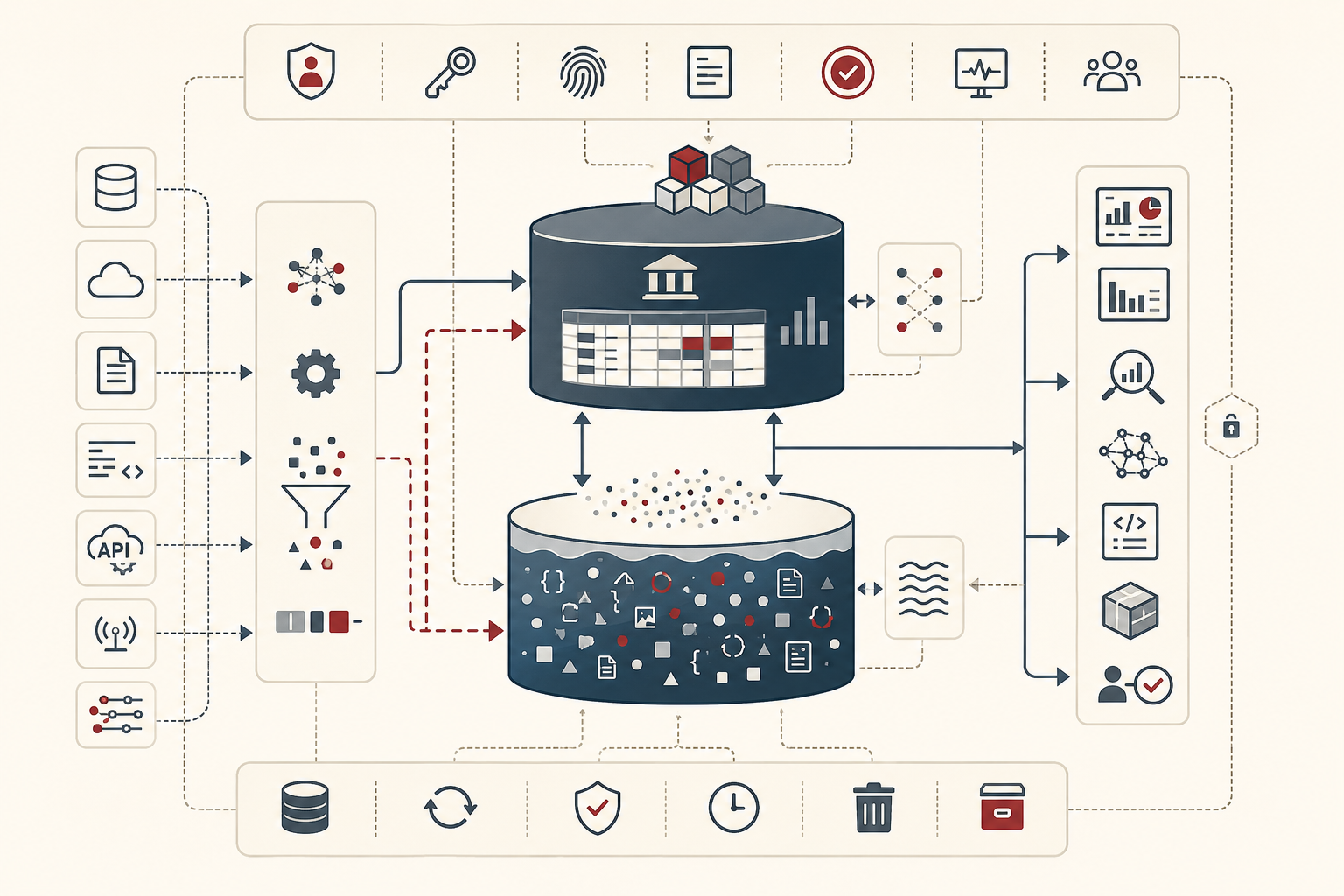
In practice, data warehouses remain foundational for governed analytics, reporting, business intelligence, semantic consistency, and repeatable decision support. Data lakes provide elastic environments for ingesting and storing raw or lightly processed data across many formats. More recent lakehouse architectures emerged as attempts to combine warehouse-style governance, transactional reliability, and performance with lake-style scale, flexibility, and openness. That convergence matters because modern analytical institutions increasingly want one data estate that can support dashboards, SQL analytics, machine learning, data science, streaming, archival retention, and large-scale storage without unnecessary duplication or fragmentation.
This article should be read alongside Database Systems and Data Architecture, Relational Databases and SQL Systems, Cloud Data Platforms and Modern Data Stack Architecture, ETL and Data Transformation Systems, Data Pipelines and Data Processing Systems, Data Cleaning and Data Quality Management, Metadata, Data Catalogs, and Lineage, and Reproducible Analytics and Versioned Data Workflows. Warehouses and lakes are not isolated storage choices. They are architectural answers to different stages of analytical readiness.
Analytical readiness as the central question
The strongest way to understand the warehouse–lake distinction is through analytical readiness. A warehouse is designed for data that has already been integrated, modeled, governed, and made ready for repeated analytical use. A lake is designed to retain broader data possibility: raw records, semi-structured files, event logs, telemetry, documents, and exploratory datasets that may not yet have a final model or use case. The issue is not whether one is “modern” and the other “legacy.” The issue is where in the lifecycle the data sits and what kind of trust, structure, and performance it must support.
This is why warehouses and lakes often coexist in mature estates. Some assets must become certified facts, dimensions, marts, and semantic metrics. Other assets need to remain closer to their source form for data science, machine learning, archival retention, future reinterpretation, or domain-specific analysis. A strong architecture allows raw optionality and curated analytical state to coexist without confusing one for the other.
This also means that storage alone is not architecture. A lake full of ungoverned files is not an analytical estate. A warehouse full of brittle, undocumented transformations is not trustworthy simply because it is structured. Analytical readiness requires metadata, lineage, ownership, quality controls, lifecycle policy, access governance, and workload-aware modeling.
What data warehouses and data lakes mean
A data warehouse is an analytical repository designed to integrate data from multiple sources so that it can be queried efficiently for reporting, business intelligence, decision support, and structured analysis. Classical warehouse thinking emphasizes integration, consistency, historical retention, governance, and performance. A warehouse is not simply a large database. It is a deliberately organized environment for analytical interpretation rather than day-to-day transactional processing.
A data lake is a centralized repository designed to store data in native or near-native form across many formats and structures. Rather than requiring every asset to be modeled into a rigid schema before storage, a lake emphasizes broad ingestion capacity, scalable storage, and downstream optionality. It can retain structured tables, JSON, logs, documents, images, sensor readings, Parquet files, model artifacts, and raw extracts from operational systems.
The two differ less in whether they store data than in how they organize readiness. Warehouses prioritize curated, modeled, and governed analytical data. Lakes prioritize flexible retention and broad ingest across diverse forms of data, often before final analytical structure is known. Lakehouse systems attempt to narrow that gap by bringing stronger table management, transactional reliability, metadata, governance, and SQL performance to lake-based storage.
Why the distinction matters
The distinction matters because organizations rarely have one kind of analytical need. They often need stable executive reporting, governed KPIs, regulatory outputs, high-performance SQL access, and shared semantic definitions. Those needs favor warehouse-style structure. They also need to store logs, documents, telemetry, raw extracts, event data, images, API payloads, and external datasets that do not yet justify or permit full modeling. Those needs favor lake-style flexibility.
When these needs are confused, architectures become brittle. If everything is forced into a warehouse prematurely, teams may create expensive bottlenecks and overmodel data before its use is understood. If everything is dumped into a lake without metadata and governance, the organization creates opacity rather than intelligence. The warehouse–lake distinction therefore clarifies a broader architectural problem: the difference between curated analytical state and potential analytical resource.
Mature data systems usually need both functions, even when they implement them inside increasingly unified platforms. The question is not warehouse versus lake as a slogan. The question is how raw data becomes trusted data, and how trusted data remains connected to its raw evidence, transformations, metadata, and lifecycle.
The logic of the data warehouse
The data warehouse emerged to support integrated analytical access across enterprise data sources. Classical warehouse thinking emphasized that decision support should not depend directly on operational transaction systems because operational databases are optimized for writes, integrity, and process support rather than complex historical analytics. Warehousing created a separate analytical layer where data could be integrated, standardized, historized, and organized for query performance.
Warehouse architecture traditionally emphasizes several goals: integration, so data from multiple operational sources can be analyzed coherently; consistency, so shared dimensions and metrics mean the same thing across reports; historical retention, so analysis can compare change over time; performance, so large aggregations and reporting queries can run efficiently; and governance, so analytical outputs remain explainable and trusted.
The warehouse is therefore not simply a large storage pool. It is an interpretive environment. It exists to produce coherent analytical truth from fragmented operational records. Its strength lies in turning repeated analytical questions into structured, governed, high-confidence data assets.
Dimensional modeling and analytical structure
One of the most influential traditions in warehouse design is dimensional modeling, especially as developed by Ralph Kimball and the Kimball Group. Dimensional models focus on measurement events and divide data into facts and dimensions. Fact tables contain measurable business or process events; dimension tables contain the descriptive context — the “who, what, where, when, why, and how” — through which facts can be grouped and interpreted.
This modeling tradition matters because analytical questions are rarely asked in the same form as operational transactions. Leaders want revenue by product and region over time, utilization by facility and service line, emissions by sector and reporting period, or incident rates by asset class and month. Dimensional schemas structure data around those analytical patterns. They also make repeated use easier by defining grains, conformed dimensions, surrogate keys, slowly changing dimensions, and fact table relationships.
Conformed dimensions are especially important because they allow information from separate fact tables to be aligned and compared consistently across the enterprise. A customer dimension, product dimension, date dimension, or location dimension can become a shared interpretive structure across multiple business processes. In that sense, warehousing is not just storage optimization. It is the deliberate modeling of data for human interpretability and repeated institutional use.
| Concept | Purpose | Why it matters |
|---|---|---|
| Fact table | Stores measurable events at a defined grain | Makes metrics, aggregation, and process analysis repeatable |
| Dimension table | Stores descriptive context for facts | Allows users to slice, filter, group, and interpret measures |
| Grain | Defines what one row represents | Prevents ambiguous aggregation and double counting |
| Conformed dimension | Provides shared descriptive structure across fact tables | Stabilizes meaning across departments, reports, and business processes |
| Slowly changing dimension | Preserves historical changes in descriptive attributes | Supports analysis of state and change over time |
| Star schema | Organizes fact tables around dimensions | Improves usability and query patterns for BI and reporting |
The logic of the data lake
The data lake emerged in response to a different set of pressures. Organizations increasingly needed to retain large quantities of heterogeneous data that did not fit neatly into pre-modeled warehouse schemas. Cloud object storage made it economically feasible to keep raw and semi-processed data at scale, while machine learning, data science, streaming systems, and exploratory analytics created demand for access to less-curated inputs.
A lake can therefore be understood as a storage-first architecture for analytical possibility. It preserves source richness and reduces the need to decide too early which data matters or what final model it should take. This flexibility is powerful because it can support future analysis, feature engineering, archival retention, reprocessing, and new use cases that were not known at ingestion time.
But the lake’s strength is also its risk. Raw retention does not automatically produce analytical value. A lake without metadata, ownership, lineage, access governance, quality checks, and lifecycle controls becomes a repository of opaque files. The lake is valuable when it preserves optionality while still maintaining enough structure for users to discover, understand, govern, and transform its contents responsibly.
Schema-on-write and schema-on-read
One of the clearest ways to distinguish warehouses and lakes is through the contrast between schema-on-write and schema-on-read. In a warehouse-oriented design, data is usually transformed into defined analytical structures before or during loading into the reporting environment. Structure, naming, conformance, and many quality rules are applied earlier in the lifecycle. The advantage is governed consistency and easier repeated use.
In lake-oriented designs, data is often stored first and structured later as it is consumed for a particular use case. This schema-on-read approach can preserve raw richness and support heterogeneous data, but it also requires stronger metadata discipline and clearer downstream transformation logic. Otherwise, each team may interpret the same raw asset differently.
The distinction should not be treated as absolute. Many modern architectures include intermediate layers where raw data, standardized data, refined data, and curated analytical data coexist. But the contrast remains useful because it clarifies where architectural discipline is applied and when. Schema-on-write tends to protect repeated trust. Schema-on-read tends to protect future optionality. Mature architectures need both.
Zones, layers, and analytical maturity
Modern warehouse/lake architectures are often layered. A raw landing zone preserves source data before interpretation. A bronze layer may standardize formats while remaining close to source structure. A silver layer may clean, deduplicate, conform, and enrich data into reusable analytical inputs. A gold layer may publish governed data products, reporting tables, metrics, or feature-ready outputs. Warehouse marts may then present dimensional models and semantic logic for repeated BI use.
This layered pattern matters because it prevents a false binary between raw storage and certified reporting. Data does not move from chaos to trust in one step. It passes through stages of increasing interpretive commitment. Each stage should have clearer metadata, stronger quality gates, more explicit ownership, more stable schema, and more controlled access.
Layering also helps separate legitimate exploratory work from authoritative outputs. A data science sandbox can be useful, but it should not be mistaken for a certified analytical layer. A raw lake zone can preserve evidence, but it should not be treated as ready-to-report data. A warehouse mart can support official metrics, but it should remain traceable back through the transformations and source evidence that produced it.
Governance, metadata, and the problem of the data swamp
The central risk of the data lake is not storage failure but interpretive collapse. A lake without reliable metadata, lineage, ownership, naming discipline, quality signals, lifecycle controls, and access governance can quickly become a data swamp: a repository full of files that are technically present but analytically opaque. If users do not know what datasets mean, where they came from, how current they are, how they were transformed, who owns them, or whether they can be trusted, the lake ceases to function as meaningful infrastructure.
This is why governance is not optional in lake environments. The more flexible the storage layer, the more important it becomes to govern discovery, access, classification, lineage, retention, and transformation pathways. Warehouses also depend on governance, but much of their governance is embedded earlier through curated schemas, conformed dimensions, controlled loading processes, and stable semantic definitions. Lakes require governance to do more work precisely because schema alone does less.
A mature lake should therefore be cataloged, classified, monitored, and connected to clear promotion pathways. Raw data can remain raw, but it should not be invisible. Experimental data can remain exploratory, but it should not be confused with certified output. Governance is what allows a lake to remain flexible without becoming unusable.
Pipelines, transformation, and layered data architecture
Few serious architectures operate as “warehouse only” or “lake only.” Modern systems rely on pipelines that move data through stages of increasing refinement. Raw data may land in a lake. Transformation workflows then clean, standardize, enrich, validate, and conform it. Curated layers may feed warehouse-style tables, dimensional marts, semantic layers, feature stores, dashboards, or machine-learning workflows. The architecture becomes less about choosing one storage ideology and more about designing a controlled flow from ingestion to interpretation.
This is where ETL, ELT, orchestration, and metadata become central. If data moves from raw lake assets into refined tables and warehouse marts, the movement must be traceable. If transformations occur inside the warehouse or lakehouse, the code and execution runs should be versioned. If dashboards rely on gold tables, those tables should identify their upstream sources, validation results, and freshness.
The practical architecture is therefore a chain of evidence. Raw data preserves source state. Refined layers document cleaning and conformance. Warehouse marts define analytical grain and metrics. Semantic layers stabilize meaning. Metadata and lineage connect the stages. Without that chain, the estate fragments into disconnected storage surfaces.
Performance, cost, and architectural tradeoffs
Warehouses and lakes involve different performance and cost logics. Warehouses typically provide faster, more predictable structured analytical performance because data has already been modeled, transformed, indexed, clustered, partitioned, or stored in ways optimized for SQL-based querying. This makes them strong for dashboards, repeated reports, governed metrics, and structured ad hoc analysis.
Lakes generally provide lower-cost and more elastic storage for raw and diverse data, especially on cloud object storage. They reduce the need to model everything upfront and can support many downstream use cases from the same retained source material. But they often require additional engineering, metadata management, table optimization, and transformation discipline to make data consistently queryable and trustworthy.
The tradeoff is therefore not merely speed versus flexibility. It is a tradeoff between pre-curated analytical readiness and broad retained optionality. Warehouses often spend more effort before publication; lakes often defer more interpretation until later. Lakehouse architectures attempt to reduce the gap, but they do not eliminate the need for governance and workload-specific design.
The rise of the lakehouse
The lakehouse emerged as an architectural response to the perceived split between warehouses and lakes. Its core promise is to combine the scale, openness, and flexibility of data lakes with the reliability, governance, and performance features associated with data warehouses. In practice, lakehouse architectures typically rely on object storage, open table formats, transactional metadata layers, schema evolution, time travel, access controls, and query engines capable of serving BI, analytics, machine learning, and streaming workloads from a more unified substrate.
The concept appeared because organizations increasingly wanted fewer silos, fewer duplicated pipelines, and more continuity between ingestion, transformation, governance, BI, and machine learning. Traditional lakes were flexible but often weakly governed. Traditional warehouses were reliable for structured analytics but often less flexible for raw, unstructured, or ML-heavy workloads. Lakehouse architecture attempts to reinterpret the warehouse–lake distinction inside a shared platform.
That convergence does not eliminate the need for architectural judgment. Some workloads still benefit from dimensional marts. Some raw data still belongs in a low-cost lake zone. Some governed lakehouse tables can support both BI and ML. The question is not whether the term “lakehouse” solves the architecture. The question is whether the platform can provide reliable metadata, transactional behavior, quality controls, performance, access governance, and workload fit.
Open table formats and governed lake tables
Open table formats are one reason lakehouse architecture became more practical. Technologies such as Delta Lake and Apache Iceberg add table-level management features over files in object storage. These features can include ACID transactions, metadata tracking, schema evolution, time travel, partition evolution, and safer concurrent operations across engines. The result is that lake data can behave more like managed analytical tables rather than loose collections of files.
This matters because many lake problems are not caused by storage itself. They are caused by weak table semantics: no reliable transaction log, no consistent snapshot, no schema enforcement, no clear version history, no safe concurrent writes, and no scalable metadata for large tables. Open table formats help address those problems by giving lake-based data stronger structure without requiring all data to move into a traditional warehouse.
But table formats do not replace governance. A table with ACID transactions can still be poorly documented. A lakehouse table can still have unclear ownership, weak lineage, stale data, or bad access controls. Technical table reliability is one layer of trust. Institutional reliability still requires metadata, lineage, quality, lifecycle policy, stewardship, and semantic clarity.
Warehouse, lake, and lakehouse operating models
A mature data estate requires an operating model that clarifies how warehouse, lake, and lakehouse assets are created, certified, maintained, and retired. Without an operating model, architectural diagrams become aspirational. Teams may land data in raw zones without metadata, publish marts without lineage, duplicate transformations across layers, or treat experimental assets as official outputs.
A useful operating model distinguishes several responsibilities. Platform teams manage storage, compute, access, catalogs, and reliability. Data engineering teams manage ingestion, transformation, quality gates, and lifecycle policies. Analytics engineering teams define semantic models, warehouse marts, metrics, and certified reporting layers. Data science and ML teams consume raw and refined assets while contributing feature definitions and model-ready datasets. Governance and stewardship roles ensure ownership, classification, retention, and access discipline.
The point is not to centralize every decision. The point is to make the pathways legible. A raw asset should have a path to refinement. A refined asset should have quality evidence. A warehouse mart should have defined grain. A lakehouse table should have table-management features and ownership. A certified output should be traceable. Without those pathways, the organization gets a collection of tools rather than a coherent data estate.
| Architecture | Primary strength | Primary risk | Best suited for |
|---|---|---|---|
| Data warehouse | Curated, structured, governed, high-performance analytical access | Premature modeling, rigidity, duplicated raw-to-report pipelines | BI, reporting, certified metrics, dimensional marts, decision support |
| Data lake | Flexible, large-scale retention of diverse raw and semi-processed data | Data swamp risk if metadata, ownership, and lifecycle controls are weak | Raw retention, exploratory analytics, data science, ML, archives, telemetry |
| Lakehouse | Convergence of lake flexibility with warehouse-style table reliability | Overpromising unity without sufficient governance or workload design | Unified analytics, ML, governed lake tables, open formats, multi-engine access |
A mathematical lens for warehouse/lake architecture
A data estate can be represented as a set of assets distributed across zones:
E = \{a_i : i = 1,\ldots,n\}
\]
Interpretation: The estate \(E\) contains assets \(a_i\), each of which may live in a raw lake, refined lakehouse layer, warehouse mart, feature store, sandbox, or archive.
A warehouse fact table can be modeled as measures at a defined grain:
F = \{(d_{1i}, d_{2i}, \ldots, d_{ki}, m_i)\}_{i=1}^{n}
\]
Interpretation: Each fact row \(i\) links dimensions \(d_1,\ldots,d_k\) to a measure \(m_i\). The grain determines what one row means and prevents ambiguous aggregation.
A lake asset can be described by metadata and governance coverage:
G_i = \alpha M_i + \beta L_i + \gamma O_i + \delta A_i
\]
Interpretation: Governance readiness \(G_i\) for asset \(i\) can combine metadata coverage \(M_i\), lineage coverage \(L_i\), ownership \(O_i\), and access-policy maturity \(A_i\).
Data-swamp risk can be expressed as the gap between stored volume and interpretive control:
S_i = V_i(1 – G_i)
\]
Interpretation: Swamp risk \(S_i\) increases when large-volume assets \(V_i\) have weak governance readiness \(G_i\). The point is not that large lakes are bad, but that scale without interpretability becomes operational risk.
A workload-fit score can compare requirements with architecture:
A_w = f(R_w, P_w, G_w, L_w, M_w)
\]
Interpretation: Architecture fit \(A_w\) for workload \(w\) depends on raw-data needs \(R_w\), performance needs \(P_w\), governance requirements \(G_w\), latency constraints \(L_w\), and machine-learning requirements \(M_w\).
An estate-readiness score can combine asset readiness, zone controls, dimensional quality, workload fit, and swamp-risk reduction:
Q_e = w_AA_e + w_ZZ_e + w_DD_e + w_WW_e + w_S(1-S_e)
\]
Interpretation: Estate readiness \(Q_e\) can combine asset readiness \(A_e\), zone control \(Z_e\), dimensional-model quality \(D_e\), workload fit \(W_e\), and reduction of data-swamp risk \(S_e\).
The purpose of this mathematical lens is not to reduce architecture to one score. It is to make the estate inspectable: assets, zones, models, governance coverage, workload requirements, and risk should be explicit rather than assumed.
Python Workflow: Warehouse, Lake, and Lakehouse Architecture Scorecard
The following Python workflow demonstrates how an architecture review can evaluate data assets, zone placement, governance controls, lakehouse table features, cost/performance signals, dimensional model readiness, workload fit, and data-swamp risk.
#!/usr/bin/env python3
"""
Python Workflow: Warehouse, Lake, and Lakehouse Architecture Scorecard

This compact example treats a data estate as governance evidence:
assets, zones, dimensional models, metadata, lineage, table features,
cost/performance signals, workload fit, and data-swamp risk.
"""

from __future__ import annotations

from statistics import mean


def status_score(value: str) -> float:
    return {
        "certified": 1.0,
        "approved": 1.0,
        "pass": 1.0,
        "good": 1.0,
        "registered": 0.75,
        "acceptable": 0.70,
        "in_review": 0.60,
        "watch": 0.45,
        "warn": 0.40,
        "missing": 0.10,
        "unknown": 0.15,
        "unregistered": 0.10,
        "high_risk": 0.05,
    }.get(value, 0.5)


def asset_readiness_score(
    metadata: float,
    lineage: float,
    owner_assigned: bool,
    classification_applied: bool,
    quality_status: str,
    access_status: str,
    lifecycle_status: str,
    certification_status: str,
    scan_efficiency: float,
) -> float:
    return round(
        0.16 * metadata
        + 0.16 * lineage
        + 0.10 * float(owner_assigned)
        + 0.08 * float(classification_applied)
        + 0.14 * status_score(quality_status)
        + 0.12 * status_score(access_status)
        + 0.08 * status_score(lifecycle_status)
        + 0.10 * status_score(certification_status)
        + 0.06 * scan_efficiency,
        3,
    )


def swamp_risk(metadata: float, lineage: float, access_status: str, certification_status: str) -> str:
    if metadata < 0.60 or lineage < 0.50 or access_status in {"missing", "unknown"}:
        return "high"

    if metadata < 0.80 or lineage < 0.70 or certification_status in {"unregistered", "in_review"}:
        return "medium"

    return "low"


def workload_fit_score(workload: dict[str, object]) -> float:
    preferred = workload["preferred_architecture"]

    if preferred == "warehouse":
        return 1.0 if workload["low_latency_sql"] and workload["strong_governance"] else 0.65

    if preferred == "warehouse_or_gold_lakehouse":
        return 0.95 if workload["low_latency_sql"] and workload["strong_governance"] else 0.65

    if preferred == "lakehouse_feature_layer":
        return 0.95 if workload["raw_access"] and workload["ml_features"] and workload["open_format"] else 0.60

    if preferred == "data_lake_with_catalog":
        return 0.85 if workload["raw_access"] and workload["strong_governance"] else 0.55

    return 0.70


def main() -> None:
    assets = [
        {
            "asset": "raw_clickstream_events",
            "zone": "raw_lake",
            "schema": "schema_on_read",
            "format": "json",
            "metadata": 0.82,
            "lineage": 0.70,
            "owner": True,
            "classified": True,
            "quality": "warn",
            "access": "approved",
            "lifecycle": "approved",
            "certification": "registered",
            "scan_efficiency": 0.35,
        },
        {
            "asset": "silver_customer_profile",
            "zone": "silver_lakehouse",
            "schema": "hybrid_schema",
            "format": "iceberg",
            "metadata": 0.95,
            "lineage": 0.90,
            "owner": True,
            "classified": True,
            "quality": "pass",
            "access": "approved",
            "lifecycle": "approved",
            "certification": "certified",
            "scan_efficiency": 0.80,
        },
        {
            "asset": "fact_sales",
            "zone": "warehouse_fact",
            "schema": "schema_on_write",
            "format": "warehouse_table",
            "metadata": 0.99,
            "lineage": 0.97,
            "owner": True,
            "classified": True,
            "quality": "pass",
            "access": "approved",
            "lifecycle": "approved",
            "certification": "certified",
            "scan_efficiency": 0.90,
        },
        {
            "asset": "sandbox_experiment_events",
            "zone": "sandbox_lake",
            "schema": "schema_on_read",
            "format": "parquet",
            "metadata": 0.35,
            "lineage": 0.20,
            "owner": False,
            "classified": True,
            "quality": "unknown",
            "access": "missing",
            "lifecycle": "missing",
            "certification": "unregistered",
            "scan_efficiency": 0.20,
        },
    ]

    scored_assets = []

    for asset in assets:
        readiness = asset_readiness_score(
            metadata=asset["metadata"],
            lineage=asset["lineage"],
            owner_assigned=asset["owner"],
            classification_applied=asset["classified"],
            quality_status=asset["quality"],
            access_status=asset["access"],
            lifecycle_status=asset["lifecycle"],
            certification_status=asset["certification"],
            scan_efficiency=asset["scan_efficiency"],
        )

        risk = swamp_risk(
            metadata=asset["metadata"],
            lineage=asset["lineage"],
            access_status=asset["access"],
            certification_status=asset["certification"],
        )

        scored_assets.append({
            "asset": asset["asset"],
            "zone": asset["zone"],
            "schema_strategy": asset["schema"],
            "format": asset["format"],
            "readiness": readiness,
            "swamp_risk": risk,
        })

    print({"asset_readiness": scored_assets})

    dimensional_tables = [
        {"table": "fact_sales", "role": "fact", "grain_defined": True, "certification": "certified"},
        {"table": "dim_customer", "role": "dimension", "grain_defined": True, "conformed": True, "certification": "certified"},
        {"table": "dim_location", "role": "dimension", "grain_defined": True, "conformed": True, "certification": "in_review"},
    ]

    dimensional_scores = []

    for table in dimensional_tables:
        dimensional_scores.append(
            0.35 * float(table["grain_defined"])
            + 0.30 * (float(table.get("conformed", False)) if table["role"] == "dimension" else 0.80)
            + 0.35 * status_score(table["certification"])
        )

    workloads = [
        {
            "name": "executive_kpi_dashboard",
            "low_latency_sql": True,
            "raw_access": False,
            "ml_features": False,
            "strong_governance": True,
            "open_format": False,
            "preferred_architecture": "warehouse_or_gold_lakehouse",
        },
        {
            "name": "customer_churn_model",
            "low_latency_sql": False,
            "raw_access": True,
            "ml_features": True,
            "strong_governance": True,
            "open_format": True,
            "preferred_architecture": "lakehouse_feature_layer",
        },
        {
            "name": "environmental_sensor_archive",
            "low_latency_sql": False,
            "raw_access": True,
            "ml_features": True,
            "strong_governance": True,
            "open_format": True,
            "preferred_architecture": "data_lake_with_catalog",
        },
    ]

    workload_scores = [
        workload_fit_score(workload)
        for workload in workloads
    ]

    high_swamp_risk_share = sum(
        1 for asset in scored_assets
        if asset["swamp_risk"] == "high"
    ) / len(scored_assets)

    estate_readiness = round(
        0.40 * mean(asset["readiness"] for asset in scored_assets)
        + 0.25 * mean(dimensional_scores)
        + 0.20 * mean(workload_scores)
        + 0.15 * (1.0 - high_swamp_risk_share),
        3,
    )

    print({
        "dimensional_model_score": round(mean(dimensional_scores), 3),
        "workload_fit_score": round(mean(workload_scores), 3),
        "high_swamp_risk_share": round(high_swamp_risk_share, 3),
        "warehouse_lake_estate_readiness": estate_readiness,
    })


if __name__ == "__main__":
    main()
This workflow treats warehouse/lake architecture as an inspectable estate. It does not only classify assets as warehouse or lake. It evaluates governance coverage, lineage, ownership, scan efficiency, swamp risk, dimensional modeling quality, and workload fit.
R Workflow: Warehouse, Lake, Lakehouse, Governance, and Workload-Fit Summary
The following R workflow summarizes assets by architecture zone, governance controls, dimensional model status, lakehouse table features, cost/performance metrics, and workload architecture requirements.
#!/usr/bin/env Rscript

# R Workflow: Warehouse, Lake, Lakehouse,
# Governance, and Workload-Fit Summary

assets <- data.frame(
  asset_id = c("a001", "a002", "a005", "a006", "a007", "a009", "a011"),
  asset_name = c(
    "raw_orders_extract",
    "raw_clickstream_events",
    "silver_customer_profile",
    "gold_customer_metrics",
    "dim_customer",
    "fact_sales",
    "sandbox_experiment_events"
  ),
  architecture_zone = c(
    "raw_lake",
    "raw_lake",
    "silver_lakehouse",
    "gold_lakehouse",
    "warehouse_dimension",
    "warehouse_fact",
    "sandbox_lake"
  ),
  storage_form = c(
    "object_storage",
    "object_storage",
    "table",
    "table",
    "relational_table",
    "relational_table",
    "object_storage"
  ),
  schema_strategy = c(
    "schema_on_read",
    "schema_on_read",
    "hybrid_schema",
    "schema_on_write",
    "schema_on_write",
    "schema_on_write",
    "schema_on_read"
  ),
  governance_status = c(
    "registered",
    "registered",
    "certified",
    "certified",
    "certified",
    "certified",
    "unregistered"
  ),
  row_count = c(5000000, 90000000, 1200000, 1200000, 1200000, 85000000, 25000000),
  size_gb = c(42.5, 620.0, 35.0, 12.5, 8.2, 210.0, 110.0),
  freshness_hours = c(3, 1, 6, 12, 24, 24, 48),
  stringsAsFactors = FALSE
)

governance <- data.frame(
  asset_id = c("a001", "a002", "a005", "a006", "a007", "a009", "a011"),
  metadata_coverage = c(0.80, 0.82, 0.95, 0.97, 0.99, 0.99, 0.35),
  lineage_coverage = c(0.65, 0.70, 0.90, 0.94, 0.96, 0.97, 0.20),
  owner_assigned = c(1, 1, 1, 1, 1, 1, 0),
  classification_applied = c(1, 1, 1, 1, 1, 1, 1),
  quality_status = c("warn", "warn", "pass", "pass", "pass", "pass", "unknown"),
  access_policy_status = c("approved", "approved", "approved", "approved", "approved", "approved", "missing"),
  certification_status = c("registered", "registered", "certified", "certified", "certified", "certified", "unregistered"),
  stringsAsFactors = FALSE
)

costs <- data.frame(
  asset_id = c("a001", "a002", "a005", "a006", "a007", "a009", "a011"),
  monthly_storage_cost_usd = c(850, 12400, 700, 250, 164, 4200, 2200),
  monthly_compute_cost_usd = c(120, 2800, 1800, 2200, 2100, 8800, 5000),
  p95_query_latency_seconds = c(95, 140, 22, 14, 8, 12, 220),
  scan_efficiency_score = c(0.30, 0.35, 0.80, 0.88, 0.92, 0.90, 0.20),
  cost_status = c("watch", "watch", "good", "good", "good", "good", "high_risk"),
  stringsAsFactors = FALSE
)

dims <- data.frame(
  table_name = c("fact_sales", "fact_inventory_snapshot", "dim_customer", "dim_product", "dim_date", "dim_location"),
  model_role = c("fact", "fact", "dimension", "dimension", "dimension", "dimension"),
  conformed_dimension = c(0, 0, 1, 1, 1, 1),
  certification_status = c("certified", "certified", "certified", "certified", "certified", "in_review"),
  stringsAsFactors = FALSE
)

lakehouse <- data.frame(
  asset_id = c("a005", "a006", "a011"),
  open_table_format = c("iceberg", "delta", "parquet_only"),
  acid_transactions = c(1, 1, 0),
  schema_evolution = c(1, 1, 0),
  time_travel = c(1, 1, 0),
  batch_stream_unified = c(1, 1, 0),
  metadata_scalability = c(1, 1, 0),
  table_status = c("certified", "certified", "unregistered"),
  stringsAsFactors = FALSE
)

workloads <- data.frame(
  workload_name = c(
    "executive_kpi_dashboard",
    "customer_churn_model",
    "regulatory_sales_reporting",
    "clickstream_exploration",
    "environmental_sensor_archive"
  ),
  primary_use_case = c(
    "business_intelligence",
    "machine_learning",
    "compliance_reporting",
    "data_science_exploration",
    "scientific_retention"
  ),
  requires_low_latency_sql = c(1, 0, 1, 0, 0),
  requires_raw_data_access = c(0, 1, 0, 1, 1),
  requires_ml_features = c(0, 1, 0, 1, 1),
  requires_strong_governance = c(1, 1, 1, 0, 1),
  requires_open_format = c(0, 1, 0, 1, 1),
  preferred_architecture = c(
    "warehouse_or_gold_lakehouse",
    "lakehouse_feature_layer",
    "warehouse",
    "data_lake_or_lakehouse",
    "data_lake_with_catalog"
  ),
  stringsAsFactors = FALSE
)

asset_summary <- aggregate(
  cbind(row_count, size_gb, freshness_hours) ~ architecture_zone + storage_form + schema_strategy + governance_status,
  data = assets,
  FUN = mean
)

governance_summary <- aggregate(
  cbind(metadata_coverage, lineage_coverage, owner_assigned, classification_applied) ~ certification_status + access_policy_status,
  data = governance,
  FUN = mean
)

cost_summary <- aggregate(
  cbind(monthly_storage_cost_usd, monthly_compute_cost_usd, p95_query_latency_seconds, scan_efficiency_score) ~ cost_status,
  data = costs,
  FUN = mean
)

dimensional_summary <- aggregate(
  table_name ~ model_role + conformed_dimension + certification_status,
  data = dims,
  FUN = length
)
names(dimensional_summary) <- c(
  "model_role",
  "conformed_dimension",
  "certification_status",
  "table_count"
)

lakehouse_summary <- aggregate(
  cbind(acid_transactions, schema_evolution, time_travel, batch_stream_unified, metadata_scalability) ~ open_table_format + table_status,
  data = lakehouse,
  FUN = mean
)

workload_summary <- aggregate(
  workload_name ~ primary_use_case + preferred_architecture + requires_strong_governance + requires_open_format,
  data = workloads,
  FUN = length
)
names(workload_summary) <- c(
  "primary_use_case",
  "preferred_architecture",
  "requires_strong_governance",
  "requires_open_format",
  "workload_count"
)

dir.create("outputs", showWarnings = FALSE, recursive = TRUE)

write.csv(asset_summary, "outputs/asset_summary_r.csv", row.names = FALSE)
write.csv(governance_summary, "outputs/governance_summary_r.csv", row.names = FALSE)
write.csv(cost_summary, "outputs/cost_performance_summary_r.csv", row.names = FALSE)
write.csv(dimensional_summary, "outputs/dimensional_model_summary_r.csv", row.names = FALSE)
write.csv(lakehouse_summary, "outputs/lakehouse_feature_summary_r.csv", row.names = FALSE)
write.csv(workload_summary, "outputs/workload_architecture_summary_r.csv", row.names = FALSE)

cat("Wrote warehouse/lake asset, governance, cost, dimensional, lakehouse, and workload summaries.\n")
This workflow treats warehouse/lake design as an architectural-fit problem. It shows how storage zone, schema strategy, governance maturity, dimensional modeling, lakehouse features, cost/performance, and workload requirements can be reviewed together instead of separately.
Applications across domains
Data warehouses and data lakes appear across many domains, but their balance varies by use case. Retail and finance often rely heavily on warehouse-style structures for governed metrics, revenue analysis, inventory monitoring, and compliance reporting. Scientific and environmental systems often benefit from lake-style retention because they must store heterogeneous observations, files, telemetry, geospatial layers, and external datasets before all downstream questions are known. Digital platforms and product organizations often use both, retaining event streams and logs in lake environments while surfacing curated behavioral metrics through warehouse or lakehouse layers.
In sustainability, infrastructure, and public-sector contexts, the combination is especially important. Sensor data, administrative records, geospatial layers, documents, regulatory disclosures, and historical indicators often arrive in different formats and at different levels of quality. Lakes can preserve this heterogeneous evidence base, while warehouses or curated marts can organize selected assets for stable reporting, dashboards, and decision support.
In machine learning and AI systems, lakes and lakehouses often provide training data, feature candidates, documents, images, event histories, and raw evidence. Warehouses and semantic layers provide governed labels, metrics, aggregates, and business definitions. The strongest architectures do not treat these as enemies. They design a controlled relationship among raw evidence, refined features, curated metrics, and governed decision outputs.
Implementation principles for high-integrity warehouse/lake architecture
Distinguish raw optionality from certified analytical state. Raw data is valuable, but it is not automatically ready for reporting, modeling, or decision-making.
Define zones and promotion paths. Raw, bronze, silver, gold, warehouse, sandbox, feature, and archive layers should have clear purposes and controls.
Use dimensional models where repeated governed analysis matters. Facts, dimensions, grain, conformed dimensions, and slowly changing logic remain central to BI and decision support.
Apply metadata and lineage to lakes. A lake without metadata, lineage, ownership, and lifecycle controls is vulnerable to data-swamp risk.
Choose schema strategy by lifecycle stage. Schema-on-read protects flexibility; schema-on-write protects repeated trust; hybrid approaches can support lakehouse convergence.
Treat lakehouse features as table-management controls. ACID transactions, schema evolution, time travel, and scalable metadata improve reliability, but they do not replace governance.
Measure cost and performance together. Storage cost, compute cost, latency, scan efficiency, cache use, and table optimization all shape architectural sustainability.
Classify and govern sensitive data across all layers. Raw zones are often the highest-risk because they may preserve sensitive fields before masking or minimization.
Connect architecture to workload requirements. BI dashboards, regulatory reports, ML features, exploration, archives, and scientific data may require different balances of structure and flexibility.
Certify outputs deliberately. A dataset should become official only after quality, lineage, ownership, access, and semantic controls are sufficient for its use.
| Control | Purpose | Failure it prevents |
|---|---|---|
| Zone policy | Defines the purpose and controls of each architectural layer | Confusing raw, refined, certified, sandbox, and archive assets |
| Dimensional modeling | Defines facts, dimensions, grain, and conformed analytical structure | Ambiguous metrics, double counting, and inconsistent reporting |
| Metadata catalog | Makes assets discoverable and interpretable | Data-swamp conditions where files exist but meaning is unclear |
| Lineage tracking | Connects raw sources, transformations, refined assets, and outputs | Unexplainable dashboards, models, and certified tables |
| Access governance | Controls who can use sensitive data across zones | Uncontrolled exposure of raw or restricted data |
| Open table-format management | Adds transaction, versioning, schema, and metadata controls to lake tables | Unreliable lake files and unsafe concurrent operations |
| Cost/performance monitoring | Tracks storage, compute, latency, and scan efficiency | Architectural sprawl and expensive low-value processing |
| Workload-fit review | Matches architecture to BI, ML, exploration, archive, and compliance needs | Forcing every workload into the same storage and modeling pattern |
GitHub Repository
This article can be paired with a companion code workflow that models warehouse, lake, and lakehouse architecture as analytical estate governance infrastructure. The example includes data assets, dimensional model tables, lake zones, governance controls, cost/performance metrics, lakehouse table features, workload requirements, SQL schemas, Python and R workflows, Julia scoring, typed contracts, Quarto report templates, and multi-language examples across Python, R, Julia, SQL, Go, Rust, C, C++, TypeScript, and Terraform placeholders.
Conclusion
Data warehouses and data lakes should be understood as complementary architectural forms for different states of analytical readiness. Warehouses organize curated, modeled, governed data for repeated analysis, BI, reporting, semantic consistency, and decision support. Lakes preserve broader data optionality by retaining raw, semi-structured, unstructured, and exploratory evidence at scale. Lakehouse architectures attempt to bring those worlds closer by adding stronger table management, transactional reliability, and governance features to lake-based storage.
The deeper point is that the warehouse–lake distinction is not a battle between old and new. It is a question of institutional evidence management. Some data must become certified, modeled, and performant. Some data must remain raw enough to be reinterpreted. Some data must move through layered refinement. Some assets belong in dimensional marts; others belong in governed lakehouse tables, feature stores, archives, or exploratory zones. Mature architecture makes those differences explicit. It preserves optionality without sacrificing trust and creates structured analytical truth without severing it from its source evidence.
Related articles
- Data Systems & Analytics
- Database Systems and Data Architecture
- Relational Databases and SQL Systems
- Cloud Data Platforms and Modern Data Stack Architecture
- ETL and Data Transformation Systems
- Data Pipelines and Data Processing Systems
- Metadata, Data Catalogs, and Lineage
- Reproducible Analytics and Versioned Data Workflows
Further reading
- Inmon, W.H. (2005) Building the Data Warehouse. 4th edn. Indianapolis: Wiley.
- Kimball, R. and Ross, M. (2013) The Data Warehouse Toolkit: The Definitive Guide to Dimensional Modeling. 3rd edn. Indianapolis: Wiley.
- Kleppmann, M. (2017) Designing Data-Intensive Applications. Sebastopol, CA: O’Reilly Media.
- Nalepa, G.J. and Baars, H. (eds.) (2022) Data Lake and Data Warehouse Architectures. Cham: Springer.
- Reis, J. and Housley, M. (2022) Fundamentals of Data Engineering. Sebastopol, CA: O’Reilly Media.
- Vassiliadis, P., Simitsis, A. and Skiadopoulos, S. (2009) ‘A survey of extract-transform-load technology’, International Journal of Data Warehousing and Mining, 5(3), pp. 1–27.
References
- Amazon Web Services (n.d.) What is a Data Lake? Available at: https://aws.amazon.com/what-is/data-lake/
- Amazon Web Services (n.d.) AWS Lake Formation. Available at: https://aws.amazon.com/lake-formation/
- Amazon Web Services (n.d.) Data Lake vs Data Warehouse vs Data Mart. Available at: https://aws.amazon.com/compare/the-difference-between-a-data-warehouse-data-lake-and-data-mart/
- Apache Iceberg (n.d.) Apache Iceberg. Available at: https://iceberg.apache.org/
- Databricks (2026) What is a data lakehouse? Available at: https://docs.databricks.com/aws/en/lakehouse/
- Databricks (2026) What is Delta Lake in Databricks? Available at: https://docs.databricks.com/aws/en/delta/
- Delta Lake (n.d.) Welcome to the Delta Lake documentation. Available at: https://docs.delta.io/
- Kimball Group (n.d.) Dimensional Modeling Techniques. Available at: https://www.kimballgroup.com/data-warehouse-business-intelligence-resources/kimball-techniques/dimensional-modeling-techniques/
- Kimball Group (n.d.) Star Schemas and OLAP Cubes. Available at: https://www.kimballgroup.com/data-warehouse-business-intelligence-resources/kimball-techniques/dimensional-modeling-techniques/star-schema-olap-cube/
- Kimball Group (n.d.) Conformed Dimensions. Available at: https://www.kimballgroup.com/data-warehouse-business-intelligence-resources/kimball-techniques/dimensional-modeling-techniques/conformed-dimension/
- Kimball Group (2009) The 10 Essential Rules of Dimensional Modeling. Available at: https://www.kimballgroup.com/2009/05/the-10-essential-rules-of-dimensional-modeling/
- Microsoft Azure (2026) What is a Data Lake? Available at: https://learn.microsoft.com/en-us/azure/architecture/data-guide/scenarios/data-lake