Author name: Tariq Ahmad

Abstract legal-studies illustration of jus cogens and erga omnes obligations as elevated peremptory norms in international law, showing legal hierarchy, non-derogability, community-wide obligation, treaty invalidity, non-recognition, and limits against domination.

Jus Cogens, Erga Omnes, and Peremptory Norms in International Law

Jus cogens and obligations erga omnes occupy a distinctive place in international law because they mark the point at which the legal order recognizes certain norms as fundamental, non-derogable, and binding in the name of the international community as a whole. This article examines the distinction and relationship between peremptory norms and community-wide obligations through the Vienna Convention on the Law of Treaties, Barcelona Traction, Belgium v. Senegal, the International Law Commission’s 2022 jus cogens conclusions, and the legal consequences of treaty invalidity, non-recognition, non-assistance, and collective legal interest. It also explores how apartheid, colonial domination, Palestine, and the unequal enforcement of foundational norms reveal both the anti-imperial promise and the practical limits of international law’s highest normative claims.


Abstract legal-studies illustration of general principles of law as foundational norms connecting legal systems, judicial reasoning, fairness, good faith, due process, equity, and international legal coherence.

General Principles of Law in International Legal Order

General principles of law occupy a distinctive place in international legal order because they help make international law coherent, operable, and capable of reasoned application where treaties and customary rules are incomplete. Recognized in Article 38 of the Statute of the International Court of Justice, these principles include foundational standards such as good faith, estoppel, procedural fairness, res judicata, and the obligation to provide reparation for legal injury. This article examines how general principles function as a source of law, how they are derived from national legal systems or formed within the international legal system itself, and how they support adjudication, systemic coherence, and the deeper juridical structure of international law.

Abstract legal-studies illustration of sovereignty, jurisdiction, and non-intervention in international law, showing territorial authority, sovereign equality, jurisdictional competence, lawful restraint, coercion, occupation, and selective enforcement.

Sovereignty, Jurisdiction, and Non-Intervention in International Law

Sovereignty, jurisdiction, and non-intervention are foundational principles of international law because they define the legal autonomy of states, the scope of lawful authority, and the limits of external interference in domestic affairs. This article examines sovereignty as juridical independence, jurisdiction as the legal competence to prescribe, adjudicate, and enforce law, and non-intervention as a protection against coercive intrusion into matters reserved to sovereign choice. Drawing on the UN Charter, the Friendly Relations Declaration, the Lotus case, and the International Court of Justice’s Nicaragua judgment, it explains how these principles structure the modern international order while also revealing the tensions created by collective security, human rights, cyber conflict, sanctions, and other contemporary pressures on state autonomy.

Abstract legal-studies illustration of statehood, recognition, and legal personality in international law, showing statehood criteria, recognition thresholds, UN membership, observer status, international organizations, contested sovereignty, and unequal legal admission.

Statehood, Recognition, and Legal Personality in International Law

Statehood, recognition, and legal personality are foundational concepts in international law because they determine who counts as a subject of the international legal order and who may possess rights, duties, and standing on the international plane. This article examines the Montevideo criteria for statehood, the legal and political significance of recognition, the debate between declaratory and constitutive theories, the role of UN membership, and the extension of legal personality beyond states to international organizations such as the United Nations. By situating doctrine alongside contested cases of independence, secession, and ambiguous status, the article clarifies how international law structures membership, authority, and participation in global legal order.

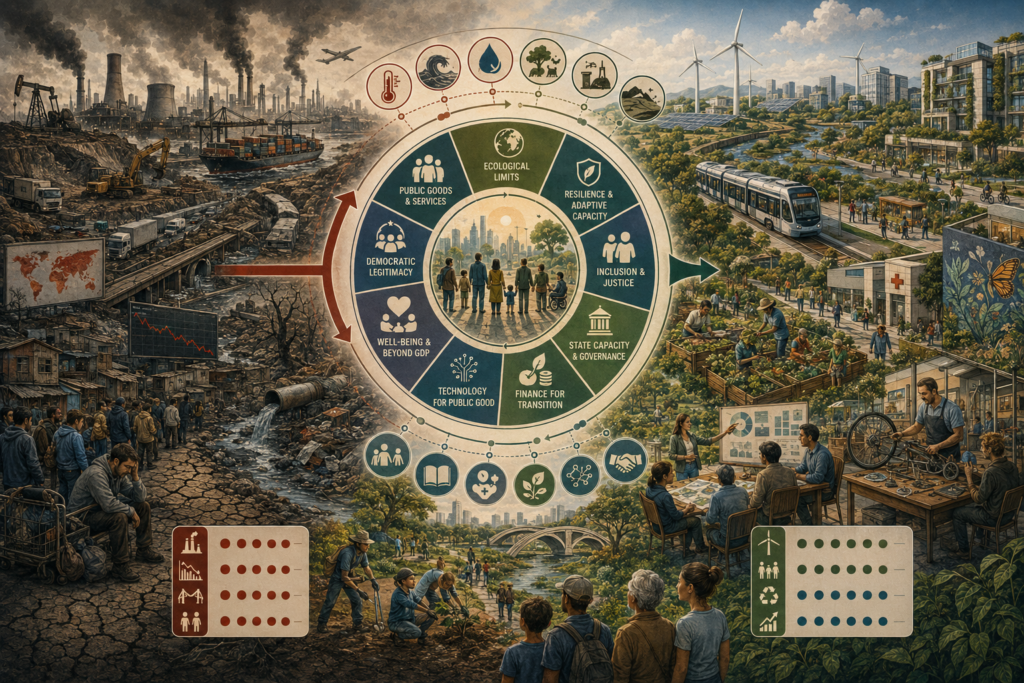
Editorial systems illustration showing the future of economic systems under ecological limits, with old expansionary assumptions contrasted against resilient, inclusive, boundary-aware, regenerative economic redesign.

The Future of Economic Systems in an Age of Limits

The future of economic systems in an age of limits examines how economies must adapt to a world shaped by ecological ceilings, material pressure, climate risk, inequality, and institutional strain. This article explores how the old assumptions of cheap fossil energy, expanding throughput, and growth-first governance are being challenged by planetary boundaries, resource constraints, fragility, and the need for broader measures of progress. It addresses energy transition, material redesign, public goods, state capacity, finance, resilience, post-growth debate, technology, global inequality, democratic legitimacy, and regenerative economic models. Within sustainable systems, the deeper issue is whether economic life can be reorganized to remain compatible with Earth-system stability, human dignity, and long-run collective flourishing at the same time.

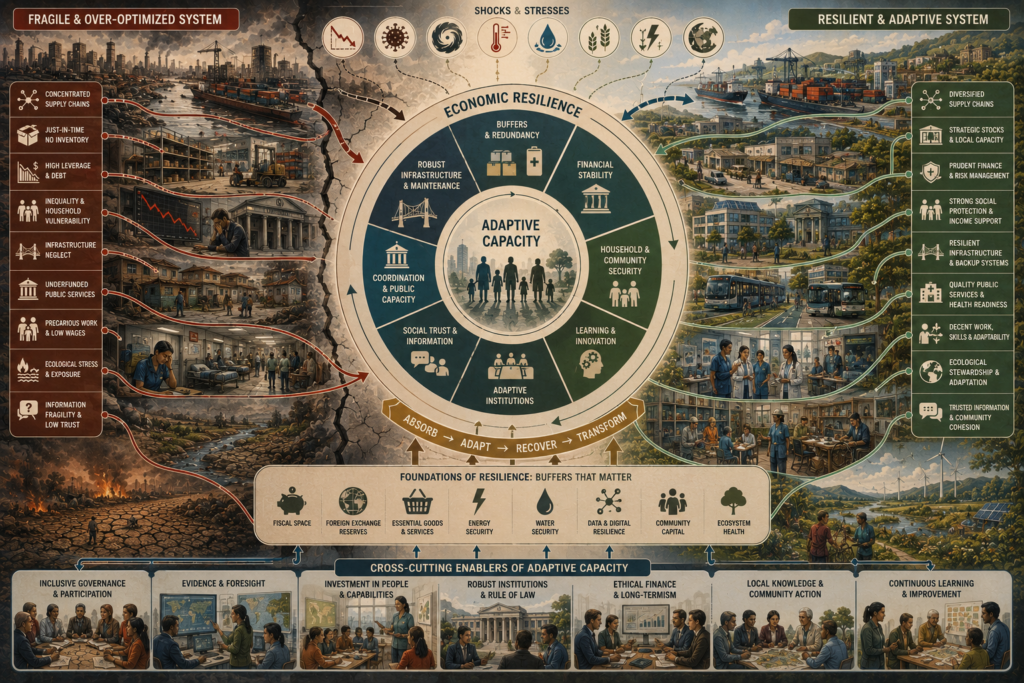
Editorial systems illustration showing economic resilience, fragility, adaptive capacity, shocks, buffers, redundancy, public institutions, supply chains, household security, infrastructure, finance, and ecological risk.

Economic Resilience, Fragility, and Adaptive Capacity

Economic resilience, fragility, and adaptive capacity examine how economies absorb disruption, endure stress, and reorganize under pressure. This article explores resilience as the ability of economic systems to withstand disturbance while maintaining core functions; fragility as the structural condition that makes systems vulnerable to breakdown, contagion, and cascading failure; and adaptive capacity as the institutional, social, financial, and technical ability to learn, coordinate, and change in response to crisis. It addresses shock exposure, over-optimization, buffers, public institutions, unequal household and firm resilience, infrastructure interdependence, debt, labor adaptation, ecological stress, trust, and transformational recovery. Within sustainable systems, the deeper issue is whether economic life is being organized for genuine durability and intelligent adaptation or for short-term performance that leaves societies increasingly brittle when disruption arrives.

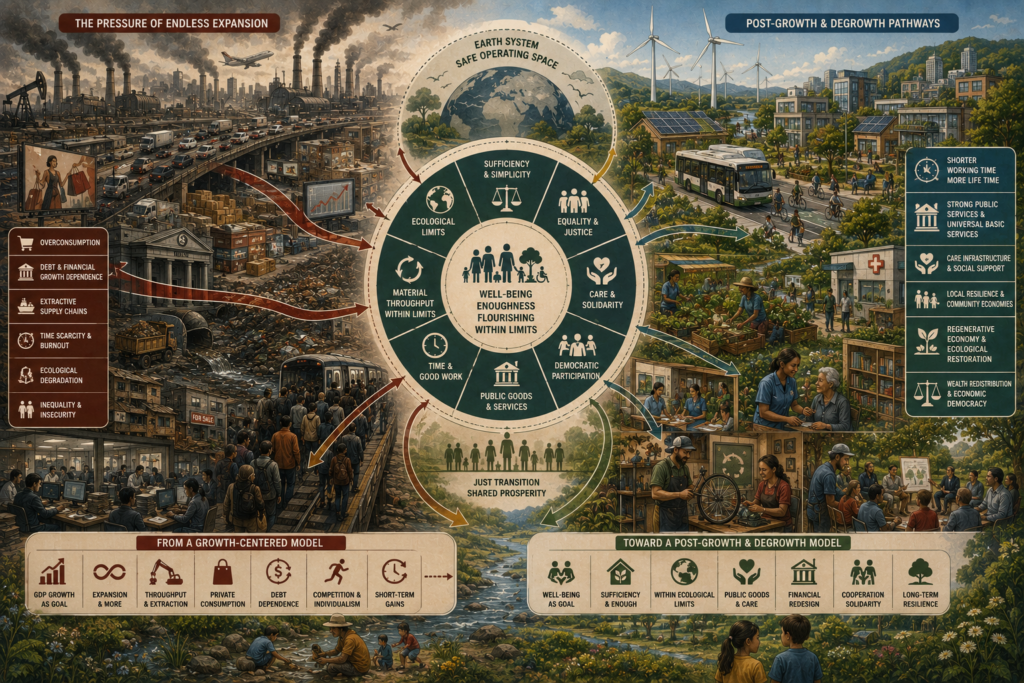
Editorial systems illustration showing post-growth and degrowth as alternatives to endless expansion, with sufficiency, care, public goods, ecological limits, shorter working time, repair economies, and democratic transition.

Post-Growth, Degrowth, and the Critique of Endless Expansion

Post-growth, degrowth, and the critique of endless expansion examine whether modern societies can remain organized around perpetual GDP growth under conditions of ecological strain, inequality, and institutional fragility. This article explores post-growth as a broad family of approaches that seek to organize economic life around wellbeing, sufficiency, resilience, and ecological stability rather than output expansion as an end in itself; degrowth as a more explicit argument for planned reductions in resource and energy throughput in high-income economies alongside stronger equality, care, public goods, and democratic capacity; and the wider critique of endless expansion as a challenge to the idea that rising output is the master solution to social problems. It addresses wellbeing beyond output, material throughput, distribution, care, productivity, debt, finance, decoupling, sufficiency, global justice, and the institutional dependence of modern systems on continuous growth.

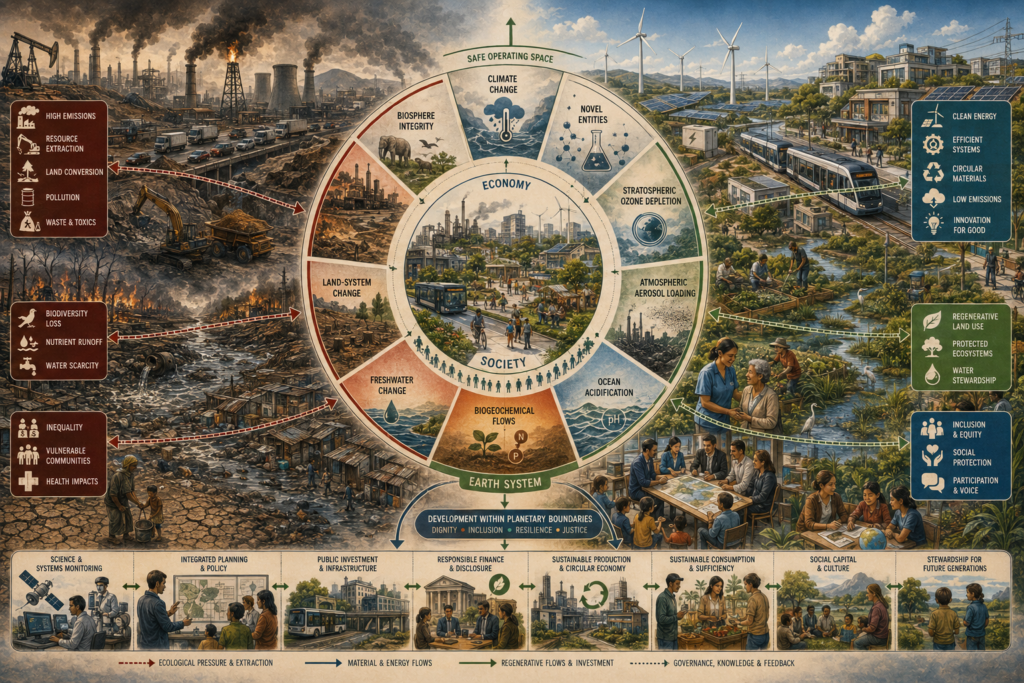
Editorial systems illustration showing the economy nested within society and Earth-system limits, with planetary boundaries, safe operating space, overshoot, resource use, ecological pressure, and boundary-aware governance.

Economic Systems Within Planetary Boundaries

Economic systems within planetary boundaries examines how economies must be governed as subsystems of the Earth system rather than as autonomous engines of unlimited expansion. This article explores the planetary boundaries framework as a way of identifying the safe operating space within which human societies can preserve the ecological conditions that support civilization, and it considers what that means for production, infrastructure, finance, public policy, development, and resource use. It addresses growth, material throughput, overshoot, energy-food-land-water interdependence, justice, state capacity, transition institutions, finance, and boundary-aware measurement. Within sustainable systems, the deeper issue is whether economic life can be reorganized to remain compatible with Earth-system resilience while still supporting dignity, inclusion, and long-run collective flourishing.

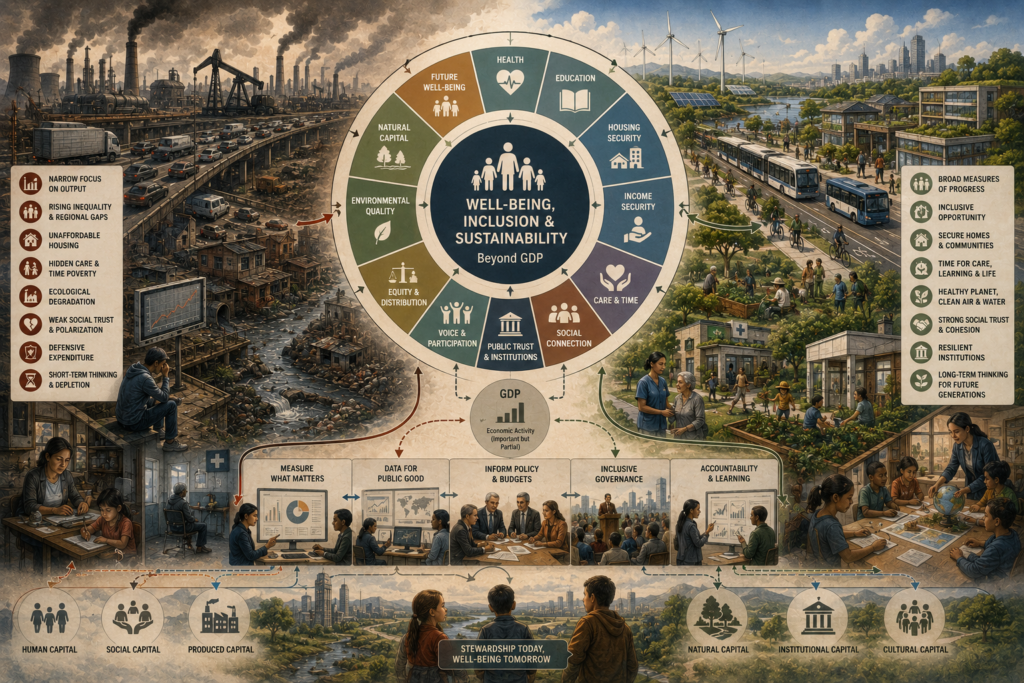
Editorial systems illustration showing a beyond-GDP framework for measuring well-being, inclusion, sustainability, health, education, housing security, care, public trust, natural capital, and future well-being.

Beyond GDP: Measuring Well-Being, Inclusion, and Sustainability

Beyond GDP: measuring well-being, inclusion, and sustainability is central to contemporary political economy because gross domestic product was never designed to capture the full quality of collective life. This article examines GDP as a measure of aggregate economic activity, while showing why it cannot adequately register health, security, care, inequality, ecological stability, social trust, or the long-term conditions of future wellbeing. It explores well-being, inclusion, distribution, sustainability, capability, subjective experience, households and care, natural capital, composite indices, human development, inclusive wealth, the SDGs, and the politics of measurement. Within sustainable systems, the deeper issue is whether societies can build richer frameworks of public evaluation that measure what they genuinely value rather than allowing market output alone to dominate how progress is understood and governed.

Scroll to Top