Author name: Tariq Ahmad

Mythic Chinese cosmological scene with sages, a dragon, celestial figures, yin-yang symbol, trigrams, sun and moon, and elemental forces suspended in a cloud-filled sacred landscape

The Huainanzi and the Philosophical Ordering of Myth

The Huainanzi is one of the most important texts for understanding how mythic material in early China was not merely preserved, but philosophically reordered within a larger synthesis of cosmology, governance, nature, and human conduct. Rather than presenting mythology as a standalone narrative canon, the text gathers inherited cosmogonic motifs, symbolic structures, legendary models of rulership, and theories of correlation into an expansive account of how the world emerges, coheres, and ought to be governed. This article examines the Huainanzi as a crucial source in the Chinese Myth, Legend, and Folklore knowledge series, showing how it transforms myth into a vehicle of philosophical world-order without stripping it of symbolic power. In doing so, it reveals how Chinese mythic tradition survives not only in sacred geography and poetic allusion, but also in systematic reflection on cosmos, pattern, and political order.


Chu Ci, with sacred landscape, visionary movement, divine presences, and cosmological atmosphere

Mythic Allusion and Cosmology in the Chu Ci

The Chu Ci is one of the most important sources for understanding how myth survives in early Chinese literature, not as a single systematic mythology, but as a richly allusive poetic world of celestial ascent, sacred longing, ritual voice, and cosmological imagination. Rather than cataloging divine beings or sacred places in direct form, the Songs of Chu preserve myth through visionary travel, symbolic landscape, shamanic address, and repeated encounters with numinous presence. This article examines how the Chu Ci stores myth in lyric movement and cosmological atmosphere, revealing a world in which gods, spirits, sacred directions, ritual mediation, and moral displacement are woven into poetic form. Read within the Chinese Myth, Legend, and Folklore knowledge series, the Chu Ci shows that Chinese mythic tradition endures not only in narrative and geography, but also in voice, image, longing, and the imaginative crossing of cosmic thresholds.

Fantastical landscape inspired by the Shanhaijing with sacred mountains, strange mythic creatures, ritual altar, temples, dragon, and celestial sky

Reading the Shanhaijing: Mythic Geography, Strange Beings, and Sacred Space

The Shanhaijing is one of the foundational texts for the study of Chinese mythology, not because it offers a single continuous mythological narrative, but because it preserves a richly spatial archive of sacred mountains, strange beings, ritual substances, distant regions, and cosmological boundaries. This article reads the Classic of Mountains and Seas as a work of mythic geography in which landscape itself becomes a medium of symbolic power. By examining its sacred topographies, extraordinary creatures, and charged borderlands, the article shows how the Shanhaijing preserves an early Chinese imagination of space as numinous, morally textured, and inseparable from the more-than-human world.

Painterly illustration of Chinese mythic sources with ancient books, sacred mountains, dragon, divine female figure, temples, and supernatural imagery

The Problem of Sources in Chinese Mythology

The study of Chinese mythology begins with a methodological challenge: the tradition does not survive as a single canonical mythology, but as a dispersed and layered archive preserved across classical texts, poetry, philosophical writings, historical compilations, religious traditions, local cults, folklore, and performance. This article examines the source problem at the heart of Chinese myth studies, showing why works such as the Shanhaijing, Chu ci, Huainanzi, and Soushen Ji must be read critically and comparatively, and why ritual life, popular religion, and living heritage are essential parts of the archive. Rather than weakening the field, this distributed survival reveals the historical depth, adaptability, and civilizational reach of Chinese mythic tradition.

Mythic Chinese fantasy landscape with dragon, divine figures, sacred mountains, waterfalls, temples, celestial bodies, and supernatural underworld imagery

What Is Chinese Myth, Folklore & Legend?

Chinese myth, folklore, and legend form a vast and layered field of cultural memory in which cosmology, sacred geography, legendary history, supernatural beings, ritual practice, and literary reinvention converge. Rather than surviving as a single canonical mythology, the Chinese mythic archive extends across classical texts, religious traditions, local cults, oral storytelling, festival life, performance, and visual culture. This article introduces the field by explaining what distinguishes myth, folklore, and legend, why Chinese mythology survives in dispersed form, and how these traditions continue to shape religion, art, historical imagination, and living heritage.

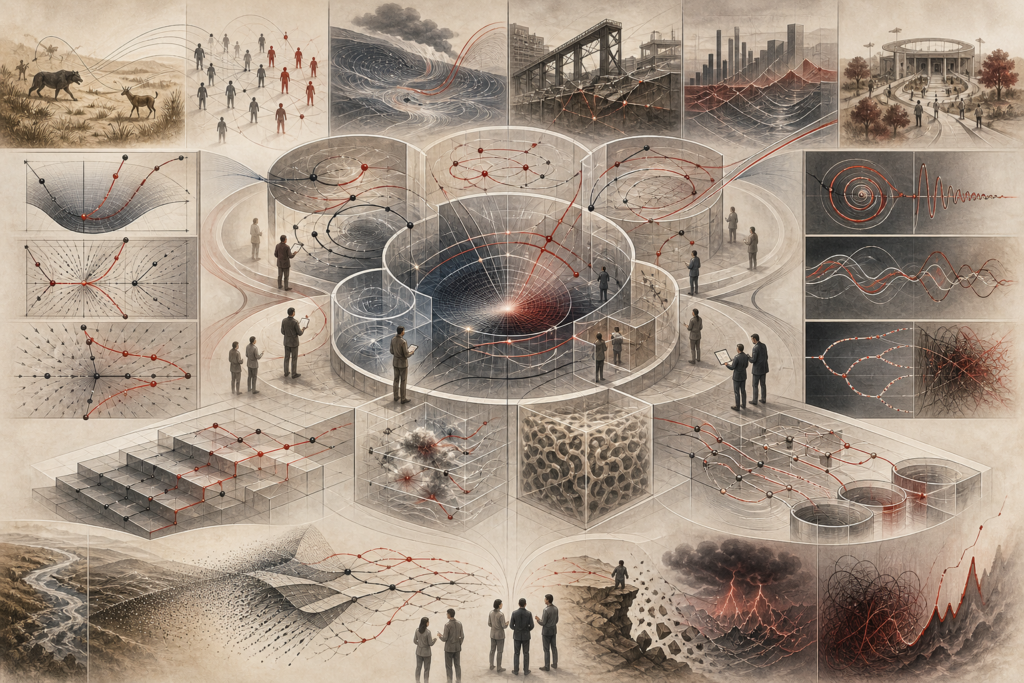
Editorial scientific illustration of differential equations for systems modeling as a dynamic-systems architecture, showing trajectory pathways, coupled feedback loops, equilibrium basins, stability fields, oscillation patterns, diffusion structures, ecological interaction, climate feedback, infrastructure stress, epidemiological pathways, public-policy systems, and responsible model interpretation.

Differential Equations for Systems Modeling: Dynamics, Stability, R, and Python

Differential Equations for Systems Modeling examines how relationships of change can be formally represented when the behavior of a system depends on rates of change, feedback, interaction, forcing, and time-dependent adjustment across economics, infrastructure, ecology, climate, engineering, epidemiology, governance, and public policy. Moving from first-order and higher-order equations to coupled systems, stability analysis, phase behavior, nonlinearity, diffusion, and numerical methods, this pillar treats differential equations as both a formal mathematical language and a practical modeling framework. It also connects differential equations to computational implementation in R and Python, showing how dynamic systems can be solved, simulated, visualized, and interpreted in applied settings.

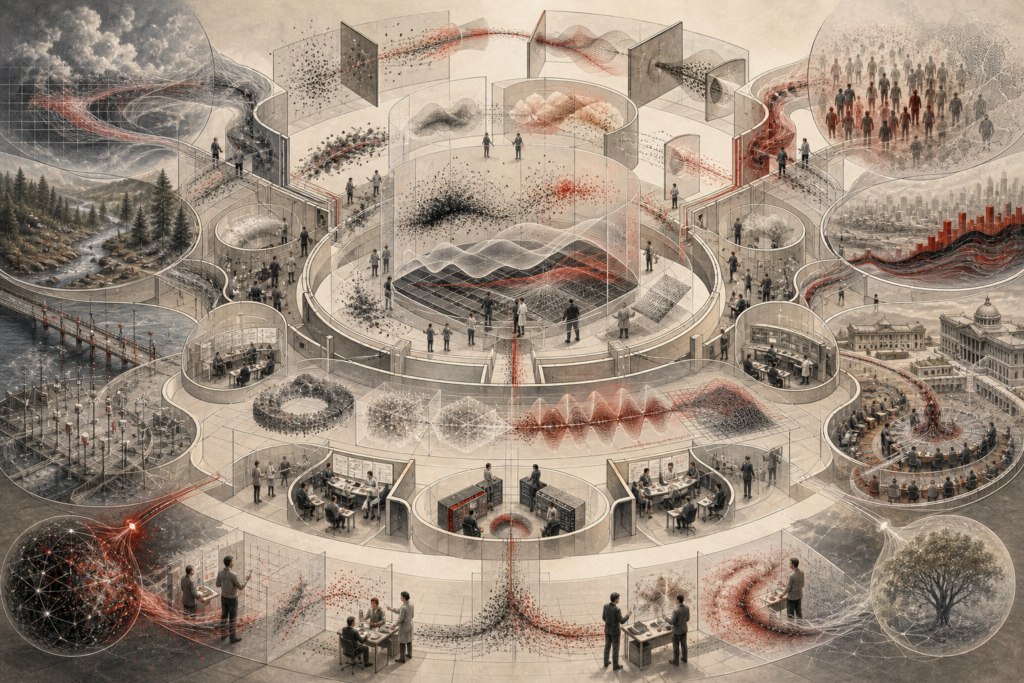
Editorial scientific illustration of statistics for systems modeling as an evidence-and-uncertainty architecture, showing data fields, measurement systems, sampling pathways, distribution clouds, uncertainty bands, regression surfaces, model diagnostics, resampling loops, forecasting structures, ecological monitoring, infrastructure sensors, climate data streams, public-policy evaluation, and responsible statistical interpretation.

Statistics for Systems Modeling: Inference, Evidence, Forecasting, R, and Python

Statistics for Systems Modeling examines how data, measurement, variation, uncertainty, and inference support the study of complex systems. This article explains statistics as a modeling language for evidence rather than a set of isolated formulas, connecting descriptive statistics, sampling, estimation, confidence intervals, hypothesis testing, regression, model diagnostics, causal inference, bias, missing data, resampling, simulation, time series, forecasting, prediction error, and responsible interpretation. It also shows why statistical reasoning matters for ecology, climate, infrastructure, epidemiology, economics, public policy, governance, and scientific computing. By combining formal statistical concepts with R and Python workflows, the article frames statistics as a disciplined way to reason from imperfect observations toward credible, transparent, and revisable claims about real-world systems.

Editorial illustration of physics featuring scientific instruments, atomic and field-like structures, cosmic systems, curved spacetime imagery, and computational analysis displays.

What Is Physics?

Physics is the disciplined study of matter, energy, motion, fields, measurement, and structure across scales, from subatomic particles to galaxies. This article introduces physics as more than a list of topics: it is a way of knowing built from measurement, mathematics, experiment, modeling, uncertainty, and computation. It explains why units, constants, and standards matter; how physical laws connect measurable quantities; how theory and experiment interact; and how branches such as mechanics, thermodynamics, electromagnetism, relativity, quantum theory, condensed matter, particle physics, and cosmology form a connected field. The article also introduces a computational physics lens through selected Python and R workflows, with expanded research-style code available through the accompanying GitHub repository.

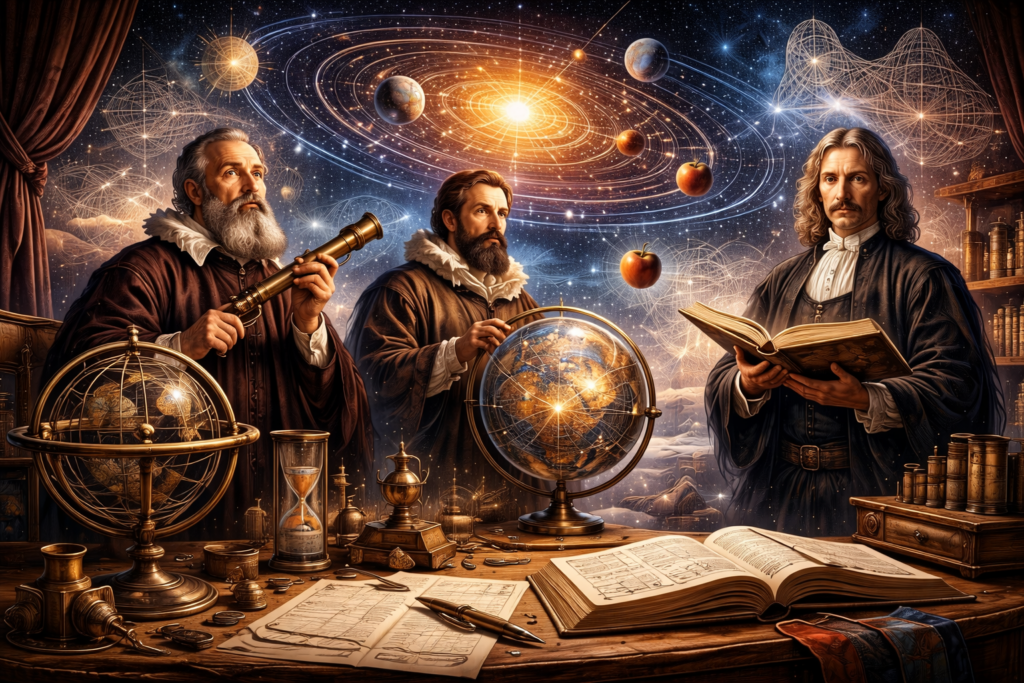
Editorial illustration of the Scientific Revolution featuring early modern scientific instruments, astronomical models, manuscripts, telescopic observation, planetary motion imagery, and a study-like setting associated with the rise of physical law.

The Scientific Revolution and the Rise of Physical Law

The Scientific Revolution transformed natural philosophy into the law-seeking structure that made modern physics possible. This article examines how early modern science moved from inherited authority and qualitative explanation toward mathematics, experiment, instruments, and universal physical law. It traces the shift from Aristotelian and scholastic frameworks through Copernicus’s heliocentric reordering, Kepler’s mathematical laws of planetary motion, Galileo’s experimental science of motion, and Newton’s synthesis of terrestrial and celestial mechanics. The article explains why physical law became central to scientific explanation, how mathematics and instrumentation reshaped knowledge, and why the legacy of the Scientific Revolution still defines physics as a discipline of measurement, modeling, evidence, and theoretical unification.

Scroll to Top