
Last Updated May 5, 2026
The Huainanzi occupies a pivotal place in the study of Chinese myth, folklore, and legend because it does something unusual within the early Chinese archive: it does not merely preserve mythic material, and it does not simply allude to it in lyric form. It thinks with myth. If the Shanhaijing preserves myth through sacred geography and strange beings, and the Chu ci preserves myth through allusive poetry, visionary movement, and ritualized longing, the Huainanzi preserves myth by philosophically ordering it. It absorbs inherited cosmological, mythic, political, and natural-symbolic materials into a broad account of the cosmos, rulership, knowledge, conduct, and the patterned structure of reality.
This makes the Huainanzi indispensable for understanding how Chinese mythology could move from narrative fragment into philosophical architecture. Mythic figures, cosmogonic sequences, symbolic correlations, and narratives of order are not discarded as primitive residues. They become part of a serious intellectual project: to explain how heaven, earth, human beings, rule, transformation, ritual, knowledge, and natural process belong to one interconnected field. Myth is not eliminated by theory. It is reorganized within theory.
Series context: This article is part of the Chinese Myth, Folklore & Legend knowledge series. Read alongside the articles on the Shanhaijing and the Chu ci, it shows how mythology in early China could be philosophically ordered without being emptied of symbolic force.
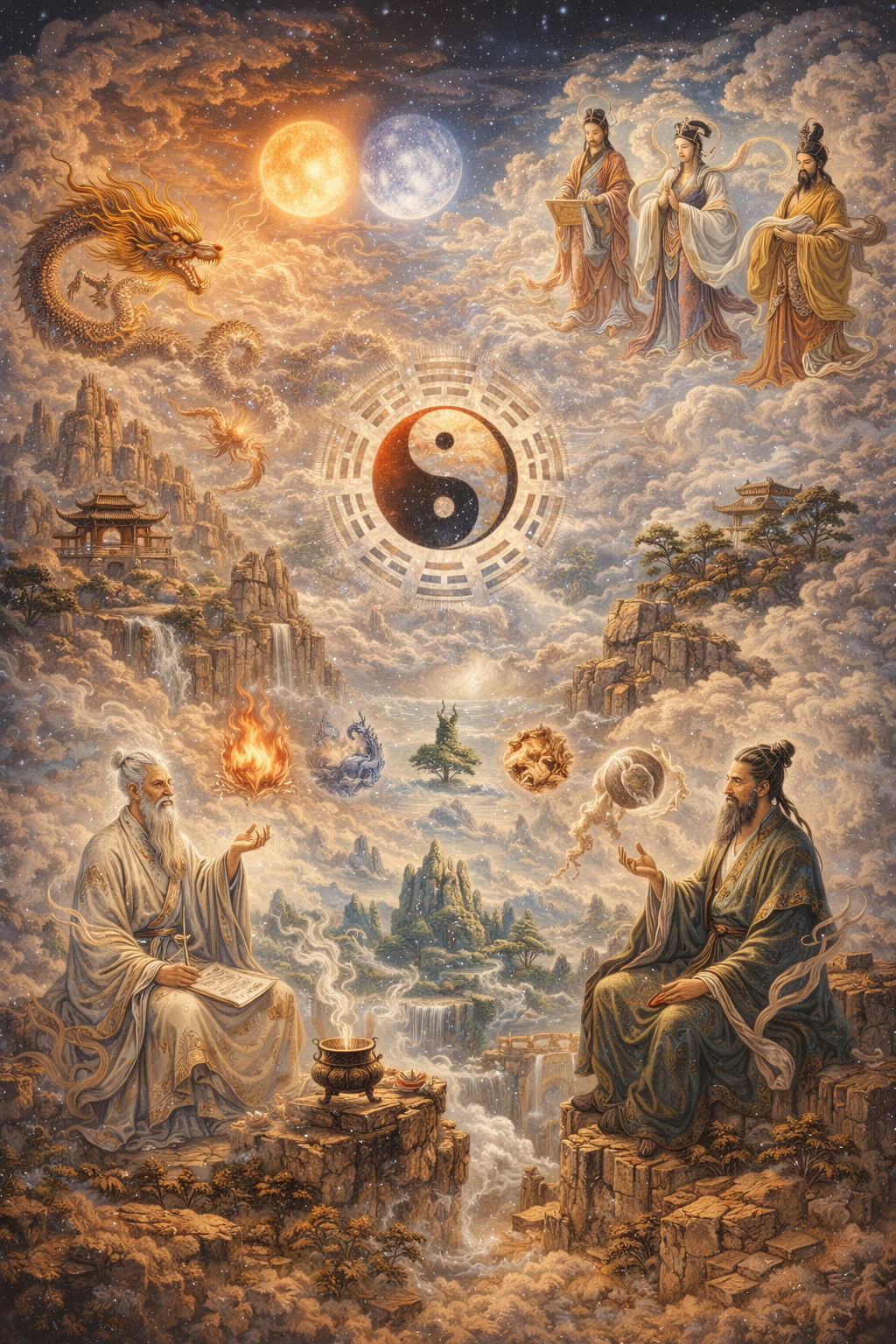
The Huainanzi should be read neither as a simple Daoist scripture nor as a miscellaneous collection of ancient learning. It is better understood as a work of intellectual synthesis in which inherited traditions are gathered, reordered, and placed within a more explicit philosophical architecture. The work moves across metaphysics, cosmology, statecraft, ethics, natural process, ritual order, and human conduct. Mythic materials enter the text within this larger architecture. They are not left as isolated episodes; they become evidence for how the world coheres.
For the study of Chinese myth, this is crucial. The Huainanzi shows that mythology in China was not only preserved in archaic fragments, poetic allusion, local cult, or popular tale. It could also be absorbed into theoretical writing. The text turns myth into a way of thinking about emergence, order, repair, governance, cosmic pattern, and the human task of living in accordance with the world’s deeper tendencies.
Why the Huainanzi Matters for Chinese Mythology
The Huainanzi matters because it reveals a distinct mode of mythic survival within the Chinese archive. Myth does not appear here primarily as regional sacred geography, as in the Shanhaijing, nor primarily as visionary lyricism, as in the Chu ci. Instead, it appears as conceptual material absorbed into a larger account of the cosmos and its right ordering. This makes the Huainanzi indispensable for understanding how Chinese myth could be philosophically reframed without being discarded.
That reframing is central to the broader study of Chinese myth, folklore, and legend. The early Chinese archive does not preserve myth in a single canonical container. It preserves it across multiple forms: geography, poetry, ritual, historical retrospection, anomaly literature, religious practice, political memory, and philosophical synthesis. The Huainanzi is one of the clearest examples of the last of these. It shows how mythic motifs, cosmogonic structures, and symbolic correlations could be drawn into a more general theory of world-order, governance, and human action.
This is especially important because philosophical ordering does not make myth less mythic. It changes the level at which myth operates. A mythic figure such as Nüwa no longer appears only as a wondrous being from an archaic tale. Her repair of the broken heavens becomes a way of thinking about restoration, cosmic rupture, catastrophe, and the reestablishment of livable order. In the Huainanzi, myth becomes a vehicle for theorizing crisis and repair.
The text therefore expands the definition of mythic evidence. A myth may survive not only in a story about what happened long ago, but also in a philosophical argument about how disorder becomes order, how rulers should respond to the world, and how human action should align with the patterned processes of heaven and earth.
What Kind of Text Is the Huainanzi?
The Huainanzi is best understood as a Han-dynasty work of compilation and synthesis rather than as the product of a single isolated philosophical voice. It is associated with Liu An, prince of Huainan, and a learned courtly environment in which multiple strands of early Chinese thought were gathered, organized, and reinterpreted. The work’s twenty-one chapters move across cosmology, metaphysics, rulership, conduct, natural processes, military thought, geography, and the relation between humanity and the larger patterned world.
This matters for interpretation because the Huainanzi is not simply “about” one thing. It is neither a narrow mythological handbook nor a single-school philosophical treatise. It is an encyclopedic project of ordering. Mythic materials enter the text as part of that project. They are placed within a conceptual order meant to explain how the world coheres and how political and ethical life ought to align with that coherence.
The Yaolüe, or “Essentials and Overview,” is especially important because it shows that the work is self-conscious about its own structure. The text presents its chapters as addressing major domains of transformation, knowledge, governance, and cosmic order. This is not accidental miscellany. It is a deliberate architecture of learning.
Primary Source
《俶真》者,窮逐終始之化,嬴垀有無之精,離別萬物之變,合同死生之形。“Chuzhen” pursues to the end the transformations of beginning and completion, examines the subtle essence of being and nonbeing, distinguishes the changes of the myriad things, and joins together the forms of death and life.Huainanzi, “Yaolüe” 要略.
The overview presents the work as an organized intellectual project. Its concern is not isolated mythic storytelling, but the relation between transformation, being and nonbeing, life and death, and the ordering of knowledge.
This helps explain why the Huainanzi is so valuable for myth studies. It preserves myth within a framework of classification and interpretation. Its authority lies not in giving the earliest possible version of every mythic motif, but in showing how early imperial thinkers reorganized inherited symbolic materials into a powerful synthetic vision.
From Mythic Material to Philosophical Order
One of the great contributions of the Huainanzi is that it demonstrates how myth can be philosophically ordered without being reduced to mere ornament. Mythic figures, cosmogonic imagery, and inherited symbolic structures are not simply repeated; they are interpreted and repositioned. The result is not the abolition of myth, but its integration into a more reflective and systematic cosmology.
This is precisely what makes the text so important for the study of Chinese mythology. It shows that mythic tradition in China was not opposed to intellectual elaboration. On the contrary, mythic materials could become part of a serious attempt to think about origins, transformation, order, rulership, measurement, classification, and the proper relation between human action and the world’s deeper tendencies.
In this respect, the Huainanzi stands in productive contrast to both the Shanhaijing and the Chu ci. Where the Shanhaijing preserves myth spatially and the Chu ci preserves it lyrically, the Huainanzi preserves it philosophically. It does not replace those earlier modes. It adds another layer to the archive: myth as theory.
To say this is not to treat the Huainanzi as modern philosophy in disguise. Its thinking remains deeply symbolic, cosmological, and correlative. But that is precisely its significance. It shows a mode of thought in which symbol, myth, nature, politics, and reason are not separate disciplines. They are aspects of a single effort to understand the world as patterned totality.
Dao, Cosmos, and Mythic Totality
The Huainanzi opens its philosophical world with a grand account of the Dao as the encompassing source and matrix of reality. This is not mythology in the narrow sense of a story about named gods, but it is mythic in a deeper sense: it offers an image of totality, origin, containment, transformation, and the invisible source from which visible order unfolds.
Primary Source
夫道者,覆天載地,廓四方,柝八極,高不可際,深不可測,包裹天地,稟授無形。As for the Dao, it covers heaven and bears up earth; it opens the four quarters and spreads to the eight limits. Its height cannot be reached; its depth cannot be measured. It enfolds heaven and earth and confers what has no form.Huainanzi, “Yuan Dao Xun” 原道訓.
This passage gives the Huainanzi its language of cosmic totality. The Dao is not a local deity or a single mythic actor, but the encompassing field through which heaven, earth, direction, depth, form, and transformation become intelligible.
This language matters for myth studies because it demonstrates how a text can move beyond narrative without leaving mythic imagination behind. The Dao is described through spatial immensity, hidden depth, generative power, and cosmic containment. The passage is philosophical, but its language is richly imagistic. It offers a mythic vocabulary for thinking totality.
The Huainanzi therefore helps show why Chinese myth and Chinese cosmology cannot be cleanly separated. The world is not explained as a mechanical system outside symbolic meaning. It is imagined as a field of power, form, relation, and transformation. Mythic thinking survives inside the grammar of cosmic order.
That grammar also has ethical and political consequences. If the Dao enfolds heaven and earth, then human action must be judged by whether it accords with the larger pattern of things. The ruler, sage, official, and ordinary person are all situated within a cosmos that is already structured, responsive, and meaningful.
Cosmogony, Correlation, and the Ordered World
The Huainanzi is especially important for cosmogony. It takes inherited ideas about origin and transformation and articulates them in a more explicit sequence of world-ordering. Rather than presenting the world as a random field of events, it imagines reality as a process of emergence, differentiation, relation, and patterned transformation.
Such ordering is not merely speculative abstraction. It shapes how the text understands pattern, differentiation, and the relation among the world’s many levels. The cosmos is not imagined as chaos interrupted by arbitrary events. It is understood as a structured process of emergence and relation. Mythic materials become meaningful within this wider correlated universe, in which heaven, earth, human order, naming, measurement, governance, and conduct all participate in larger patterns.
Primary Source
所謂有始者,繁憤未發,萌兆牙櫱,未有形埒垠無無蠕蠕,將欲生興而未成物類。What is called “having a beginning” is when the dense and turbulent has not yet issued forth, when sprouts and signs are only beginning, when there are not yet forms, boundaries, or limits, and things stir as if about to arise but have not yet become kinds of beings.Huainanzi, “Chu Zhen Xun” 俶真訓.
This passage preserves cosmogony as a staged account of emergence. The world begins not with a simple event, but with a threshold between undifferentiated potential and the formation of distinct beings.
For a knowledge series devoted to Chinese myth, folklore, and legend, this is especially significant. The Huainanzi demonstrates that mythology in China is inseparable from cosmology. Mythic structures are not simply narrative residues from a pre-philosophical age. They are part of the effort to think the world as ordered, patterned, and intelligible.
Correlation is central here. The world is not divided into isolated domains. Heaven and earth, yin and yang, seasons, directions, elements, government, human conduct, and natural process respond to one another. Mythic material becomes part of this web of resonances. It gives concrete symbolic form to otherwise abstract patterns of emergence and transformation.
Nüwa’s Repair and the Philosophy of Restoration
One of the most important mythic passages in the Huainanzi is the account of Nüwa repairing the broken heavens. The story is ancient, vivid, and cosmologically charged: the four limits collapse, the nine provinces split, heaven and earth fail in their basic functions, fire and flood rage, and predatory beings threaten human life. Nüwa responds by repairing the heavens, stabilizing the world, stopping the flood, and restoring the conditions of life.
This passage matters because it shows the Huainanzi at its most mythically powerful. Yet the story does not remain a detached marvel. In context, it becomes a theory of restoration. It shows what it means to reestablish order after cosmic breakdown. Myth becomes a language for catastrophe, repair, moral authority, and the return of livable structure.
Primary Source
往古之時,四極廢,九州裂,天不兼覆,地不周載,火爁炎而不滅,水浩洋而不息……於是女媧煉五色石以補蒼天,斷鼇足以立四極。In ancient times, the four limits collapsed and the nine provinces split; heaven could not fully cover, and earth could not fully bear; fire blazed without ceasing and waters surged without rest. Then Nüwa smelted five-colored stones to repair the blue heaven and cut the turtle’s legs to set up the four limits.Huainanzi, “Lan Ming Xun” 覽冥訓.
The Nüwa myth presents world-repair as the restoration of cosmic, ecological, and human order. In the Huainanzi, mythic action becomes philosophical reflection on the conditions of a habitable world.
Nüwa’s repair is especially important because it does not separate cosmology from ethics. A broken cosmos produces human suffering. A repaired cosmos allows life to continue. The myth therefore links cosmic structure, environmental stability, political imagination, and moral order. Heaven must cover; earth must bear; waters must be controlled; destructive forces must be restrained. A livable world is one whose relations have been restored.
This gives the Huainanzi one of its most enduring contributions to Chinese myth studies. It shows how myth can become a model for thinking repair after catastrophe. The story is not merely about the past. It becomes a symbolic grammar for any situation in which order collapses and must be reconstituted.
Myth, Rulership, and Political Thought
The philosophical ordering of myth in the Huainanzi is inseparable from political thought. Legendary antiquity, models of rulership, and the harmonizing relation between human governance and cosmic order become part of a larger vision of how authority should function. Mythic and legendary materials help articulate what legitimate order looks like when it is aligned with the deeper processes of the cosmos rather than with coercive distortion or short-sighted force.
This framework helps explain why myth in the text is not merely retrospective. It becomes politically diagnostic. Legendary and cosmological materials are used to think about how rule should accord with the grain of reality. A ruler who violates seasonal rhythm, ignores patterned order, or governs through aggression rather than harmony is not merely politically mistaken. He is cosmologically disordered.
This makes the Huainanzi particularly important for reading Chinese mythology beyond the narrow category of “story.” Myth here helps organize a political ontology: a vision of how the world is structured and how power ought to move within it. The cosmos becomes a model for governance, and governance becomes accountable to cosmic pattern.
In such a framework, sage rulership is not simply administrative efficiency. It is the art of responding rightly to the world. The ruler must understand timing, relation, measure, transformation, restraint, and the limits of force. Mythic antiquity provides images of such alignment, while stories of disorder show what happens when rule cuts against the world’s deeper tendencies.
Nature, Pattern, and the Human Place in the Cosmos
Another major feature of the Huainanzi is its account of humanity’s place within the cosmos. Human beings are neither sovereign masters of an inert world nor helpless spectators before cosmic necessity. Humanity occupies an intermediate place: interpretive, constructive, responsive, and responsible. Human action matters because it can either accord with pattern or disrupt it.
This has important implications for myth. Mythic materials are not only tales of gods, sages, or primordial stages. They help articulate the larger setting within which human action becomes either harmonious or disordered. The world has tendencies, relations, rhythms, and forms of responsiveness. Myth gives symbolic shape to this patterned environment.
The result is a more integrated account of cosmos and culture than modern categories often allow. Nature, ethics, statecraft, symbolic order, and mythic inheritance are not sharply separated domains. The Huainanzi belongs to a world in which they interpenetrate. To understand the cosmos is also to understand conduct; to understand conduct is also to understand the way human life participates in larger transformations.
This is one reason the text remains useful for contemporary readers interested in systems thinking, environmental thought, and cultural memory. Its categories are ancient and must not be modernized too quickly, but the underlying insight remains powerful: human life is embedded in a web of relations that cannot be reduced to individual will or isolated technical control.
The Huainanzi and Daoist Synthesis
The Huainanzi draws deeply on Daoist language and concerns, but it should not be flattened into a simple label. It is not only Daoist in the narrow sense, nor is it a sectarian scripture. It is a broad Han synthesis that incorporates Daoist, cosmological, political, and classificatory ambitions. Its Daoist dimension appears in its concern with noncoercive action, alignment with the world’s tendencies, transformation, naturalness, and the dangers of artificial distortion.
That breadth is one reason the text matters so much for myth studies. Mythic and cosmological materials in the Huainanzi are not preserved only as “religious” content. They are philosophically productive. They help build a total picture of reality, governance, conduct, and knowledge. In this sense, the Huainanzi marks an important transformation in the life of myth: inherited symbolic materials become part of an expansive intellectual architecture rather than remaining confined to isolated cult or narrative settings.
Daoist synthesis also changes how mythic agency is understood. The highest order is not always represented by dramatic intervention. Often it is represented by responsiveness, noncoercion, quiet alignment, and subtle efficacy. Mythic order is not only the heroic conquest of chaos; it is also the ability to allow things to follow their appropriate patterns.
This gives the Huainanzi a distinctive tone. It is grandly cosmological, but it is also wary of force. It imagines power not simply as domination, but as attunement. For mythology, this matters because it reframes heroic and divine action within a broader philosophy of harmony, timing, and the patterned unfolding of things.
The Huainanzi and the Problem of Sources
The Huainanzi also sharpens the larger source problem in Chinese mythology. Because it is a Han compilation that organizes inherited materials into a later synthesis, it cannot be treated as a transparent window onto an untouched archaic past. Its authority lies elsewhere. It is authoritative as evidence of how mythic, cosmological, political, and natural-symbolic materials were gathered and philosophically reinterpreted in early imperial China.
This is why the article belongs in close dialogue with source-critical approaches to Chinese mythology. The Huainanzi reminds us that later texts are not less important simply because they are later. They may be indispensable precisely because they preserve the interpretive reordering of older material. The question is not whether a text is “pure myth” or “mere philosophy.” The question is what kind of witness it provides to the life of myth in history.
The Huainanzi provides a witness to myth as synthesis. It shows how earlier motifs could become part of a larger account of world-order. It also shows how mythic materials could be politically and ethically activated. When Nüwa repairs heaven, when the Dao enfolds heaven and earth, when cosmogony moves from indeterminate potential to differentiated beings, myth becomes more than narrative memory. It becomes a framework for thinking.
For this reason, the text should be read neither as a passive repository nor as a philosophical system that has outgrown myth. It is both repository and system. Its genius lies in the fact that it makes inherited symbolic materials thinkable at a new scale.
Why the Huainanzi Still Matters
The Huainanzi still matters because it shows that mythology can become a vehicle of philosophical world-construction. It stands as one of the clearest examples in the Chinese archive of myth being neither discarded by philosophy nor left behind by political thought. Instead, mythic materials are drawn into a fuller account of cosmology, governance, conduct, and human situatedness.
It also matters because it complicates any simplistic opposition between imagination and reason. In the Huainanzi, the ordering of myth is not the elimination of symbolic depth. It is its reorganization. Myth remains present, but now as part of a more explicit attempt to understand the world as a patterned totality.
The text matters for comparative mythology because it offers a model of mythic survival different from epic preservation, ritual continuity, or folkloric transmission. It shows what happens when a culture’s inherited mythic materials are drawn into philosophical synthesis. The resulting text is neither mythology in the narrow sense nor philosophy in a purely abstract sense. It is a cosmological archive where the two are inseparable.
Finally, the Huainanzi matters because many of the questions it organizes remain intellectually powerful: How does order arise from indeterminacy? How should human beings act within a patterned cosmos? What happens when political power violates natural and moral order? How does a broken world become livable again? These questions are ancient, but the text’s way of joining myth, cosmology, ethics, and governance still makes it one of the richest sources for understanding Chinese mythic thought.
Related Reading
- Chinese Myth, Folklore & Legend
- What Is Chinese Myth, Folklore & Legend?
- The Problem of Sources in Chinese Mythology
- Reading the Shanhaijing: Mythic Geography, Strange Beings, and Sacred Space
- Mythic Allusion and Cosmology in the Chu Ci
- From Classical Text to Folkloric Archive: How Chinese Myth Survived
- Chinese Thought
- East Asian Traditions
Primary Sources
- Chinese Text Project (n.d.) Huainanzi 淮南子. Available at: https://ctext.org/huainanzi
- Chinese Text Project (n.d.) Huainanzi: Yuan Dao Xun 淮南子:原道訓. Available at: https://ctext.org/huainanzi/yuan-dao-xun/zh
- Chinese Text Project (n.d.) Huainanzi: Chu Zhen Xun 淮南子:俶真訓. Available at: https://ctext.org/huainanzi/chu-zhen-xun/zhs
- Chinese Text Project (n.d.) Huainanzi: Lan Ming Xun 淮南子:覽冥訓. Available at: https://ctext.org/huainanzi/lan-ming-xun/zh
- Chinese Text Project (n.d.) Huainanzi: Yaolüe 淮南子:要略. Available at: https://ctext.org/huainanzi/yao-lve
- Wikisource (n.d.) Huainanzi: Yuan Dao Xun 淮南子:原道訓. Available at: https://zh.wikisource.org/wiki/%E6%B7%AE%E5%8D%97%E5%AD%90/%E5%8E%9F%E9%81%93%E8%A8%93
- Wikisource (n.d.) Huainanzi: Lan Ming Xun 淮南子:覽冥訓. Available at: https://zh.wikisource.org/wiki/%E6%B7%AE%E5%8D%97%E5%AD%90/%E8%A6%BD%E5%86%A5%E8%A8%93
Further Reading
- Major, J.S., Queen, S.A., Meyer, A.S. and Roth, H.D. (2010) The Huainanzi: A Guide to the Theory and Practice of Government in Early Han China. New York: Columbia University Press. Available at: https://cup.columbia.edu/book/the-huainanzi/9780231142045
- Liu, An (2012) The Essential Huainanzi. Translated by J.S. Major, S.A. Queen, A.S. Meyer and H.D. Roth. New York: Columbia University Press. Available at: https://cup.columbia.edu/book/the-essential-huainanzi/9780231165372
- Chinese Text Project (n.d.) Huainanzi. Available at: https://ctext.org/huainanzi
- Chinese Text Project (n.d.) Huainanzi: Yaolüe. Available at: https://ctext.org/huainanzi/yao-lve
- Encyclopaedia Britannica (n.d.) “Huainanzi.” Available at: https://www.britannica.com/topic/Huainanzi
- Encyclopaedia Britannica (n.d.) “Taoism: Early eclectic contributions.” Available at: https://www.britannica.com/topic/Taoism/Early-eclectic-contributions
- Encyclopaedia Britannica (n.d.) “Liu An.” Available at: https://www.britannica.com/biography/Liu-An
- Stanford Encyclopedia of Philosophy (2022) “Philosophy in Han Dynasty China.” Available at: https://plato.stanford.edu/entries/han-dynasty/
- Stanford Encyclopedia of Philosophy (2015) “Metaphysics in Chinese Philosophy.” Available at: https://plato.stanford.edu/entries/chinese-metaphysics/
References
- Chinese Text Project (n.d.) Huainanzi. Available at: https://ctext.org/huainanzi
- Chinese Text Project (n.d.) Huainanzi: Yuan Dao Xun. Available at: https://ctext.org/huainanzi/yuan-dao-xun/zh
- Chinese Text Project (n.d.) Huainanzi: Chu Zhen Xun. Available at: https://ctext.org/huainanzi/chu-zhen-xun/zhs
- Chinese Text Project (n.d.) Huainanzi: Lan Ming Xun. Available at: https://ctext.org/huainanzi/lan-ming-xun/zh
- Chinese Text Project (n.d.) Huainanzi: Yaolüe. Available at: https://ctext.org/huainanzi/yao-lve
- Wikisource (n.d.) Huainanzi: Yuan Dao Xun. Available at: https://zh.wikisource.org/wiki/%E6%B7%AE%E5%8D%97%E5%AD%90/%E5%8E%9F%E9%81%93%E8%A8%93
- Wikisource (n.d.) Huainanzi: Lan Ming Xun. Available at: https://zh.wikisource.org/wiki/%E6%B7%AE%E5%8D%97%E5%AD%90/%E8%A6%BD%E5%86%A5%E8%A8%93
- Encyclopaedia Britannica (n.d.) “Huainanzi.” Available at: https://www.britannica.com/topic/Huainanzi
- Encyclopaedia Britannica (n.d.) “Taoism: Early eclectic contributions.” Available at: https://www.britannica.com/topic/Taoism/Early-eclectic-contributions
- Encyclopaedia Britannica (n.d.) “Liu An.” Available at: https://www.britannica.com/biography/Liu-An
- Liu, An (2012) The Essential Huainanzi. Translated by J.S. Major, S.A. Queen, A.S. Meyer and H.D. Roth. New York: Columbia University Press. Available at: https://cup.columbia.edu/book/the-essential-huainanzi/9780231165372
- Major, J.S., Queen, S.A., Meyer, A.S. and Roth, H.D. (2010) The Huainanzi: A Guide to the Theory and Practice of Government in Early Han China. New York: Columbia University Press. Available at: https://cup.columbia.edu/book/the-huainanzi/9780231142045
- Stanford Encyclopedia of Philosophy (2022) “Philosophy in Han Dynasty China.” Available at: https://plato.stanford.edu/entries/han-dynasty/
- Stanford Encyclopedia of Philosophy (2015) “Metaphysics in Chinese Philosophy.” Available at: https://plato.stanford.edu/entries/chinese-metaphysics/