
Last Updated May 5, 2026
The study of Chinese mythology begins with a methodological difficulty: the tradition does not survive in the form of a single canonical mythology. There is no one authoritative epic, no universally fixed divine genealogy, and no single sacred text that gathers the full range of cosmogony, legendary rulers, sacred geography, supernatural beings, ritual practices, and mythic motifs into a unified narrative system. Instead, the archive is dispersed across many textual, ritual, visual, oral, and performative forms. Early materials survive in fragmentary passages, layered compilations, poetic allusions, cosmological treatises, dynastic histories, religious writings, local cults, vernacular storytelling, festival traditions, and later literary reinventions.
This makes the problem of sources foundational rather than secondary. Before one can interpret Chinese mythology, one must ask what counts as a source, how the source was transmitted, what genre it belongs to, what historical layer it reflects, what kind of authority it claims, and how later traditions may have reframed or transformed the material. In Chinese myth studies, source criticism is not a technical preliminary that can be quickly dispatched. It is one of the central intellectual tasks of the field.
Series context: This article is part of the Chinese Myth, Folklore & Legend knowledge series. It examines the source problem behind the field: why Chinese mythology must be reconstructed across texts, genres, rituals, landscapes, and living traditions rather than read from a single canonical mythological book.
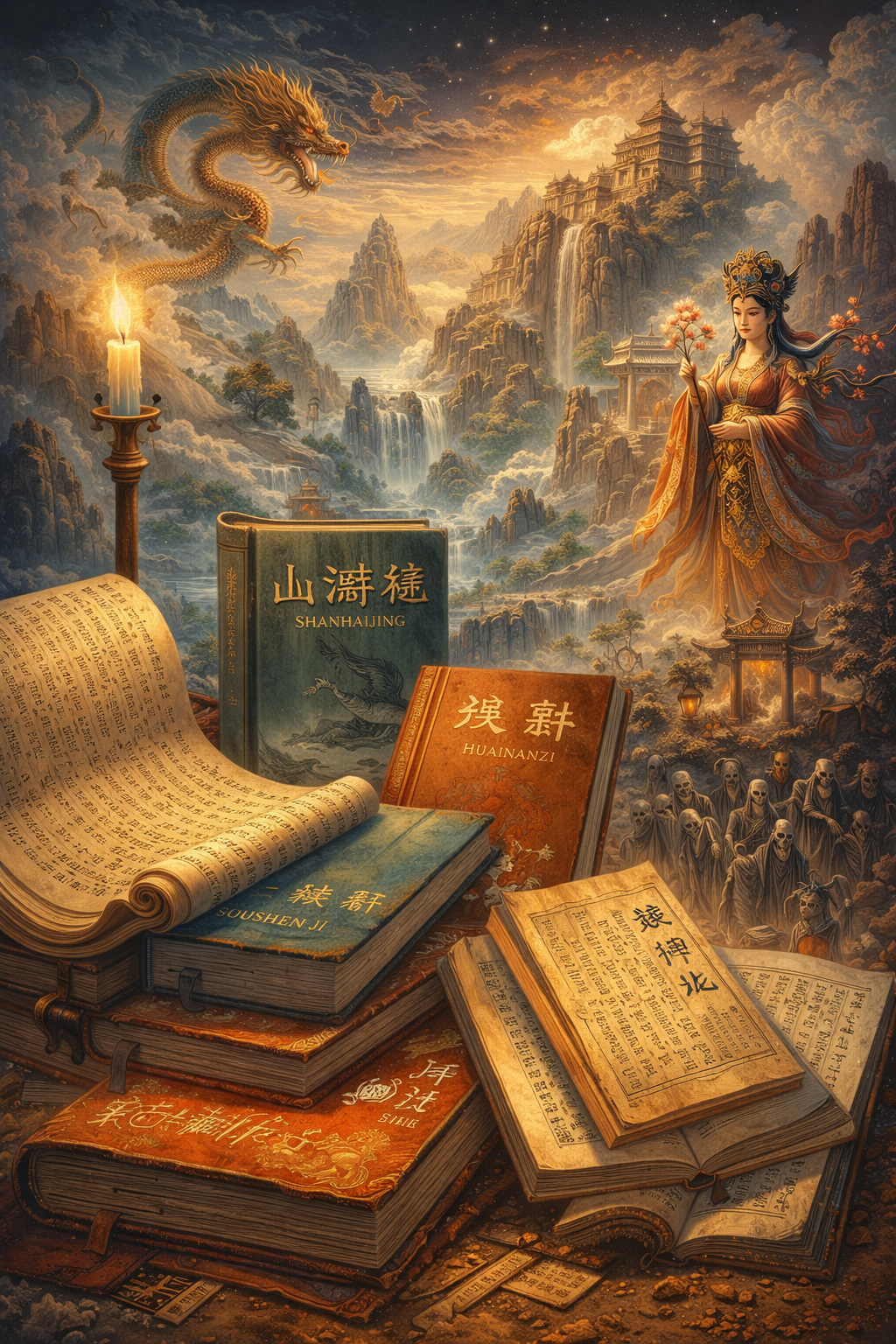
The difficulty is also what makes the subject so rich. Chinese mythology survives not as a sealed relic but as a long-duration symbolic archive. Its materials were preserved because they were quoted, adapted, ritualized, localized, moralized, visualized, dramatized, and retold. The task of scholarship is therefore not to reconstruct a lost perfect system, but to understand how mythic materials moved across genres and institutions, and how different layers of Chinese civilization preserved different aspects of the mythic world.
Why Sources Are a Problem in Chinese Mythology
The source problem in Chinese mythology arises because mythic materials are scattered, layered, and often preserved indirectly. Many early texts that contain mythic material were not composed for the purpose of preserving mythology as such. They may be geographical compendia, poetic anthologies, philosophical syntheses, ritual records, dynastic histories, anecdotal collections, temple materials, or local records. Mythic elements appear within these works, but often in compressed, allusive, or recontextualized form.
As a result, Chinese mythology is frequently reconstructed from fragments rather than received whole. A single figure may appear in one source as a cosmological force, in another as a political ancestor, in another as an object of cultic devotion, and in another as a literary symbol. A sacred mountain may function at once as a geographic marvel, ritual center, site of divine presence, and later religious paradise. The archive must therefore be read comparatively, historically, and across genres.
Primary Source
曰:遂古之初,誰傳道之?
上下未形,何由考之?It asks: at the beginning of ancient time, who handed down the way? Before above and below had taken form, how could it be examined?Chu ci, “Tianwen” 天問.
The opening of “Tianwen” makes source uncertainty part of the mythic imagination itself. Origins are not simply narrated; they are questioned, challenged, and approached through poetic inquiry.
This means that source criticism is not merely about authenticity in a narrow sense. It is also about function. Scholars must ask not only whether a source is early or late, but what the source is doing with its material. Is it preserving, moralizing, systematizing, localizing, literary embellishing, ritualizing, philosophically repurposing, or retrospectively organizing inherited traditions? Different sources preserve different kinds of truth, and understanding those differences is indispensable.
The Absence of a Single Canonical Mythology
One of the most persistent misconceptions about Chinese mythology is that its fragmentary condition reflects some lack or deficiency. In reality, the absence of a single canonical mythology reflects a different cultural history of preservation. Mythic materials in early China were not gathered into one universally normative mythological scripture. Instead, they survived through distributed transmission across many genres and institutions.
This matters because modern readers often approach mythology expecting a unified system of divine genealogy, origin narrative, and heroic cycle. Chinese materials do not usually present themselves in that form. Rather, they preserve cosmogonic motifs, flood narratives, sacred landscapes, culture heroes, legendary rulers, celestial imagery, supernatural beings, ritual practices, and local deity traditions in dispersed and overlapping ways. The archive is real, but it is not centralized.
The interpretive consequence is clear: Chinese mythology must be studied as a field rather than a book. Its coherence lies not in a single master text, but in recurring symbols, figures, motifs, cosmological structures, ritual forms, and long continuities of transmission across time. This is why the field requires both textual sensitivity and cultural breadth. A myth may survive in a classical source, but its later meaning may depend on temple practice, festival recurrence, regional performance, or religious reinterpretation.
Major Types of Sources
The source base for Chinese mythology is broad and heterogeneous. It includes early textual witnesses such as the Shanhaijing, the Chu ci, and the Huainanzi; transmitted classics and historical compilations; ritual materials; religious literature; local gazetteers; hagiographic writings; temple inscriptions; supernatural collections; vernacular fiction; drama; festival traditions; oral performance; and visual culture.
Each type of source preserves myth differently. Some are valuable because they preserve archaic motifs. Some show how mythic materials were philosophically reorganized. Some illuminate the political uses of legendary antiquity. Some preserve local cultic life and regional sacred geography. Some document how myths survived through popular performance rather than elite textual commentary. Taken together, these sources reveal that Chinese mythology was always larger than any single textual container.
The major source types may be understood as overlapping rather than sequential. Classical textual witnesses preserve early fragments and symbolic patterns. Philosophical works reorganize myth into cosmological and ethical systems. Historical writing retroactively orders legendary antiquity. Religious sources preserve myth through devotion, liturgy, and ritual efficacy. Anomaly collections preserve supernatural encounters and marvels. Performance and festival practice preserve stories through repeated social action. None of these forms is sufficient alone. Together, they create a layered archive.
The Shanhaijing and Mythic Geography
The Shanhaijing is one of the most indispensable sources for the study of early Chinese mythology because it preserves a dense archive of mythic geography. Sacred mountains, strange creatures, divine presences, extraordinary peoples, ritual associations, medicinal plants, mineral wealth, rivers, seas, and cosmographic boundaries appear throughout the work. It offers not a single narrative of origins, but a world textured by marvel, danger, sacred concentration, and symbolic space.
Its importance is methodological as well as substantive. The Shanhaijing demonstrates that myth in early China often survives spatially rather than narratively. Geography itself becomes one of the principal media of mythic preservation. The text therefore teaches readers not to search only for continuous plots, but also for symbolic landscapes, distributed figures, strange bodies, charged mountains, and recurring topographies of sacred power.
Primary Source
南山經之首曰䧿山。其首曰招搖之山,臨于西海之上,多桂,多金玉。The first of the Southern Mountain Classic is called Feishan. Its first height is Zhaoyao Mountain, overlooking the western sea; it has many cassia trees and much gold and jade.Shanhaijing, “Nanshan jing” 南山經.
The passage shows the catalogue-like form of the Shanhaijing: mythic knowledge is preserved through named mountains, directional movement, substances, plants, creatures, and sacred geography rather than through a single continuous plot.
At the same time, the Shanhaijing cannot be read naively as a transparent window into an untouched archaic past. It is a compiled and transmitted text with a long reception history. Its current form reflects layers of organization, commentary, copying, and preservation. It is foundational, but it must still be handled critically. Its value lies not in giving readers a simple map of “what ancient China believed,” but in preserving a mode of mythic spatial thinking that later traditions repeatedly reinterpreted.
The text’s treatment of Kunlun illustrates the point. Kunlun is not merely a physical mountain. It becomes a cosmic and sacred center, a place of divine presence, impossible scale, guarded thresholds, and mythic geography. Such passages remind readers that early Chinese mythic sources often collapse the modern distinction between landscape, cosmology, and sacred narrative.
Primary Source
海內崑崙之墟,在西北,帝之下都。崑崙之墟,方八百里,高萬仞。Within the realm, the ruins of Kunlun lie in the northwest, the lower capital of the Thearch. The ruins of Kunlun measure eight hundred li on each side and rise ten thousand ren high.Shanhaijing, “Hainei xi jing” 海內西經.
Kunlun shows why sacred geography must be treated as source material in its own right. The text preserves cosmology through place, scale, direction, divine residence, and impossible landscape.
Poetry, Allusion, and the Chu ci
The Chu ci reveals another challenge of source work: mythic material may survive in highly allusive poetic form rather than in expository narrative. Celestial travel, divine encounter, shamanic imagery, sacred longing, exile, political grief, and cosmological symbolism are central to its imaginative world. Yet these materials are not presented as a systematic mythological handbook. They appear in literary and affective form, requiring interpretive sensitivity to symbol, reference, and intertextual resonance.
This means that the study of Chinese mythology cannot rely only on explicitly narrative sources. Poetry may preserve mythic worlds with extraordinary force, but in indirect form. Myth survives here as image, question, allusion, rhythm, and visionary structure. The scholar must therefore learn to treat poetic language not as ornamental decoration around myth, but as one of myth’s major modes of survival.
The Chu ci is especially important because it unsettles the assumption that a mythic source must tell a story in a straightforward way. In “Tianwen,” myth is preserved through interrogation. The poem asks about heaven, earth, primordial darkness, celestial structure, sun and moon, divine genealogy, flood, rule, violence, and transformation. It does not resolve all of these questions into a tidy system. Instead, it preserves a world of contested memory and cosmological uncertainty.
Philosophical Texts and the Huainanzi
Texts such as the Huainanzi show how mythic materials were incorporated into broader cosmological and philosophical systems. This is one of the distinctive features of the Chinese archive: myth is often preserved through intellectual reframing rather than through isolation as an autonomous genre. Philosophical authors did not necessarily reject myth. They re-situated it within wider accounts of cosmic process, rulership, order, correlation, natural resonance, and moral pattern.
The source problem here is interpretive. When a philosophical text deploys mythic material, one must ask whether it is preserving an older tradition, transforming it, or using it instrumentally within a new conceptual structure. Often the answer is all three. The Huainanzi is thus valuable not only because it contains mythic motifs, but because it demonstrates how myth was reworked within Han intellectual life.
Primary Source
往古之時,四極廢,九州裂,天不兼覆,地不周載,火爁炎而不滅,水浩洋而不息……於是女媧煉五色石以補蒼天,斷鼇足以立四極。In ancient times, the four limits collapsed and the nine provinces split; heaven could not fully cover, and earth could not fully bear; fire blazed without ceasing and waters surged without rest. Then Nüwa smelted five-colored stones to repair the blue heaven and cut the turtle’s legs to set up the four limits.Huainanzi, “Lanming xun” 覽冥訓.
The Nüwa passage is not merely a mythic story of repair. In the Huainanzi, it becomes part of a philosophical argument about order, cosmic disruption, rulership, and the restoration of harmony.
This is why philosophical sources must be read both for content and for framing. The presence of myth in a philosophical text does not make the myth less important. It shows that mythic figures could be redeployed as vehicles for cosmology, political ethics, and theories of order. Such texts preserve ancient narrative material while also transforming its meaning.
Historical Writing, Legend, and Retrospective Ordering
Historical compilations and dynastic writing introduce another layer of complexity. Legendary rulers, sage-kings, founders, culture heroes, exemplary ministers, rebels, dangerous rulers, and civilizational ancestors often appear within narratives that retrospectively organize the deep past into morally intelligible history. Such materials are indispensable, but they cannot be treated simply as neutral records of mythic antiquity. They are already shaped by political, ethical, and historiographical purposes.
This does not make them unusable. On the contrary, they are crucial for showing how later societies interpreted legendary antiquity and tied it to rulership, virtue, flood control, order, ritual, dynastic legitimacy, and the foundations of civilization. But these are mediated sources. They tell us as much about later visions of the past as about the earliest stratum of mythic material itself.
The methodological challenge is to avoid two extremes. One extreme treats legendary history as if it were literal modern historiography. The other dismisses it as fiction and therefore irrelevant. A stronger approach asks what kind of memory the text constructs. Legendary rulers and culture heroes may not provide simple factual data, but they reveal the symbolic grammar through which political order, moral authority, ancestry, and cosmic legitimacy were imagined.
Religious Texts, Local Cults, and Popular Religion
A major part of Chinese mythology survives not in elite literary texts alone, but in the practices and representations of religion. Daoist writings, Buddhist adaptations, local deity cults, temple inscriptions, liturgical traditions, pilgrimage networks, spirit mediumship, regional ritual systems, protective rites, and festival calendars all preserve mythic figures and symbolic worlds in active social form.
This is especially important because local cults often preserve what centralized texts do not. A sea goddess, mountain deity, tutelary protector, spirit official, plague deity, mother goddess, or local hero may become richly elaborated in ritual and communal life even when the textual record is scattered. Religious practice, in other words, is itself a source archive.
The methodological challenge is that religious sources rarely preserve myth as pure narrative alone. They integrate it with ritual efficacy, moral order, doctrinal development, liturgical repetition, communal identity, healing, protection, and sacred geography. Yet this integration is precisely what makes them essential. Chinese mythology did not survive apart from religion. Much of it survived through religion.
Daoist and Buddhist transformations are especially important here. Daoist materials reframed immortals, sacred mountains, celestial bureaucracies, talismans, thunder rites, and paradisal geographies. Buddhist materials reshaped underworld imagination, karmic moral narrative, miracle tales, and the localization of transregional sacred figures. Popular religion, meanwhile, continually adapted these elements into temple communities, processions, festivals, and household practice.
Anomaly Literature and Supernatural Collections
Collections of anomaly literature and supernatural narrative provide another critical source layer. Works such as the Soushen Ji preserve ghosts, marvels, transformations, divine encounters, strange beings, omens, local wonders, and stories at the margins of ordinary reality. These texts stand at an important threshold between earlier mythic motifs and later tale literature.
They are methodologically valuable because they document how the supernatural was narrated, collected, and transmitted in more anecdotal form. They also reveal the permeability between myth, folklore, legend, and marvel literature. A ghost story may preserve older ritual anxieties. A transformation tale may carry cosmological implications. A local wonder report may encode a sacred geography. A strange encounter may preserve social fears about class, gender, death, marriage, exile, violence, or injustice.
These collections also expand the archive beyond elite cosmology and legendary antiquity. They bring forward the dead, the uncanny, the monstrous, the marginal, the local, and the unresolved. In doing so, they make visible the anxieties and imaginative pressures that more formal sources may conceal. Chinese mythology is not only a tradition of cosmic origins and divine rulers. It is also a tradition of ghosts, foxes, demons, revenants, dreams, uncanny bodies, and unstable boundaries between the living and the dead.
Performance, Ritual, and Living Heritage
Some of the most important sources for Chinese mythology are not textual in the narrow sense at all. Festival practices, temple fairs, calendrical observances, shadow puppetry, opera, ritual drama, pilgrimage, oral epic, local storytelling, devotional processions, and other forms of performance have preserved and transmitted mythic and legendary material across generations. These traditions are especially important when written sources are fragmentary, elite-centered, regionally thin, or shaped by later editorial priorities.
Performance preserves myth through embodiment, repetition, social memory, and communal participation. It often stabilizes narrative elements that would otherwise remain scattered. It can also transform inherited materials, giving them new emotional, moral, political, gendered, or regional emphasis. The source problem therefore widens into a media problem: myth does not survive only in books. It survives in voices, gestures, stages, images, processions, festivals, and sacred calendars.
For this reason, the study of Chinese mythology intersects with the study of intangible cultural heritage. Living traditions are not merely afterlives of an original archive. They are part of the archive. They show how communities continue to inherit, adapt, perform, and argue with mythic materials in changing historical conditions.
Core Methodological Principles
Several methodological principles follow from the source problem. First, no single source should be treated as exhaustive. Chinese mythology emerges from triangulation across texts, practices, images, rituals, places, and media. Second, genre matters. A poetic source, a philosophical source, a ritual source, a local gazetteer, and a performance tradition preserve different dimensions of the same mythic field. Third, chronology matters, but later does not automatically mean less valuable. Later sources may preserve important evidence of reception, ritual continuity, regional survival, and symbolic transformation.
Fourth, scholars must distinguish between the preservation of a motif and the interpretation of that motif. A source may preserve a figure while also moralizing, systematizing, localizing, or politicizing it. Fifth, local and religious traditions are not peripheral supplements to the textual archive; they are central components of it. Sixth, translation is never neutral. Names, titles, cosmological terms, divine offices, and ritual categories can be flattened if translated too quickly into Western mythological categories.
Finally, the goal is not to force Chinese mythology into an artificially unified system, but to understand how unity and plurality coexist within a long civilizational record. The field has coherence, but not because all materials derive from one authoritative book. Its coherence comes from recurring patterns: heaven and earth, flood and repair, sacred mountains, divine bureaucracy, dragons and waters, ghosts and ancestors, celestial romance, underworld judgment, immortality, local protection, ritual recurrence, and the moral pressure of cosmic order.
Why Source Criticism Matters
The problem of sources matters because every later interpretation of Chinese mythology depends on how the archive is assembled. If sources are treated carelessly, myth becomes either a romantic fantasy of timeless ancient wisdom or a flattened catalog of disconnected tales. Neither approach does justice to the actual complexity of the tradition.
Source criticism allows us to see that Chinese mythology is not weak because it is distributed. It is historically deep because it is distributed. Its symbols endured because they were never confined to one medium, one institution, or one era. They moved across poetry, philosophy, ritual, politics, religion, performance, art, family memory, local devotion, and modern media. The archive is difficult precisely because it remained alive.
To study the sources of Chinese mythology, then, is to study the conditions of cultural memory itself. It is to ask how civilizations preserve sacred imagination when no single container holds the whole. In the Chinese case, the answer is clear: through layered transmission, regional persistence, symbolic adaptation, ritual repetition, textual fragmentation, and the continual reactivation of mythic forms across changing historical worlds.
Related Reading
- Chinese Myth, Folklore & Legend
- Mythology
- Chinese Literature and Classical Memory
- Chinese Thought
- East Asian Traditions
Primary Sources
- Chinese Text Project (n.d.) Shanhaijing 山海經 / Classic of Mountains and Seas. Available at: https://ctext.org/shan-hai-jing
- Chinese Text Project (n.d.) Shanhaijing: Nanshan jing 山海經:南山經. Available at: https://ctext.org/shan-hai-jing/nan-shan-jing/zh
- Chinese Text Project (n.d.) Shanhaijing: Hainei xi jing 山海經:海內西經. Available at: https://ctext.org/shan-hai-jing/hai-nei-xi-jing/zh
- Chinese Text Project (n.d.) Chu ci 楚辭 / Songs of Chu. Available at: https://ctext.org/chu-ci
- Chinese Text Project (n.d.) Chu ci: Tianwen 楚辭:天問. Available at: https://ctext.org/chu-ci/tian-wen/zh
- Chinese Text Project (n.d.) Huainanzi 淮南子. Available at: https://ctext.org/huainanzi
- Wikisource (n.d.) Huainanzi: Lanming xun 淮南子:覽冥訓. Available at: https://zh.wikisource.org/wiki/%E6%B7%AE%E5%8D%97%E5%AD%90/%E8%A6%BD%E5%86%A5%E8%A8%93
- Chinese Text Project (n.d.) Soushen Ji 搜神記 / In Search of the Supernatural. Available at: https://ctext.org/wiki.pl?if=en&res=839038
- Chinese Text Project (n.d.) Shijing 詩經 / Book of Odes. Available at: https://ctext.org/book-of-poetry
Further Reading
- Birrell, A. (1993) Chinese Mythology: An Introduction. Baltimore: Johns Hopkins University Press. Available at: https://archive.org/details/chinesemythology0000birr
- Major, J.S., Queen, S.A., Meyer, A.S. and Roth, H.D. (2010) The Huainanzi: A Guide to the Theory and Practice of Government in Early Han China. New York: Columbia University Press. Available at: https://cup.columbia.edu/book/the-huainanzi/9780231142045
- Strassberg, R.E. (2002) A Chinese Bestiary: Strange Creatures from the Guideways Through Mountains and Seas. Berkeley: University of California Press. Available at: https://www.ucpress.edu/book/9780520298514/a-chinese-bestiary
- Yang, L. and An, D. (2005) Handbook of Chinese Mythology. Santa Barbara: ABC-CLIO. Available at: https://archive.org/details/handbookofchines0000yang
- Metropolitan Museum of Art (2011) “Daoism and Daoist Art.” Available at: https://www.metmuseum.org/essays/daoism-and-daoist-art
- UNESCO Intangible Cultural Heritage (n.d.) “China.” Available at: https://ich.unesco.org/en/state/china-CN?info=elements-on-the-lists
- Encyclopaedia Britannica (n.d.) “Chinese mythology.” Available at: https://www.britannica.com/topic/Chinese-mythology
References
- Chinese Text Project (n.d.) “Introduction.” Available at: https://ctext.org/
- Chinese Text Project (n.d.) Shanhaijing. Available at: https://ctext.org/shan-hai-jing
- Chinese Text Project (n.d.) Shanhaijing: Nanshan jing. Available at: https://ctext.org/shan-hai-jing/nan-shan-jing/zh
- Chinese Text Project (n.d.) Shanhaijing: Hainei xi jing. Available at: https://ctext.org/shan-hai-jing/hai-nei-xi-jing/zh
- Chinese Text Project (n.d.) Chu ci. Available at: https://ctext.org/chu-ci
- Chinese Text Project (n.d.) Chu ci: Tianwen. Available at: https://ctext.org/chu-ci/tian-wen/zh
- Chinese Text Project (n.d.) Huainanzi. Available at: https://ctext.org/huainanzi
- Wikisource (n.d.) Huainanzi: Lanming xun. Available at: https://zh.wikisource.org/wiki/%E6%B7%AE%E5%8D%97%E5%AD%90/%E8%A6%BD%E5%86%A5%E8%A8%93
- Chinese Text Project (n.d.) Soushen Ji. Available at: https://ctext.org/wiki.pl?if=en&res=839038
- Chinese Text Project (n.d.) Shijing. Available at: https://ctext.org/book-of-poetry
- Encyclopaedia Britannica (n.d.) “Chinese mythology.” Available at: https://www.britannica.com/topic/Chinese-mythology
- Metropolitan Museum of Art (2011) “Daoism and Daoist Art.” Available at: https://www.metmuseum.org/essays/daoism-and-daoist-art
- UNESCO Intangible Cultural Heritage (n.d.) “China.” Available at: https://ich.unesco.org/en/state/china-CN?info=elements-on-the-lists