Author name: Tariq Ahmad

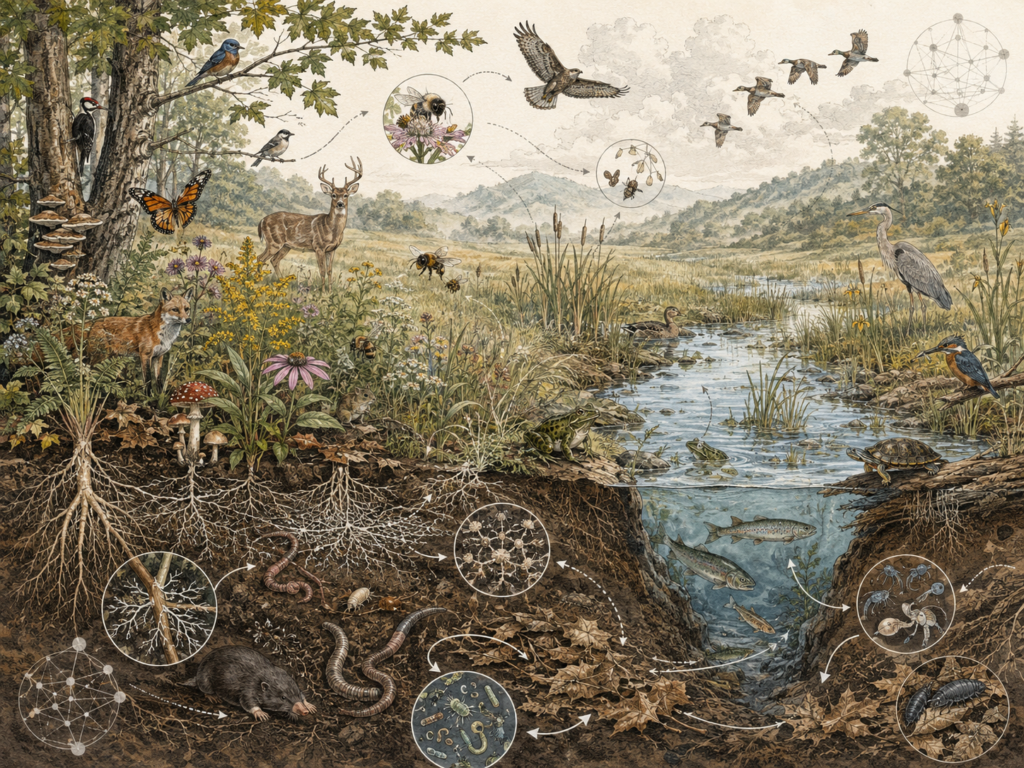
Research-grade ecological systems illustration showing forest, meadow, wetland, stream, soil, roots, fungi, insects, birds, mammals, amphibians, fish, pollinators, decomposers, and subtle ecological network diagrams.

Ecology and the Interdependence of Life

Ecology and the interdependence of life examine how organisms interact with one another and with their physical environments, how those interactions form populations, communities, ecosystems, and landscapes, and how the persistence of life depends on networks of exchange, constraint, adaptation, and material flow. Ecology is central to biology because no organism lives alone. Every form of life exists within relations of energy capture, nutrient cycling, competition, predation, mutualism, decomposition, disturbance, and environmental limitation. Ecology therefore studies not only organisms themselves, but the systems they form together and the conditions under which those systems remain viable or break down.
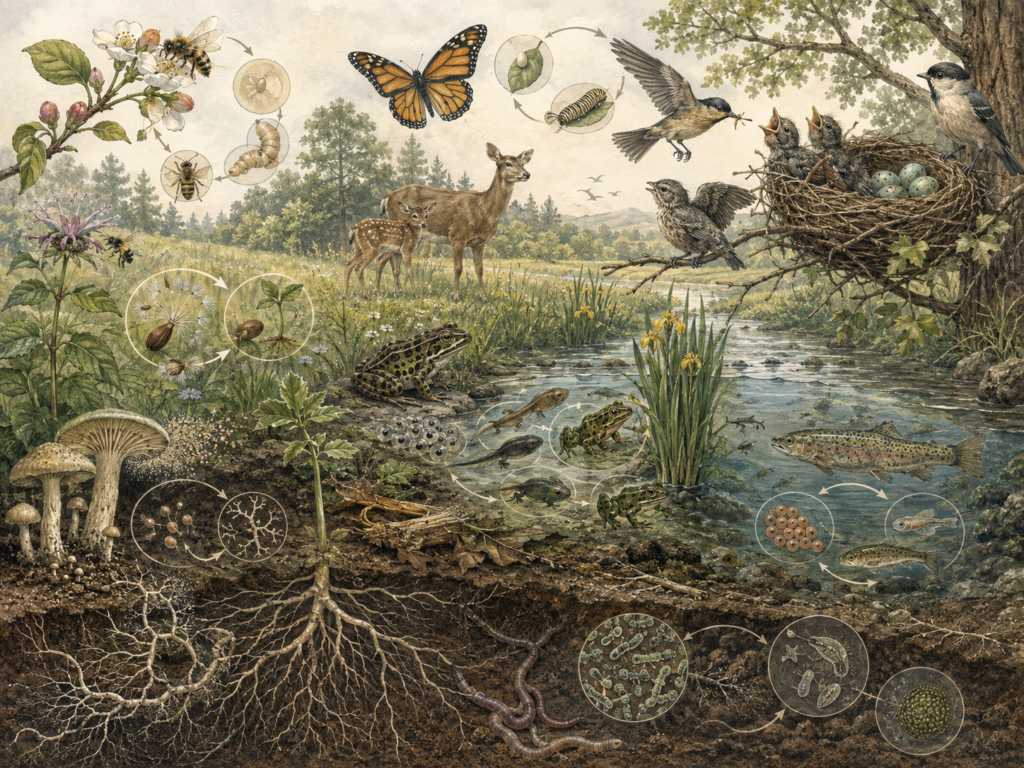
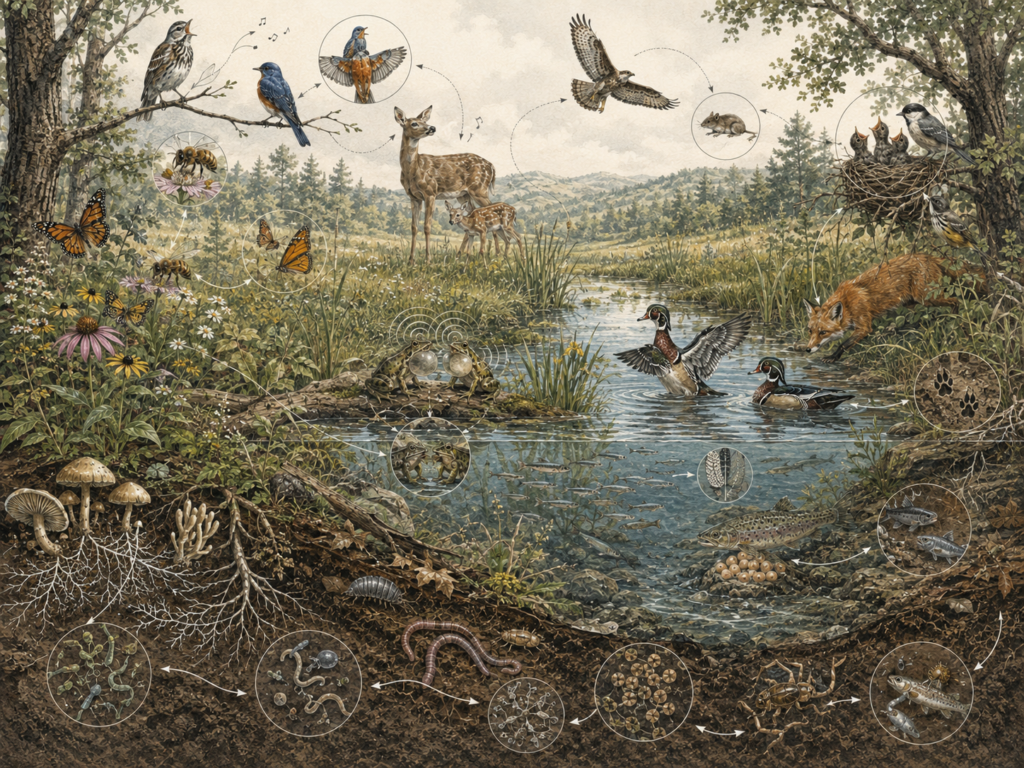
Research-grade ecological systems illustration showing forest, meadow, wetland, stream, soil, roots, fungi, insects, birds, mammals, amphibians, fish, pollinators, decomposers, and subtle ecological network diagrams.

Reproduction, Life Cycles, and Biological Continuity

Reproduction, life cycles, and biological continuity examine how living systems generate new individuals, transmit biological information across generations, alternate between developmental stages, and preserve life through changing forms of inheritance, growth, and renewal. Reproduction is central to biology because life persists not only through metabolism, development, defense, and behavior, but through the capacity to continue beyond the lifespan of any one organism. Life cycles matter because continuity is not achieved by reproduction alone, but by the patterned sequence through which organisms pass across growth, maturation, gamete formation, fertilization, dormancy, metamorphosis, senescence, and renewal.

Research-grade natural-history illustration showing animals and plants communicating and behaving strategically across a wetland and meadow ecosystem, including birdsong, pollination, courtship, predator-prey behavior, parental care, amphibian calls, fish schooling, fungi, roots, microbes, and soil organisms.

Behavior, Communication, and Biological Strategy

Behavior, communication, and biological strategy examine how organisms act in the world, exchange information, adjust to opportunity and danger, coordinate with others, and deploy evolved patterns of response that shape survival, reproduction, and ecological success. Behavior is central to biology because organisms do not merely exist as structures or internal physiological systems. They move, choose, signal, court, hide, cooperate, compete, forage, flee, parent, defend, and adapt their actions to changing conditions. Communication matters because many of these actions depend on transmitting information across bodies, whether through sound, posture, color, movement, touch, chemicals, or multimodal signaling. Strategy matters because behavior is not random motion, but organized response shaped by evolution, development, physiology, perception, learning, and ecological context.

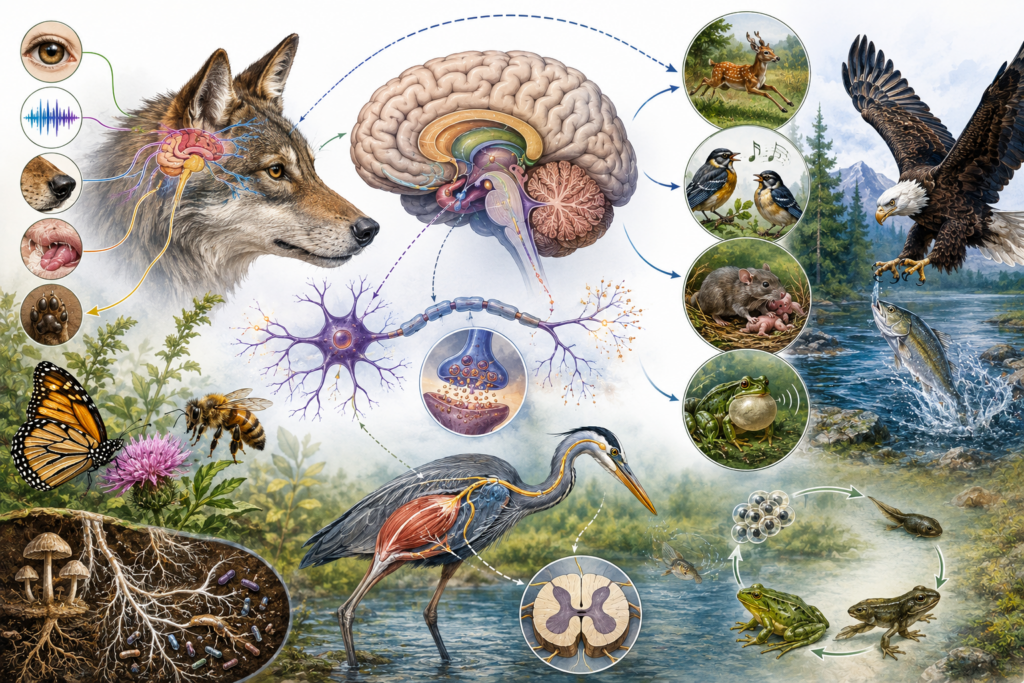
Research-grade neurobiology illustration showing sensory inputs, neural pathways, brain organization, neurons, synaptic signaling, animal behavior, movement, communication, predation, reproduction, and ecological response with minimal text.

Neurobiology and the Organization of Living Response

Neurobiology and the organization of living response examine how nervous systems detect signals, integrate information, coordinate action, generate perception and behavior, and organize the rapid, adaptive responses through which organisms engage changing environments. Neurobiology is central to biology because living systems do not merely persist through metabolism, development, and homeostasis. They must also sense, select, communicate, remember, and respond. Nervous systems make this possible by linking receptors, neurons, circuits, effectors, and whole-body states into organized patterns of action across time. This article explores neurobiology through the lenses of neurons, synapses, circuits, sensory systems, motor coordination, development, plasticity, behavior, and ecological adaptation.

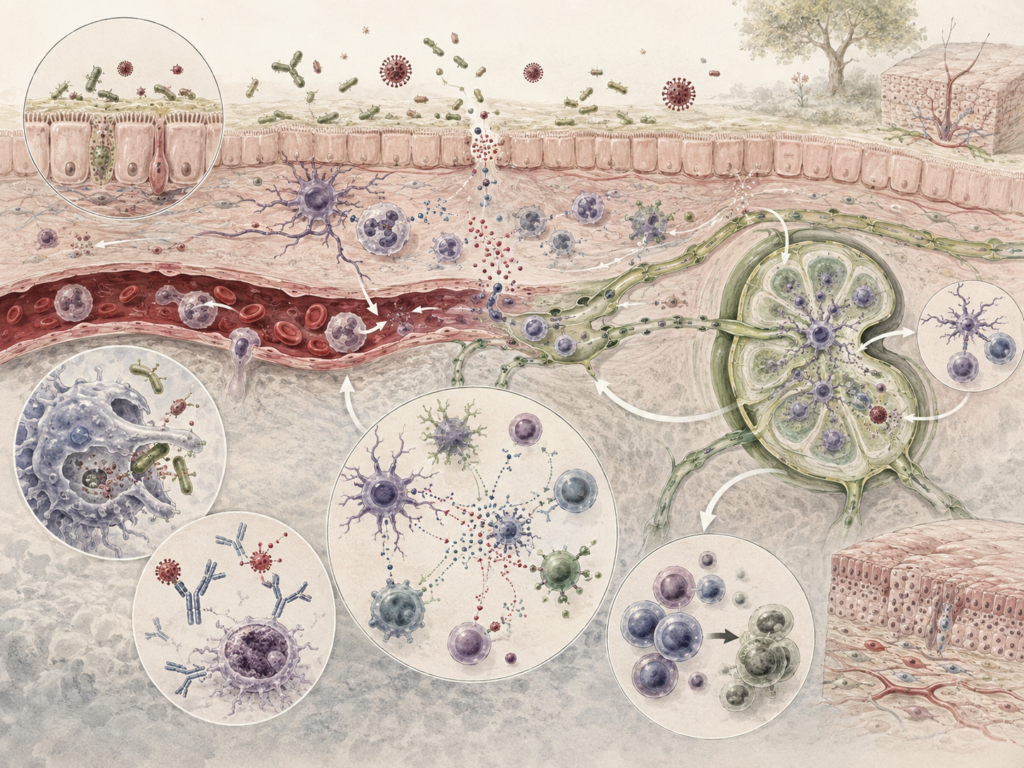
Research-grade immunology illustration showing tissue barriers, epithelial cells, microbes, immune cells, blood vessels, lymphatic pathways, antibodies, antigen recognition, inflammation, and immune defense across biological layers.

Immunology and Biological Defense

Immunology and biological defense examine how living systems detect danger, distinguish self from non-self or altered self, coordinate protective responses against infection and damage, and regulate the fine balance between defense, tolerance, inflammation, and injury. Immunology is central to biology because life persists not only through metabolism, development, and regulation, but also through the capacity to resist invasion, contain damage, remember prior exposure, and preserve internal integrity under continual microbial and environmental challenge. This article explores immunology through the lenses of innate defense, adaptive immunity, inflammation, immune memory, host-pathogen interaction, tolerance, immune dysregulation, and ecological context, while also situating biological defense within wider systems of physiology, microbiology, animal biology, plant biology, disease ecology, evolution, and sustainability-oriented science. It further extends the topic into quantitative and computational biology through feedback models, and population dynamics.

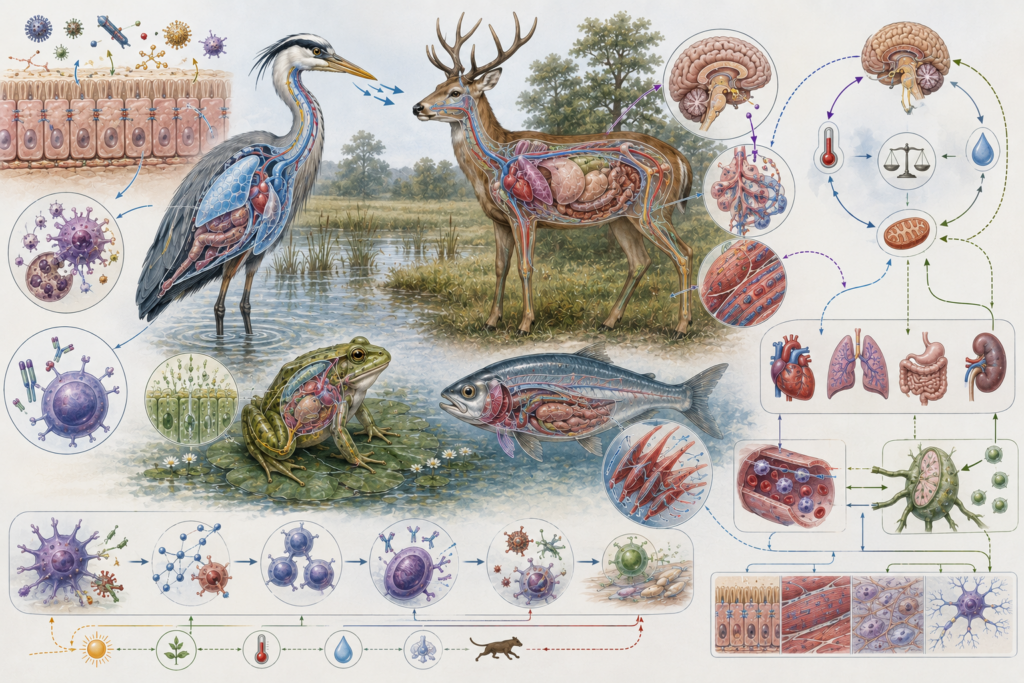
Research-grade systems biology illustration showing animals, tissue layers, organs, cellular pathways, immune signals, neural control, circulation, respiration, metabolism, and feedback loops with minimal text.

Physiology and the Regulation of Living Systems

Physiology and the regulation of living systems examine how organisms maintain functional order through the coordinated control of energy, matter, temperature, water, ions, gases, nutrients, signaling, and internal balance across cells, tissues, organs, and whole organisms. Physiology is central to biology because life does not persist through structure alone. Living systems must regulate themselves continuously in the face of environmental fluctuation, metabolic demand, developmental change, injury, stress, reproduction, and ecological challenge. This article explores physiology through the lenses of homeostasis, feedback, internal regulation, organ-system coordination, metabolic integration, environmental response, and adaptive constraint, while also situating physiology within wider systems of cell biology, development, animal biology, plant biology, microbiology, ecology, disease biology, and Earth-system change.

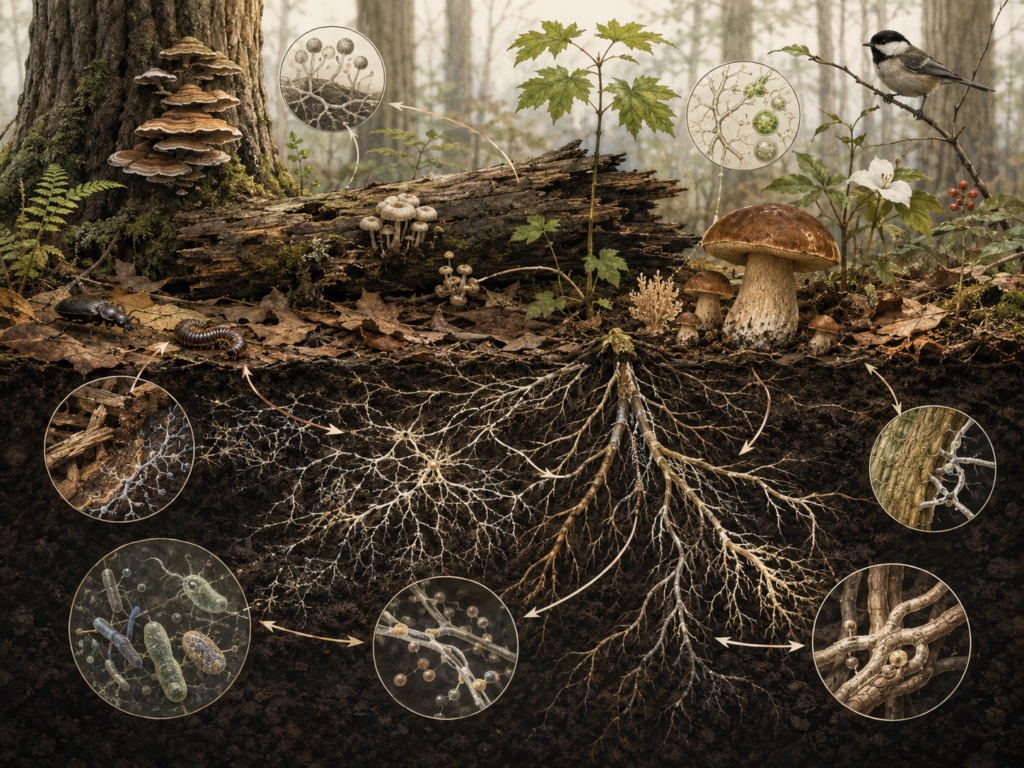
Research-grade systems biology illustration showing forest fungi, mushrooms, decomposing wood, leaf litter, soil organisms, plant roots, mycorrhizal networks, microbial communities, nutrient exchange, and decomposition pathways with minimal text.

Fungi and the Networks of Decomposition and Exchange

Fungi and the networks of decomposition and exchange examine how fungal life breaks down organic matter, redistributes nutrients, forms vast symbiotic networks, shapes soils and ecosystems, and connects living and dead matter through some of the most consequential biological processes on Earth. Fungi are central to biology because they do not merely occupy a narrow kingdom between plants and animals. They are among the principal agents through which organic material is decomposed, nutrients are recycled, soils are structured, symbioses are sustained, and ecological systems remain metabolically active across time. This article explores fungi through the lenses of cell structure, growth form, reproduction, decomposition, mycorrhizal exchange, ecological function, symbiosis, evolution, and environmental significance, while also situating fungal biology within wider systems of soil ecology, plant biology, microbiology, forest dynamics, disease ecology, and Earth-system change.

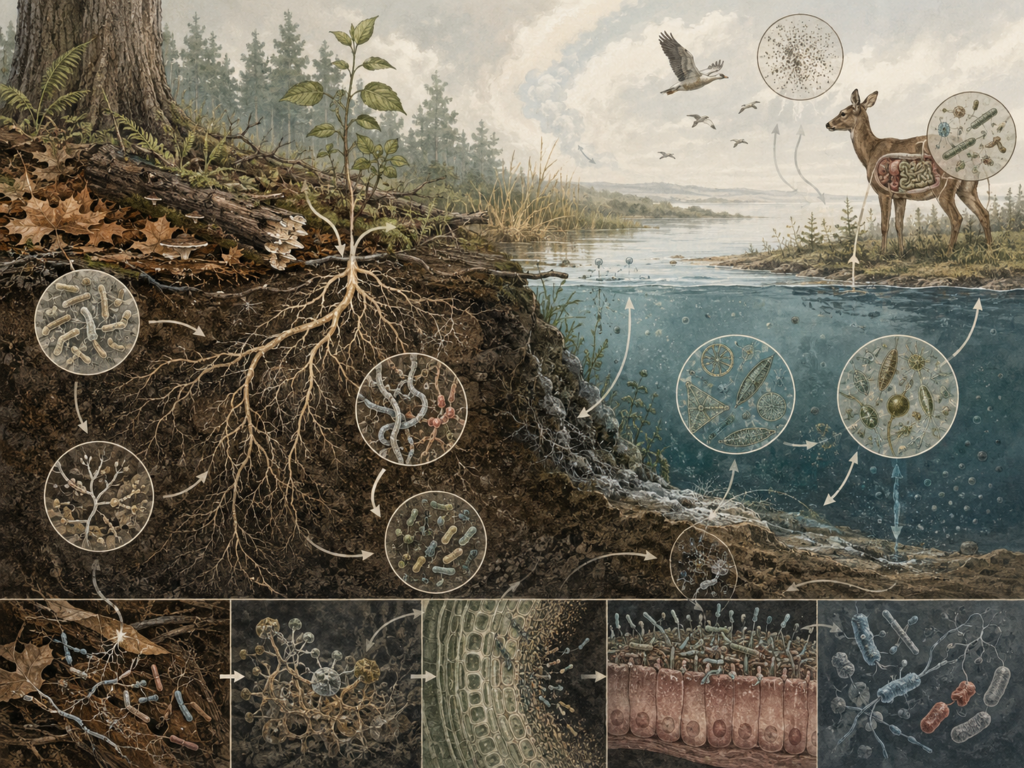
Research-grade systems biology illustration showing microbial life across soil, roots, leaf litter, freshwater, sediments, atmosphere, and animal microbiomes, with subtle microscope-style insets and fine-line ecological pathways.

Microbiology and the Hidden Majority of Life

Microbiology and the hidden majority of life examine the organisms, processes, and unseen systems through which microbes sustain biogeochemical cycles, shape ecosystems, regulate health and disease, drive evolution, and constitute much of the living activity of the biosphere. Microbes are central to biology because most of life’s metabolic diversity, much of its numerical abundance, and many of its deepest evolutionary innovations are microbial. Bacteria, archaea, microscopic eukaryotes, many fungi, and viruses interacting with cellular life all belong to the broader world through which organic matter is decomposed, nutrients are recycled, pathogens emerge, symbioses are sustained, soils are formed, oceans remain productive, and biochemical transformation continues across every major environment on Earth.

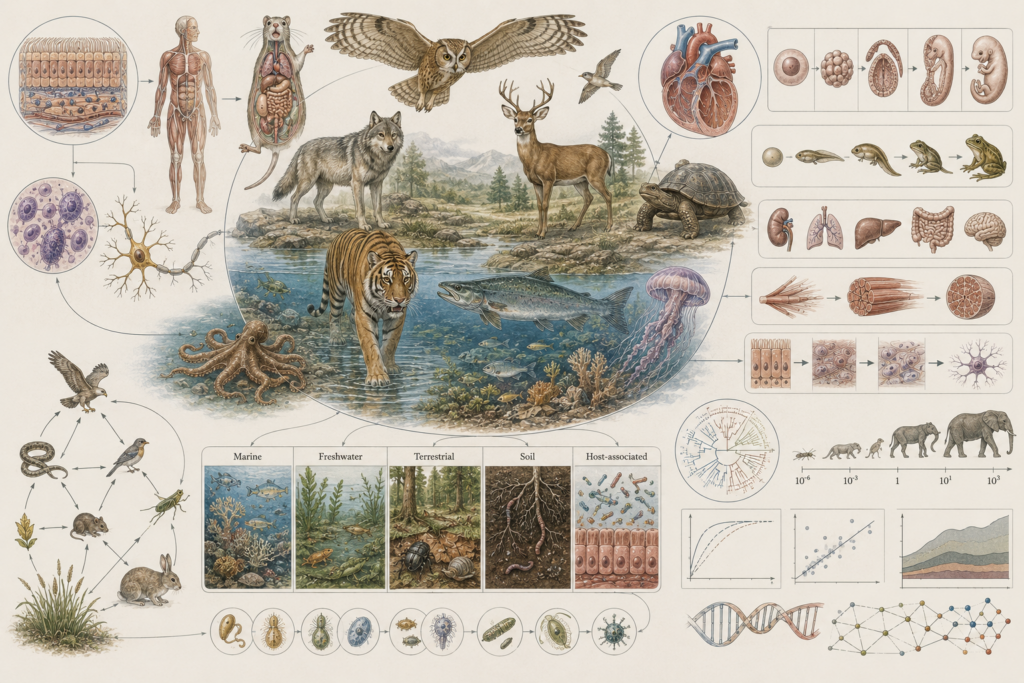
Research-grade systems biology illustration showing diverse animals across terrestrial, freshwater, marine, soil, and host-associated environments, with tissue structures, organ systems, development, food webs, phylogeny, microbiomes, and quantitative modeling elements.

Animal Biology and the Organization of Complex Life

Animal biology and the organization of complex life examine how multicellular heterotrophic organisms build tissues, organs, body plans, sensory systems, and coordinated behaviors through development, physiology, ecology, and evolutionary history. Animals are central to biology because they represent one of the most consequential expressions of multicellular organization: living systems in which specialized cells are integrated into tissues, tissues into organs, and organs into coordinated whole organisms capable of sensation, movement, predation, symbiosis, reproduction, and ecological transformation. This article explores what animals are, how metazoan complexity is organized, how animal form and function emerge through development and evolution, and why animal biology matters across ecology, marine and freshwater systems, disease ecology, conservation, and comparative life science.

Scroll to Top