Resilience Thinking

Resilience thinking examines how complex systems respond to disturbance, disruption, and long-term structural change. Originally developed within ecology, resilience theory has expanded into fields such as sustainability science, climate adaptation, infrastructure planning, and social systems analysis.

Resilience focuses on a system’s capacity to absorb shocks while maintaining core functions and adapting to new conditions. Rather than assuming stability or equilibrium, resilience thinking recognizes that ecological and social systems continually experience stress and transformation.

Key concepts include adaptive cycles, system thresholds, redundancy, and recovery capacity. Researchers analyze how systems transition between phases of growth, stability, collapse, and renewal.

Resilience thinking has become central to addressing challenges such as climate change, biodiversity loss, and economic instability. By identifying vulnerabilities and strengthening adaptive capacity, resilience-oriented approaches help institutions design systems capable of withstanding uncertainty and maintaining long-term sustainability.

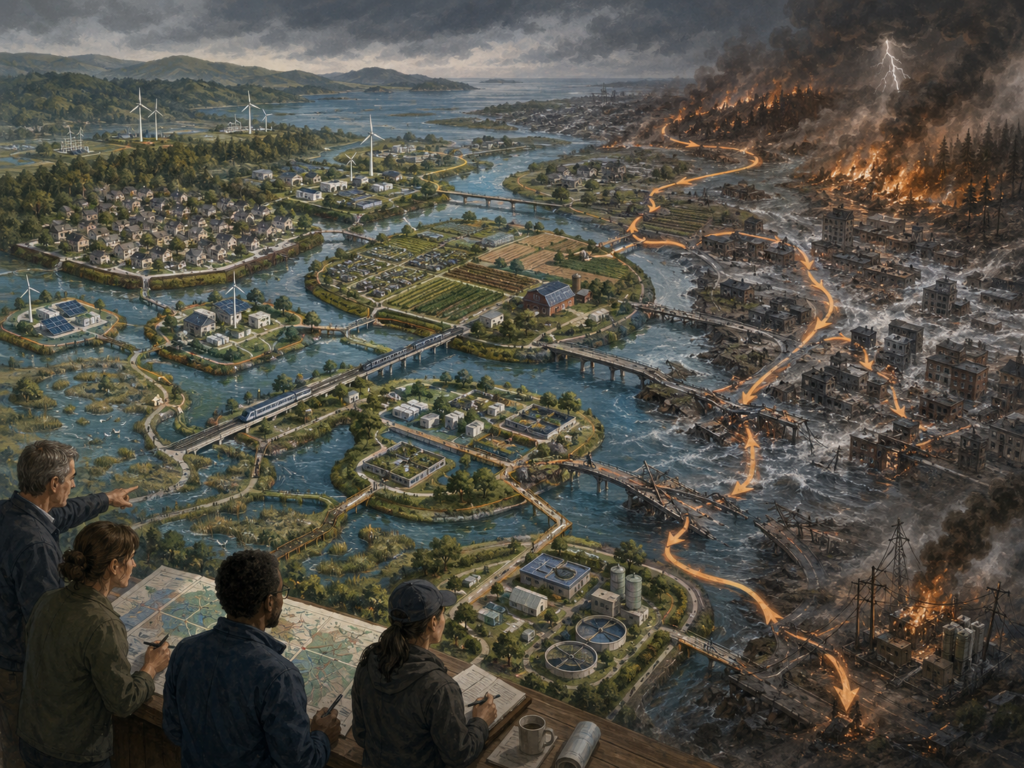
Panoramic systems illustration of a modular river-city landscape where protected districts, farms, wetlands, bridges, and energy systems contrast with cascading infrastructure failure, fire, flood damage, and network breakdown.

Modularity and Cascading Failure

Modularity and cascading failure explain why some systems contain disturbance while others transmit failure across networks, institutions, ecosystems, infrastructures, economies, and communities. Modularity creates semi-independent components that can absorb, isolate, or recover from disruption without destabilizing the whole. Cascading failure occurs when disruption spreads through dependencies, feedback loops, shared infrastructure, common-mode vulnerabilities, or tightly coupled processes. This article examines how modular structure supports resilience, why tight coupling increases fragility, how infrastructure and ecological cascades unfold, and why modularity must be balanced with coordination, redundancy, diversity, and justice. It also explores cascade risk in public health, digital systems, supply chains, and governance, showing how resilient systems manage interdependence without allowing one failure to become everyone’s failure.
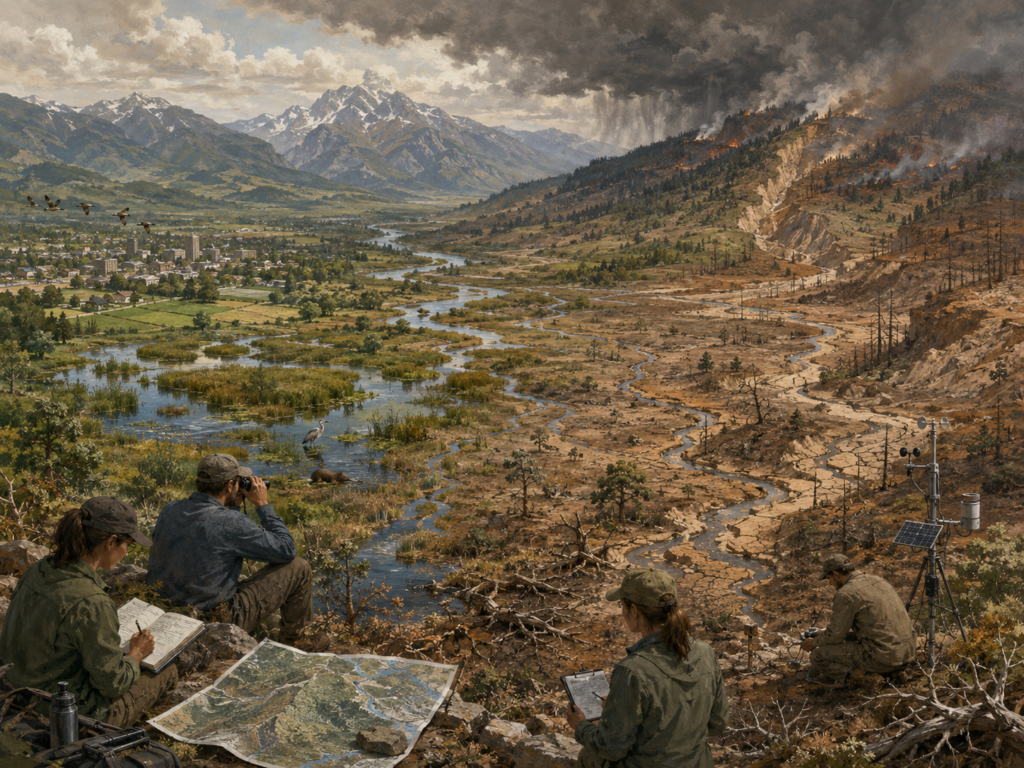
Panoramic ecological systems illustration of a watershed shifting from healthy wetlands and farms into drought, wildfire damage, erosion, degraded streams, and monitored warning conditions.

Regime Shifts and Early Warning Signals

Regime shifts and early warning signals explain how complex systems can move from apparent stability into different and persistent patterns of behavior. A lake may shift from clear water to algal dominance, a dryland from vegetation to erosion, a forest from regeneration to repeated fire vulnerability, or an institution from strained legitimacy to widespread distrust. These shifts are not simply temporary disturbances; they are changes in the feedbacks, structures, and relationships that maintain system behavior. This article examines how alternative regimes form, why degraded states can become self-reinforcing, and how early warning signals such as critical slowing down, rising variance, increasing autocorrelation, repeated near misses, spatial clustering, trust decline, and weakening recovery capacity can reveal hidden resilience loss before crisis becomes irreversible.

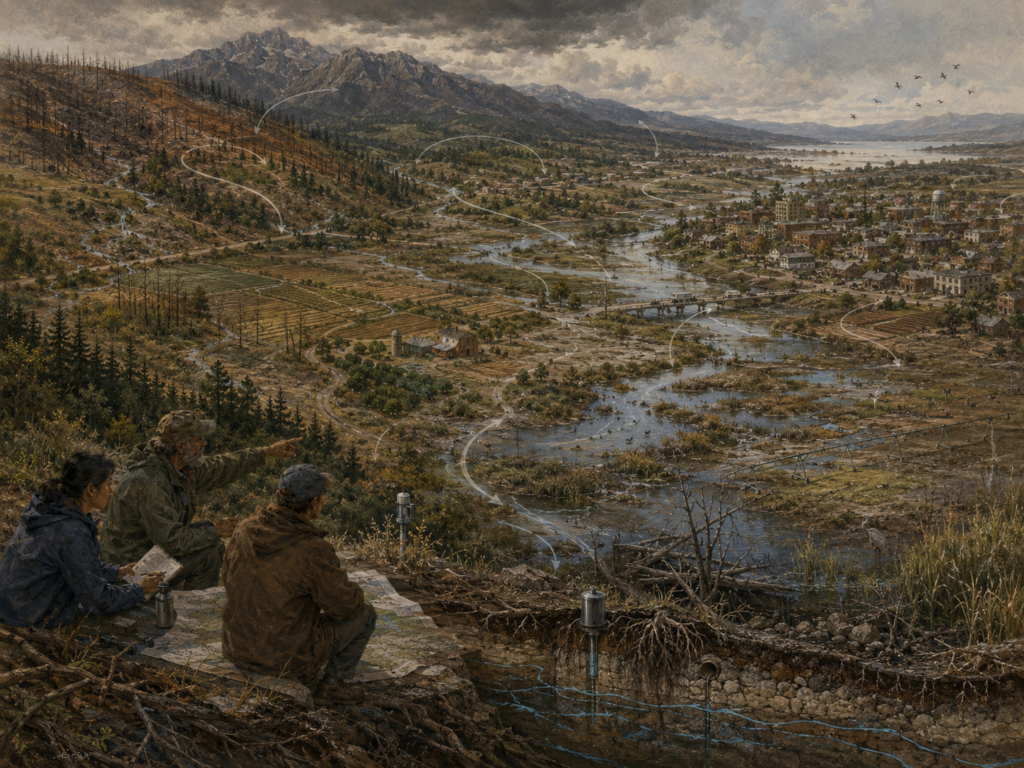
Panoramic systems illustration of a river valley where gradual hidden changes in soil, groundwater, vegetation, wetlands, farms, and infrastructure accumulate beneath visible landscape change.

Slow Variables and Hidden System Change

Slow variables are the hidden forces that change gradually but determine whether a system remains resilient, approaches a threshold, or reorganizes into a different regime. A forest may appear stable while soil moisture, fuel load, seed-bank viability, species composition, and drought stress quietly change underneath. A city may function while maintenance backlog, housing insecurity, public trust, heat exposure, and drainage capacity deteriorate. An institution may continue operating while legitimacy, staffing depth, professional memory, and compliance decline. This article examines why slow variables matter for resilience thinking, how hidden system change accumulates beneath visible events, and why fast shocks often become crises only after long periods of slow vulnerability. It connects ecological memory, infrastructure aging, institutional trust, climate pressure, public-health capacity, community resilience, threshold distance, justice, and monitoring into a practical framework for understanding resilience before crisis becomes undeniable.

Panoramic ecological illustration of a mountain watershed shaped by wildfire, storm patterns, regrowth, wetlands, wildlife, farms, and restoration work.

Landscape Resilience and Disturbance Regimes

Landscape resilience depends on how disturbance moves through space, how ecological memory survives across patches, and how landscape structure either absorbs, redirects, or amplifies change. A landscape is not simply a large ecosystem. It is a spatial mosaic of habitats, patches, edges, corridors, watersheds, soils, vegetation, species populations, human land uses, infrastructures, and disturbance histories. Its resilience depends on pattern as much as process: where forests, wetlands, grasslands, rivers, farms, roads, cities, refugia, and fire-prone zones are located, how they connect, and how disturbance spreads across them. This article explains how disturbance regimes shape landscape resilience through patch dynamics, spatial heterogeneity, connectivity, refugia, ecological memory, fire, flooding, drought, fragmentation, climate change, social vulnerability, and adaptive governance.

Panoramic ecological illustration of a biodiverse watershed with pollinators, birds, fish, amphibians, beavers, wetlands, forests, meadows, farms, and a recovering burned slope.

Biodiversity, Redundancy, and Ecological Function

Biodiversity, redundancy, and ecological function are central to resilience because living systems persist through disturbance not by relying on a single species, pathway, or mechanism, but through overlapping forms of life, function, response, memory, and repair. Biodiversity includes genetic diversity, species diversity, functional diversity, response diversity, habitat diversity, trophic diversity, microbial diversity, and the ecological relationships that allow systems to regulate, regenerate, adapt, and reorganize under changing conditions. This article explains why redundancy is not waste but ecological insurance, why functional diversity matters more than simple species counts, and why response diversity becomes essential under climate uncertainty. It connects biodiversity to ecosystem services, food webs, soil systems, genetic adaptation, landscape connectivity, disturbance recovery, governance, justice, and the practical modeling workflows needed to study ecological resilience responsibly.

Panoramic editorial illustration of a resilient watershed providing ecosystem services through forests, wetlands, clean water, farmland, wildlife, pollinators, and community stewardship.

Ecosystem Services and Resilience

Ecosystem services and resilience are inseparable because the benefits people receive from ecosystems depend on the ecological capacities that allow those systems to absorb disturbance, reorganize, and continue functioning over time. Food, water purification, pollination, flood regulation, carbon storage, soil formation, coastal protection, cultural meaning, recreation, biodiversity support, and climate regulation are not isolated outputs. They emerge from living systems shaped by species interactions, feedback loops, hydrology, disturbance regimes, ecological memory, and adaptive capacity. This article explains why ecosystem services cannot be managed as static goods, why service flows depend on ecological structure and function, and why resilience thinking is essential for understanding thresholds, tradeoffs, biodiversity, redundancy, governance, access, and justice. It connects ecosystem-service analysis to climate adaptation, urban planning, social-ecological systems, and long-term ecological stewardship.

Editorial illustration of a flood-prone river basin with wildfire, storm risk, infrastructure, wetlands, city systems, and planners coordinating risk governance.

Resilience Thinking and Risk Governance

Resilience thinking and risk governance meet where uncertainty, disturbance, institutional responsibility, and public consequence can no longer be managed by technical risk assessment alone. Risk governance asks how societies frame, assess, evaluate, manage, communicate, and review risks that affect public life. Resilience thinking asks whether exposed systems can absorb disturbance, adapt, avoid dangerous thresholds, and transform when existing arrangements are no longer viable. This article explains how the two frameworks work together across climate adaptation, disaster risk reduction, infrastructure, public health, supply chains, cybersecurity, ecosystems, and institutions. It shows why risk is shaped not only by hazards, but by exposure, vulnerability, capacity, trust, participation, coordination, and accountability. The article also examines systemic risk, cascading failure, justice, institutional legitimacy, and the governance conditions required for resilient public decision-making under uncertainty.

Wide editorial illustration of an interconnected watershed, city, farms, transit, energy systems, wetlands, and communities linked by feedback loops and adaptive pathways.

Resilience Thinking and Systems Thinking

Resilience thinking and systems thinking are closely connected, but they answer different questions. Systems thinking reveals how feedback loops, stocks, flows, delays, boundaries, incentives, mental models, and leverage points produce behavior over time. Resilience thinking asks whether that structure can absorb disturbance, preserve essential function, avoid dangerous thresholds, and adapt or transform when conditions change. This article explains how the two frameworks work together across ecosystems, infrastructure, public health, cities, institutions, supply chains, and climate adaptation. It shows why resilience cannot be understood through isolated components, recovery metrics, or motivational language alone. Real resilience depends on system structure: feedback visibility, adaptive capacity, redundancy, boundary clarity, threshold distance, learning, and accountability. The article also examines ethical cautions, showing why resilience must always ask: resilience of what, for whom, against what disturbance, and at whose cost, before intervention claims success too?

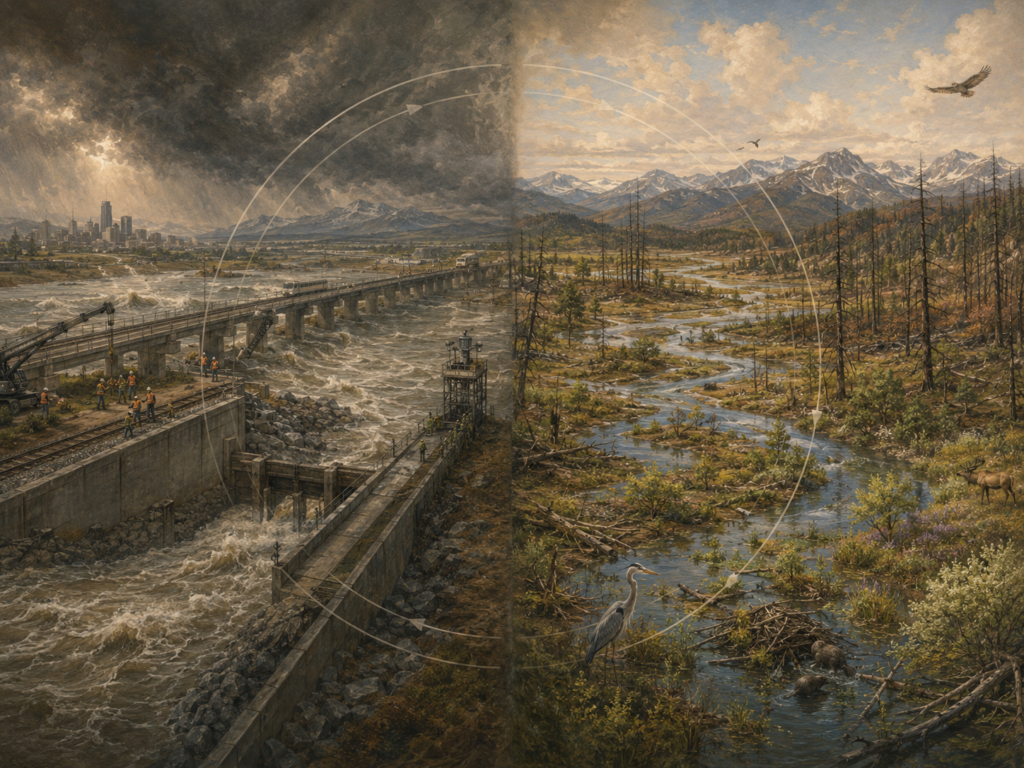
Editorial illustration comparing engineered flood infrastructure resisting storm pressure with a recovering wetland and forest ecosystem after disturbance.

Engineering Resilience and Ecological Resilience

Engineering resilience and ecological resilience describe two different ways systems respond to disturbance. Engineering resilience emphasizes return speed, reliability, repair capacity, and restoration of a defined operating state after disruption. Ecological resilience asks a deeper systems question: how much disturbance can a system absorb before it crosses a threshold into a different regime? This distinction matters for infrastructure, ecosystems, public health, supply chains, cities, and social-ecological systems. A bridge, hospital, or power grid may need rapid recovery and strict performance standards. A wetland, forest, community, or watershed may need diversity, adaptive capacity, ecological memory, and threshold monitoring. This article explains how recovery logic and threshold logic differ, why both are useful, and how confusing them can lead to fragile design, harmful restoration, or missed opportunities for adaptation and transformation.

Scroll to Top