
Last Updated June 1, 2026
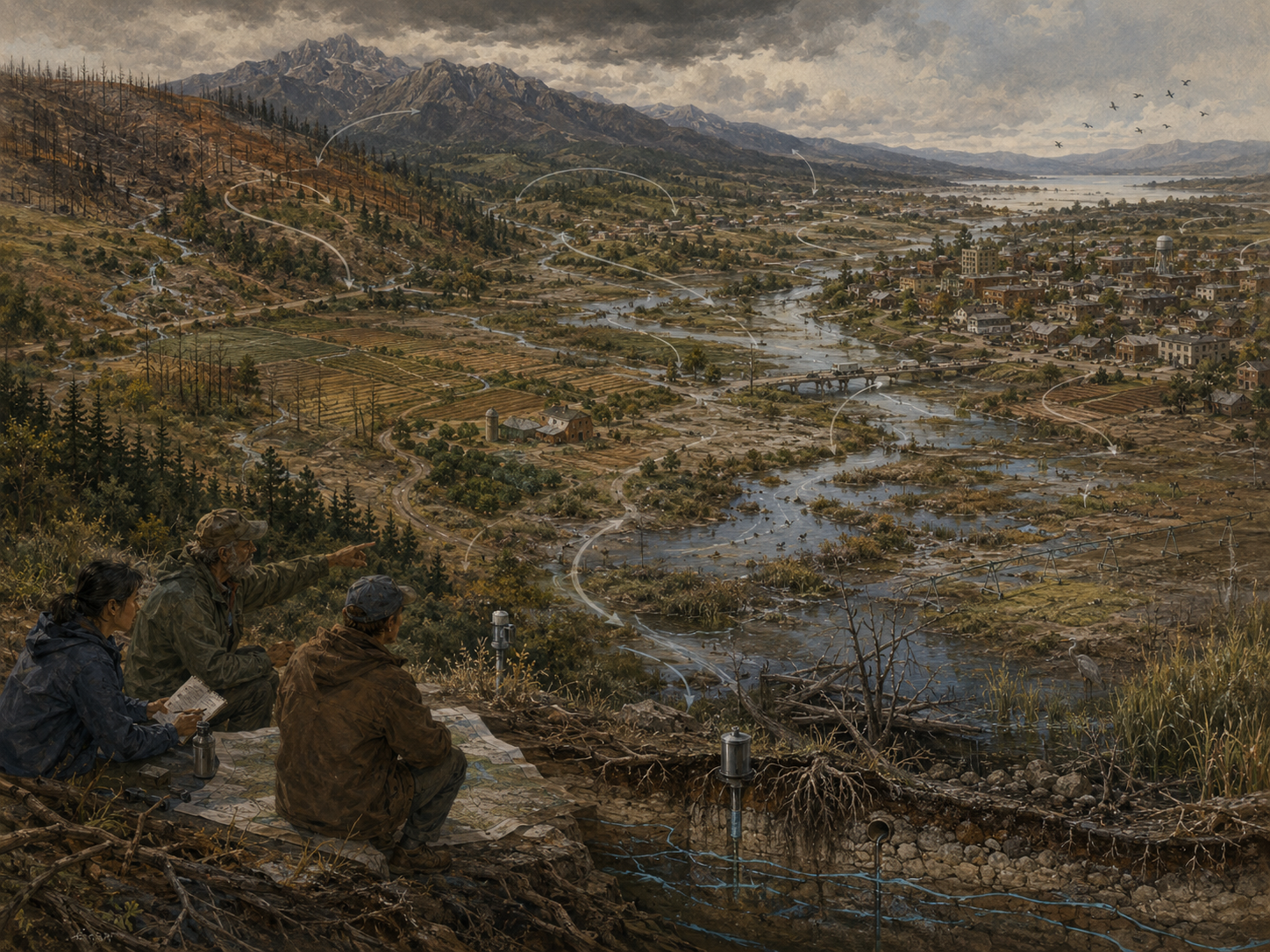
Slow variables are the hidden forces that change gradually but determine whether a system remains resilient, approaches a threshold, or reorganizes into a different regime. They are often difficult to see because they do not move at the speed of daily events. A forest may look stable while soil moisture, fuel load, seed-bank viability, species composition, and drought stress are changing underneath. A city may appear functional while maintenance backlog, housing insecurity, public trust, heat exposure, and drainage capacity quietly deteriorate. An institution may continue operating while legitimacy, staffing depth, professional memory, and compliance slowly decline.
In resilience thinking, slow variables matter because they shape the conditions under which fast events become consequential. A storm, fire, outage, disease outbreak, economic shock, or political scandal may look like the cause of crisis. But the deeper cause may be years of slow accumulation: deferred maintenance, biodiversity loss, groundwater depletion, debt, distrust, inequality, soil degradation, fuel buildup, infrastructure aging, public-health erosion, or climate pressure. The visible event is often only the trigger. The slow variable is what made the system vulnerable.
Slow variables also explain why resilience work must begin before crisis becomes obvious. Systems can function for long periods while resilience declines. Surface performance may remain stable because balancing feedbacks, reserves, institutions, or ecological buffers are still compensating. But if slow variables continue moving in the wrong direction, the system may eventually cross a threshold where recovery becomes difficult, costly, unjust, or impossible on relevant timescales.
This article examines how slow variables and hidden system change across ecology, climate adaptation, infrastructure, institutions, economics, public health, community resilience, and social-ecological systems. It explains the difference between fast and slow variables, why hidden change creates surprise, how slow variables interact with feedback loops and thresholds, how they can be measured, and why justice-centered resilience practice must ask whose slow-moving harms are ignored until they become crisis.
What Slow Variables Are
Slow variables are system conditions that change gradually but strongly influence long-term behavior, resilience, and threshold risk. They are called “slow” not because they are unimportant, but because their effects often unfold beneath the surface of visible events. They can accumulate, erode, deplete, intensify, or reorganize over months, years, decades, or generations.
Examples include soil fertility, groundwater depth, ecological memory, biodiversity, institutional trust, maintenance backlog, debt, inequality, public-health capacity, housing affordability, climate warming, fuel accumulation, species composition, administrative capacity, professional memory, neighborhood social cohesion, and legitimacy. These variables may not explain today’s headline event by themselves, but they shape whether tomorrow’s disturbance becomes manageable, damaging, or transformative.
Slow variables are central to resilience thinking because they often determine the system’s distance from a threshold. A system may look stable when fast variables are normal — rainfall, prices, service levels, hospital occupancy, daily traffic, or routine compliance. But slow variables may be moving the system closer to a boundary. When a fast shock arrives, the system’s response depends on the slow conditions already in place.
| Slow variable | System domain | Why it matters for resilience |
|---|---|---|
| Soil fertility | Ecology, agriculture, food systems | Determines whether vegetation and crops can recover after drought, erosion, or disturbance. |
| Groundwater level | Water systems, agriculture, urban planning | Shapes drought resilience, drinking-water security, and long-term ecological function. |
| Maintenance backlog | Infrastructure | Determines whether storms, heat, load, or outages remain local failures or become systemic crises. |
| Institutional trust | Governance, public health, emergency response | Shapes compliance, cooperation, legitimacy, communication, and recovery capacity. |
| Biodiversity | Ecology, social-ecological systems | Supports redundancy, response diversity, ecological memory, and recovery pathways. |
| Household insecurity | Economics, community resilience, public health | Determines whether a shock becomes a temporary hardship or a cascading crisis. |
| Climate warming | Earth systems, infrastructure, public health | Changes the baseline conditions under which all other disturbances occur. |
A slow variable can be easy to ignore precisely because it changes gradually. But gradual change is often the most powerful form of system change.
Why Hidden System Change Matters
Hidden system change matters because systems often fail suddenly only after changing slowly for a long time. The crisis is visible, but the preparation for crisis is often hidden. A lake shifts after years of nutrient accumulation. A forest burns severely after years of fuel buildup and drought stress. A city floods after decades of wetland loss, impervious surface expansion, drainage neglect, and climate-intensified rainfall. A public institution loses legitimacy after years of unequal treatment, opacity, underperformance, and dismissed warnings.
This produces a dangerous illusion. As long as the system continues performing, decision-makers may assume that risk is under control. But visible performance can be maintained by depleting hidden reserves. A hospital can function while staff burnout rises. A bridge can carry traffic while structural deterioration advances. A community can endure repeated disaster while savings, trust, health, and social networks are depleted. An ecosystem can appear intact while regeneration capacity declines.
Slow variables therefore help explain “surprise.” Many system failures are not truly surprising from the standpoint of structure. They are surprising only because the indicators being watched were too fast, too narrow, too convenient, or too disconnected from the deeper state of the system.
What hidden system change reveals
Surface stability can mislead
Routine performance may continue while soil, trust, infrastructure, biodiversity, or public capacity declines beneath the surface.
Crises often have long histories
Fast shocks become disasters when slow variables have already reduced buffers and response space.
Prevention depends on slow signals
Waiting for visible crisis often means waiting until options are narrower, costs are higher, and recovery is harder.
Governance must see below events
Resilience planning must monitor underlying conditions, not only emergency outcomes or short-term indicators.
Hidden change is not invisible because it cannot be measured. It is often invisible because institutions are not organized to value the signals early enough.
Fast Variables vs. Slow Variables
Fast variables change quickly and are often easy to observe. They include daily rainfall, market prices, traffic flow, emergency calls, hospital admissions, outage reports, water turbidity, wildfire ignition, or social-media attention. Slow variables change more gradually: groundwater depletion, climate warming, infrastructure aging, trust erosion, soil degradation, fuel accumulation, public-health capacity, biodiversity loss, and debt.
Fast variables often get more attention because they are visible, urgent, and politically salient. Slow variables often get less attention because they require long-term monitoring, historical context, and institutional memory. Yet slow variables frequently govern the meaning of fast variables. The same rainfall event can be manageable or catastrophic depending on soil saturation, drainage capacity, wetland loss, housing vulnerability, and maintenance backlog. The same disease outbreak can be contained or devastating depending on trust, surveillance, staffing, health access, and communication systems.
| Fast variable | Slow variable shaping its effect | Why the distinction matters |
|---|---|---|
| Storm rainfall | Wetland loss, impervious surface, drainage capacity, housing exposure | The hazard becomes disaster when slow conditions reduce absorption and response. |
| Wildfire ignition | Fuel accumulation, drought stress, forest structure, land-use patterns | The ignition is fast; severity often reflects slow ecological and planning variables. |
| Hospital surge | Workforce capacity, public trust, chronic disease burden, supply redundancy | Daily case counts matter, but system resilience depends on deeper capacity. |
| Price spike | Debt, household savings, supply concentration, labor precarity | Economic shocks cascade when slow financial insecurity has already accumulated. |
| Public protest | Legitimacy, inequality, historical grievance, institutional trust | The visible event may express a long buildup of ignored feedback. |
Fast variables tell us what is happening now. Slow variables tell us why the system is vulnerable to what happens now.
Stocks, Flows, and Accumulation
Slow variables are often stocks: accumulations that change through inflows and outflows. Soil organic matter accumulates through vegetation, decomposition, and management, and declines through erosion, disturbance, and extraction. Trust accumulates through reliable performance and fair treatment, and declines through betrayal, neglect, opacity, and unequal outcomes. Maintenance backlog accumulates when repair needs exceed repair investment. Debt accumulates when obligations grow faster than income or public capacity.
Thinking in stocks and flows is useful because it prevents a common error: focusing only on current rates. A system can have a small annual loss that becomes severe over decades. A city can defer maintenance in small increments until backlog becomes structural. A watershed can lose wetlands parcel by parcel until flood behavior changes. A community can absorb repeated small shocks until savings, health, and social trust are depleted.
Accumulation also explains why slow variables are politically difficult. The effects may not be visible within one budget cycle, election cycle, grant cycle, quarterly report, or emergency response window. By the time accumulation becomes obvious, responsibility is diffused across many decisions and many years.
Slow variables as accumulated stocks
Maintenance backlog
Repair needs accumulate when infrastructure ages faster than budgets, staffing, and planning systems can respond.
Ecological memory
Seed banks, soil biota, refugia, species traits, and surviving organisms store recovery capacity across time.
Public trust
Trust accumulates through fair, reliable, transparent performance and depletes through repeated institutional failure.
Household security
Savings, health, income stability, housing security, and social support determine shock-absorption capacity.
Slow variables are where systems remember the past. They are also where systems quietly prepare the future.
Slow Variables and Thresholds
Slow variables often determine threshold distance: how close a system is to a boundary beyond which it may reorganize into a different regime. A lake may approach a nutrient threshold as phosphorus accumulates. A dryland may approach a degradation threshold as vegetation cover and soil structure decline. A city may approach a flood threshold as development, drainage limits, and rainfall intensity change. An institution may approach a legitimacy threshold as trust and capacity erode.
This relationship is central to resilience thinking. Thresholds are not usually crossed because of one fast event alone. They are crossed when slow variables have moved the system close enough to a boundary that a fast event can push it over. The tipping event is visible, but the slow movement toward the tipping point may be the deeper resilience story.
Slow variables also shape hysteresis. If a system crosses a threshold, returning may require rebuilding slow variables that took years or decades to form: soil structure, trust, biodiversity, maintenance capacity, public-health workforce, local knowledge, or institutional legitimacy. Reversal is not simply a matter of removing the last shock.
| System | Slow variable | Potential threshold | Why recovery may be difficult |
|---|---|---|---|
| Shallow lake | Nutrient accumulation, sediment phosphorus, aquatic vegetation loss | Clear-water regime shifts to turbid algal dominance | Algal feedbacks and sediment recycling can stabilize the degraded state. |
| Dryland | Vegetation cover, soil structure, infiltration, erosion | Vegetated system shifts toward desertified conditions | Soil loss and water-runoff feedbacks can limit regrowth. |
| Forest | Fuel load, drought stress, seed sources, species composition | Forest regeneration fails after severe fire | Climate, soil, and seed limitations may block return to prior forest structure. |
| Institution | Trust, legitimacy, staffing, public cooperation | Formal authority loses practical legitimacy | Trust may require years of accountable performance to rebuild. |
| Infrastructure system | Maintenance backlog, redundancy, capacity margin, asset age | Localized failure becomes cascading service breakdown | Repair may require capital, planning, workforce, and redesign, not just emergency fixes. |
Thresholds often appear sudden because slow variables made them possible long before the crossing became visible.
Feedback Loops, Delays, and Hidden Change
Slow variables interact with feedback loops and delays. Feedback loops determine how slow variables accumulate or recover. Delays determine when the effects of that accumulation become visible. Together, they explain why systems can drift toward danger while appearing stable.
For example, deferred maintenance may not cause immediate failure. The feedback is delayed. Roads, pipes, bridges, drainage systems, and electrical equipment may keep operating while the hidden stock of risk grows. Eventually a storm, heat wave, freeze, or load spike reveals the accumulated weakness. Similarly, trust erosion may not immediately stop institutional function. People may comply out of habit, necessity, or lack of alternatives. But once distrust crosses a threshold, cooperation can drop quickly.
Delayed feedback can also weaken accountability. If harm appears years after decisions were made, the causal chain becomes easier to deny. The people who benefited from short-term extraction, deferral, or neglect may no longer be responsible when consequences arrive. This is why slow-variable governance must include memory, transparency, and long-term accountability.
How delays hide slow-variable risk
Late symptoms
Damage may appear only after buffers are depleted, making the system seem healthier than it is.
Diffused responsibility
When consequences arrive years later, institutions may treat predictable harm as surprise.
Overshoot
Systems can continue extracting, building, emitting, borrowing, or deferring repair after safe limits have already been passed.
Delayed learning
Slow feedback can prevent timely correction unless monitoring systems make hidden change visible earlier.
Feedback delays do not make slow variables less important. They make them more dangerous.
Ecological Slow Variables
Ecological systems are shaped by slow variables such as soil fertility, groundwater, nutrient stores, species composition, seed banks, habitat connectivity, ecological memory, landscape fragmentation, fire regimes, invasive species pressure, and climate stress. These variables determine whether ecosystems can absorb disturbance, recover function, and avoid regime shifts.
Ecological slow variables matter because ecosystems can appear healthy while recovery capacity is declining. A forest may still have canopy cover while seedling recruitment is failing. A grassland may still appear productive while soil structure is eroding. A wetland may still hold water while sediment supply, salinity, or migration space is disappearing. A reef may still contain coral structure while warming, acidification, pollution, and herbivore loss reduce recovery pathways.
Many ecological thresholds are governed by slow variables. Fire behavior is shaped by fuel accumulation and vegetation structure. Eutrophication is shaped by nutrient stores and sediment feedbacks. Desertification is shaped by vegetation cover, infiltration, and soil loss. Biodiversity decline reduces redundancy and response diversity before collapse becomes obvious.
| Ecological slow variable | What it controls | Resilience warning sign |
|---|---|---|
| Soil organic matter | Water retention, fertility, microbial life, erosion resistance | Declining infiltration, lower productivity, dust, erosion, reduced recovery after drought. |
| Groundwater | Baseflow, drought resilience, agriculture, wetlands, drinking water | Falling wells, stream drying, land subsidence, ecosystem stress. |
| Seed banks and refugia | Post-disturbance regeneration | Weak recruitment, loss of source populations, poor recovery after fire or flood. |
| Species composition | Food webs, disturbance response, functional redundancy | Dominance by invasive, opportunistic, or disturbance-adapted species. |
| Habitat connectivity | Movement, recolonization, gene flow, landscape recovery | Fragmentation, isolated populations, reduced dispersal and migration options. |
| Fuel load | Fire intensity, spread, and severity | Increasing continuity of combustible material under hotter and drier conditions. |
Ecological resilience depends on protecting the slow conditions that allow ecosystems to recover after fast disturbances.
Climate Slow Variables
Climate change is one of the largest slow-variable transformations affecting resilience. It changes baseline conditions: temperature, ocean heat content, sea level, ice volume, soil moisture, drought frequency, precipitation intensity, wildfire weather, pest ranges, and ecosystem stress. These variables may change gradually, but they alter the meaning of every fast event.
A heat wave under a warmer baseline is not the same as a heat wave in the past. A storm falling on a more urbanized, wetter, or more intensely developed watershed has different consequences. A drought affecting depleted groundwater and stressed vegetation is more dangerous than the same rainfall deficit in a system with stronger buffers. Climate slow variables change the background against which all hazards operate.
Climate slow variables are also difficult because they interact with infrastructure, governance, housing, public health, insurance, agriculture, migration, and ecological thresholds. A drainage system designed for historical rainfall may become inadequate. A forest adapted to past fire and moisture regimes may face regeneration failure. A public-health system designed around past heat patterns may face new morbidity and mortality risks.
Climate slow variables that reshape resilience
Rising baseline heat
Higher average temperatures make heat waves more dangerous and increase stress on health, energy, labor, and ecosystems.
Ocean heat and sea level
Slow ocean change can intensify coastal flooding, storm surge, erosion, and saltwater intrusion.
Soil moisture decline
Drying soils change drought response, crop resilience, vegetation stress, and wildfire behavior.
Changing disturbance regimes
Fire, flood, drought, pest, and disease patterns shift as background climate conditions change.
Climate adaptation must therefore manage slow variables, not only respond to disasters after they occur.
Infrastructure Slow Variables
Infrastructure systems are deeply shaped by slow variables: asset age, maintenance backlog, design assumptions, redundancy, modularity, workforce capacity, spare parts, funding stability, interdependency, demand growth, and climate exposure. These variables determine whether infrastructure can continue providing essential services under stress.
Infrastructure failure often appears sudden, but it is frequently prepared by slow deterioration. A bridge collapse, stormwater failure, power outage, water-main break, or transit disruption may be triggered by one event, but the system’s vulnerability may reflect years of deferred repair, underinvestment, outdated design standards, and increasing loads.
Infrastructure slow variables are especially important because systems are interconnected. Deferred maintenance in one sector can affect others. Power supports water, hospitals, communications, finance, transit, and emergency response. Transportation supports labor and supply chains. Digital infrastructure supports coordination. When slow variables reduce buffers across connected systems, a fast disturbance can cascade.
| Infrastructure slow variable | Hidden risk created | Resilience practice |
|---|---|---|
| Maintenance backlog | Assets continue operating while failure probability rises | Track backlog by criticality, equity, climate exposure, and service dependency. |
| Outdated design standards | Systems are built for historical conditions no longer reliable | Update standards using forward-looking climate, demand, and risk scenarios. |
| Low redundancy | Single failures become service-wide disruptions | Build backup pathways, modularity, distributed capacity, and contingency plans. |
| Workforce depletion | Repair and operations capacity erodes before assets fail | Protect skilled labor, training pipelines, institutional memory, and staffing depth. |
| Interdependency growth | Systems become efficient but tightly coupled | Map dependencies, test cascading failure, and preserve emergency isolation capacity. |
Infrastructure resilience depends on seeing decline before the asset fails and before one failure becomes many.
Institutional Slow Variables
Institutions have slow variables too. Trust, legitimacy, administrative capacity, staffing depth, professional memory, legal flexibility, accountability, public participation, fiscal reserves, coordination routines, and compliance are all slow-moving conditions that determine whether institutions can respond to disturbance.
Institutional decline can be hidden by formal continuity. Offices remain open. Procedures continue. Reports are filed. Meetings are held. Rules exist. But the institution may be losing the capacity that makes those procedures meaningful. Staff may be burned out. Public trust may be low. Data may be ignored. Communities may no longer believe consultation is genuine. Internal warnings may be suppressed. Institutional memory may be lost through turnover.
When crisis arrives, these slow variables become visible. A public-health agency with weak trust may struggle to communicate. A disaster agency with thin staffing may fail to coordinate. A regulator with low legitimacy may face noncompliance. A city with weak administrative capacity may not be able to deploy funds effectively. The crisis reveals institutional slow change that was already underway.
Institutional slow variables
Trust
Built through consistent, fair, transparent performance; depleted through neglect, unequal treatment, and broken promises.
Administrative capacity
Staffing, expertise, procurement, coordination, data systems, and implementation routines determine response ability.
Institutional memory
Records, experienced personnel, after-action reviews, and professional norms preserve lessons across crises.
Legitimacy
Formal authority becomes resilient only when people believe institutions are accountable, fair, and competent.
Institutional resilience is slow to build and quick to damage. That is why legitimacy is a resilience variable, not merely a political preference.
Economic and Supply-Chain Slow Variables
Economic resilience is shaped by slow variables such as debt, savings, income stability, labor protections, household security, production diversity, supplier concentration, inventory practices, regional capacity, public investment, infrastructure quality, and ecological dependence. These variables determine whether shocks are absorbed or cascaded downward.
A price spike, supply disruption, recession, crop failure, or job loss may be fast. But its effects depend on slow economic structure. Households with savings, stable housing, healthcare access, and social support experience shocks differently from households already near crisis. Regions with diversified industries respond differently from regions dependent on one employer or one export. Supply chains with redundancy respond differently from supply chains optimized around narrow efficiency.
Slow economic variables also reveal who is being asked to absorb risk. A firm may appear resilient because it preserves profit by cutting labor, shifting costs, or relying on precarious suppliers. But that resilience may be achieved by reducing household, worker, community, or ecological resilience. A systems view must ask where the shock goes.
| Economic slow variable | Hidden system change | Resilience concern |
|---|---|---|
| Household debt | Obligations accumulate before crisis | Small income shocks can trigger housing, health, and financial cascades. |
| Supplier concentration | Efficiency increases while redundancy declines | One disruption can interrupt many downstream functions. |
| Labor precarity | Workers absorb volatility without buffers | Economic recovery may hide household and community fragility. |
| Regional specialization | Local economy depends on a narrow base | Sector-specific shocks can produce long-term decline. |
| Inventory depletion | Lean systems reduce slack | Disruption becomes shortage faster when buffers are absent. |
Economic resilience is not only whether aggregate output returns. It is whether the system preserves security, capacity, dignity, and future options across the whole system.
Public Health and Community Slow Variables
Public health and community resilience are shaped by slow variables that accumulate long before emergency. Chronic disease burden, healthcare access, workforce capacity, trust, housing stability, social networks, food security, environmental exposure, communication infrastructure, public-health funding, and institutional coordination determine whether a fast shock becomes a manageable event or a widespread crisis.
The COVID-19 pandemic made this visible. Technical capacity mattered, but so did trust, misinformation, workforce protection, supply chains, housing, paid leave, racial and economic inequality, chronic disease, public communication, and institutional coordination. Many of these were slow variables, not sudden conditions.
Community resilience also depends on slow social infrastructure: mutual aid networks, civic organizations, local leadership, cultural memory, neighborhood trust, public spaces, schools, libraries, clinics, faith communities, local knowledge, and communication channels. These are not decorative social assets. They are resilience infrastructure.
Public-health and community slow variables
Health burden
Chronic disease, environmental exposure, stress, and unequal care access shape vulnerability before a crisis begins.
Workforce capacity
Staffing depth, burnout, training, protection, and retention determine surge resilience.
Community trust
Trusted communication and legitimate institutions determine whether warnings and guidance are actionable.
Social infrastructure
Mutual aid, civic networks, local leadership, and shared memory help communities coordinate under stress.
Public-health resilience is built in the years before emergency. It cannot be manufactured instantly when crisis arrives.
Slow Variables in Social-Ecological Systems
Social-ecological systems combine ecological and social slow variables. A fishery is shaped by fish populations, habitat, market pressure, local knowledge, regulation, enforcement, livelihoods, fuel costs, climate conditions, and cultural practice. A watershed is shaped by land use, hydrology, soil, water rights, governance, infrastructure, agricultural practice, wetlands, forests, and climate pressure. A fire-prone landscape is shaped by vegetation, fuel, housing patterns, suppression policy, Indigenous fire stewardship, insurance, drought, and governance.
These systems are difficult because slow variables operate across scales. A local community may manage land carefully but still face regional climate shifts or national market pressures. A city may improve stormwater management but remain vulnerable if upstream land use, watershed hydrology, and regional rainfall patterns shift. A fishery may be managed locally but affected by ocean warming, global demand, and habitat decline.
Slow-variable analysis helps reveal scale mismatch. The system may be governed at one scale while slow variables move at another. Resilience practice must therefore align ecological processes, institutional authority, funding, monitoring, and public participation with the scales at which slow variables actually operate.
| Social-ecological system | Slow variables | Scale challenge |
|---|---|---|
| Fishery | Stock structure, habitat quality, market pressure, local knowledge, enforcement legitimacy | Local harvest decisions interact with regional ecology and global demand. |
| Watershed | Groundwater, land use, wetlands, forest cover, water law, infrastructure, climate | Hydrological boundaries rarely match political boundaries. |
| Fire landscape | Fuel load, vegetation structure, drought, housing patterns, suppression policy, cultural fire knowledge | Parcel-level decisions interact with landscape-scale fire behavior. |
| Urban heat system | Tree canopy, housing quality, pavement, energy burden, health inequity, social isolation | Neighborhood exposure is shaped by citywide planning and regional climate. |
Social-ecological resilience depends on governing slow variables across the scales where they accumulate and interact.
Early Warning, Monitoring, and Signal Quality
Slow variables require monitoring systems that can detect hidden change before crisis. This includes ecological monitoring, infrastructure condition assessment, public-health surveillance, institutional trust measures, workforce indicators, household vulnerability data, environmental justice mapping, climate trends, and community reporting.
But monitoring is not enough. Signals must be meaningful, trusted, interpretable, and connected to authority. A system may collect data without acting. It may monitor the wrong variables. It may ignore local knowledge. It may suppress inconvenient findings. It may produce reports that do not change budgets, rules, design standards, maintenance priorities, or public accountability.
Early warning is strongest when quantitative data, qualitative evidence, local knowledge, professional judgment, and historical context reinforce one another. Rising variance or slower recovery may matter in some systems. Repeated near misses may matter in infrastructure. Declining trust and staffing may matter in institutions. Weak recruitment may matter in ecosystems. The correct signal depends on the system.
Good slow-variable monitoring asks
What is changing slowly?
Identify variables that alter threshold distance, recovery capacity, adaptive options, and future disturbance response.
Who notices first?
Workers, residents, Indigenous communities, local practitioners, and frontline staff often detect slow change before official metrics do.
Can the signal change action?
Monitoring matters only if it affects decisions, budgets, rules, maintenance, protection, or public accountability.
What uncertainty remains?
Slow-variable monitoring should support precaution without pretending to provide perfect prediction.
Signal quality is a resilience issue. A system that cannot hear slow change cannot govern it.
Slow Variables and Adaptive Capacity
Adaptive capacity is itself shaped by slow variables. Learning systems, trust, diversity, redundancy, public capacity, financial reserves, institutional memory, ecological memory, social networks, and governance flexibility all develop over time. They cannot be created instantly once crisis begins.
This is why slow-variable management is central to adaptive capacity. A system with strong adaptive capacity has more response space. It can detect change earlier, revise rules, mobilize resources, protect vulnerable groups, coordinate across scales, and preserve essential function. A system with weak adaptive capacity may drift toward thresholds while lacking the means to change course.
Adaptive capacity also depends on maintaining options. Slow variables can either preserve or close future pathways. Biodiversity preserves ecological options. Local knowledge preserves practical options. Maintenance preserves infrastructure options. Trust preserves governance options. Savings and public investment preserve economic options. When these variables decline, the system may still operate, but its future choices narrow.
| Adaptive-capacity slow variable | How it preserves response space | How decline narrows options |
|---|---|---|
| Diversity | Provides multiple pathways for response and recovery | System becomes dependent on fewer species, suppliers, institutions, or strategies. |
| Redundancy | Provides backup when one function fails | Small failures become systemic because no substitute pathway exists. |
| Trust | Supports cooperation, communication, and difficult decisions | Warnings are ignored and coordination becomes harder. |
| Institutional memory | Preserves lessons from past disturbance | Organizations repeat mistakes and lose context. |
| Financial reserves | Buy time during stress | Every disturbance becomes a fiscal or household crisis. |
| Ecological memory | Supports regeneration after disturbance | Recovery pathways weaken or disappear. |
Adaptive capacity is accumulated resilience. It is built through slow investment, slow learning, and slow trust.
Why Slow Variables Are Hard to Govern
Slow variables are hard to govern because they do not match the time horizon of many institutions. Budgets are annual. Elections are periodic. Markets report quarterly. Emergency systems focus on immediate events. Media attention follows visible crisis. Slow variables require long-term monitoring, maintenance, prevention, and stewardship — all of which are easy to postpone.
Slow variables also create accountability problems. The people who benefit from deferral may not be the people who suffer the consequences. A government can defer maintenance to balance a budget. A company can externalize ecological cost. A landlord can underinvest in housing. A society can emit carbon while future generations face the consequences. Slow harm often travels across time, geography, class, race, and political power.
Governance systems also struggle because slow variables rarely produce one clear emergency moment. They produce gradients, warning signs, uncertainty, and contested interpretation. This makes denial and delay easier. Decision-makers can claim that more data are needed while response space disappears.
Why slow-variable governance fails
Short-term incentives
Political and financial systems often reward visible outputs and delay investment in hidden resilience.
Unclear ownership
Slow variables often cross agencies, sectors, jurisdictions, ecosystems, and generations.
Delayed consequences
Harm appears later, making responsibility easier to deny and prevention harder to justify.
Unequal voice
Those who notice slow harm first often have the least power to force institutional response.
Governing slow variables requires institutions that can value prevention before crisis validates the warning.
Justice, Power, and Slow Violence
Slow variables are inseparable from justice because slow harm is often distributed unequally. Pollution exposure, heat risk, housing insecurity, infrastructure neglect, food insecurity, chronic disease, ecological degradation, debt, and public disinvestment can accumulate for years in marginalized communities before being treated as emergencies. The crisis appears sudden only to those who were not listening.
Slow violence is harm that occurs gradually and often invisibly, making it easier for institutions to ignore. In resilience work, this matters because “resilience” can become a harmful word if it praises communities for enduring slow abandonment. A community that survives repeated flooding, pollution, or economic disinvestment is not simply resilient. It may be absorbing risk that should have been prevented, repaired, or redistributed.
Justice-centered slow-variable analysis asks who experiences hidden change first, whose data are collected, whose warnings are believed, who benefits from delay, who has adaptive capacity, and who controls reorganization after crisis. It also asks whether slow variables preserve injustice. Property regimes, zoning, infrastructure investment, policing, environmental permitting, lending, and healthcare access can all accumulate unequal resilience over time.
| Justice question | Why it matters for slow variables | Example |
|---|---|---|
| Who is exposed first? | Slow harm often accumulates in places with less political power | Heat islands, pollution corridors, flood-prone housing, disinvested infrastructure. |
| Whose warnings count? | Local knowledge may be dismissed until official systems confirm harm too late | Residents reporting odors, flooding, illness, unsafe housing, or infrastructure decline. |
| Who benefits from delay? | Slow variables can allow powerful actors to profit while costs accumulate elsewhere | Deferred maintenance, extractive land use, pollution, low-wage risk transfer. |
| Who has adaptive capacity? | Response space is unequal | Savings, mobility, insurance, healthcare, political voice, legal protection. |
| Who controls recovery? | After crisis, reorganization can repair harm or reproduce displacement | Post-disaster redevelopment, managed retreat, infrastructure rebuilding, land acquisition. |
Slow-variable governance must be justice-centered because the slowest harms are often the easiest for powerful systems to normalize.
Measurement and Indicators
Measuring slow variables requires choosing indicators that reveal underlying system condition, not only immediate outcomes. A good indicator framework asks: What slow variables determine resilience? What direction are they moving? How close are they to thresholds? Who is affected first? How reliable are the data? What uncertainty remains? What decision will the indicator inform?
Measurement should combine multiple forms of evidence. Ecological data may include soil, groundwater, biodiversity, recruitment, habitat connectivity, and disturbance history. Infrastructure data may include asset age, maintenance backlog, failure history, redundancy, and interdependency. Institutional data may include trust, staffing, compliance, complaints, turnover, response time, and public participation. Community data may include housing security, health burden, social networks, savings, food access, and local knowledge.
Slow-variable indicators must also be interpreted carefully. A single number can hide distribution. Average citywide tree canopy can hide neighborhood heat exposure. Average income can hide household insecurity. Average water availability can hide local depletion. Average trust can hide deep distrust among groups harmed by past institutions.
| Measurement focus | Possible indicators | Interpretive caution |
|---|---|---|
| Ecological condition | Soil organic matter, groundwater, biodiversity, recruitment, habitat connectivity | Short-term productivity may hide long-term recovery decline. |
| Threshold distance | Pressure relative to known or modeled boundary, safety margin, recovery rate | Exact thresholds are often uncertain; use precautionary ranges. |
| Infrastructure condition | Asset age, maintenance backlog, failure frequency, spare capacity, dependency maps | Condition ratings may miss cascading failure across interdependent systems. |
| Institutional resilience | Trust, legitimacy, staffing, compliance, transparency, response time, learning routines | Formal procedures may hide declining practical legitimacy. |
| Community resilience | Housing security, health burden, savings, social networks, access to services | Community endurance should not be mistaken for adequate public support. |
| Justice exposure | Disaggregated heat, flood, pollution, health, infrastructure, and economic risk | Averages can erase marginalized groups and localized slow harm. |
Slow-variable measurement should make hidden change visible enough to act on, not merely visible enough to document after failure.
Management Principles
Managing slow variables means governing the conditions that create future resilience. It requires monitoring underlying system state, protecting buffers, reducing pressure before thresholds are crossed, preserving memory, funding maintenance, building trust, and acting even when crisis has not yet made risk undeniable.
Principles for slow-variable resilience practice
Track what changes slowly
Monitor soil, water, trust, capacity, debt, maintenance, biodiversity, health, exposure, and public legitimacy over time.
Protect buffers before crisis
Maintain redundancy, reserves, ecological memory, social networks, fiscal capacity, and infrastructure margins.
Use precautionary thresholds
When exact boundaries are uncertain, manage with safety margins rather than waiting for proof at the edge.
Connect monitoring to authority
Indicators must influence budgets, rules, design standards, maintenance, public health, and emergency planning.
Preserve institutional memory
Turn slow lessons into records, routines, staffing, training, review, and public accountability.
Listen to local knowledge
Residents, workers, Indigenous communities, practitioners, and frontline staff often detect slow change early.
Avoid risk transfer
Do not preserve system performance by shifting slow harm onto marginalized communities, workers, ecosystems, or future generations.
Plan for transformation
When slow variables show that restoration is no longer viable, create just pathways for deliberate transition.
Slow-variable management is the discipline of acting before the system makes delay impossible.
Mathematical Lens: Slow Accumulation, Threshold Distance, and Hidden Risk
Slow variables can be represented as stocks that change gradually through inflows and outflows:
S_{t+1} = S_t + I_t – O_t
\]
Interpretation: \(S_t\) is the slow variable stock at time \(t\), \(I_t\) is inflow, and \(O_t\) is outflow. Soil fertility, trust, maintenance backlog, groundwater, debt, biodiversity, and institutional memory can all be modeled as accumulated stocks.
Threshold distance can be represented as the gap between a critical boundary and the current slow-variable state:
D_t = T – S_t
\]
Interpretation: \(D_t\) is threshold distance, \(T\) is a critical threshold, and \(S_t\) is the slow variable. When \(D_t\) shrinks, the system has less margin before crossing into a different regime.
When multiple slow variables interact, hidden system risk can be represented as a weighted index:
H_t = w_1P_t + w_2F_t + w_3D_t^{-1} – w_4A_t – w_5M_t
\]
Interpretation: \(H_t\) is hidden system risk, \(P_t\) is pressure, \(F_t\) is reinforcing feedback strength, \(D_t^{-1}\) represents declining threshold distance, \(A_t\) is adaptive capacity, and \(M_t\) is system memory. Risk rises when pressure and feedback increase while threshold distance, adaptive capacity, and memory decline.
Slow recovery can also be represented by a gradual rebuilding process:
S_{t+1} = S_t + r(K – S_t)
\]
Interpretation: \(K\) is a desired stock level and \(r\) is the recovery rate. When \(r\) is small, rebuilding slow variables such as trust, soil fertility, ecological memory, or infrastructure capacity can take many periods.
These equations are simplified, but they clarify a central resilience lesson: slow variables shape future vulnerability long before fast events reveal it.
Advanced R Workflow: Modeling Slow Variables and Threshold Distance
The R workflow below simulates slow-variable accumulation, threshold distance, hidden risk, and a fast shock interacting with hidden conditions. It is designed as a transparent modeling scaffold rather than a literal prediction model.
# Install packages if needed.
# install.packages(c("tidyverse"))

library(tidyverse)

# ------------------------------------------------------------
# R Workflow:
# Slow Variables, Hidden System Change, and Threshold Distance
#
# Purpose:
#   Simulate how slow changes in maintenance backlog,
#   public trust, ecological memory, and climate pressure alter
#   threshold distance before a visible shock occurs.
# ------------------------------------------------------------

time_steps <- 1:120

slow_df <- tibble(
  time = time_steps,
  maintenance_backlog = numeric(length(time_steps)),
  public_trust = numeric(length(time_steps)),
  ecological_memory = numeric(length(time_steps)),
  climate_pressure = numeric(length(time_steps)),
  adaptive_capacity = numeric(length(time_steps)),
  threshold_distance = numeric(length(time_steps)),
  hidden_risk = numeric(length(time_steps)),
  fast_shock = numeric(length(time_steps)),
  system_function = numeric(length(time_steps))
)

slow_df$maintenance_backlog[1] <- 0.25
slow_df$public_trust[1] <- 0.72
slow_df$ecological_memory[1] <- 0.68
slow_df$climate_pressure[1] <- 0.22
slow_df$adaptive_capacity[1] <- 0.62
slow_df$system_function[1] <- 0.86

for (t in 2:length(time_steps)) {

  slow_df$maintenance_backlog[t] <-
    min(1, slow_df$maintenance_backlog[t - 1] + 0.006)

  slow_df$public_trust[t] <-
    max(0, slow_df$public_trust[t - 1] - 0.0035)

  slow_df$ecological_memory[t] <-
    max(0, slow_df$ecological_memory[t - 1] - 0.0025)

  slow_df$climate_pressure[t] <-
    min(1, slow_df$climate_pressure[t - 1] + 0.0045)

  slow_df$adaptive_capacity[t] <-
    max(
      0,
      min(
        1,
        0.35 * slow_df$public_trust[t] +
          0.30 * slow_df$ecological_memory[t] +
          0.20 * (1 - slow_df$maintenance_backlog[t]) +
          0.15 * (1 - slow_df$climate_pressure[t])
      )
    )

  slow_df$threshold_distance[t] <-
    max(
      0,
      1 -
        0.30 * slow_df$maintenance_backlog[t] -
        0.28 * slow_df$climate_pressure[t] -
        0.22 * (1 - slow_df$public_trust[t]) -
        0.20 * (1 - slow_df$ecological_memory[t])
    )

  slow_df$hidden_risk[t] <-
    min(
      1,
      0.32 * slow_df$maintenance_backlog[t] +
        0.30 * slow_df$climate_pressure[t] +
        0.22 * (1 - slow_df$public_trust[t]) +
        0.16 * (1 - slow_df$ecological_memory[t])
    )

  slow_df$fast_shock[t] <-
    if_else(t %in% c(72, 96), 0.32, 0)

  slow_df$system_function[t] <-
    max(
      0,
      min(
        1,
        slow_df$system_function[t - 1] -
          0.22 * slow_df$hidden_risk[t] -
          0.46 * slow_df$fast_shock[t] +
          0.18 * slow_df$adaptive_capacity[t]
      )
    )
}

slow_long <- slow_df %>%
  pivot_longer(
    cols = c(
      maintenance_backlog,
      public_trust,
      ecological_memory,
      climate_pressure,
      adaptive_capacity,
      threshold_distance,
      hidden_risk,
      system_function
    ),
    names_to = "variable",
    values_to = "value"
  )

summary_df <- slow_df %>%
  summarise(
    final_system_function = last(system_function),
    minimum_threshold_distance = min(threshold_distance),
    maximum_hidden_risk = max(hidden_risk),
    final_adaptive_capacity = last(adaptive_capacity)
  )

print(summary_df)

ggplot(slow_long, aes(x = time, y = value, color = variable)) +
  geom_line(linewidth = 1) +
  labs(
    title = "Slow Variables and Hidden System Change",
    x = "Time Step",
    y = "Value",
    color = "Variable"
  ) +
  theme_minimal(base_size = 12)

ggplot(slow_df, aes(x = time)) +
  geom_line(aes(y = threshold_distance, color = "Threshold Distance"), linewidth = 1.1) +
  geom_line(aes(y = hidden_risk, color = "Hidden Risk"), linewidth = 1.1) +
  geom_line(aes(y = system_function, color = "System Function"), linewidth = 1.1) +
  labs(
    title = "Threshold Distance, Hidden Risk, and System Function",
    x = "Time Step",
    y = "Value",
    color = "Metric"
  ) +
  theme_minimal(base_size = 12)

write_csv(slow_df, "slow_variables_hidden_change_simulation.csv")
write_csv(slow_long, "slow_variables_hidden_change_long.csv")
write_csv(summary_df, "slow_variables_hidden_change_summary.csv")
This workflow demonstrates how hidden risk can rise even when system function remains temporarily visible. The fast shock matters, but the slow variables determine how damaging the shock becomes.
Advanced Python Workflow: Simulating Hidden System Change
The Python workflow below models slow variables, threshold distance, adaptive capacity, hidden risk, and fast shocks. It also adds a simple scenario comparison so analysts can test how prevention, neglect, and adaptive investment change outcomes.
# Install packages if needed:
# pip install pandas numpy matplotlib

import numpy as np
import pandas as pd
import matplotlib.pyplot as plt

# ------------------------------------------------------------
# Python Workflow:
# Slow Variables and Hidden System Change
#
# Purpose:
#   Simulate how gradual change in maintenance backlog,
#   trust, ecological memory, and climate pressure changes
#   threshold distance before visible crisis.
# ------------------------------------------------------------

def simulate_slow_variables(
    scenario_name,
    maintenance_growth,
    trust_decline,
    memory_decline,
    climate_growth,
    adaptive_investment,
    steps=120
):
    rows = []

    maintenance_backlog = 0.25
    public_trust = 0.72
    ecological_memory = 0.68
    climate_pressure = 0.22
    system_function = 0.86

    for t in range(1, steps + 1):

        maintenance_backlog = np.clip(
            maintenance_backlog + maintenance_growth - 0.006 * adaptive_investment,
            0,
            1
        )

        public_trust = np.clip(
            public_trust - trust_decline + 0.007 * adaptive_investment,
            0,
            1
        )

        ecological_memory = np.clip(
            ecological_memory - memory_decline + 0.005 * adaptive_investment,
            0,
            1
        )

        climate_pressure = np.clip(
            climate_pressure + climate_growth,
            0,
            1
        )

        adaptive_capacity = np.clip(
            0.35 * public_trust
            + 0.30 * ecological_memory
            + 0.20 * (1 - maintenance_backlog)
            + 0.15 * (1 - climate_pressure),
            0,
            1
        )

        threshold_distance = np.clip(
            1
            - 0.30 * maintenance_backlog
            - 0.28 * climate_pressure
            - 0.22 * (1 - public_trust)
            - 0.20 * (1 - ecological_memory),
            0,
            1
        )

        hidden_risk = np.clip(
            0.32 * maintenance_backlog
            + 0.30 * climate_pressure
            + 0.22 * (1 - public_trust)
            + 0.16 * (1 - ecological_memory),
            0,
            1
        )

        fast_shock = 0.32 if t in [72, 96] else 0.0

        system_function = np.clip(
            system_function
            - 0.22 * hidden_risk
            - 0.46 * fast_shock
            + 0.18 * adaptive_capacity,
            0,
            1
        )

        rows.append({
            "scenario": scenario_name,
            "time": t,
            "maintenance_backlog": maintenance_backlog,
            "public_trust": public_trust,
            "ecological_memory": ecological_memory,
            "climate_pressure": climate_pressure,
            "adaptive_capacity": adaptive_capacity,
            "threshold_distance": threshold_distance,
            "hidden_risk": hidden_risk,
            "fast_shock": fast_shock,
            "system_function": system_function
        })

    return pd.DataFrame(rows)

# ------------------------------------------------------------
# Scenario comparison
# ------------------------------------------------------------

scenarios = [
    {
        "scenario_name": "Deferred maintenance and slow trust erosion",
        "maintenance_growth": 0.006,
        "trust_decline": 0.0035,
        "memory_decline": 0.0025,
        "climate_growth": 0.0045,
        "adaptive_investment": 0.0
    },
    {
        "scenario_name": "Moderate adaptive investment",
        "maintenance_growth": 0.005,
        "trust_decline": 0.0025,
        "memory_decline": 0.0018,
        "climate_growth": 0.0045,
        "adaptive_investment": 0.45
    },
    {
        "scenario_name": "High prevention and memory protection",
        "maintenance_growth": 0.004,
        "trust_decline": 0.0015,
        "memory_decline": 0.0010,
        "climate_growth": 0.0045,
        "adaptive_investment": 0.80
    }
]

results = pd.concat([
    simulate_slow_variables(**scenario)
    for scenario in scenarios
], ignore_index=True)

summary = (
    results
    .groupby("scenario")
    .agg(
        final_system_function=("system_function", "last"),
        minimum_threshold_distance=("threshold_distance", "min"),
        maximum_hidden_risk=("hidden_risk", "max"),
        final_adaptive_capacity=("adaptive_capacity", "last")
    )
    .reset_index()
)

print(summary)

# ------------------------------------------------------------
# Plot hidden risk and threshold distance.
# ------------------------------------------------------------

plt.figure(figsize=(10, 6))

for scenario_name in results["scenario"].unique():
    subset = results[results["scenario"] == scenario_name]
    plt.plot(
        subset["time"],
        subset["hidden_risk"],
        label=f"{scenario_name} — hidden risk"
    )

plt.xlabel("Time Step")
plt.ylabel("Hidden Risk")
plt.title("Hidden Risk Across Slow-Variable Scenarios")
plt.legend(fontsize=8)
plt.tight_layout()
plt.show()

plt.figure(figsize=(10, 6))

for scenario_name in results["scenario"].unique():
    subset = results[results["scenario"] == scenario_name]
    plt.plot(
        subset["time"],
        subset["threshold_distance"],
        label=f"{scenario_name} — threshold distance"
    )

plt.xlabel("Time Step")
plt.ylabel("Threshold Distance")
plt.title("Threshold Distance Across Slow-Variable Scenarios")
plt.legend(fontsize=8)
plt.tight_layout()
plt.show()

plt.figure(figsize=(10, 6))

for scenario_name in results["scenario"].unique():
    subset = results[results["scenario"] == scenario_name]
    plt.plot(
        subset["time"],
        subset["system_function"],
        label=f"{scenario_name} — system function"
    )

plt.xlabel("Time Step")
plt.ylabel("System Function")
plt.title("System Function Under Fast Shocks and Slow Change")
plt.legend(fontsize=8)
plt.tight_layout()
plt.show()

# ------------------------------------------------------------
# Export results.
# ------------------------------------------------------------

results.to_csv("slow_variables_hidden_change_simulation.csv", index=False)
summary.to_csv("slow_variables_scenario_summary.csv", index=False)
This workflow shows why resilience planning cannot focus only on fast shocks. The same shock produces different outcomes depending on the slow variables that have accumulated before it arrives.
GitHub Repository
The companion GitHub repository for this article is designed as an advanced slow-variable and hidden-system-change modeling scaffold. It translates slow accumulation, threshold distance, hidden risk, adaptive capacity, system memory, public trust, maintenance backlog, ecological memory, climate pressure, and fast-shock interaction into reproducible workflows for resilience analysis.
Complete Code Repository
Companion code for modeling slow variables and hidden system change, including slow accumulation, threshold-distance diagnostics, hidden-risk scoring, fast-shock interaction, adaptive-capacity scenarios, ecological and institutional memory, monitoring indicators, responsible-use notes, and multi-language computational examples.
The companion article directory is articles/slow-variables-and-hidden-system-change/. It is structured to support a professional modeling workflow: Python for slow-variable simulation, threshold-distance scoring, hidden-risk modeling, and scenario comparison; R for slow-variable visualization and summary diagnostics; SQL for systems, slow variables, monitoring indicators, thresholds, scenarios, model runs, and outputs; Julia for slow accumulation and regime-risk examples; and Rust, Go, C, C++, and Fortran for lightweight diagnostic and simulation utilities.
The modeling objective is to show how gradual changes in trust, ecological memory, maintenance backlog, climate pressure, adaptive capacity, and public capacity can alter resilience long before a visible shock occurs. The scaffold includes synthetic data, validation notes, responsible-use documentation, scenario diagnostics, generated outputs, and notebook placeholders.
This repository extends the article from conceptual slow-variable theory into applied resilience modeling. It gives readers a reproducible foundation for exploring how hidden change accumulates, how threshold distance narrows, and why prevention depends on seeing slow variables before crisis makes them undeniable.
Conclusion
Slow variables are the hidden architecture of resilience. They determine whether systems absorb disturbance, drift toward thresholds, recover after shocks, or reorganize into new regimes. They also explain why crisis often appears sudden only because the deeper change was not being watched, valued, or acted upon.
A serious resilience practice must therefore move below events. It must monitor soil, water, biodiversity, trust, legitimacy, maintenance, health, housing, debt, public capacity, ecological memory, institutional memory, and climate pressure. It must ask how these variables are changing, who is affected first, how close the system is to thresholds, and whether adaptive capacity is being built or depleted.
Slow-variable thinking also makes resilience more ethical. It reveals that many crises are not natural surprises. They are the result of accumulated decisions, ignored warnings, unequal exposure, deferred responsibility, and hidden harm. A justice-centered approach does not praise people for enduring slow abandonment. It changes the systems that make endurance necessary.
In the broader Resilience Thinking series, slow variables connect feedback loops, thresholds, adaptive cycles, regime shifts, early warning signals, adaptive governance, and transformation. They remind us that the future is often built quietly before it arrives.
Related Articles
- Feedback Loops in Resilient Systems
- System Thresholds and Tipping Points
- Regime Shifts and Early Warning Signals
- Adaptive Cycles and Panarchy
- Adaptive Capacity in Complex Systems
- Resilience Indicators and Dashboard Risk
- Decision-Making Under Deep Uncertainty
Further Reading
- Biggs, R., Schlüter, M. and Schoon, M.L. (eds.) (2015) Principles for Building Resilience: Sustaining Ecosystem Services in Social-Ecological Systems. Cambridge: Cambridge University Press. Available at: https://www.cambridge.org/core/books/principles-for-building-resilience/578EBCAA6C9A18430498982D66CFB042.
- Carpenter, S.R., Walker, B., Anderies, J.M. and Abel, N. (2001) ‘From metaphor to measurement: Resilience of what to what?’, Ecosystems, 4, pp. 765–781. Available at: https://link.springer.com/article/10.1007/s10021-001-0045-9.
- Holling, C.S. (1986) ‘The resilience of terrestrial ecosystems: Local surprise and global change’, in Clark, W.C. and Munn, R.E. (eds.) Sustainable Development of the Biosphere. Cambridge: Cambridge University Press, pp. 292–317. Available at: https://www.resalliance.org/publications/423.
- Meadows, D.H. (2008) Thinking in Systems: A Primer. White River Junction, VT: Chelsea Green. Available at: https://www.chelseagreen.com/product/thinking-in-systems/.
- Scheffer, M. (2009) Critical Transitions in Nature and Society. Princeton: Princeton University Press. Available at: https://press.princeton.edu/books/paperback/9780691122045/critical-transitions-in-nature-and-society.
- Walker, B. and Salt, D. (2012) Resilience Practice: Building Capacity to Absorb Disturbance and Maintain Function. Washington, DC: Island Press. Available at: https://islandpress.org/books/resilience-practice.
References
- Biggs, R., Schlüter, M. and Schoon, M.L. (eds.) (2015) Principles for Building Resilience: Sustaining Ecosystem Services in Social-Ecological Systems. Cambridge: Cambridge University Press. Available at: https://www.cambridge.org/core/books/principles-for-building-resilience/578EBCAA6C9A18430498982D66CFB042.
- Carpenter, S.R., Walker, B., Anderies, J.M. and Abel, N. (2001) ‘From metaphor to measurement: Resilience of what to what?’, Ecosystems, 4, pp. 765–781. Available at: https://link.springer.com/article/10.1007/s10021-001-0045-9.
- Dakos, V. et al. (2012) ‘Methods for detecting early warnings of critical transitions in time series illustrated using simulated ecological data’, PLOS ONE, 7(7), e41010. Available at: https://doi.org/10.1371/journal.pone.0041010.
- Gunderson, L.H. and Holling, C.S. (eds.) (2002) Panarchy: Understanding Transformations in Human and Natural Systems. Washington, DC: Island Press. Available at: https://islandpress.org/books/panarchy.
- Holling, C.S. (1973) ‘Resilience and stability of ecological systems’, Annual Review of Ecology and Systematics, 4, pp. 1–23. Available at: https://pure.iiasa.ac.at/id/eprint/26/1/RP-73-003.pdf.
- Holling, C.S. (1986) ‘The resilience of terrestrial ecosystems: Local surprise and global change’, in Clark, W.C. and Munn, R.E. (eds.) Sustainable Development of the Biosphere. Cambridge: Cambridge University Press, pp. 292–317. Available at: https://www.resalliance.org/publications/423.
- Lade, S.J., Walker, B.H. and Haider, L.J. (2020) ‘Resilience as pathway diversity: Linking systems, individual and temporal perspectives on resilience’, Ecology and Society, 25(3), 19. Available at: https://doi.org/10.5751/ES-11760-250319.
- Meadows, D.H. (2008) Thinking in Systems: A Primer. White River Junction, VT: Chelsea Green. Available at: https://www.chelseagreen.com/product/thinking-in-systems/.
- Resilience Alliance (no date) Resilience. Available at: https://www.resalliance.org/resilience.
- Resilience Alliance (no date) Adaptive Capacity. Available at: https://www.resalliance.org/adaptive-capacity.
- Resilience Alliance (no date) Social-Ecological Systems. Available at: https://www.resalliance.org/concepts-social-ecological-systems.
- Scheffer, M. (2009) Critical Transitions in Nature and Society. Princeton: Princeton University Press. Available at: https://press.princeton.edu/books/paperback/9780691122045/critical-transitions-in-nature-and-society.
- Scheffer, M. et al. (2009) ‘Early-warning signals for critical transitions’, Nature, 461, pp. 53–59. Available at: https://doi.org/10.1038/nature08227.
- Walker, B., Holling, C.S., Carpenter, S.R. and Kinzig, A. (2004) ‘Resilience, adaptability and transformability in social-ecological systems’, Ecology and Society, 9(2), 5. Available at: https://www.ecologyandsociety.org/vol9/iss2/art5/.
- Walker, B. and Salt, D. (2012) Resilience Practice: Building Capacity to Absorb Disturbance and Maintain Function. Washington, DC: Island Press. Available at: https://islandpress.org/books/resilience-practice.