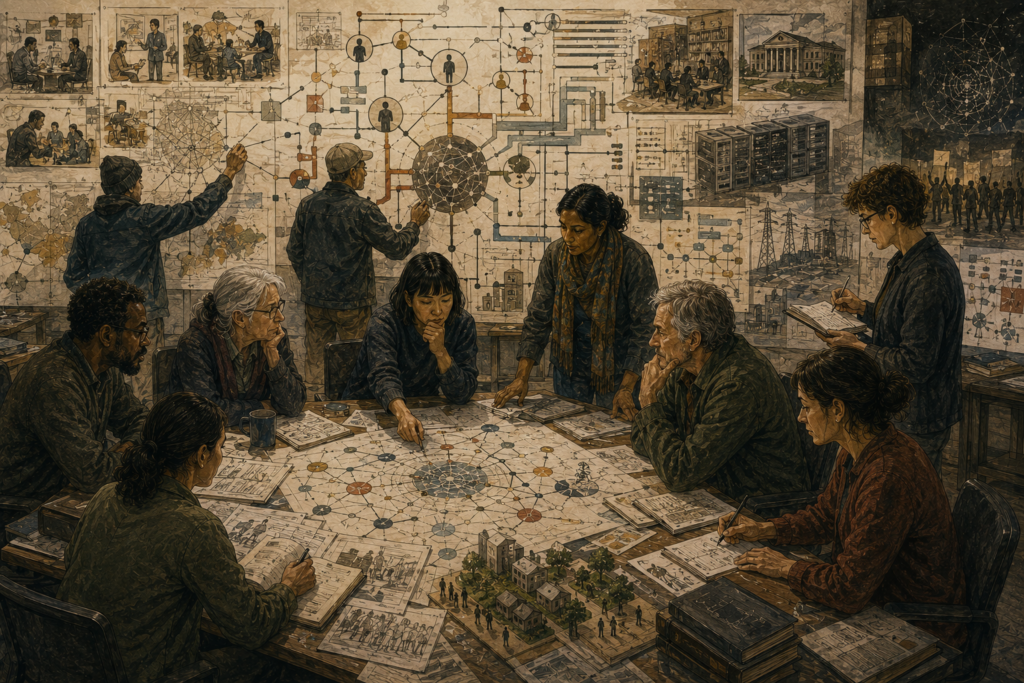
Thinking

Thinking refers to the frameworks through which complexity is interpreted, uncertainty is framed, and change is understood across time. Contemporary thought increasingly recognizes that many real-world conditions are dynamic, adaptive, and interconnected, requiring approaches that move beyond linear analysis toward more relational and systems-oriented ways of understanding.

Modern approaches to thinking draw from multiple disciplines, including systems theory, design research, ecology, futures studies, and organizational learning. These frameworks help individuals and institutions make sense of patterns, feedback, resilience, emergence, and long-term change, while providing more structured ways to engage with uncertainty.

Effective thinking is central to research, governance, innovation, and strategy. In rapidly changing environments, organizations increasingly rely on interdisciplinary thinking frameworks to strengthen sense-making, support adaptive learning, and improve the quality of judgment in complex settings.

Researchers study systemic risk through paper maps, causal diagrams, climate hazards, infrastructure stress, vulnerability assessments, and future scenarios.

Futures Thinking and Risk Analysis: Uncertainty, Scenario Design, and the Limits of Prediction

Futures Thinking and Risk Analysis examines how uncertainty can be structured and navigated when complex systems make probability-based prediction unreliable. The article argues that many of the most consequential risks arise not simply from calculable probability, but from deep uncertainty, nonlinear system behavior, model limits, interdependence, and the structural limits of present knowledge. It develops this through Knight’s distinction between risk and uncertainty, the concept of deep uncertainty, scenario analysis, nonlinear and tail risk, robust and adaptive strategy, institutional failure, and the acceleration of technological risk. The article emphasizes that futures-oriented risk analysis is less about forecasting one correct outcome than about exploring multiple plausible futures and designing strategies that remain viable across them.

Infrastructure planners study future systems across ports, power grids, transit, water, housing, climate risk, and ecological restoration.

Infrastructure Futures: System Fragility, Interdependence, and the Architecture of Long-Term Development

Infrastructure Futures examines how physical, digital, and institutional infrastructures shape the long-term possibilities of societies by organizing circulation, energy, coordination, and control. The article argues that infrastructure is not passive background support, but the deep architecture that defines what systems can become, while also locking them into durable paths of dependence. It develops this through interdependence, path dependency, network topology, efficiency-fragility tradeoffs, cascading failure, thresholds, geopolitical leverage, climate nonstationarity, digital control layers, infrastructure finance, governance failure, and resilience-oriented design. The article emphasizes that infrastructure futures are inseparable from political economy, environmental change, and long-horizon strategy because infrastructures determine not only system performance, but the boundaries of adaptation itself.

Urban planners and researchers study future city pathways across transit, housing, infrastructure, climate risk, public space, and ecological restoration.

Urban Futures: Cities as Interdependent Systems of Infrastructure, Technology, Human Movement, and Long-Term Transformation

Urban Futures examines how cities evolve as complex, interdependent systems shaped by infrastructure, digital networks, migration, finance, climate stress, governance, and political economy. The article argues that cities are not governed by single variables or isolated planning decisions, but by the interaction of multiple layered systems operating simultaneously under uncertainty, feedback, and constraint. It develops this through complexity theory, path dependency, cascade failure, urban metabolism, network topology, smart-city governance, migration pressure, informality, climate exposure, inequality, speculative finance, temporal conflict, and comparative development pathways. The article emphasizes that the future of cities depends not only on growth or innovation, but on whether urban systems are governed as adaptive, resilient, and socially integrative systems rather than extractive ones.

A foresight group studies geopolitical futures across global power networks, trade routes, energy systems, migration, climate risk, and regional instability.

Geopolitical Futures: Power, Strategic Interaction, and Systemic Risk in an Interdependent World

Geopolitical Futures examines how global order evolves through dynamic interaction among states operating under uncertainty within deeply interconnected economic, technological, environmental, and institutional systems. The article argues that geopolitics is no longer well understood as a static distribution of power alone, but as a system of strategic interaction shaped by signaling, misperception, rivalry, interdependence, technological change, ecological stress, and coordination failure. It develops this through the shift from balance-of-power thinking to systems analysis, the instability of multipolar transition, cascade risk in networked systems, technology as a multiplier of power and uncertainty, climate as a threat multiplier, and resilience as a condition of systemic adaptation. The article emphasizes that geopolitical outcomes emerge less from linear causation than from feedback, constraint, and interaction effects that no actor fully controls.

Researchers examine global economic futures across trade networks, infrastructure, energy transition, development pathways, labor, and ecological systems.

Economic Futures and Global Development: Navigating Growth, Risk, and System Transformation

Economic Futures and Global Development examines how development pathways evolve under the combined pressure of technological change, environmental limits, institutional design, global inequality, and systemic uncertainty. The article argues that development is not a linear process of output expansion, but a branching and contested transformation shaped by the interaction of markets, states, infrastructures, ecosystems, and political choices. It develops this through complexity, sustainability, uneven global development, technological restructuring, systemic risk, institutional variation, resilience, and the difficulty of coordinating policy across national and global scales. The article emphasizes that the future of development depends not only on how much economies grow, but on how prosperity is distributed, how ecological and social constraints are managed, and whether institutions can adapt under long-horizon stress.

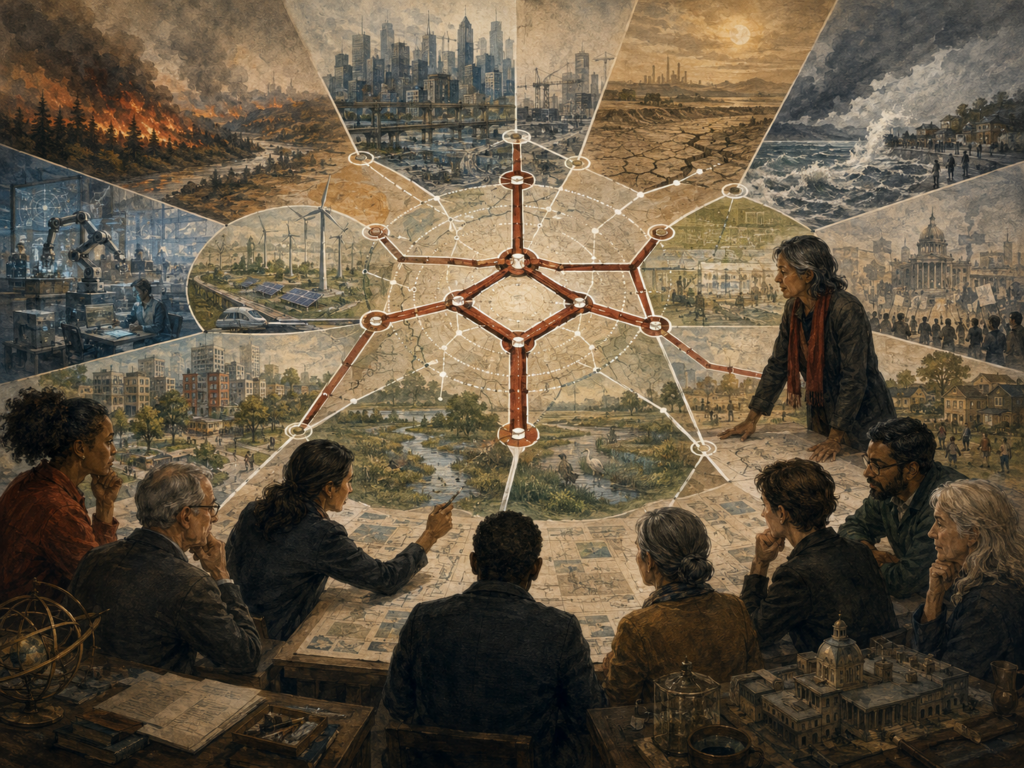
A foresight group examines branching climate futures across wildfire, drought, flooding, coastal risk, cities, farms, renewable energy, and ecological restoration.

Climate Futures and Environmental Change: Anticipating Risk, Uncertainty, and Planetary Transformation

Climate Futures and Environmental Change examines how Earth systems may evolve under anthropogenic pressure, long-term transformation, and deep uncertainty. The article argues that climate change is not a single-variable environmental problem, but a systemic interaction among atmospheric dynamics, ecological thresholds, infrastructure, political economy, technological change, and unequal human vulnerability. It develops this through complex-systems reasoning, emissions pathways, deep uncertainty, tipping points, planetary boundaries, adaptation and mitigation, climate risk, transition dynamics, and the difficulty of coordinating governance across fragmented institutions. The article emphasizes that climate futures are shaped not only by physical forcing, but by how societies govern transition, manage feedbacks, and distribute risk under nonstationary conditions.

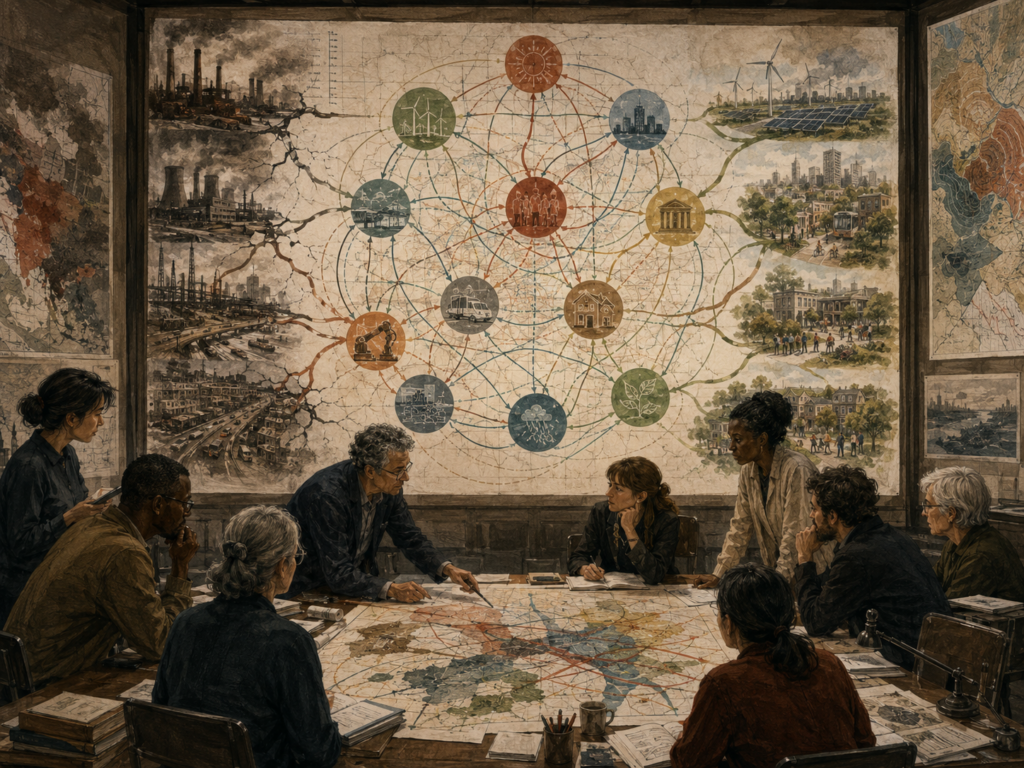
A diverse foresight group maps sustainability futures across pollution, renewable energy, ecological restoration, communities, infrastructure, and long-term systems change.

Futures Thinking and Sustainability: Anticipating and Designing Long-Term System Transitions

Futures Thinking and Sustainability examines how long-horizon foresight and sustainability become inseparable once ecological stability, social equity, and economic viability are treated as problems of system transition rather than short-term management. The article argues that sustainability is inherently a futures problem because present decisions must be made under uncertainty about long-term system behavior, thresholds, and irreversible risk. It develops this through complex systems reasoning, uncertainty, backcasting, technological change, resilience, adaptation, transformation, political economy, and the difficulty of implementing sustainable pathways within existing institutional constraints. The article emphasizes that sustainability is not simply about preserving the present, but about intentionally shaping more viable futures under ecological limits and contested transition politics.

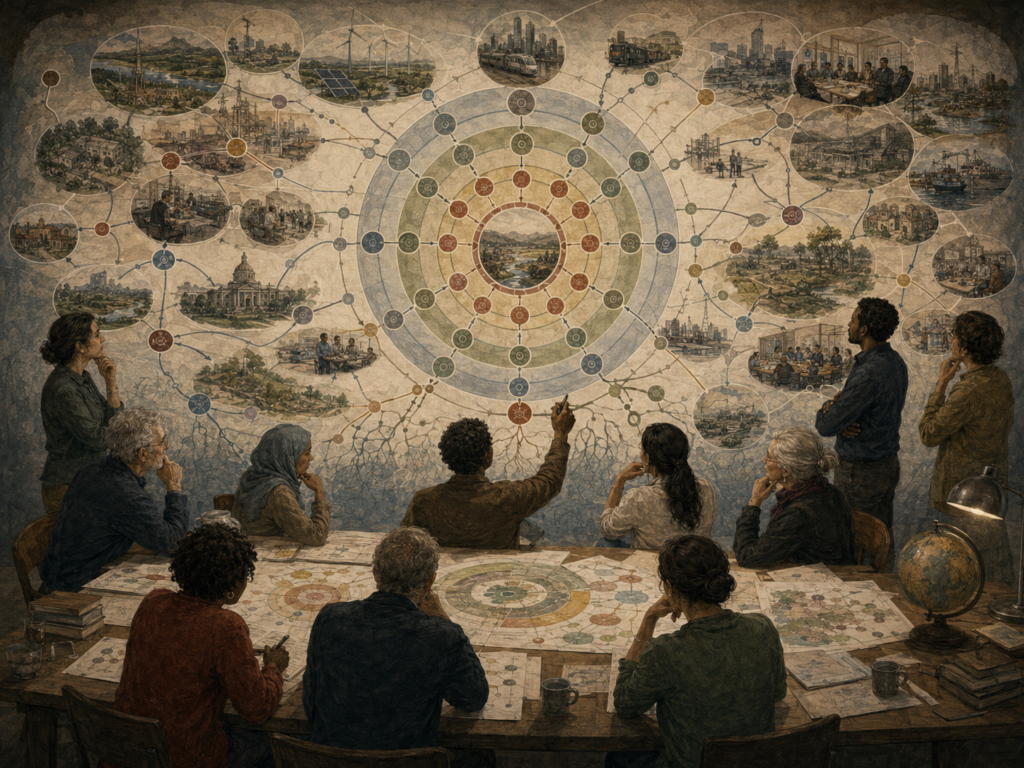
A diverse planning group works backward from a desired future to map strategic steps across infrastructure, communities, ecology, and public systems.

Backcasting and Strategic Planning: Designing Pathways from Desired Futures to Present Action

Backcasting and Strategic Planning explains how long-range strategy can begin from a desired future rather than from the inertia of present trends. The article argues that backcasting is a normative planning method designed for contexts where continuation is inadequate, undesirable, or structurally incapable of delivering long-term goals. It develops this through the distinction between forecasting and backcasting, the logic of pathway design, the role of systems thinking, socio-technical transitions, applications across policy and business, and the political and institutional constraints that shape feasibility. The article emphasizes that backcasting is not simply a planning technique but a way of translating preferred futures into staged, actionable transitions under uncertainty.

A strategy group studies branching business futures across supply chains, energy transition, infrastructure, climate risk, markets, and long-term systems change.

Futures Thinking in Business Strategy: Anticipation, Adaptation, and Competitive Advantage

Futures Thinking in Business Strategy examines how organizations can use foresight to remain competitive under conditions of technological disruption, market volatility, systemic uncertainty, and structural change. The article argues that business strategy can no longer rely on assumptions of stability or linear market evolution, but must instead be designed to operate across multiple plausible futures. It develops this through foresight methods, uncertainty, dynamic capabilities, competitive advantage, systems thinking, organizational culture, institutional constraints, and the practical challenge of translating future awareness into strategic action. The article emphasizes that the value of futures thinking lies not in predicting one correct future, but in increasing strategic range, resilience, and coherence before disruption forces reactive change.

Scroll to Top