Thinking

Thinking refers to the frameworks through which complexity is interpreted, uncertainty is framed, and change is understood across time. Contemporary thought increasingly recognizes that many real-world conditions are dynamic, adaptive, and interconnected, requiring approaches that move beyond linear analysis toward more relational and systems-oriented ways of understanding.

Modern approaches to thinking draw from multiple disciplines, including systems theory, design research, ecology, futures studies, and organizational learning. These frameworks help individuals and institutions make sense of patterns, feedback, resilience, emergence, and long-term change, while providing more structured ways to engage with uncertainty.

Effective thinking is central to research, governance, innovation, and strategy. In rapidly changing environments, organizations increasingly rely on interdisciplinary thinking frameworks to strengthen sense-making, support adaptive learning, and improve the quality of judgment in complex settings.

Editorial scientific illustration of mathematical thinking as a formal reasoning architecture, showing pattern recognition, abstraction, proof pathways, symbolic representation, recursion, graph structures, geometric reasoning, algorithms, counterexamples, and mathematical history.

Mathematical Thinking: Pattern, Proof, and the Architecture of Reason

Mathematical thinking is not only the ability to calculate; it is a disciplined way of seeing patterns, relationships, structures, limits, quantities, uncertainty, change, and logical consequence. This article introduces mathematical thinking as a foundational practice for reasoning across science, technology, economics, sustainability, artificial intelligence, governance, and everyday decision-making. It explains how abstraction, proof, modeling, measurement, estimation, functions, systems, probability, and visual representation help transform complex problems into clearer forms of inquiry. Rather than treating mathematics as a narrow school subject, the article presents it as a language of structure and a method for disciplined judgment. Mathematical thinking helps people ask better questions, test assumptions, compare alternatives, recognize uncertainty, and build models that clarify how systems behave over time.

Editorial scientific illustration of systems thinking as a structural reasoning architecture, showing feedback loops, interdependence, delays, stocks and flows, leverage points, resilience, thresholds, policy resistance, sustainability, governance, organizations, and structural change.

Systems Thinking: Patterns, Interdependence, and Structural Change

Systems thinking examines how recurring patterns arise from relationships, feedback loops, delays, accumulations, incentives, goals, constraints, and structures of interdependence. This article presents systems thinking as a discipline of structural reasoning rather than a vague language of complexity. It explains why familiar problems return, why well-intentioned interventions often produce unintended consequences, and why durable change usually requires attention to feedback, stocks and flows, leverage points, mental models, system boundaries, and behavior over time. It also connects systems thinking to organizations, sustainability, governance, technology, resilience, public policy, and computational modeling, showing how causal-loop diagrams, stock-and-flow models, scenarios, and simulations can make structural assumptions visible without replacing ethical judgment.

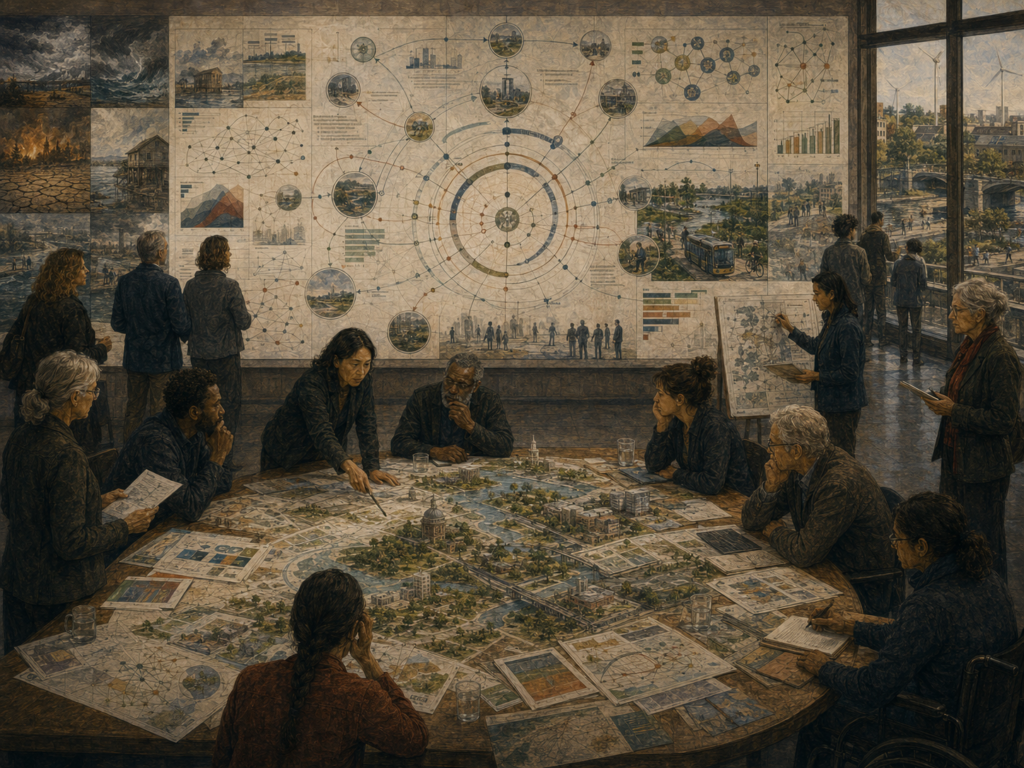
A diverse multigenerational group discusses future pathways amid images of ecological crisis, collective imagination, community repair, and long-term social transformation.

Future Directions in Strategic Foresight: Systems Integration, Decision Architectures, and the Evolution of Long-Term Strategy

Future Directions in Strategic Foresight examines how foresight is moving beyond periodic planning exercises and becoming an integrated component of continuous decision systems. The article argues that in environments shaped by nonlinear change, deep uncertainty, rapid feedback, and global interdependence, strategic foresight must evolve from isolated scenario work into a system-level capability linked to analytics, governance, institutional learning, and adaptive strategy. It explores the role of data, real-time monitoring, AI-assisted decision support, continuous scenario updating, institutionalization, global coordination, and ethical responsibility in shaping the next phase of foresight practice. The article emphasizes that the future of foresight is not prediction in a narrow sense, but the design of institutions capable of sensing change, updating assumptions, and preserving strategic options under uncertainty.

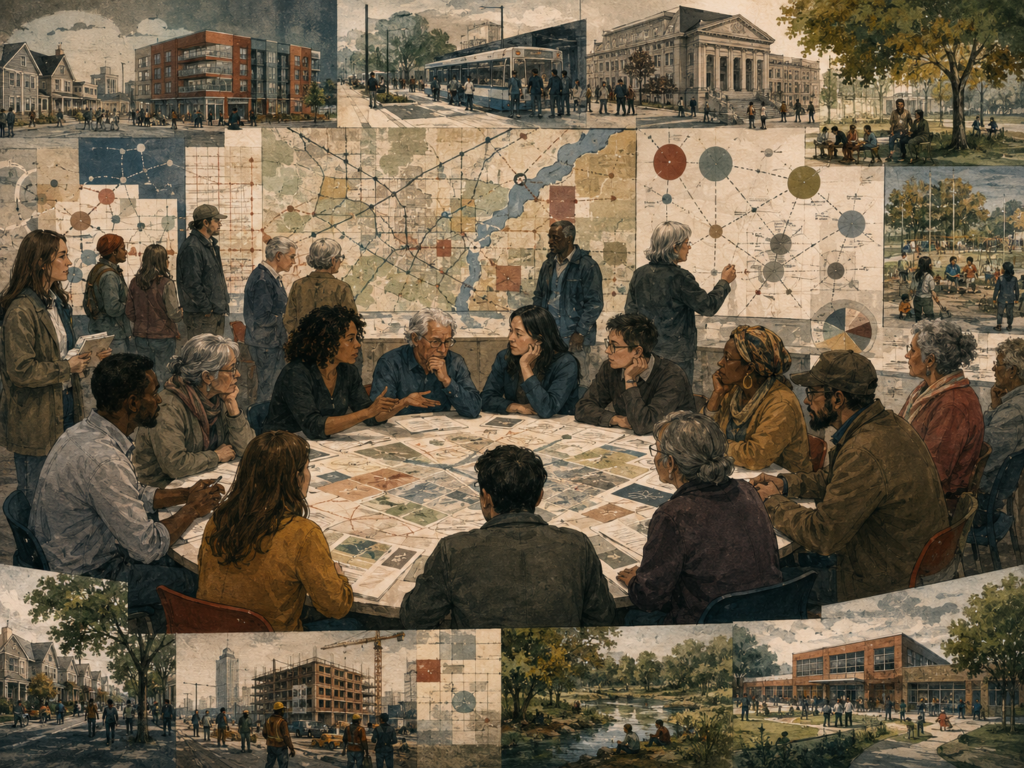
A diverse group examines ethical futures through community maps, justice concerns, ecological risk, public institutions, accessibility, and long-term responsibility.

Ethics of Futures Thinking: Responsibility, Power, and the Moral Boundaries of Anticipating the Future

The Ethics of Futures Thinking examines how anticipation, scenario design, and long-range planning are never value-neutral exercises, but practices that shape whose futures are protected, prioritized, or marginalized. The article argues that futures thinking does not merely describe possible futures; it actively helps produce them through choices about scenarios, risk frames, time horizons, and strategic action. It develops this argument through intergenerational responsibility, power over future narratives, uncertainty, unequal risk distribution, representation, technological governance, accountability, and the moral tradeoffs that emerge when institutions plan under deep uncertainty. The article emphasizes that ethical futures practice requires more than technical sophistication: it requires explicit values, inclusive participation, institutional accountability, and attention to justice across time.

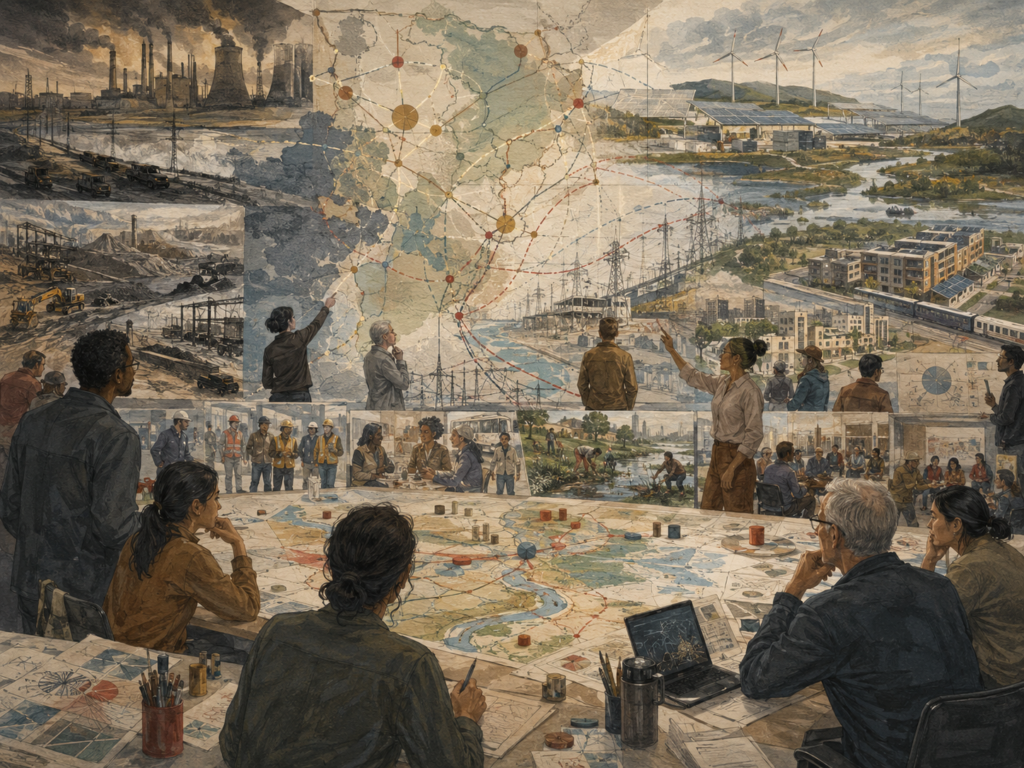
Researchers model complex system scenarios across climate risks, infrastructure, communities, energy, ecology, and governance.

Scenario Modeling for Complex Systems: Structure, Uncertainty, and the Exploration of Alternative Futures

Scenario Modeling for Complex Systems examines how organizations and analysts can explore multiple plausible futures when linear forecasting breaks down under deep uncertainty, interdependence, and nonlinear change. The article argues that scenario modeling is not a tool for prediction, but a structured method for mapping the space of possible futures and designing decisions that remain viable across them. It develops this through the foundations of scenario work, the dynamics of complex systems, deep uncertainty, system structure, quantitative simulation, qualitative narrative logic, cross-system interdependence, and the relationship between scenario design, robustness, and resilience. The article also emphasizes the limits of models, the risks of false precision, and the need to treat scenario construction as disciplined exploration rather than speculative storytelling.

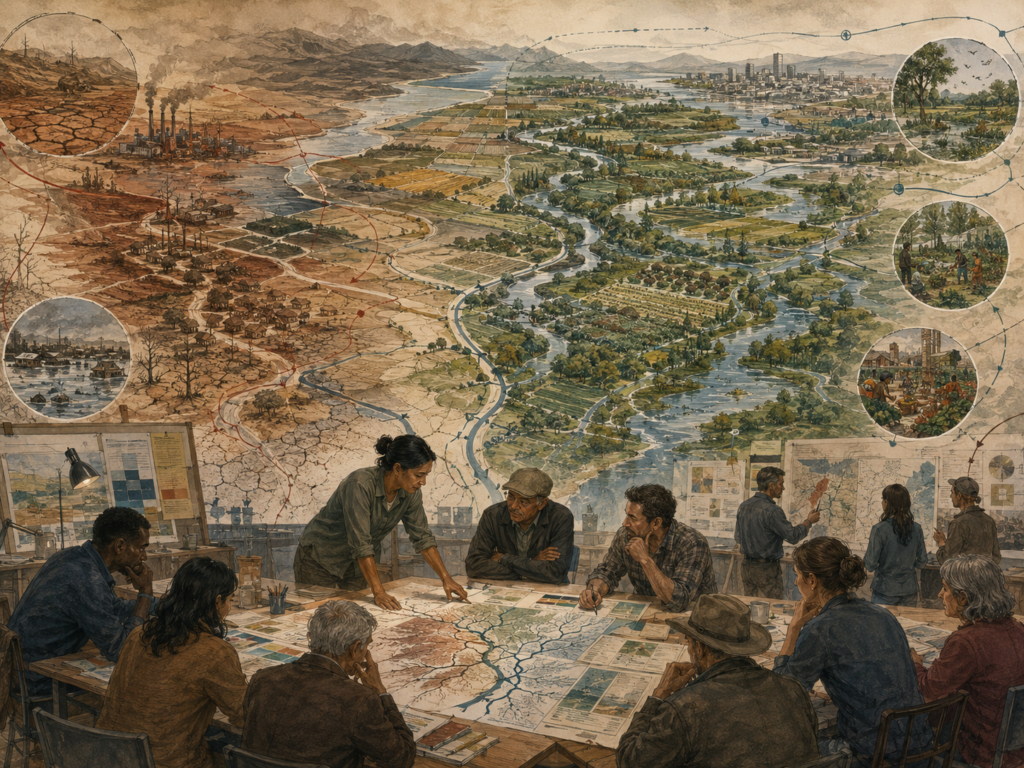
Researchers and institutional leaders study long-term adaptation across climate risk, governance, infrastructure, public services, and community resilience.

Institutional Adaptation to Long-Term Change: Governance, Learning Systems, and the Limits of Structural Transformation

Institutional Adaptation to Long-Term Change examines how governments, organizations, and governance systems respond to structural change under uncertainty, path dependency, and inherited constraint. The article argues that institutions are typically built for stability, coordination, and predictability, yet those same strengths often become barriers when technological, environmental, social, or geopolitical conditions shift. It develops this tension through path dependency, institutional inertia, feedback systems, learning, adaptive capacity, governance coordination, crisis-driven change, technological lag, and the difficulty of aligning institutions across global systems. The article emphasizes that institutional adaptation is not a one-time reform event but an ongoing process of learning under uncertainty, shaped by power, incentives, and the internal ability of institutions to revise their own rules.

A diverse group studies AI-assisted decision-making through ecological models, community planning, systems maps, and long-term public choices.

AI and the Future of Decision-Making: Algorithmic Systems, Human Judgment, and the Transformation of Strategic Choice

AI and the Future of Decision-Making examines how artificial intelligence is restructuring decision-making by redistributing cognition across humans, algorithms, data infrastructures, and institutional systems. The article argues that AI does not eliminate bounded rationality or uncertainty, but relocates them into the architecture of models, data, objectives, interfaces, and governance. It develops this through bounded rationality, socio-technical systems, the problem of representation, automation and optimization, hybrid intelligence, bias, prediction limits, governance, economic competition, and strategic decision-making under uncertainty. The article emphasizes that AI-driven decisions are not simply algorithmic outputs, but outcomes of larger systems in which accountability, transparency, and institutional design remain central.

Scroll to Top