Technology & Systems Intelligence

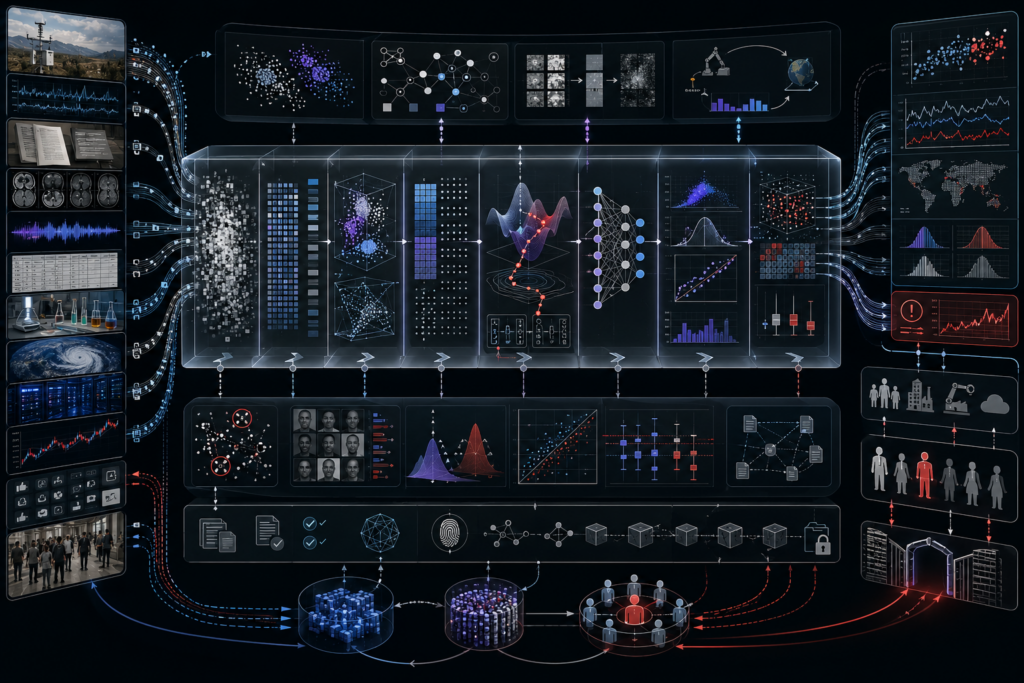
Technology and systems intelligence examine how advanced analytical tools and digital technologies can enhance our understanding of complex systems. Technologies such as artificial intelligence, machine learning, sensor networks, and large-scale data analytics are increasingly used to analyze environmental, economic, and social systems.

Systems intelligence emphasizes the ability to integrate data, models, and human expertise in order to interpret complex patterns and support informed decision-making. Rather than replacing human judgment, these technologies augment the capacity of researchers and institutions to detect trends, simulate outcomes, and evaluate policy interventions.

As digital technologies become more deeply integrated into governance and sustainability research, the challenge lies in deploying them responsibly. Effective systems intelligence requires transparency, accountability, and careful integration with ethical and institutional frameworks.

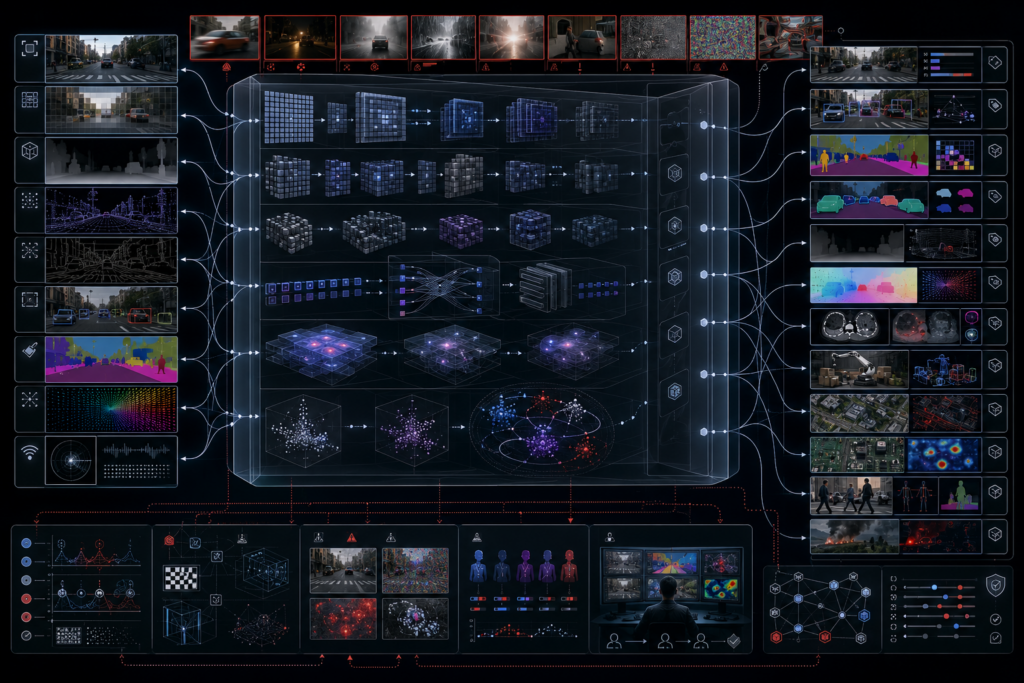
Editorial scientific illustration showing AI as a governed media-system architecture with synthetic media pathways, provenance chains, verification gates, recommender flows, disinformation-risk signals, correction loops, public trust, and accountability structures.

Intelligent Infrastructure Systems: How Digital Technologies Transform Physical Infrastructure

Intelligent infrastructure systems integrate sensing, embedded computing, edge intelligence, communication networks, data platforms, analytics, automated control, and governance into essential physical systems. This pillar explores how roads, grids, water networks, buildings, emergency systems, environmental assets, and public services become dynamically monitored cyber-physical infrastructure. It emphasizes LPWAN, LoRaWAN, MQTT, OPC UA, Embedded C, TinyML, PYNQ, HDL, SQL, Python, R, geospatial analytics, digital twins, disaster relief, remote monitoring, predictive maintenance, and infrastructure observability. By connecting field devices, telemetry, edge processing, data governance, resilience modeling, and institutional decision support, the series frames intelligent infrastructure as a public-interest system for improving reliability, adaptation, emergency response, lifecycle stewardship, and accountable infrastructure governance.

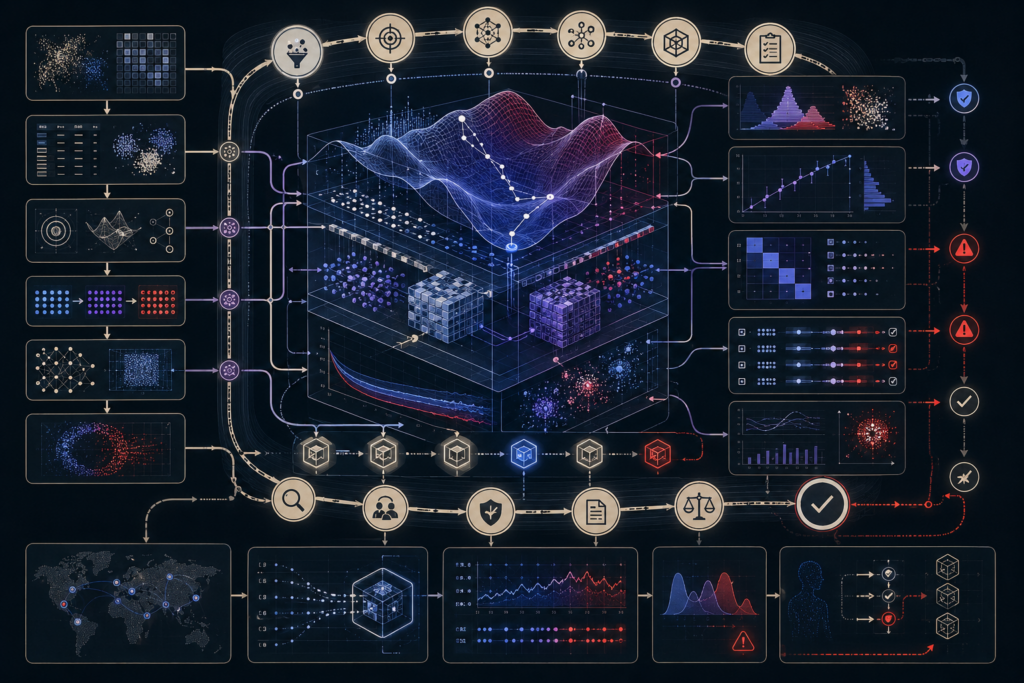
Editorial systems illustration showing environmental monitoring infrastructure with field sensors, satellite and drone observation, embedded devices, edge analytics, telemetry flows, environmental data layers, dashboards, and institutional decision-making connected in a layered observational architecture.

Environmental Monitoring Systems: How Sensor Networks and Data Systems Measure Environmental Change

Environmental monitoring systems are the observational infrastructures that make environmental change measurable, interpretable, and actionable. This pillar explores how field sensors, embedded devices, remote sensing platforms, edge computing, TinyML, PYNQ, HDL workflows, data pipelines, geospatial analytics, statistical models, and decision-support systems monitor air, water, soil, biodiversity, climate, land systems, and environmental risk. It emphasizes the full chain from physical observation to calibrated signal, telemetry, data validation, analysis, visualization, governance, and institutional response. By connecting environmental science with Embedded C, SQL, Python, R, hardware-aware edge workflows, and reproducible data systems, the series frames monitoring as a technical and institutional foundation for sustainability strategy, resilience planning, ecological stewardship, public accountability, and responsible environmental governance.

Editorial systems illustration showing sensors, embedded boards, edge gateways, local processing cores, telemetry pathways, security controls, cloud-edge coordination, and physical infrastructure connected through a distributed cyber-physical architecture.

Embedded and Edge Systems: Real-Time Computing in Devices, Sensors, and Infrastructure

Embedded and edge systems examine how computation moves into physical devices, sensors, machines, and infrastructure. This pillar explores microcontrollers, firmware, sensor networks, real-time operating systems, edge computing, TinyML, PYNQ, local analytics, cyber-physical control, security, and device lifecycle governance. It shows how physical signals become digital telemetry, how local processing can reduce latency and bandwidth dependence, and how embedded intelligence can support environmental monitoring, infrastructure resilience, health technology, industrial automation, robotics, and sustainable systems. The series emphasizes engineering constraints such as memory, energy, timing, signal quality, reliability, privacy, and field maintenance. By connecting Embedded C, SQL, Python, R, TinyML, and hardware-aware edge workflows, the pillar presents embedded and edge systems as the technical foundation for trustworthy, distributed, real-world intelligence.

Editorial systems illustration showing data sources, databases, pipelines, validation gates, analytical models, visualization panels, governance controls, security layers, and institutional decision pathways arranged as a circular data lifecycle infrastructure.

Data Systems and Analytics: How Data Infrastructure Enables Measurement, Insight, and Decision-Making

Data Systems and Analytics maps the infrastructure, methods, and governance practices that turn raw data into trustworthy measurement, insight, and decision-making. This article map connects database systems, cloud platforms, pipelines, warehouses, lakes, distributed systems, metadata, lineage, data quality, observability, analytics engineering, semantic layers, visualization, reporting, statistical modeling, forecasting, predictive analytics, privacy, security, and reproducible workflows into one integrated framework. It treats data not as a passive resource, but as an institutional system that must be structured, governed, interpreted, protected, and made reusable over time. Across the series, data infrastructure is examined as the foundation for reliable evidence: how information is collected, transformed, modeled, validated, analyzed, communicated, and used responsibly in operational, scientific, business, public-sector, and AI-enabled environments.

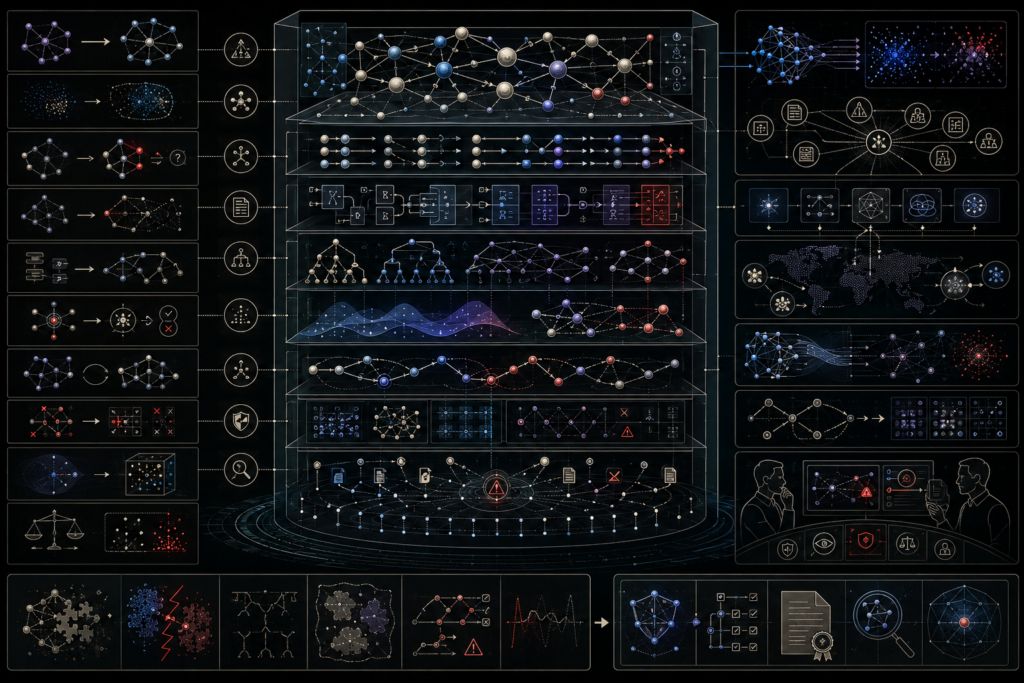
Editorial illustration of artificial intelligence systems shown as a layered sociotechnical architecture, with a central AI governance core connected to data pipelines, model structures, human oversight, institutional review, infrastructure, public systems, and societal impact pathways.

Artificial Intelligence Systems: How Machines Learn, Reason, and Support Decision-Making

Artificial intelligence systems transform data, models, infrastructure, and human judgment into computational forms of prediction, classification, generation, recommendation, and decision support. This pillar introduces AI as a layered systems field rather than a narrow collection of algorithms. It examines symbolic reasoning, machine learning, neural networks, natural language processing, computer vision, reinforcement learning, data governance, model validation, explainability, safety, fairness, infrastructure, organizational deployment, and regulatory oversight. The article also emphasizes the mathematical and computational foundations of responsible AI, including probability, optimization, evaluation metrics, drift monitoring, subgroup diagnostics, reproducible workflows, and audit-ready metadata. By connecting technical design to governance, institutional risk, and human oversight, the series frames artificial intelligence as one of the defining infrastructures of modern knowledge.

Technical embedded systems workspace featuring a PYNQ-Z2 FPGA board, STM32 microcontroller board, breadboarded sensors, logic analyzer traces, Linux terminal windows, TinyML inference visualizations, and PYNQ Python code displayed across multiple monitors.

Energy-Efficient Embedded Systems for Sustainable Digital Infrastructure

Energy-Efficient Embedded Systems for Sustainable Digital Infrastructure examines how sustainable digital infrastructure depends on mapping workloads across ultra-low-power MCU endpoints, Linux-capable edge nodes, and adaptive acceleration platforms rather than treating all embedded compute as the same design problem. The article argues that embedded efficiency is best understood as a systems-engineering question about duty-cycling, memory discipline, local inference, power-state control, and lifecycle servicing, since billions of deployed devices turn small per-device inefficiencies into infrastructure-scale energy, maintenance, and material burdens. It explores Cortex-M event-driven design, TinyML on constrained endpoints, Linux CPUFreq and scheduler-aware edge tuning, and PYNQ-based adaptive acceleration, showing that durable digital infrastructure depends on choosing the lightest adequate compute tier and minimizing both active-time energy and long-run maintenance overhead.

Environmental cost of data centers powering artificial intelligence infrastructure

Environmental Cost of Data Centers: Energy, Water, and AI Infrastructure

Data centers make the cloud physically visible: servers, cooling systems, electrical substations, backup power, water systems, land, buildings, and global supply chains. As artificial intelligence and cloud computing expand, these facilities are becoming major infrastructure systems with significant environmental costs. This article examines data centers through the lens of energy demand, water consumption, cooling design, grid expansion, AI compute growth, hardware supply chains, and public accountability. It argues that digital infrastructure cannot be evaluated only by speed, scale, or efficiency metrics. Its sustainability depends on where power comes from, how water is used, how cooling systems are designed, how hardware is produced and retired, and whether communities can understand and govern the impacts of the infrastructure behind the cloud.

Aerial view of a flooded community showing the need for wide-area IoT networks and resilient communication systems for disaster recovery

Wide-Area IoT Protocols: Resilient Communication Infrastructure for Disaster Recovery in Remote Regions

Wide-area IoT protocols are becoming critical to disaster recovery in remote regions where floods, storms, landslides, earthquakes, or infrastructure failures can sever roads, power, cellular service, and conventional communications at once. This article examines how LoRaWAN, NB-IoT, LTE-M, and satellite IoT can preserve basic situational awareness through low-power, long-range transmission of small but essential messages from sensors, clinics, shelters, bridges, roads, supply depots, and isolated communities. It explains the technical foundations of LPWAN systems, compares protocol strengths and limitations, and shows how disaster IoT depends on coverage, energy budgets, delivery probability, latency, governance, maintenance, and local trust. Rather than treating connectivity as a purely technical problem, the article frames wide-area IoT as resilience infrastructure: a layered system for early warning, accountable recovery, data sovereignty, and equitable disaster response.

Deep learning for biodiversity illustrated as AI-assisted monitoring of wildlife and ecosystems

Deep Learning for Biodiversity: Monitoring, Prediction, and the Governance Challenge

Deep learning for biodiversity can transform ecological monitoring by helping researchers classify species, detect habitat change, analyze acoustic recordings, process satellite imagery, and identify early warning signals across complex ecosystems. But its conservation value depends on more than model performance. Biodiversity loss is driven by land-use change, extraction, climate stress, pollution, weak enforcement, and institutional failure, not simply by a lack of data. This article examines deep learning as one layer within a broader environmental monitoring system: data collection, validation, uncertainty reporting, governance, policy translation, and ecological stewardship. It argues that AI-assisted biodiversity monitoring is most valuable when it is transparent, auditable, scientifically validated, ethically governed, and connected to institutions capable of turning prediction into preservation.

Scroll to Top