Religious Studies

Religious Studies examines the sacred texts, ritual systems, interpretive traditions, cosmologies, institutions, and moral worlds through which human societies have sought to understand existence, obligation, suffering, transcendence, and the structure of reality. In the history of ideas, religion has shaped conceptions of law, community, authority, salvation, memory, and the relationship between visible life and invisible order across civilizations.

This category explores the study of religion through scripture, commentary, ritual, myth, ethics, law, symbolism, and lived practice, including the ways traditions define truth, preserve continuity, negotiate difference, and respond to historical change. It considers how religious worlds organize meaning, structure belonging, authorize power, and generate enduring debates about justice, destiny, liberation, and the good life.

Religious Studies plays an important role in comparative inquiry because religion remains one of the central ways human beings have interpreted the cosmos, organized collective life, and confronted mortality, moral struggle, and ultimate questions of meaning. By engaging religious traditions seriously, this category deepens understanding of civilization, symbolic order, and the intellectual, ethical, and spiritual frameworks that have shaped human history.

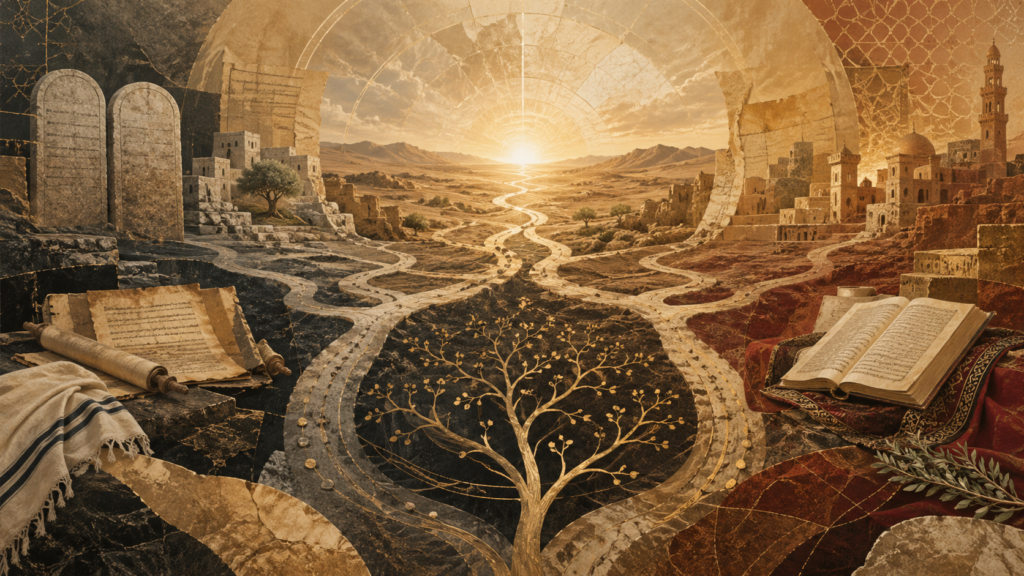
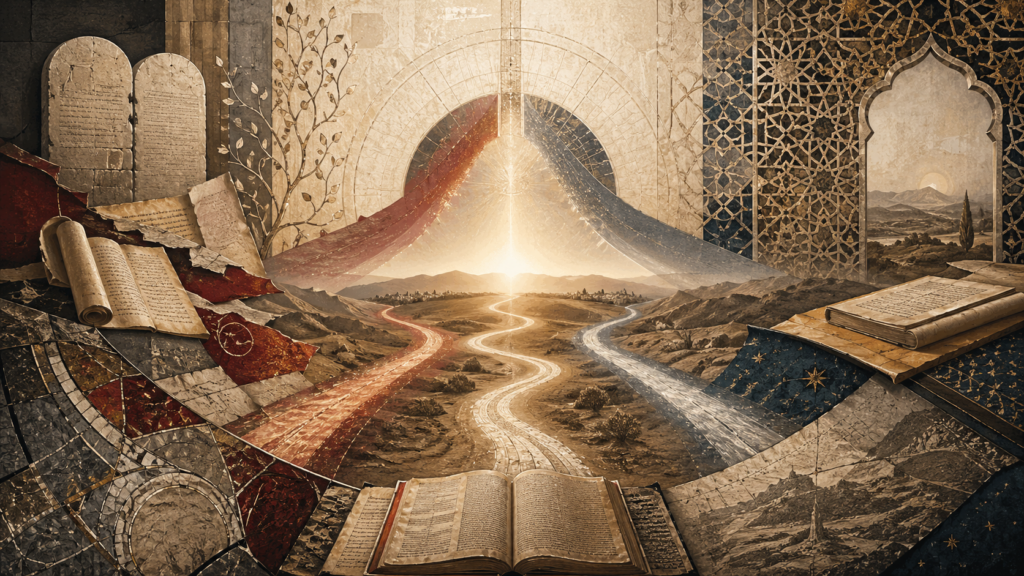
Editorial illustration of Abrahamic covenant and sacred ancestry shown through branching desert pathways, manuscript forms, covenantal light, and a genealogical tree motif across Judaism, Christianity, and Islam.

Abraham, Covenant, and Sacred Ancestry

Abraham stands at the center of Jewish, Christian, and Islamic sacred history as a figure of covenant, migration, trust, sacrifice, ancestry, and moral testing. This article examines Abraham not merely as a genealogical ancestor, but as a spiritual archetype whose legacy is claimed, interpreted, and contested across the Abrahamic traditions. Judaism emphasizes covenantal peoplehood through Isaac and Jacob; Christianity reads Abraham through faith, promise, and fulfillment in Christ; Islam presents Ibrahim as a pure monotheist, prophet, builder of sacred worship, and ancestor of both Israelite and Ishmaelite lines. Through a Qur’an-centered comparative lens, the article argues that Abrahamic ancestry is not only biological descent, but moral inheritance: fidelity to the One God, rejection of idolatry, reverence for revelation, and responsibility before divine judgment.
Editorial illustration of Judaism, Christianity, and Islam as three interwoven paths of sacred history, prophecy, revelation, covenant, law, and moral responsibility.

What Are the Abrahamic Traditions?

The Abrahamic traditions are Judaism, Christianity, and Islam: three intertwined religious civilizations shaped by belief in one God, revelation, prophecy, covenant, law, moral accountability, and sacred history. This article introduces the Abrahamic traditions not as isolated religions competing for ownership of God, but as related communities of memory that preserve, dispute, interpret, and renew a shared inheritance. Beginning with Abraham as a figure of faith, covenant, migration, and moral testing, it explores how Jews, Christians, and Muslims understand scripture, prophecy, law, Jesus, Muhammad, community, and divine guidance. The article also establishes the interpretive lens for this series: sacred texts will be read directly, but through a Qur’an-centered framework that emphasizes continuity of revelation, prophetic vindication, rational inquiry, peaceful reform, and respectful comparison with Sunni, Shia, Jewish, and Christian perspectives.

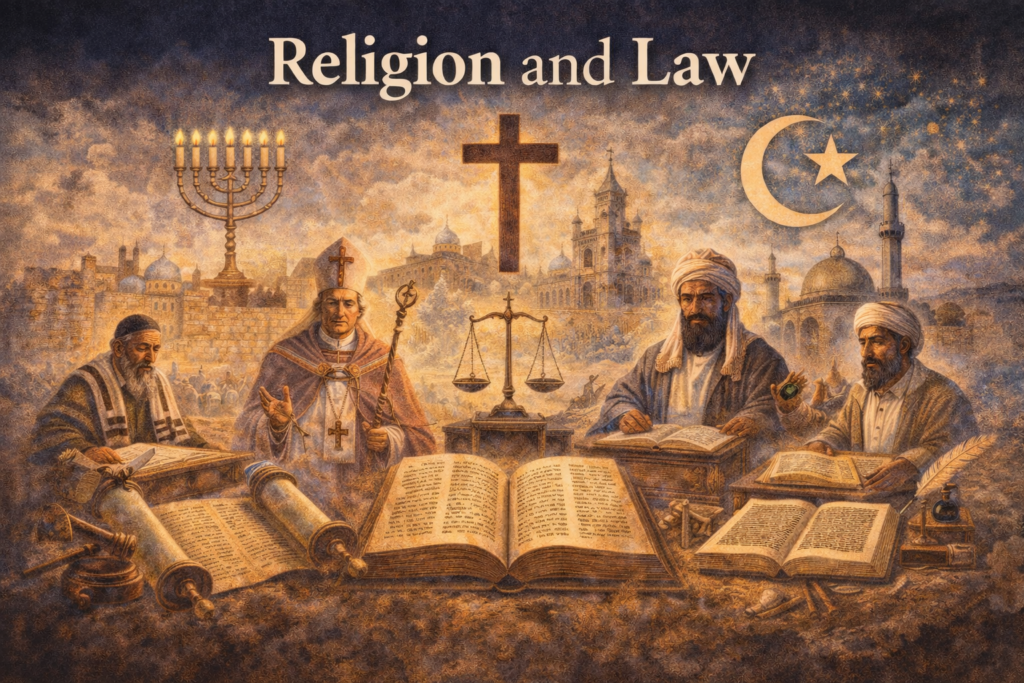
A composite illustration of Jewish, Christian, and Islamic legal traditions featuring a menorah, cross, crescent, scholars with sacred texts, scales of justice, and religious architecture in the background.

Religion and Law: Sacred Authority, Abrahamic Legal Traditions, and the Moral Ordering of Civilization

Religion and Law examines the relationship between sacred authority, moral obligation, legal reasoning, and political order across religious civilizations. This category explores scriptural law, jurisprudence, canon law, halakhah, dharma, legal commentary, religious courts, and the role of sacred normativity in organizing communal and political life. It gives special attention to Judaism, Christianity, and Islam as Abrahamic legal traditions, comparing halakhah, canon law, and Sharia as distinct yet historically related structures of sacred normativity. By linking law to revelation, interpretation, family order, institutional authority, political sovereignty, and historical change, this category illuminates how religious traditions shaped the moral and institutional architecture of civilization.

Symbolic sacred landscape with religious texts, ritual objects, temples, water, mountains, and celestial light representing shared sacred themes across traditions.

Comparative Sacred Themes: Creation, Sacrifice, Justice, Death, and Sacred Order

Comparative Sacred Themes examines the recurring moral, symbolic, ritual, metaphysical, and civilizational patterns through which religious traditions have addressed creation, death, sacrifice, purity, justice, suffering, salvation, revelation, wisdom, time, community, law, transcendence, and the meaning of human life. This pillar explores origin and cosmic order, sacred obligation, sacrifice and exchange, purity and pollution, suffering and evil, death and afterlife, wisdom and revelation, pilgrimage and sacred geography, apocalypse and renewal, compassion and justice, ascetic discipline, personhood, and sacred belonging across religious worlds. By treating comparison as a disciplined method rather than a flattening exercise, the category provides a serious framework for understanding both the recurring sacred questions human beings ask and the radically different ways religious traditions answer them.

Sacred natural landscape with lake, forest, mountains, ritual objects, shrine structures, and people in prayer and contemplation representing religion and ecology.

Religion and Ecology: Sacred Earth, Stewardship, Justice, and Ecological Responsibility

Religion and Ecology examines the ethical, cosmological, ritual, theological, civilizational, and practical worlds through which religious traditions understand the natural world, human responsibility toward land and life, the meaning of creation, the moral status of nonhuman beings, and the ecological consequences of human power. This pillar explores creation and kinship, stewardship and dominion, Indigenous sacred reciprocity, ritual purity and pollution, animals and food ethics, climate crisis, biodiversity loss, ecological grief, and environmental justice across religious traditions. By treating ecological breakdown as not only a technical problem but also a crisis of worldview, moral order, and unequal power, the category provides a serious framework for understanding how religions shape both extractive systems and the ethical resources for restraint, repair, and ecological responsibility.

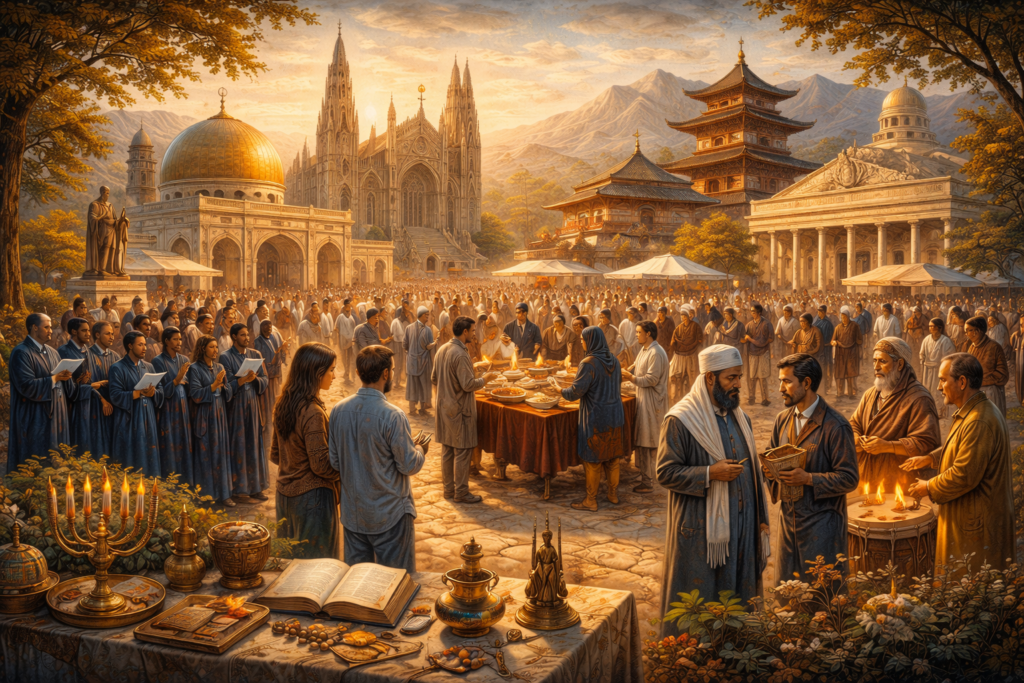
Symbolic public scene with diverse religious communities, sacred buildings, civic space, ritual objects, and social gathering representing religion’s role in public life.

Religion and Society: Power, Identity, Pluralism, and Social Order

Religion and Society examines the social, ethical, political, institutional, cultural, and civilizational worlds through which religion shapes collective life, public order, identity, moral imagination, ritual belonging, social hierarchy, solidarity, conflict, education, family life, and the long negotiation between sacred authority and social change. This pillar explores religion as social institution; the role of ritual, family, and education in forming communities; the entanglement of religion with class, race, ethnicity, gender, and nationalism; and the ways pluralism, conflict, media, migration, and globalization reshape religious life in modern societies. By treating religion as lived social power rather than private belief alone, the category provides a serious framework for understanding how sacred worlds move through institutions, public life, inequality, and struggles over belonging.

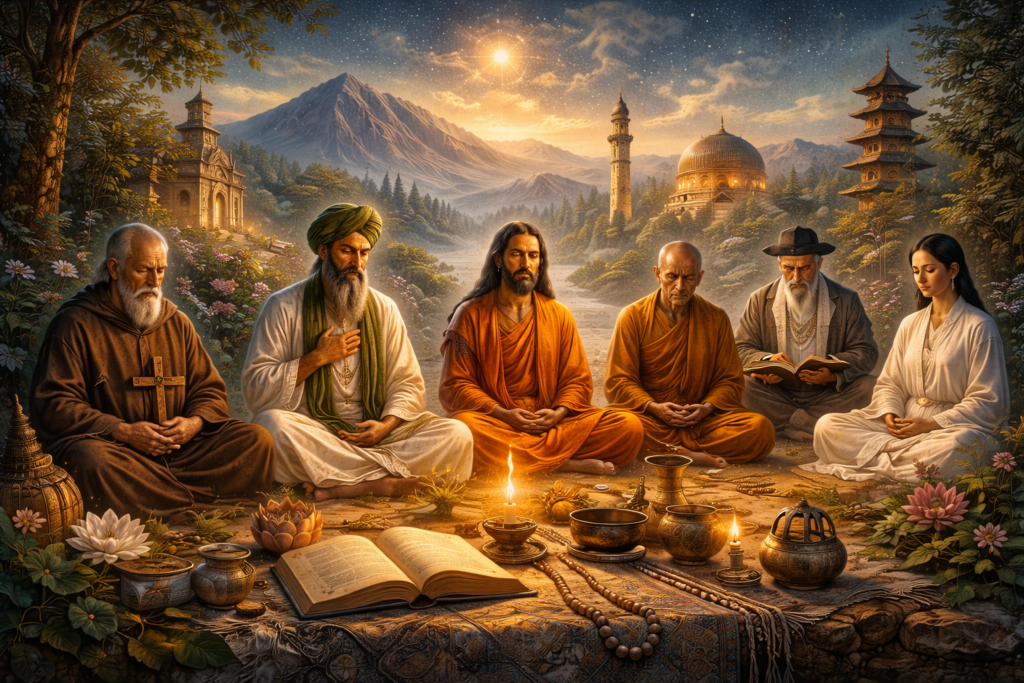
Symbolic contemplative scene with figures from multiple traditions in meditation and prayer among sacred texts, candles, mountains, and religious architecture.

Mysticism and Contemplative Traditions: Silence, Union, Discipline, and Awakening

Mysticism and Contemplative Traditions examines the religious, philosophical, devotional, ascetic, and experiential worlds through which human beings have sought direct transformation of perception, deeper union with ultimate reality, disciplined purification of the self, contemplative insight, sacred presence, interior stillness, and the reordering of life around what is held to be highest, truest, or most real. This pillar explores Christian mysticism, Sufism, Jewish mysticism, South Asian contemplative paths, Buddhist meditation traditions, Daoist interior cultivation, and the symbolic languages of silence, love, emptiness, illumination, and detachment. By treating contemplation and mysticism as rigorously formed paths of transformation rather than vague spirituality or private feeling, the category provides a serious framework for understanding how religious civilizations have pursued inward discipline, sacred knowledge, and the remaking of consciousness.

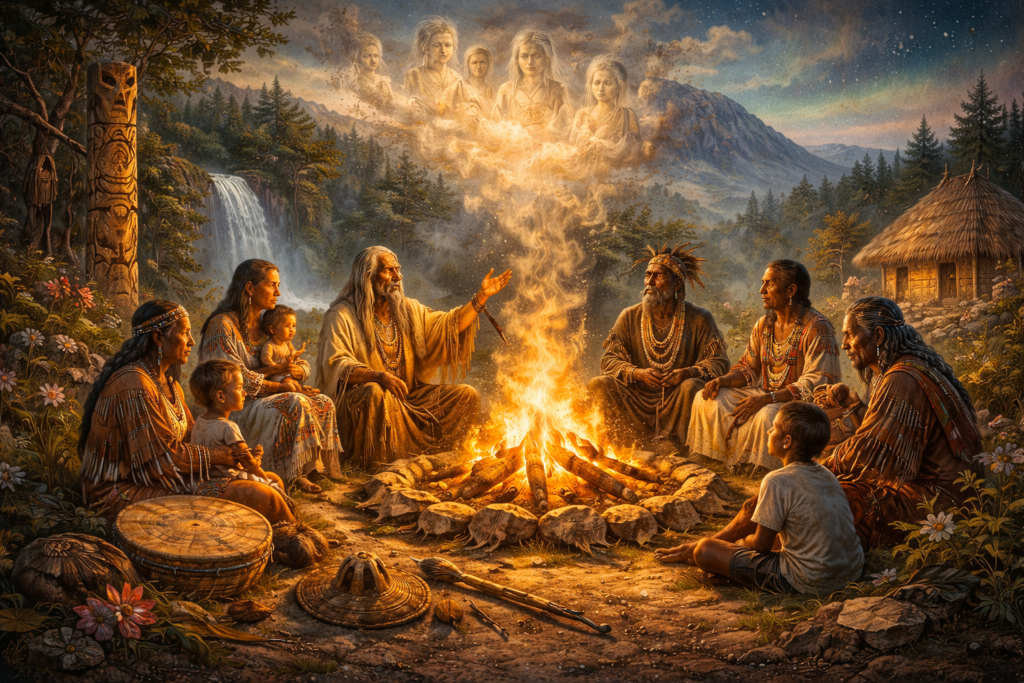
Symbolic scene of Indigenous oral storytelling around a fire with elders, children, ceremonial objects, sacred landscape, and ancestral presence.

Indigenous and Oral Traditions: Land, Memory, Ceremony, and Sacred Continuity

Indigenous and Oral Traditions examine the religious, ethical, cosmological, ceremonial, ecological, and civilizational worlds preserved through oral transmission, ancestral memory, land-based practice, sacred performance, kinship structures, and enduring relationships among people, place, spirit, animal life, and the more-than-human world. This pillar explores oral tradition as a disciplined archive of law, memory, and cosmology; the sacred significance of land and ancestry; healing, ritual, and ecological relation; and the global range of Indigenous religious worlds across North America, Mesoamerica, the Andes, Amazonia, Africa, Aboriginal Australia, the Pacific, the Arctic, and Indigenous Asia. By treating these traditions as intellectually rigorous and historically enduring worlds rather than as marginal folklore or vague spirituality, the category provides a serious framework for understanding some of humanity’s oldest and most profound religious inheritances.

Symbolic East Asian scene featuring Confucian, Buddhist, Daoist, and Shinto imagery with temples, mountains, sacred texts, and ritual symbols.

East Asian Traditions: Harmony, Ritual, Emptiness, and Civilizational Order

East Asian Traditions examines the religious, philosophical, ritual, and civilizational worlds that emerged across China, Korea, Japan, and the wider Sinosphere through sacred texts, canonical teachings, contemplative disciplines, ritual orders, ethical traditions, state formations, and enduring reflections on harmony, self-cultivation, cosmic order, moral duty, emptiness, transformation, and the relationship between Heaven, Earth, and human life. This pillar explores Confucian ethics, Daoist cosmology, East Asian Buddhist thought, Shinto ritual life, ancestor reverence, sacred kingship, meditative discipline, and the long civilizational interplay between philosophy, spirituality, governance, and social order. By treating these traditions as internally rich and historically layered worlds rather than as a vague language of balance or wisdom, the category provides a serious framework for understanding one of the deepest religious and philosophical archives in human history.

Scroll to Top