
Last Updated May 5, 2026
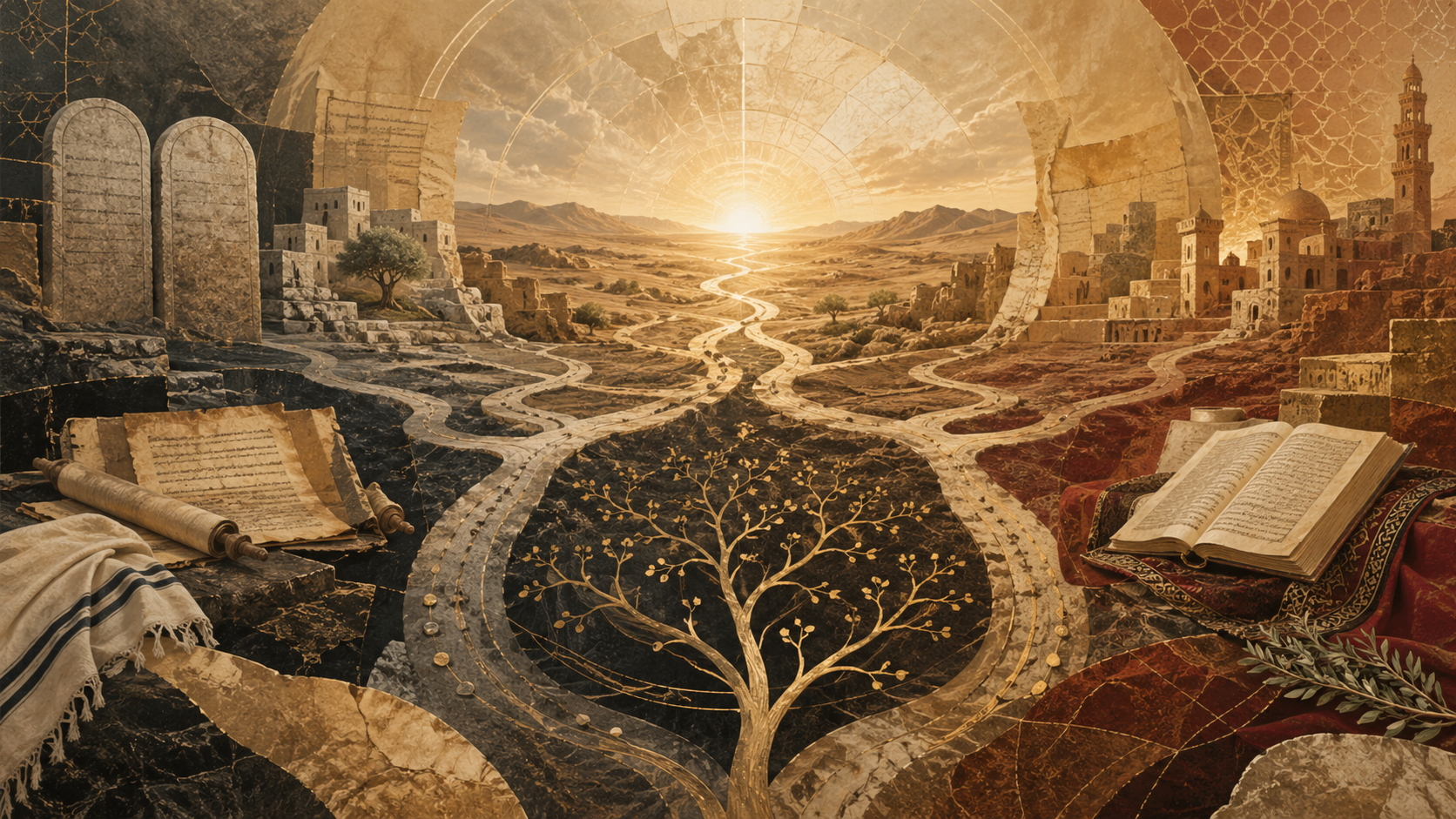
Abraham is the great ancestor of sacred history. Judaism, Christianity, and Islam all return to him when they ask where faith begins, what covenant means, how divine promise enters history, why revelation reshapes ordinary life, and why ancestry can never be reduced to bloodline alone. Abraham is remembered as patriarch, prophet, migrant, host, intercessor, iconoclast, father, builder, and servant of God. His story gathers many of the themes that define the Abrahamic traditions: revelation, covenant, land, promise, sacrifice, law, family, exile, hospitality, prayer, moral testing, sacred geography, and the struggle against idolatry.
Yet Abraham is not interpreted in the same way by all three traditions. Judaism remembers him as the covenantal ancestor of Israel, the one through whom promise moves toward Isaac, Jacob, Torah, peoplehood, and the land. Christianity reads Abraham through the language of faith, promise, and fulfillment, especially in relation to Christ and the extension of blessing to the nations. Islam presents Ibrahim as a prophet and ḥanīf, a pure monotheist who belongs neither exclusively to later Jewish nor Christian identity, but to the primordial religion of surrender to the One God.
This article approaches Abraham through a Qur’an-centered comparative lens while taking Jewish, Christian, Sunni, Shia, and broader academic perspectives seriously. It does not treat Abrahamic ancestry as a simple genealogy of religious ownership. It treats it as a moral and spiritual inheritance. To be a child of Abraham, in the deepest prophetic sense, is not merely to descend from him, invoke him, or claim his name. It is to inherit his struggle against idolatry, his trust in God, his hospitality, his willingness to leave false security, and his submission to divine command.
A serious Abrahamic account must therefore resist two temptations. The first is sentimental harmony, which turns Abraham into a vague interfaith symbol without doctrine, covenant, sacrifice, conflict, law, or truth claims. The second is possessive exclusivism, which treats Abraham as the property of one community and forgets that sacred ancestry is always accountable before God. Abraham is not merely a figure communities claim. He is a figure who judges the claims made in his name.
Current Space
Religious Studies
Article List
Abrahamic Traditions
Related Topic
Foundations of Religion
Series context: This article is part of the Abrahamic Traditions: Prophecy, Revelation, Law, and Sacred History knowledge series. For the broader category structure, return to the Religious Studies category.
The Arabic word Allah is used by Arabic-speaking Muslims, Christians, and Jews as the word for God. That linguistic fact matters for Abrahamic study because it prevents a false separation between “God” and “Allah” as though they referred to unrelated deities. The real differences among Judaism, Christianity, and Islam are theological, scriptural, legal, and interpretive. They are not the result of Muslims worshiping a different God. The traditions argue within a shared Abrahamic horizon of the One God, even when they disagree profoundly over covenant, incarnation, prophecy, scripture, law, sacred ancestry, and religious authority.
Hebrew Bible
לֶךְ־לְךָ מֵאַרְצְךָ וּמִמּוֹלַדְתְּךָ וּמִבֵּית אָבִיךָ אֶל־הָאָרֶץ אֲשֶׁר אַרְאֶךָּGo forth from your land, from your kindred, and from the house of your father, toward the land that I will show you.Genesis 12:1. Hebrew text with English rendering.
Abrahamic sacred history begins with departure. Faith is not first presented as possession, identity, or inheritance, but as response: leaving the familiar under the pressure of divine command.
Abraham as Sacred Ancestor
Abraham is one of the few figures whose memory is powerful enough to shape multiple civilizations at once. He belongs to the Hebrew Bible, the New Testament, and the Qur’an. He belongs to synagogue, church, and mosque. He belongs to legal traditions, mystical traditions, philosophical traditions, popular devotion, sacred geography, and interfaith imagination. To speak of “Abrahamic traditions” is to recognize that Judaism, Christianity, and Islam all preserve a sacred memory of Abraham, even while they disagree about what that memory means.
In Genesis, Abraham begins as Abram, a man called by God to leave his country, kindred, and father’s house. This departure is foundational. Abrahamic faith begins with movement: away from inherited security and toward an unseen promise. The call does not begin with a completed legal system, a settled nation, a royal dynasty, or a temple. It begins with trust. God commands, Abraham responds, and sacred history begins to unfold through migration.
This is why Abraham is never merely a tribal ancestor. His life becomes a pattern. He receives promise but must wait. He receives covenant but must be tested. He receives descendants but must confront the vulnerability of family. He receives land but often lives as a stranger. He is promised blessing, but that blessing is never for him alone. In Genesis, Abraham is told that through him all the families of the earth will be blessed. The Abrahamic traditions are built around that tension between particular covenant and universal moral significance.
From a Qur’an-centered perspective, Abraham’s importance lies especially in his witness to pure monotheism. He is not presented as the founder of a narrow ethnic religion, but as a servant of God who turns away from idolatry and submits wholly to the Divine. The Qur’an repeatedly describes him as upright, devout, thankful, and neither Jew nor Christian in the later communal sense. He represents religion before sectarian hardening: the primordial orientation of the human being toward the One God.
Qur’anic Text
مَا كَانَ إِبْرَاهِيمُ يَهُودِيًّا وَلَا نَصْرَانِيًّا وَلَٰكِن كَانَ حَنِيفًا مُّسْلِمًا وَمَا كَانَ مِنَ الْمُشْرِكِينَAbraham was neither Jew nor Christian; he was upright in faith, surrendered to God, and not among those who joined others with Him.Qur’an 3:67. Arabic text with English rendering.
The Qur’an places Abraham before later communal labels. This does not erase Jewish or Christian claims to Abraham; it asks whether any community that claims him has preserved his monotheism, humility, and surrender to God.
The question of Abrahamic ancestry is therefore more than historical. It is moral. The traditions ask not only, “Who comes from Abraham?” but also, “Who walks in the way of Abraham?” The answer differs across Judaism, Christianity, and Islam, yet the question itself reveals Abraham’s enduring power. He stands at the beginning of sacred ancestry, but also above every shallow claim to ancestry. He is ancestor, witness, and judge of the traditions that invoke his name.
That is why Abraham cannot be reduced to an interfaith slogan. He is not a harmless symbol of shared heritage detached from conflict, law, land, sacrifice, exile, and promise. He is a demanding figure. He asks whether inherited religion still obeys God, whether sacred memory produces justice, and whether communities that invoke covenant are willing to be judged by covenant.
Covenant in the Hebrew Bible
The Hebrew Bible gives the Abrahamic covenant its earliest canonical form. In Genesis 12, God calls Abram and promises land, descendants, blessing, and a great name. In Genesis 15, the covenant is dramatized through a solemn ritual in which God promises Abram descendants and land. In Genesis 17, Abram becomes Abraham, Sarai becomes Sarah, circumcision becomes the sign of the covenant, and the promise is linked to generations.
Hebrew Bible
וַהֲקִמֹתִי אֶת־בְּרִיתִי בֵּינִי וּבֵינֶךָ וּבֵין זַרְעֲךָ אַחֲרֶיךָ לְדֹרֹתָם לִבְרִית עוֹלָםI will establish My covenant between Me and you, and between your seed after you, throughout their generations, as an everlasting covenant.Genesis 17:7. Hebrew text with English rendering.
The covenant is not a passing blessing. It reaches into generations, identity, memory, worship, and obligation. Abraham receives promise, but promise becomes responsibility.
Covenant in the Hebrew Bible is not simply a contract. It is a binding relationship between God and human beings, marked by promise, obligation, memory, sign, and identity. Abraham is called into relationship with God, but the relationship extends beyond him. It reaches into family, descendants, land, worship, law, and communal destiny. This covenantal structure becomes essential to Jewish identity. The God of Abraham becomes the God of Isaac and Jacob; the family becomes Israel; the promise becomes peoplehood; the memory becomes liturgy, law, and historical consciousness.
The Hebrew Bible’s covenantal language also introduces one of the central tensions in Abrahamic religion: election and ethics. If God chooses Abraham and his descendants, what is that chosenness for? Is it privilege, responsibility, mission, blessing, burden, or all of these at once? The prophets of Israel repeatedly answer that covenant does not exempt a community from moral judgment. On the contrary, covenant intensifies accountability. To be chosen is to be responsible before God.
This prophetic critique is essential. Abrahamic ancestry becomes spiritually dangerous when it is treated as ownership of God rather than accountability before God. The Hebrew prophets attack precisely this kind of religious complacency. Worship without justice, sacrifice without righteousness, and identity without obedience are not signs of covenantal health. They are signs of covenantal corruption.
In this sense, the Abrahamic covenant is never only backward-looking. It is not merely a sacred memory of origin. It is a demand placed upon the present. The covenant asks each generation what it has done with the promise it inherited. Has blessing become mercy? Has chosenness become responsibility? Has sacred memory become justice? Or has ancestry become pride?
This distinction also helps prevent crude comparison. Judaism’s covenantal reading of Abraham cannot be dismissed as tribal particularism. Covenant is particular, but it is not morally empty. It forms a people under divine obligation. At the same time, covenant can be corrupted whenever election is separated from justice. The biblical tradition itself knows this danger and speaks against it from within.
Abraham in Jewish Tradition
In Jewish tradition, Abraham is the first patriarch and one of the foundational figures of covenantal memory. He is associated with faith, hospitality, obedience, intercession, circumcision, and the beginning of Israel’s sacred ancestry. He is not only remembered as an individual; he is remembered as the beginning of a people’s relationship with God.
Rabbinic tradition expands Abraham’s character in powerful ways. He becomes the one who recognizes the One God amid a world of idolatry. Midrashic traditions often portray him as a destroyer of idols and as a seeker who comes to know the Creator through reflection on the world. These stories deepen Abraham’s role as a moral and intellectual ancestor. He is not passive. He searches, reasons, rejects false worship, and bears witness.
Rabbinic Text
תַּלְמִידָיו שֶׁל אַבְרָהָם אָבִינוּThe disciples of Abraham our father.Pirkei Avot 5:19. Hebrew text with English rendering.
Rabbinic tradition does not treat Abraham only as a biological ancestor. It speaks of his “disciples,” implying that Abrahamic inheritance can be measured by character, discipline, humility, generosity, and the moral qualities one learns from him.
Jewish tradition also emphasizes Abraham’s hospitality. Genesis 18 shows Abraham welcoming mysterious visitors near the oaks of Mamre. This scene becomes a classic image of hospitality as sacred practice. Abraham’s tent is open. He receives strangers. He serves. He intercedes for Sodom. His righteousness is not abstract belief; it appears in conduct toward others.
At the same time, Jewish memory of Abraham is inseparable from Isaac and Jacob. The covenant moves through the patriarchal line that becomes Israel. This does not mean Jewish tradition denies Abraham’s wider significance, but it does mean that Abraham is centrally connected to the formation of a specific covenantal people. Jewish sacred ancestry is therefore both universal and particular: Abraham is honored beyond Judaism, but within Judaism he remains the father of Israel’s covenantal vocation.
This Jewish particularity should not be flattened in comparative study. Abraham’s significance for Judaism is not merely symbolic. It is covenantal, liturgical, legal, familial, and historical. The invocation of the God of Abraham, Isaac, and Jacob belongs to the deep grammar of Jewish prayer and memory. To read Abraham well, therefore, is to recognize that he is not an abstract interfaith icon detached from Israel’s story. He is the patriarch through whom Israel understands its vocation before God.
Jewish history also gives Abrahamic memory a profound diasporic dimension. A people can carry Abrahamic covenant through exile, dispersion, persecution, study, Sabbath, food law, prayer, language, household practice, and communal resilience. Sacred ancestry here is not only land and genealogy; it is memory preserved under pressure. Abraham’s departure from homeland becomes, in later history, part of a wider Jewish grammar of movement, vulnerability, promise, and return.
Abraham in Christian Tradition
Christianity inherits Abraham through Jewish scripture but rereads him through Christ. The New Testament repeatedly returns to Abraham because early Christians had to explain how Gentiles could enter the promises of Israel without becoming Jews in the full legal and ethnic sense. Abraham becomes central to the Christian argument that faith precedes and exceeds lineage.
Paul’s letters to the Romans and Galatians are especially important. Paul argues that Abraham was counted righteous by faith before the giving of the Mosaic law. This allows Paul to present Abraham as the father of all who have faith, whether Jew or Gentile. In this reading, Abraham’s promise is not abolished but expanded through Christ. The blessing promised to Abraham reaches the nations through the gospel.
New Testament
Ἐπίστευσεν δὲ Ἀβραὰμ τῷ θεῷ, καὶ ἐλογίσθη αὐτῷ εἰς δικαιοσύνην.Abraham trusted God, and it was reckoned to him as righteousness.Romans 4:3. Greek New Testament with English rendering.
Paul cites Abraham to argue that faith is not merely inner opinion but trustful relation to God. Christian interpretation uses Abraham to connect promise, righteousness, Gentile inclusion, and the unfolding of salvation history.
The Gospel of Matthew opens with a genealogy that begins with Abraham and moves through David to Jesus. This genealogy frames Jesus as heir to Israel’s story. Luke’s genealogy moves further back, connecting Jesus not only to Abraham but to Adam, thereby widening the scope of salvation history. Christian tradition therefore reads Abraham both covenantally and universally: he belongs to Israel’s story, but his promise opens toward all humanity.
Christianity also reads the binding or near-sacrifice of Isaac typologically. In many Christian interpretations, Isaac becomes a figure through whom the later sacrifice of Christ is foreshadowed. This is one of the major differences between Christian and Islamic readings. Christian theology often places Abraham’s test within a larger drama of sacrifice, sonship, and redemption fulfilled in Christ. Islam places the test within submission, obedience, and the purification of human will before God.
At its strongest, the Christian reading of Abraham resists racialized, ethnic, or merely inherited religion. John the Baptist’s warning in Matthew that God can raise children for Abraham from stones strikes directly at ancestry without repentance. Abrahamic identity, in this sense, must bear fruit. It cannot remain a slogan.
New Testament
δύναται ὁ θεὸς ἐκ τῶν λίθων τούτων ἐγεῖραι τέκνα τῷ ἈβραάμGod is able, from these stones, to raise up children for Abraham.Matthew 3:9. Greek New Testament with English rendering.
The warning cuts against complacent ancestry. It suggests that the name of Abraham cannot be used to escape repentance, justice, humility, or moral transformation.
Christian interpretation of Abraham also requires caution. It has often generated profound theology of faith, promise, and universal blessing. But it has also been misused in supersessionist ways that treat Judaism as merely obsolete. A responsible Christian reading should not use Abraham to erase Jewish covenantal life. It should recognize that Christianity’s claim about Abraham is a Christian claim made from within its own theological grammar, not a neutral description of Judaism.
The best comparative reading lets the Christian Abraham remain Christian without making him anti-Jewish. Abraham becomes a father of faith, a sign of promise reaching the nations, and a witness to trust in God. But he remains rooted in the Hebrew Bible and Israel’s sacred history. Christianity receives Abraham through Judaism, not apart from it.
Ibrahim in the Qur’an
The Qur’an presents Ibrahim as one of the greatest prophets and as a model of pure monotheism. He is a seeker of truth, a rejecter of idols, a servant tested by God, a builder of sacred worship, and a father whose prayer reaches into future communities. He is repeatedly associated with submission, gratitude, uprightness, and the rejection of false gods.
One of the Qur’an’s most important claims is that Abraham was neither a Jew nor a Christian in the later historical sense, but a ḥanīf, one who turned away from idolatry toward the One God. This does not erase Jewish or Christian claims to Abraham, but it reframes the argument. The Qur’an asks communities not merely whether they descend from Abraham or invoke Abraham, but whether they follow Abraham’s religion of surrender, unity, and righteousness.
The Qur’an also connects Abraham with the Ka‘bah and with Ishmael. Abraham and Ishmael are depicted as raising the foundations of the House and praying that God accept their service, make them submissive, and raise among their descendants a messenger who will recite God’s messages, teach the Book and wisdom, and purify the people. This gives the Abrahamic covenant a powerful Arabian dimension. Sacred ancestry does not move only through Isaac and Jacob; it also moves through Ishmael and the sacred geography of Makkah.
Qur’anic Text
وَإِذْ يَرْفَعُ إِبْرَاهِيمُ الْقَوَاعِدَ مِنَ الْبَيْتِ وَإِسْمَاعِيلُ رَبَّنَا تَقَبَّلْ مِنَّا إِنَّكَ أَنْتَ السَّمِيعُ الْعَلِيمُAnd when Abraham and Ishmael raised the foundations of the House, they prayed: Our Lord, accept this from us; surely You are the Hearing, the Knowing.Qur’an 2:127. Arabic text with English rendering.
The Qur’an joins Abraham and Ishmael in sacred construction and prayer. The House is not merely an architectural site; it is a sign of worship, submission, continuity, and purified devotion to the One God.
From this perspective, Islam is not presented as a religious novelty detached from prior revelation. It is presented as restoration. The Qur’an confirms earlier prophets, honors previous revelation, and calls Jews and Christians to recognition of the One God. But it also corrects what it sees as later distortions, exclusivist claims, and theological overextensions. Abraham is therefore central to the Qur’an’s argument about continuity and correction.
The Qur’anic Abraham is also an iconoclast. He is not merely a gentle ancestor of interfaith sentiment. He breaks with false worship. He resists inherited idolatry. He asks whether human beings have mistaken created things for the Creator. This dimension matters because Abrahamic ancestry becomes meaningless if it is detached from the struggle against idols. Idols are not only statues. They can be empire, tribe, wealth, nation, ego, ideology, market, race, sect, or any created power treated as ultimate.
Qur’anic Text
رَبِّ اجْعَلْ هَٰذَا الْبَلَدَ آمِنًا وَاجْنُبْنِي وَبَنِيَّ أَنْ نَعْبُدَ الْأَصْنَامَMy Lord, make this city secure, and keep me and my children far from worshiping idols.Qur’an 14:35. Arabic text with English rendering.
Abraham’s prayer links sacred place with moral purification. Security is not only political; it is spiritual. The city must be protected from idolatry, domination, and the corruption of worship.
A Qur’an-centered reading also emphasizes that Abrahamic inheritance is not closed by later communal pride. The Qur’an repeatedly asks communities to return to the religion of Abraham: surrender to the One God, purification of worship, gratitude, prayer, justice, and refusal of idolatry. In this reading, Abraham is not owned by genealogy. He is followed through orientation.
Ishmael, Isaac, and the Question of Inheritance
The question of Ishmael and Isaac is one of the most sensitive points in Abrahamic sacred history. Jewish and Christian traditions generally place covenantal inheritance through Isaac. Islam honors Isaac as a prophet and righteous servant, but it also gives Ishmael a central sacred role. The Qur’anic Abrahamic horizon includes both sons, and its theological argument resists the exclusion of Ishmael from meaningful covenantal blessing.
This matters because ancestry can become a battlefield. Communities often build religious identity by privileging one line and minimizing another. The Qur’an’s treatment of Abraham challenges that narrowing. It recognizes Israelite sacred history, but it also insists that the Ishmaelite line is not spiritually barren. Ishmael is not merely a biological side branch; he is a prophet, a participant in the building of the House, and an ancestor of the community through which the Qur’an is revealed.
The Hebrew Bible itself contains blessing language for Ishmael, even though Isaac carries the central line of Israel’s covenantal story. Genesis 17 presents divine attention to Ishmael in response to Abraham’s prayer. The Islamic reading takes this seriously and argues that Ishmael’s role cannot be reduced to temporal or secondary significance. If Abraham’s promise concerns nations, descendants, worship, and divine guidance, then Ishmael’s descendants remain part of the sacred horizon.
A respectful comparative approach should acknowledge the real difference. Judaism and Christianity are not simply ignoring Abraham when they emphasize Isaac. They are reading from within their own covenantal canon. Islam is not merely reacting polemically when it emphasizes Ishmael. It is reading Abrahamic history through the Qur’an’s claim that divine guidance culminates in a final revelation sent among the descendants of Ishmael. The disagreement is not superficial. It concerns how sacred history itself is structured.
The most careful reading does not turn either son into an instrument of contempt. Isaac and Ishmael both belong to Abraham’s household, though differently interpreted. The tragedy of later polemic is that one line is often exalted by humiliating the other. A more serious Abrahamic approach recognizes that sacred inheritance is not a finite object to be hoarded. It is a moral demand. The question is not only which line carries which promise, but whether the descendants of either line embody justice, mercy, worship, and truth.
Isaac and Ishmael also remind readers that sacred history often moves through family fracture. The Abrahamic household is not a clean diagram of harmony. It contains longing, barrenness, jealousy, exile, promise, fear, blessing, and separation. The traditions inherit not only Abraham’s faith, but also the unresolved pain of Abraham’s family. To speak responsibly about sacred ancestry is therefore to speak with humility. The sons of Abraham should not be used to authorize contempt between their descendants.
Hagar and Marginalized Abrahamic Memory
No article on Abraham, covenant, and sacred ancestry should ignore Hagar. Her story forces Abrahamic readers to confront the vulnerable body inside sacred history: the enslaved woman, the displaced mother, the outsider, the one sent into the wilderness, the one whose suffering is not peripheral to the covenantal drama but part of it. Hagar’s presence prevents Abrahamic ancestry from becoming a story told only by patriarchs, heirs, jurists, theologians, and ruling communities.
In the Hebrew Bible, Hagar is an Egyptian servant of Sarah and the mother of Ishmael. Her story includes coercion, conflict, flight, divine encounter, return, expulsion, fear for her child, and divine hearing. The God who speaks to Abraham also sees Hagar. The God who promises covenant also hears the cry of the child in the wilderness. This matters. Sacred history does not belong only to those who stand at the center of social power.
In Islamic sacred memory, Hajar becomes central to the sacred geography of Makkah. Her search for water between Safa and Marwa is remembered in the rites of Hajj and Umrah. The mother in the wilderness becomes part of the ritual memory of the global Muslim community. This is one of the most powerful reversals in Abrahamic history: a woman marginalized in one household becomes a figure whose embodied struggle is ritually remembered by millions.
Hagar’s story also deepens the human-rights dimension of Abrahamic memory. Human dignity is not only expressed through modern legal vocabulary. It is also expressed when a tradition remembers the abandoned, hears the mother, protects the child, gives sacred meaning to survival, and refuses to let the wilderness erase the vulnerable. Hagar becomes a witness against every religious system that honors ancestry while ignoring those harmed by household, empire, slavery, patriarchy, or displacement.
For Jewish, Christian, and Muslim readers, Hagar raises difficult questions. Who gets remembered? Who is called legitimate? Who is forced to leave? Whose pain becomes invisible because the official covenantal line is being narrated elsewhere? How does God’s mercy appear outside the center of recognized inheritance? These questions do not abolish the distinct claims of each tradition, but they make those claims morally accountable.
Hagar also belongs to any effort to foreground marginalized voices. She is not an ornament added to Abraham’s story. She is a theological challenge inside it. If Abrahamic traditions claim to honor the God who sees and hears, then they must attend to those whose suffering has been pushed to the margins of sacred and political memory.
Sacrifice, Submission, and Moral Testing
The near-sacrifice of Abraham’s son is among the most difficult and powerful stories in Abrahamic scripture. In Jewish tradition, the Akedah, or binding of Isaac, becomes a profound meditation on obedience, covenant, testing, merit, and divine mercy. In Christianity, the story often becomes a typological anticipation of Christ. In Islam, the story is associated with Abraham’s submission and the son’s willing patience, commemorated through Eid al-Adha and the ritual memory of sacrifice.
Hebrew Bible
אַל־תִּשְׁלַח יָדְךָ אֶל־הַנַּעַר וְאַל־תַּעַשׂ לוֹ מְאוּמָהDo not stretch out your hand against the boy, and do not do anything to him.Genesis 22:12. Hebrew text with English rendering.
The command is interrupted. The story does not culminate in human blood but in divine restraint, testing, fear of God, and substitution. Its moral power lies partly in the fact that the knife is stopped.
The Qur’an does not name the son in the sacrifice passage, but many Muslim interpretations identify him as Ishmael, especially because the announcement of Isaac appears after the sacrifice narrative in Surah 37. Other Muslim scholars have discussed the issue differently, and the history of interpretation is complex. Sunni and Shia traditions both preserve deep reverence for the story as a sign of Abraham’s obedience, even where exegetical details vary.
Qur’anic Text
يَا أَبَتِ افْعَلْ مَا تُؤْمَرُ سَتَجِدُنِي إِنْ شَاءَ اللَّهُ مِنَ الصَّابِرِينَO my father, do what you are commanded; God willing, you will find me among the steadfast.Qur’an 37:102. Arabic text with English rendering.
In the Qur’anic account, the son is not merely passive. His patience becomes part of the moral test. Submission is shared: father and son stand together before divine command.
The deepest point of the story is not divine cruelty. It is moral testing. Abraham is asked to surrender what is most beloved. The son, in the Qur’anic account, responds with patience and trust. The sacrifice is not completed; it is transformed. The animal substitute becomes a sign that God does not desire human blood, but the surrender of the lower self, possessiveness, ego, and rebellion. The true sacrifice is the sacrifice of the animal within the human being: domination, pride, idolatry, and refusal of divine command.
This makes the story central to sacred ancestry. Abrahamic inheritance is not inherited without trial. It must be proven in conduct. A community may claim Abraham, but the claim is spiritually empty if it does not produce trust, mercy, obedience, and moral courage. The story of sacrifice warns every Abrahamic tradition against turning ancestry into entitlement.
The story also places limits on sacrificial politics. Human communities often ask the vulnerable to sacrifice for the powerful: children for dynasties, the poor for empires, women for family honor, workers for profit, minorities for national purity, and soldiers for rulers’ ambitions. Abraham’s test must not be used to sanctify those demands. In both biblical and Qur’anic memory, the test belongs to divine command and divine restraint, not to human domination. The knife is stopped. The son is preserved. The lesson cannot be made into a license for sacrificing others.
Sunni and Shia Perspectives
Sunni and Shia traditions both honor Ibrahim as one of the greatest prophets and as a model of pure monotheism. In Sunni tafsir, Abraham is often discussed in relation to tawḥīd, the rejection of idolatry, the building of the Ka‘bah, the rites of pilgrimage, and the prophetic ancestry leading to Muhammad. Classical Sunni commentators emphasize Abraham’s obedience, his debate with idolaters, his hospitality, and his role in establishing the sacred rites associated with Makkah.
Shia perspectives also honor Abraham deeply, often placing him within a broader theology of divine guidance, purified leadership, and sacred lineage. The Abrahamic promise can be read in relation to the continuity of divinely guided authority, culminating not only in prophethood but also, for Shia Islam, in the Imamate through the family of the Prophet. Abraham’s tested leadership becomes a way to think about the moral qualifications required for sacred authority.
Qur’anic Text
وَإِذِ ابْتَلَىٰ إِبْرَاهِيمَ رَبُّهُ بِكَلِمَاتٍ فَأَتَمَّهُنَّ قَالَ إِنِّي جَاعِلُكَ لِلنَّاسِ إِمَامًا قَالَ وَمِنْ ذُرِّيَّتِي قَالَ لَا يَنَالُ عَهْدِي الظَّالِمِينَAnd when Abraham’s Lord tested him with words, and he fulfilled them, He said: I am making you an imam for humankind. Abraham said: And from my offspring? He said: My covenant does not reach the wrongdoers.Qur’an 2:124. Arabic text with English rendering.
This verse is especially important for thinking about sacred leadership. Abraham is tested before being made an imam, and descent alone is not enough. Divine covenant does not authorize wrongdoing.
The Qur’anic verse in which Abraham is made an imam for humanity is especially important here. Abraham asks about his offspring, and the divine answer states that the covenant does not include wrongdoers. This is a profound theological principle. Sacred leadership is not mere descent. It requires righteousness. The verse can be read across traditions as a warning: ancestry may carry promise, but wrongdoing disqualifies claims to divine authority.
This point resonates beyond Islam. Jewish prophets also insist that covenantal identity does not protect injustice. Christian texts also warn that God can raise children for Abraham from stones and that true kinship is shown by faith and obedience. Across the traditions, the deepest reading is the same: sacred ancestry must become moral life.
Hadith
وَالأَنْبِيَاءُ إِخْوَةٌ لِعَلَّاتٍ، أُمَّهَاتُهُمْ شَتَّى، وَدِينُهُمْ وَاحِدٌThe prophets are brothers of one father; their mothers are different, but their religion is one.Sahih al-Bukhari 3443. Arabic text with English rendering.
This hadith gives a powerful image for Abrahamic continuity: prophetic communities may differ historically, legally, and communally, yet the source of prophetic religion is one.
Sunni and Shia perspectives therefore deepen the Abrahamic question rather than narrowing it. Both traditions affirm Abraham as a model of monotheism, but they also ask what kind of authority can truly inherit Abraham. The answer cannot be descent alone. It must include obedience, purity of worship, justice, and fidelity to divine guidance.
This is also why Shia attention to divinely guided leadership and Sunni attention to prophetic continuity should be treated respectfully in comparative Abrahamic study. They are not minor sectarian details. They represent different ways of asking a central Abrahamic question: how does divine guidance continue after the founding prophet, patriarch, or messenger? Who has authority to interpret, preserve, and embody the path?
Sacred Ancestry as Moral Inheritance
Abrahamic ancestry has often been treated as a question of descent: Who comes from Abraham? Which son carries the promise? Which community has the right to claim the patriarch? These questions matter historically and theologically, but they are incomplete. Sacred ancestry is not only biological. It is moral, spiritual, and prophetic.
The Qur’an sharpens this distinction. Abraham’s covenant does not include wrongdoers. This means that descent alone cannot guarantee spiritual authority. A person or community may be physically descended from Abraham yet betray Abraham’s religion by injustice, idolatry, arrogance, or moral corruption. Conversely, those who follow Abraham’s way of sincere devotion, truthfulness, submission, and righteousness participate in his spiritual inheritance.
Christianity makes a related claim through the language of faith. Paul argues that Abraham’s true children are those who share his trust in God. Judaism, too, contains strong internal traditions of ethical covenant: to be Israel is not only to possess ancestry, but to live under the obligations of Torah, justice, mercy, and holiness. The prophets repeatedly remind Israel that covenant without righteousness becomes judgment.
In this sense, Abraham belongs to all three traditions, but he cannot be possessed by any of them in a simplistic way. He stands over them as a witness. He asks Judaism whether covenant is being lived as justice and holiness. He asks Christianity whether faith is being lived as obedience and love. He asks Islam whether submission is being lived as mercy, unity, and moral reform. He asks every community whether it has turned sacred memory into humility or pride.
This is the most important difference between ancestry and inheritance. Ancestry can be claimed; inheritance must be lived. Ancestry can be recorded in names, lines, genealogies, and communal memory. Inheritance must appear as trust, hospitality, moral courage, mercy, and worship of the One God. Abrahamic traditions fail Abraham when they use him to exclude without self-examination. They honor him when they allow his life to judge their own conduct.
That distinction also protects against religious nationalism. Sacred ancestry is easily corrupted when it becomes proof of superiority, entitlement to dominate others, or exemption from moral accountability. Abraham’s covenantal significance does not authorize arrogance. It intensifies responsibility. If Abraham is a father of faith, then his children must be known by faithfulness, not merely by inherited names.
Abraham against Idolatry
Abraham’s struggle against idolatry is one of the strongest links among the traditions, even though each tradition narrates it differently. In Jewish midrash, Abraham becomes the one who sees through the falsehood of idols and recognizes the Creator. In Christianity, Abraham’s trust in God becomes a model of faith that resists reliance on visible security. In Islam, Ibrahim’s rejection of idols is one of the central signs of his prophetic mission.
Idolatry should not be understood only as ancient statue worship. The traditions themselves invite a deeper reading. An idol is any created thing treated as ultimate. Wealth can become an idol. Nation can become an idol. Tribe, race, empire, ideology, technology, market, party, celebrity, self, or even religious institution can become an idol when it claims the loyalty due to God alone.
Abraham’s iconoclasm therefore remains modern. The question is not whether people today bow before carved figures. The question is what they obey without question, what they protect from moral criticism, what they sacrifice others to, and what they treat as beyond judgment. Abrahamic religion becomes false when it denounces ancient idols while serving modern ones.
This is especially important for communities that claim sacred ancestry. The name of Abraham can itself become an idol if it is used to avoid obedience to the God of Abraham. Covenant can become an idol when it is separated from justice. Faith can become an idol when it becomes tribal identity. Law can become an idol when it loses mercy. Tradition can become an idol when it protects power from repentance.
Abraham’s relevance lies in his refusal to let inherited religion remain unquestioned. He turns against false worship, including the false worship of his own people. That is why his memory is dangerous. He does not merely confirm identity; he purifies it. He asks every Abrahamic tradition whether it has mistaken its inheritance for God Himself.
Seen from the perspective of marginalized voices, this anti-idolatrous Abraham is essential. The poor, colonized, enslaved, displaced, and silenced are often those sacrificed to the idols of the powerful. They know when nation, empire, profit, sect, race, or security has been treated as divine. Abraham’s struggle against idols is therefore not only theological. It is also a defense of human dignity against false absolutes.
Why Abraham Still Matters
Abraham still matters because the modern world remains haunted by the misuse of ancestry, identity, land, religion, and sacred memory. Communities still invoke divine promise to justify domination. They still turn chosenness into superiority. They still confuse inheritance with entitlement. They still use scripture to defend power rather than purify it.
Abraham offers a different model. He leaves. He listens. He trusts. He argues for mercy. He welcomes strangers. He submits to testing. He rejects idols. He prays for his descendants. He does not own God; he obeys God. His greatness is not that he possesses the future, but that he entrusts himself to the One who does.
The Abrahamic traditions are therefore at their best when they read Abraham as a call to moral transformation rather than as a weapon of communal pride. Jewish, Christian, and Islamic traditions each have resources for such a reading. The Hebrew Bible presents Abraham as covenantal ancestor and ethical witness. The New Testament presents him as father of faith. The Qur’an presents him as pure monotheist, prophet, builder, and submitter to God.
To study Abraham well is to study the difference between ancestry and faithfulness. Ancestry remembers where a tradition comes from. Faithfulness asks whether it still deserves the name it carries. Abraham’s legacy is not secured by claiming him. It is renewed by walking, however imperfectly, in the direction he faced: toward the One God, away from idols, and into a life accountable to revelation, mercy, and truth.
Abraham also matters because he makes sacred history morally uncomfortable. He does not allow communities to hide behind origins. If Abraham left false security, then inherited security must be questioned. If Abraham welcomed strangers, then religious communities must examine how they treat outsiders. If Abraham interceded for a corrupt city, then righteousness cannot mean indifference to others. If Abraham prayed for his descendants to avoid idols, then descendants must ask which idols they now serve.
For the present age, Abraham speaks to religious nationalism, civilizational arrogance, anti-Jewish and anti-Muslim hatred, Christian supersessionism, sectarian pride, racialized religion, and every attempt to turn sacred ancestry into a weapon. He reminds the traditions that the name of God cannot be used to protect injustice. He also reminds modern secular societies that ancestry, memory, worship, law, and moral obligation cannot be reduced to private preference. Human beings live by what they treat as sacred, whether they admit it or not.
Comparative Cautions
Several cautions are necessary. First, Abraham should not be turned into a vague interfaith mascot. He is a scriptural, covenantal, prophetic, and contested figure. The traditions agree that he matters, but they do not agree on what his covenantal meaning finally is.
Second, Jewish interpretation of Abraham should not be reduced to ethnic exclusivism. Jewish covenantal memory is particular, but it is also filled with ethical demand, liturgy, law, hospitality, study, and prophetic accountability.
Third, Christian interpretation of Abraham should not be allowed to erase Judaism. Christian readings of Abraham through faith, promise, and Christ are central to Christianity, but they become distorted when used to deny the dignity and continuing life of Jewish tradition.
Fourth, Islamic interpretation of Ibrahim should not be dismissed as a late borrowing from Judaism and Christianity. The Qur’an presents Ibrahim as central to its own theology of primordial monotheism, prophecy, Makkah, Ishmael, purified worship, and restoration of divine guidance.
Fifth, Ishmael and Isaac should not be used as instruments of contempt. Jewish, Christian, and Islamic traditions structure inheritance differently, but neither son should be turned into a symbol for humiliation of the other’s descendants.
Sixth, Hagar should not be treated as peripheral. Her story is essential for understanding displacement, motherhood, survival, divine hearing, and the sacred memory of marginalized persons within Abrahamic history.
Seventh, sacrifice should not be romanticized as violence. In both biblical and Qur’anic memory, the sacrifice story is marked by testing, restraint, substitution, obedience, and divine mercy. It should not be used to sanctify the suffering of victims at the hands of the powerful.
Eighth, sacred ancestry should not be confused with moral exemption. The Qur’anic statement that God’s covenant does not reach wrongdoers is a principle of extraordinary force. Descent alone cannot justify injustice.
Ninth, original-language quotation should be used carefully. Hebrew, Greek, Arabic, and rabbinic passages should advance interpretation, not serve as decoration. Sacred texts require reverence, context, and restraint.
Finally, marginalized voices should not be added as an afterthought. Abrahamic history includes patriarchs and prophets, but also Hagar, exiles, slaves, women, servants, strangers, refugees, minority communities, and those whose suffering is often hidden behind grand narratives of covenant and promise.
Why This Article Matters
Abraham matters because he is one of the central figures through whom Judaism, Christianity, and Islam understand faith, covenant, promise, sacrifice, ancestry, and the worship of the One God. He stands near the beginning of sacred history, but he does not belong to the past alone. He continues to judge the present. Every community that invokes Abraham must ask whether it lives by Abraham’s trust, hospitality, courage, obedience, and rejection of idols.
This article matters because it refuses to treat Abrahamic ancestry as mere genealogy. Judaism, Christianity, and Islam all claim Abraham, but the deepest question is not only who descends from him. The deeper question is who walks in his way. Sacred ancestry becomes morally serious only when it becomes faithfulness.
For the Abrahamic Traditions knowledge series, this article deepens the foundations laid by What Are the Abrahamic Traditions?. It shows how Abraham functions as patriarch, prophet, covenantal ancestor, model of faith, builder of sacred worship, and witness against idolatry. It also connects to later articles on Ishmael, Isaac, Hagar, sacrifice, law, prophecy, sacred geography, and religious freedom.
Seen from the perspective of marginalized voices, Abraham’s story also requires attention to those often displaced by covenantal narratives: Hagar, Ishmael, strangers, servants, mothers, exiles, and communities whose sacred memory has been minimized by dominant traditions. Abrahamic history is not truthful if it remembers only the recognized heir and forgets those in the wilderness whom God also sees and hears.
The final value of Abraham’s story is that it places identity under judgment. The name of Abraham is not a shield for pride. It is a summons to leave idols, welcome the stranger, trust God, protect the vulnerable, and submit ancestry itself to divine command. Abrahamic traditions honor Abraham most deeply when they allow him to correct them.
Related Reading
- What Are the Abrahamic Traditions?
- Abrahamic Traditions: Prophecy, Revelation, Law, and Sacred History
- Hagar, Ishmael, and the Sacred Geography of Survival
- Ishmael / Isma‘il and the Ishmaelite Covenant Line
- Sacrifice, Offering, and Atonement in Abrahamic Traditions
- Eid al-Adha, Ibrahim, Isma‘il, and the Ethics of Sacrifice
- Pilgrimage, Sacred Geography, and the Journey to God
- Law, State Power, and Religious Freedom in Abrahamic History
- Covenant, Commandment, and Conscience in Abrahamic Ethics
- Comparative Sacred Themes
Further Reading
- Armstrong, K. (1993) A History of God: The 4,000-Year Quest of Judaism, Christianity and Islam. New York: Knopf. Available at: https://www.penguinrandomhouse.com/
- Armstrong, K. (1996) Jerusalem: One City, Three Faiths. New York: Knopf. Available at: https://www.penguinrandomhouse.com/
- Armstrong, K. (2006) Muhammad: A Prophet for Our Time. New York: HarperOne. Available at: https://www.harpercollins.com/
- Firestone, R. (1990) Journeys in Holy Lands: The Evolution of the Abraham-Ishmael Legends in Islamic Exegesis. Albany: State University of New York Press. Available at: https://sunypress.edu/
- Levenson, J.D. (1993) The Death and Resurrection of the Beloved Son: The Transformation of Child Sacrifice in Judaism and Christianity. New Haven: Yale University Press. Available at: https://yalebooks.yale.edu/
- Levenson, J.D. (2012) Inheriting Abraham: The Legacy of the Patriarch in Judaism, Christianity, and Islam. Princeton: Princeton University Press. Available at: https://press.princeton.edu/
- Lings, M. (1983) Muhammad: His Life Based on the Earliest Sources. London: George Allen & Unwin. Available through academic libraries and major booksellers.
- Nasr, S.H. (2002) The Heart of Islam: Enduring Values for Humanity. New York: HarperOne. Available at: https://www.harpercollins.com/
- Sachedina, A.A. (1981) Islamic Messianism: The Idea of Mahdi in Twelver Shi‘ism. Albany: State University of New York Press. Available at: https://sunypress.edu/
References
- Ahmadiyya Anjuman Lahore Publications (n.d.) The Holy Quran: Arabic Text with English Translation and Commentary. Available at: https://www.alahmadiyya.org/quran/english-trans-quran-2010.pdf
- Ahmadiyya Anjuman Lahore Publications (n.d.) History of the Prophets. Available at: https://www.alahmadiyya.org/books-islam-ahmadiyya/english-books/history-of-the-prophets/
- Al-Islam.org (n.d.) Ahlul Bayt Digital Islamic Library Project. Available at: https://www.al-islam.org/
- BibleGateway (n.d.) Genesis 12, New Revised Standard Version Updated Edition. Available at: https://www.biblegateway.com/passage/?search=Genesis%2012&version=NRSVUE
- BibleGateway (n.d.) Genesis 15, New Revised Standard Version Updated Edition. Available at: https://www.biblegateway.com/passage/?search=Genesis%2015&version=NRSVUE
- BibleGateway (n.d.) Genesis 17, New Revised Standard Version Updated Edition. Available at: https://www.biblegateway.com/passage/?search=Genesis%2017&version=NRSVUE
- BibleGateway (n.d.) Genesis 18, New Revised Standard Version Updated Edition. Available at: https://www.biblegateway.com/passage/?search=Genesis%2018&version=NRSVUE
- BibleGateway (n.d.) Genesis 21, New Revised Standard Version Updated Edition. Available at: https://www.biblegateway.com/passage/?search=Genesis%2021&version=NRSVUE
- BibleGateway (n.d.) Genesis 22, New Revised Standard Version Updated Edition. Available at: https://www.biblegateway.com/passage/?search=Genesis%2022&version=NRSVUE
- BibleGateway (n.d.) Matthew 3:9, New Revised Standard Version Updated Edition. Available at: https://www.biblegateway.com/passage/?search=Matthew%203%3A9&version=NRSVUE
- BibleGateway (n.d.) Romans 4, New Revised Standard Version Updated Edition. Available at: https://www.biblegateway.com/passage/?search=Romans%204&version=NRSVUE
- BibleGateway (n.d.) Galatians 3, New Revised Standard Version Updated Edition. Available at: https://www.biblegateway.com/passage/?search=Galatians%203&version=NRSVUE
- Bucaille, M. (1976) The Bible, The Qur’an and Science: The Holy Scriptures Examined in the Light of Modern Knowledge. Translated by A.D. Pannell. Available at: https://archive.org/details/TheBibleTheQuranAndScience
- Quran.com (n.d.) Surah Al-Baqarah 2:124. Available at: https://quran.com/2/124
- Quran.com (n.d.) Surah Al-Baqarah 2:127. Available at: https://quran.com/2/127
- Quran.com (n.d.) Surah Al-Baqarah 2:132–136. Available at: https://quran.com/2/132-136
- Quran.com (n.d.) Surah Aal-Imran 3:67–68. Available at: https://quran.com/3/67-68
- Quran.com (n.d.) Surah Al-An‘am 6:74–84. Available at: https://quran.com/6/74-84
- Quran.com (n.d.) Surah Ibrahim 14:35–41. Available at: https://quran.com/14/35-41
- Quran.com (n.d.) Surah An-Nahl 16:120–123. Available at: https://quran.com/16/120-123
- Quran.com (n.d.) Surah Maryam 19:41–50. Available at: https://quran.com/19/41-50
- Quran.com (n.d.) Surah Al-Anbiya 21:51–73. Available at: https://quran.com/21/51-73
- Quran.com (n.d.) Surah As-Saffat 37:99–113. Available at: https://quran.com/37/99-113
- Sefaria (n.d.) Genesis 12. Available at: https://www.sefaria.org/Genesis.12
- Sefaria (n.d.) Genesis 15. Available at: https://www.sefaria.org/Genesis.15
- Sefaria (n.d.) Genesis 17. Available at: https://www.sefaria.org/Genesis.17
- Sefaria (n.d.) Genesis 18. Available at: https://www.sefaria.org/Genesis.18
- Sefaria (n.d.) Genesis 21. Available at: https://www.sefaria.org/Genesis.21
- Sefaria (n.d.) Genesis 22. Available at: https://www.sefaria.org/Genesis.22
- Sefaria (n.d.) Pirkei Avot 5:19. Available at: https://www.sefaria.org/Pirkei_Avot.5.19
- Sefaria (n.d.) Midrash and Rabbinic Texts on Abraham. Available at: https://www.sefaria.org/topics/abraham
- Society of Biblical Literature (n.d.) The Greek New Testament: SBLGNT. Available at: https://sblgnt.com/
- Sunnah.com (n.d.) Sahih al-Bukhari 3443. Available at: https://sunnah.com/bukhari:3443
- Sunnah.com (n.d.) Hadith Collections. Available at: https://sunnah.com/
- Vatican Council II (1965) Nostra Aetate: Declaration on the Relation of the Church to Non-Christian Religions. Available at: https://www.vatican.va/archive/hist_councils/ii_vatican_council/documents/vat-ii_decl_19651028_nostra-aetate_en.html