
Last Updated May 3, 2026
Religion and Society examines the social, ethical, political, institutional, cultural, educational, familial, economic, racial, gendered, national, media, and civilizational worlds through which religion shapes collective life, public order, identity, moral imagination, ritual belonging, hierarchy, solidarity, conflict, memory, social repair, and the long negotiation between sacred authority and social change. As a major category within the Religious Studies knowledge series, it studies religion first through lived communities, institutions, practices, social structures, public symbols, and historical consequences, and only after that through modern scholarship.
Religion has never been only a matter of inward belief. It creates communities, authorizes norms, sanctifies time, orders kinship, structures education, shapes law, defines moral boundaries, marks life transitions, sustains memory, and gives public meaning to suffering, obligation, guilt, hope, purity, violence, reconciliation, and belonging. Religious traditions organize the social world through ritual, narrative, institution, authority, discipline, public symbols, and the distinction between what is sacred, ordinary, forbidden, polluted, honorable, or morally binding. Even where formal secularization has weakened institutional religion, religious inheritances continue to shape moral vocabularies, national myths, legal assumptions, public ceremonies, social movements, architecture, education, and conflicts over who belongs.
This category includes religion as social institution, religion and family, religion and education, religion and class, religion and race, religion and nationalism, religion and gender, religion and media, religion and globalization, religious pluralism, secularization, civil religion, public theology, communal identity, social movements, religious conflict, peacebuilding, tolerance, minority life, colonial classification, diaspora, and the role of religion in shaping both solidarity and division. It treats religion and society not as separate domains that occasionally intersect, but as deeply entangled worlds in which religious life is always already social, and social life is often shaped by religious inheritance whether acknowledged or denied.
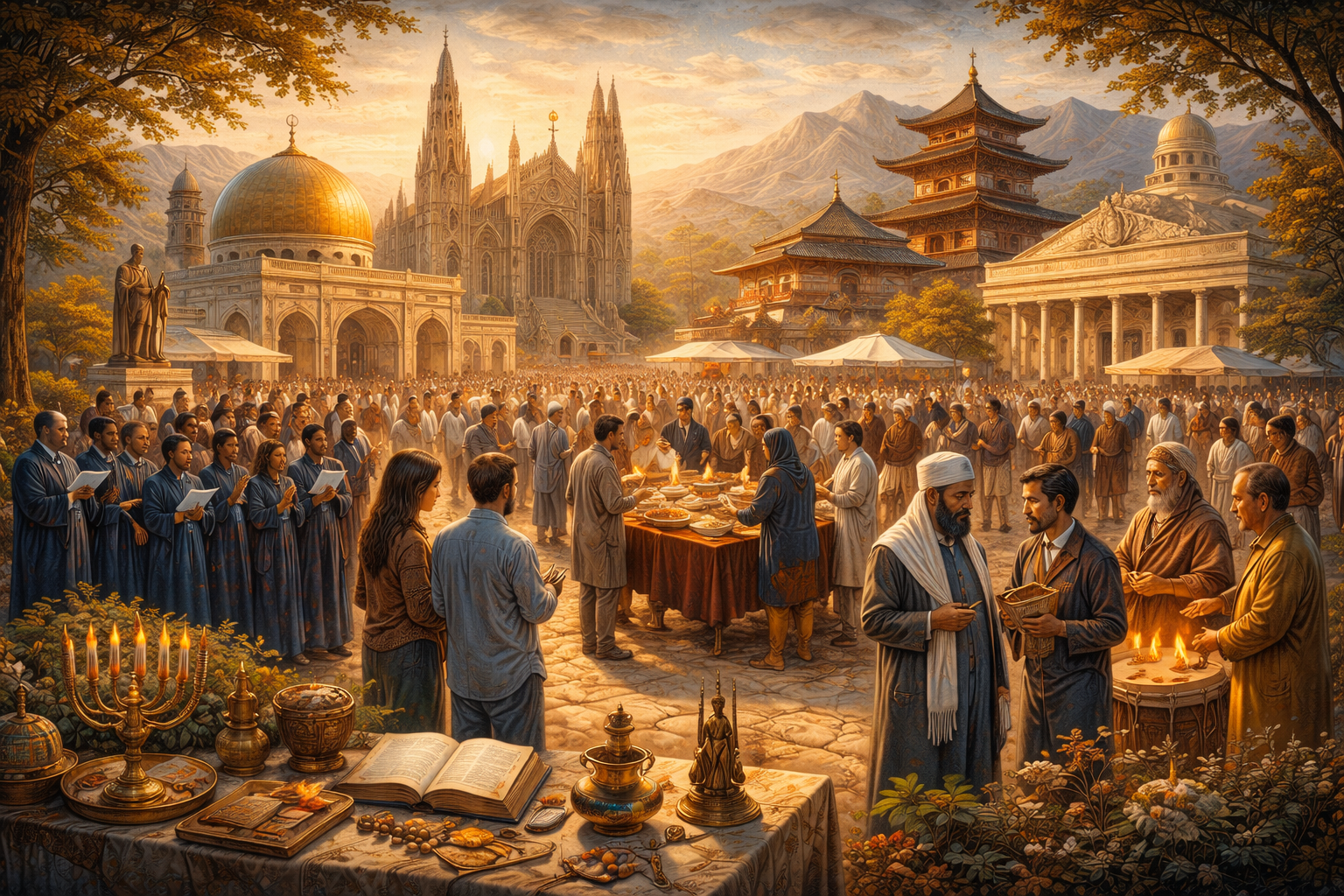
Religion and Society is especially important to the broader architecture of this site because it connects religion to institutions, power, culture, inequality, public ethics, civic identity, media systems, education, family life, social movements, conflict, reconciliation, migration, and collective memory. In this respect, the category links not only to Foundations of Religion and Comparative Sacred Themes, but also to Global Governance, Philosophy, Religion and Law, Cultural Anthropology, Indigenous and Oral Traditions, Psychology, Institutions & Governance, and Ethics & Moral Philosophy.
The goal of this pillar is not to reduce religion to sociology alone. It is to take seriously the fact that religion is always lived in institutions, communities, hierarchies, rituals, bodies, families, public spaces, media environments, legal arrangements, and social struggles. Sacred claims do not remain abstract. They move through schools, courts, households, festivals, national ceremonies, charitable networks, activist movements, burial practices, public controversies, social boundaries, and inherited moral languages. To study religion socially is not to diminish its sacred claims. It is to understand how those claims move through the world.
This pillar also gives special attention to inequality and power. Religious communities have preserved dignity, memory, care, resistance, and solidarity under conditions of empire, racialization, dispossession, and social exclusion. They have also sanctified hierarchy, patriarchy, caste, nationalism, colonial mission, racial domination, sectarian violence, and the exclusion of minorities. A mature account of Religion and Society must hold both realities together. Religion is not inherently oppressive or inherently liberating. It is a powerful social field in which sacred meaning, institutional authority, moral imagination, and historical power converge.
Why Religion and Society Matter
Religion and Society matters because religion is never only private conviction. It creates moral communities, organizes calendars, marks transitions of birth and death, legitimates institutions, shapes kinship, structures education, defines authority, and gives symbolic force to both hierarchy and solidarity. Religious worlds do not merely sit inside society; they help produce it. They offer languages of belonging, purity, responsibility, justice, salvation, repentance, dignity, obligation, exclusion, and hope that can bind communities together or divide them sharply.
This matters even where formal belief declines. Religious inheritances often outlast explicit devotion. They remain in legal frameworks, public ceremonies, architecture, national myth, moral vocabulary, educational structures, family expectations, memorial rituals, public holidays, and assumptions about what kinds of persons and families count as normal. The social study of religion therefore includes both active religion and sedimented religious history. It studies churches, mosques, synagogues, temples, shrines, monasteries, rituals, movements, and schools, but also the religious residues embedded in supposedly secular institutions.
Religion and Society also matters because religion is one of the major ways communities confront suffering, death, guilt, injustice, loss, and historical trauma. Funerals, memorials, repentance rituals, pilgrimage, fasting, charity, martyr remembrance, holy days, public mourning, and social service all show that religion is deeply involved in how societies make suffering meaningful. It can comfort, organize, mobilize, and repair. It can also intensify resentment, justify violence, and sacralize grievance.
For that reason, Religion and Society belongs near the center of Religious Studies. It is where sacred claims become institutions, identities, public controversies, family structures, educational systems, moral movements, and lived structures of power. The category shows that religion must be studied not only as belief, text, or doctrine, but as organized social life.
Religion as a Social Institution
Religion is one of the great social institutions through which human beings organize meaning, obligation, memory, and belonging. Like family, law, economy, and education, religion provides patterned structures that shape conduct across generations. It does so through ritual repetition, sacred authority, institutional continuity, public symbols, moral teaching, sacred time, and the ability to distinguish between what is ordinary and what is set apart as holy, forbidden, blessed, impure, ancestral, or binding.
This institutional quality matters because it prevents religion from being reduced to interior feeling. A religion persists because it is taught, embodied, funded, administered, celebrated, transmitted, contested, and defended. Temples, churches, mosques, synagogues, shrines, schools, monasteries, councils, charitable networks, ritual specialists, pilgrimage systems, cemeteries, publishing houses, media platforms, and community organizations all give visible shape to what might otherwise appear as private belief alone.
Religious institutions also shape social authority. They decide who may teach, preach, bless, interpret, initiate, marry, bury, discipline, exclude, reconcile, or represent the community. These decisions are never merely administrative. They structure access to sacred power, moral legitimacy, social recognition, and communal memory. Institutional religion can preserve continuity and care, but it can also consolidate elite control and silence dissent.
To understand religion socially, then, is to understand how the sacred is stabilized through institutions capable of surviving beyond any single individual experience. The social question is not only what religion means, but how meaning becomes durable, organized, and publicly consequential.
The Sacred, the Social, and the Problem of Definition
One of the enduring questions in the study of religion is whether religion should be defined by belief in supernatural beings, by relation to transcendence, by ritual, by moral community, by ultimate concern, by sacred law, by embodied practice, or by symbolic systems that organize experience. A social approach complicates all simple answers. Religion is not just what individuals think. It is what communities mark, protect, celebrate, regulate, fear, transmit, and treat as sacred.
This makes the category difficult but productive. The sacred may appear in gods, ancestors, texts, relics, rituals, land, law, nation, martyrdom, memory, moral absolutes, bodily purity, pilgrimage, graves, holy days, or public sacrifice. Some traditions are highly theistic; others are ritual, ethical, ancestral, cosmological, contemplative, or civilizational in ways that challenge narrow definitions. The social study of religion therefore has to remain open to multiple forms of sacralization.
At the same time, not every shared value is religion. The category becomes too weak if everything meaningful becomes religious. The social study of religion must therefore ask how communities distinguish sacred from ordinary, ultimate from negotiable, pure from polluted, obligatory from optional, and protected from profane. The point is not to impose one definition across all traditions, but to study how communities themselves construct binding significance.
Done well, this prevents the pillar from becoming merely denominational or narrowly theological. It allows religion to be studied as a pattern of collective life structured by symbols, prohibitions, institutions, rituals, authorities, memories, and forms of meaning that bind people to one another and to what they understand as sacred.
Ritual, Community, and Belonging
Ritual is one of the main ways religion becomes social. Through repeated gesture, chant, pilgrimage, feast, sacrifice, fasting, mourning, initiation, confession, washing, procession, blessing, and commemorative gathering, individuals are formed into communities and communities are reminded of what they hold sacred. Ritual joins body, memory, time, and social order. It teaches people not only what to believe, but how to stand, speak, eat, mourn, celebrate, repent, forgive, remember, and belong.
This matters because belonging is rarely produced through doctrine alone. Communities endure because they gather, repeat, remember, and embody a shared symbolic world. Ritual also draws boundaries. It distinguishes insiders and outsiders, purity and pollution, ordinary time and sacred time, lawful action and prohibited conduct, living community and ancestral memory. Through ritual, social life becomes morally and cosmologically patterned.
Ritual also makes religion public. It places sacred meaning into streets, homes, schools, cemeteries, courts, public squares, processions, festivals, hospitals, battlefields, and national ceremonies. Even private rituals are socially shaped because they are learned through inherited forms. Ritual is therefore one of the deepest bridges between inner meaning and collective life.
For the broader site, this branch links directly to Foundations of Religion, Indigenous and Oral Traditions, and Mysticism and Contemplative Traditions. It shows how religious life is enacted collectively rather than merely affirmed intellectually.
Religion, Family, and the Ordering of Life
Family is one of the primary sites where religion enters social life. Through naming, marriage, inheritance, food, mourning, childrearing, gender expectations, ancestor memory, household ritual, sexuality, kinship obligations, and intergenerational teaching, religion shapes the smallest and most persistent social unit. It does so not only through doctrine, but through ordinary repetition: who speaks, who leads, how meals are marked, how children are disciplined, how grief is honored, and how obligations across generations are understood.
This branch matters because family is also where religious continuity is most often reproduced. Communities survive not simply because sacred texts exist, but because ways of life are transmitted through households, kinship networks, domestic memory, language, festival practice, and everyday discipline. A child learns religion not only through formal instruction, but through food, clothing, prayer, song, story, gesture, calendar, and the moral expectations of family life.
At the same time, family is a major site of contest over authority, gender, sexuality, inheritance, divorce, marriage recognition, reproductive ethics, and the legal recognition of religious norms. Religious traditions often treat family as sacred continuity, while those excluded or subordinated within family structures may experience the same arrangements as domination. A serious pillar must therefore treat family as both a site of care and a site of power.
Religion and family belong together in any serious social treatment of religion. They reveal how sacred order becomes intimate, inherited, embodied, and everyday.
Religion, Education, and Socialization
Religion has long shaped education, not only through formal schools but through catechesis, memorization, moral instruction, apprenticeship, liturgical participation, sacred language, Qur’an schools, yeshivas, seminaries, Sunday schools, monastic training, temple education, gurukula traditions, missionary schools, Indigenous elder teaching, and household instruction. Religious communities socialize members by forming imagination, posture, conduct, memory, and moral identity as much as by transmitting propositions. Education is therefore one of the main mechanisms through which religions reproduce themselves socially.
This matters because schooling is never only about literacy or information. It forms citizens, moral subjects, and collective identity. Religious education can sustain minority continuity, preserve language, authorize moral worlds, and resist assimilation. It can also reproduce hierarchy, exclusion, sectarian closure, gendered limitation, colonial discipline, or ideological control. The social meaning of religious education depends on who teaches, what is taught, whose authority is recognized, and how education relates to state power.
Religion and education are especially charged in plural societies. Public schools must decide how to handle religious holidays, dress, dietary practice, prayer, curriculum, sexuality, history, science, and moral instruction. Religious communities must decide how much engagement with broader society is acceptable. Parents, children, religious authorities, and states may all claim different rights over formation.
For this site, religion and education create strong bridges to Religion and Law, Psychology, and Global Governance, especially where public schooling, parental rights, minority protection, and state authority come into conflict with religious inheritance.
Religion, Power, and Social Hierarchy
Religion frequently legitimates social hierarchy even as it can also challenge it. Sacred narratives may authorize rulers, sanctify priesthoods, naturalize caste, dignify patriarchy, racialize chosenness, moralize poverty, or encode systems of purity and exclusion. At the same time, religion can also produce prophetic critique, anti-imperial witness, egalitarian movements, abolitionist energies, anti-caste struggle, liberation theology, and moral arguments against domination. This ambivalence is one of the defining features of religion in society.
This matters because religion is never outside power. It shapes who may speak, who is recognized as pure or impure, which bodies are honored or subordinated, which histories are remembered, and what forms of authority appear natural. Religious institutions can preserve order and justify violence, but they can also mobilize conscience against entrenched injustice. The same sacred vocabulary may be used to defend hierarchy in one setting and to challenge oppression in another.
In colonial settings especially, religion often became a key technology of rule. Missionaries, schools, conversion regimes, marriage law, moral discipline, civilizational rankings, and religious classifications were used to reorder subject populations and classify them within imperial hierarchies. Colonized peoples were often governed not only as political subjects but as religious and civilizational objects to be corrected, converted, assimilated, or contained.
A mature pillar on Religion and Society must therefore treat religion not as inherently oppressive or inherently liberating, but as a socially powerful field capable of reinforcing and contesting hierarchy at once. It must also be honest that hierarchy is not always an accidental byproduct. In many cases it is produced, defended, normalized, and sacralized through religious language itself.
Religion, Class, and Economic Life
Religion shapes economic life in multiple ways: through teachings on work, wealth, charity, debt, usury, almsgiving, tithing, zakat, stewardship, hospitality, asceticism, patronage, prosperity, labor, Sabbath, fair trade, poverty, and the moral legitimacy of accumulation. Religious institutions also hold property, organize redistribution, fund schools, sustain hospitals, support charities, structure landholding, shape labor ethics, and sometimes legitimize class order. Economic life is therefore not external to religion. It is frequently moralized by it.
This branch matters because class is not only an economic reality but also a moral and symbolic one. Religious communities may soften class difference through charity and solidarity, or they may sanctify wealth, suffering, and hierarchy in ways that stabilize unequal structures. Religious movements can become vehicles of labor justice, agrarian resistance, anti-capitalist critique, prosperity theology, elite reproduction, or welfare provision depending on context.
Religious charity also has a double social character. It can meet real needs and create networks of care where states or markets fail. But charity can also preserve dependency, paternalism, or moral hierarchy if it does not address structural causes of poverty. The distinction between charity, justice, redistribution, and social repair is therefore crucial.
For comparative study, this branch helps reveal how religion enters the material ordering of society rather than floating above it as pure ideal. Sacred meaning moves through money, labor, property, debt, giving, hunger, and the moral imagination of economic life.
Religion, Race, Ethnicity, and Peoplehood
Religion is often inseparable from peoplehood. It can bind communities through shared memory, sacred ancestry, language, liturgy, suffering, migration, territory, and collective destiny. It can also become entangled with race and ethnicity in ways that shape who is seen as native, alien, chosen, assimilable, dangerous, civilized, backward, loyal, or fully human. In many societies, religion and ethnicity are not cleanly separable categories; they co-produce one another.
This matters because minority religions are often racialized, and ethnic identities are often sacralized. Empires and nation-states alike have used religion to classify populations, rank civilizational worth, and determine who belongs within the moral core of the polity. Colonial systems frequently treated Indigenous, African, Asian, Jewish, Muslim, and other religious communities not simply as believers with different doctrines, but as civilizational problems to be governed, converted, segregated, surveilled, or erased. Religion in such contexts became part of a wider grammar of racial hierarchy and administrative domination.
At the same time, religious communities have often served as shelters of memory and dignity under racialized oppression. Black churches, synagogues in exile, Muslim diasporic institutions, Indigenous ceremonial worlds, Dalit religious movements, and other communities have preserved peoplehood under conditions of dispossession and social degradation. Religion can harden boundaries, but it can also carry survival, resistance, and communal self-recognition when dominant society denies both.
This branch is especially important for the site’s broader attention to unequal power, marginalization, and the historically differentiated treatment of communities under law and social order. Religion and race cannot be treated as adjacent topics. In many contexts they are structurally fused.
Religion, Gender, and the Regulation of Bodies
Religion has long shaped gender roles, bodily discipline, family order, reproduction, sexuality, modesty, purity, clerical office, domestic labor, inheritance, marriage, dress, and the symbolic status of women and men in communal life. It often does so through ritual, law, dress codes, purity systems, teachings on marriage, and inherited patterns of authority. Bodies become socially meaningful through religious norm.
This matters because gender is one of the most persistent sites where religious authority is both defended and contested. Religious communities may present gendered order as sacred continuity, while reformers, dissidents, and marginalized members experience the same order as domination or exclusion. The result is not one fixed pattern, but a continuing struggle over embodiment, dignity, authority, and the lawful or moral shape of communal life.
Women have also been among the major makers and carriers of religious society. They transmit ritual in households, preserve songs and stories, sustain devotional practice, lead reform movements, build charitable networks, teach children, organize community life, and generate theological critique. A social account of religion that studies only male clerics, official institutions, or formal doctrine will miss much of how religion is actually reproduced.
For this pillar, the point is not to flatten all traditions into one story, but to show how religion participates in the social regulation of bodies and how those regulations become sites of conflict, continuity, reform, care, and change.
Religion, Nationalism, and Civil Religion
Religion and nation are among the most powerful social combinations in modern history. States borrow sacred symbols, martyrs, rituals, providential narratives, and collective myths to present themselves as morally meaningful communities rather than mere administrations of power. This is one of the central dynamics of civil religion: the sacralization of public order through ceremony, memory, sacrifice, founding myth, constitutional reverence, and symbolic destiny.
This matters because nationalism often operates through religious form even when it claims secular legitimacy. National holidays, monuments, flags, military sacrifice, founding documents, civic oaths, public mourning, and national memorials can function with quasi-sacred force. In other contexts, explicit majoritarian religion fuses with state identity, making minorities appear less fully national and casting dissent as sacrilege rather than political disagreement.
The fusion of religion and nationalism becomes especially dangerous when the sacred is used to naturalize territory, majority rule, or civilizational entitlement. Then religious memory is converted into a weapon of exclusion. Minorities are no longer merely different; they are imagined as threats to the sacred body of the nation. Colonial and postcolonial histories intensify this dynamic. States emerging from empire often define authenticity through majority religion, while minorities carry the burden of proving loyalty within a national story that was never written for them.
A strong Religion and Society pillar must therefore treat civil religion and religious nationalism not as abstractions, but as concrete social forces that organize school curricula, memorial cultures, public mourning, citizenship norms, border politics, and the moral boundaries of belonging.
Religion, Media, and the Public Sphere
Religion is never only inherited through temple, family, school, or congregation. It also circulates through print, broadcast, film, music, social media, podcasts, livestreaming, public controversy, influencer culture, and digital networks. Media transform the scale and style of religious authority. Sermons become content, ritual becomes spectacle, debate becomes algorithmic, testimony becomes shareable, and communities become simultaneously local and transnational.
This matters because media do not merely transmit religion; they reshape it. They alter who can speak, how charisma is perceived, how controversy spreads, how authority is challenged, and how religious identity is performed publicly. Digital media can expand access to teaching, sustain diasporic communities, and amplify marginalized religious voices. It can also intensify conspiracy, sectarian hostility, spiritual commodification, harassment, and algorithmic polarization.
The public sphere is therefore not a neutral arena into which religion enters unchanged. It is one of the conditions under which modern religious life is produced. A tradition that once depended on local authority may now be shaped by distant preachers, viral clips, digital archives, online communities, and global controversy. Authority becomes more distributed, but not necessarily more accountable.
For this site, religion and media also provide an important bridge to content systems, narrative power, information integrity, and the social circulation of belief and conflict. Religion in modern society must be studied through platforms as well as pulpits.
Religion, Pluralism, and the Management of Difference
Plural societies must decide how religious difference will be lived. Toleration, accommodation, neutrality, privatization, multicultural recognition, majoritarian privilege, secular assimilation, and coercive exclusion are all possible responses. None is neutral in practice. Each reflects judgments about what counts as acceptable public religion, whose customs are protected, and whether minority visibility is treated as enrichment or threat.
This matters because pluralism is not only a moral ideal but an institutional problem. Shared cities, schools, workplaces, cemeteries, public holidays, dress norms, dietary practices, prisons, hospitals, and legal rules require actual management. Religion becomes social conflict not simply because difference exists, but because institutions distribute recognition unequally. A majority religion may move invisibly through calendars, architecture, school routines, and assumptions about public order, while minority religions are forced to appear as requests, exceptions, or disruptions.
Pluralism is therefore always structured by power. Colonial regimes often classified communities into administratively manageable religious blocs, hardening identities that had once been more fluid or differently organized. Postcolonial states frequently inherited these legal and bureaucratic templates, reproducing unequal recognition under new national banners. The management of difference is thus rarely innocent. It often bears the sediment of older domination.
A serious Religion and Society pillar must therefore address pluralism not romantically but politically and socially. Difference must be lived through structure, not merely praised in rhetoric. The real question is not whether societies say they value pluralism, but whose sacred lives are allowed to appear as normal within the public order.
Secularization, Disenchantment, and Postsecular Society
The secularization thesis once suggested that modernization would steadily reduce religion’s social significance. In some regions, institutional decline and privatization seemed to confirm that view. Yet religion has persisted, adapted, re-entered public debate, and in many places grown in new forms. This has led to more complicated accounts of secularization, disenchantment, and so-called postsecular society.
This matters because religion’s social role cannot be measured only by attendance or formal belief. Religious symbols, moral languages, political mobilizations, educational institutions, media networks, spiritual practices, civil religious ceremonies, and collective memories often remain potent even where institutional participation weakens. Secular society is not simply religion’s absence. It is often a reordered field in which religion still acts under altered conditions.
Secularization also does not unfold evenly across the world. European patterns differ from American, Middle Eastern, South Asian, East Asian, African, Latin American, and Indigenous contexts. In some settings, secularism limits religious authority; in others, it manages religious difference; in still others, it becomes a civilizational identity or a tool of state power. Secularism itself must therefore be studied socially and historically.
For comparative analysis, this means secularization must be treated as uneven, regional, contested, and historically specific rather than as a universal law of development. Religion and Society is the pillar where those differences can be studied without assuming that modernity has one single religious outcome.
Religion, Conflict, Violence, and Peacebuilding
Religion can intensify conflict by sacralizing identity, territory, grievance, martyrdom, honor, purity, revenge, and exclusion. It can also sustain reconciliation, nonviolence, forgiveness, moral courage, and peacebuilding through ritual repair, moral authority, shared memory, and community leadership. Religion is therefore neither simply cause nor cure. It is a force multiplier whose effects depend on institutional context, political structure, leadership, social history, and the conditions of power.
This matters because modern public discourse often oscillates between blaming religion for violence and romanticizing it as a source of peace. Both are inadequate. Religious traditions can be mobilized for hatred, but they can also provide some of the deepest languages for dignity, coexistence, repentance, hospitality, and social repair. What matters socially is how religion is embedded in structures of dispossession, state formation, minority status, memory, fear, and political opportunity.
Conflict framed as religious is often inseparable from colonial borders, ethnic ranking, legal asymmetry, land theft, settler rule, class violence, imperial intervention, or state collapse. Religion provides the symbols, martyrs, sacred geographies, and moral intensity through which these conflicts are lived, remembered, and justified. To say religion is involved is not to say religion is the sole cause. It is to recognize that sacred meaning can magnify political fracture and make compromise appear like betrayal of the holy.
At the same time, peacebuilding through religion is real when communities retain moral authority, shared ritual forms, and traditions of repentance or mutual recognition. But even here the question is not abstract peace. It is whether religious actors are willing to confront the histories of domination in which their own institutions may be implicated.
Religion, Social Movements, and Moral Change
Religion has often served as a vehicle for social movements, reform, abolition, anti-colonial struggle, labor activism, civil rights, women’s organizing, anti-caste struggle, Indigenous resurgence, environmental justice, refugee solidarity, and movements for dignity among marginalized peoples. At other times, it has defended existing power. The point is not that religion always liberates, but that it provides moral language, institutional infrastructure, memory, discipline, sacrifice, music, ritual, and symbolic force that movements can mobilize.
This matters because moral change rarely happens through abstract theory alone. It requires communities, rituals, trusted language, sacrifice, and narratives of justice. Religious traditions often supply those materials in concentrated form. They can authorize prophetic critique against systems that other institutions normalize. Black church traditions, liberationist movements, anti-colonial religious networks, Indigenous ceremonial revival, anti-caste religious thought, and other forms of sacred organizing all show that religion can be a carrier of historical memory against official forgetting.
Yet religion is not automatically on the side of emancipation. The same institutions that mobilize resistance may reproduce patriarchy, nationalism, caste, sectarianism, ableism, class hierarchy, or moral exclusion. For that reason, the study of religion and social movements must keep power in view. What kinds of change are imagined as holy, and whose freedom is left out of that moral imagination?
For the broader site direction, this branch is especially important because it highlights religion as a field in which power, resistance, and moral imagination meet. It is one of the clearest places where sacred language enters history as organized social force.
Religion, Globalization, and Transnational Life
Religion today moves across borders through migration, diaspora, digital communication, humanitarian networks, pilgrimage, education, missionary activity, remittances, publishing, translation, social media, and transnational institutions. Globalization does not dissolve religion into sameness. It often intensifies identity, multiplies hybrid forms, and relocates traditions into new legal, linguistic, and political settings.
This matters because religious communities increasingly live between national orders. A congregation may be shaped by one homeland, funded from another, taught through media from a third, and governed by laws in a fourth. Religion becomes transnational social life rather than merely local inheritance. Diasporic religion in particular often carries both preservation and reinvention: sacred memory becomes portable, but it is also reworked under new conditions of minority existence.
Globalization also reproduces inequality. Wealthy religious institutions circulate resources, media, missionaries, and influence at scales unavailable to poorer communities. States differentially monitor religious mobility depending on whose networks are seen as benign, suspect, civilized, extremist, traditional, or dangerous. Muslim, African, Indigenous, migrant, refugee, and other communities are often positioned very differently within global narratives of security, development, and legitimacy.
This branch therefore connects strongly to Global Governance and helps position the pillar within a world of migration, pluralism, border regimes, digital media, and contested belonging. Religion in modern society cannot be understood only through national sociology. It must also be read through empire, diaspora, transnational asymmetry, and global circulation.
Religion, Charity, Care, and Social Repair
Religion has long organized care. Temples, churches, mosques, synagogues, monasteries, shrines, confraternities, religious charities, hospitals, mutual aid societies, food distribution networks, orphan care, burial societies, and disaster relief organizations have all made religion socially consequential through service. Care is one of the main ways religion becomes public without necessarily becoming state power.
This matters because religious care is not only practical assistance. It expresses moral anthropology: who is the neighbor, who is the stranger, who deserves mercy, what is owed to the poor, how suffering should be understood, and whether charity is a gift, duty, justice, penance, purification, or solidarity. Religious traditions often preserve deep languages of obligation toward the vulnerable, but they differ in how they understand the relation between charity and structural justice.
Care can also become paternalistic, conditional, proselytizing, or entangled with hierarchy. Missionary charity, colonial schooling, and religious welfare institutions have sometimes served both genuine need and systems of domination. The social study of religion must therefore ask how care is organized, who controls it, whose dignity is preserved, and whether assistance becomes a form of dependency or liberation.
This section links Religion and Society to Healing Traditions, Religion and Law, Stewardship Ethics, and Ethics & Moral Philosophy. It shows that religion’s social power is not only symbolic or political; it is also materially caring, institutionally embodied, and morally contested.
Religion and Society in Comparative Perspective
Religion and Society is indispensable to comparative inquiry because it reveals both recurring structures and civilizational difference. Ritual, community, family order, authority, symbolic boundary, minority status, sacred memory, social discipline, and public identity recur across traditions. Yet the ways these are organized vary sharply across Indigenous, Abrahamic, South Asian, East Asian, African, diasporic, and secular-modern contexts.
Comparative study must therefore resist both flattening and fragmentation. It must notice recurring social functions of religion without assuming that all religions produce the same kinds of societies or the same relations to law, family, gender, state, media, and public life. The point is not to force uniform theory, but to understand how religious worlds become social orders under different historical conditions.
It must also reckon with asymmetry. Religions do not enter modernity, empire, law, or global circulation on equal terms. Some are treated as heritage, some as danger, some as civilization, some as superstition, some as private preference, some as national essence, and some as permanent minorities. A serious comparative approach must therefore include not only structure and symbolism, but unequal power.
This makes Religion and Society one of the central pillars in the larger knowledge architecture. It is where sacred meaning enters institutions, conflict, identity, inequality, public ethics, and everyday life.
Major Questions of Interpretation
This pillar is organized around several major questions. How does religion become social life? How do rituals, institutions, families, schools, media systems, and public symbols transmit religious worlds across generations? How do communities define belonging, purity, authority, memory, and moral order? How does religion shape the formation of persons, families, publics, nations, and social movements?
The pillar also asks how religion works through power. How does sacred language legitimate hierarchy, race, class, caste, gender, nationalism, and empire? How does it also generate critique, resistance, solidarity, abolition, anti-colonial struggle, social care, and moral reform? How do marginalized communities use religion to preserve memory, dignity, and collective survival?
Finally, the pillar asks how religion persists under modern conditions. What happens to religion under secularization, globalization, migration, media transformation, legal pluralism, and postcolonial state formation? How do traditions adapt when moved across borders, translated into new languages, monitored by states, or circulated through platforms?
These questions keep Religion and Society from becoming a narrow sociology of belief. The category studies religion as lived social architecture: symbolic, institutional, embodied, contested, and historically consequential.
Religion and Society Pillar Map
The following article map is designed as a serious research agenda for the Religion and Society pillar, with emphasis on institutions, identity, inequality, public life, social formation, pluralism, conflict, media, migration, and comparative depth.
Religion and Society is organized to move from foundational questions about religion as social institution into ritual, family, education, hierarchy, class, race, gender, nationalism, media, pluralism, secularization, conflict, social movements, globalization, care, and comparative public life. The goal is to show how religion becomes lived social order while preserving the specificity of traditions, institutions, communities, and historical inequalities.
Foundational Frames
- What Is Religion and Society? (planned)
Introduces the category as the study of religion as lived community, institution, public meaning, social power, and collective memory. - Religion as a Social Institution (planned)
Explains how religious traditions persist through organizations, rituals, schools, authorities, buildings, calendars, and inherited practices. - The Sacred, Community, and Social Order (planned)
Studies how communities define sacred meaning and translate it into social boundaries, obligations, and forms of belonging. - Religion Beyond Private Belief (planned)
Challenges the reduction of religion to individual conviction by foregrounding ritual, institution, body, law, memory, and public life. - How Religion Becomes Social Architecture (planned)
Explores religion as a structure that organizes time, space, authority, kinship, moral identity, and collective action.
Institutions and Everyday Life
- Ritual, Community, and Belonging (planned)
Studies ritual as embodied social formation through repetition, gesture, sacred time, gathering, and shared memory. - Religion and Family Life (planned)
Examines how religion shapes naming, marriage, childrearing, inheritance, domestic ritual, mourning, and kinship obligation. - Religion and Education (planned)
Explores religious schooling, moral formation, sacred language, memorization, catechesis, and public education conflicts. - Religion, Death, and Collective Memory (planned)
Studies funerals, mourning, ancestors, martyrdom, memorials, cemeteries, and the social life of the dead. - Religion, Food, Calendar, and Everyday Discipline (planned)
Examines dietary practice, fasting, feast days, Sabbath, pilgrimage seasons, and the religious ordering of ordinary life. - Religious Institutions, Authority, and Community Continuity (planned)
Studies churches, mosques, temples, synagogues, monasteries, shrines, councils, and community organizations as durable social forms.
Power and Social Structure
- Religion and Social Hierarchy (planned)
Explores how religion legitimates, naturalizes, contests, or reforms social hierarchy across different traditions. - Religion, Class, and Economic Order (planned)
Studies work, wealth, charity, debt, almsgiving, class formation, prosperity, poverty, and economic morality. - Religion, Race, and Peoplehood (planned)
Examines the fusion of religion, ethnicity, racialization, sacred ancestry, minority identity, and collective survival. - Religion, Gender, and the Social Regulation of Bodies (planned)
Studies gender, sexuality, dress, purity, family authority, clerical office, reproduction, and embodied religious normativity. - Religion, Caste, and Social Exclusion (planned)
Examines caste, purity, hierarchy, anti-caste critique, religious reform, and the social reproduction of inequality. - Religion, Disability, Illness, and Social Belonging (planned)
Explores how traditions interpret disability, illness, care, healing, stigma, dignity, and communal inclusion.
Religion in Public Life
- Religion and National Identity (planned)
Studies how nations use religious memory, symbols, rituals, and majority identities to define belonging. - Civil Religion and the Sacred Nation (planned)
Explores public rituals, monuments, founding myths, national sacrifice, constitutional reverence, and civic sacralization. - Religion, Media, and the Public Sphere (planned)
Examines how print, broadcast, film, social media, livestreaming, and digital platforms transform religious authority and conflict. - Religion, Law, and Social Order (planned)
Studies how religion shapes legal norms, family law, public morality, minority recognition, and institutional governance. - Religion, Public Ethics, and Civic Life (planned)
Explores religion as a source of moral language in debates over justice, care, dignity, rights, and the common good. - Religion, Architecture, and Public Space (planned)
Studies sacred buildings, monuments, processions, zoning conflicts, urban visibility, and the spatial politics of religion.
Pluralism, Conflict, and Change
- Religious Pluralism and Social Cohesion (planned)
Examines how societies manage religious difference through toleration, accommodation, secularism, multiculturalism, or exclusion. - Religion, Violence, and Peacebuilding (planned)
Studies religion as a force in conflict, reconciliation, peacebuilding, memory, and moral repair. - Religion and Social Movements (planned)
Explores abolition, civil rights, anti-colonial struggle, liberation theology, anti-caste activism, and religious social reform. - Religion, Tolerance, and the Management of Difference (planned)
Studies tolerance as an institutional practice shaped by power, recognition, majority norms, and minority vulnerability. - Religion, Colonialism, and Social Classification (planned)
Examines how colonial states classified, governed, converted, racialized, and administratively managed religious communities. - Religion, Memory, and Historical Trauma (planned)
Studies how religious communities remember violence, dispossession, exile, martyrdom, genocide, and survival.
Modernity and Transnational Life
- Secularization and Its Discontents (planned)
Explores the uneven decline, transformation, privatization, and public return of religion under modern conditions. - Postsecular Society (planned)
Studies the persistence and reconfiguration of religion in societies that imagined themselves as secular. - Religion in Global and Diasporic Worlds (planned)
Examines migration, diaspora, transnational networks, remittances, media, and portable religious memory. - Religion, Migration, and Transnational Identity (planned)
Studies how migrant communities rebuild religion under new legal, linguistic, racial, and social conditions. - Digital Religion and Platformed Community (planned)
Explores online worship, digital authority, religious influencers, algorithmic publics, and platform-mediated belonging. - Religion, Security, and Global Suspicion (planned)
Examines surveillance, counterterrorism, racialized religion, border regimes, and the unequal treatment of religious mobility.
Care, Charity, and Social Repair
- Religion, Charity, and the Moral Economy of Care (planned)
Studies charity, almsgiving, tithing, zakat, service, mutual aid, and the moral organization of care. - Religious Hospitals, Schools, and Welfare Institutions (planned)
Examines the institutional role of religious communities in health, education, social services, and public welfare. - Religion, Disaster Relief, and Humanitarian Action (planned)
Studies faith-based response to crisis, disaster, displacement, famine, war, and social emergency. - Religion, Social Repair, and Restorative Memory (planned)
Explores ritual repair, apology, repentance, restitution, reconciliation, and historical accountability. - Religion, Poverty, and Structural Justice (planned)
Compares charity, solidarity, redistribution, prophetic critique, and the limits of paternalistic care.
Comparative Themes
- Religion and Society Across Civilizations (planned)
Compares how religious worlds become social orders across Indigenous, Abrahamic, South Asian, East Asian, African, and modern secular contexts. - Sacred Symbol, Social Boundary, and Collective Memory (planned)
Studies how symbols, rituals, sacred sites, stories, and commemorations create social belonging and exclusion. - Religion, Public Ethics, and Social Repair (planned)
Explores religion’s role in moral language, civic responsibility, reconciliation, justice, and care. - Religion, Institution, and the Future of Plural Societies (planned)
Examines how religious institutions may support or undermine plural, accountable, and peaceful societies. - Religion, Power, and the Unequal Public Sphere (planned)
Studies why some religious traditions appear as normal public culture while others are framed as threat, exception, or problem. - Why Religion and Society Still Matter (planned)
Concludes the series by connecting religion’s social power to contemporary questions of identity, justice, conflict, pluralism, and moral change.
This structure allows the category to remain comparative while preserving the internal specificity of traditions, institutions, inequalities, and public formations through which religion becomes social life. It also supports the broader Sustainable Catalyst architecture by linking Religious Studies to Cultural Anthropology, Religion and Law, Global Governance, Institutions and Governance, Psychology, Ethics, and public life.
Closing Perspective
Religion and Society gives Religious Studies one of its most important public-facing frameworks. It shows that religion is not limited to belief, doctrine, scripture, or private devotion. Religion becomes social through institutions, families, schools, rituals, laws, media, economies, nations, social movements, care networks, and public conflicts over belonging. It shapes how communities remember, mourn, celebrate, educate, discipline, exclude, forgive, and imagine justice.
The strongest reason to study this field is that it refuses abstraction. It asks what religion does in the world: how it binds people together, how it marks boundaries, how it gives moral language to suffering, how it organizes hierarchy, how it sustains marginalized communities, how it legitimates power, and how it becomes a force for reform, nationalism, violence, peacebuilding, or social repair. It makes religion visible as lived structure.
For the broader Sustainable Catalyst architecture, this pillar is essential. It strengthens Religious Studies while linking to Global Governance, Cultural Anthropology, Religion and Law, Institutions and Governance, Psychology, Ethics, and Comparative Sacred Themes. Religion and Society shows how sacred meaning enters collective life not as a decorative addition to social order, but as one of the ways societies imagine authority, dignity, belonging, memory, justice, and the moral limits of power.
Related Reading
- Religious Studies
- Foundations of Religion
- Comparative Sacred Themes
- Religion and Law
- Religion and Ecology
- Global Governance
- Institutions & Governance
- Cultural Anthropology
- Culture, Meaning, and Symbolism
- Power, Norms, and Institutions
- Indigenous and Oral Traditions
- Psychology
- Social Psychology
- Ethics & Moral Philosophy
- Political Philosophy and Justice
- Liberation Theology
Primary Texts and Institutional Sources
- Religious community sources: liturgical texts, catechisms, sermons, pastoral letters, community statements, educational curricula, ritual manuals, monastic rules, mosque and church publications, synagogue and temple materials, organizational bylaws, and public teachings issued by religious institutions.
- Legal and public sources: constitutions, religious freedom cases, public policy documents, human rights instruments, education policy, family-law materials, minority recognition frameworks, and public regulations concerning religious institutions, dress, holidays, schooling, burial, or worship.
- International human rights sources: Universal Declaration of Human Rights, especially Article 18; United Nations and OHCHR materials on freedom of religion or belief, equality, minority rights, and non-discrimination; UNESCO materials on tolerance, cultural diversity, and intercultural dialogue.
- Community and movement archives: materials from civil rights movements, liberation theology, anti-colonial religious networks, Indigenous revitalization efforts, interfaith organizations, faith-based charities, religious peacebuilding initiatives, and minority religious communities.
- Media and public-sphere sources: religious newspapers, radio broadcasts, digital sermons, podcasts, livestreamed worship, platform-based religious teaching, public controversies, and faith-based media networks.
Internal Interpretive Traditions
- Religious communities: clerical, communal, educational, ritual, legal, and household authorities who interpret the social shape of religious life.
- Institutional traditions: schools, congregations, monastic communities, charitable networks, councils, seminaries, lineage-based structures, religious courts, and community organizations.
- Public and civic traditions: constitutional, human-rights, interfaith, intercultural, and civic frameworks through which societies interpret religious diversity.
- Social movement traditions: liberation theology, civil rights traditions, anti-colonial religious movements, anti-caste religious thought, Indigenous resurgence, women’s religious organizing, and faith-based justice movements.
- Minority and diaspora traditions: community institutions, language preservation, homeland memory, intergenerational transmission, minority religious education, and diasporic adaptation.
- Digital religious traditions: online worship, platformed authority, digital religious education, transnational religious media, and mediated forms of belonging.
Modern Scholarship
- Berger, P.L. The Sacred Canopy.
- Casanova, J. Public Religions in the Modern World.
- Davie, G. Religion in Modern Europe.
- Durkheim, É. The Elementary Forms of Religious Life.
- Smith, C. Religion: What It Is, How It Works, and Why It Matters.
- Taylor, C. A Secular Age.
- Asad, T. Genealogies of Religion.
- Bellah, R.N. “Civil Religion in America.”
- Habermas, J. Work on religion in the public sphere and postsecular society.
- Mahmood, S. Politics of Piety.
- McGuire, M.B. Lived Religion.
- Orsi, R.A. Between Heaven and Earth.
- Putnam, R.D. and Campbell, D.E. American Grace.
- Warner, R.S. Work on new immigrant religion and congregational life.
- Wuthnow, R. Work on religion, public life, and social change.
Further Reading
- Asad, T. (1993) Genealogies of Religion: Discipline and Reasons of Power in Christianity and Islam. Baltimore, MD: Johns Hopkins University Press.
- Bellah, R.N. (1967) ‘Civil Religion in America’, Daedalus, 96(1), pp. 1–21.
- Berger, P.L. (1967) The Sacred Canopy: Elements of a Sociological Theory of Religion. New York: Anchor Books.
- Casanova, J. (1994) Public Religions in the Modern World. Chicago: University of Chicago Press.
- Davie, G. (2000) Religion in Modern Europe: A Memory Mutates. Oxford: Oxford University Press.
- Durkheim, É. (2008) The Elementary Forms of Religious Life. Oxford: Oxford University Press.
- Habermas, J. (2008) ‘Notes on Post-Secular Society’, New Perspectives Quarterly, 25(4), pp. 17–29.
- Mahmood, S. (2005) Politics of Piety: The Islamic Revival and the Feminist Subject. Princeton, NJ: Princeton University Press.
- McGuire, M.B. (2008) Lived Religion: Faith and Practice in Everyday Life. Oxford: Oxford University Press.
- Orsi, R.A. (2005) Between Heaven and Earth: The Religious Worlds People Make and the Scholars Who Study Them. Princeton, NJ: Princeton University Press.
- Putnam, R.D. and Campbell, D.E. (2010) American Grace: How Religion Divides and Unites Us. New York: Simon & Schuster.
- Smith, C. (2017) Religion: What It Is, How It Works, and Why It Matters. Princeton, NJ: Princeton University Press.
- Taylor, C. (2007) A Secular Age. Cambridge, MA: Harvard University Press.
- Warner, R.S. (1993) ‘Work in Progress Toward a New Paradigm for the Sociological Study of Religion in the United States’, American Journal of Sociology, 98(5), pp. 1044–1093.
- Wuthnow, R. (1988) The Restructuring of American Religion: Society and Faith Since World War II. Princeton, NJ: Princeton University Press.
References
- Asad, T. (1993) Genealogies of Religion: Discipline and Reasons of Power in Christianity and Islam. Baltimore, MD: Johns Hopkins University Press.
- Bellah, R.N. (1967) ‘Civil Religion in America’, Daedalus, 96(1), pp. 1–21.
- Berger, P.L. (1967) The Sacred Canopy: Elements of a Sociological Theory of Religion. New York: Anchor Books.
- Britannica (n.d.) Émile Durkheim. Available at: https://www.britannica.com/biography/Emile-Durkheim (Accessed: 11 April 2026).
- Britannica (n.d.) Social Structure. Available at: https://www.britannica.com/topic/social-structure (Accessed: 11 April 2026).
- Casanova, J. (1994) Public Religions in the Modern World. Chicago: University of Chicago Press.
- Davie, G. (2000) Religion in Modern Europe: A Memory Mutates. Oxford: Oxford University Press.
- Durkheim, É. (2008) The Elementary Forms of Religious Life. Oxford: Oxford University Press.
- Habermas, J. (2008) ‘Notes on Post-Secular Society’, New Perspectives Quarterly, 25(4), pp. 17–29.
- Mahmood, S. (2005) Politics of Piety: The Islamic Revival and the Feminist Subject. Princeton, NJ: Princeton University Press.
- McGuire, M.B. (2008) Lived Religion: Faith and Practice in Everyday Life. Oxford: Oxford University Press.
- OHCHR (n.d.) Freedom of Religion or Belief. Available at: https://www.ohchr.org/en/topic/freedom-religion-or-belief (Accessed: 11 April 2026).
- OHCHR (2018) Rapporteur’s Digest on Freedom of Religion or Belief. Available at: https://www.ohchr.org/Documents/Issues/Religion/RapporteursDigestFreedomReligionBelief.pdf (Accessed: 11 April 2026).
- Orsi, R.A. (2005) Between Heaven and Earth: The Religious Worlds People Make and the Scholars Who Study Them. Princeton, NJ: Princeton University Press.
- Putnam, R.D. and Campbell, D.E. (2010) American Grace: How Religion Divides and Unites Us. New York: Simon & Schuster.
- Smith, C. (2017) Religion: What It Is, How It Works, and Why It Matters. Princeton, NJ: Princeton University Press.
- Taylor, C. (2007) A Secular Age. Cambridge, MA: Harvard University Press.
- UNESCO (1995) Declaration of Principles on Tolerance. Available at: https://www.unesco.org/en/days/tolerance (Accessed: 11 April 2026).
- UNESCO (2021) Cutting Edge: Overcoming Barriers to Peace Through Culture. Available at: https://www.unesco.org/en/articles/cutting-edge-overcoming-barriers-peace-through-culture (Accessed: 11 April 2026).
- United Nations (n.d.) Universal Declaration of Human Rights. Available at: https://www.un.org/en/about-us/universal-declaration-of-human-rights (Accessed: 11 April 2026).
- Warner, R.S. (1993) ‘Work in Progress Toward a New Paradigm for the Sociological Study of Religion in the United States’, American Journal of Sociology, 98(5), pp. 1044–1093.
- Wuthnow, R. (1988) The Restructuring of American Religion: Society and Faith Since World War II. Princeton, NJ: Princeton University Press.