Abrahamic Traditions

Abrahamic Traditions examines the scriptural, theological, legal, and historical worlds associated with Judaism, Christianity, and Islam, with attention to revelation, covenant, prophecy, salvation, law, and community. In the history of ideas, these traditions have contributed profoundly to conceptions of divine authority, moral obligation, sacred history, universal truth, and the relationship between God, humanity, and political order.

This category explores foundational texts such as the Hebrew Bible / Tanakh, the New Testament, and the Qur’an, along with the interpretive traditions, legal systems, doctrinal developments, and communal practices that grew around them. It considers how Abrahamic religions have understood creation, justice, sin, redemption, prophecy, worship, and the formation of collective identity through scripture, commentary, ritual, and institutional life.

Abrahamic traditions play an important role in comparative inquiry because they have shaped vast religious civilizations and influenced law, empire, philosophy, ethics, and global history in enduring ways. By engaging these traditions seriously, this category deepens understanding of monotheism, sacred authority, historical memory, and the moral and political imaginations that continue to influence the modern world.

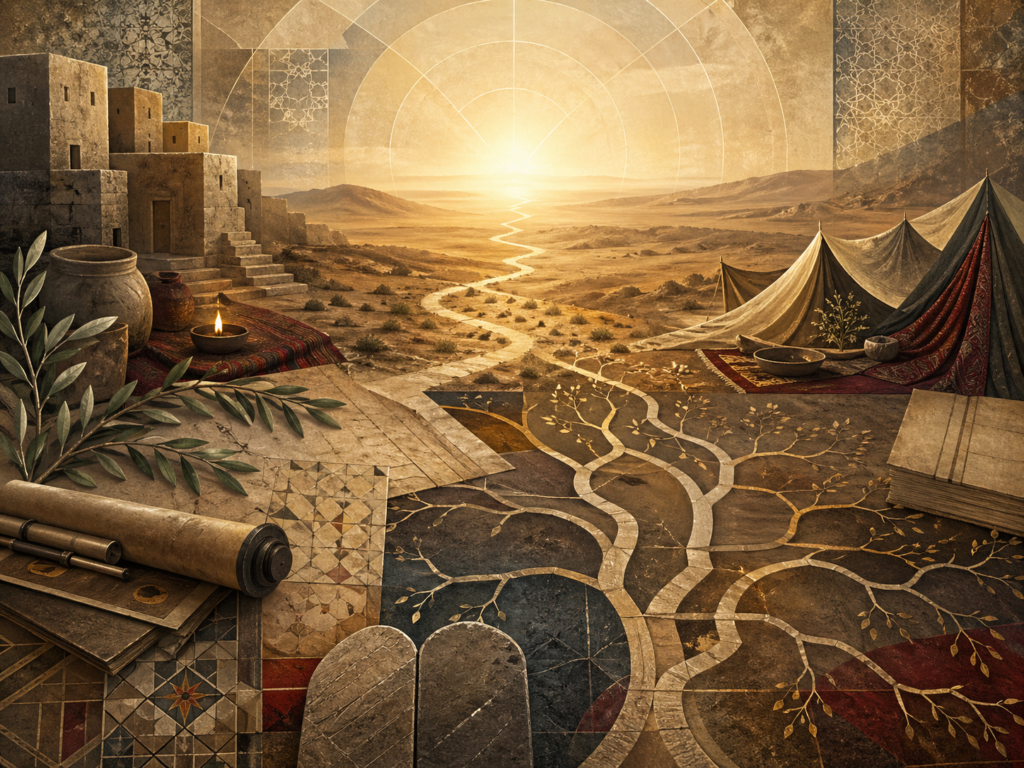
Editorial illustration of Ishmael / Isma‘il and the Ishmaelite covenant line shown through branching desert pathways, a wilderness well, tent-like shelter, manuscripts, stone forms, sacred geometry, and a radiant horizon.

Ishmael (Isma‘il) and the Ishmaelite Covenant Line

Ishmael, known in the Qur’an as Isma‘il, stands in Abrahamic sacred history as son of Abraham, prophet, covenantal heir, ancestor of a great nation, and witness to prayer, sacrifice, patience, and sacred worship. In the Bible, Ishmael is blessed by God and promised fruitfulness, descendants, princes, and nationhood, though the later covenantal line is centered through Isaac. In the Qur’an, Isma‘il is honored as truthful in promise, a messenger and prophet, and one who enjoined prayer and almsgiving on his people. Through a Qur’an-centered comparative lens, this article reads the Ishmaelite line not as a rejected branch, but as a real Abrahamic covenant line leading toward Makkah, the Ka‘bah, prophetic prayer, and the later mission of Muhammad.
Editorial illustration of Lot / Lut and the moral order of community shown through an abstract ancient city divided between fractured darkness and ordered light, with a glowing path, open shelter, manuscripts, stone forms, and a radiant desert horizon.

Lot (Lut) and the Moral Order of Community

Lot, known in the Qur’an as Lut, stands in Abrahamic sacred history as a prophet of moral warning, communal accountability, hospitality, justice, and deliverance. The biblical story of Sodom and Gomorrah remembers a society whose disorder culminates in violence against strangers, while later Jewish and Christian interpretation often connects Sodom with arrogance, injustice, inhospitality, sexual violence, and contempt for the vulnerable. The Qur’an presents Lut as a faithful messenger sent to a people whose corruption is not reducible to one act alone, but includes sexual transgression, highway robbery, public indecency, and organized moral disorder. Through a Qur’an-centered comparative lens, this article reads Lot’s story as a warning about what happens when a community loses reverence for God, hospitality, restraint, justice, and protection of the vulnerable.

Editorial illustration of Abraham / Ibrahim as a shared Abrahamic figure shown through a desert path, luminous horizon, covenantal geometry, tent-like shelter, manuscripts, stone forms, olive leaves, and branching ancestral lines.

Abraham (Ibrahim) as Patriarch, Model of Faith, and Friend of God

Abraham, known in the Qur’an as Ibrahim, stands at the center of the Abrahamic traditions as patriarch, prophet, model of faith, and friend of God. Judaism, Christianity, and Islam all remember him as a foundational figure of trust, covenant, migration, prayer, hospitality, moral testing, and devotion to the One God. In the Bible, Abraham is called from his homeland, receives covenantal promise, welcomes divine visitors, intercedes for others, and becomes ancestor of a people shaped by sacred history. In the Qur’an, Ibrahim is the pure monotheist, opponent of idolatry, builder of sacred worship, spiritual leader, and friend of Allah. Through a Qur’an-centered comparative lens, this article reads Abraham not as the possession of one tradition, but as a shared witness to faith, submission, moral courage, and divine nearness.

Editorial illustration of Noah / Nuh, judgment, and survival shown through an abstract ark-like vessel, stylized floodwaters, radiant guidance, sacred manuscripts, stone tablets, and renewed life.

Noah (Nuh), Judgment, and Survival

Noah, known in the Qur’an as Nuh, stands in the Abrahamic traditions as a figure of warning, patience, judgment, mercy, survival, and moral renewal. The Bible remembers Noah as righteous in a corrupt generation and as the builder of the ark through whom life survives the flood. The Qur’an presents Nuh as a prophet who struggles intensely to reform his people, calling them night and day to serve Allah, seek forgiveness, abandon pride, and return to righteousness. Through a Qur’an-centered comparative lens, this article reads Noah’s flood not as indiscriminate destruction, but as sacred history about moral consequence: evil, injustice, and arrogant rejection of guidance cannot endure, while those who respond to revelation are carried through judgment into renewed life.

Editorial illustration of Enoch / Idris and early sacred wisdom shown through a quiet vertical column of light, layered manuscripts, scrolls, sacred geometry, desert landscape, and spiritual elevation.

Enoch / Idris and Early Sacred Wisdom

Enoch, known in the Qur’an as Idris, stands near the beginning of sacred history as a figure of early wisdom, truthfulness, patience, prophetic dignity, and spiritual elevation. The Bible remembers Enoch as one who “walked with God,” while later Jewish and Christian traditions developed rich interpretations of his ascent, heavenly knowledge, and apocalyptic vision. The Qur’an mentions Idris briefly but powerfully, calling him truthful and a prophet and saying that God raised him to an elevated state. Through a Qur’an-centered comparative lens, this article reads Enoch / Idris not primarily as a figure of speculative heavenly travel, but as an early witness to sacred wisdom: human nearness to God through truth, patience, revelation, moral refinement, and spiritual rank.

Editorial illustration of Adam as a shared Abrahamic figure shown through a luminous garden-desert threshold, tree motif, dust and clay textures, manuscripts, stone tablets, flowing streams, repentance, mercy, and divine guidance.

Adam in the Bible and the Qur’an: Creation, Temptation, Repentance, and Guidance

Adam stands at the beginning of biblical and Qur’anic sacred history as a figure through whom the Abrahamic traditions reflect on creation, human nature, moral knowledge, temptation, repentance, and divine guidance. In Genesis, Adam is the first human placed in Eden, commanded by God, tested through the tree, and drawn into the drama of disobedience, shame, exile, mortality, and human ancestry. In the Qur’an, Adam is also central, but the story is framed less as inherited guilt than as an allegory of human nature, moral struggle, knowledge, repentance, and divine mercy. Through a Qur’an-centered comparative lens, this article reads Adam as a shared Abrahamic figure whose story reveals humanity’s dignity, vulnerability, capacity for knowledge, need for revelation, and continuing struggle to overcome evil.

Editorial illustration of prophecy in the Abrahamic traditions shown as radiant streams of divine guidance flowing through desert pathways, manuscripts, stone tablets, and symbolic sacred history.

What Is Prophecy in the Abrahamic Traditions?

Prophecy is one of the deepest unifying ideas in the Abrahamic traditions. Judaism, Christianity, and Islam all preserve the memory of human beings called by the One God to receive revelation, warn against injustice, restore worship, purify moral life, and guide communities back to truth. This article explains prophecy not primarily as prediction, but as divine guidance entering history through human witnesses. Prophets speak against idolatry, oppression, arrogance, empty ritual, and moral forgetfulness; they call people toward mercy, justice, repentance, law, worship, and accountability before God. Through a Qur’an-centered and comparative Abrahamic lens, the article emphasizes shared prophetic memory across Jewish, Christian, Sunni, Shia, and Islamic traditions while framing differences as interpretive distinctions within a common sacred horizon.

Editorial illustration showing a radiant shared horizon, interwoven sacred pathways, manuscripts, stone-tablet forms, and symbolic landscapes representing monotheism, revelation, and sacred history across Judaism, Christianity, and Islam.

Monotheism, Revelation, and Sacred History

Monotheism, revelation, and sacred history form the shared foundation of the Abrahamic traditions. Judaism, Christianity, and Islam are not unrelated religious systems, but related communities of memory centered on the One God, divine guidance, prophetic witness, covenant, law, worship, mercy, justice, and moral accountability. This article introduces monotheism not as an abstract doctrine alone, but as a way of seeing reality as created, guided, judged, and sustained by God. It treats revelation as the divine address that calls human beings toward truth and righteousness, and sacred history as the moral memory of humanity’s response to that call. Through a Qur’an-centered and comparative Abrahamic lens, it emphasizes continuity across Judaism, Christianity, and Islam while acknowledging interpretive distinctions within a shared sacred horizon.

Editorial illustration showing Judaism, Christianity, and Islam as interwoven Abrahamic traditions through a shared luminous horizon, manuscript forms, sacred pathways, and balanced symbolic landscapes.

The Promise of the Abrahamic Frame: One God, Shared Revelation, and Sacred History

The Abrahamic frame is most powerful when it begins with unity: one God, shared revelation, prophetic memory, covenant, sacred law, mercy, justice, worship, and moral accountability. This article presents Judaism, Christianity, and Islam as related traditions within a shared Abrahamic and Semitic sacred horizon, while still acknowledging their distinct interpretations of scripture, Jesus, Muhammad, law, and sacred history. It emphasizes that the Arabic word Allah is used by Arabic-speaking Muslims, Christians, and Jews, including in Palestine and the wider Arabic-speaking world, and should not be mistaken for a narrowly Muslim deity-name. Through this lens, the Abrahamic frame becomes a discipline of recognition: not erasing difference, but foregrounding the deeper continuity of the One God, shared prophetic inheritance, and sacred moral responsibility.

Scroll to Top