
Abrahamic Traditions

Abrahamic Traditions examines the scriptural, theological, legal, and historical worlds associated with Judaism, Christianity, and Islam, with attention to revelation, covenant, prophecy, salvation, law, and community. In the history of ideas, these traditions have contributed profoundly to conceptions of divine authority, moral obligation, sacred history, universal truth, and the relationship between God, humanity, and political order.

This category explores foundational texts such as the Hebrew Bible / Tanakh, the New Testament, and the Qur’an, along with the interpretive traditions, legal systems, doctrinal developments, and communal practices that grew around them. It considers how Abrahamic religions have understood creation, justice, sin, redemption, prophecy, worship, and the formation of collective identity through scripture, commentary, ritual, and institutional life.

Abrahamic traditions play an important role in comparative inquiry because they have shaped vast religious civilizations and influenced law, empire, philosophy, ethics, and global history in enduring ways. By engaging these traditions seriously, this category deepens understanding of monotheism, sacred authority, historical memory, and the moral and political imaginations that continue to influence the modern world.

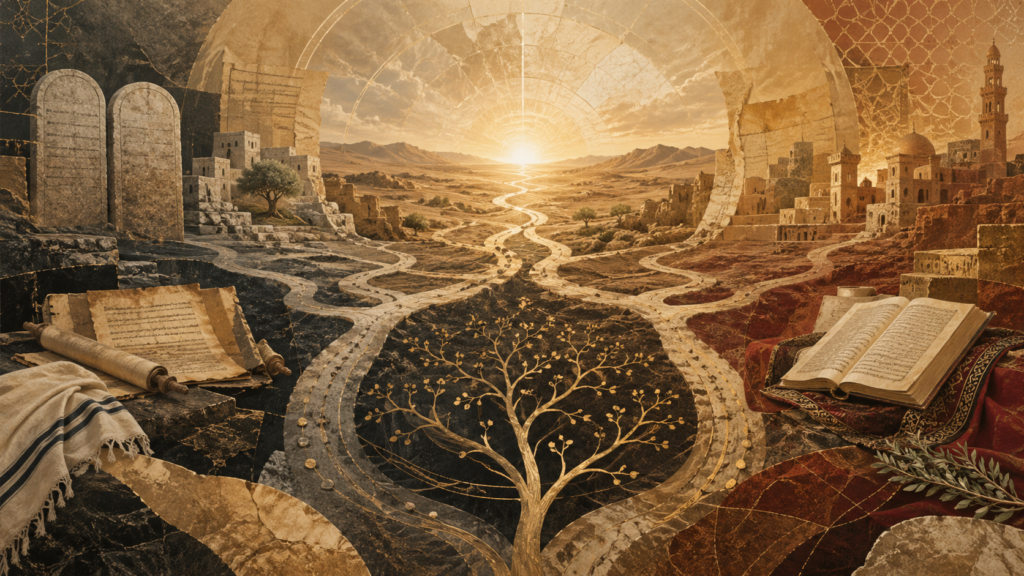
Editorial illustration of Abrahamic covenant and sacred ancestry shown through branching desert pathways, manuscript forms, covenantal light, and a genealogical tree motif across Judaism, Christianity, and Islam.

Abraham, Covenant, and Sacred Ancestry

Abraham stands at the center of Jewish, Christian, and Islamic sacred history as a figure of covenant, migration, trust, sacrifice, ancestry, and moral testing. This article examines Abraham not merely as a genealogical ancestor, but as a spiritual archetype whose legacy is claimed, interpreted, and contested across the Abrahamic traditions. Judaism emphasizes covenantal peoplehood through Isaac and Jacob; Christianity reads Abraham through faith, promise, and fulfillment in Christ; Islam presents Ibrahim as a pure monotheist, prophet, builder of sacred worship, and ancestor of both Israelite and Ishmaelite lines. Through a Qur’an-centered comparative lens, the article argues that Abrahamic ancestry is not only biological descent, but moral inheritance: fidelity to the One God, rejection of idolatry, reverence for revelation, and responsibility before divine judgment.
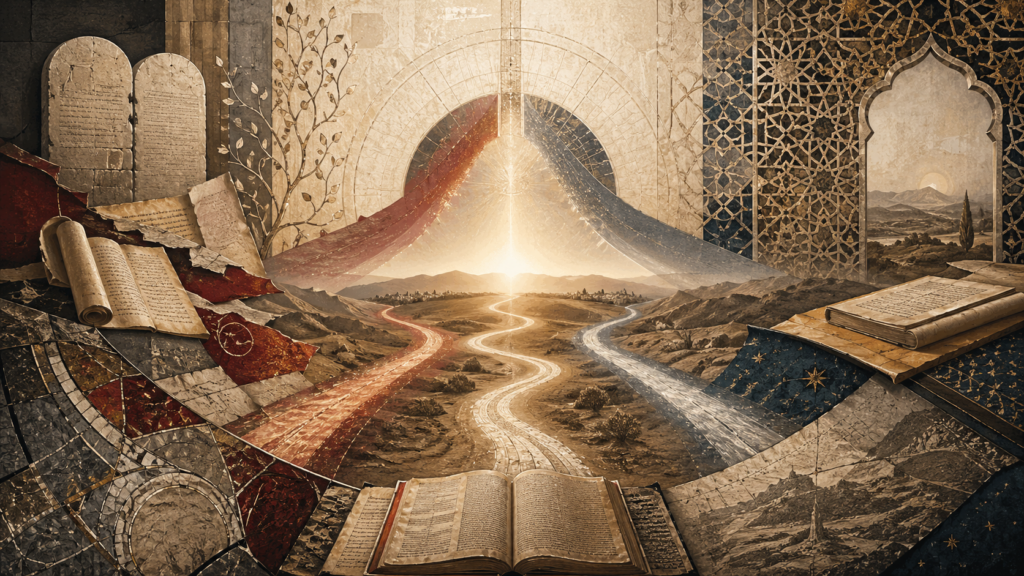
Editorial illustration of Judaism, Christianity, and Islam as three interwoven paths of sacred history, prophecy, revelation, covenant, law, and moral responsibility.

What Are the Abrahamic Traditions?

The Abrahamic traditions are Judaism, Christianity, and Islam: three intertwined religious civilizations shaped by belief in one God, revelation, prophecy, covenant, law, moral accountability, and sacred history. This article introduces the Abrahamic traditions not as isolated religions competing for ownership of God, but as related communities of memory that preserve, dispute, interpret, and renew a shared inheritance. Beginning with Abraham as a figure of faith, covenant, migration, and moral testing, it explores how Jews, Christians, and Muslims understand scripture, prophecy, law, Jesus, Muhammad, community, and divine guidance. The article also establishes the interpretive lens for this series: sacred texts will be read directly, but through a Qur’an-centered framework that emphasizes continuity of revelation, prophetic vindication, rational inquiry, peaceful reform, and respectful comparison with Sunni, Shia, Jewish, and Christian perspectives.

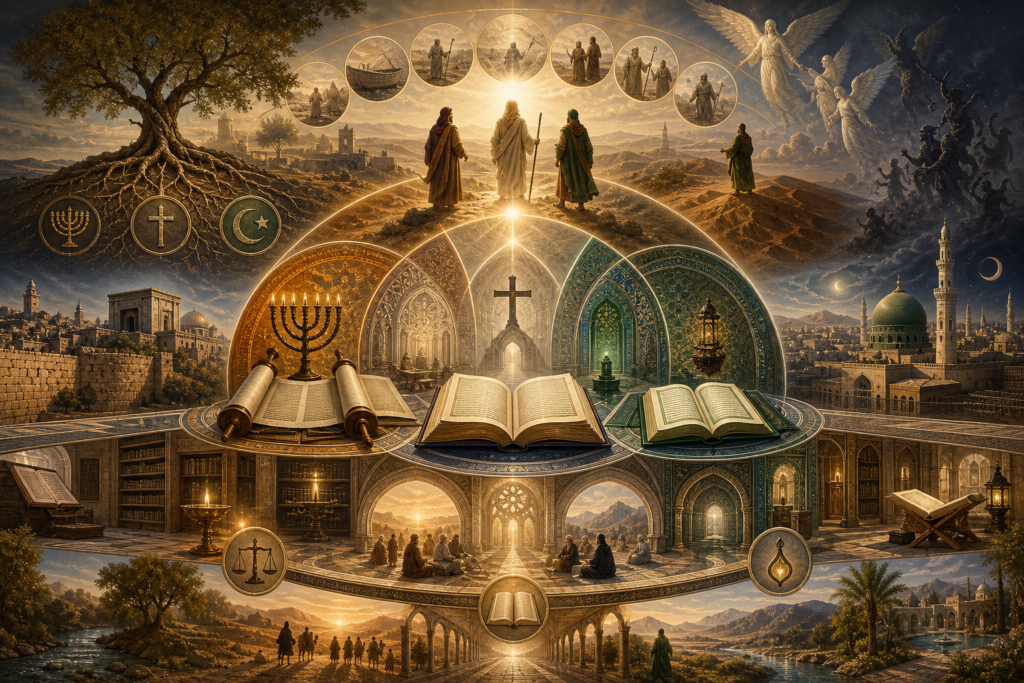
Symbolic religious-studies illustration showing Judaism, Christianity, and Islam through sacred books, architectural forms, desert landscapes, prophetic figures, angelic and demonic imagery, law, prayer, and shared Abrahamic sacred history.

Abrahamic Traditions: Prophecy, Revelation, Law, and Sacred History

Abrahamic Traditions examines the scriptural, prophetic, theological, legal, ritual, spiritual, philosophical, and historical worlds associated with Judaism, Christianity, and Islam through the primary texts, interpretive traditions, and civilizational forms by which these religions have understood God, revelation, covenant, prophecy, law, mercy, worship, judgment, knowledge, and the destiny of human communities. This pillar traces the prophetic arc from Adam to Jesus and culminates in Muhammad and the finality of Qur’anic revelation, while also exploring the interpretive traditions, legal structures, devotional worlds, and intellectual cultures that shaped Abrahamic civilization. With particular emphasis on Islam, the category connects revelation not only to worship and law, but also to philosophy, natural science, medicine, and the wider history of knowledge.

Scroll to Top