
Last Updated May 5, 2026
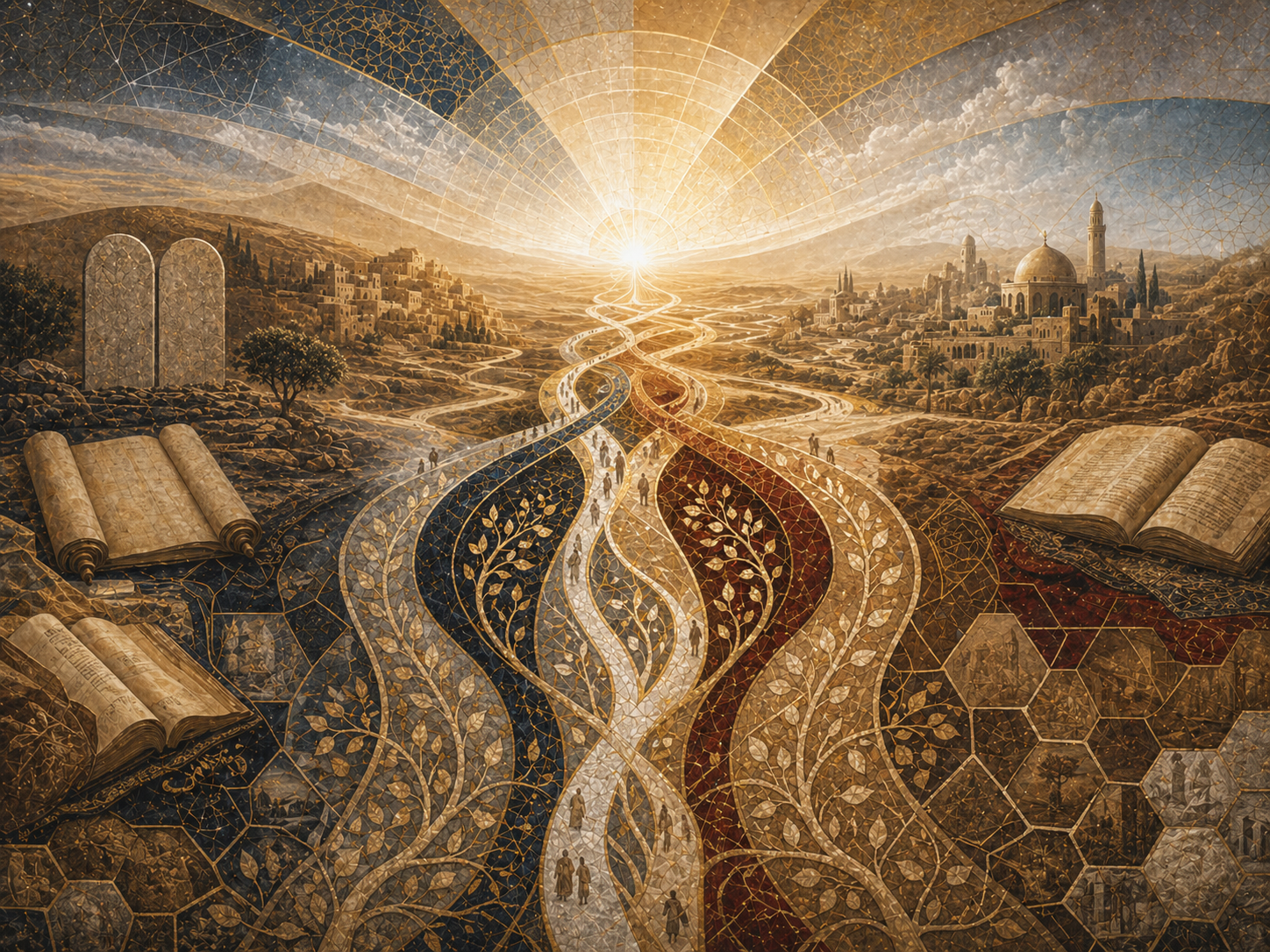
Monotheism, revelation, and sacred history form the deep structure of the Abrahamic traditions. Judaism, Christianity, and Islam are not merely three “religions” placed side by side in a textbook. They are related communities of memory centered on the One God, divine guidance, prophetic witness, covenant, sacred law, worship, mercy, justice, repentance, and moral accountability. Each tradition has its own scripture, theology, ritual life, legal tradition, and historical path, but all three share the conviction that human life unfolds before God and that history itself carries moral meaning.
This shared sacred horizon should be the starting point. The Abrahamic traditions are not best understood by beginning with division. They are best understood by beginning with the One God and then asking how different communities have received, interpreted, preserved, disputed, and lived under divine address. Jews, Christians, and Muslims differ in how they understand revelation, Jesus, Muhammad, covenant, scripture, law, salvation, and religious authority, but those differences unfold within a common world of creation, commandment, prophecy, judgment, forgiveness, and return.
The Arabic word الله helps clarify this shared horizon. In Arabic, Allah is the word for God, used by Arabic-speaking Muslims, Christians, and Jews, including in Palestine and across the wider Arabic-speaking Abrahamic world. This matters because it resists the misleading idea that Muslims worship a different deity from Jews and Christians. The deeper Abrahamic question is not whether these traditions speak of the One God, but how they understand God’s revelation, covenant, law, mercy, and action in sacred history.
This article introduces monotheism, revelation, and sacred history as three interwoven foundations of Abrahamic thought. Monotheism names the unity of God and the moral unity of reality. Revelation names God’s guidance to humanity through scripture, prophecy, wisdom, law, and sacred memory. Sacred history names the remembered drama of God’s call and humanity’s response: obedience and rebellion, exile and return, oppression and deliverance, sin and repentance, judgment and mercy.
Current Space
Religious Studies
Article List
Abrahamic Traditions
Series context: This article is part of the Abrahamic Traditions: Prophecy, Revelation, Law, and Sacred History knowledge series. For the broader category structure, return to the Religious Studies category.
Hebrew Bible
שְׁמַע יִשְׂרָאֵל יְהוָה אֱלֹהֵינוּ יְהוָה אֶחָדHear, O Israel: the LORD is our God; the LORD is One.Deuteronomy 6:4. Hebrew text with English rendering.
The Shema gives one of the clearest scriptural foundations for Abrahamic monotheism. It declares not merely belief in God, but the oneness of God as the center of worship, memory, commandment, and covenantal life.
Monotheism as the Shared Center
Monotheism is often described simply as belief in one God. That definition is accurate, but incomplete. In the Abrahamic traditions, monotheism is not merely a numerical claim that there is one divine being rather than many. It is a comprehensive way of understanding reality. The world is created by one God, sustained by one God, judged by one God, and called toward one moral order. Human life is not divided among competing cosmic powers. It stands before the One.
This gives Abrahamic monotheism its moral force. If there is one God, then reality is not morally fragmented. Justice, mercy, truth, worship, and accountability are not local preferences or tribal inventions. They are rooted in the Creator. The Abrahamic traditions therefore connect theology to ethics. To believe in the One God is to reject idols, false absolutes, arrogance, cruelty, exploitation, and the worship of power.
Judaism expresses this through covenantal monotheism: the God of Abraham, Isaac, and Jacob calls Israel into a life of Torah, holiness, memory, and responsibility. Christianity expresses monotheism through the God of Israel revealed through Christ, the Gospel, worship, and the life of the church. Islam expresses monotheism through tawḥīd, the absolute oneness of Allah, who sends guidance through prophets and calls all human beings to surrender, worship, justice, and mercy.
Qur’anic Text
قُلْ هُوَ اللَّهُ أَحَدٌSay: He is Allah, the One.Qur’an 112:1. Arabic text with English rendering.
This short Qur’anic declaration gives Islamic monotheism its uncompromising center. God’s oneness is not simply arithmetic; it is the rejection of every rival ultimate.
These formulations are not identical, but they share a common center: God is One, and human life must be oriented toward that One. The Abrahamic traditions reject the idea that ultimate loyalty belongs to tribe, empire, wealth, race, nation, desire, or human ego. All such things may become idols when they claim the place that belongs only to God.
That is why monotheism is not abstract metaphysics alone. It is spiritual discipline and social critique. It asks what human beings serve. It asks which powers they obey. It asks whether worship has become justice, whether law has become mercy, whether prayer has become humility, and whether sacred memory has become moral responsibility. The question is not only whether a community confesses one God, but whether that confession disciplines its power, purifies its desires, and binds its members to justice.
Monotheism also gives dignity a theological foundation. If all people stand before one Creator, then no empire, race, nation, class, or religious elite can possess ultimate authority over human worth. The human person is not sacred because the modern state grants dignity. The human person is dignified because life belongs first to God. This does not remove the need for legal rights; it deepens the moral ground beneath them.
Allah, God, and Shared Abrahamic Language
The shared Abrahamic horizon becomes clearer when language is handled carefully. In Arabic, الله means God. Muslims use it in the Qur’an, prayer, theology, and daily devotion. Arabic-speaking Christians also use Allah in Arabic Bibles, liturgies, sermons, hymns, and prayer. Arabic-speaking Jews have also used Arabic religious vocabulary in Jewish philosophical, exegetical, and communal life, especially in the long history of Judeo-Arabic writing.
This is not a minor linguistic point. It changes the frame of comparison. When an Arabic-speaking Christian in Palestine prays to Allah, that Christian is not praying to a Muslim deity. When a Muslim says Allah, the word does not refer to a foreign god disconnected from Abraham, Moses, Mary, or Jesus. The word belongs to the Arabic-speaking Abrahamic world.
Qur’anic Text
اللَّهُ لَا إِلَٰهَ إِلَّا هُوَ الْحَيُّ الْقَيُّومُGod — there is no god but He, the Living, the Self-Subsisting.Qur’an 2:255. Arabic text with English rendering.
The verse opens with divine uniqueness. Its language is Qur’anic, but its theological horizon is recognizably Abrahamic: the living God, the sustaining God, the One before whom all knowledge, power, and history are accountable.
Theologically, Jews, Christians, and Muslims still interpret God differently. Christianity’s doctrine of the Trinity differs from Jewish and Islamic expressions of divine unity. Islam’s doctrine of tawḥīd rejects divine incarnation and any association of partners with God. Judaism preserves the covenantal confession of the God of Israel through Torah, prayer, law, and communal memory. These distinctions matter, but they should be understood as distinctions within a shared monotheistic field rather than as evidence that the traditions speak of unrelated divine realities.
The broader Semitic context matters as well. Hebrew, Aramaic, Syriac, Geʽez, and Arabic belong to related linguistic and religious worlds. The sacred naming of God across these languages reveals deep historical continuity. The Abrahamic traditions are not merely linked by later comparison. They emerged, developed, argued, translated, and prayed across overlapping linguistic and cultural worlds.
A better Abrahamic method therefore begins by refusing false separation. It does not say that all doctrines are the same. It says something more accurate and more important: Jews, Christians, and Muslims speak from related traditions of the One God, even when they interpret revelation and sacred history differently.
This linguistic clarification is also morally important. The false opposition between “God” and “Allah” has often been used to estrange Muslims from the Abrahamic family, to make Islam appear foreign to biblical religion, and to erase Arabic-speaking Christians and Jews. A serious account should reject that distortion from the beginning. The real questions are not whether Muslims worship God, but how Islam understands divine unity, revelation, prophecy, law, Jesus, Muhammad, mercy, and judgment.
Revelation as Divine Guidance
Revelation is the second major foundation of the Abrahamic traditions. If monotheism names the One God, revelation names God’s address to humanity. The Abrahamic traditions teach that human beings are not left to moral confusion without guidance. God speaks, commands, warns, promises, teaches, corrects, and consoles.
In Judaism, revelation is inseparable from Torah, covenant, prophetic witness, and the interpretive life of the Jewish people. The giving of Torah is not merely an ancient event; it becomes the foundation of a disciplined communal life ordered toward holiness, justice, memory, and obedience. Revelation is preserved through text, but also through study, argument, liturgy, law, and practice.
In Christianity, revelation is centered on God’s action in Christ, the Gospel, the Scriptures, the life of the church, and the continuing work of the Spirit. Christian traditions understand Jesus not only as a teacher, but as the decisive disclosure of God’s redemptive will. Christian revelation therefore rereads Israel’s sacred history through Christ, promise, fulfillment, grace, and the hope of the kingdom of God.
New Testament
Ἐν ἀρχῇ ἦν ὁ λόγοςIn the beginning was the Word.John 1:1. Greek New Testament with English rendering.
This passage is not included as a generic Christian quotation. It matters here because it shows how Christian revelation is organized around the language of logos: word, wisdom, reason, creative speech, and divine self-disclosure. It gives Christianity a distinctive grammar of revelation that cannot simply be collapsed into Jewish Torah or Qur’anic recitation.
In Islam, revelation reaches its final and preserved form in the Qur’an. The Qur’an presents itself not as a disconnected new message, but as confirmation, reminder, criterion, and guidance. It calls believers to affirm what was revealed to earlier prophets, including Abraham, Ishmael, Isaac, Jacob, Moses, and Jesus. From a Qur’an-centered perspective, revelation is one in source, even though communities differ in how they receive, preserve, interpret, and sometimes dispute it.
Qur’anic Text
قُولُوا آمَنَّا بِاللَّهِ وَمَا أُنْزِلَ إِلَيْنَا وَمَا أُنْزِلَ إِلَىٰ إِبْرَاهِيمَ وَإِسْمَاعِيلَ وَإِسْحَاقَ وَيَعْقُوبَ وَالْأَسْبَاطِSay: We believe in God, and in what has been sent down to us, and in what was sent down to Abraham, Ishmael, Isaac, Jacob, and the tribes.Qur’an 2:136. Arabic text with English rendering.
This verse gives revelation a shared Abrahamic structure. It refuses to isolate the Qur’anic message from earlier prophetic history, placing Islam within a wider field of divine guidance.
Revelation in the Abrahamic traditions is not merely private inspiration. It forms communities. It creates law, worship, moral memory, sacred calendars, liturgy, theology, ethical obligation, and historical identity. It tells human beings who they are, what they owe to God, how they should treat others, and what kind of world they are responsible for building.
Revelation is therefore not only about information. It is about transformation. It aims to move human beings from forgetfulness to remembrance, from arrogance to humility, from injustice to righteousness, from idolatry to worship, and from despair to trust in divine mercy.
That is why revelation cannot be reduced to text alone, even though texts are central. Revelation becomes lived through prayer, recitation, commandment, worship, teaching, interpretation, ethical reform, and communal memory. A community receives revelation truthfully only when sacred words become moral life.
Sacred History as Moral Memory
Sacred history is the memory of revelation in time. It is not simply a record of events. It is history interpreted through divine meaning. The stories of Adam, Noah, Abraham, Sarah, Hagar, Ishmael, Isaac, Jacob, Joseph, Moses, Miriam, David, Solomon, Mary, Jesus, Muhammad, and many others are not preserved merely as ancient biography. They are remembered because they reveal patterns of human life before God.
Those patterns recur across the Abrahamic traditions. God calls; human beings respond or resist. Prophets warn; communities accept or reject them. Power becomes arrogant; revelation exposes it. The poor are neglected; divine judgment falls on injustice. People forget; God reminds. Communities fail; repentance remains possible. Exile comes; return remains a hope. Judgment is real; mercy remains greater than despair.
This is why sacred history is moral memory. It teaches communities how to understand themselves. It asks whether they are repeating Pharaoh’s arrogance, Abraham’s trust, Moses’ courage, Mary’s surrender, Jesus’ mercy, Muhammad’s perseverance, or the recurring failures of communities that receive guidance but forget its spirit.
Sacred history also challenges modern assumptions about religion. It refuses to treat faith as a purely private opinion. In the Abrahamic traditions, revelation enters public history. It confronts rulers, judges economies, commands justice, disciplines desire, protects the vulnerable, and forms communal life. Sacred history is not an escape from the world. It is a way of seeing the world as accountable to God.
From a Qur’an-centered perspective, sacred history also has a corrective function. The Qur’an retells prophetic narratives not merely to repeat earlier versions, but to vindicate prophetic character, restore moral clarity, and draw lessons for the believing community. This approach treats sacred history as both continuity and purification: a recovery of the moral truth at the heart of revelation.
Sacred history also gives voice to those whom ordinary political history often overlooks. Hagar in the wilderness, Moses confronting Pharaoh, Mary facing suspicion, Jesus among the sick and poor, Muhammad and the early believers under persecution, the Ahl al-Bayt in suffering, Jewish communities in exile, and countless unnamed believers under pressure all belong to Abrahamic memory. Sacred history remembers vulnerability as well as power.
The Prophetic Pattern
Prophecy is the living bridge between monotheism, revelation, and sacred history. A prophet is not merely a predictor of future events. In the Abrahamic traditions, a prophet is a witness, messenger, reformer, warner, teacher, intercessor, and moral exemplar. Prophets call communities back to the One God and expose the idols that corrupt human life.
The prophetic pattern is remarkably consistent. A community becomes forgetful, unjust, idolatrous, complacent, or oppressive. A prophet is raised with guidance. The prophet calls people back to God, warns against judgment, defends the vulnerable, and demands moral reform. Some believe; others resist. The story becomes a test of truth, power, patience, and accountability.
The Hebrew Bible preserves this pattern in the lives and messages of the prophets of Israel. They denounce injustice, empty ritual, exploitation, false security, and idolatry. They remind the people that covenant without righteousness is spiritually dangerous.
Hebrew Bible
הִגִּיד לְךָ אָדָם מַה־טּוֹב וּמָה־יְהוָה דּוֹרֵשׁ מִמְּךָ כִּי אִם־עֲשׂוֹת מִשְׁפָּט וְאַהֲבַת חֶסֶד וְהַצְנֵעַ לֶכֶת עִם־אֱלֹהֶיךָHe has told you, O human one, what is good: to do justice, to love mercy, and to walk humbly with your God.Micah 6:8. Hebrew text with English rendering.
This passage is useful here because it compresses covenantal responsibility into a prophetic moral triad: justice, mercy, and humility. It prevents law from being reduced either to external regulation or to communal self-justification.
The New Testament presents Jesus within Israel’s prophetic world while also giving him a unique role in Christian theology. Jesus announces the kingdom of God, calls for repentance, heals, teaches, confronts hypocrisy, embodies mercy, and stands at the center of Christian sacred history. Christians confess him not only as prophet, but as Messiah, Lord, and incarnate Word. That confession distinguishes Christianity sharply from Judaism and Islam, but the prophetic pattern remains part of the shared field.
The Qur’an universalizes the prophetic pattern. Prophets are sent to many peoples. Some are named; others are not. Their shared message is worship of the One God and righteous conduct. Muhammad is presented as the final prophet, confirming the earlier prophetic tradition and restoring the call to pure monotheism.
Qur’anic Text
وَمَا أَرْسَلْنَا مِن قَبْلِكَ مِن رَّسُولٍ إِلَّا نُوحِي إِلَيْهِ أَنَّهُ لَا إِلَٰهَ إِلَّا أَنَا فَاعْبُدُونِWe sent no messenger before you except that We revealed to him: There is no god but Me, so worship Me.Qur’an 21:25. Arabic text with English rendering.
This verse presents prophecy as continuity: different messengers, different communities, but one central summons to worship the One God.
This shared prophetic pattern strengthens the Abrahamic frame. It shows that the traditions are linked not only by ancestry, but by a recurring moral drama: revelation confronts forgetfulness, truth confronts power, mercy confronts cruelty, and divine guidance calls human beings back to responsibility.
Covenant, Law, and Accountability
Monotheism and revelation lead naturally to covenant and law. If God is One and God guides humanity, then human life is not morally self-invented. It is accountable. The Abrahamic traditions differ in how they understand covenant and law, but they share the conviction that faith must become a way of life.
In Judaism, covenant is central. Torah orders communal life through commandment, worship, memory, justice, study, and holiness. Jewish law is not merely regulation; it is a path of sanctification and fidelity. It binds ordinary life to divine command.
In Christianity, law is interpreted through Jesus, love of God and neighbor, grace, discipleship, church teaching, and moral transformation. Christian traditions differ internally over law and gospel, but they share the conviction that faith must produce a transformed life marked by love, mercy, humility, and righteousness.
In Islam, divine guidance includes worship, ethics, law, social responsibility, charity, fasting, prayer, family life, economic conduct, and purification of the self. Sharia in its broadest sense is the path of life ordered toward Allah. Fiqh is the human effort to understand and apply that guidance.
Rabbinic Text
עַל שְׁלשָׁה דְבָרִים הָעוֹלָם עוֹמֵד עַל הַתּוֹרָה וְעַל הָעֲבוֹדָה וְעַל גְּמִילוּת חֲסָדִיםOn three things the world stands: on Torah, on worship, and on acts of lovingkindness.Pirkei Avot 1:2. Hebrew text with English rendering.
This rabbinic teaching joins revelation, worship, and mercy. It offers a compact moral architecture for covenantal life: sacred teaching must become service and acts of lovingkindness.
Covenant and law should not be reduced to control. At their best, they are moral architecture. They ask what kind of people human beings are becoming. They discipline power, desire, speech, wealth, and community. They insist that worship cannot be separated from justice, and that belief without responsibility is incomplete.
The Abrahamic traditions therefore share a moral seriousness often missing from modern spiritual individualism. They do not simply ask what a person feels about God. They ask how a person lives before God.
This also offers a wider way to think about human rights. A rights framework can protect persons against abuse, but Abrahamic moral language asks why persons deserve protection in the first place. The answer is not only autonomy. It is creaturely dignity, accountability before God, the moral claim of the neighbor, the duty of mercy, the discipline of law, and the prophetic demand to protect the vulnerable.
Mercy and Judgment
Mercy and judgment belong together in the Abrahamic imagination. Judgment means that human actions matter. Mercy means that failure is not the final word. The One God is not indifferent to injustice, but neither is God’s relationship to humanity exhausted by punishment.
Judaism preserves this tension through covenant, repentance, divine compassion, prophetic warning, and the repeated possibility of return. Christianity centers divine mercy in the Gospel, forgiveness, reconciliation, and the redemptive work of Christ. Islam repeatedly names Allah as the Beneficent and Merciful and calls human beings to repentance, prayer, charity, and trust in divine forgiveness.
Hadith
إِنَّمَا الأَعْمَالُ بِالنِّيَّاتِActions are only by intentions.Sahih al-Bukhari 1; Sahih Muslim 1907. Arabic text with English rendering.
This hadith draws the moral life inward. Abrahamic ethics is not only outward conformity; it is also sincerity, intention, purification, and accountability before God.
The shared pattern is clear: God judges because justice matters; God forgives because mercy is central to divine reality. Human beings are accountable, but not abandoned. Communities may fall into injustice, idolatry, and hypocrisy, but the door of return remains open.
This balance prevents two distortions. A religion of judgment without mercy becomes cruelty. A religion of mercy without accountability becomes sentimentality. The Abrahamic traditions hold both together. They warn that oppression, arrogance, and false worship have consequences. They also teach that repentance, reform, and forgiveness are always possible through God’s mercy.
Sacred history is filled with this rhythm: warning, failure, judgment, repentance, renewal. The pattern is not only ancient. It is contemporary. Every community that claims revelation must ask whether it has become merciful, just, humble, and truthful — or whether it has inherited sacred words while losing their moral force.
This is also why marginalized voices matter. The oppressed often know whether judgment has been forgotten and whether mercy has become selective. A society cannot claim Abrahamic faith while treating the poor, displaced, imprisoned, colonized, disabled, or religiously marginalized as disposable. Divine mercy does not cancel justice; it calls human beings to repair what injustice has broken.
Jewish, Christian, and Islamic Emphases
A unifying Abrahamic frame should foreground sameness while still honoring each tradition’s distinctive emphasis. Judaism, Christianity, and Islam share a sacred horizon, but each preserves that horizon through its own forms of scripture, worship, law, memory, and theology.
Judaism emphasizes covenantal life with the God of Israel. Torah, prayer, Sabbath, festivals, ethical responsibility, rabbinic interpretation, memory, land, diaspora, and peoplehood all shape Jewish sacred history. Jewish monotheism is not abstract. It is lived through commandment, study, worship, community, and historical endurance.
Christianity emphasizes the revelation of God through Jesus Christ. It reads Israel’s scriptures through Gospel, incarnation, cross, resurrection, church, sacrament, discipleship, and hope in the kingdom of God. Christian sacred history is centered on redemption, grace, love of God and neighbor, and the transformation of life through Christ.
New Testament
Ἀγαπήσεις κύριον τὸν θεόν σου ἐν ὅλῃ τῇ καρδίᾳ σου καὶ ἐν ὅλῃ τῇ ψυχῇ σου καὶ ἐν ὅλῃ τῇ διανοίᾳ σουYou shall love the Lord your God with all your heart, and with all your soul, and with all your mind.Matthew 22:37. Greek New Testament with English rendering.
In Christian scripture, love of God becomes the great commandment from which moral life is ordered. This love is not sentiment alone; it becomes discipleship, mercy, obedience, and love of neighbor.
Islam emphasizes the absolute oneness of Allah, the continuity of all prophets, and the Qur’an as final guidance. It understands Muhammad as the final prophet and the Qur’an as confirming and clarifying earlier revelation. Islamic sacred history is deeply prophetic: it sees humanity repeatedly called back to worship, justice, mercy, and surrender to God.
Sunni and Shia perspectives enrich this picture. Sunni traditions emphasize Qur’an, Sunnah, law, community, scholarship, and continuity with the early Muslim community. Shia traditions emphasize the Prophet’s family, Imamate, Karbala, martyrdom, justice, sacred leadership, and the moral struggle against oppression. Both belong within the wider Islamic witness to the One God.
These emphases should not be treated as barriers to comparison. They are different ways of preserving and interpreting a shared inheritance. The Abrahamic frame becomes most useful when it allows each tradition to speak in its own voice while still recognizing the shared grammar beneath those voices.
That shared grammar is not a lowest common denominator. It is a serious moral and theological field: God, creation, revelation, law, prophecy, worship, mercy, justice, repentance, and hope. The traditions differ because they interpret this field differently, not because they occupy unrelated worlds.
Continuity Without Erasure
The challenge of Abrahamic study is to affirm continuity without erasing particularity. If the traditions are treated as totally separate, their shared sacred world disappears. If they are treated as identical, their real histories and doctrines are flattened. A serious Abrahamic method must hold both truths, but the center of gravity should remain continuity.
Continuity means that Judaism, Christianity, and Islam are related traditions of the One God. They share prophetic memory, reverence for revelation, moral accountability, sacred law, prayer, mercy, judgment, and hope. Their scriptures speak across one another. Their histories intersect. Their languages overlap. Their communities have argued, translated, coexisted, competed, learned, and suffered together.
Particularity means that each tradition must still be understood on its own terms. Judaism should not be reduced to the background of Christianity or Islam. Christianity should not be reduced to generic monotheism. Islam should not be reduced to a late borrowing from biblical tradition. Each tradition has its own integrity.
Qur’anic Text
شَرَعَ لَكُم مِّنَ الدِّينِ مَا وَصَّىٰ بِهِ نُوحًا وَالَّذِي أَوْحَيْنَا إِلَيْكَ وَمَا وَصَّيْنَا بِهِ إِبْرَاهِيمَ وَمُوسَىٰ وَعِيسَىٰ أَنْ أَقِيمُوا الدِّينَ وَلَا تَتَفَرَّقُوا فِيهِHe has laid down for you the religion He enjoined upon Noah, and what We have revealed to you, and what We enjoined upon Abraham, Moses, and Jesus: establish the religion, and do not be divided concerning it.Qur’an 42:13. Arabic text with English rendering.
This passage is placed here because it directly raises the article’s central interpretive problem: continuity without erasure. It names a shared prophetic command while also acknowledging that communities can fracture around what they have inherited.
Particularity need not mean separation. The better frame is kinship. Related traditions can differ without becoming strangers. Shared inheritance can produce multiple interpretations without destroying the reality of the inheritance itself. The Abrahamic traditions are not identical, but they are profoundly connected.
This is why the language of the One God matters. It allows difference to be placed within a larger unity. It keeps comparison from becoming rivalry. It reminds each community that sacred identity is not ownership of God, but responsibility before God.
Continuity without erasure also protects against both Western chauvinism and religious triumphalism. It refuses to measure all traditions by a modern secular liberal template, but it also refuses to excuse injustice when religious communities betray their own moral sources. The goal is not flattening, relativism, or propaganda. The goal is a truthful shared frame that can name both kinship and failure.
Marginalized Voices and Sacred History
Sacred history is incomplete when it remembers only the powerful. Abrahamic memory includes patriarchs, prophets, kings, priests, apostles, caliphs, jurists, rabbis, bishops, imams, theologians, and scholars. But it also includes enslaved people, women, exiles, refugees, the poor, the sick, the imprisoned, colonized communities, religious minorities, and those whose prayers and suffering were not preserved by official institutions.
Hagar is one of the clearest examples. She stands inside Abrahamic sacred history as an enslaved woman, displaced mother, and witness to divine hearing. Her story asks whether sacred ancestry can be narrated truthfully if the vulnerable are pushed outside the frame. In Islamic memory, Hajar’s search for water becomes ritually remembered in pilgrimage, turning the survival of a marginalized mother into a living act of communal devotion.
Mary is another essential figure. Christianity honors Mary as the mother of Jesus, and Islam honors Maryam as a woman of purity, devotion, and divine election. Her presence in both traditions complicates any account that treats sacred history as only male authority. Mary’s story is also a story of vulnerability, public suspicion, divine protection, and the dignity of a woman through whom sacred history is transformed.
Arabic-speaking Christians, Judeo-Arabic Jews, Syriac Christians, Mizrahi and Sephardi communities, Black churches, Shia communities shaped by martyrdom and resistance, Muslims under colonial rule, Jews under exile and persecution, and many other communities show that Abrahamic history cannot be reduced to dominant institutional narratives. Their languages, liturgies, manuscripts, songs, rituals, and memories are not peripheral. They reveal the depth of the Abrahamic world.
This is why human dignity must be treated through a wider lens than Western liberalism alone. The Abrahamic traditions preserve moral vocabularies of creation, covenant, mercy, justice, neighbor-love, charity, repentance, divine judgment, communal protection, and sacred obligation. These vocabularies can enrich modern rights language by grounding dignity not only in individual autonomy, but also in divine accountability, communal responsibility, and the protection of the vulnerable.
At the same time, marginalized voices also expose religious failure. Abrahamic communities have sometimes used scripture, law, and sacred memory to justify domination, patriarchy, slavery, antisemitism, Islamophobia, sectarianism, colonialism, forced conversion, and exclusion. A serious article cannot hide that. The traditions are most credible when they allow their own prophetic and moral resources to judge their historical failures.
A truthful Abrahamic frame therefore asks: Who is seen? Who is heard? Who interprets revelation? Who is protected by law? Who is excluded from worship, education, land, archive, and public dignity? Sacred history becomes morally serious only when it remembers those whom power would prefer to forget.
A Scholarly Abrahamic Method
A better method for studying the Abrahamic traditions should be scholarly, comparative, textually grounded, and morally serious. It should begin with the shared horizon of the One God without pretending that doctrinal differences are minor. It should treat Judaism, Christianity, and Islam as living traditions rather than as static textbook categories.
First, this method should read primary texts closely. The Qur’an, Hebrew Bible, New Testament, Hadith, rabbinic literature, patristic writings, tafsir, law, liturgy, and historical commentary all matter. Sacred traditions should not be described only through modern summaries when their own textual worlds remain available.
Second, it should respect original languages where possible. Arabic, Hebrew, Greek, Aramaic, Syriac, and Geʽez do not function merely as decorative signs of antiquity. They carry concepts, rhythms, and interpretive worlds that shape how communities hear revelation.
Third, it should distinguish comparison from flattening. A comparative method can notice shared themes — prophecy, revelation, mercy, judgment, law, covenant, worship — without pretending that all traditions mean the same thing by those words.
Fourth, it should resist polemical caricature. Judaism is not reducible to law, Christianity is not reducible to incarnation, and Islam is not reducible to submission. Each tradition contains moral philosophy, law, mysticism, devotion, commentary, ritual, prayer, politics, suffering, reform, and internal argument.
Fifth, it should foreground ethical consequence. Abrahamic study is not only about classification. It is about understanding how sacred memory forms moral life: how people treat strangers, how communities remember suffering, how power is judged, how mercy is practiced, and how worship becomes responsibility.
Sixth, it should make room for marginalized voices. A scholarly method that only cites elite men and official institutions will reproduce the exclusions of the past. Women, minority communities, the poor, colonized peoples, displaced communities, converts, dissidents, and ordinary practitioners belong to the history of revelation as lived reality.
Seventh, it should reject both Western chauvinism and anti-Western reversal. The answer to civilizational arrogance is not another civilizational arrogance. The better method is historical honesty: recognizing the dignity, contribution, failure, and complexity of every tradition while refusing to make Western modernity the only measure of truth, rights, reason, or moral progress.
A scholarly Abrahamic method should therefore be faithful to texts, attentive to communities, honest about difference, generous toward continuity, and morally awake to power. It should help readers see not only what the traditions teach, but what kind of human beings their teachings are meant to form.
Why This Frame Matters
Monotheism, revelation, and sacred history matter because they shape how communities understand truth, power, justice, memory, and human responsibility. The Abrahamic traditions have formed civilizations, legal systems, moral vocabularies, artistic traditions, political arguments, reform movements, spiritual disciplines, and visions of human dignity.
They also matter because misunderstanding among Jews, Christians, and Muslims has often produced fear, contempt, persecution, colonial arrogance, antisemitism, Islamophobia, sectarianism, and political manipulation. A unifying Abrahamic frame does not erase historical wounds, but it changes the starting point. It begins with shared sacred ground rather than inherited suspicion.
Recognizing that Allah is used by Arabic-speaking Muslims, Christians, and Jews is one example of this correction. It removes a false barrier and allows the real questions to appear: How does God guide humanity? What is revelation? What does covenant require? How should law serve mercy and justice? What do the prophets teach? How should communities remember sacred history without turning it into pride or domination?
The Abrahamic traditions are at their best when they call human beings away from idols and toward God; away from cruelty and toward mercy; away from arrogance and toward humility; away from injustice and toward righteousness. They teach that history is not morally empty and that human beings are accountable for how they live.
Monotheism gives the world moral unity. Revelation gives humanity guidance. Sacred history gives communities memory. Together, they form the heart of the Abrahamic imagination: one God, one moral universe, one human family, and a continuing call to worship, justice, mercy, and truth.
This frame also matters for public life. A society without sacred memory may still speak of rights, values, and dignity, but it can lose the deeper question of accountability. The Abrahamic traditions insist that power is judged, that the vulnerable are not invisible, that mercy is not weakness, that justice is not optional, and that human beings are more than economic units, national subjects, or political tribes.
Comparative Cautions
Several cautions are necessary. First, monotheism should not be reduced to a numerical claim. In Abrahamic thought, the oneness of God shapes moral order, worship, law, community, and the critique of idolatry.
Second, revelation should not be treated as generic inspiration. Judaism, Christianity, and Islam preserve distinct accounts of scripture, authority, interpretation, and divine address.
Third, sacred history should not be confused with neutral chronology. Sacred history is moral memory: it remembers events through the meaning of divine call, human response, judgment, mercy, and reform.
Fourth, the word Allah should be handled accurately. It is the Arabic word for God and is used by Arabic-speaking Muslims, Christians, and Jews. Theological difference should be named, but false linguistic separation should be rejected.
Fifth, Christianity’s doctrine of the Word, incarnation, cross, and resurrection should not be flattened into generic monotheism. It is a distinct Christian grammar of revelation.
Sixth, Islam’s Qur’anic claim to confirm and correct earlier revelation should be understood on its own terms, even where Jews and Christians do not accept that claim.
Seventh, Judaism should not be reduced to a precursor tradition. Torah, covenant, rabbinic interpretation, Jewish law, diaspora, land, liturgy, and communal memory belong to Judaism’s continuing integrity.
Eighth, human dignity should not be treated as the exclusive achievement of Western liberalism. The Abrahamic traditions preserve older moral vocabularies of dignity, obligation, mercy, law, covenant, creation, and accountability before God.
Ninth, original-language quotations should be curated rather than decorative. Hebrew, Arabic, Greek, Aramaic, Syriac, and other languages should be used when they advance interpretation and preserve textual specificity.
Finally, marginalized voices should not be added as an afterthought. Hagar, Mary, exiles, the poor, enslaved peoples, religious minorities, colonized communities, women, refugees, and the forgotten belong to sacred history because God’s judgment and mercy concern them directly.
Why This Article Matters
Monotheism, revelation, and sacred history matter because they provide the deepest structure for understanding the Abrahamic traditions. Judaism, Christianity, and Islam are not merely communities with some overlapping stories. They are related traditions of the One God, each shaped by divine address, prophetic memory, law, worship, mercy, judgment, and moral responsibility.
This article matters because it establishes a foundation for the wider Abrahamic Traditions sequence. It explains why the series begins with the One God, why revelation must be treated as guidance rather than mere information, and why sacred history should be read as moral memory. It also clarifies that Allah belongs to the shared Arabic-speaking Abrahamic world and should not be misused to separate Muslims from Jews and Christians as though they worshiped an unrelated deity.
For the Abrahamic Traditions knowledge series, this article builds directly on The Promise of the Abrahamic Frame and What Are the Abrahamic Traditions?. It also prepares the way for articles on Abraham, covenant, prophecy, law, sacred geography, religious freedom, translation, wisdom, angels, jinn, heaven, hell, judgment, and shared knowledge worlds.
Seen from the perspective of marginalized voices, this frame matters because sacred history is not only the history of official institutions. It is also the memory of those whom God sees when societies do not: Hagar in the wilderness, Mary under suspicion, the poor under exploitation, exiles under empire, communities under persecution, and ordinary believers trying to preserve worship and dignity under pressure.
The final value of this article is that it treats Abrahamic study as moral responsibility. To speak of one God is to ask what human beings serve. To speak of revelation is to ask whether guidance has been heard or betrayed. To speak of sacred history is to ask whether communities have remembered truthfully. The Abrahamic traditions are most faithful to their own foundations when monotheism becomes justice, revelation becomes guidance, and sacred history becomes a summons to mercy, humility, and reform.
Related Reading
- What Are the Abrahamic Traditions?
- The Promise of the Abrahamic Frame: One God, Shared Revelation, and Sacred History
- Abraham, Covenant, and Sacred Ancestry
- Abrahamic Traditions: Prophecy, Revelation, Law, and Sacred History
- Arabic as a Shared Language of Jewish, Christian, and Muslim Knowledge
- Translation Movements in Abrahamic Civilization
- Light, Wisdom, and Knowledge in Abrahamic Thought
- Law, State Power, and Religious Freedom in Abrahamic History
- Foundations of Religion
- Comparative Sacred Themes
Further Reading
- Armstrong, K. (1993) A History of God: The 4,000-Year Quest of Judaism, Christianity and Islam. New York: Knopf. Available at: https://www.penguinrandomhouse.com/
- Armstrong, K. (1996) Jerusalem: One City, Three Faiths. New York: Knopf. Available at: https://www.penguinrandomhouse.com/
- Armstrong, K. (2006) Muhammad: A Prophet for Our Time. New York: HarperOne. Available at: https://www.harpercollins.com/
- Heschel, A.J. (1962) The Prophets. New York: Harper & Row. Available through academic libraries.
- Levenson, J.D. (2012) Inheriting Abraham: The Legacy of the Patriarch in Judaism, Christianity, and Islam. Princeton: Princeton University Press. Available at: https://press.princeton.edu/
- Lings, M. (1983) Muhammad: His Life Based on the Earliest Sources. London: George Allen & Unwin. Available through academic libraries and major booksellers.
- Nasr, S.H. (2002) The Heart of Islam: Enduring Values for Humanity. New York: HarperOne. Available at: https://www.harpercollins.com/
- Neusner, J., Chilton, B. and Graham, W.A. (eds.) (2002) Three Faiths, One God: The Formative Faith and Practice of Judaism, Christianity, and Islam. Leiden: Brill. Available at: https://brill.com/
- Volf, M. (2011) Allah: A Christian Response. New York: HarperOne. Available at: https://www.harpercollins.com/
References
- Afsaruddin, A. and Encyclopaedia Britannica Editors (2026) ‘Allah’, Encyclopaedia Britannica. Available at: https://www.britannica.com/topic/Allah
- Ahmadiyya Anjuman Lahore Publications (n.d.) The Holy Quran: Arabic Text with English Translation and Commentary. Available at: https://www.alahmadiyya.org/quran/english-trans-quran-2010.pdf
- Ahmadiyya Anjuman Lahore Publications (n.d.) History of the Prophets. Available at: https://www.alahmadiyya.org/books-islam-ahmadiyya/english-books/history-of-the-prophets/
- Al-Islam.org (n.d.) Ahlul Bayt Digital Islamic Library Project. Available at: https://www.al-islam.org/
- Arabic Bible Outreach Ministry (n.d.) ‘The Word Allah and Islam’. Available at: https://www.arabicbible.com/for-christians/understanding/1810-the-word-allah-and-islam.html
- BibleGateway (n.d.) Matthew 22:37–40, New Revised Standard Version Updated Edition. Available at: https://www.biblegateway.com/passage/?search=Matthew%2022%3A37-40&version=NRSVUE
- BibleGateway (n.d.) John 1, New Revised Standard Version Updated Edition. Available at: https://www.biblegateway.com/passage/?search=John%201&version=NRSVUE
- Bucaille, M. (1976) The Bible, The Qur’an and Science: The Holy Scriptures Examined in the Light of Modern Knowledge. Translated by A.D. Pannell. Available at: https://archive.org/details/TheBibleTheQuranAndScience
- Quran.com (n.d.) Surah Al-Baqarah 2:62. Available at: https://quran.com/2/62
- Quran.com (n.d.) Surah Al-Baqarah 2:136. Available at: https://quran.com/2/136
- Quran.com (n.d.) Surah Aal-Imran 3:64. Available at: https://quran.com/3/64
- Quran.com (n.d.) Surah Aal-Imran 3:84. Available at: https://quran.com/3/84
- Quran.com (n.d.) Surah An-Nisa 4:136. Available at: https://quran.com/4/136
- Quran.com (n.d.) Surah Al-Ma’idah 5:48. Available at: https://quran.com/5/48
- Quran.com (n.d.) Surah An-Nahl 16:120–123. Available at: https://quran.com/16/120-123
- Quran.com (n.d.) Surah Al-Anbiya 21:25. Available at: https://quran.com/21/25
- Quran.com (n.d.) Surah Al-Ankabut 29:46. Available at: https://quran.com/29/46
- Quran.com (n.d.) Surah Ash-Shura 42:13. Available at: https://quran.com/42/13
- Quran.com (n.d.) Surah Al-Ikhlas 112:1–4. Available at: https://quran.com/112
- Sefaria (n.d.) Deuteronomy 6:4. Available at: https://www.sefaria.org/Deuteronomy.6.4
- Sefaria (n.d.) Genesis 12. Available at: https://www.sefaria.org/Genesis.12
- Sefaria (n.d.) Genesis 15. Available at: https://www.sefaria.org/Genesis.15
- Sefaria (n.d.) Genesis 17. Available at: https://www.sefaria.org/Genesis.17
- Sefaria (n.d.) Exodus 3. Available at: https://www.sefaria.org/Exodus.3
- Sefaria (n.d.) Exodus 19–20. Available at: https://www.sefaria.org/Exodus.19 and https://www.sefaria.org/Exodus.20
- Sefaria (n.d.) Isaiah 1. Available at: https://www.sefaria.org/Isaiah.1
- Sefaria (n.d.) Amos 5. Available at: https://www.sefaria.org/Amos.5
- Sefaria (n.d.) Micah 6:8. Available at: https://www.sefaria.org/Micah.6.8
- Sefaria (n.d.) Jewish Texts and Rabbinic Interpretation. Available at: https://www.sefaria.org/texts
- Society of Biblical Literature (n.d.) The Greek New Testament: SBLGNT. Available at: https://sblgnt.com/
- Sunnah.com (n.d.) Sahih al-Bukhari 1. Available at: https://sunnah.com/bukhari:1
- Sunnah.com (n.d.) Sahih Muslim 1907. Available at: https://sunnah.com/muslim:1907
- Sunnah.com (n.d.) Hadith Collections. Available at: https://sunnah.com/
- Vatican Council II (1965) Nostra Aetate: Declaration on the Relation of the Church to Non-Christian Religions. Available at: https://www.vatican.va/archive/hist_councils/ii_vatican_council/documents/vat-ii_decl_19651028_nostra-aetate_en.html