
Last Updated May 5, 2026
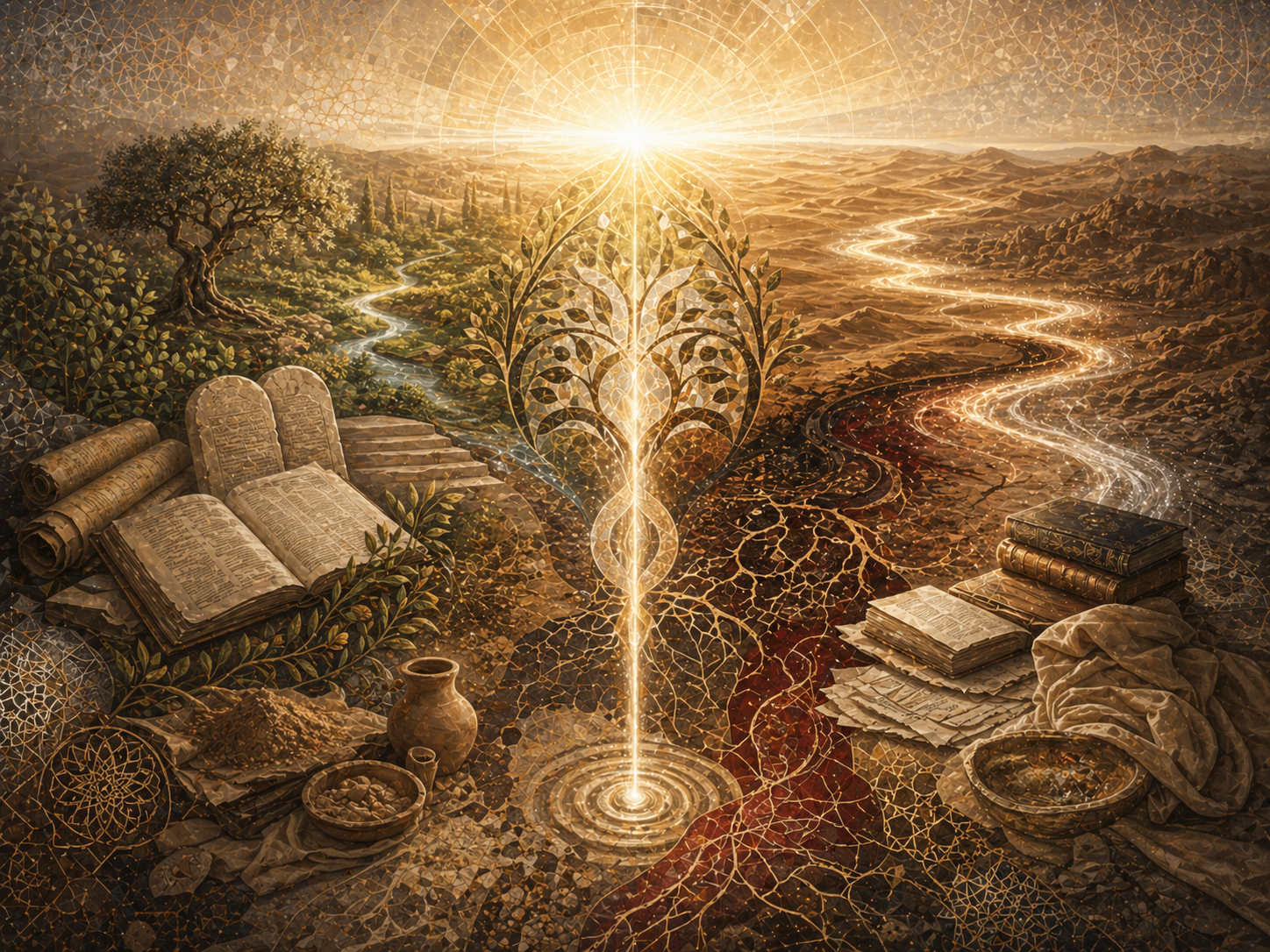
Adam stands at the beginning of Abrahamic sacred history as a figure of human origin, moral knowledge, temptation, repentance, and divine guidance. Judaism, Christianity, and Islam all remember Adam as a foundational representative of humanity before God. His story is not merely about the beginning of biological life. It is about what human beings are: creatures of dust and spirit, knowledge and weakness, freedom and accountability, forgetfulness and repentance.
In Genesis, Adam appears as the first human being formed from the dust of the ground, placed in the garden of Eden, joined with Eve, commanded by God, tempted through the tree, and expelled from the garden after disobedience. In Christian interpretation, Adam becomes central to doctrines of sin, fall, death, redemption, and Christ as the “new Adam.” In Jewish interpretation, Adam belongs to the wider story of creation, human dignity, mortality, commandment, moral responsibility, and the beginning of human life before God.
In the Qur’an, Adam is also foundational, but the emphasis is different. The Qur’anic Adam is not presented primarily as the source of inherited guilt. He is a sign of human nature itself. His story is the story of humanity’s capacity for knowledge, its elevation above other creatures, its vulnerability to evil suggestion, its forgetfulness, its repentance, and its continuing need for divine guidance. In a Qur’an-centered reading, the Adam narrative is not only the story of one ancient figure; it is also a spiritual mirror of the human condition.
This article approaches Adam through a Qur’an-centered comparative Abrahamic lens. It honors the biblical story while reading the Qur’anic account as a moral and spiritual clarification: Adam is not simply a remote ancestor in the past, but a mirror of human nature. It also gives careful attention to Islamic traditions that speak of previous worlds, previous human cycles, or “many Adams,” especially in Shia reports and Sufi cosmological reflection. These traditions should not be treated as the mainstream Sunni hadith position or as a settled Qur’anic doctrine, but they are important because they show that Islamic thought has contained more than one way of imagining Adam’s relation to cosmic history, human origins, and sacred anthropology.
The deeper issue is not rivalry between the Bible and the Qur’an, or between scripture and scientific inquiry. The deeper issue is the shared Abrahamic question: what does it mean for human beings to be created by the One God, endowed with knowledge, tested by freedom, and called back through revelation, repentance, and mercy?
Current Space
Religious Studies
Article List
Abrahamic Traditions
Series context: This article is part of the Abrahamic Traditions: Prophecy, Revelation, Law, and Sacred History knowledge series. For the broader category structure, return to the Religious Studies category.
Hebrew Bible
וַיִּיצֶר יְהוָה אֱלֹהִים אֶת־הָאָדָם עָפָר מִן־הָאֲדָמָה וַיִּפַּח בְּאַפָּיו נִשְׁמַת חַיִּיםThen the LORD God formed the human being from the dust of the ground, and breathed into his nostrils the breath of life.Genesis 2:7. Hebrew text with English rendering.
This passage anchors the biblical anthropology of Adam: human beings are earthly and God-breathed at once. Adam is not pure spirit and not mere matter. The human person is dust animated by divine gift.
Adam as a Shared Abrahamic Figure
Adam is one of the most important shared figures in the Abrahamic traditions because his story is not only about one person. It is about humanity. Adam represents the human being before God: created, honored, tested, morally aware, vulnerable to temptation, capable of repentance, and dependent on divine guidance.
In the Hebrew Bible, Adam is the first man, placed in Eden and joined with Eve. His story opens the biblical account of human life: creation, companionship, commandment, temptation, shame, toil, mortality, and the beginning of human generations. Genesis does not present Adam as a prophet in the later Islamic sense, but it gives him a foundational role in sacred anthropology: he is the one through whom the Bible begins to ask what human beings are and why human life is morally accountable.
In Christianity, Adam becomes central to the theology of sin and redemption. Paul’s letters contrast Adam and Christ, reading Adam as the figure through whom sin and death enter the human story and Christ as the one through whom redemption and life are offered. Christian traditions differ in how they understand inherited sin, guilt, mortality, and grace, but Adam remains a key figure for understanding the human condition.
In Islam, Adam is a prophet, a chosen human being, and a symbol of human dignity and moral struggle. The Qur’an presents him in a way that is both universal and deeply personal. Adam is taught, honored, tested, forgets, repents, receives words from his Lord, and is guided. His story becomes the story of every human being: the struggle between higher guidance and lower impulse, between divine remembrance and forgetfulness, between spiritual clothing and moral exposure.
From a unifying Abrahamic perspective, Adam teaches that human beings are neither worthless nor divine. They are creatures of God, made from humble origins, elevated by knowledge and spirit, and held accountable for how they respond to guidance. Adam is therefore a beginning, but not only a beginning. He is a continuing mirror.
The Arabic word Allah, used by Arabic-speaking Muslims, Christians, and Jews as the word for God, helps frame Adam’s story within the wider Abrahamic world. Adam belongs to the shared memory of humanity before the One God. The traditions differ in how they interpret his lapse, but they agree that human life begins in divine creation, moral responsibility, and dependence upon God’s mercy.
Adam in Genesis
The biblical story of Adam appears primarily in Genesis 2–3, though Genesis 1 provides the broader creation frame in which humanity is made in the image of God. In Genesis 2, Adam is formed from the dust of the ground and receives the breath of life. He is placed in the garden of Eden to till and keep it. He is commanded not to eat from the tree of the knowledge of good and evil. Eve is then formed as his companion, and the story moves toward temptation, disobedience, shame, and expulsion.
The Genesis account is powerful because it compresses many dimensions of human life into one symbolic narrative: earthiness, breath, vocation, companionship, commandment, freedom, temptation, knowledge, shame, alienation, labor, mortality, and exile. Adam is formed from dust, but receives breath from God. He is placed in a garden, but given a command. He has companionship, but also responsibility. He is free enough to disobey, yet accountable for his disobedience.
Hebrew Bible
וַיִּקַּח יְהוָה אֱלֹהִים אֶת־הָאָדָם וַיַּנִּחֵהוּ בְגַן־עֵדֶן לְעָבְדָהּ וּלְשָׁמְרָהּThe LORD God took the human being and placed him in the garden of Eden, to serve it and to keep it.Genesis 2:15. Hebrew text with English rendering.
Adam’s first setting is not idle paradise but entrusted vocation. The garden is gift, but also responsibility: the human being is placed within creation to serve, guard, cultivate, and answer to God.
The serpent plays a major role in Genesis. It questions the divine command, tempts the woman, and reframes disobedience as a path to becoming like God. Eve eats, Adam eats, their eyes are opened, and they realize their nakedness. The garden becomes a place of hiding rather than communion. God questions them, judgment follows, and they are sent out from Eden.
Within Jewish tradition, the Adam story has often been read in relation to human mortality, commandment, inclination, repentance, and the dignity of being created in the image of God. Within Christian tradition, it becomes the foundation for reflection on the Fall, sin, grace, and redemption. The biblical Adam is therefore not only the first man; he is the beginning of a continuing meditation on human freedom before God.
The story also refuses to let humanity treat moral failure as accidental. Adam and Eve are questioned. Their answers reveal evasion, blame, fear, and exposure. The narrative is psychologically acute: disobedience does not simply break a rule; it disrupts relation — with God, with the self, with the other, and with the world. Eden becomes a study of alienation as much as a story of origin.
Genesis also introduces a profound ecological and vocational theme. Adam’s relation to the ground is not incidental. He is formed from it, placed upon it, assigned to serve and guard the garden, and later told that his labor will be marked by hardship. Human beings are not separate from the earth. They are earth-born creatures accountable for how they inhabit creation.
Adam in the Qur’an
The Qur’anic account of Adam appears in several passages, including Sūrat al-Baqarah, al-A‘rāf, al-Ḥijr, al-Isrā’, al-Kahf, Ṭā Hā, and Ṣād. These passages do not simply reproduce the Genesis account. They reshape the story around moral knowledge, human dignity, spiritual struggle, repentance, and divine guidance.
A Qur’an-centered interpretive reading emphasizes that the Qur’an does not present Adam only as a biological data point in human chronology. The sacred narrative is concerned above all with the human condition: knowledge, moral agency, temptation, repentance, and the need for guidance. Adam’s story can therefore be read as a universal account of human nature, not only as a remote origin story.
The Qur’anic Adam is created from dust, but the Qur’an also applies creation from dust to every human being. This is a key interpretive point. Dust is not merely the material of one ancient body; it is the humble origin of human life generally. Human beings arise from the earth, depend on the earth, and return to the earth. Yet they are also given spirit, perception, reason, and moral capacity.
The Qur’an gives special weight to knowledge. Adam is taught “the names,” and this knowledge becomes a sign of human capacity. The angels are commanded to make obeisance to Adam, while Iblis refuses. The refusal of Iblis is not merely a mythic quarrel. It dramatizes the opposition between humanity’s higher spiritual possibility and the lower forces that obstruct moral ascent.
Qur’anic Text
إِنِّي جَاعِلٌ فِي الْأَرْضِ خَلِيفَةًI am placing in the earth one who will bear responsibility and succession.Qur’an 2:30. Arabic text with interpretive English rendering.
The Qur’anic Adam is connected to responsibility on earth. The human being is not created for passive innocence alone, but for moral agency, knowledge, stewardship, and accountability before God.
The Qur’anic story culminates not in permanent damnation, but in repentance and guidance. Adam receives words from his Lord, turns back, and is chosen and guided. The human story begins with weakness, but also with mercy. Forgetfulness is real, but repentance is real. Temptation is real, but guidance is real. The Qur’anic Adam therefore becomes a sign of hope.
This Qur’an-centered reading does not need to deny the power of the biblical story. It clarifies the moral emphasis differently. Adam is the human being in spiritual drama: honored with knowledge, tempted by false permanence, exposed by disobedience, clothed through righteousness, and restored through repentance. His story is not only about origin. It is about the path of return.
This reading also leaves room for a careful distinction between Adam as a prophet and Adam as a biological or cosmological marker. The Qur’an clearly gives Adam theological meaning: knowledge, responsibility, temptation, repentance, and guidance. Whether Adam should be read as the absolute first biological human being, the first spiritually responsible human community, the first prophet of our present human cycle, or the archetypal human before God has been interpreted differently across Islamic history. The most responsible approach is to preserve Adam’s sacred function without forcing every symbolic and cosmological question into one narrow model.
Many Adams, Previous Worlds, and Islamic Cosmology
Some Islamic traditions speak of previous worlds, previous human cycles, or “many Adams.” These reports do not form the mainstream Sunni hadith position and should not be treated as a settled Qur’anic doctrine. They appear especially in Shia report literature and in Sufi cosmological reflection, where they are used to imagine the vastness of divine creation, the possibility of earlier human-like communities, and the difference between Adam as a spiritual-prophetic figure and Adam as a simple biological starting point.
The most frequently cited Shia report is associated with the idea that God created “a thousand-thousand worlds” and “a thousand-thousand Adams,” with the present human community belonging to the last of those worlds and Adams. The report is often cited from al-Saduq’s Kitāb al-Tawḥīd and related Shia compilations. Its language is cosmological and expansive: it does not merely ask whether some creatures existed before Adam, but imagines divine creation as far wider than the present human world.
Shia Report Tradition
بلى والله لقد خلق الله ألف ألف عالم وألف ألف آدم، وأنت في آخر تلك العوالم وأولئك الآدميينYes, by God, Allah created a thousand-thousand worlds and a thousand-thousand Adams, and you are in the last of those worlds and those Adams.Reported in Shia sources from al-Saduq’s Kitāb al-Tawḥīd, commonly cited around p. 277 in printed references; Arabic text and attribution also appear in contemporary Shia discussions and fatwa-style answers.
This report should be handled cautiously. It is important within Shia and esoteric discussions of previous worlds or human cycles, but it is not part of the canonical Sunni hadith collections and should not be presented as a universally accepted Islamic doctrine.
Another cluster of reports speaks of “seven worlds” or previous populations on earth that were not from the children of the present Adam. Such reports are often used in modern discussions to suggest that the earth may have hosted earlier human-like communities before the Adam of the present religious dispensation. Some Shia discussions interpret these as previous human cycles, not necessarily as beings living alongside Adam’s descendants in the same historical period.
This distinction matters. A “many Adams” reading can mean several different things. It may mean previous worlds before this world. It may mean previous cycles of morally responsible beings. It may mean human-like creatures before the present Adamic humanity. It may mean spiritual archetypes rather than biological populations. It may mean visionary cosmology rather than empirical anthropology. A careful article should not collapse these meanings into one claim.
Sufi literature also preserves expansive cosmological reflections on Adam. Ibn ʿArabī is often cited in this connection, especially through material in the Futūḥāt al-Makkiyya in which visionary experience opens onto the possibility of Adams before the Adam of the present human cycle. Sunni scholars who discuss this material often treat it cautiously, distinguishing between canonical hadith, statements attributed to early authorities, visionary unveiling, metaphysical speculation, and symbolic teaching.
The value of the Sufi material is not that it supplies a simple historical timeline. Its value is that it expands Adam beyond flat chronology. In mystical cosmology, Adam can be read as a recurring form of human manifestation, a symbol of the complete human being, or a sign of the macrocosm reflected in the microcosm. Adam is not only a first ancestor. Adam is the human form as a mirror of divine teaching, knowledge, and responsibility.
Some Sunni discussions reject the “many Adams” idea as unsupported by the canonical hadith corpus, or treat related reports as statements, Israelite material, weak reports, or visionary claims rather than binding doctrine. That caution should be preserved. The Qur’an is clear about Adam’s theological meaning, but it does not require a detailed map of all previous worlds or possible pre-Adamic populations. The report tradition is suggestive, but not definitive.
At the same time, the existence of these reports matters for Islamic intellectual history. They show that Muslims have not always read Adam through a narrow literalist chronology. Some Shia, Sufi, philosophical, and modernist discussions have allowed for a wider cosmic horizon: previous worlds, earlier cycles, beings before Adam, or a distinction between biological humanity and the first divinely guided, spiritually responsible Adamic community.
Such readings can be important in contemporary conversations about evolution and human origins. They allow a Muslim writer to ask whether Adam’s sacred role must be identical with the first biological appearance of Homo sapiens. A cautious approach might say that the Qur’an’s central concern is not modern taxonomy but spiritual anthropology: the human being as knower, moral agent, recipient of guidance, and creature accountable before God. The “many Adams” motif can support that openness, but it should not be treated as scientific proof or as a mandatory theological solution.
The strongest use of this tradition is therefore modest but meaningful. It does not say, “Islam proves modern evolution through many Adams.” It says: Islamic tradition contains resources for imagining divine creation as vast, layered, cyclical, and not exhausted by the immediate human world. It also contains ways of reading Adam as a prophetic and spiritual beginning rather than only a biological first. This gives Muslim thought room to engage science without surrendering Adam’s sacred meaning.
For the present article, the key point is interpretive breadth. Adam should not be reduced to a single modern question: “Was he the first biological human?” He is a sacred figure of human knowledge, responsibility, temptation, repentance, and guidance. The many-Adams tradition does not replace that meaning. It deepens the sense that the human story unfolds within a vast divine creation whose full history belongs ultimately to God.
Creation from Dust and Human Dignity
Both the Bible and the Qur’an associate Adam with dust. In Genesis, Adam is formed from the dust of the ground. In the Qur’an, Adam and humanity are created from dust, clay, or an extract of clay. The shared symbolism is profound: the human being is earthly, dependent, humble, and mortal.
Yet dust does not mean humiliation alone. It means that human beings are part of creation. They belong to the earth, but they are not reducible to it. In Genesis, God breathes into Adam. In the Qur’an, God breathes into the human being of His spirit and gives hearing, sight, and hearts. The human being is therefore both earthly and spiritually accountable.
Qur’anic Text
وَمِنْ آيَاتِهِ أَنْ خَلَقَكُم مِّن تُرَابٍ ثُمَّ إِذَا أَنتُم بَشَرٌ تَنتَشِرُونَAnd among His signs is that He created you from dust; then, behold, you are human beings spreading abroad.Qur’an 30:20. Arabic text with English rendering.
The Qur’an extends the dust symbolism beyond Adam alone. Creation from dust is a sign for all human beings: humble origin, earthly dependence, and divine power turning lowly matter into conscious, responsible life.
This Qur’anic creation-from-dust language can be read as applying to all humanity. Human life begins in earthly dependence. Food comes from the earth, nourishment sustains the body, and bodily life remains tied to material processes that humans neither create nor fully control. The point is not reductionism. It is humility: human beings are formed through earthly means, yet elevated by divine gift.
This has ethical consequences. Human beings should not be arrogant, because they are made from dust. But they should not despise themselves either, because they are endowed with spirit, reason, moral perception, and the capacity for divine guidance. Adam holds together humility and dignity.
The Abrahamic traditions share this tension. Humanity is fragile, mortal, and dependent. Yet humanity is also called, addressed, taught, commanded, forgiven, and made responsible. To be human is to live between dust and spirit. The danger is to forget either side: to become arrogant as though one were divine, or to become degraded as though one were only earth.
This balance is crucial for human dignity. If human beings are only dust, then they can be treated as disposable matter. If human beings imagine themselves as divine, they become tyrannical. Adamic dignity lies between these errors. Human beings are lowly in origin but honored by God; fragile in body but answerable in spirit; mortal but capable of repentance, knowledge, and worship.
Knowledge, Names, and Human Capacity
One of the most distinctive Qur’anic features of the Adam story is the teaching of “the names.” Adam is taught knowledge that the angels do not possess. This gives the Qur’anic account a remarkable emphasis on human capacity: the ability to know, classify, understand, name, learn, reason, and rise through the use of the faculties God has given.
Qur’anic Text
وَعَلَّمَ آدَمَ الْأَسْمَاءَ كُلَّهَا ثُمَّ عَرَضَهُمْ عَلَى الْمَلَائِكَةِAnd He taught Adam the names, all of them; then He presented them to the angels.Qur’an 2:31. Arabic text with English rendering.
This passage is central because Adam’s dignity is linked to knowledge. The human being is not honored through force, wealth, or domination, but through the capacity to know, name, distinguish, and receive meaning.
In a Qur’an-centered reading, this knowledge is central to human power and spiritual possibility. Humanity’s superiority is not brute force. It is knowledge, moral capacity, and the light of the divine spirit within. The human being is entrusted with faculties that can discover, organize, interpret, and responsibly inhabit creation.
This helps explain why the angels’ obeisance to Adam follows the teaching of the names. The story is not about divine favoritism toward one individual. It is about the high place assigned to humanity when knowledge is joined to moral and spiritual responsibility. Human beings are capable of mastering nature, building civilization, learning truth, and rising toward God.
But knowledge is also dangerous if separated from humility. The Adam story reminds us that knowledge alone does not guarantee righteousness. The same human being who is taught the names can be tempted by false immortality, pride, and the desire for a kingdom that does not decay. Knowledge must therefore be guided by revelation, moral discipline, and remembrance of God.
In modern terms, Adam’s story warns against a purely technical vision of humanity. Human beings can know, build, classify, engineer, calculate, govern, and transform the earth. But if knowledge is not joined to piety, mercy, justice, and humility, it can become another form of temptation. The names are a gift; they can also become instruments of arrogance if the human being forgets the Giver.
This has special relevance in an age of artificial intelligence, biotechnology, ecological crisis, and global systems of power. Humanity has learned many names, but the question remains Adamic: has knowledge become wisdom, or has it become a new path toward false immortality and imperishable dominion?
The Garden as a Spiritual State
The garden is one of the most important points of comparison between Genesis and the Qur’an. In Genesis, Eden is presented as the garden in which Adam and Eve are first placed, a place of beauty, vocation, divine command, and direct relation to God. After disobedience, the garden is lost, and human life moves into toil, pain, and mortality.
In a Qur’an-centered spiritual reading, the garden is not simply an earthly garden located somewhere in ancient geography. It can be read as a spiritual state of contentment and rest, a condition before the full struggle with evil becomes manifest. This interpretation fits the Qur’anic emphasis on Adam as a picture of human nature rather than merely a biological ancestor.
The garden, then, can be read as the human being’s state before lower impulses become dominant. It is a condition of innocence, harmony, and nearness to divine provision. But human life is not meant to remain morally untested. The struggle with temptation becomes the path through which human beings learn, repent, seek guidance, and rise.
This interpretation does not deny the biblical power of Eden. It reframes the Qur’anic story as spiritual anthropology. The garden is the state humanity longs for: peace, provision, harmony, and freedom from spiritual hunger. The loss of the garden is the beginning of moral struggle. The return to the garden is achieved not by innocence alone, but by repentance, guidance, and mastery over evil.
The Adam story therefore speaks to every person. Human beings know moments of contentment, but they also know temptation, shame, and struggle. The question is whether they remain captive to the lower self or turn back to God. Eden is not simply behind humanity. It is also a sign of what humanity seeks: restored relation, purified desire, and peace under divine guidance.
The garden also offers an ecological and spiritual warning. Paradise is not domination over creation. It is ordered relation within creation. When command is broken, relation is broken. Human beings lose harmony not only with God, but with the self, the other, and the earth. Adam’s story therefore invites a theology of restoration: the healing of relation through repentance, guidance, humility, and renewed responsibility.
The Tree, Temptation, and the Struggle with Evil
The tree is another major point of comparison. In Genesis, the tree is the tree of the knowledge of good and evil. The serpent tempts Eve, Eve eats, Adam eats, and the consequences unfold. The story has often been read as the beginning of sin, shame, and mortality.
In the Qur’an, the serpent is absent. Iblis, or the devil, makes an evil suggestion. This difference matters. The Qur’anic account universalizes temptation. It is not a story about a serpent deceiving the first woman and then the first man. It is a story about evil suggestion directed toward the human being. Temptation belongs to the ongoing spiritual life of every child of Adam.
Qur’anic Text
فَوَسْوَسَ إِلَيْهِ الشَّيْطَانُ قَالَ يَا آدَمُ هَلْ أَدُلُّكَ عَلَىٰ شَجَرَةِ الْخُلْدِ وَمُلْكٍ لَّا يَبْلَىٰThen Satan whispered to him, saying: O Adam, shall I show you the tree of immortality and a kingdom that does not decay?Qur’an 20:120. Arabic text with English rendering.
This verse is a precise description of temptation as false permanence. The devil does not merely invite Adam to taste fruit; he offers immortality and imperishable dominion — the recurring human fantasy of power without dependence on God.
The forbidden tree can be read as the tree of evil: a symbol of false desire, disobedience, and the illusion that transgression will lead to permanence or power. The point is not an arbitrary restriction. The tree represents the temptation to seek life, stability, and dominion apart from God.
The devil’s promise is deeply recognizable: transgress, and you will gain a kingdom that does not decay. This is the recurring human temptation. People are drawn toward power, permanence, and self-exaltation. They imagine that disobedience will liberate them, when in fact it exposes them.
The Qur’anic account then moves to covering. Adam and his wife become aware of their shame and seek to cover themselves. This can be read allegorically as the human attempt to repair the consequences of wrongdoing. The Qur’an later speaks of “clothing that guards against evil” as the best clothing. The true covering is not merely external. It is piety, moral protection, and spiritual discipline.
Qur’anic Text
وَلِبَاسُ التَّقْوَىٰ ذَٰلِكَ خَيْرٌAnd the clothing of reverent God-consciousness — that is best.Qur’an 7:26. Arabic text with English rendering.
The Qur’an turns the image of covering toward moral protection. The deepest covering is not appearance, status, or concealment, but taqwā: the reverent discipline that guards the soul from evil.
This is one reason the Adam story remains so powerful. Its symbols are ancient, but its psychology is contemporary. Human beings still mistake false promises of immortality for freedom. They seek imperishable kingdoms through wealth, fame, domination, technology, ideology, empire, and self-mythology. Adam’s story tells us that the desire to escape dependence on God is already a fall.
Eve, Woman, and Shared Human Origin
The story of Eve has often been read in ways that burden women with special responsibility for temptation and fall. The Genesis narrative has sometimes been interpreted through that lens, especially in later Christian and cultural traditions. The Qur’anic account moves differently. It does not make the woman the unique gateway of sin. Adam and his wife are addressed together, tempted together, and morally responsible together.
A Qur’an-centered reading also resists interpretations that make woman a secondary or morally inferior creation. Where the Qur’an speaks of humanity being created from a single being and its mate from it, this can be read as shared essence and origin rather than as a hierarchy of worth. The broader Qur’anic language speaks of spouses being created from among yourselves, with love and compassion between them.
Qur’anic Text
يَا أَيُّهَا النَّاسُ اتَّقُوا رَبَّكُمُ الَّذِي خَلَقَكُم مِّن نَّفْسٍ وَاحِدَةٍ وَخَلَقَ مِنْهَا زَوْجَهَاO humankind, be mindful of your Lord, who created you from a single soul, and from it created its mate.Qur’an 4:1. Arabic text with English rendering.
This passage matters because it begins with shared human origin and shared moral accountability. It does not frame woman as a separate moral species, but places human life within one created source before God.
This is important for the article’s unifying frame. The Adam story should not be used to diminish women. In the Qur’anic account, the human pair shares origin, moral testing, repentance, and responsibility. The story is not about female blame. It is about human vulnerability and the shared need for divine guidance.
Jewish and Christian traditions also contain resources for a dignified reading. Genesis presents the woman as a fitting companion, not a lesser species. The image of God in Genesis 1 belongs to humanity, male and female. Christian traditions that have overemphasized Eve’s blame can be balanced by scriptural themes of Mary, grace, redemption, and the equal need of all humanity for divine mercy.
A Qur’an-centered Abrahamic reading therefore emphasizes shared human origin and shared moral accountability. Adam and his wife stand for humanity together. The question is not how to assign blame to woman or man, but how to understand the human condition: dignity, vulnerability, temptation, shame, repentance, and return.
This reading also matters for marginalized voices. Interpretations of Adam and Eve have often been used to justify women’s subordination, suspicion of female agency, or the framing of women as spiritually dangerous. A serious Abrahamic approach should resist those distortions. The human story is shared. So are dignity, trial, accountability, repentance, and mercy.
Repentance, Guidance, and Mercy
The Qur’anic Adam story is ultimately a story of mercy. Adam forgets, but does not persist in rebellion. He receives words from his Lord, turns back, and is guided. The story does not end with despair. It ends with the promise of guidance.
Qur’anic Text
فَتَلَقَّىٰ آدَمُ مِن رَّبِّهِ كَلِمَاتٍ فَتَابَ عَلَيْهِ إِنَّهُ هُوَ التَّوَّابُ الرَّحِيمُThen Adam received words from his Lord, and He turned to him in mercy; surely He is the Oft-Returning, the Merciful.Qur’an 2:37. Arabic text with English rendering.
This verse is the theological center of the Qur’anic Adam story. The first great human lapse is answered not by inherited guilt, but by divine teaching, repentance, and mercy.
This is one of the most important differences between many Christian readings of Adam and the Qur’anic reading. In much Christian theology, Adam’s fall becomes the starting point for inherited sin and the need for redemption through Christ. In the Qur’an, Adam’s lapse is serious, but it is not final. He repents, and God turns to him mercifully. Human beings inherit not Adam’s guilt, but Adam’s condition: weakness, temptation, forgetfulness, and the need for guidance.
The Qur’an’s promise is universal: guidance will come, and whoever follows divine guidance will not be overcome by fear or grief. The human story therefore begins with both failure and hope. The possibility of sin is real, but so is the possibility of return.
Adam’s expulsion from the garden can be read as entry into the state of struggle: the human condition in which lower passions must be disciplined through revelation, repentance, and divine guidance. This is not a pessimistic view of humanity. It is a serious view. Human beings are capable of falling, but also capable of rising.
Repentance is therefore central to Adam’s sacred meaning. He teaches that human dignity is not destroyed by weakness when weakness becomes the doorway to humility, prayer, and renewed guidance.
The Adam story also clarifies the meaning of mercy. Mercy is not denial that wrongdoing occurred. Adam is corrected. The garden state is lost. Human life enters struggle. But mercy means that failure does not become the final definition of the human being. God teaches the words of return. The path back remains open.
Adam and the Question of Original Sin
No article on Adam in the Bible and the Qur’an can avoid the question of original sin. In much Christian theology, especially in Western traditions influenced by Augustine, Adam’s disobedience becomes the source of inherited sin. Humanity is understood as fallen in Adam and in need of redemption through Christ. Paul’s contrast between Adam and Christ becomes central: as death comes through Adam, life comes through Christ.
New Testament
Διὰ τοῦτο ὥσπερ δι’ ἑνὸς ἀνθρώπου ἡ ἁμαρτία εἰς τὸν κόσμον εἰσῆλθεν καὶ διὰ τῆς ἁμαρτίας ὁ θάνατοςTherefore, just as through one human being sin entered into the world, and through sin, death.Romans 5:12. Greek New Testament with English rendering.
This passage is essential because it shows why Adam becomes so important in Christian theology. Adam is not only the first human; he becomes the figure through whom Paul interprets sin, death, and the need for redemption in Christ.
Islam does not accept inherited guilt. The Qur’an teaches moral accountability, but each soul bears its own burden. Adam’s error is real, but it is followed by repentance and divine mercy. The human being is not born guilty for Adam’s act. The human being is born into a world of trial, endowed with moral capacity, vulnerable to temptation, and in need of guidance.
This difference should be stated clearly, but not polemically. Christianity’s doctrine of Adam is linked to its doctrine of redemption. Islam’s doctrine of Adam is linked to its doctrine of guidance, repentance, and mercy. Both traditions are asking how human beings can be restored to God. They answer differently, but they share the recognition that human life is morally wounded and cannot heal itself without divine help.
A unifying Abrahamic frame can hold this distinction while emphasizing the shared truth beneath it: human beings are accountable, tempted, morally fragile, and dependent on God’s mercy. Whether one speaks of sin, fall, forgetfulness, estrangement, or lower desire, the Adam story tells the truth that human beings need guidance from beyond themselves.
The difference is still profound. In much Christian theology, Adam’s act becomes the precondition for understanding Christ’s saving work. In Qur’anic theology, Adam’s lapse becomes the precondition for understanding repentance, guidance, and divine mercy. Christian anthropology is often shaped by fall and redemption; Qur’anic anthropology is shaped by forgetfulness, repentance, guidance, and accountability.
Jewish tradition complicates the comparison further because it does not generally develop original sin in the same way as Western Christianity. Jewish readings often focus more on mortality, inclination, commandment, repentance, and the moral drama of human life before God. This makes Adam a point of real Abrahamic comparison rather than a simple Bible-versus-Qur’an contrast.
Jewish, Christian, Sunni, Shia, and Sufi Perspectives
Jewish tradition reads Adam within the broader framework of creation, commandment, mortality, repentance, and the dignity of humanity made in the image of God. Rabbinic interpretation often expands the Adam story in many directions: the nature of the human inclination, the creation of man and woman, the meaning of Eden, the relation between body and soul, and the moral responsibilities of human life.
Christian tradition reads Adam through creation and fall, but also through Christ. The Adam-Christ parallel becomes central to Christian theology. Christ is the one through whom the broken human condition is restored. This gives Adam a dramatic role in Christian sacred history: he is not only first man, but the figure through whom the need for redemption is explained.
Sunni Islamic traditions generally read Adam as the father of humanity and the first prophet of the present human order. The dominant Sunni approach is cautious about claims of many Adams if those claims are treated as binding doctrine. Sunni scholars may acknowledge isolated statements, reports, or visionary material about other worlds, but they usually distinguish such material from the Qur’an and from rigorously authenticated hadith. This caution protects the central theological meaning of Adam without turning speculative cosmology into creed.
Shia perspectives often preserve a broader range of reports about previous worlds, earlier creations, and multiple Adams. These reports are not all interpreted in the same way. Some are read literally as previous human cycles. Others are read cosmologically, spiritually, or symbolically. Their importance lies in showing that Islamic sacred anthropology has room for a layered understanding of creation: Adam can be the father of this humanity, the prophet of this cycle, or the sacred beginning of the morally accountable human order, without necessarily exhausting every question about previous beings or worlds.
Sufi perspectives often read Adam through the symbolism of the human being as microcosm, the complete human being, and the mirror of divine names. In this setting, “Adam” can function on more than one level: historical ancestor, prophetic figure, spiritual archetype, and cosmic form. Reports of many Adams or previous worlds are therefore not always simple claims about fossil history. They may belong to a metaphysical imagination in which creation unfolds in cycles, forms, mirrors, and levels of manifestation known fully only to God.
Across these perspectives, Adam remains a shared figure of sacred anthropology. He reveals what human beings are: created, taught, tested, vulnerable, repentant, and called to God. The traditions differ sharply in how they interpret his lapse, and Islamic schools differ over how far to extend cosmological speculation, but Adam remains a key to human moral reality.
These differences should not be flattened, but they should also not be treated as total separation. Adam belongs to a shared Abrahamic question: what is the human being before God? Each tradition answers with a different theological grammar. The strongest comparative method lets those grammars remain distinct while recognizing the common field of creation, temptation, moral knowledge, mercy, and return.
Adam as Sacred Anthropology
Adam should be understood as sacred anthropology: a scriptural way of asking what the human being is. Modern categories often divide the human person into biology, psychology, economics, politics, or technology. The Adam story refuses such reduction. It presents the human being as earth and breath, desire and command, knowledge and temptation, shame and repentance, freedom and accountability.
This makes Adam a foundational figure for religious anthropology, moral philosophy, theology, and spiritual psychology. The story asks: Why does knowledge not guarantee wisdom? Why does freedom include the possibility of self-ruin? Why does shame follow disobedience? Why do human beings seek false immortality? Why is repentance possible? Why does divine guidance remain necessary even after knowledge has been given?
The Qur’anic emphasis on names and guidance is especially important here. Human beings are not merely guilty; they are educable. They can learn, repent, receive words, and rise. The biblical emphasis on dust and breath is equally important. Human beings are not self-created; they are dependent, finite, and answerable to the One who gives life.
The many-Adams motif, when handled carefully, strengthens this sacred-anthropological reading. It suggests that Adam should not be reduced to a narrow chronological problem. Adam is the divinely taught human being, the spiritually responsible creature, the one tested by evil suggestion, the one restored through repentance, and the figure through whom human life becomes accountable sacred history. Whether one accepts or rejects reports of previous Adams, the theological meaning remains: human beings become truly human through knowledge, responsibility, divine guidance, and the struggle against evil.
Adam’s story also opens a profound ecological and civilizational question. If the human being is from dust, then the earth is not merely raw material for domination. It is the ground of human origin and the field of moral responsibility. To forget the earthliness of Adam is to risk the arrogance of mastery without gratitude. To forget the divine breath is to reduce humanity to matter without moral horizon.
As sacred anthropology, Adam therefore teaches humility without nihilism and dignity without arrogance. Human beings are lowly in origin and exalted in calling. They can fall, but they can return. They can know, but they must remember. They can build, but they must not worship what they build.
Adam also challenges every system that reduces human beings to utility. A person is not merely labor, data, body, consumer, voter, tribe member, enemy, biological unit, or economic resource. The Adamic human being is addressed by God. That address is the foundation of dignity.
Marginalized Voices and Adamic Dignity
Adamic dignity matters most where human dignity is denied. If all human beings share Adamic origin — dust, breath, knowledge, moral testing, and accountability before God — then no race, empire, class, caste, gender, nation, or religious elite can claim a monopoly on human worth. Adam is not the ancestor of the powerful alone. He is the sign of humanity itself.
This matters for marginalized voices because many systems of domination begin by denying full humanity. Enslaved people, colonized peoples, women, the poor, refugees, prisoners, disabled persons, racialized communities, and religious minorities have often been treated as less fully human. The Adam story resists that denial at the root. The human being is God’s creature before becoming anyone’s subject, property, worker, target, or category.
The Qur’anic emphasis on shared origin is especially important. Human beings are created from a single soul, divided into peoples and communities, and made morally accountable before God. Difference is real, but difference does not cancel shared dignity. The Adamic frame allows human rights to be grounded not only in modern Western liberal individualism, but in creation, divine address, moral responsibility, and the shared origin of humanity before the One God.
At the same time, the Adam story does not reduce dignity to innocence. Human beings are dignified and morally vulnerable. They can oppress and be oppressed. They can learn and misuse knowledge. They can fall and repent. A serious account of human dignity must therefore include responsibility. Adamic dignity is not permission for arrogance; it is a summons to humility, justice, repentance, and care.
For communities seeking to give voice to suppressed histories, Adam provides a powerful theological foundation. Those pushed to the margins are not outside the sacred story. They belong to the same human origin, the same divine concern, and the same moral horizon. To deny their dignity is not merely social failure. It is a failure to understand what Adam means.
The many-Adams tradition can also be read in this light. If divine creation is wider than the present human community can imagine, then humility becomes even more necessary. Human beings do not possess the whole archive of creation. They do not know every world, every cycle, every form of life, or every history before God. Such traditions, when handled responsibly, do not diminish Adamic dignity. They expand humility before the vastness of God’s creative power.
Why Adam Matters Today
Adam matters today because modern societies still struggle to understand the human being. Are people merely consumers? Biological organisms? Economic units? Political identities? Technological users? Psychological bundles of desire? The Adam story gives a deeper answer. Human beings are creatures of God, formed from humble origins, endowed with knowledge, tested by freedom, and accountable for how they live.
Adam also matters because the story refuses both despair and arrogance. It refuses despair because human failure is not the end. Adam repents and receives guidance. It refuses arrogance because human beings, despite their knowledge and power, remain vulnerable to temptation, forgetfulness, and false promises of immortality.
The story also speaks directly to technological and political modernity. Human beings have learned many “names.” They classify, calculate, build, engineer, govern, and transform the earth. But knowledge without moral guidance can become destructive. Adam teaches that knowledge must be joined to humility, repentance, and responsibility before God.
The garden, the tree, the devil, the clothing, and the guidance all remain spiritually contemporary. People still seek false immortality through power, wealth, fame, ideology, empire, or technology. They still cover shame with appearances. They still mistake temptation for liberation. They still need the clothing that guards against evil.
At its deepest level, Adam’s story is not about blaming the first human beings. It is about understanding ourselves. We are made from dust and spirit. We know and forget. We fall and can return. We are tempted and can be guided. We leave the garden, but the path back is opened through revelation, repentance, mercy, and the struggle to master the lower self before the One God.
Adam also matters for ecological responsibility. A human being formed from dust cannot treat the earth as a disposable object. The ground is not alien to human identity. It is the material field from which human life is formed and to which it returns. Adam’s story should therefore humble modern fantasies of limitless extraction, technological domination, and escape from creaturely dependence.
The many-Adams motif matters today because it offers a way to speak about human origins with reverence and intellectual flexibility. It does not solve every scientific or theological question, and it should not be overstated. But it reminds readers that Islamic thought has included expansive cosmological possibilities: previous worlds, previous cycles, beings before the present Adam, and a distinction between biological life and spiritually guided humanity. That breadth can help contemporary readers avoid a false choice between sacred anthropology and honest engagement with the history of life.
Comparative Cautions
Several cautions are necessary. First, Adam should not be reduced to a simple biological chronology. The biblical and Qur’anic accounts have sacred, symbolic, theological, moral, and anthropological depth.
Second, the Qur’anic Adam should not be forced into a doctrine of inherited guilt. The Qur’an presents Adam’s lapse as serious, but it is followed by repentance, divine mercy, and guidance.
Third, Christian interpretations of Adam should not be caricatured. Original sin, fall, grace, and redemption belong to a larger Christian theological structure centered on Christ. They should be represented accurately even where Islamic interpretation differs.
Fourth, Jewish readings of Adam should not be treated as merely a prelude to Christian or Islamic theology. Jewish tradition has its own rich reflections on creation, image of God, mortality, commandment, inclination, and repentance.
Fifth, Eve should not be used as a symbol for female blame. The Qur’anic account emphasizes shared human origin, shared temptation, shared responsibility, and shared need for guidance.
Sixth, the tree should not be treated only as an arbitrary forbidden object. In Qur’an-centered interpretation, it can be read as a symbol of evil, false immortality, and the temptation to seek imperishable dominion apart from God.
Seventh, knowledge should not be romanticized. Adam is honored through knowledge, but knowledge without humility becomes dangerous. The teaching of names requires moral guidance.
Eighth, the “many Adams” motif should be handled cautiously. It appears in Shia reports and Sufi cosmological reflection, but it is not part of the canonical Sunni hadith collections and should not be presented as a universally accepted Islamic creed.
Ninth, the many-Adams tradition should not be used as simplistic scientific proof. Its value is interpretive and theological: it opens space for previous worlds, previous cycles, or a distinction between biological humanity and spiritually guided Adamic responsibility. It does not replace careful science or careful theology.
Tenth, original-language quotations should be used carefully. Hebrew, Arabic, and Greek passages should advance the interpretation rather than serve as decoration.
Eleventh, modern human dignity should not be grounded only in Western liberal individualism. Adamic dignity offers an older Abrahamic foundation: shared creation, divine address, moral responsibility, and the equal worth of human beings before God.
Finally, marginalized voices should not be added as an afterthought. Adam’s story concerns all humanity. Any interpretation that allows some human beings to be treated as less fully human has failed the central meaning of Adamic origin and dignity.
Why This Article Matters
Adam matters because he stands at the beginning of Abrahamic reflection on what it means to be human. Judaism, Christianity, and Islam do not read him in identical ways, but all three preserve his story as a foundational account of human origin, dignity, weakness, freedom, temptation, and accountability before God.
This article matters because it reads Adam not only as an ancient figure, but as sacred anthropology. Adam is the human being made from dust and elevated by divine gift; taught knowledge yet vulnerable to temptation; exposed by wrongdoing yet capable of repentance; removed from the garden yet not abandoned by God. His story is the story of humanity’s need for guidance.
The article also matters because it gives careful space to Islamic teachings about previous worlds and many Adams. These teachings should not be exaggerated into a universal doctrine, but they should not be ignored. They show that Islamic thought has included expansive ways of imagining creation, human cycles, and Adamic responsibility. They allow Adam to be read as the beginning of the present spiritually accountable human order without forcing every question of human biological history into a narrow frame.
For the Abrahamic Traditions knowledge series, this article builds on Monotheism, Revelation, and Sacred History, What Is Prophecy in the Abrahamic Traditions?, The Promise of the Abrahamic Frame, and What Are the Abrahamic Traditions?. It also prepares later articles on Eve, Cain and Abel, Noah, Abraham, Moses, Jesus, Muhammad, repentance, sin, mercy, human origins, and sacred anthropology.
Seen from the perspective of marginalized voices, Adam is especially important because he establishes shared human dignity before all later divisions. No people, class, race, empire, gender, or religious elite owns humanity. The human being is God’s creature before being assigned any social rank. Adamic dignity therefore challenges every system that treats some people as disposable, inferior, voiceless, or less fully human.
The final value of Adam’s story is that it holds humility and hope together. Human beings are dust, but not worthless. They know, but are not self-sufficient. They fall, but can return. They are tempted, but can receive guidance. Adam teaches that the human condition is neither despair nor self-glory. It is the struggle to remember God, repent after failure, and rise through mercy, knowledge, and divine guidance.
Related Reading
- What Are the Abrahamic Traditions?
- The Promise of the Abrahamic Frame: One God, Shared Revelation, and Sacred History
- Monotheism, Revelation, and Sacred History
- What Is Prophecy in the Abrahamic Traditions?
- Abraham, Covenant, and Sacred Ancestry
- Abrahamic Traditions: Prophecy, Revelation, Law, and Sacred History
- Light, Wisdom, and Knowledge in Abrahamic Thought
- Covenant, Commandment, and Conscience in Abrahamic Ethics
- Foundations of Religion
- Comparative Sacred Themes
Further Reading
- Armstrong, K. (1993) A History of God: The 4,000-Year Quest of Judaism, Christianity and Islam. New York: Knopf. Available at: https://www.penguinrandomhouse.com/
- Armstrong, K. (1996) In the Beginning: A New Interpretation of Genesis. New York: Knopf. Available at: https://www.penguinrandomhouse.com/
- Chittick, W.C. (1989) The Sufi Path of Knowledge: Ibn al-ʿArabi’s Metaphysics of Imagination. Albany: State University of New York Press. Available at: https://sunypress.edu/
- Ibn ʿArabī (n.d.) al-Futūḥāt al-Makkiyya. Classical Arabic text available in print editions and specialist libraries; relevant passages are often cited in discussions of previous Adams and visionary cosmology.
- Levenson, J.D. (2012) Inheriting Abraham: The Legacy of the Patriarch in Judaism, Christianity, and Islam. Princeton: Princeton University Press. Available at: https://press.princeton.edu/
- Nasr, S.H. et al. (eds.) (2015) The Study Quran: A New Translation and Commentary. New York: HarperOne. Available at: https://www.harpercollins.com/
- Neusner, J., Chilton, B. and Graham, W.A. (eds.) (2002) Three Faiths, One God: The Formative Faith and Practice of Judaism, Christianity, and Islam. Leiden: Brill. Available at: https://brill.com/
- St. Augustine (1991) Confessions. Translated by H. Chadwick. Oxford: Oxford University Press. Available at: https://global.oup.com/academic/
- Williams, R. (2016) Being Human: Bodies, Minds, Persons. London: SPCK. Available at: https://spckpublishing.co.uk/
References
- Ali, M.M. (n.d.) History of the Prophets. Lahore: Ahmadiyya Anjuman Isha‘at Islam. Available at: https://www.alahmadiyya.org/books-islam-ahmadiyya/english-books/history-of-the-prophets/
- Ali, M.M. (2010) English Translation of the Holy Quran with Explanatory Notes. Edited by Zahid Aziz. Wembley: Ahmadiyya Anjuman Lahore Publications. Available at: https://www.ahmadiyya.org/quran/english-quran-with-short-commentary.htm
- Al-Mojib (n.d.) Tartīb khalq al-bashar min qabl Allāh. Answer citing the report from al-Saduq’s Kitāb al-Tawḥīd on “a thousand-thousand worlds” and “a thousand-thousand Adams.” Available at: https://almojib.com/ar/question/43410
- Al-Mojib (n.d.) Question on Kitāb al-Tawḥīd, p. 277, chapter 38, report 2. Available at: https://almojib.com/ar/question/781096
- Al-Saduq, Ibn Babawayh (classical source) Kitāb al-Tawḥīd. Frequently cited for the Shia report: “God created a thousand-thousand worlds and a thousand-thousand Adams.” See also modern references and discussions listed above.
- Al-Saduq, Ibn Babawayh (classical source) al-Khiṣāl. Often cited in discussions of reports on previous worlds or beings before the present Adamic humanity.
- Al-Islam.org (n.d.) Ahlul Bayt Digital Islamic Library Project. Available at: https://www.al-islam.org/
- Al-Sanad, M. (n.d.) Khulāṣa maʿrifiyya, vol. 1, p. 33. Discussion of Adam, previous beings, and reports of “a thousand-thousand Adams.” Available at: https://ar.lib.eshia.ir/72062/1/33
- Kitabat (2013) Ādam laysa awwal al-bashar — ʿalā ḍawʾ al-Qurʾān wa-riwāyāt Aʾimmat Ahl al-Bayt. Article compiling Shia and interpretive sources on previous Adams and previous worlds. Available at: https://kitabat.com/آدم-ليس-أول-البشر-على-ضوء-القرآن-ورواي/
- SeekersGuidance (2022) Is This a Hadith or a Statement, “There Are Seven Earths: In Every Earth Is a Prophet Like Your Prophet”? Answer discussing Ibn ʿArabī’s visionary reference to many Adams and Sunni hadith-critical caution around related reports. Available at: https://seekersguidance.org/answers/islamic-belief/is-this-a-hadith-or-a-statement-there-are-seven-earths-in-every-earth-is-a-prophet-like-your-prophet/
- The Muslim Vibe (2024) Is Adam the First Human Being? Exploring a Quranic Perspective on Evolution. Contemporary article summarizing Shia reports on pre-Adamic humans and many Adams, with references to al-Saduq and Bihar al-Anwar. Available at: https://themuslimvibe.com/faith-islam/is-adam-the-first-human-being-exploring-a-quranic-perspective-on-evolution
- Quran.com (n.d.) Surah Al-Baqarah 2:30–39. Available at: https://quran.com/2/30-39
- Quran.com (n.d.) Surah An-Nisa 4:1. Available at: https://quran.com/4/1
- Quran.com (n.d.) Surah Al-A‘raf 7:11–27. Available at: https://quran.com/7/11-27
- Quran.com (n.d.) Surah Al-Hijr 15:26–44. Available at: https://quran.com/15/26-44
- Quran.com (n.d.) Surah Al-Isra 17:61–65. Available at: https://quran.com/17/61-65
- Quran.com (n.d.) Surah Al-Kahf 18:50. Available at: https://quran.com/18/50
- Quran.com (n.d.) Surah Ta-Ha 20:115–124. Available at: https://quran.com/20/115-124
- Quran.com (n.d.) Surah Al-Hajj 22:5. Available at: https://quran.com/22/5
- Quran.com (n.d.) Surah Al-Mu’minun 23:12–14. Available at: https://quran.com/23/12-14
- Quran.com (n.d.) Surah Ar-Rum 30:20–21. Available at: https://quran.com/30/20-21
- Quran.com (n.d.) Surah As-Sajdah 32:7–9. Available at: https://quran.com/32/7-9
- Quran.com (n.d.) Surah Sad 38:71–85. Available at: https://quran.com/38/71-85
- Quran.com (n.d.) Surah Ghafir 40:67. Available at: https://quran.com/40/67
- Sefaria (n.d.) Genesis 1. Available at: https://www.sefaria.org/Genesis.1
- Sefaria (n.d.) Genesis 2. Available at: https://www.sefaria.org/Genesis.2
- Sefaria (n.d.) Genesis 3. Available at: https://www.sefaria.org/Genesis.3
- Sefaria (n.d.) Genesis 4–5. Available at: https://www.sefaria.org/Genesis.4 and https://www.sefaria.org/Genesis.5
- Society of Biblical Literature (n.d.) The Greek New Testament: SBLGNT. Available at: https://sblgnt.com/
- BibleGateway (n.d.) Romans 5:12–21, New Revised Standard Version Updated Edition. Available at: https://www.biblegateway.com/passage/?search=Romans%205%3A12-21&version=NRSVUE
- BibleGateway (n.d.) 1 Corinthians 15:20–49, New Revised Standard Version Updated Edition. Available at: https://www.biblegateway.com/passage/?search=1%20Corinthians%2015%3A20-49&version=NRSVUE
- BibleGateway (n.d.) 1 Timothy 2:13–14, New Revised Standard Version Updated Edition. Available at: https://www.biblegateway.com/passage/?search=1%20Timothy%202%3A13-14&version=NRSVUE
- Sefaria (n.d.) Jewish Texts and Rabbinic Interpretation. Available at: https://www.sefaria.org/texts
- Sunnah.com (n.d.) Hadith Collections. Available at: https://sunnah.com/