
Last Updated May 21, 2026
Social cognition explains how people perceive, interpret, remember, and use information about other people, groups, institutions, and social situations. Within social psychology, it examines how human beings construct meaning from social environments, form impressions, infer intentions, assign responsibility, judge trust and threat, interpret group membership, and respond to social cues under uncertainty, time pressure, cognitive load, and incomplete information.
The field matters because social perception is never only perception. People do not simply record faces, voices, actions, categories, and contexts. They interpret them through schemas, memories, prior beliefs, affective reactions, identity commitments, attributional habits, cultural models, and institutional narratives. Social cognition is the mental architecture through which social reality becomes meaningful.
A serious treatment of social cognition must therefore hold two truths together. The cognitive systems that make social life possible also make social judgment vulnerable to distortion. Schemas help people navigate complexity, but they can harden into stereotypes. Heuristics make fast judgment possible, but they can misread risk and responsibility. Attribution helps people explain behavior, but it can turn context into character. Identity gives meaning to social life, but it can organize selective attention, biased memory, and unequal moral concern.
Main Library
Publications
Article Map
Social Psychology
Related Topic
Stewardship & Ethics
Related Topic
Behavioral Economics
Related Topic
Institutions & Governance
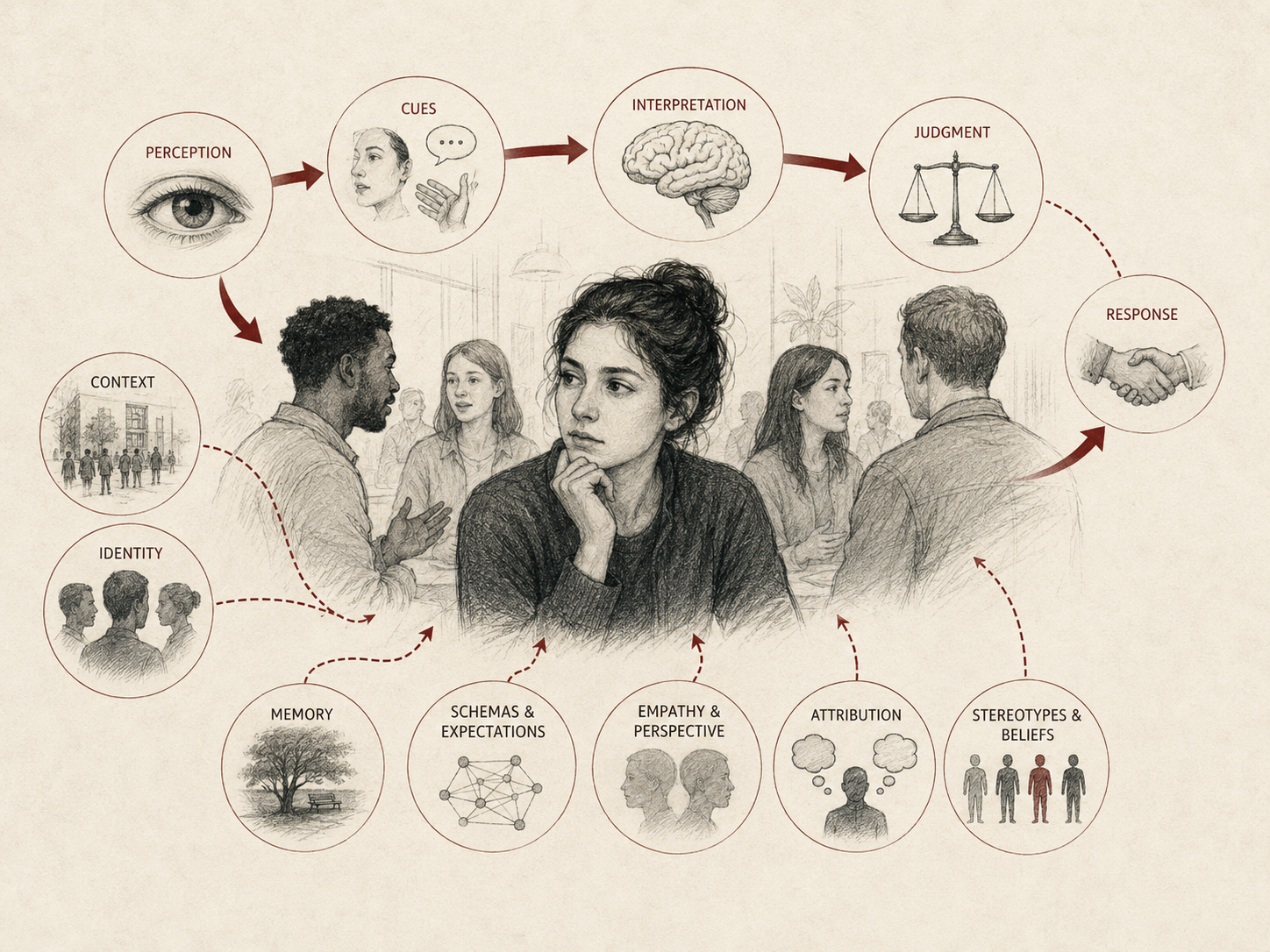
Social cognition sits at the center of social psychology because nearly every social process depends on interpretation. People must decide whether others are trustworthy, competent, dangerous, warm, hostile, fair, credible, responsible, sincere, powerful, vulnerable, similar, or different. These judgments shape cooperation, conflict, persuasion, institutional trust, prejudice, political interpretation, workplace evaluation, moral judgment, and collective action.
This article connects directly to attribution theory, fundamental attribution error, self-serving bias, heuristics and biases, cognitive dissonance theory, stereotypes, prejudice, and discrimination, implicit bias, social identity theory, Behavioral Economics, and Institutions & Governance. Together these frameworks explain why social judgment is fast, meaningful, efficient, biased, embodied, emotional, cultural, and institutionally consequential.
What is social cognition?
Social cognition refers to the cognitive processes through which people perceive, encode, interpret, remember, and use information about other people and social situations. It includes the mental processes involved in forming impressions, reading cues, assigning motives, recognizing emotion, making attributions, judging groups, remembering social information, and deciding how to respond.
The central concern of social cognition is not only what people think about others, but how they think about others. It asks what information becomes salient, what categories are activated, what memories are retrieved, what causal explanations are formed, what emotional meanings are attached, and what social responses follow.
Social cognition operates through multiple processes:
- perception of social cues;
- activation of schemas and categories;
- attribution of motives, causes, and responsibility;
- formation of impressions about warmth, competence, trust, and threat;
- retrieval and reconstruction of social memory;
- use of heuristics under uncertainty;
- identity-based weighting of information;
- automatic and implicit associations;
- deliberative correction and contextual interpretation.
These processes are often fast and efficient. People need to interpret social environments quickly. But efficiency comes at a cost. The same mechanisms that support rapid social understanding can also produce stereotyping, premature judgment, selective memory, attribution bias, hostile interpretation, overconfidence, and institutional misrecognition.
Social cognition is therefore a field about both capacity and vulnerability: how human beings make social meaning, and how that meaning can become distorted.
Why social cognition matters
Social cognition matters because nearly every human institution depends on social judgment. Teachers evaluate students. Judges evaluate defendants. Doctors evaluate patients. Managers evaluate workers. Voters evaluate leaders. Journalists frame public events. Citizens interpret protest, poverty, violence, illness, migration, and institutional failure. These judgments are not neutral recordings of reality. They are social interpretations.
Social cognition helps explain why people can reach different conclusions from the same event. One observer sees protest as disorder; another sees grievance. One manager sees low motivation; another sees burnout. One teacher sees defiance; another sees trauma or unmet need. One voter sees threat; another sees injustice. The difference is often not the stimulus alone, but the interpretive framework through which the stimulus is processed.
Social cognition also matters because errors scale. A biased first impression may affect one relationship. A biased institutional decision system can affect thousands of students, patients, workers, defendants, tenants, applicants, migrants, or citizens. When social cognition becomes embedded in policy, records, algorithms, risk categories, performance reviews, disciplinary systems, or public narratives, it becomes institutional cognition.
The field is especially important for understanding inequality. Dominant groups often receive more individuating context, while marginalized groups are more likely to be interpreted through category, stereotype, threat, deviance, or deficiency. Social cognition helps explain how unequal perception becomes unequal treatment.
The ethical stakes are therefore high. To study social cognition is to study how societies decide who is credible, who is dangerous, who deserves help, who deserves punishment, whose suffering counts, and whose context is allowed to matter.
Origins and development of the field
Social cognition emerged from the convergence of social psychology and cognitive psychology. Earlier social psychology studied attitudes, persuasion, conformity, attribution, group influence, and prejudice. Cognitive psychology provided models of attention, memory, categorization, inference, schemas, automaticity, and information processing. Social cognition brought these traditions together by asking how cognitive processes operate in social life.
Fritz Heider’s work on interpersonal relations helped establish the idea that people function as everyday causal interpreters. Attribution research then examined how people explain behavior. Later work on person perception, schemas, stereotypes, impression formation, memory, automaticity, and implicit cognition extended the field.
By the late twentieth century, social cognition had become one of the organizing frameworks of social psychology. It provided tools for studying how people process social information, how category-based perception shapes judgment, how stereotypes become cognitively available, how impressions are updated, how memory is reconstructed, and how social identities influence interpretation.
The field also expanded beyond individual cognition. Contemporary social cognition links brain, body, culture, language, social structure, digital environments, and institutions. It recognizes that minds do not interpret social reality from nowhere. They interpret from within histories, categories, relationships, media systems, institutional rules, and unequal distributions of power.
This makes social cognition a bridge field: cognitive, social, cultural, moral, institutional, and political at the same time.
Schemas and cognitive frameworks
Schemas are structured mental frameworks that organize knowledge about people, roles, groups, institutions, relationships, and recurring situations. They allow people to interpret new information quickly by connecting it to prior patterns.
People develop schemas for teachers, doctors, leaders, police, activists, students, workers, parents, strangers, professionals, bureaucracies, neighborhoods, political groups, religious communities, and social roles. These schemas guide what people expect, notice, remember, and infer.
Schemas are useful because social life is too complex to interpret from scratch every time. A classroom, hospital, courtroom, job interview, protest, meeting, family gathering, or online exchange carries expectations about roles and conduct. Schemas help people navigate those expectations.
But schemas can also distort judgment. When a schema becomes active, ambiguous evidence may be interpreted in schema-consistent ways. Information that confirms the schema may be noticed and remembered more easily. Information that contradicts the schema may be ignored, explained away, or treated as exception.
This makes schemas central to stereotype formation. A stereotype is not merely a false belief about a group. It is a schema that organizes perception, memory, affect, expectation, and response around a social category.
Schema-based cognition therefore illustrates a central tension: the same mental structures that make interpretation efficient can also make perception unjust.
Categories, prototypes, and social classification
Social cognition depends heavily on categorization. People classify others by role, age, gender, race, ethnicity, class, religion, nationality, language, disability, profession, political identity, status, and group membership. These categories shape expectations before individuating information is fully processed.
Categories can be cognitively useful. They reduce complexity and allow people to make predictions. But social categories are not neutral. They are shaped by history, hierarchy, representation, law, media, education, and institutional practice.
Prototype-based thinking is especially important. People often judge others by similarity to a culturally available prototype. Someone may be perceived as “professional,” “threatening,” “credible,” “foreign,” “intelligent,” “dangerous,” “respectable,” “noncompliant,” or “leadership material” because they resemble or fail to resemble a social prototype.
Category activation can occur quickly. Salient cues such as accent, clothing, name, appearance, neighborhood, job title, institutional role, or group label can trigger expectations before careful reflection begins.
Individuating information can correct category-based judgment, but only when the perceiver has motivation, time, cognitive resources, and a social environment that supports correction. Under cognitive load, time pressure, threat, or institutional routine, category-based processing can dominate.
The ethical problem is not categorization itself. Categorization is unavoidable. The problem is when categories become rigid, unequal, decontextualized, and institutionally consequential.
Heuristics and cognitive shortcuts
Heuristics are simplified judgment strategies that allow people to make social evaluations quickly. In social environments, they help people interpret complex information under limited time, limited attention, uncertainty, and cognitive load.
Several heuristics are central to social cognition:
- availability: judging frequency or likelihood by how easily examples come to mind;
- representativeness: judging a person or event by similarity to a prototype;
- anchoring: allowing an initial cue, label, number, or first impression to shape later judgment;
- affect: allowing immediate emotional reaction to guide evaluation of risk, trust, benefit, or danger;
- fluency: treating information that is easy to process as more familiar, credible, or true;
- social proof: using other people’s apparent beliefs or behavior as evidence.
Heuristics are not simply errors. They are often adaptive because social environments require fast judgment. But they can mislead when the cue is unreliable, manipulated, emotionally vivid, distorted by media, shaped by stereotype, or disconnected from base rates.
For example, availability can make rare but vivid risks feel common. Representativeness can make stereotypes feel like evidence. Anchoring can make first impressions hard to revise. Affect can make dislike feel like danger. Social proof can make false beliefs feel credible when they are widely repeated.
Social cognition therefore depends on the design of environments. If institutions and platforms repeatedly expose people to distorted cues, human judgment will predictably follow those cues.
Attribution and causal explanation
Attribution theory examines how people explain the causes of behavior. When observing an action, people ask whether it reflects internal characteristics such as intention, ability, personality, effort, or morality, or external circumstances such as pressure, opportunity, role, coercion, discrimination, institutional rules, or situational constraint.
Attribution matters because social response depends on causal explanation. A behavior interpreted as intentional produces different judgment from the same behavior interpreted as accidental. A failure attributed to laziness produces different response from failure attributed to lack of support. Harm attributed to malice produces different response from harm attributed to system design, negligence, or coercion.
Social cognition research shows that attribution is often biased. Observers may overemphasize disposition and underemphasize situation, especially when interpreting other people’s behavior. They may explain their own failures through circumstance but explain others’ failures through character. They may attribute outgroup behavior to stable traits and ingroup behavior to context.
Attribution is therefore not only cognitive. It is moral and institutional. It shapes blame, sympathy, punishment, forgiveness, support, trust, legitimacy, and reform.
A careful social-cognitive approach asks: What causes are visible? What context is missing? What categories are active? Who is being granted complexity? Who is being reduced to disposition?
Impression formation and person perception
Impression formation is the process by which people integrate social information into judgments about another person. These judgments may concern warmth, competence, trustworthiness, status, morality, sincerity, intelligence, threat, leadership, or responsibility.
Impressions often begin quickly. Facial expression, tone, clothing, posture, group membership, role, accent, name, professional status, and setting can shape interpretation before full evidence is available. First impressions can become anchors for later interpretation.
The continuum model of impression formation explains that perceivers can move between category-based and individuating processing. When motivation and resources are low, perceivers may rely heavily on categories and stereotypes. When motivation, accountability, time, and attention are higher, perceivers may process more individuating information.
This does not mean individuating processing is always perfect or category-based processing is always wrong. It means that social judgment depends on motivation, attention, evidence quality, and context. A person is not perceived in a vacuum; they are perceived through a field of cues and expectations.
Institutional settings make impression formation consequential. A first impression in hiring, policing, medicine, law, education, or management can affect records, opportunities, surveillance, discipline, diagnosis, and trust. The more consequential the judgment, the greater the need for structured correction.
Warmth, competence, trust, and threat
Social cognition often organizes person perception around broad evaluative dimensions. Two of the most important are warmth and competence. Warmth concerns intention: Is this person friendly, sincere, cooperative, threatening, or hostile? Competence concerns capability: Is this person skilled, intelligent, effective, reliable, or capable of acting on intentions?
These dimensions shape trust. A person seen as warm but incompetent may be liked but not relied upon. A person seen as competent but cold may be respected but distrusted. A person seen as both warm and competent is more likely to be trusted. A person seen as hostile and competent may be perceived as threatening.
Warmth and competence judgments are socially consequential because they affect hiring, leadership evaluation, medical trust, legal credibility, political support, group stereotypes, and institutional legitimacy.
They are also vulnerable to inequality. Social groups may be stereotyped as warm but incompetent, competent but cold, dangerous but capable, dependent, threatening, untrustworthy, or undeserving. These judgments can justify paternalism, exclusion, surveillance, punishment, or neglect.
A serious social-cognitive analysis must therefore ask how warmth, competence, trust, and threat are distributed across social categories, and how institutions convert those perceptions into consequences.
Automaticity and implicit social cognition
Much of social cognition is automatic. People can categorize, evaluate, and respond to social cues without deliberate intention or full awareness. Automatic processes can involve attention, affect, trait inference, stereotype activation, emotional reaction, memory retrieval, and behavioral readiness.
Automaticity does not mean inevitability. It means that some processes can occur quickly, efficiently, and with limited conscious control. Deliberation, accountability, motivation, training, and institutional design can sometimes interrupt or redirect them.
Implicit social cognition refers to the influence of prior experience on social judgment in ways that may not be fully accessible to introspection. People may sincerely endorse fairness while still showing patterns of attention, association, memory, or response that reflect learned cultural categories.
This is important because social bias is not always conscious hostility. It can operate through automatic attention, fluency, familiarity, threat perception, credibility judgment, and memory. A person may not intend unfairness but may still participate in unequal perception.
The institutional implication is clear: good intentions are not enough. High-stakes decisions need structure, feedback, accountability, diverse evidence, and procedures that reduce reliance on unexamined automatic judgments.
Social memory and reconstruction
Social cognition depends on memory. People remember prior interactions, reputations, stories, group narratives, institutional histories, and social categories. These memories guide later perception and judgment.
Social memory is reconstructive rather than purely reproductive. People do not simply retrieve perfect records. They reconstruct past information through current schemas, emotions, identities, and goals.
Schema-consistent information is often easier to remember because it fits existing expectations. Schema-inconsistent information can also be memorable when it is surprising, but it may be explained away or treated as exception. Over time, memory can become more coherent with existing beliefs than the original evidence was.
This matters for prejudice and institutional trust. If a group is already associated with threat, ambiguous events may be remembered as more threatening. If an institution is already trusted, errors may be forgotten or minimized. If a person is already disliked, negative behavior may be remembered more readily than positive behavior.
Social memory also matters for marginalized communities. Public memory often preserves dominant narratives while erasing histories of harm, resistance, exclusion, and structural constraint. Social cognition therefore intersects with collective memory and historical power.
A fairer social cognition requires better memory: records, testimony, institutional archives, counter-narratives, and practices that preserve context rather than only stereotype-confirming fragments.
Identity, self, and motivated interpretation
Social cognition is shaped by identity. People interpret social information from within a self-concept, group memberships, moral commitments, histories, loyalties, and social positions.
Identity affects what becomes salient. A threat to one’s group may be noticed quickly. A criticism from an outgroup may be discounted. A success by an ingroup member may feel personally meaningful. A failure by an outgroup member may be treated as confirming expectation. A policy may be interpreted differently depending on whether it is framed as protecting, attacking, recognizing, or humiliating a valued identity.
Motivated interpretation does not always involve conscious deception. People can sincerely see evidence differently because identity shapes attention, trust, affect, and memory.
This is one reason political and intergroup conflict can be difficult to resolve. People are not only debating facts. They are protecting moral identities, group narratives, social belonging, and self-understanding.
Identity can also support ethical perception. People who identify with justice, care, solidarity, professional responsibility, religious obligation, public service, or scientific honesty may notice harms or inconsistencies that others ignore. Identity is not only a source of bias; it can also organize moral attention.
The question is what kind of identity is active and what kind of social cognition it encourages.
Affect, empathy, and moral perception
Social cognition is not cold computation. Emotion shapes perception, memory, attribution, trust, threat, and moral judgment.
Affect can guide attention. Fear makes threat salient. Anger makes blame salient. Disgust can moralize boundaries. Sympathy can make need visible. Pride can protect group identity. Shame can motivate concealment or repair. Empathy can expand the perceived relevance of another person’s suffering.
Emotion can improve social understanding when it directs attention to real harm, vulnerability, injustice, or relational meaning. But emotion can also distort judgment when fear, contempt, disgust, resentment, or group-based anger are attached to categories rather than evidence.
Empathy is especially important because it can increase contextual understanding. When people take another person’s perspective, they may become more likely to recognize constraints, pain, uncertainty, and motive complexity. But empathy can also be selective. People often empathize more readily with those who are similar, familiar, socially valued, or ingroup members.
Social cognition therefore requires emotional discipline, not emotional suppression. The goal is not to remove emotion from judgment. The goal is to understand how emotion shapes what people see, ignore, remember, and do.
Culture and models of social understanding
Social cognition is culturally shaped. People learn how to interpret behavior through language, family, religion, education, law, media, class position, historical memory, political economy, and institutional norms.
Culture shapes models of self and agency. Some contexts emphasize individual autonomy, personal choice, internal traits, and self-expression. Others emphasize relation, role, obligation, hierarchy, context, interdependence, and social harmony. These models influence attribution, emotion, responsibility, and moral judgment.
Culture also shapes what social cues mean. Eye contact, silence, directness, deference, emotional expression, disagreement, apology, time, authority, and public criticism can carry different meanings across social contexts.
A serious social cognition must therefore resist universalizing one cultural model of interpretation. It should ask how perception is learned, how categories are named, how institutions teach people to classify others, and how historical power shapes what feels natural or obvious.
Cultural social cognition is not an add-on to individual cognition. It is one of the conditions under which social cognition develops.
Systematic biases in social judgment
Because social cognition relies on schemas, categories, heuristics, memory, emotion, and identity, it is vulnerable to systematic bias.
Major biases include:
- fundamental attribution error: overemphasizing disposition and underemphasizing situation when explaining others’ behavior;
- confirmation bias: seeking or weighting evidence that supports existing beliefs;
- self-serving bias: interpreting success and failure in ways that protect self-image;
- ingroup bias: evaluating one’s own group more favorably than outgroups;
- outgroup homogeneity: seeing outgroup members as more alike than ingroup members;
- hostile attribution bias: inferring hostile intent from ambiguous behavior;
- availability bias: judging likelihood by ease of recall;
- anchoring: allowing initial impressions or labels to shape later judgment;
- halo effect: allowing one positive trait to influence broad evaluation;
- horn effect: allowing one negative trait to contaminate broad evaluation.
These biases are not simply individual flaws. They can be socially produced and institutionally reinforced. Media systems, workplace norms, legal categories, school records, policing practices, platform algorithms, and political rhetoric can all shape which cues become salient and which explanations feel natural.
The purpose of studying bias is not to shame ordinary cognition. It is to make predictable distortion visible so that individuals and institutions can design better conditions for judgment.
Stereotypes, prejudice, and category-based perception
Stereotypes are socially shared schemas about groups. They organize expectations about traits, roles, motives, abilities, morality, danger, competence, warmth, work ethic, sexuality, intelligence, citizenship, deservingness, and threat.
Stereotypes are powerful because they operate cognitively, emotionally, and institutionally. They influence what people notice, how ambiguity is interpreted, what is remembered, what is considered evidence, and what response feels justified.
Category-based perception can be efficient in ordinary cognition, but it becomes unjust when social categories carry histories of domination, exclusion, racialization, colonization, patriarchy, class hierarchy, ableism, religious suspicion, or national threat.
For example, a behavior read as confidence in one person may be read as aggression in another. A mistake read as youth or stress in one group may be read as criminality or deficiency in another. A need read as vulnerability in one group may be read as dependency in another.
This is why social cognition must be linked to stereotypes, prejudice, and discrimination. Bias is not only a matter of private attitude. It is a process by which perception itself becomes unequal.
Reducing stereotype-based judgment requires more than positive messaging. It requires individuating information, structural context, accountability, counter-stereotypic evidence, institutional review, diverse decision makers, slower high-stakes decisions, and systems that track outcomes rather than intentions alone.
Institutions and social cognition at scale
Institutions do not merely contain social cognition. They organize it. Schools, courts, hospitals, workplaces, welfare systems, police departments, media organizations, platforms, and governments create categories, records, metrics, labels, procedures, and narratives that shape how people are interpreted.
An institution may classify someone as gifted, risky, noncompliant, high-performing, suspicious, disabled, employable, dangerous, vulnerable, credible, uncooperative, deserving, or undeserving. Once recorded, these classifications influence later interpretation.
Institutional social cognition becomes especially powerful when categories accumulate. A disciplinary record, risk score, credit file, medical note, performance review, algorithmic flag, or case history can anchor future judgment. Later decision makers may treat the record as objective evidence without seeing the social cognition that produced it.
This is why context visibility matters. Institutions often make individual behavior visible while hiding system conditions: staffing, workload, discrimination, policy constraints, resource scarcity, algorithmic ranking, language access, transportation barriers, trauma, disability, and historical exclusion.
Fair institutions need social-cognitive safeguards: structured criteria, context fields, decision logs, appeal mechanisms, audit trails, independent review, outcome monitoring, protected dissent, and explicit attention to how categories are created and used.
Good institutions do not assume perception is neutral. They design against predictable misperception.
Digital environments and algorithmic social perception
Digital environments reshape social cognition by changing what people see, how often they see it, and what cues are attached to it. Platforms make some social information more salient than other information: likes, shares, views, comments, follower counts, profile images, headlines, labels, warnings, ratings, and recommendation patterns.
These cues become part of social judgment. A highly shared claim may feel credible. A person with many followers may seem authoritative. A viral incident may feel representative. A clipped video may become the basis for moral judgment. A platform label may become an anchor.
Algorithmic ranking can amplify availability and representativeness. If certain groups or topics are repeatedly associated with conflict, threat, ridicule, corruption, or crisis, users may come to experience those associations as common sense.
Digital social cognition is also compressed. People judge others through fragments: posts, avatars, comments, screenshots, clips, bios, metrics, and group labels. Context is often missing. The result is rapid attribution under extreme ambiguity.
Responsible digital design should therefore consider cognitive effects: context collapse, virality, outrage amplification, stereotype reinforcement, reputation systems, harassment dynamics, and algorithmic salience. The question is not only what content is shown, but what forms of social perception the system trains.
Formalizing social cognition
Social cognition can be formalized as inference under uncertainty. Let \(x\) represent observed social cues, and let \(h\) represent a social hypothesis such as “cooperative,” “threatening,” “competent,” “untrustworthy,” or “constrained by context”:
P(h \mid x)=\frac{P(x \mid h)P(h)}{P(x)}
\]
Interpretation: Social judgment depends on current evidence \(x\), prior expectations \(P(h)\), and the perceived likelihood of the cue under a given social hypothesis.
Attribution can be represented as a weighted comparison between dispositional and situational explanations:
A=\omega_DD+\omega_SS
\]
Interpretation: Attributional judgment \(A\) depends on dispositional evidence \(D\), situational evidence \(S\), and the weights assigned to each. Attribution bias can occur when one weight is systematically too large.
Impression updating can be represented as a learning process:
T_{t+1}=T_t+\alpha(e_t-T_t)
\]
Interpretation: A trait estimate \(T\) updates when new evidence \(e_t\) arrives. The learning rate \(\alpha\) determines whether impressions change quickly or remain anchored by earlier judgment.
Category-weighted impression formation can be represented as:
J=\beta_0+\beta_1C+\beta_2I+\beta_3X+\varepsilon
\]
Interpretation: Social judgment \(J\) is shaped by category cue \(C\), individuating information \(I\), contextual evidence \(X\), and residual uncertainty \(\varepsilon\).
Identity-shaped evaluation can be represented as:
V_j=\sum_{k=1}^{m}\omega_k(G)x_{jk}
\]
Interpretation: Evaluation of person or option \(j\) depends on attributes \(x_{jk}\), but the weights \(\omega_k\) can shift when group identity \(G\) becomes salient.
These models do not reduce social cognition to equations. They clarify the variables that researchers can measure: cues, priors, category activation, individuating evidence, context visibility, identity salience, memory, confidence, and judgment.
Limits and interpretive cautions
Social cognition is a powerful framework, but it should not be used carelessly.
- Do not reduce all social problems to individual cognitive bias.
- Do not treat schemas as inherently false; many are practical forms of learned knowledge.
- Do not assume fast judgment is always wrong or slow judgment is always fair.
- Do not treat implicit cognition as destiny.
- Do not ignore institutions, incentives, and structural inequality.
- Do not treat marginalized groups as objects of perception without including their own interpretive authority.
- Do not confuse social category effects with biological inevitability.
- Do not assume that awareness training alone changes institutional outcomes.
- Do not treat social cognition as purely individual; perception is culturally and institutionally organized.
- Do not use bias language to excuse harm or avoid accountability.
The best use of social cognition is diagnostic and constructive. It helps identify where interpretation becomes distorted, where context is missing, where categories are overused, where memory is selective, and where institutions need better judgment architecture.
A serious social cognition does not deny agency. It asks how agency, perception, context, culture, and power interact.
Social cognition in the architecture of social influence
Within the broader architecture of social influence, social cognition explains the mental processes that make influence possible. Attribution theory explains how people assign causes. Heuristics and biases explain shortcuts under uncertainty. Cognitive dissonance theory explains how people preserve coherence. Social identity theory explains how group membership shapes self and judgment. Social cognition links these processes into one interpretive system.
It also connects to conformity and social influence. Social consensus is not only external pressure; it is information. If others appear to believe something, it may become more credible. If ingroup members repeat a claim, it may become more available. If authority figures label a group as dangerous or deserving, those labels become interpretive cues.
Social cognition connects to stereotypes, prejudice, and discrimination because unequal perception often precedes unequal action. It connects to groupthink because cohesive groups can filter information through shared assumptions. It connects to Institutions & Governance because institutions formalize perception through categories, metrics, records, and decisions.
The central lesson is that social influence does not act on blank minds. It acts on minds already structured by memory, identity, affect, category, expectation, and social position.
Measurement, data, and research design
Research on social cognition can use laboratory experiments, online judgment tasks, vignette studies, implicit-association measures, memory-recall tasks, response-time studies, impression-updating tasks, attribution studies, eye-tracking, field experiments, organizational audits, platform experiments, and institutional simulations.
Key variables include:
- participant, session, group, scenario, site, and institutional identifiers;
- target group;
- target role;
- condition;
- cue salience;
- schema consistency;
- identity salience;
- stereotype activation;
- category accessibility;
- individuating information;
- context visibility;
- cognitive load;
- time pressure;
- internal attribution;
- external attribution;
- warmth rating;
- competence rating;
- trust rating;
- threat rating;
- empathy rating;
- responsibility rating;
- memory accuracy;
- schema-consistent recall;
- schema-inconsistent recall;
- confidence rating;
- implicit-explicit gap;
- response time;
- decision quality.
Strong research should separate multiple levels of analysis. Category activation is not identical to explicit prejudice. Trust is not identical to warmth. Warmth is not identical to competence. Attribution is not identical to responsibility. Memory confidence is not identical to memory accuracy.
Institutional research should also measure context visibility. If decision makers do not see workload, resource constraints, discrimination, policy design, or historical data, their social cognition will be shaped by missing information.
Good social cognition research therefore studies both mental process and information environment.
R code for social cognition research
The following R workflow models attribution, trust, threat, memory accuracy, schema recall bias, decision quality, and response time.
# Install packages if needed:
# pak::pak(c("tidyverse", "lme4", "lmerTest", "emmeans", "broom.mixed", "performance"))

library(tidyverse)
library(lme4)
library(lmerTest)
library(emmeans)
library(broom.mixed)
library(performance)

# Expected columns:
# participant, session_id, group_id, scenario_id, site_id,
# institution_context, target_group, target_role, condition,
# trial, cue_salience, schema_consistency, identity_salience,
# stereotype_activation, category_accessibility,
# individuating_information, context_visibility, cognitive_load,
# time_pressure, attribution_internal, attribution_external,
# warmth_rating, competence_rating, trust_rating, threat_rating,
# empathy_rating, responsibility_rating, memory_accuracy,
# schema_consistent_recall, schema_inconsistent_recall,
# confidence_rating, implicit_explicit_gap, response_time_ms,
# decision_quality

dat <- read_csv("social_cognition_trials.csv") %>%
  mutate(
    participant = factor(participant),
    session_id = factor(session_id),
    group_id = factor(group_id),
    scenario_id = factor(scenario_id),
    site_id = factor(site_id),
    institution_context = factor(institution_context),
    target_group = factor(target_group),
    target_role = factor(target_role),
    condition = factor(condition),
    log_response_time = log(response_time_ms),
    schema_recall_bias = schema_consistent_recall - schema_inconsistent_recall,
    disposition_bias_index = attribution_internal - attribution_external,
    category_processing_index = (
      cue_salience +
      stereotype_activation +
      category_accessibility -
      individuating_information -
      context_visibility
    ) / 3,
    contextual_correction_index = (
      context_visibility +
      individuating_information +
      empathy_rating / 10 -
      cognitive_load -
      time_pressure
    ) / 3
  )

summary_table <- dat %>%
  group_by(condition, target_group) %>%
  summarise(
    n = n(),
    participants = n_distinct(participant),
    mean_internal = mean(attribution_internal, na.rm = TRUE),
    mean_external = mean(attribution_external, na.rm = TRUE),
    mean_warmth = mean(warmth_rating, na.rm = TRUE),
    mean_competence = mean(competence_rating, na.rm = TRUE),
    mean_trust = mean(trust_rating, na.rm = TRUE),
    mean_threat = mean(threat_rating, na.rm = TRUE),
    mean_memory_accuracy = mean(memory_accuracy, na.rm = TRUE),
    mean_schema_recall_bias = mean(schema_recall_bias, na.rm = TRUE),
    mean_decision_quality = mean(decision_quality, na.rm = TRUE),
    .groups = "drop"
  )

print(summary_table)

internal_model <- lmer(
  attribution_internal ~
    schema_consistency +
    stereotype_activation +
    category_accessibility +
    individuating_information +
    context_visibility +
    cognitive_load +
    time_pressure +
    target_group +
    condition +
    (1 | participant) +
    (1 | scenario_id),
  data = dat,
  REML = FALSE
)

summary(internal_model)

trust_model <- lmer(
  trust_rating ~
    warmth_rating +
    competence_rating +
    threat_rating +
    individuating_information +
    context_visibility +
    target_group +
    condition +
    (1 | participant) +
    (1 | scenario_id),
  data = dat,
  REML = FALSE
)

summary(trust_model)
emmeans(trust_model, ~ target_group)

threat_model <- lmer(
  threat_rating ~
    cue_salience +
    stereotype_activation +
    category_accessibility +
    context_visibility +
    identity_salience +
    target_group +
    condition +
    (1 | participant) +
    (1 | scenario_id),
  data = dat,
  REML = FALSE
)

summary(threat_model)

memory_model <- lmer(
  memory_accuracy ~
    schema_consistency +
    individuating_information +
    context_visibility +
    cognitive_load +
    time_pressure +
    condition +
    (1 | participant) +
    (1 | scenario_id),
  data = dat,
  REML = FALSE
)

summary(memory_model)

schema_recall_model <- lmer(
  schema_recall_bias ~
    schema_consistency +
    stereotype_activation +
    individuating_information +
    cognitive_load +
    condition +
    (1 | participant) +
    (1 | scenario_id),
  data = dat,
  REML = FALSE
)

summary(schema_recall_model)

decision_quality_model <- lmer(
  decision_quality ~
    context_visibility +
    individuating_information +
    stereotype_activation +
    cognitive_load +
    time_pressure +
    empathy_rating +
    condition +
    (1 | participant) +
    (1 | scenario_id),
  data = dat,
  REML = FALSE
)

summary(decision_quality_model)

response_time_model <- lmer(
  log_response_time ~
    cognitive_load +
    time_pressure +
    schema_consistency +
    individuating_information +
    target_group +
    condition +
    (1 | participant) +
    (1 | scenario_id),
  data = dat %>% filter(response_time_ms >= 150),
  REML = FALSE
)

summary(response_time_model)

condition_summary <- dat %>%
  group_by(condition) %>%
  summarise(
    n = n(),
    mean_trust = mean(trust_rating, na.rm = TRUE),
    mean_threat = mean(threat_rating, na.rm = TRUE),
    mean_memory_accuracy = mean(memory_accuracy, na.rm = TRUE),
    mean_decision_quality = mean(decision_quality, na.rm = TRUE),
    .groups = "drop"
  )

write_csv(summary_table, "social_cognition_summary.csv")
write_csv(condition_summary, "social_cognition_condition_summary.csv")
write_csv(
  tidy(decision_quality_model, effects = "fixed", conf.int = TRUE),
  "social_cognition_decision_quality_coefficients.csv"
)

ggplot(
  condition_summary,
  aes(x = reorder(condition, mean_decision_quality), y = mean_decision_quality, group = 1)
) +
  geom_line() +
  geom_point() +
  coord_flip() +
  labs(
    title = "Mean decision quality by social cognition condition",
    x = "Condition",
    y = "Mean decision quality"
  ) +
  theme_minimal()
This workflow supports social cognition research by separating schema consistency, stereotype activation, category accessibility, individuating information, context visibility, cognitive load, time pressure, attribution, trust, threat, memory, and decision quality.
Python code for social cognition research
The Python workflow below parallels the R analysis and adds a schema-amplification simulation for studying category weighting, context visibility, time pressure, individuating information, correction prompts, and institutional decision quality.
import numpy as np
import pandas as pd
import statsmodels.formula.api as smf
import matplotlib.pyplot as plt

# Expected columns:
# participant, session_id, group_id, scenario_id, site_id,
# institution_context, target_group, target_role, condition,
# trial, cue_salience, schema_consistency, identity_salience,
# stereotype_activation, category_accessibility,
# individuating_information, context_visibility, cognitive_load,
# time_pressure, attribution_internal, attribution_external,
# warmth_rating, competence_rating, trust_rating, threat_rating,
# empathy_rating, responsibility_rating, memory_accuracy,
# schema_consistent_recall, schema_inconsistent_recall,
# confidence_rating, implicit_explicit_gap, response_time_ms,
# decision_quality

df = pd.read_csv("social_cognition_trials.csv")

for col in [
    "participant",
    "session_id",
    "group_id",
    "scenario_id",
    "site_id",
    "institution_context",
    "target_group",
    "target_role",
    "condition",
]:
    df[col] = df[col].astype("category")

df["log_response_time"] = np.log(df["response_time_ms"])

df["schema_recall_bias"] = (
    df["schema_consistent_recall"] - df["schema_inconsistent_recall"]
)

df["disposition_bias_index"] = (
    df["attribution_internal"] - df["attribution_external"]
)

df["category_processing_index"] = (
    df["cue_salience"]
    + df["stereotype_activation"]
    + df["category_accessibility"]
    - df["individuating_information"]
    - df["context_visibility"]
) / 3

df["contextual_correction_index"] = (
    df["context_visibility"]
    + df["individuating_information"]
    + df["empathy_rating"] / 10
    - df["cognitive_load"]
    - df["time_pressure"]
) / 3

summary_table = (
    df.groupby(["condition", "target_group"], observed=True)
    .agg(
        n=("participant", "size"),
        participants=("participant", "nunique"),
        mean_internal=("attribution_internal", "mean"),
        mean_external=("attribution_external", "mean"),
        mean_warmth=("warmth_rating", "mean"),
        mean_competence=("competence_rating", "mean"),
        mean_trust=("trust_rating", "mean"),
        mean_threat=("threat_rating", "mean"),
        mean_memory_accuracy=("memory_accuracy", "mean"),
        mean_schema_recall_bias=("schema_recall_bias", "mean"),
        mean_decision_quality=("decision_quality", "mean"),
    )
    .reset_index()
)

print(summary_table)

internal_model = smf.ols(
    "attribution_internal ~ schema_consistency + stereotype_activation "
    "+ category_accessibility + individuating_information + context_visibility "
    "+ cognitive_load + time_pressure + target_group + condition",
    data=df
)

internal_result = internal_model.fit(
    cov_type="cluster",
    cov_kwds={"groups": df["participant"]}
)

print(internal_result.summary())

trust_model = smf.ols(
    "trust_rating ~ warmth_rating + competence_rating + threat_rating "
    "+ individuating_information + context_visibility "
    "+ target_group + condition",
    data=df
)

trust_result = trust_model.fit(
    cov_type="cluster",
    cov_kwds={"groups": df["participant"]}
)

print(trust_result.summary())

threat_model = smf.ols(
    "threat_rating ~ cue_salience + stereotype_activation "
    "+ category_accessibility + context_visibility "
    "+ identity_salience + target_group + condition",
    data=df
)

threat_result = threat_model.fit(
    cov_type="cluster",
    cov_kwds={"groups": df["participant"]}
)

print(threat_result.summary())

memory_model = smf.ols(
    "memory_accuracy ~ schema_consistency + individuating_information "
    "+ context_visibility + cognitive_load + time_pressure + condition",
    data=df
)

memory_result = memory_model.fit(
    cov_type="cluster",
    cov_kwds={"groups": df["participant"]}
)

print(memory_result.summary())

schema_recall_model = smf.ols(
    "schema_recall_bias ~ schema_consistency + stereotype_activation "
    "+ individuating_information + cognitive_load + condition",
    data=df
)

schema_recall_result = schema_recall_model.fit(
    cov_type="cluster",
    cov_kwds={"groups": df["participant"]}
)

print(schema_recall_result.summary())

decision_quality_model = smf.ols(
    "decision_quality ~ context_visibility + individuating_information "
    "+ stereotype_activation + cognitive_load + time_pressure "
    "+ empathy_rating + condition",
    data=df
)

decision_quality_result = decision_quality_model.fit(
    cov_type="cluster",
    cov_kwds={"groups": df["participant"]}
)

print(decision_quality_result.summary())

rt_df = df[df["response_time_ms"] >= 150].copy()

response_time_model = smf.ols(
    "log_response_time ~ cognitive_load + time_pressure "
    "+ schema_consistency + individuating_information "
    "+ target_group + condition",
    data=rt_df
)

response_time_result = response_time_model.fit(
    cov_type="cluster",
    cov_kwds={"groups": rt_df["participant"]}
)

print(response_time_result.summary())

def simulate_schema_amplification(steps=80, seed=42):
    rng = np.random.default_rng(seed)
    rows = []

    scenarios = [
        "high_load_low_context",
        "time_pressure",
        "individuating_information",
        "system_visibility",
        "accountability_and_correction",
    ]

    for scenario in scenarios:
        category_weight = 0.55
        context_weight = 0.35

        for step in range(1, steps + 1):
            if scenario == "high_load_low_context":
                load, pressure, individuation, context, correction = 0.85, 0.75, 0.20, 0.20, 0.10
            elif scenario == "time_pressure":
                load, pressure, individuation, context, correction = 0.70, 0.95, 0.25, 0.25, 0.10
            elif scenario == "individuating_information":
                load, pressure, individuation, context, correction = 0.45, 0.40, 0.85, 0.55, 0.45
            elif scenario == "system_visibility":
                load, pressure, individuation, context, correction = 0.45, 0.40, 0.65, 0.90, 0.55
            else:
                load, pressure, individuation, context, correction = 0.35, 0.30, 0.85, 0.90, 0.85

            category_pressure = (
                load
                + pressure
                - individuation
                - context
                - correction
            )

            category_weight = np.clip(
                category_weight
                + 0.05 * category_pressure
                + rng.normal(0, 0.02),
                0,
                1
            )

            context_weight = np.clip(
                context_weight
                + 0.05 * (
                    context
                    + individuation
                    + correction
                    - load
                    - pressure
                )
                + rng.normal(0, 0.02),
                0,
                1
            )

            decision_quality = np.clip(
                0.35
                + 0.45 * context_weight
                + 0.20 * individuation
                - 0.25 * category_weight,
                0,
                1
            )

            rows.append({
                "scenario": scenario,
                "step": step,
                "category_weight": category_weight,
                "context_weight": context_weight,
                "decision_quality": decision_quality,
                "cognitive_load": load,
                "time_pressure": pressure,
                "individuation": individuation,
                "context_visibility": context,
                "correction": correction,
            })

    return pd.DataFrame(rows)

simulation = simulate_schema_amplification()

condition_summary = (
    df.groupby("condition", observed=True)
    .agg(
        mean_trust=("trust_rating", "mean"),
        mean_threat=("threat_rating", "mean"),
        mean_memory_accuracy=("memory_accuracy", "mean"),
        mean_decision_quality=("decision_quality", "mean"),
    )
    .reset_index()
)

fig, ax = plt.subplots(figsize=(8, 5))

ordered = condition_summary.sort_values("mean_decision_quality")
ax.plot(
    ordered["mean_decision_quality"],
    ordered["condition"].astype(str),
    marker="o"
)

ax.set_xlabel("Mean decision quality")
ax.set_ylabel("Condition")
ax.set_title("Mean decision quality by social cognition condition")
plt.tight_layout()
plt.show()

summary_table.to_csv("social_cognition_summary.csv", index=False)
condition_summary.to_csv("social_cognition_condition_summary.csv", index=False)
simulation.to_csv("schema_amplification_simulation.csv", index=False)
This Python workflow supports social cognition research by modeling attribution, trust, threat, warmth, competence, schema recall, memory accuracy, category processing, context visibility, decision quality, and institutional schema amplification.
Research data architecture
Social cognition research often depends on relational data: participants, sessions, groups, scenarios, institutions, target groups, target roles, conditions, cue salience, schema consistency, identity salience, stereotype activation, category accessibility, individuating information, context visibility, cognitive load, time pressure, attribution, warmth, competence, trust, threat, empathy, responsibility, memory accuracy, recall bias, confidence, implicit-explicit discrepancy, response time, and decision quality.
The companion GitHub repository includes a full SQL schema and example analytical queries for researchers who want to reproduce, inspect, or extend the data model. Keeping executable SQL in GitHub avoids WordPress hosting restrictions while preserving the technical infrastructure for readers who want to use the article as a reproducible research workflow.
The research data model supports questions such as:
- Does schema consistency increase internal attribution?
- Does stereotype activation increase threat perception?
- Does individuating information increase trust and decision quality?
- Does context visibility increase external attribution and empathy?
- Does cognitive load increase category-based processing?
- Does time pressure reduce memory accuracy?
- Does schema consistency increase schema-consistent recall?
- Does accountability improve social judgment under uncertainty?
- Does system visibility reduce dispositional bias in institutional settings?
- Does category accessibility predict trust, threat, or responsibility judgments?
View the SQL research data architecture in GitHub.
GitHub repository
The companion repository provides reusable code and research scaffolding for studying social cognition, schemas, impression formation, attribution, social memory, category-based processing, implicit cognition, trust judgment, threat perception, context visibility, and institutional social judgment.
Complete Code Repository
Access the full companion repository for this article, including reproducible analysis materials and multi-language code workflows for social cognition research.
Why social cognition matters for social psychology
Social cognition matters because social life depends on interpretation. Human beings do not simply see others. They classify, infer, remember, explain, evaluate, and respond. They interpret people through schemas, categories, emotions, identities, memories, institutions, and cultural histories.
The field’s deepest insight is that social judgment is both necessary and vulnerable. People need fast interpretive systems to navigate social life. But those systems can overread categories, underread context, misassign responsibility, remember selectively, and convert social inequality into apparent common sense.
Social cognition helps explain why first impressions stick, why stereotypes shape perception, why context disappears, why trust and threat are unevenly distributed, why institutions misclassify people, why digital environments amplify outrage, and why social judgment must be designed with safeguards in high-stakes settings.
Read alongside attribution theory, fundamental attribution error, self-serving bias, heuristics and biases, cognitive dissonance theory, stereotypes, prejudice, and discrimination, implicit bias, Behavioral Economics, and Institutions & Governance, social cognition becomes more than a theory of perception. It becomes a framework for understanding how societies produce meaning, trust, blame, recognition, exclusion, and repair.
Related articles
- Social Psychology
- Attribution Theory
- Fundamental Attribution Error
- Self-Serving Bias
- Heuristics and Biases
- Cognitive Dissonance Theory
- Stereotypes, Prejudice, and Discrimination
- Implicit Bias
- Social Identity Theory
- Groupthink in Social Psychology
- Behavioral Economics
- Institutions & Governance
- Stewardship & Ethics
Further reading
- American Psychological Association (n.d.) ‘Social cognition’, APA Dictionary of Psychology. Available at: https://dictionary.apa.org/social-cognition.
- Bargh, J.A. (2006) ‘What have we been priming all these years? On the development, mechanisms, and ecology of nonconscious social behavior’, European Journal of Social Psychology, 36(2), pp. 147–168. Available at: https://doi.org/10.1002/ejsp.336.
- Fiske, S.T. and Neuberg, S.L. (1990) ‘A continuum of impression formation, from category-based to individuating processes: Influences of information and motivation on attention and interpretation’, Advances in Experimental Social Psychology, 23, pp. 1–74. Available at: https://doi.org/10.1016/S0065-2601(08)60317-2.
- Fiske, S.T. and Taylor, S.E. (2021) Social Cognition: From Brains to Culture. 5th edn. London: Sage. Publisher information available at: https://study.sagepub.com/fiskeandtaylor3e.
- Greenwald, A.G. and Banaji, M.R. (1995) ‘Implicit social cognition: Attitudes, self-esteem, and stereotypes’, Psychological Review, 102(1), pp. 4–27. Available at: https://doi.org/10.1037/0033-295X.102.1.4.
- Higgins, E.T. and Bargh, J.A. (1987) ‘Social cognition and social perception’, Annual Review of Psychology, 38, pp. 369–425. Available at: https://doi.org/10.1146/annurev.ps.38.020187.002101.
- Kahneman, D. (2011) Thinking, Fast and Slow. New York: Farrar, Straus and Giroux.
- Macrae, C.N. and Bodenhausen, G.V. (2000) ‘Social cognition: Thinking categorically about others’, Annual Review of Psychology, 51, pp. 93–120. Available at: https://doi.org/10.1146/annurev.psych.51.1.93.
- Tversky, A. and Kahneman, D. (1974) ‘Judgment under uncertainty: Heuristics and biases’, Science, 185(4157), pp. 1124–1131. Available at: https://doi.org/10.1126/science.185.4157.1124.
References
- American Psychological Association (n.d.) ‘Social cognition’, APA Dictionary of Psychology. Available at: https://dictionary.apa.org/social-cognition.
- Bargh, J.A. (2006) ‘What have we been priming all these years? On the development, mechanisms, and ecology of nonconscious social behavior’, European Journal of Social Psychology, 36(2), pp. 147–168. Available at: https://doi.org/10.1002/ejsp.336.
- Fiske, S.T. and Neuberg, S.L. (1990) ‘A continuum of impression formation, from category-based to individuating processes: Influences of information and motivation on attention and interpretation’, Advances in Experimental Social Psychology, 23, pp. 1–74. Available at: https://doi.org/10.1016/S0065-2601(08)60317-2.
- Fiske, S.T. and Taylor, S.E. (2021) Social Cognition: From Brains to Culture. 5th edn. London: Sage. Publisher information available at: https://study.sagepub.com/fiskeandtaylor3e.
- Greenwald, A.G. and Banaji, M.R. (1995) ‘Implicit social cognition: Attitudes, self-esteem, and stereotypes’, Psychological Review, 102(1), pp. 4–27. Available at: https://doi.org/10.1037/0033-295X.102.1.4.
- Heider, F. (1958) The Psychology of Interpersonal Relations. New York: Wiley. Available at: https://cipra.cl/biblioteca/heider/1958-FritzHeider-ThePsychologyofInterpersonalRelations.pdf.
- Higgins, E.T. and Bargh, J.A. (1987) ‘Social cognition and social perception’, Annual Review of Psychology, 38, pp. 369–425. Available at: https://doi.org/10.1146/annurev.ps.38.020187.002101.
- Macrae, C.N. and Bodenhausen, G.V. (2000) ‘Social cognition: Thinking categorically about others’, Annual Review of Psychology, 51, pp. 93–120. Available at: https://doi.org/10.1146/annurev.psych.51.1.93.
- Tversky, A. and Kahneman, D. (1974) ‘Judgment under uncertainty: Heuristics and biases’, Science, 185(4157), pp. 1124–1131. Available at: https://doi.org/10.1126/science.185.4157.1124.