
Last Updated May 22, 2026
Temperament is the name personality psychology gives to some of the earliest visible differences among human beings: differences in emotional reactivity, attention, motor activity, soothability, fearfulness, frustration, approach, withdrawal, and the developing capacity for regulation. These early variations do not amount to a finished adult personality, but they matter because they help establish the biological and behavioral foundations out of which later personality traits emerge.
The central question is not whether infants already possess a mature personality architecture. They do not. The question is whether early differences in reactivity and regulation show enough continuity, structure, and developmental consequence to count as the first foundations of personality. Modern temperament research answers yes, but with an important qualification: biology provides beginnings, not destiny. Temperament is developmentally potent precisely because it unfolds through reciprocal interaction with caregivers, peers, institutions, stress, opportunity, culture, and time.
This article argues that temperament should be understood as an early developmental system rather than a fixed character blueprint. Temperamental differences bias how children respond to novelty, threat, frustration, reward, stimulation, and social contact; but those biases are continually reorganized by regulation, attachment, language, self-concept, learning, family life, schooling, inequality, and cultural expectation. Temperament is therefore neither a miniature adult personality nor a biologically sealed fate. It is the earliest visible grammar of personality development.
Main Library
Publications
Article Map
Personality Psychology
Related Topic
Developmental Psychology
Related Topic
Biology
Related Topic
Cognitive Psychology
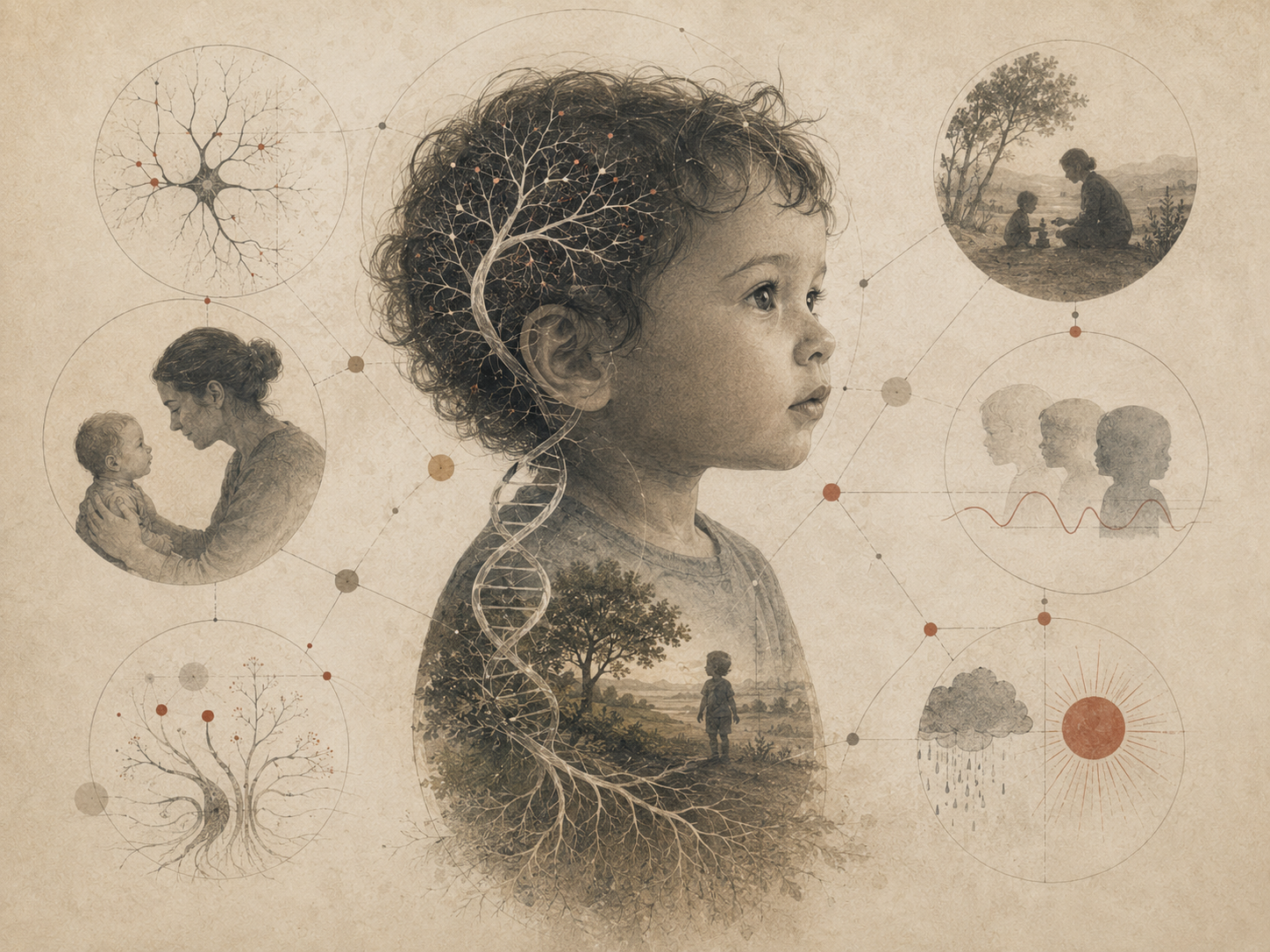
Temperament matters because it appears before children can tell coherent stories about themselves. It is visible in how they startle, cry, approach, avoid, focus, persist, calm down, seek stimulation, resist change, and recover from distress. Yet it becomes personality only through development. The infant’s reactivity becomes meaningful as it enters relationships, routines, language, expectations, institutions, and culture.
What temperament is
Temperament refers to early-appearing individual differences in emotional reactivity, motor activity, attention, approach, withdrawal, soothability, and self-regulatory capacity. It is usually treated as more biologically rooted and developmentally earlier than the broader trait structures studied in adult personality psychology. Contemporary developmental work describes temperament as foundational because it shapes how children respond to novelty, frustration, reward, social stimulation, and stress before they possess a mature sense of self, stable identity commitments, or a fully elaborated trait profile.
That early appearance is important, but it should not be romanticized into a doctrine of fixed essence. Temperament is not a miniature adult personality hidden inside the infant. It is better understood as a set of organizing biases: differences in arousal, sensitivity, attention, approach, withdrawal, frustration, and regulation that make some developmental pathways more likely than others. These biases matter because they alter exposure to environments, shape caregiver response, influence peer experience, and affect the pace and pattern through which later personality becomes organized.
Temperament is often visible in ordinary caregiving before it becomes a formal psychological construct. Some infants are easily soothed; others remain distressed. Some approach novelty; others freeze or withdraw. Some sustain attention; others shift quickly. Some are highly active; others are quiet and watchful. Some respond intensely to frustration; others recover quickly. Such differences are not yet adult traits, but they are not meaningless fluctuations either. They provide early evidence of organized individual variation.
Temperament also differs from transient mood. A baby who cries on one occasion is not necessarily temperamentally reactive. A toddler who refuses one unfamiliar food is not necessarily inhibited. Temperament refers to repeated patterns across situations and time. It is inferred from regularity in the child’s responses, not from isolated episodes.
Still, temperament is not destiny. It is an early probability structure. It helps describe how a child tends to enter the world, but not how the world will respond, how the child will learn to regulate, or what meanings later identity and social life will attach to those early tendencies. The importance of temperament lies precisely in this combination: it is real enough to matter, but plastic enough to develop.
To study temperament seriously is therefore to study beginnings without mistaking them for endings.
Temperament and personality
Temperament and personality are related but not identical. Temperament is generally narrower, earlier, and more tightly tied to reactivity and regulation. Personality is broader and includes not only dispositions but also goals, values, identity commitments, self-concepts, narrative organization, moral orientation, social roles, and socially elaborated patterns of behavior. The most defensible formulation is developmental rather than oppositional: temperament provides some of the earliest raw materials from which later personality traits and adaptations are built.
This distinction helps avoid two common mistakes. The first is to collapse temperament into adult trait language too quickly, as though a fearful infant were already simply “high neuroticism,” or an active toddler were already “high extraversion.” The second is to separate temperament from personality so sharply that early reactivity appears irrelevant to later individuality. Serious developmental personality theory rejects both extremes. Early temperament and later personality are developmentally linked, but the linkage is mediated by maturation, learning, caregiving, stress exposure, peer response, family dynamics, schooling, identity, and institutional environments.
Temperament can be understood as one early layer of the personality system. It shapes what children notice, avoid, seek, endure, and repeat. A highly reactive child may experience the same classroom, playground, or family conflict differently from a less reactive child. A child high in effortful control may be better able to inhibit impulses, shift attention, follow routines, and recover from frustration. A child high in approach may encounter more novelty and social stimulation, generating different learning opportunities. Over time, these differences accumulate.
Later personality is not simply temperament plus age. Development adds language, memory, self-evaluation, moral reasoning, friendships, school roles, social comparison, cultural ideals, family stories, identity claims, and life narratives. A child who was initially inhibited may become socially anxious, cautiously observant, quietly competent, creatively inward, morally careful, or socially confident after supportive experiences. A child who was initially intense may become volatile, passionate, athletic, empathic, artistic, or disciplined depending on regulation and context.
The relation between temperament and personality is therefore probabilistic and developmental. Temperament biases trajectories, but trajectories are built through transaction. Early reactivity may become vulnerability, sensitivity, creativity, vigilance, courage, empathy, or self-protection depending on the social worlds through which it develops.
This is why temperament belongs inside personality psychology but cannot be treated as the whole of personality. It is the early biological-behavioral foundation on which later psychological architecture is gradually constructed.
Biology, reactivity, and regulation
The biological importance of temperament lies mainly in systems of reactivity and regulation. Temperamental differences have been linked to patterns of arousal, attentional control, behavioral inhibition, reward sensitivity, autonomic response, stress physiology, and neural systems involved in threat detection, approach motivation, and self-regulation. Modern research does not treat biology as a single causal layer. It treats biology as a set of interacting systems through which children differ in how strongly they react, how quickly they recover, and how effectively they regulate attention and behavior.
Reactivity refers to how intensely and quickly a child responds to stimulation: fear, excitement, frustration, novelty, social input, sensory intensity, separation, or reward. A highly reactive child may show strong distress, strong joy, intense anger, rapid startle, or heightened sensitivity to change. A less reactive child may appear calm, slow to activate, or less easily disrupted. Reactivity is not inherently good or bad. Its developmental meaning depends on what kind of reactivity is involved and how regulation and context shape it.
Regulation refers to the processes that modulate those reactions. Early regulation includes soothing, orienting, attention shifting, gaze aversion, caregiver-assisted calming, and later effortful control and executive function. A child may be highly reactive yet increasingly well regulated. Another may be low in reactivity but poor at sustaining attention or organizing behavior. These combinations matter more than any single biological story about “innate temperament.”
The distinction between reactivity and regulation is crucial because outcomes often depend on their balance. High negative affectivity combined with weak regulation may create more developmental risk than high negative affectivity combined with strong support and improving effortful control. High approach combined with strong regulation may support exploration, social initiative, and learning; high approach combined with weak regulation may increase impulsivity or risk-taking. Biology matters through profiles, not isolated labels.
Biological accounts of temperament also require developmental humility. Neural systems mature over time. Stress physiology changes with experience. Regulation is scaffolded by caregivers before it is internalized by children. Attention, language, executive control, and self-understanding develop gradually. Even biologically grounded differences are reorganized by growth and experience.
Temperament is therefore biological, but not biologically sealed. It begins in embodied reactivity and regulation, then becomes increasingly shaped by relationships, routines, learning, culture, and institutional demands.
Major temperament traditions
Several major traditions shaped the modern study of temperament. Thomas and Chess emphasized dimensions such as activity, rhythmicity, adaptability, approach-withdrawal, threshold of responsiveness, intensity, mood, distractibility, and attention span. Their influential concept of “goodness of fit” stressed that child outcomes depend partly on whether environments recognize, support, and adapt to temperamental style. The point was not that some children are universally easy and others universally difficult, but that fit between child and environment matters.
Mary Rothbart’s influential framework emphasized constitutionally based differences in reactivity and self-regulation. Her work is often organized around higher-order dimensions such as negative affectivity, surgency or extraversion, and effortful control. This framework helped connect temperament to attention, executive control, emotion regulation, and later personality traits. It also clarified that temperament includes both reactive and regulatory components.
Jerome Kagan’s work gave special prominence to behavioral inhibition and the biological significance of early high-reactive patterns. Kagan and colleagues showed that some infants and children display heightened responses to novelty and unfamiliarity and that these patterns can predict later cautiousness, shyness, social reticence, or anxiety vulnerability. This tradition was especially important because it linked observed behavior, physiology, longitudinal development, and risk.
Other traditions have emphasized emotionality, activity, sociability, impulsivity, attentional persistence, sensory sensitivity, reward responsiveness, and regulatory control. The field does not have one perfectly unified temperament taxonomy, but several convergent themes recur: children differ early in emotional intensity, approach-withdrawal, attentional control, activity, stress response, and regulatory capacity.
These traditions collectively established the central architecture of temperament research. Temperament became a study of early individual differences that are measurable, biologically meaningful, developmentally consequential, and context-sensitive. That shift matters historically because it moved the field away from vague notions of “innate character” toward a more disciplined science of early disposition.
The traditions also converge on a crucial anti-deterministic insight. Temperament matters most when studied in development. A temperament dimension is never simply a trait waiting to reveal itself unchanged. It is a starting pattern that becomes meaningful through time, relationship, and context.
Behavioral inhibition and early biases
One of the most important findings in temperament research concerns behavioral inhibition. Kagan and later researchers identified a subgroup of children who responded to novelty with elevated motor activity, distress, withdrawal, reticence, or caution and who were more likely later to appear shy, fearful, or socially reserved in unfamiliar contexts. Subsequent developmental work has treated this research as foundational for understanding how early temperamental biases can be linked to later patterns of social behavior and vulnerability to anxiety.
Behavioral inhibition is important because it shows how early reactivity can organize experience. A child who withdraws from novelty may have fewer opportunities to practice social approach. A child who experiences unfamiliar settings as threatening may rely more heavily on caregiver protection. A child who is cautious in peer contexts may be interpreted by others as shy, aloof, fearful, well behaved, or sensitive depending on cultural norms and institutional expectations. The early bias shapes both the child’s behavior and the world’s response.
Yet inhibition is not a simple fixed trait. Not every inhibited child becomes an anxious adolescent, and not every anxious adult began as an inhibited infant. The significance of behavioral inhibition lies precisely in its probabilistic status. It is a meaningful early bias that can interact with parenting, peer experience, chronic stress, social support, temperament-sensitive caregiving, and institutional demand to amplify or soften developmental risk.
This is one of the clearest examples of why temperament research is strongest when it links biology to developmental transaction rather than biological fate. A high-reactive infant may become avoidant if repeatedly overwhelmed, but may become thoughtfully cautious if supported, gently scaffolded, and given manageable opportunities for mastery. The same early disposition can take different developmental forms depending on the relational and institutional environment.
Behavioral inhibition also highlights the importance of distinguishing temperament from pathology. Inhibition is not itself a disorder. Caution, carefulness, watchfulness, and sensitivity can be adaptive. The developmental question is whether the child gains enough regulation, confidence, social support, and contextual safety to prevent early caution from hardening into chronic avoidance or anxiety.
Temperamental inhibition therefore reveals personality development in miniature: biology creates a bias, environment responds, the child adapts, and repeated transactions gradually shape later personality and risk.
Effortful control and self-regulation
Effortful control is one of the most important bridges between temperament and later personality because it concerns the developing capacity to regulate attention, inhibit impulses, shift focus, persist with tasks, delay gratification, and modulate emotional expression. It is closely related to later conscientiousness, self-regulation, academic functioning, social competence, and adaptive development, though it should not be reduced to any one adult trait.
Effortful control matters because temperament is not only about how strongly a child reacts. It is also about how the child comes to manage reaction. A child high in frustration may still develop adaptive functioning if they can shift attention, seek help, use language, pause before acting, and recover from upset. A child low in frustration may still struggle if they cannot sustain attention or organize behavior. Regulation changes the developmental meaning of reactivity.
Early self-regulation is deeply relational. Infants do not regulate alone. Caregivers help regulate arousal through touch, voice, timing, routine, gaze, feeding, sleep, protection, and emotional attunement. Over time, children internalize regulatory strategies: naming feelings, waiting, breathing, redirecting attention, planning, asking for support, or inhibiting action. What begins as co-regulation gradually becomes self-regulation.
Effortful control also connects temperament to institutions. Schools reward sustained attention, impulse control, compliance with routines, delayed gratification, and task persistence. Children who develop these capacities may be viewed as mature or capable; children who struggle may be viewed as disruptive, inattentive, or oppositional. But these judgments are not purely individual. They depend on classroom conditions, disability support, teacher expectations, cultural norms, sleep, nutrition, stress, and family stability.
The developmental importance of effortful control is therefore both psychological and social. It helps children manage emotion and behavior, but it also affects how they are treated by adults, peers, and institutions. Regulatory capacity can open or close developmental opportunities.
A serious temperament theory must therefore study reactivity and regulation together. Reactivity gives intensity; regulation gives direction, modulation, and developmental possibility.
Developmental continuity and change
Temperament shows continuity, but continuity is never the same as immutability. Longitudinal studies suggest meaningful differential stability from infancy and toddlerhood through childhood and beyond, yet the size and meaning of continuity vary by dimension, developmental period, informant, method, and context. Reviews of personality development emphasize that temperament-related dispositions can contribute to later personality structure, but the relationship is indirect, unfolding through repeated interaction between child characteristics and social experience.
This is why later personality should not be imagined as a simple linear unfolding of infant biology. Children grow into language, institutions, moral norms, peer systems, school structures, cultural expectations, and differentiated identities. These developments reorganize what early dispositions mean. A highly reactive infant may become a vigilant and disciplined adolescent, an anxious and withdrawn one, or a socially perceptive adult with strong regulatory skill. Temperament provides an early developmental grammar, not a final script.
Continuity can take several forms. Rank-order continuity occurs when children maintain relative position compared with peers. Mean-level change occurs when average levels of a temperament-related tendency shift over time. Structural continuity occurs when early dimensions map onto later trait structures. Functional continuity occurs when an early tendency changes form but serves a similar psychological function. A fearful toddler may not look like a fearful adolescent in obvious behavior, but the underlying threat sensitivity may remain visible in different ways.
Change is equally important. Maturation can strengthen regulation. Supportive caregiving can reduce distress. Chronic stress can intensify vigilance. Schooling can cultivate persistence. Peer rejection can amplify withdrawal. Therapy or intervention can alter coping strategies. Developmental transitions can create new roles in which earlier temperament is expressed differently. Personality development is not a frozen extension of infancy.
Continuity and change therefore belong together. Temperament matters because early differences persist enough to influence developmental pathways. Development matters because those pathways are open enough to be modified, redirected, amplified, or softened.
The most accurate account is neither fixed-character determinism nor unlimited plasticity. Temperament provides patterned beginnings. Development turns those beginnings into history.
Caregiving, context, and transaction
The child’s temperament does not act on a passive environment. Caregivers respond to children’s reactivity, activity, attention, and emotional style; children in turn alter the behavior of caregivers. This reciprocal process is one reason temperament research repeatedly emphasizes evocative and transactional effects. A highly irritable child may elicit harsher parenting under conditions of stress, but may also evoke more sensitive scaffolding in supportive contexts. A shy child may be protected, pressured, misunderstood, gently encouraged, or carefully supported depending on the social world into which that temperament enters.
The language of “goodness of fit” remains useful here, provided it is not oversimplified. The point is not that some children are easy and others difficult in any universal sense. The point is that developmental outcomes depend partly on how well environments recognize, regulate, challenge, and support temperamental style. A mismatch between child disposition and institutional demand can intensify dysfunction; a supportive match can transform vulnerability into strength.
Goodness of fit is not indulgence. It does not mean environments should never challenge children. Rather, it means challenge should be developmentally calibrated. A behaviorally inhibited child may need gradual exposure to novelty, not overwhelming pressure. A highly active child may need structure and outlets, not constant punishment. A highly sensitive child may need emotional naming and recovery support, not shaming. A child low in effortful control may need routines, scaffolding, and patience, not moral condemnation.
Transactions also unfold under unequal conditions. Parenting a highly reactive child is different under economic security than under chronic stress, housing instability, discrimination, sleep deprivation, or lack of childcare. Caregiver sensitivity is not merely an individual virtue; it is also supported or undermined by social conditions. A serious account of temperament cannot detach caregiving from stress, resources, time, health, safety, and institutional support.
Peer and school contexts become increasingly important as children age. Teachers, classmates, coaches, clinicians, and institutions all interpret temperament. A child may be labeled shy, difficult, gifted, defiant, sensitive, immature, disciplined, anxious, or disruptive. These labels can shape opportunity and identity. Temperament becomes socially elaborated through repeated responses from others.
Development is therefore transactional at every level. Children bring tendencies into environments; environments respond; children adapt to those responses; and over time, both personality and context become organized around recurring patterns.
Temperament, risk, and psychopathology
Temperament matters clinically because early differences in reactivity and regulation can shape vulnerability to later psychopathology. Research has long linked particular temperamental configurations with elevated risk for anxiety, mood disturbance, externalizing behavior, attentional problems, and related developmental difficulties. Negative affectivity, poor regulation, certain forms of inhibition, impulsivity, irritability, and reward sensitivity can create developmental conditions in which later disorder becomes more likely, especially under adverse environmental circumstances.
But temperament should not be treated as pathology in embryonic form. Risk is not destiny, and some temperamental styles can become liabilities or strengths depending on context. High sensitivity can support empathy and careful perception. Intense approach can support leadership, exploration, or creativity. Caution can become prudence rather than fear. Strong emotionality can become expressive depth if paired with regulation and support. Temperament research is most useful when it distinguishes early predisposition from inevitable outcome and keeps environmental inequality in view.
The distinction between risk factor and disorder is essential. A child high in behavioral inhibition may have elevated risk for later anxiety, but inhibition is not anxiety disorder. A child high in activity may have elevated risk for behavioral difficulty in rigid environments, but activity is not pathology. A child high in negative affectivity may struggle under stress, but negative emotionality can also signal sensitivity to threat, injustice, loss, or unmet need. Temperament becomes clinically relevant through development, impairment, context, and suffering—not through labels alone.
Developmental psychopathology is especially useful here because it treats risk as probabilistic and pathway-based. A temperament pattern can lead to different outcomes depending on parenting, peer experience, trauma, social support, sleep, school context, intervention, culture, and timing. The same early profile may become maladaptive in one environment and adaptive in another.
Temperament also matters for intervention. A child’s regulatory profile can shape which supports are likely to work. Some children need gradual exposure; others need impulse-control scaffolding; others need emotional naming, sensory regulation, relational safety, or predictable routines. A temperament-informed approach can help adults respond more precisely.
Responsible clinical interpretation therefore treats temperament as developmental information, not diagnostic destiny. It asks what the child tends to experience, what environments amplify or reduce difficulty, what supports improve regulation, and how early vulnerabilities can be redirected toward adaptive functioning.
Culture, inequality, and early formation
Temperament never develops in a culture-free space. Caregiver expectations, household stress, economic insecurity, social norms, migration, discrimination, educational institutions, religious communities, health systems, and neighborhood conditions all shape what early reactivity comes to mean. Some societies value restraint and caution more than others. Some settings punish impulsivity harshly while rewarding assertive initiative. Some institutions interpret quietness as maturity, others as disengagement. Structural inequality also matters: children with similar temperamental tendencies can be sorted into radically different developmental trajectories depending on resources, exposure to stress, and the responsiveness of institutions.
This means the early foundations of personality are not simply biological. They are biosocial from the beginning. Biology contributes starting conditions, but those conditions are immediately mediated by culture, caregiving, power, and opportunity. Any serious account of temperament must therefore resist the temptation to naturalize what are partly social outcomes.
Culture shapes the meaning of behavior. A highly restrained child may be praised in one context and viewed as socially delayed in another. A direct and active child may be encouraged in one classroom and punished in another. Emotional expressiveness may be understood as authenticity, immaturity, disrespect, sensitivity, or disorder depending on social norms. Temperament is interpreted through cultural categories.
Inequality shapes developmental risk. Chronic stress can heighten reactivity and strain regulation. Economic hardship can reduce caregiver bandwidth. Unsafe neighborhoods can make vigilance adaptive. Discrimination can make withdrawal or guardedness protective. Under-resourced schools may have less capacity to accommodate attention, activity, sensory sensitivity, or emotional regulation differences. What looks like child temperament may partly reflect the child’s adaptation to unequal conditions.
Institutional response is also formative. Early labels can follow children. A temperamentally active child may be supported, disciplined, medicated, excluded, or creatively engaged. A behaviorally inhibited child may be gently scaffolded, ignored, protected, or shamed. These responses influence identity and future behavior.
The developmental lesson is clear: temperament begins in the child, but it becomes personality in a world. Any account that leaves culture, inequality, and institutions outside the frame will mistake part of development for fixed nature.
Professional use and applied boundaries
Temperament concepts can be professionally useful in research, education, developmental psychology, parenting support, clinical formulation, early-childhood practice, teacher training, and science communication. They help professionals understand why children differ early in reactivity, attention, activity, fearfulness, approach, frustration, and regulation. They also help adults avoid moralizing every behavioral difference as willful defiance or fixed character.
A temperament-informed scaffold can support professional education by showing how early dispositions are measured, how continuity is estimated, how caregiving and environment moderate outcomes, how regulation develops, and how early risk should be interpreted probabilistically. These are legitimate uses when the goal is conceptual clarification, research prototyping, methodological demonstration, or low-stakes developmental reflection.
But professional use does not mean unrestricted assessment use. A synthetic developmental dataset is not evidence about real children. A temperament profile is not a diagnosis. A behavioral-inhibition score is not an anxiety prediction. An effortful-control score is not a moral ranking. Temperament should not be used as a standalone system for educational placement, clinical diagnosis, hiring, legal judgment, custody evaluation, insurance decisions, surveillance, or individual prediction.
Any consequential use involving real children, families, students, patients, or workers would require validated instruments, qualified interpretation, privacy protections, documented intended use, informed consent where appropriate, fairness and cultural validity analysis, careful communication of uncertainty, and appropriate ethical and legal oversight. Because temperament often concerns children, the standard for responsible interpretation must be especially high.
Professional use is appropriate for education, research prototyping, developmental formulation, consulting support, organizational learning, teacher training, parenting education, and methodological demonstration. It is not appropriate as a standalone gatekeeping tool.
The intended use is analytic, educational, methodological, and reflective. The purpose is to understand early development more carefully—not to convert early differences into fixed labels or predictive verdicts.
Mathematical lens: early dispositions in developmental systems
Temperament becomes easier to interpret when expressed formally. Let \(T_t\) represent a child’s temperament-related standing at time \(t\), such as negative affectivity, behavioral inhibition, surgency, or effortful control. A simple developmental continuity model can be written as:
T_{t+1} = \alpha + \beta T_t + \gamma E_t + \varepsilon_t
\]
Interpretation: \(\beta\) captures continuity, \(E_t\) represents environmental influences such as caregiving quality, school context, or chronic stress, and \(\varepsilon_t\) captures unmodeled change. If \(\beta\) is substantial but less than 1, temperament shows meaningful continuity without implying fixed destiny.
Because temperament involves both reactivity and regulation, an observed behavioral response \(B_t\) can be represented as a function of both:
B_t = \theta_1 R_t – \theta_2 C_t + \eta_t
\]
Interpretation: \(R_t\) is reactivity, \(C_t\) is regulatory control, and \(\eta_t\) is residual variation. The same child may show high emotional reactivity but increasingly strong control, producing different developmental outcomes than a child with high reactivity and weak regulation.
Transactional processes can be represented reciprocally:
E_{t+1} = \phi_0 + \phi_1 E_t + \phi_2 T_t + u_t
\]
Interpretation: The child’s temperament \(T_t\) can influence later environment \(E_{t+1}\), because children evoke, select, and shape responses from caregivers, peers, and institutions.
T_{t+1} = \alpha_0 + \alpha_1 T_t + \alpha_2 E_t + v_t
\]
Interpretation: Environment also influences later temperament-related standing. These paired equations express a central developmental insight: temperament shapes environments, and environments reshape temperament.
Environmental moderation can be represented with an interaction term:
P_{t+1} = \delta_0 + \delta_1 T_t + \delta_2 S_t + \delta_3(T_t \times S_t) + \epsilon_t
\]
Interpretation: \(P_{t+1}\) is later personality or adjustment, \(S_t\) is support or stress, and \(T_t \times S_t\) captures the possibility that temperament has different developmental consequences under different environmental conditions.
Finally, if later adult personality \(P_{\mathrm{adult}}\) is partly built from earlier temperament dimensions \(T_1, T_2, \dots, T_k\), one might write:
P_{\mathrm{adult}} = \sum_{j=1}^{k} w_j T_j + \sum_{m=1}^{M} z_m X_m + \epsilon
\]
Interpretation: The \(T_j\) terms capture early temperamental foundations and the \(X_m\) terms represent later developmental experiences, roles, relationships, institutions, and social conditions. This is more realistic than treating adult personality as the direct and undisturbed expression of infancy.
These equations clarify the main point: temperament is an early developmental input, but personality emerges through dynamic systems. Continuity, regulation, caregiving, environment, and later experience all matter.
R: modeling early temperament and later personality
The R example below shows how a researcher might examine continuity from early temperament to later personality while also accounting for caregiving support, family stress, and environmental moderation. It assumes a synthetic longitudinal dataset with temperament variables in childhood and personality or adjustment outcomes later in development.
# Temperament, Biology, and Early Foundations of Personality
# R workflow for longitudinal temperament and later personality

# Install packages if needed:
# install.packages(c("readr", "dplyr", "ggplot2", "psych", "broom"))

library(readr)
library(dplyr)
library(ggplot2)
library(psych)
library(broom)

# -------------------------------------------------------------------
# Load longitudinal data
# -------------------------------------------------------------------

# Expected columns:
# child_id
# inhibition_t1
# negative_affect_t1
# surgency_t1
# effortful_control_t1
# parenting_support_t1
# family_stress_t1
# classroom_support_t2
# conscientiousness_t2
# neuroticism_t2
# social_confidence_t2
# regulation_skill_t2

data <- read_csv("temperament_personality_longitudinal.csv")

str(data)
summary(data)

# -------------------------------------------------------------------
# Correlation matrix:
# early temperament and later personality/adaptation
# -------------------------------------------------------------------

cor_vars <- data %>%
  select(
    inhibition_t1,
    negative_affect_t1,
    surgency_t1,
    effortful_control_t1,
    conscientiousness_t2,
    neuroticism_t2,
    social_confidence_t2,
    regulation_skill_t2
  )

cor_matrix <- cor(cor_vars, use = "pairwise.complete.obs")
print(round(cor_matrix, 2))

write.csv(
  round(cor_matrix, 3),
  "temperament_personality_correlations_r.csv"
)

# -------------------------------------------------------------------
# Model 1:
# early effortful control predicting later conscientiousness
# -------------------------------------------------------------------

model_conscientiousness <- lm(
  conscientiousness_t2 ~ effortful_control_t1 +
    parenting_support_t1 +
    family_stress_t1 +
    classroom_support_t2,
  data = data
)

summary(model_conscientiousness)

# -------------------------------------------------------------------
# Model 2:
# parenting support as a moderator of early inhibition
# predicting later neuroticism
# -------------------------------------------------------------------

model_neuroticism <- lm(
  neuroticism_t2 ~ inhibition_t1 * parenting_support_t1 +
    negative_affect_t1 +
    family_stress_t1,
  data = data
)

summary(model_neuroticism)

# -------------------------------------------------------------------
# Model 3:
# social confidence as a function of inhibition, surgency,
# classroom support, and family stress
# -------------------------------------------------------------------

model_social_confidence <- lm(
  social_confidence_t2 ~ inhibition_t1 +
    surgency_t1 +
    classroom_support_t2 +
    family_stress_t1,
  data = data
)

summary(model_social_confidence)

# -------------------------------------------------------------------
# Model 4:
# later regulation skill as a combined product of early
# effortful control and environmental support
# -------------------------------------------------------------------

model_regulation <- lm(
  regulation_skill_t2 ~ effortful_control_t1 *
    parenting_support_t1 +
    classroom_support_t2 +
    family_stress_t1,
  data = data
)

summary(model_regulation)

# -------------------------------------------------------------------
# Interaction plot:
# inhibition, parenting support, and later neuroticism
# -------------------------------------------------------------------

ggplot(
  data,
  aes(
    x = inhibition_t1,
    y = neuroticism_t2,
    color = parenting_support_t1
  )
) +
  geom_point(alpha = 0.6) +
  geom_smooth(method = "lm", se = FALSE) +
  labs(
    title = "Early Inhibition, Parenting Support, and Later Neuroticism",
    x = "Behavioral Inhibition at Time 1",
    y = "Neuroticism at Time 2",
    color = "Parenting Support"
  )

# -------------------------------------------------------------------
# Save outputs
# -------------------------------------------------------------------

model_summaries <- bind_rows( tidy(model_conscientiousness) %>%
    mutate(model = "conscientiousness_t2"),
  tidy(model_neuroticism) %>%
    mutate(model = "neuroticism_t2"),
  tidy(model_social_confidence) %>%
    mutate(model = "social_confidence_t2"),
  tidy(model_regulation) %>%
    mutate(model = "regulation_skill_t2")
)

write_csv(
  model_summaries,
  "temperament_personality_models_r.csv"
)

write_csv(
  data,
  "temperament_personality_longitudinal_scored_r.csv"
)
This workflow is useful because it shows the real logic of developmental personality science: early dispositions matter, but their effects are best studied in relation to later environments rather than in isolation. Temperament predicts developmental probability, not fixed destiny.
Python: estimating stability and transactional effects
The Python example below performs a similar analysis, using a longitudinal file to estimate continuity from early temperament to later personality and to test whether caregiving and classroom support moderate developmental outcomes.
# Temperament, Biology, and Early Foundations of Personality
# Python workflow for longitudinal temperament and later personality

# Install packages if needed:
# pip install pandas numpy statsmodels

from pathlib import Path

import numpy as np
import pandas as pd
import statsmodels.formula.api as smf

# -------------------------------------------------------------------
# Load longitudinal data
# -------------------------------------------------------------------

# Expected columns:
# child_id
# inhibition_t1
# negative_affect_t1
# surgency_t1
# effortful_control_t1
# parenting_support_t1
# family_stress_t1
# classroom_support_t2
# conscientiousness_t2
# neuroticism_t2
# social_confidence_t2
# regulation_skill_t2

data_path = Path("temperament_personality_longitudinal.csv")
df = pd.read_csv(data_path)

print(df.head())
print(df.info())
print(df.describe(include="all"))

# -------------------------------------------------------------------
# Correlations among early temperament and later personality variables
# -------------------------------------------------------------------

corr_vars = [
    "inhibition_t1",
    "negative_affect_t1",
    "surgency_t1",
    "effortful_control_t1",
    "conscientiousness_t2",
    "neuroticism_t2",
    "social_confidence_t2",
    "regulation_skill_t2",
]

correlations = df[corr_vars].corr()
print(correlations)

correlations.to_csv(
    "temperament_personality_correlations_python.csv"
)

# -------------------------------------------------------------------
# Model 1:
# early effortful control predicting later conscientiousness
# -------------------------------------------------------------------

model_conscientiousness = smf.ols(
    "conscientiousness_t2 ~ effortful_control_t1 + "
    "parenting_support_t1 + family_stress_t1 + classroom_support_t2",
    data=df,
).fit()

print(model_conscientiousness.summary())

# -------------------------------------------------------------------
# Model 2:
# parenting support as a moderator of early inhibition
# predicting later neuroticism
# -------------------------------------------------------------------

model_neuroticism = smf.ols(
    "neuroticism_t2 ~ inhibition_t1 * parenting_support_t1 + "
    "negative_affect_t1 + family_stress_t1",
    data=df,
).fit()

print(model_neuroticism.summary())

# -------------------------------------------------------------------
# Model 3:
# social confidence as a function of inhibition, surgency,
# classroom support, and family stress
# -------------------------------------------------------------------

model_social_confidence = smf.ols(
    "social_confidence_t2 ~ inhibition_t1 + surgency_t1 + "
    "classroom_support_t2 + family_stress_t1",
    data=df,
).fit()

print(model_social_confidence.summary())

# -------------------------------------------------------------------
# Model 4:
# later regulation skill as a combined product of early
# effortful control and environmental support
# -------------------------------------------------------------------

model_regulation = smf.ols(
    "regulation_skill_t2 ~ effortful_control_t1 * "
    "parenting_support_t1 + classroom_support_t2 + family_stress_t1",
    data=df,
).fit()

print(model_regulation.summary())

# -------------------------------------------------------------------
# Export model summaries
# -------------------------------------------------------------------

def coefficient_table(result, model_name):
    return pd.DataFrame(
        {
            "model": model_name,
            "term": result.params.index,
            "estimate": result.params.values,
            "standard_error": result.bse.values,
            "p_value": result.pvalues.values,
        }
    )

model_summaries = pd.concat(
    [
        coefficient_table(
            model_conscientiousness,
            "conscientiousness_t2",
        ),
        coefficient_table(
            model_neuroticism,
            "neuroticism_t2",
        ),
        coefficient_table(
            model_social_confidence,
            "social_confidence_t2",
        ),
        coefficient_table(
            model_regulation,
            "regulation_skill_t2",
        ),
    ],
    ignore_index=True,
)

model_summaries.to_csv(
    "temperament_personality_models_python.csv",
    index=False,
)

df.to_csv(
    "temperament_personality_longitudinal_scored_python.csv",
    index=False,
)
This kind of analysis is especially appropriate for temperament research because it preserves the distinction between early biological-behavioral dispositions and later personality outcomes while still allowing the two to be developmentally linked.
GitHub repository
The companion GitHub repository provides reproducible research scaffolding for this article, including synthetic longitudinal temperament data, documentation, validation materials, and multi-language workflows for examining early reactivity, behavioral inhibition, negative affectivity, effortful control, caregiving support, family stress, classroom support, later personality outcomes, developmental continuity, and transactional effects.
Complete Code Repository
Access the full companion repository for this article, including reproducible analysis materials and multi-language code workflows for temperament, early personality foundations, developmental continuity, caregiving transaction, environmental moderation, reactivity, regulation, and later personality outcomes.
Responsible interpretation
Temperament research requires careful interpretation because early labels can follow children. A child described as inhibited, difficult, reactive, impulsive, sensitive, fearless, intense, or poorly regulated may be treated differently by caregivers, teachers, clinicians, and institutions. Such labels can help adults understand developmental needs, but they can also become self-fulfilling if treated as fixed verdicts.
The first principle is non-reduction. A child cannot be reduced to temperament, biology, inhibition, effortful control, negative affectivity, activity level, or any early profile. Temperament can reveal developmental tendencies, but it does not exhaust identity, family history, culture, disability, trauma, language, opportunity, moral development, creativity, or future possibility.
The second principle is developmental humility. Early temperament is not adult personality in miniature. Continuity matters, but change matters too. The same early disposition can lead to different outcomes depending on regulation, caregiving, school context, peer experience, stress, support, culture, and time.
The third principle is contextual interpretation. Temperament is always expressed in environments. A child’s behavior may reflect biological sensitivity, but also sleep, hunger, stress, discrimination, family instability, sensory overload, classroom demands, social threat, or lack of support. Responsible interpretation avoids blaming the child for adaptations to difficult conditions.
The fourth principle is strength-based caution. Temperamental styles often carry both vulnerability and potential. Sensitivity can become anxiety or empathy. Caution can become avoidance or prudence. High activity can become disruption or energy. Strong approach can become impulsivity or initiative. The developmental task is not to erase temperament, but to support adaptive expression and regulation.
The fifth principle is proportional use. Temperament workflows are suitable for professional education, research prototyping, developmental formulation, methodological demonstration, consulting support, parent education, teacher training, and reproducible workflow development. They are not standalone systems for diagnosis, educational placement, legal evaluation, custody decisions, hiring, surveillance, or individual prediction. Any consequential use involving real children or families would require validated instruments, qualified interpretation, privacy safeguards, informed consent where appropriate, cultural validity review, fairness analysis, and appropriate ethical and legal oversight.
Temperament should help adults respond more wisely to children. It should not become a language for early sorting, stigma, or deterministic prediction.
Conclusion
Temperament provides some of the earliest foundations of personality because it captures biologically meaningful differences in reactivity and regulation that appear early in life and continue to influence development across time. But temperament is not a final personality architecture in miniature. It is a set of beginnings: structured, consequential, and real, yet always subject to reorganization through caregiving, culture, inequality, schooling, stress, support, and developmental experience.
The strongest view is therefore neither biologically deterministic nor socially weightless. Early dispositions matter because they shape how children meet the world and how the world meets them. Personality begins in those early differences, but it is built through transaction. To study temperament seriously is to study the meeting point of biology, development, and social life.
Temperament teaches personality psychology one of its most important lessons: the person is not formed from biology alone, but neither is development written on a blank slate. Personality begins as patterned possibility, then becomes history through relationship, regulation, culture, and time.
Related articles
- Behavior Genetics and the Biological Basis of Personality
- Personality Stability and Change Across the Life Course
- Personality Dynamics: Traits, States, and Situational Variability
- What Is a Trait? Stability, Disposition, and the Logic of Individual Difference
- Trait Hierarchies, Facets, and the Architecture of Personality
- Genes, Environment, and Developmental Plasticity
- Developmental Systems Theory and the Ecology of Human Growth
Further reading
- Rothbart, M.K. (2011) Becoming Who We Are: Temperament and Personality in Development. New York: Guilford Press.
- Zentner, M. and Shiner, R.L. (eds.) (2012) Handbook of Temperament. New York: Guilford Press.
- Thomas, A. and Chess, S. (1977) Temperament and Development. New York: Brunner/Mazel.
- Kagan, J. (2018) ‘Perspectives on two temperamental biases’, Nature Human Behaviour, 2, pp. 574–576.
- Fox, N.A., Henderson, H.A., Pérez-Edgar, K. and White, L.K. (2022) ‘Annual Research Review: Developmental pathways linking early-life temperament and psychopathology’, Journal of Child Psychology and Psychiatry.
- Shiner, R.L. and Caspi, A. (2003) ‘Personality differences in childhood and adolescence: Measurement, development, and consequences’, Journal of Child Psychology and Psychiatry.
- Putnam, S.P. and Gartstein, M.A. (2024) Temperament and Child Development in Context. Cambridge: Cambridge University Press.
References
- Anaya, B., Mount, M.K. and Oh, I.S. (2018) ‘Personality development in the context of individual traits and parenting dynamics’, Journal of Personality. Available at: https://pmc.ncbi.nlm.nih.gov/articles/PMC6411068/.
- Fox, N.A., Henderson, H.A., Pérez-Edgar, K. and White, L.K. (2022) ‘Annual Research Review: Developmental pathways linking early-life temperament and psychopathology’, Journal of Child Psychology and Psychiatry. Available at: https://pmc.ncbi.nlm.nih.gov/articles/PMC10690832/.
- Guyer, A.E., et al. (2015) ‘Temperament and parenting styles in early childhood differentially influence neural response to peer evaluation in adolescence’, Journal of Abnormal Child Psychology. Available at: https://pmc.ncbi.nlm.nih.gov/articles/PMC4468038/.
- Hickie, I.B., et al. (2024) ‘How are the relationships between childhood temperament, personality development, and interpersonal function and risk to depressive and other mood disorders best conceptualised?’, Australasian Psychiatry. Available at: https://www.cambridge.org/core/services/aop-cambridge-core/content/view/4201625A3C0A59B65D7AC2DAB5FA1FBE/S2976900023000130a.pdf/how_are_the_relationships_between_childhood_temperament_personality_development_and_interpersonal_function_and_risk_to_depressive_and_other_mood_disorders_best_conceptualised_what_are_the_implications_for_preventive_or_treatment_research.pdf.
- Ostlund, B.D., et al. (2021) ‘The centrality of temperament to the research domain criteria framework’, Development and Psychopathology. Available at: https://pmc.ncbi.nlm.nih.gov/articles/PMC10039756/.
- Pérez-Edgar, K. (2024) ‘Revisiting Jerome Kagan and his research legacy’, Development and Psychopathology. Available at: https://pmc.ncbi.nlm.nih.gov/articles/PMC11883976/.
- Putnam, S.P. and Gartstein, M.A. (2024) Temperament and Child Development in Context. Cambridge: Cambridge University Press. Available at: https://www.cambridge.org/core/elements/temperament-and-child-development-in-context/F255674009E53D6E849B8505BAEB74DC.
- Rettew, D.C. and McKee, L. (2005) ‘Temperament and its role in developmental psychopathology’, Harvard Review of Psychiatry, 13(1), pp. 14–27. Available at: https://pmc.ncbi.nlm.nih.gov/articles/PMC3319036/.
- Ringwald, W.R., et al. (2025) ‘Linking temperament and personality traits from late childhood to early adulthood’, Development and Psychopathology. Available at: https://pmc.ncbi.nlm.nih.gov/articles/PMC12802452/.
- Rothbart, M.K. (2011) ‘Becoming Who We Are’, excerpt. Available at: https://www.guilford.com/excerpts/rothbart.pdf.