
Last Updated May 23, 2026
Broaden-and-Build Theory is one of the most influential scientific frameworks for explaining why positive emotions matter for human flourishing. Developed by psychologist Barbara Fredrickson, the theory proposes that positive emotions broaden momentary thought-action repertoires and, over time, help individuals build durable psychological, social, intellectual, and physical resources. This claim was conceptually important because it challenged older emotion models that treated affect mainly through threat, defense, and immediate survival.
The theory’s central insight is deceptively simple: positive emotions do not usually produce the same narrow, urgent action tendencies as fear, anger, or disgust. Fear prepares escape. Anger prepares confrontation. Disgust prepares rejection or withdrawal. Joy, interest, gratitude, serenity, amusement, hope, pride, inspiration, awe, and love operate differently. They widen attention. They invite exploration. They open possibilities for play, learning, relationship, creativity, cooperation, and meaning-making.
Over time, these broadened states can become developmentally consequential. A moment of curiosity may lead to learning. A moment of joy may lead to play, skill, or connection. A moment of gratitude may strengthen a relationship. A moment of serenity may support recovery. A moment of interest may become expertise. Broaden-and-Build Theory therefore links short-lived emotional states to long-term resource formation.
The theory is especially important within positive psychology because it gives positive emotion a functional role. Positive emotions are not merely pleasant by-products of a good life. They may help create the conditions through which lives become more adaptive, resilient, creative, connected, and open to growth. At the same time, the theory must be used carefully. Positive emotion is not equally available to everyone under all conditions, and the theory should never be used to minimize fear, grief, anger, injustice, trauma, or structural hardship. Its strongest form is not forced positivity. It is a research-based account of how positive emotional experience may widen possibility when people have enough safety, support, context, and opportunity for broadening to occur.
Main Library
Publications
Article Map
Positive Psychology
Related Topic
Cognitive Psychology
Related Topic
Social Psychology
Related Topic
Behavioral Economics
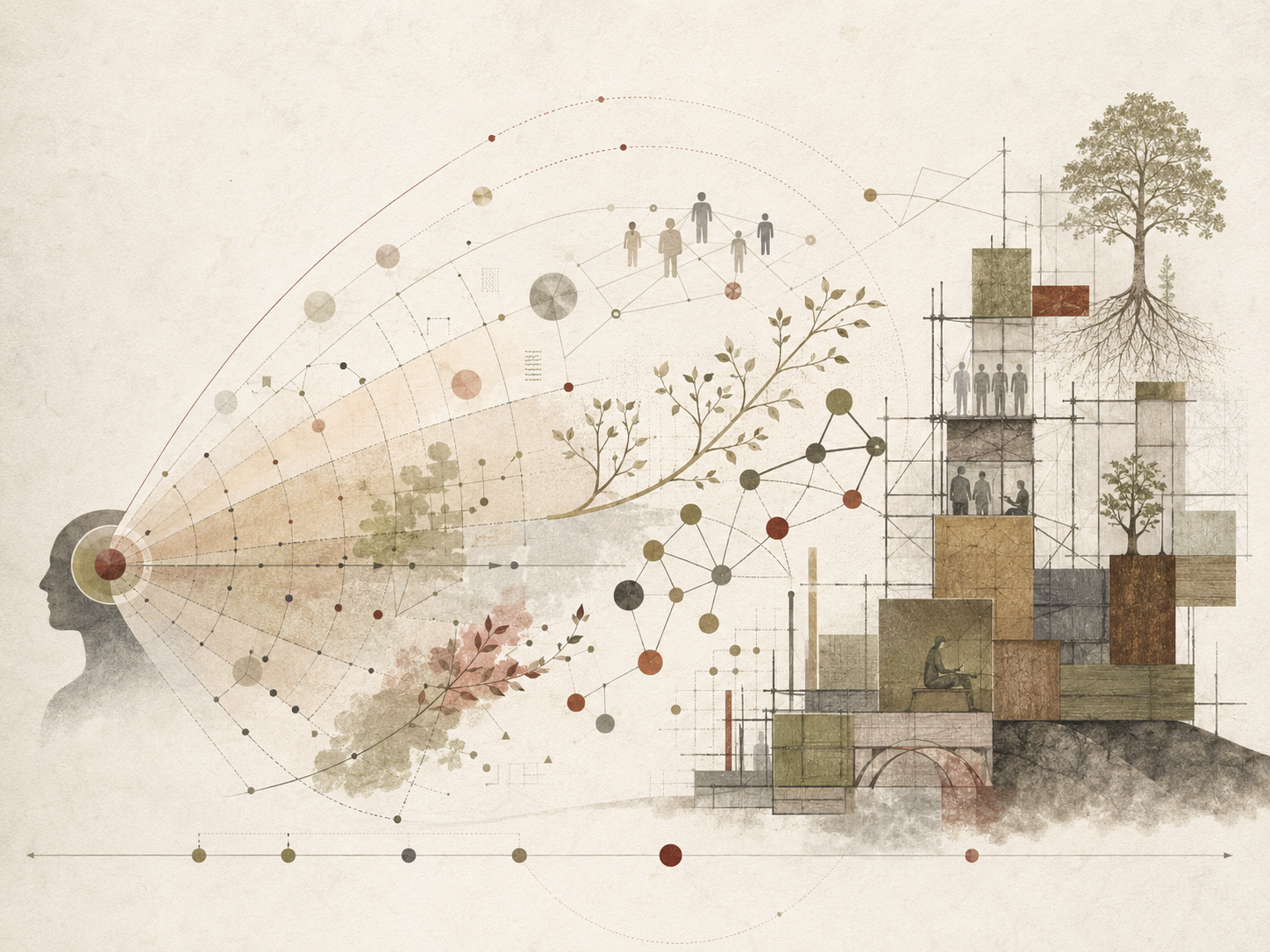
This article examines the origins of Broaden-and-Build Theory, the evolutionary problem it addressed, the mechanisms through which positive emotions may broaden cognition and build lasting resources, the empirical work on recovery and resilience, the theory’s applications in education and well-being research, and the limits that must be acknowledged if the framework is to be used seriously.
Origins of Broaden-and-Build Theory
Barbara Fredrickson developed Broaden-and-Build Theory in the late 1990s while examining the adaptive significance of positive emotions. At the time, much emotion research had focused on negative emotions because their functions were easier to identify. Fear, anger, disgust, and anxiety appear to solve urgent adaptive problems. They narrow attention, mobilize physiology, and prepare the organism for specific defensive actions.
Positive emotions were harder to explain within that framework. Joy, interest, contentment, gratitude, amusement, serenity, hope, awe, and love do not map neatly onto single survival actions. Joy does not produce one clear action tendency in the way fear produces escape. Interest does not produce one immediate behavior in the way disgust produces withdrawal. Contentment may appear quiet rather than urgent. Gratitude may orient toward relationship rather than immediate survival. Love may involve many action tendencies depending on context.
This raised a theoretical problem: if positive emotions are not primarily designed for immediate threat response, what are they for?
Fredrickson’s answer was that positive emotions have a different adaptive function. They broaden attention, cognition, and behavioral possibility. They create conditions for exploration, play, learning, bonding, creativity, and resource acquisition. These processes may not solve an immediate threat, but they can shape long-term adaptation. A child’s play may build coordination and social skill. Curiosity may build knowledge. Gratitude may build social bonds. Love may build attachment and commitment. Interest may build expertise. Serenity may support integration and recovery.
The theory therefore changed the scale at which positive emotions were understood. Instead of asking only what action a positive emotion produces right now, Broaden-and-Build Theory asks what capacities positive emotions make possible across time.
The Evolutionary Problem of Positive Emotion
Broaden-and-Build Theory begins with an evolutionary puzzle. Negative emotions are relatively easy to explain because they are tightly linked to immediate adaptive responses in dangerous contexts. If a person perceives danger, fear narrows attention toward the threat and prepares escape. If a person perceives obstruction or violation, anger narrows attention toward the offender and prepares confrontation. If a person perceives contamination, disgust prepares rejection and withdrawal.
These emotions are powerful because they compress possibility. They reduce the field of action so the organism can respond quickly. In moments of danger, this narrowing can be life-saving. One does not want endless creative exploration when escaping a predator, avoiding a car accident, or responding to a fire.
Positive emotions appear less urgent. They often arise when immediate threat is reduced or when conditions allow openness. Their adaptive value therefore cannot be understood only through the logic of emergency response. Broaden-and-Build Theory argues that positive emotions are adaptive because they improve future functioning. They widen attention and behavior in the present, and those broadened patterns can accumulate into resources that matter later.
This is a major conceptual shift. It implies that emotion has at least two broad adaptive modes:
| Emotional mode | Primary function | Typical effect on attention | Adaptive value |
|---|---|---|---|
| Threat-response mode | Respond to immediate danger, obstruction, or contamination | Narrows attention toward urgent cues | Supports rapid defensive action |
| Broaden-and-build mode | Expand possibility, exploration, learning, and connection | Broadens attention and thought-action repertoires | Builds durable resources for future adaptation |
This does not mean negative emotions are bad and positive emotions are good in a simplistic sense. Negative emotions are necessary for survival, moral perception, boundary-setting, grief, realism, and protection. Positive emotions are not always appropriate or sufficient. The theory’s contribution is more precise: positive emotions have functional value because they can widen the field of cognition and behavior when conditions permit exploration, connection, and growth.
Why Negative Emotions Narrow Attention
Negative emotions often narrow attention because they prepare the organism for immediate action. This narrowing can be understood cognitively, physiologically, and behaviorally.
Cognitively, threat-related emotion prioritizes the most relevant danger signals. A fearful person may become highly attentive to escape routes, signs of harm, or potential attackers. An angry person may focus on the source of obstruction or injustice. A disgusted person may focus on what must be avoided. This attentional narrowing helps reduce complexity when rapid response is needed.
Physiologically, negative emotions often prepare the body for action. Heart rate, muscle tension, respiration, hormonal activity, and autonomic arousal may change in ways that support confrontation, escape, withdrawal, or vigilance. The body becomes organized around immediate response.
Behaviorally, negative emotions reduce the range of plausible actions. Fear pushes toward flight or freezing. Anger pushes toward confrontation or correction. Disgust pushes toward avoidance. Sadness may promote withdrawal, conservation, or social signaling. These tendencies can be adaptive, especially in urgent or harmful contexts.
Broaden-and-Build Theory does not deny these functions. It begins from them. Its key claim is that positive emotions cannot be understood by forcing them into the same narrow-action model. Positive emotions often do not prepare one immediate action. Instead, they expand possible action.
This difference matters for well-being science. A life dominated by threat narrowing may become rigid, defensive, isolated, and cognitively constrained. But a life with sufficient access to positive emotion may have more room for exploration, learning, relationship, and recovery. Positive emotions do not replace negative emotions; they help prevent the whole cognitive field from being permanently narrowed by them.
What Positive Emotions Do Differently
Positive emotions differ from negative emotions not because they are vague or unimportant, but because they have a different temporal logic. Many negative emotions are organized around immediate survival. Many positive emotions are organized around possibility.
Joy encourages play, experimentation, and social openness. Interest encourages exploration and learning. Contentment encourages integration and savoring. Gratitude encourages recognition of benefit and relational reciprocity. Serenity encourages restoration and reflective awareness. Hope encourages future-oriented agency. Inspiration encourages aspiration and emulation. Awe expands the perceived scale of the self and the world. Love may gather many positive emotions into durable patterns of care, trust, and attachment.
| Positive emotion | Broadening tendency | Possible resource built over time |
|---|---|---|
| Joy | Play, spontaneity, experimentation | Social skill, creativity, behavioral flexibility |
| Interest | Exploration, curiosity, learning | Knowledge, competence, expertise |
| Contentment | Savoring, integration, reflection | Emotional regulation, self-understanding, recovery capacity |
| Gratitude | Recognition of support and beneficence | Social bonds, reciprocity, trust, humility |
| Hope | Future-oriented possibility and pathway thinking | Agency, persistence, strategic coping |
| Love | Affiliation, care, trust, shared attention | Attachment, belonging, mutual support |
| Awe | Expanded perspective and diminished self-focus | Meaning, humility, openness, collective orientation |
The important point is that positive emotions often create optionality. They allow the person to see more, try more, connect more, imagine more, and learn more. In the moment, that may look small. Across time, it may become developmental.
This is why Broaden-and-Build Theory has become so central to positive psychology interventions. Practices that cultivate gratitude, kindness, interest, savoring, social connection, or hope may matter because they do not merely improve mood. They may change the range of thoughts, actions, and relationships available to the person.
How Positive Emotions Broaden Cognition
The first major claim of Broaden-and-Build Theory is that positive emotions broaden momentary thought-action repertoires. A thought-action repertoire is the range of thoughts, perceptions, impulses, and possible behaviors that feel available in a given moment. Under fear, the repertoire may narrow to escape. Under anger, it may narrow to confrontation. Under positive emotion, the repertoire may widen.
Broadening can occur in several ways:
- attentional broadening: noticing a wider range of cues, opportunities, people, or possibilities;
- cognitive broadening: thinking more flexibly, creatively, and integratively;
- behavioral broadening: experimenting, exploring, playing, reaching out, or trying new actions;
- social broadening: becoming more open to connection, cooperation, and trust;
- temporal broadening: seeing beyond immediate threat or frustration toward future possibilities.
Positive emotions can therefore influence what becomes thinkable. A person in a state of curiosity may ask questions that would not have occurred under anxiety. A person experiencing gratitude may notice sources of support that were invisible under resentment. A person feeling hope may perceive pathways that despair had obscured. A person experiencing love may consider another person’s needs more fully.
The broadening effect is not identical across all positive emotions. Interest broadens toward exploration. Joy broadens toward play. Gratitude broadens toward relational recognition. Serenity broadens toward integration. Hope broadens toward future pathways. Love broadens toward care and affiliation. The theory is not that all positive emotions do the same thing. It is that they share a tendency to widen the field of cognition and action relative to narrow threat states.
| Broadening domain | What expands | Example |
|---|---|---|
| Attention | The range of cues noticed | A calm or interested person notices possibilities beyond the immediate problem |
| Cognition | The range of interpretations and solutions | A hopeful person considers multiple pathways around an obstacle |
| Behavior | The range of actions attempted | A joyful child experiments through play |
| Social orientation | The range of relational possibilities | A grateful person recognizes support and becomes more open to reciprocity |
| Time horizon | The range of future possibilities imagined | A person experiencing hope can think beyond immediate discouragement |
This broadening process is central to the theory because it explains how short-lived emotion can alter learning, relationship, resilience, and development. Positive emotion matters because it changes the field in which action is selected.
How Positive Emotions Build Enduring Resources
The second major claim of the theory is that broadened states can build enduring resources over time. Positive emotions are often brief, but the actions they make possible can have lasting consequences. This is the “build” part of Broaden-and-Build Theory.
A moment of interest may lead to exploration. Repeated exploration may build knowledge. A moment of joy may lead to play. Repeated play may build social skill, coordination, creativity, and flexibility. A moment of gratitude may lead to expressed appreciation. Repeated appreciation may build trust and relational support. A moment of hope may lead to pathway thinking. Repeated pathway thinking may build agency and persistence. A moment of serenity may support recovery and integration. Repeated recovery may build emotional regulation.
| Resource type | How positive emotion may build it | Example |
|---|---|---|
| Psychological resources | Positive emotion supports flexible coping, optimism, agency, and regulation | Hope helps a person identify alternative pathways after failure |
| Social resources | Positive emotion encourages connection, trust, gratitude, kindness, and affiliation | Gratitude strengthens a relationship by making care visible |
| Intellectual resources | Interest and curiosity promote exploration, learning, and creativity | Curiosity leads to new skill acquisition |
| Physical resources | Positive emotion may support recovery, health behavior, and regulation | Serenity and connection may support stress recovery |
| Moral resources | Gratitude, love, and elevation can deepen reciprocity and concern for others | Appreciation of care motivates prosocial action |
| Developmental resources | Repeated broadening supports cumulative growth across life stages | Play and curiosity in childhood support later flexibility and competence |
This developmental logic is what makes the theory powerful. Positive emotion is not framed as a luxury or decorative psychological state. It becomes part of the process through which human beings acquire adaptive capacity.
The theory also helps explain why small positive experiences can matter. A single moment of amusement may not transform a life. But repeated moments of play, curiosity, appreciation, and connection can shape relationships, skills, and identities. Resource building is cumulative. It often happens through patterns that look ordinary while they are happening.
The Undoing Effect and Stress Recovery
One of the most influential empirical extensions of Broaden-and-Build Theory is the undoing effect hypothesis. Fredrickson and colleagues proposed that positive emotions can help undo or accelerate recovery from the lingering physiological effects of negative emotional arousal. In this line of research, positive emotions were associated with faster cardiovascular recovery after stress.
The undoing effect adds a regulatory dimension to the theory. Positive emotions do not only broaden cognition and build resources over time. They may also help the body return toward baseline after stress activation. This matters because unresolved physiological arousal can prolong strain. If positive emotions help shorten the duration of stress activation, they may support recovery in ways that are both psychological and bodily.
The claim should be interpreted carefully. Positive emotion does not erase stress, trauma, danger, or grief. It does not make harmful conditions harmless. It does not mean people should be encouraged to “be positive” while facing real threat. The more precise claim is that, under some conditions, positive emotions may help regulate the aftereffects of negative arousal and restore flexibility.
The undoing effect also helps explain why positive emotions may be important during adversity. Not because adversity is good, and not because positive emotion cancels suffering, but because moments of relief, connection, gratitude, humor, hope, or love can prevent stress from occupying the whole system indefinitely. They can help widen the space in which recovery becomes possible.
Upward Spirals of Emotion and Resource Formation
Broaden-and-Build Theory also supports the idea of upward spirals. Positive emotions broaden cognition and behavior; broadened behavior helps build resources; those resources make future positive emotion more likely; and future positive emotion supports further broadening and building. Over time, the process can become self-reinforcing.
For example, a person who experiences interest may explore a subject. Exploration builds competence. Competence makes further engagement more rewarding. That reward creates more interest. A person who experiences gratitude may express appreciation. Expression strengthens a relationship. Stronger relationship support increases future positive emotion. A person who experiences hope may take action toward a goal. Action builds agency. Agency supports further hope.
| Step | Process | Example |
|---|---|---|
| Positive emotion | A moment of interest, joy, gratitude, hope, or love occurs | A student becomes curious about a topic |
| Broadening | Attention and action possibilities expand | The student asks questions and explores beyond the assignment |
| Behavior | The person experiments, connects, learns, or reaches out | The student reads, practices, and discusses ideas |
| Resource building | Skills, relationships, knowledge, or resilience accumulate | The student gains competence and confidence |
| Future positive emotion | New resources make future positive emotion more available | Competence makes continued learning more rewarding |
The upward-spiral model is important because it avoids treating positive emotion as a static possession. Positive emotion is dynamic. It interacts with context, behavior, skill, relationship, and feedback. It may become more available when resources grow, and resources may grow when positive emotion makes exploration and connection possible.
This idea also helps explain why social environments matter. Upward spirals are easier to sustain in contexts that provide safety, opportunity, recognition, time, care, and support. They are harder to sustain in contexts of chronic threat, humiliation, instability, isolation, or deprivation.
Positive Emotions and Resilience
Broaden-and-Build Theory has been especially influential in research on resilience. The theory suggests that positive emotions can support resilience in at least three ways. First, they broaden cognition during stress, allowing people to see more than the immediate threat. Second, they help build resources before adversity occurs. Third, they may support recovery after negative arousal.
This does not mean resilient people are cheerful all the time. Resilience is not constant positivity. Resilient individuals may feel fear, grief, anger, sadness, uncertainty, and exhaustion. The difference is that they may also retain access to moments of hope, gratitude, humor, connection, interest, or love. These positive emotions can help preserve flexibility when stress narrows attention.
For example, gratitude may help a person remember support during hardship. Humor may briefly reduce the totalizing force of fear. Love may sustain commitment during difficulty. Hope may make action possible when despair narrows the future. Interest may help a person learn from a challenge rather than only endure it.
The theory connects closely to Hope Theory, post-traumatic growth, meaning and purpose, and broader resilience research. In each case, adaptive functioning depends not on denying difficulty but on maintaining access to resources that keep life from being organized entirely around threat.
Examples of Broadening and Building
Broaden-and-Build Theory is easiest to understand through ordinary examples. The theory does not depend only on dramatic interventions or large life events. It often operates through small moments that accumulate over time.
A child at play experiences joy. That joy broadens action into experimentation, movement, imagination, role-play, and social negotiation. Over time, play builds coordination, creativity, emotional expression, cooperation, and problem-solving.
A student experiences interest. Interest broadens attention toward questions, evidence, examples, and alternative explanations. Over time, curiosity builds knowledge, expertise, and intellectual identity.
A friend experiences gratitude after being helped. Gratitude broadens attention toward the other person’s care and generosity. Expressing thanks strengthens the relationship. Over time, trust and reciprocity grow.
A person under stress experiences a moment of humor. Humor does not remove the stressor, but it briefly widens attention and reduces emotional rigidity. Over time, the ability to access humor may support coping and social bonding.
A person experiences awe in nature, art, science, or religious life. Awe can expand perspective, reduce self-preoccupation, and increase awareness of larger patterns. Over time, such moments may build humility, meaning, and ecological or spiritual orientation.
| Everyday event | Positive emotion | Broadening effect | Resource potentially built |
|---|---|---|---|
| Play with others | Joy | Experimentation and social openness | Creativity, coordination, friendship |
| Encountering a new idea | Interest | Questioning and exploration | Knowledge, skill, expertise |
| Receiving help | Gratitude | Recognition of support | Trust, reciprocity, relationship strength |
| Recovering during stress | Serenity or amusement | Reduced rigidity and renewed perspective | Emotion regulation and recovery capacity |
| Seeing beauty or vastness | Awe | Expanded perspective | Meaning, humility, connection to larger systems |
| Imagining a possible path forward | Hope | Future-oriented pathway thinking | Agency, persistence, adaptive planning |
These examples show why positive emotions should not be dismissed as minor or ornamental. Their cumulative value may lie in what they make possible over time.
Applications in Well-Being Research
Broaden-and-Build Theory has influenced research across well-being science, health psychology, education, organizational psychology, resilience studies, and intervention design. It provides a theoretical basis for practices that cultivate positive emotion not merely to improve mood, but to support exploration, social connection, learning, coping, and resource formation.
Many positive psychology interventions draw implicitly or explicitly on the theory. Gratitude exercises may broaden awareness of support. Acts of kindness may broaden social connection. Savoring practices may broaden attention to positive experience. Hope interventions may broaden future-oriented thinking. Strengths-use practices may broaden identity and behavioral possibility.
The theory also helps explain why positive emotion is often treated as a mechanism rather than only an outcome. In some intervention studies, the goal is not simply to measure whether people feel happier afterward. The deeper question is whether positive emotion helps produce changes in cognition, behavior, relationship, and resilience.
In health psychology, the theory has been used to examine stress recovery, social connection, and physiological regulation. In education, it has influenced discussions of curiosity, engagement, belonging, and positive classroom climates. In organizational research, it informs work on psychological safety, creativity, recognition, and high-quality connection. In resilience research, it helps explain why positive emotion during adversity can support coping without denying distress.
Applications in Education and Development
Broaden-and-Build Theory has particular relevance for education and developmental psychology because learning depends on attention, exploration, curiosity, safety, and social connection. Students who experience interest are more likely to ask questions. Students who feel belonging may participate more fully. Students who experience joy in learning may engage in deeper exploration. Students who feel hope may persist through difficulty.
This connects naturally to positive education, which applies well-being science to learning environments. A broaden-and-build approach suggests that educational settings should not treat positive emotion as a decorative add-on. Curiosity, belonging, play, encouragement, and meaningful engagement may shape the cognitive field in which learning happens.
In early childhood, play is a central example. Joyful exploration builds physical, social, emotional, and cognitive resources. In adolescence, interest and belonging can support identity formation and learning motivation. In higher education, curiosity, intellectual humility, and social trust can shape inquiry and persistence.
| Educational condition | Positive emotion supported | Possible broadening effect | Longer-term resource |
|---|---|---|---|
| Psychological safety | Interest, trust, hope | Students ask questions and take intellectual risks | Learning confidence and cognitive flexibility |
| Supportive feedback | Hope, gratitude, pride | Students see pathways for improvement | Agency and persistence |
| Playful exploration | Joy | Students experiment and try alternatives | Creativity and problem-solving skill |
| Belonging | Love, connection, serenity | Students participate more openly | Social trust and academic engagement |
| Meaningful challenge | Interest, purpose, inspiration | Students connect effort to valued goals | Identity, competence, and purpose |
The educational implication is not that classrooms should be constantly cheerful. Serious learning includes frustration, difficulty, correction, uncertainty, and struggle. But if learning environments are dominated by fear, humiliation, boredom, or threat, students’ thought-action repertoires may narrow. Positive emotional conditions help create the room in which learning can become exploratory rather than merely defensive.
Institutions, Workplaces, and Social Conditions
Broaden-and-Build Theory is often presented as a psychological theory, but its implications are institutional as well. Positive emotions are not produced only by private mindset. They are shaped by relationships, organizations, culture, safety, workload, recognition, autonomy, fairness, and material conditions.
In workplaces, for example, positive emotions may support creativity, cooperation, learning, and resilience. But those emotions are more likely to emerge in contexts where people experience psychological safety, respect, fair treatment, manageable workload, meaningful contribution, and trustworthy leadership. A workplace cannot responsibly demand positivity while producing fear, insecurity, humiliation, or burnout.
In community settings, positive emotions may build social trust and collective capacity. Shared joy, gratitude, pride, care, and hope can strengthen communities. But such emotions require conditions of participation, recognition, and belonging. Communities under chronic threat may need safety and justice before broadening becomes possible.
In public institutions, the theory suggests that environments enabling trust, curiosity, social connection, and meaningful participation may help build civic resources. Libraries, parks, schools, public health systems, cultural institutions, and community centers can all create contexts in which broadening and building occur. Flourishing is therefore not only an individual achievement. It depends on environments that make positive emotional experience socially available.
This institutional dimension prevents a shallow reading of the theory. Broaden-and-Build Theory should not be used to tell individuals to generate positive emotion regardless of circumstances. It should also ask what conditions make broadening possible and what institutions help people build durable resources.
Measurement, Data Design, and Research Limits
Research on Broaden-and-Build Theory often measures positive emotion, negative emotion, cognitive flexibility, attention, creativity, social support, resilience, physiological recovery, and longitudinal resource accumulation. Each of these domains presents measurement challenges.
Positive emotion can be measured through self-report scales, experience sampling, affect diaries, behavioral tasks, physiological indicators, or experimental induction. Cognitive broadening can be measured through attentional tasks, creativity tasks, problem-solving measures, categorization breadth, or cognitive flexibility indicators. Resource building requires longer time horizons because resources accumulate across repeated experience.
A serious research design should distinguish immediate broadening from longer-term resource building. A study that measures momentary cognitive flexibility after a positive emotion induction is testing one part of the theory. A longitudinal study tracking social support, resilience, or skill development over time is testing another.
| Research domain | Example variables | Interpretive role |
|---|---|---|
| Positive emotion | Joy, interest, gratitude, serenity, hope, love, amusement | Primary emotional input in the theory |
| Negative emotion | Fear, anger, anxiety, sadness, threat arousal | Captures narrowing pressure and stress context |
| Cognitive broadening | Flexibility, creativity, attentional breadth, openness to alternatives | Tests the broadening pathway |
| Behavioral broadening | Exploration, play, help-seeking, experimentation, social approach | Links emotion to action repertoire |
| Resource building | Resilience, social support, skill, knowledge, coping ability | Tests the developmental pathway |
| Recovery | Stress arousal, cardiovascular recovery, perceived recovery | Tests the undoing effect and regulation pathway |
| Context | Safety, support, hardship, culture, workload, trauma exposure | Prevents decontextualized interpretation |
The theory is strongest when studied dynamically. Cross-sectional correlations can be useful, but they cannot fully capture upward spirals or resource accumulation. Longitudinal designs, experience sampling, intervention studies, multilevel models, and network approaches are often more appropriate for studying how emotion, cognition, behavior, and resources interact over time.
Critiques and Limitations
While Broaden-and-Build Theory is widely influential, it is not beyond critique. One concern is that broadening is not always adaptive. In some contexts, narrowed attention is necessary. When danger is real, broad exploration may be unsafe. When moral harm is present, anger may clarify boundaries. When grief is appropriate, sadness may honor loss. Positive emotion should not be treated as superior to negative emotion in all situations.
A second concern is that positive emotion does not operate independently of context. Chronic insecurity, trauma, discrimination, poverty, unsafe workplaces, unstable housing, or social isolation can restrict access to positive emotional experience. Telling people to cultivate positive emotion without addressing conditions that produce chronic threat can become ethically shallow.
A third concern is methodological. The theory links momentary emotion to long-term resource building, but measuring that developmental pathway is difficult. Researchers must distinguish short-term broadening from durable resources, and must account for reciprocal causality. Positive emotion may build resources, but resources may also increase positive emotion.
A fourth concern is cultural variation. Positive emotion, expression, play, gratitude, pride, and social connection are shaped by cultural norms. Broadening may look different across societies, communities, religious traditions, and family systems. A theory of positive emotion must be flexible enough to accommodate these differences.
A fifth concern is misuse in institutions. Workplaces, schools, and organizations may invoke positive emotion to demand cheerfulness, resilience, or optimism from people under harmful conditions. That is not a responsible use of the theory. Broaden-and-Build should support conditions for flourishing, not emotional compliance.
These critiques refine the theory rather than negate it. They remind us that positive emotions matter, but they matter within real lives, real bodies, real histories, and real institutions.
Context, Culture, Equity, and Responsible Adaptation
Broaden-and-Build Theory should be interpreted through context, culture, equity, and access. Positive emotions are not distributed evenly across social life. People facing chronic stress, discrimination, disability exclusion, trauma, poverty, family instability, unsafe communities, or institutional mistrust may have fewer opportunities for the kinds of safety and support that allow broadening to occur.
This does not mean positive emotion is irrelevant under hardship. Many people experience gratitude, humor, love, hope, faith, awe, and solidarity under extremely difficult conditions. But the presence of positive emotion within hardship should not be used to romanticize hardship. Positive emotions can support endurance and resourcefulness, but they should not be used to justify the conditions that make endurance necessary.
Cultural adaptation also matters. Some cultures emphasize high-arousal positive emotions such as excitement and enthusiasm. Others may value low-arousal positive states such as serenity, harmony, humility, or contentment. Some communities emphasize individual pride and agency; others emphasize gratitude, relational duty, spiritual meaning, or collective joy. Broadening and building may occur through different emotional forms in different cultural contexts.
Responsible use requires several questions:
- What positive emotions are culturally meaningful in this setting?
- Is broadening safe under the current conditions?
- Are people being invited into positive emotion or pressured into emotional performance?
- What structural conditions support or block positive emotion?
- Are negative emotions carrying important information that should not be suppressed?
- Does the intervention build resources, or merely ask people to endure more?
A serious broaden-and-build approach therefore includes institutional responsibility. If positive emotions help build resources, then schools, workplaces, communities, and public systems should ask how to create environments where curiosity, play, trust, gratitude, love, serenity, hope, and connection are realistically possible.
A Semi-Formal Framework for Broaden-and-Build Theory
Broaden-and-Build Theory can be represented semi-formally as a dynamic model linking emotion to cognition, action, recovery, and long-term resource accumulation.
Let momentary cognitive breadth at time \(t\) be expressed as:
B_t = \alpha_1 P_t – \alpha_2 N_t + \alpha_3 C_t + \varepsilon_t
\]
Interpretation: Cognitive breadth \(B_t\) is modeled as a function of positive emotional activation \(P_t\), negative emotional narrowing pressure \(N_t\), contextual safety or support \(C_t\), and unexplained variation \(\varepsilon_t\). The equation captures the theory’s basic claim that positive emotion can widen attention and thought-action repertoires, while threat pressure narrows them.
Resource accumulation across time can then be written as:
R_{t+1} = R_t + \beta_1 B_t + \beta_2 E_t + \beta_3 S_t – \beta_4 D_t + u_t
\]
Interpretation: Future resources \(R_{t+1}\) depend on existing resources \(R_t\), cognitive broadening \(B_t\), exploratory or affiliative behavior \(E_t\), supportive social feedback \(S_t\), contextual depletion or drag \(D_t\), and unmeasured disturbance \(u_t\). This expresses the “build” pathway.
The undoing effect can be represented as a recovery dynamic:
A_{t+1} = A_t – \gamma_1 P_t + \gamma_2 H_t + \eta_t
\]
Interpretation: Residual physiological arousal \(A_{t+1}\) depends on prior arousal \(A_t\), positive emotional activation \(P_t\), ongoing threat or hardship \(H_t\), and disturbance \(\eta_t\). Positive emotion may accelerate recovery, while ongoing hardship may sustain arousal.
An upward-spiral model can be expressed as:
P_{t+1} = \delta_1 R_t + \delta_2 S_t + \delta_3 M_t – \delta_4 X_t + \omega_t
\]
Interpretation: Future positive emotion \(P_{t+1}\) becomes more likely when accumulated resources \(R_t\), social support \(S_t\), and meaning \(M_t\) are strong, while stressor load \(X_t\) reduces availability. This captures reciprocal growth: positive emotion builds resources, and resources support later positive emotion.
A simplified intervention contrast can be written as:
\Delta R = (R_{post} – R_{pre})_{positive\ emotion} – (R_{post} – R_{pre})_{comparison}
\]
Interpretation: The estimated resource-building effect compares change in resources in a positive-emotion condition with change in a comparison condition.
These equations do not reduce the theory to mathematics. They clarify its logic: positive emotions may broaden cognition, broadened cognition may support exploratory and affiliative behavior, those behaviors may build resources, and resources may increase the future availability of positive emotion.
R: Modeling Broadening and Resource Building Over Time
The following R workflow illustrates how a researcher might model the relationship between positive emotion, cognitive breadth, social support, resilience, and stress recovery in repeated-measures data. The example estimates whether increases in positive emotion predict later gains in resilience-related resources and whether positive emotion is associated with lower residual arousal.
# Broaden-and-Build Theory longitudinal modeling workflow
#
# Purpose:
#   Model positive emotion, cognitive flexibility, social support,
#   resilience, negative emotion, and stress recovery over time.
#
# Notes:
#   This workflow is for research, teaching, and exploratory analysis.
#   It is not a clinical, diagnostic, therapeutic, workplace-screening,
#   employment-selection, or individual well-being assessment tool.

library(tidyverse)
library(lme4)
library(lmerTest)
library(broom.mixed)
library(emmeans)
library(performance)

# Expected columns:
# id, wave,
# positive_emotion, negative_emotion, cognitive_flexibility,
# exploratory_behavior, affiliative_behavior, social_support,
# resilience_score, stress_arousal, contextual_safety

df <- read_csv("data/broaden_build_panel.csv")

panel <- df %>%
  mutate(
    id = as.factor(id),
    wave = as.integer(wave)
  ) %>%
  filter(complete.cases(
    positive_emotion,
    negative_emotion,
    cognitive_flexibility,
    exploratory_behavior,
    affiliative_behavior,
    social_support,
    resilience_score,
    stress_arousal,
    contextual_safety
  )) %>%
  mutate(
    wave_c = as.numeric(scale(wave, center = TRUE, scale = FALSE)),
    positive_c = as.numeric(scale(positive_emotion, center = TRUE, scale = FALSE)),
    negative_c = as.numeric(scale(negative_emotion, center = TRUE, scale = FALSE)),
    flexibility_c = as.numeric(scale(cognitive_flexibility, center = TRUE, scale = FALSE)),
    exploration_c = as.numeric(scale(exploratory_behavior, center = TRUE, scale = FALSE)),
    affiliation_c = as.numeric(scale(affiliative_behavior, center = TRUE, scale = FALSE)),
    support_c = as.numeric(scale(social_support, center = TRUE, scale = FALSE)),
    arousal_c = as.numeric(scale(stress_arousal, center = TRUE, scale = FALSE)),
    safety_c = as.numeric(scale(contextual_safety, center = TRUE, scale = FALSE)),
    broadening_index = rowMeans(
      select(., cognitive_flexibility, exploratory_behavior, affiliative_behavior),
      na.rm = TRUE
    ),
    resource_index = rowMeans(
      select(., social_support, resilience_score, contextual_safety),
      na.rm = TRUE
    )
  )

model_broadening <- lmer(
  broadening_index ~
    wave_c +
    positive_c -
    negative_c +
    safety_c +
    positive_c:safety_c +
    positive_c:negative_c +
    (1 + wave_c | id),
  data = panel,
  REML = FALSE
)

model_resilience <- lmer(
  resilience_score ~
    wave_c +
    positive_c -
    negative_c +
    flexibility_c +
    exploration_c +
    affiliation_c +
    support_c -
    arousal_c +
    safety_c +
    positive_c:flexibility_c +
    support_c:safety_c +
    (1 + wave_c | id),
  data = panel,
  REML = FALSE
)

model_recovery <- lmer(
  stress_arousal ~
    wave_c -
    positive_c +
    negative_c -
    support_c -
    safety_c +
    positive_c:safety_c +
    (1 + wave_c | id),
  data = panel,
  REML = FALSE
)

summary(model_broadening)
summary(model_resilience)
summary(model_recovery)

performance::check_model(model_broadening)
performance::check_model(model_resilience)
performance::check_model(model_recovery)

emm_broadening <- emmeans(
  model_broadening,
  ~ positive_c | safety_c,
  at = list(
    positive_c = c(-1, 0, 1),
    safety_c = c(-1, 0, 1),
    negative_c = 0,
    wave_c = 0
  )
)

emm_resilience <- emmeans(
  model_resilience,
  ~ positive_c | flexibility_c,
  at = list(
    positive_c = c(-1, 0, 1),
    flexibility_c = c(-1, 0, 1),
    negative_c = 0,
    exploration_c = 0,
    affiliation_c = 0,
    support_c = 0,
    arousal_c = 0,
    safety_c = 0,
    wave_c = 0
  )
)

dir.create("outputs", showWarnings = FALSE)

write_csv(
  broom.mixed::tidy(model_broadening, effects = "fixed", conf.int = TRUE),
  "outputs/broaden_build_broadening_fixed_effects.csv"
)

write_csv(
  broom.mixed::tidy(model_resilience, effects = "fixed", conf.int = TRUE),
  "outputs/broaden_build_resilience_fixed_effects.csv"
)

write_csv(
  broom.mixed::tidy(model_recovery, effects = "fixed", conf.int = TRUE),
  "outputs/broaden_build_recovery_fixed_effects.csv"
)

write_csv(
  as.data.frame(emm_broadening),
  "outputs/broaden_build_positive_by_safety_estimated_margins.csv"
)

write_csv(
  as.data.frame(emm_resilience),
  "outputs/broaden_build_positive_by_flexibility_estimated_margins.csv"
)

summary_table <- panel %>%
  summarize(
    mean_positive_emotion = mean(positive_emotion, na.rm = TRUE),
    mean_negative_emotion = mean(negative_emotion, na.rm = TRUE),
    mean_cognitive_flexibility = mean(cognitive_flexibility, na.rm = TRUE),
    mean_exploratory_behavior = mean(exploratory_behavior, na.rm = TRUE),
    mean_affiliative_behavior = mean(affiliative_behavior, na.rm = TRUE),
    mean_social_support = mean(social_support, na.rm = TRUE),
    mean_resilience = mean(resilience_score, na.rm = TRUE),
    mean_stress_arousal = mean(stress_arousal, na.rm = TRUE),
    mean_contextual_safety = mean(contextual_safety, na.rm = TRUE)
  )

write_csv(
  summary_table,
  "outputs/broaden_build_summary.csv"
)
This workflow is useful because it separates three linked claims: positive emotion may predict broadening, broadening may predict resilience-related resources, and positive emotion may support stress recovery. It also includes contextual safety, which is essential because broadening is less likely when a person remains under threat.
Python: Network Analysis of Positive Emotion Dynamics
The following Python example treats Broaden-and-Build Theory as a connected system of variables rather than a simple linear chain. It estimates a sparse partial-correlation network across positive emotion, negative emotion, cognitive flexibility, exploratory behavior, affiliative behavior, social support, resilience, stress arousal, and contextual safety.
"""
Broaden-and-Build Theory network workflow

Purpose:
    Estimate a sparse partial-correlation network of positive emotion,
    negative emotion, cognitive flexibility, exploratory behavior,
    affiliative behavior, social support, resilience, stress arousal,
    and contextual safety.

Use:
    Research, teaching, exploratory systems analysis, and intervention
    mechanism design.

Not for:
    Clinical diagnosis, therapeutic decision-making, employment selection,
    workplace screening, or individual well-being assessment.
"""

from pathlib import Path

import matplotlib.pyplot as plt
import networkx as nx
import numpy as np
import pandas as pd

from sklearn.covariance import GraphicalLassoCV
from sklearn.impute import SimpleImputer
from sklearn.preprocessing import StandardScaler

DATA_PATH = Path("data/broaden_build_network.csv")
OUTPUT_DIR = Path("outputs")
OUTPUT_DIR.mkdir(exist_ok=True)

cols = [
    "positive_emotion",
    "negative_emotion",
    "cognitive_flexibility",
    "exploratory_behavior",
    "affiliative_behavior",
    "social_support",
    "resilience_score",
    "stress_arousal",
    "contextual_safety",
]

df = pd.read_csv(DATA_PATH)

missing_cols = [col for col in cols if col not in df.columns]
if missing_cols:
    raise ValueError(f"Missing expected columns: {missing_cols}")

imputer = SimpleImputer(strategy="median")
X = pd.DataFrame(imputer.fit_transform(df[cols]), columns=cols)

scaler = StandardScaler()
X_scaled = pd.DataFrame(scaler.fit_transform(X), columns=cols)

X_scaled["broadening_index"] = (
    X_scaled["cognitive_flexibility"] +
    X_scaled["exploratory_behavior"] +
    X_scaled["affiliative_behavior"]
) / 3

X_scaled["resource_index"] = (
    X_scaled["social_support"] +
    X_scaled["resilience_score"] +
    X_scaled["contextual_safety"]
) / 3

X_scaled["net_adaptation_index"] = (
    X_scaled["positive_emotion"] +
    X_scaled["cognitive_flexibility"] +
    X_scaled["exploratory_behavior"] +
    X_scaled["affiliative_behavior"] +
    X_scaled["social_support"] +
    X_scaled["resilience_score"] +
    X_scaled["contextual_safety"] -
    X_scaled["negative_emotion"] -
    X_scaled["stress_arousal"]
)

glasso = GraphicalLassoCV()
glasso.fit(X_scaled[cols])

precision = glasso.precision_
partial_corr = -precision / np.sqrt(np.outer(np.diag(precision), np.diag(precision)))
np.fill_diagonal(partial_corr, 0)

partial_df = pd.DataFrame(partial_corr, index=cols, columns=cols)

threshold = 0.08
G = nx.Graph()

for node in cols:
    G.add_node(node)

for i, source in enumerate(cols):
    for j, target in enumerate(cols):
        if j > i:
            weight = partial_df.iloc[i, j]
            if abs(weight) >= threshold:
                G.add_edge(source, target, weight=weight, sign=np.sign(weight))

degree = nx.degree_centrality(G)
betweenness = nx.betweenness_centrality(G, weight="weight")

try:
    eigenvector = nx.eigenvector_centrality_numpy(G, weight="weight")
except nx.NetworkXException:
    eigenvector = {node: np.nan for node in G.nodes()}

centrality = pd.DataFrame({
    "node": list(G.nodes()),
    "degree_centrality": [degree[node] for node in G.nodes()],
    "betweenness_centrality": [betweenness[node] for node in G.nodes()],
    "eigenvector_centrality": [eigenvector[node] for node in G.nodes()],
}).sort_values(
    ["eigenvector_centrality", "degree_centrality"],
    ascending=False
)

edge_table = pd.DataFrame([
    {
        "source": source,
        "target": target,
        "partial_correlation": data["weight"],
        "absolute_weight": abs(data["weight"]),
        "sign": "positive" if data["weight"] > 0 else "negative",
    }
    for source, target, data in G.edges(data=True)
]).sort_values("absolute_weight", ascending=False)

centrality.to_csv(OUTPUT_DIR / "broaden_build_network_centrality.csv", index=False)
edge_table.to_csv(OUTPUT_DIR / "broaden_build_network_edges.csv", index=False)
partial_df.to_csv(OUTPUT_DIR / "broaden_build_partial_correlations.csv")
X_scaled.to_csv(OUTPUT_DIR / "broaden_build_scaled_indices.csv", index=False)

print("\nCentrality summary:")
print(centrality)

print("\nStrongest edges:")
print(edge_table.head(15))

plt.figure(figsize=(12, 9))
pos = nx.spring_layout(G, seed=42, k=0.85)

positive_edges = [(u, v) for u, v in G.edges() if G[u][v]["weight"] > 0]
negative_edges = [(u, v) for u, v in G.edges() if G[u][v]["weight"] < 0]

nx.draw_networkx_nodes(G, pos, node_size=1800)
nx.draw_networkx_labels(G, pos, font_size=9)

nx.draw_networkx_edges(
    G,
    pos,
    edgelist=positive_edges,
    width=[abs(G[u][v]["weight"]) * 5 for u, v in positive_edges],
    alpha=0.75,
)

nx.draw_networkx_edges(
    G,
    pos,
    edgelist=negative_edges,
    width=[abs(G[u][v]["weight"]) * 5 for u, v in negative_edges],
    style="dashed",
    alpha=0.75,
)

plt.title("Partial Correlation Network of Broaden-and-Build Variables")
plt.axis("off")
plt.tight_layout()
plt.savefig(OUTPUT_DIR / "broaden_build_network.png", dpi=300)
plt.close()
This type of analysis can reveal whether positive emotion, contextual safety, social support, cognitive flexibility, or resilience functions as a more central feature in a given sample. That matters because the building process may depend on different hubs under different conditions.
Network models should not be interpreted as causal proof. They are exploratory tools for identifying patterns that may deserve longitudinal testing, experimental follow-up, qualitative interpretation, or mechanism-specific intervention design.
Interpretation and Responsible Use
Broaden-and-Build Theory is powerful, but it can be misused if interpreted as a demand for positivity. The theory does not mean that people should feel positive under all circumstances. It does not mean that negative emotions are inferior. It does not mean that people can overcome structural harm through emotional broadening alone. It does not mean that institutions can avoid responsibility by asking individuals to become more hopeful, grateful, joyful, or resilient.
The code examples above are designed for research, teaching, exploratory modeling, and mechanism analysis. They should not be used as clinical diagnostic instruments, therapeutic decision tools, workplace-screening systems, employment-selection tools, public-benefits eligibility tools, school disciplinary tools, or individual well-being assessment systems.
Several principles follow:
- Do not force positivity. Positive emotions broaden most meaningfully when they are authentic, contextually fitting, and not imposed.
- Respect negative emotions. Fear, anger, grief, sadness, and disgust can carry necessary information.
- Measure context. Safety, support, stress load, trauma exposure, workload, culture, and institutions shape whether broadening is possible.
- Do not individualize structural harm. Positive emotion cannot replace safe schools, fair workplaces, healthcare, housing, social support, or justice.
- Protect privacy. Well-being, emotion, resilience, and recovery data can be sensitive.
- Use the theory developmentally. The strongest claim is cumulative: positive emotions can help build resources over time when conditions allow.
- Evaluate fit. Not every positive-emotion intervention fits every person, culture, or setting.
A responsible broaden-and-build approach asks not only how individuals can cultivate positive emotion, but how environments can become safer, more supportive, more curious, more relational, and more capable of sustaining human development.
GitHub Repository
The companion repository for this article organizes the R, Python, data-schema, and documentation materials into a reproducible workflow for studying positive emotion, cognitive broadening, social support, resilience, stress recovery, and resource building. It includes sample data dictionaries, scripts for longitudinal modeling, network-analysis outputs, validation notes, and guidance for responsible interpretation.
Complete Code Repository
Access the full companion repository for this article, including reproducible analysis materials, R and Python workflows, data-schema documentation, validation notes, and network-modeling examples for Broaden-and-Build Theory and positive emotion research.
Conclusion
Broaden-and-Build Theory provides one of the clearest explanations for why positive emotions matter in human flourishing. By proposing that positive emotions broaden cognition and behavior while building lasting resources over time, Barbara Fredrickson transformed the study of emotion within positive psychology.
The theory’s enduring contribution lies in showing that positive emotions are not merely pleasant by-products of well-being. They are functional processes that can expand awareness, deepen connection, support learning, accelerate recovery, and strengthen resilience. Joy, interest, gratitude, serenity, hope, love, and awe matter not only because they feel good, but because they may open the field of possibility from which growth emerges.
The theory also requires humility. Positive emotion cannot be separated from context. People need safety, support, dignity, and opportunity for broadening to become realistic. Negative emotions remain necessary for survival, moral clarity, grief, and protection. The responsible use of Broaden-and-Build Theory is therefore not forced optimism. It is a careful account of how positive emotional experience can support resource formation when embedded in real conditions that allow human beings to explore, connect, recover, and grow.
Within the broader field of positive psychology, Broaden-and-Build Theory remains foundational because it explains how flourishing may develop dynamically across time. Human beings do not only survive difficulty. Under the right conditions, they also build capacities through curiosity, play, connection, gratitude, love, and hope.
Related articles
- Positive Psychology article map
- Positive Psychology Interventions
- Gratitude in Positive Psychology
- Hope Theory in Positive Psychology
- Meaning and Purpose in Positive Psychology
- Flow and Optimal Experience in Positive Psychology
- Post-Traumatic Growth in Positive Psychology
- Positive Education
- The Science of Flourishing: How Positive Psychology Measures Well-Being
Further reading
- Fredrickson, B.L. (2009) Positivity. New York: Crown.
- Fredrickson, B.L. (2013) ‘Positive emotions broaden and build’, in Advances in Experimental Social Psychology, 47, pp. 1–53. Available at: https://peplab.web.unc.edu/wp-content/uploads/sites/18901/2019/06/Fredrickson2013ChapteronBnBinAESP.pdf.
- Kok, B.E., Coffey, K.A., Cohn, M.A. et al. (2013) ‘How positive emotions build physical health: Perceived positive social connections account for the upward spiral between positive emotions and vagal tone’, Psychological Science, 24(7), pp. 1123–1132. Available at: https://peplab.web.unc.edu/wp-content/uploads/sites/18901/2018/11/koketal2013.pdf.
- Peterson, C. (2006) A Primer in Positive Psychology. New York: Oxford University Press.
- Tugade, M.M. and Fredrickson, B.L. (2004) ‘Resilient individuals use positive emotions to bounce back from negative emotional experiences’, Journal of Personality and Social Psychology, 86(2), pp. 320–333.
References
- Fredrickson, B.L. (1998) ‘What good are positive emotions?’, Review of General Psychology, 2(3), pp. 300–319. Available at: https://peplab.web.unc.edu/wp-content/uploads/sites/18901/2018/11/fredrickson1998.pdf.
- Fredrickson, B.L. (2001) ‘The role of positive emotions in positive psychology: The broaden-and-build theory of positive emotions’, American Psychologist, 56(3), pp. 218–226. Available at: https://peplab.web.unc.edu/wp-content/uploads/sites/18901/2018/11/fredricksonampsyc2001.pdf.
- Fredrickson, B.L. (2013) ‘Positive emotions broaden and build’, in Advances in Experimental Social Psychology, 47, pp. 1–53. Available at: https://peplab.web.unc.edu/wp-content/uploads/sites/18901/2019/06/Fredrickson2013ChapteronBnBinAESP.pdf.
- Fredrickson, B.L. and Joiner, T. (2002) ‘Positive emotions trigger upward spirals toward emotional well-being’, Psychological Science, 13(2), pp. 172–175.
- Fredrickson, B.L., Mancuso, R.A., Branigan, C. and Tugade, M.M. (2000) ‘The undoing effect of positive emotions’, Motivation and Emotion, 24(4), pp. 237–258. Available at: https://peplab.web.unc.edu/wp-content/uploads/sites/18901/2018/11/fredricksonmancusobranigantugade2000.pdf.
- Kok, B.E., Coffey, K.A., Cohn, M.A. et al. (2013) ‘How positive emotions build physical health: Perceived positive social connections account for the upward spiral between positive emotions and vagal tone’, Psychological Science, 24(7), pp. 1123–1132. Available at: https://peplab.web.unc.edu/wp-content/uploads/sites/18901/2018/11/koketal2013.pdf.
- Peterson, C. (2006) A Primer in Positive Psychology. New York: Oxford University Press.
- Positive Psychology Center (n.d.) Positive Psychology: The science of the factors that enable individuals and communities to thrive. Available at: https://ppc.sas.upenn.edu/.
- Tugade, M.M. and Fredrickson, B.L. (2004) ‘Resilient individuals use positive emotions to bounce back from negative emotional experiences’, Journal of Personality and Social Psychology, 86(2), pp. 320–333.