Behavioral Economics

Behavioral economics examines how psychological factors influence economic decision-making. Traditional economic theory assumes that individuals act as perfectly rational agents who maximize utility based on complete information. Behavioral economics challenges this assumption by demonstrating that real-world decision-making is shaped by cognitive biases, heuristics, social influences, and emotional responses.

Research in behavioral economics explores phenomena such as loss aversion, framing effects, present bias, and bounded rationality. These insights help explain why individuals and institutions often make choices that deviate from classical economic predictions.

The field draws heavily from cognitive psychology, experimental economics, and decision science. Its findings have important implications for public policy, financial systems, organizational strategy, and consumer behavior. Governments and institutions increasingly apply behavioral insights through tools such as “nudges,” choice architecture, and policy experimentation to improve outcomes in areas such as health, savings behavior, environmental policy, and sustainable development.

Editorial systems illustration showing trust and cooperation in economic systems through markets, contracts, institutions, supply chains, community exchange, savings, public goods, and shared infrastructure.

Trust and Cooperation in Economic Systems

Trust and cooperation are foundational to economic systems because exchange, coordination, and institutional stability depend not only on contracts and incentives, but also on expectations of reciprocity, fairness, and reliable behavior under uncertainty. This article examines the behavioral foundations of trust, collective action, experimental evidence from trust and public-goods games, transaction costs, repeated interaction, economic development, digital trust systems, and governance. It also develops a formal analytical framework for trust and cooperation and includes substantial R and Python sections for simulating reciprocity, punishment, and institutionally supported exchange. The broader argument is that trust is not a soft cultural extra, but a core economic resource that links micro-level behavior to macro-level institutional performance.


Editorial systems illustration showing inequality aversion in economic decision-making through unequal resource distribution, fairness judgments, cooperation, social comparison, bargaining, and public institutions.

Inequality Aversion in Economic Decision-Making

Inequality aversion examines how distributive fairness enters economic decision-making by shaping how people evaluate outcomes relative to others rather than solely through their own material payoff. This article explores the concept of advantageous and disadvantageous inequality aversion, the Fehr-Schmidt and Bolton-Ockenfels models, experimental evidence from bargaining and allocation games, labor-market and policy implications, and the relation between distributive justice and institutional legitimacy. It also includes substantial R and Python sections with fully commented code for simulating bargaining, redistribution, and distributional welfare under heterogeneous social preferences. The broader argument is that inequality aversion is a central part of economic behavior, not a peripheral moral exception to otherwise self-interested choice.

Editorial systems illustration showing fairness and reciprocity in economic behavior through exchange, trust, cooperation, bargaining, social networks, shared norms, and institutional coordination.

Fairness and Reciprocity in Economic Behavior

Fairness and reciprocity are central social preferences in economic behavior because individuals often evaluate outcomes not only by personal gain, but by whether distributions are equitable and whether others have acted cooperatively or exploitatively. This article explores social preferences, experimental evidence from ultimatum and related games, reciprocal cooperation, market institutions, public-policy implications, and the role of fairness in institutional legitimacy. It also develops a formal analytical framework for fairness and reciprocity and includes substantial R and Python sections with fully commented code for simulating bargaining, rejection, and welfare under different interaction regimes. The broader argument is that fairness is not peripheral to economic life, but one of the recurring behavioral conditions through which markets and institutions function.

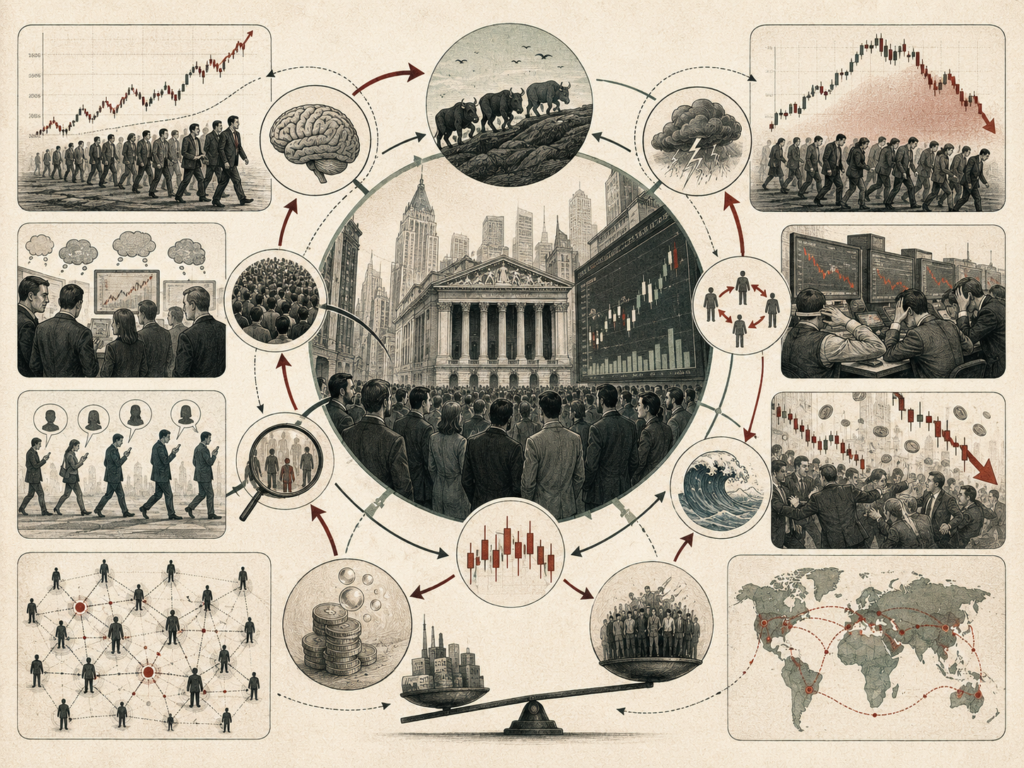
Editorial systems illustration showing herd behavior in financial markets through crowd psychology, price charts, investor imitation, bubbles, crashes, social signals, risk perception, and market contagion.

Herd Behavior in Financial Markets

Herd behavior in financial markets refers to the tendency of investors to follow the actions of others rather than relying solely on independent analysis or private information. This article examines the psychological foundations of herding, informational cascades, speculative bubbles, institutional and technological amplification, and the implications of imitation for financial stability. It also develops a formal analytical framework for herd behavior and includes substantial R and Python sections with fully commented code for simulating cascades, synchronized buying, and price deviations under different herd-intensity regimes. The broader argument is that financial markets are shaped not only by information aggregation, but also by collective psychology, reputational pressure, and socially reinforced expectations.

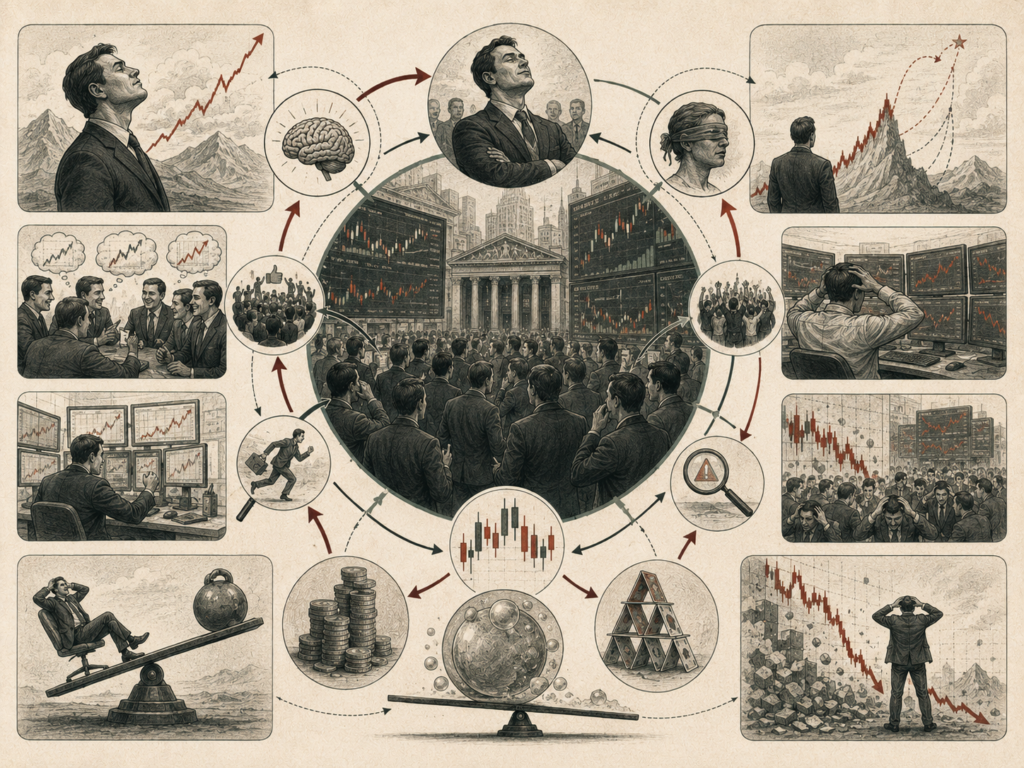
Editorial systems illustration showing overconfidence bias in financial markets through investor certainty, rising price charts, risk blindness, market bubbles, leverage, crowd optimism, volatility, and crashes.

Overconfidence Bias in Financial Markets

Overconfidence bias refers to the tendency of investors to overestimate the precision of their knowledge, the quality of their judgment, and their ability to control uncertain outcomes. This article examines the psychology of overconfidence, excessive trading, market-level effects, institutional and technological influences, and the implications of unwarranted confidence for financial decision-making and governance. It also develops a formal analytical framework for overconfidence and includes substantial R and Python sections with fully commented code for simulating signal overprecision, trading intensity, and performance drag under different investor regimes. The broader argument is that overconfidence is not simply a private cognitive error, but a recurring source of portfolio inefficiency and market instability.

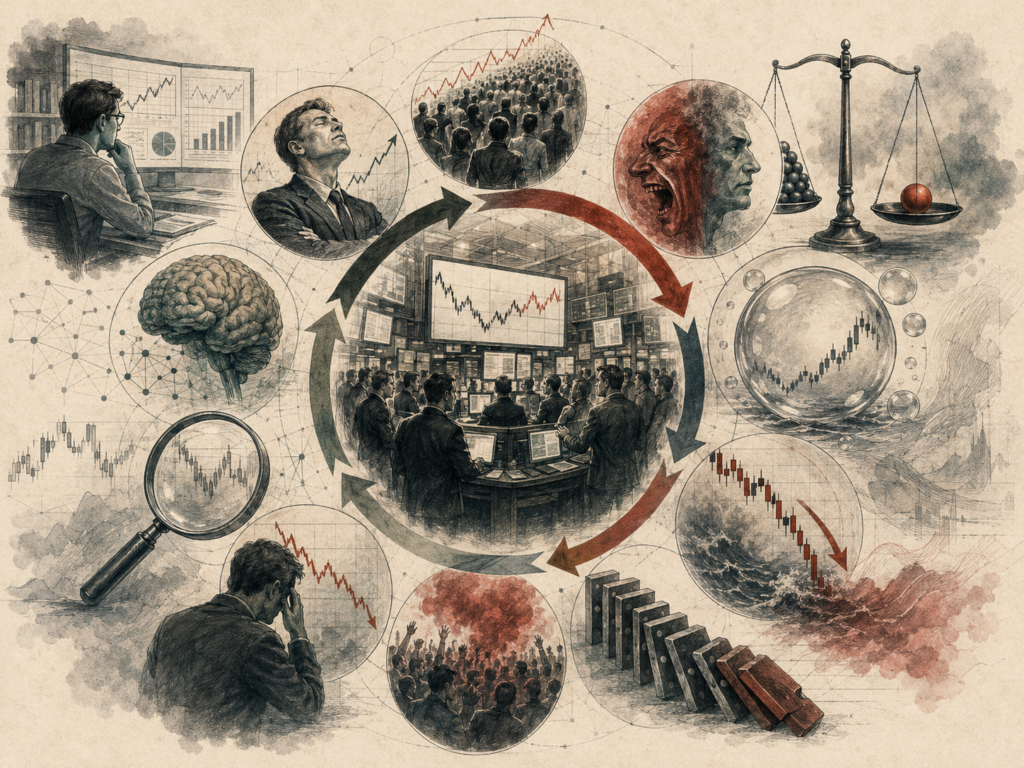
Editorial behavioral finance illustration showing investors, market charts, emotional reactions, bubbles, crashes, cognitive bias, herd behavior, and feedback loops in financial decision-making.

Behavioral Finance: Why Investors Deviate from Rational Models

Behavioral finance examines how psychological biases, cognitive limitations, and emotional responses shape investor behavior and financial market outcomes. Rather than assuming that markets are driven entirely by rational information processing, the field explains how real investors rely on heuristics, react asymmetrically to gains and losses, imitate one another, and bring overconfidence, anchoring, and sentiment into financial decisions. This article explores the limits of rational market models, the major biases that influence investing, the institutional and technological conditions that amplify or constrain those biases, and the implications of behavioral finance for economic governance. It also develops a formal analytical framework and includes substantial R and Python sections showing how investor psychology can scale into mispricing, volatility, and broader market instability.

Editorial systems illustration showing self-control and commitment devices through savings, locked choices, calendars, reminders, contracts, temptation, healthy habits, accountability, and behavioral feedback loops.

Self-Control and Commitment Devices in Behavioral Economics

Self-control problems arise when individuals face recurring conflict between immediate incentives and long-term goals, causing them to reverse plans they genuinely endorse once short-term temptation becomes salient. This article explains how behavioral economics approaches that conflict through present bias, hyperbolic discounting, and time-inconsistent preferences, and why commitment devices become so important in domains such as saving, health, education, productivity, and sustainability. It also examines how institutions, public policy, and digital systems can serve as external commitment mechanisms that help translate fragile intention into durable action. The broader argument is that commitment devices are not peripheral behavioral hacks, but one of the clearest ways economic systems are designed to help people manage the psychological constraints of intertemporal choice.

Editorial systems illustration showing mental accounting in personal finance through separate spending categories, savings jars, household budgets, debt, purchases, goals, and financial decision-making.

Mental Accounting in Personal Finance

Mental accounting examines how individuals categorize, label, and evaluate money in separate psychological accounts rather than treating all financial resources as fully fungible. This article explores the concept’s foundations in behavioral economics, its challenge to the classical fungibility assumption, its role in consumer behavior, windfall spending, time preferences, personal finance, and behavioral policy, and its importance for institutional design. It also develops a formal analytical framework for mental accounting and includes substantial R and Python sections with fully commented code for simulating windfalls, labeled savings, debt persistence, and segmented versus unified money views. The broader argument is that mental accounting is not a minor quirk of personal finance, but one of the central ways real people structure economic decision-making.

Editorial systems illustration showing present bias through immediate rewards, delayed goals, time pressure, temptation, savings, habit formation, self-control, and long-term decision pathways.

Present Bias and the Psychology of Immediate Reward

Present bias refers to the tendency to assign disproportionately greater weight to immediate rewards than to larger future benefits, making the present moment behaviorally distinct from all later periods in economic choice. This article explains how present bias shapes intertemporal decision-making through present-focused valuation, hyperbolic discounting, and time-inconsistent preferences, and why it helps explain under-saving, procrastination, debt persistence, and short-termism in both private and public life. It also examines the role of commitment devices, institutional design, and long-horizon sustainability policy, while developing a formal analytical framework and including substantial R and Python sections with fully commented code. The broader argument is that present bias is not merely impatience, but a structural feature of human decision-making that institutions must account for if they are to support long-term welfare.

Scroll to Top